China Infant Toiletries Market Size & Growth Rate
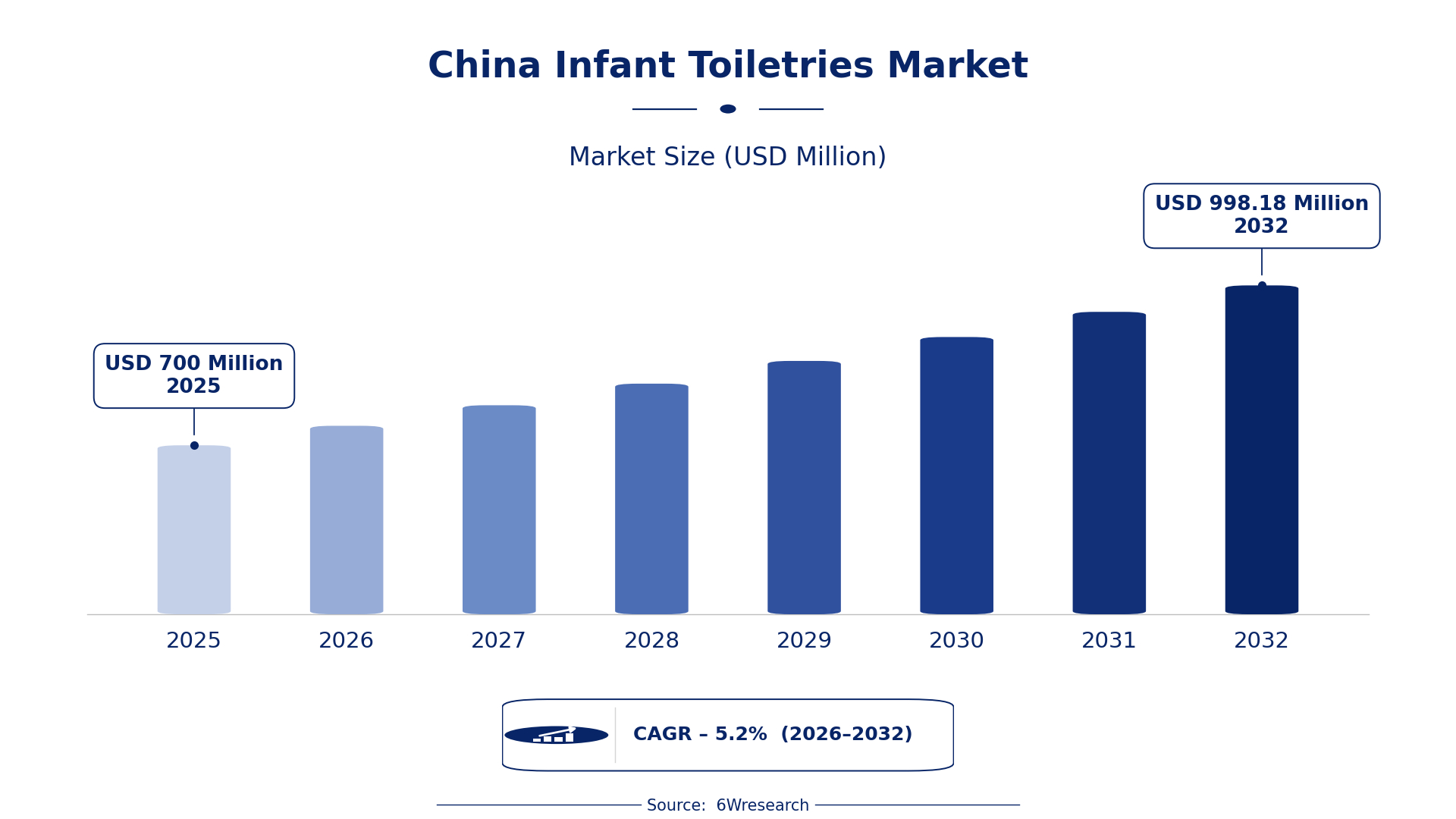
According to 6Wresearch internal database and industry insights, the China Infant Toiletries Market was valued at USD 700.0 million in 2025 and is projected to reach USD 998.18 million by 2032, growing at a CAGR of approximately 5.2% during 2026–2032.
China Infant Toiletries Market Highlights
| Report Metric | Details |
| Report Name | China Infant Toiletries Market |
| Market Size 2025 | USD 700.0 million |
| Market Size 2032 | USD 998.18 million |
| Absolute Growth 2025–2032 | USD 298.18 million |
| CAGR 2026–2032 | 5.2% |
| Peak Annual Growth | 7.3% in 2028 |
| Forecast Period | 2026–2032 |
| Historical Data | 2022–2025 |
| Base Year | 2025 |
| Leading Infant Toiletries, 2025 | Baby Shampoos (46% share) |
| Leading Product Type, 2025 | Tear-Free Formula (40% share) |
| Leading Formula Type, 2025 | pH Balanced (46% share) |
| Leading Packaging Style, 2025 | Flip Cap Bottles (36% share) |
| Leading Distribution Channel, 2025 | Pharmacies (37% share) |
| Fastest-Growing Infant Toiletries | Diaper Rash Creams (7.5% CAGR) |
| Fastest-Growing Product Type | Zinc Oxide Based (6.4% CAGR) |
| Fastest-Growing Formula Type | Hypoallergenic (6.4% CAGR) |
| Fastest-Growing Packaging Style | Tubes (7.6% CAGR) |
| Fastest-Growing Distribution Channel | Retail Chains (7.3% CAGR) |
| Growing Sector | personal care products for infants |
| Key End Users | parents, hospitals, pharmacies, online retailers |
China Infant Toiletries Market Year-wise Growth Rate and Key Drivers (2022–2032)
This graph illustrates the annual growth rates of the market from 2022 to 2032, highlighting a steady upward trajectory and projected market expansion over the forecast period.
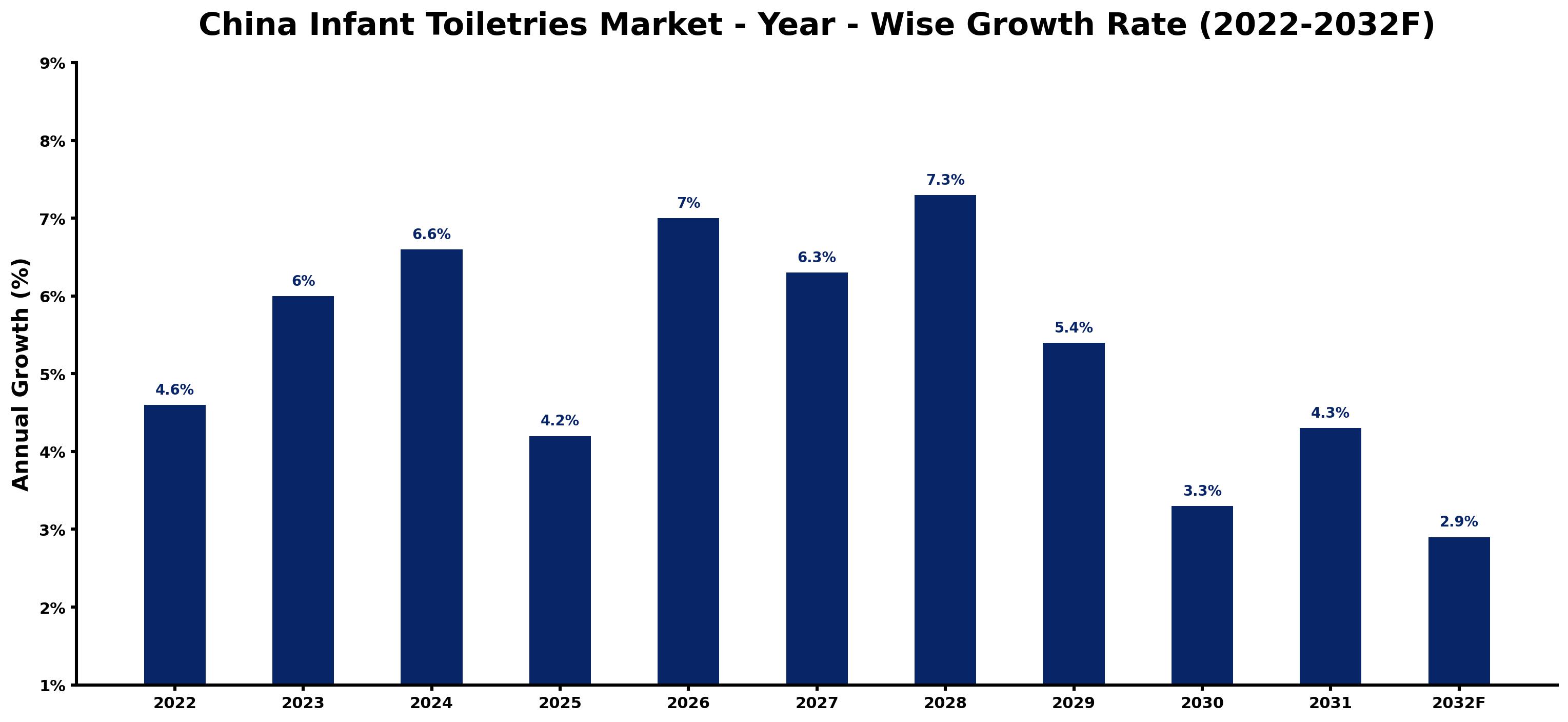
Below, each year's estimated growth is shown next to the factor that most influenced it.
| Year | Estimated Annual Growth (%) | Market Rationale |
| 2022 | 4.6 | The market showed steady growth with a birth rate of approximately 9.56 million infants, creating demand for infant toiletries. |
| 2023 | 6.0 | Demand increased as online retail sales of infant toiletries rose by 30% compared to 2022, enhancing consumer access. |
| 2024 | 6.6 | Growth accelerated due to the promotion of hypoallergenic products by the National Health Commission, influencing purchasing decisions. |
| 2025 | 4.2 | The market experienced a slowdown as the growth rate fell to 4.2% amid changing consumer preferences for natural products. |
| 2026 | 7.0 | A resurgence in demand is expected, driven by the introduction of new safety standards for infant toiletries in 2023. |
| 2027 | 6.3 | Growth is projected to slow again as competition intensifies among various product types in the market. |
| 2028 | 7.3 | The market is expected to peak with a growth rate of 7.3% as diaper rash creams gain popularity in hospitals across China. |
| 2029 | 5.4 | A slowdown is anticipated as growth decreases to 5.4% due to market saturation in urban areas and increased competition. |
| 2030 | 3.3 | Demand is expected to continue slowing, reaching a growth rate of 3.3% as parents become more selective in product choices. |
| 2031 | 4.3 | Growth is projected to rebound slightly to 4.3% as the average age of first-time parents rises to around 30 years. |
| 2032 | 2.9 | The market is expected to grow at a slower rate of 2.9% as consumer preferences shift towards natural products. |
Note: Market size estimations and growth projections presented in this report are based on 6Wresearch's proprietary forecasting methodology, utilizing the latest available industry data, government publications, and primary research inputs.
China Infant Toiletries Market Synopsis
Infant toiletries in China include personal care products specifically designed for babies, such as shampoos, creams, oils, and soaps. These products are crafted to be gentle on infants' sensitive skin and often feature natural ingredients. The market benefits from a birth rate of around 9.56 million infants in 2022 and a thriving online retail sector. The rising demand for hypoallergenic products and updated safety standards further stimulates growth in this sector.
Market Dynamics Impact Analysis (2026–2032)
| Factor | Type | Impact | Primary Segment Affected |
| Rising birth rate leading to increased demand for infant care products | Driver | High | Baby Shampoos |
| Growth of online retail channels providing greater accessibility | Driver | High | Diaper Rash Creams |
| Increasing preference for natural and hypoallergenic products among parents | Opportunity | High | Baby Oils |
| Expansion of retail chains in urban areas to meet rising demand | Opportunity | High | Baby Soaps |
| Intense competition among brands leading to price wars | Restraint | Medium | Diaper Rash Creams |
| Regulatory compliance costs for safety standards affecting smaller producers | Restraint | Medium | Baby Shampoos |
| Limited awareness of product benefits among rural consumers | Challenge | High | Baby Oils |
| Challenges in maintaining consistent product quality across various suppliers | Challenge | High | Baby Soaps |
Evaluation of Drivers in China Infant Toiletries Market (2026–2032)
Below mentioned are some major drivers and their influence on market dynamics.
| Drivers | Primary Segment Affected | Why It Matters (Evidence) |
| Increasing birth rate | Baby Shampoos | The birth rate in China was approximately 9.56 million infants in 2022, driving demand for baby shampoos. |
| Rise in online retail sales | Diaper Rash Creams | Online retail sales of infant toiletries increased by 30% in 2023, improving accessibility for consumers. |
| Promotion of hypoallergenic products | Baby Oils | The National Health Commission promotes hypoallergenic products, resulting in increased purchases among health-conscious parents. |
| Growing urban retail infrastructure | Baby Soaps | Expansion of retail chains in urban areas improves availability, catering to the rising demand for baby soaps. |
| Introduction of new safety standards | Diaper Rash Creams | Updated safety standards in 2023 encourage hospitals to use more diaper rash creams, boosting market demand. |
Growth in the Infant Toiletries market in China comes from rising birth rates, increased online retail sales, and a shift towards hypoallergenic products. In 2022, approximately 9.56 million infants were born, creating substantial demand for baby care items. Online retail sales surged by 30% in 2023, improving consumer access to these items. The promotion of hypoallergenic products by the National Health Commission drives parents to seek safer options for their infants. The introduction of new safety standards in 2023 is expected to enhance product quality, further encouraging purchases among health-conscious parents.
Evaluation of Restraints in China Infant Toiletries Market
The key brakes on demand, and where they bite hardest, are shown below.
| Market Restraint | Primary Segment Affected | Why It Matters (Evidence) |
| Intense competition causing price wars | Diaper Rash Creams | Increased competition among brands has resulted in price wars, affecting profit margins for producers. |
| High compliance costs for safety standards | Baby Shampoos | Smaller producers face challenges with regulatory compliance costs, hindering their market entry. |
| Limited awareness in rural areas | Baby Oils | Many rural consumers lack awareness of the benefits of infant toiletries, limiting market reach. |
| Quality consistency issues across suppliers | Baby Soaps | Maintaining consistent product quality across various suppliers poses challenges for producers. |
| Changing consumer preferences towards natural products | Diaper Rash Creams | A shift towards natural products may lead to decreased demand for conventional diaper rash creams. |
China Infant Toiletries Market Challenges
Buyers in the China infant toiletries market encounter supply chain disruptions due to concentrated production in Guangdong, which can result in delays and compel pharmacies to hold excess stock, raising costs by 15%. A shortage of skilled workers restricts production capabilities, limiting the development of new products that address the growing demand for natural ingredients among parents. Outdated manufacturing technology leads to inefficiencies, causing delays in product launches that hinder retailers’ competitiveness in a rapidly changing market. Regulatory updates, including new safety standards, increase compliance costs for producers, potentially resulting in price hikes of up to 10% for consumers.
Trends in the China Infant Toiletries Market
The trends below show where the China Infant Toiletries Market is heading.
- 30% Increase in Online Retail Sales: In 2023, online retail sales of infant toiletries grew by 30% compared to 2022, reflecting a shift in consumer purchasing behaviour towards convenience and accessibility.
- Growing Popularity of Hypoallergenic Products: The National Health Commission's promotion of hypoallergenic products is resonating with urban parents, leading to a marked increase in demand for these safer options.
- Rise of Retail Chains in Urban Areas: Urban regions are seeing the expansion of retail chains that cater to the increasing demand for infant toiletries, enhancing product availability for consumers.
- Zinc Oxide-Based Products in Hospitals: Zinc oxide-based diaper rash creams are becoming more prevalent in hospitals across China, underscoring their effectiveness and boosting demand among parents.
Investment Opportunities in the China Infant Toiletries Market
Below are the investment opportunities with the strongest case in the China Infant Toiletries Market.
- 10 billion CNY Market Potential: With the infant toiletries market projected to reach 10 billion CNY by 2025, there is a prime opportunity for investment in product development and marketing aimed at urban parents.
- Guangdong Province as a Manufacturing Hub: Guangdong province, a key manufacturing hub, offers opportunities for local partnerships in producing infant toiletries to satisfy growing demand.
- Urban Parents Seeking Natural Products: Urban parents are increasingly in search of natural and hypoallergenic products, providing opportunities for suppliers to launch new product lines.
- Joint Ventures for Market Entry: Forming joint ventures with local manufacturers can ease market entry and distribution of infant toiletries in China.
Government Initiatives in the China Infant Toiletries Market
The China National Standard GB 7919-2018 regulates the safety of baby cosmetics, ensuring that products meet stringent safety requirements. This regulation impacts producers by requiring them to conduct thorough testing and certification of their products before they can be marketed. Compliance with these standards is essential for gaining consumer trust and ensuring product safety, thereby influencing purchasing decisions among parents. The updated standards are expected to enhance product quality and safety in the market.
The State Administration for Market Regulation oversees the approval of infant toiletries, ensuring that products meet safety and quality standards. This agency also funds initiatives to promote safe infant care products, which benefits both producers and consumers by improving product quality and safety in the market. The agency's efforts are expected to increase the number of approved products, enhancing consumer confidence.
Future Insight of the China Infant Toiletries Market
The China infant toiletries market is set to undergo significant evolution by 2032, driven by key factors that will reshape the sector. The birth rate is expected to stabilise around 10 million infants annually, maintaining demand for infant care products. Online retail sales are projected to continue their upward trend, building on a 30% increase in 2023. The promotion of hypoallergenic products by health authorities will encourage suppliers to reformulate their offerings, aligning with consumer preferences for safer options. Stricter safety regulations will compel manufacturers to enhance product quality, ultimately benefiting buyers with a wider selection of high-quality infant toiletries.
Market Segmentation Analysis
The analysis below covers each segmentation, its leading category in 2025 and its fastest-growing category through 2032.
By Infant Toiletries – Baby Shampoos Dominated, Diaper Rash Creams Expected to Grow Fastest
According to Shubham Deep, Research Manager at 6Wresearch, in 2025, Baby Shampoos led the infant toiletries split with a 46% share. Baby shampoos capture a large market share as they are essential for the daily hygiene of infants, often used in hospitals for newborn care. The high birth rate of approximately 9.56 million infants in 2022 significantly contributes to the demand for these products. Diaper Rash Creams are set to record the highest CAGR in this split, 7.5% over 2026–2032. Diaper rash creams are experiencing rapid growth as parents increasingly prioritise their infants' skin health, especially with the National Health Commission promoting hypoallergenic options. This rising awareness among urban parents is driving a surge in sales for these creams. Suppliers must focus on expanding their diaper rash cream offerings to align with the growing consumer demand.
By Product Type – Tear-Free Formula Dominated, Zinc Oxide Based Expected to Grow Fastest
Tear-Free Formula held a 40% share of the China Infant Toiletries Market by product type in 2025. Tear-free formulas lead the product type segment as they are specifically designed to prevent stinging in infants' eyes, making them a preferred choice among parents. The focus on gentle, safe products aligns with the growing demand for infant toiletries that prioritise comfort and safety. Over 2026–2032, Zinc Oxide Based is expected to post the fastest growth, at a CAGR of 6.4%. Zinc oxide-based products are rapidly gaining traction due to their effectiveness in protecting against diaper rashes, which is increasingly valued by parents. The recognition of their protective properties is driving their popularity in the market. This suggests that suppliers should consider expanding their range of zinc oxide-based products to capitalise on the growing consumer preference.
By Formula Type – pH Balanced Dominated, Hypoallergenic Expected to Grow Fastest
pH Balanced accounted for a 46% market share by formula type in 2025. pH balanced products hold a significant market share as they ensure safety for infants' sensitive skin, making them a preferred choice for parents. This focus on skin safety aligns with the increasing awareness of the need for gentle formulations in infant care. Hypoallergenic is projected to grow fastest, at a CAGR of 6.4% during 2026–2032. Hypoallergenic formulas are witnessing the fastest growth as they specifically address the needs of infants with sensitive skin, minimising the risk of allergic reactions. This heightened concern among parents for skin safety is driving greater demand for these products. Suppliers should prioritise the development of hypoallergenic options to cater to the rising consumer demand for safe and gentle infant toiletries.
By Packaging Style – Flip Cap Bottles Dominated, Tubes Expected to Grow Fastest
With a 36% revenue share in 2025, Flip Cap Bottles was the largest packaging style category. Flip cap bottles are the leading packaging style due to their convenience for parents, allowing for easy dispensing during bath time. This practical design aligns with the needs of busy parents seeking efficient solutions for infant care. The quickest growth will come from Tubes, forecast to expand at a CAGR of 7.6% between 2026 and 2032. Tubes are emerging as the fastest-growing packaging style, particularly for creams and ointments, as they offer ease of application and portability. The growing preference for convenient packaging options is driving their popularity in the market. Suppliers should consider expanding their product lines in tube packaging to align with consumer preferences for convenience and ease of use.
By Distribution Channel – Pharmacies Dominated, Retail Chains Expected to Grow Fastest
The largest distribution channel category in 2025 was Pharmacies, with a 37% share of total revenue. Pharmacies represent a substantial share of the market as they serve as the primary distribution channel for infant toiletries, offering parents reliable access to essential products. Their established presence in urban areas underscores the critical role of pharmacies in this market. Retail Chains are set to record the highest CAGR in this split, 7.3% over 2026–2032. Retail chains are rapidly growing as they provide convenient access to infant toiletries in supermarkets and stores, meeting the needs of busy parents. The increasing foot traffic in these retail environments is contributing to higher sales volumes. This trend suggests that suppliers should enhance their partnerships with retail chains to improve product visibility and accessibility.
Key Attractiveness of the Report
- 10 Years of Market Numbers
- Historical Data Starting from 2022 to 2025
- Base Year 2025
- Forecast Data until 2032
- Key Performance Indicators Impacting the Market
- Major Upcoming Developments and Projects
Key Highlights of the Report:
- China Infant Toiletries Market Outlook
- Market Size of China Infant Toiletries Market, 2025
- Forecast of China Infant Toiletries Market, 2032
- Historical Data and Forecast of China Infant Toiletries Revenues & Volume for the Period 2022 - 2032F
- China Infant Toiletries Market Trend Evolution
- China Infant Toiletries Market Drivers and Challenges
- China Infant Toiletries Price Trends
- China Infant Toiletries Porter's Five Forces
- China Infant Toiletries Industry Life Cycle
- Historical Data and Forecast of China Infant Toiletries Market Revenues & Volume By Infant Toiletries for the Period 2022 - 2032F
- Historical Data and Forecast of China Infant Toiletries Market Revenues & Volume By Baby Shampoos for the Period 2022 - 2032F
- Historical Data and Forecast of China Infant Toiletries Market Revenues & Volume By Diaper Rash Creams for the Period 2022 - 2032F
- Historical Data and Forecast of China Infant Toiletries Market Revenues & Volume By Baby Oils for the Period 2022 - 2032F
- Historical Data and Forecast of China Infant Toiletries Market Revenues & Volume By Baby Soaps for the Period 2022 - 2032F
- Historical Data and Forecast of China Infant Toiletries Market Revenues & Volume By Product Type for the Period 2022 - 2032F
- Historical Data and Forecast of China Infant Toiletries Market Revenues & Volume By Tear-Free Formula for the Period 2022 - 2032F
- Historical Data and Forecast of China Infant Toiletries Market Revenues & Volume By Zinc Oxide Based for the Period 2022 - 2032F
- Historical Data and Forecast of China Infant Toiletries Market Revenues & Volume By Ayurvedic/Herbal for the Period 2022 - 2032F
- Historical Data and Forecast of China Infant Toiletries Market Revenues & Volume By Glycerin Base for the Period 2022 - 2032F
- Historical Data and Forecast of China Infant Toiletries Market Revenues & Volume By Formula Type for the Period 2022 - 2032F
- Historical Data and Forecast of China Infant Toiletries Market Revenues & Volume By pH Balanced for the Period 2022 - 2032F
- Historical Data and Forecast of China Infant Toiletries Market Revenues & Volume By Hypoallergenic for the Period 2022 - 2032F
- Historical Data and Forecast of China Infant Toiletries Market Revenues & Volume By Fragrance-Free for the Period 2022 - 2032F
- Historical Data and Forecast of China Infant Toiletries Market Revenues & Volume By Moisturizing for the Period 2022 - 2032F
- Historical Data and Forecast of China Infant Toiletries Market Revenues & Volume By Packaging Style for the Period 2022 - 2032F
- Historical Data and Forecast of China Infant Toiletries Market Revenues & Volume By Flip Cap Bottles for the Period 2022 - 2032F
- Historical Data and Forecast of China Infant Toiletries Market Revenues & Volume By Tubes for the Period 2022 - 2032F
- Historical Data and Forecast of China Infant Toiletries Market Revenues & Volume By Plastic Bottles for the Period 2022 - 2032F
- Historical Data and Forecast of China Infant Toiletries Market Revenues & Volume By Paper Wrapped for the Period 2022 - 2032F
- Historical Data and Forecast of China Infant Toiletries Market Revenues & Volume By Distribution Channel for the Period 2022 - 2032F
- Historical Data and Forecast of China Infant Toiletries Market Revenues & Volume By Pharmacies for the Period 2022 - 2032F
- Historical Data and Forecast of China Infant Toiletries Market Revenues & Volume By Retail Chains for the Period 2022 - 2032F
- Historical Data and Forecast of China Infant Toiletries Market Revenues & Volume By Online Retail for the Period 2022 - 2032F
- Historical Data and Forecast of China Infant Toiletries Market Revenues & Volume By General Stores for the Period 2022 - 2032F
- China Infant Toiletries Import Export Trade Statistics
- Market Opportunity Assessment By Infant Toiletries
- Market Opportunity Assessment By Product Type
- Market Opportunity Assessment By Formula Type
- Market Opportunity Assessment By Packaging Style
- Market Opportunity Assessment By Distribution Channel
- China Infant Toiletries Top Companies Market Share
- China Infant Toiletries Competitive Benchmarking By Technical and Operational Parameters
- China Infant Toiletries Company Profiles
- China Infant Toiletries Key Strategic Recommendations
Market Covered
The report offers an extensive study of the following market segments.
By Infant Toiletries
- Baby Shampoos
- Diaper Rash Creams
- Baby Oils
- Baby Soaps
By Product Type
- Tear-Free Formula
- Zinc Oxide Based
- Ayurvedic/Herbal
- Glycerin Base
By Formula Type
- pH Balanced
- Hypoallergenic
- Fragrance-Free
- Moisturizing
By Packaging Style
- Flip Cap Bottles
- Tubes
- Plastic Bottles
- Paper Wrapped
By Distribution Channel
- Pharmacies
- Retail Chains
- Online Retail
- General Stores































