India Infant Wear Market Size & Growth Rate
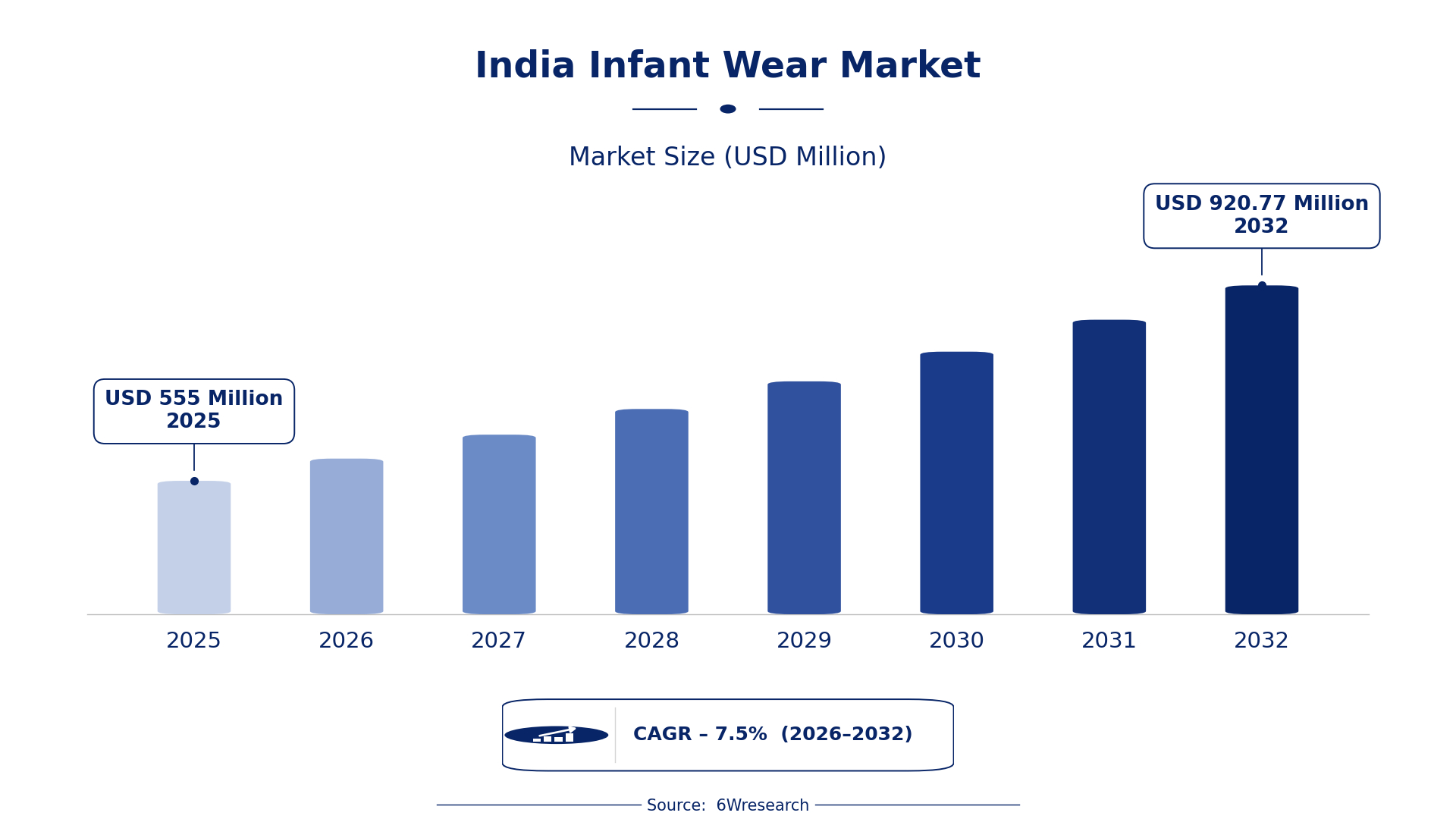
According to 6Wresearch internal database and industry insights, the India Infant Wear Market was valued at USD 555.0 million in 2025 and is projected to reach USD 920.77 million by 2032, growing at a CAGR of approximately 7.5% during 2026–2032.
India Infant Wear Market Highlights
| Report Metric | Details |
| Report Name | India Infant Wear Market |
| Market Size 2025 | USD 555.0 million |
| Market Size 2032 | USD 920.77 million |
| Absolute Growth 2025–2032 | USD 365.77 million |
| CAGR 2026–2032 | 7.5% |
| Peak Annual Growth | 10.0% in 2030 |
| Forecast Period | 2026–2032 |
| Historical Data | 2022–2025 |
| Base Year | 2025 |
| Leading Infant Wear, 2025 | Onesies (40% share) |
| Leading Garment Type, 2025 | Bodysuits (43% share) |
| Leading Fabric Material, 2025 | Organic Cotton (41% share) |
| Leading Style Segment, 2025 | Casual Basics (38% share) |
| Leading Sales Channel, 2025 | E-commerce Sites (43% share) |
| Fastest-Growing Infant Wear | Rompers (8.8% CAGR) |
| Fastest-Growing Garment Type | Jumpsuits (9.3% CAGR) |
| Fastest-Growing Fabric Material | Bamboo Fabric (9.7% CAGR) |
| Fastest-Growing Style Segment | Printed/Plain (8.9% CAGR) |
| Growing Sector | E-commerce Sites |
| Key End Users | parents, retailers, e-commerce platforms, textile manufacturers |
India Infant Wear Market Year-wise Growth Rate and Key Drivers (2022–2032)
This graph illustrates the annual growth rates of the market from 2022 to 2032, highlighting a steady upward trajectory and projected market expansion over the forecast period.
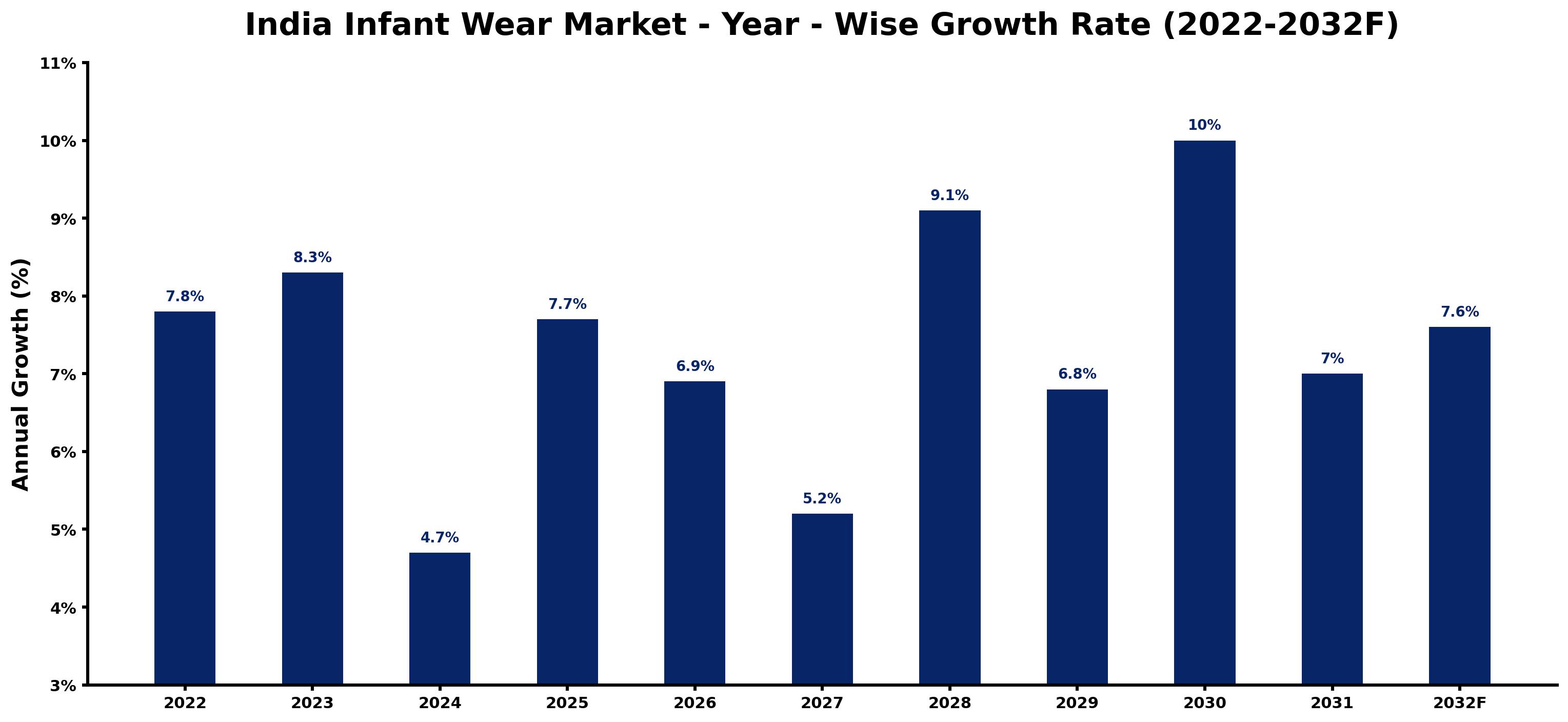
Below, each year's estimated growth is shown next to the factor that most influenced it.
| Year | Estimated Annual Growth (%) | Market Rationale |
| 2022 | 7.8 | The market experienced steady growth due to rising consumer demand for infant clothing driven by the 'Make in India' initiative. |
| 2023 | 8.3 | Growth accelerated as e-commerce sales surged, reflecting changing shopping habits among parents. |
| 2024 | 4.7 | The market saw a slowdown as competition intensified among local manufacturers, affecting pricing strategies. |
| 2025 | 7.7 | Demand increased again, driven by the popularity of casual infant wear in the growing e-commerce sector. |
| 2026 | 6.9 | Growth is expected to slow as manufacturers face challenges in sourcing sustainable materials for production. |
| 2027 | 5.2 | The market will continue to grow, supported by the increasing infant population and rising disposable incomes. |
| 2028 | 9.1 | Growth is projected to pick up pace, driven by innovations in fabric technology and design. |
| 2029 | 6.8 | The market will experience a slowdown as price sensitivity affects consumer choices in a fluctuating economy. |
| 2030 | 10.0 | A surge in growth is anticipated, driven by the expansion of online retail channels and increased consumer awareness of quality. |
| 2031 | 7.0 | Growth is projected to slow as the market adjusts to changing consumer preferences for sustainable options. |
| 2032 | 7.6 | Demand is expected to rise as awareness of organic fabrics increases among health-conscious parents. |
Note: Market size estimations and growth projections presented in this report are based on 6Wresearch's proprietary forecasting methodology, utilizing the latest available industry data, government publications, and primary research inputs.
India Infant Wear Market Synopsis
Infant Wear in India encompasses clothing designed for babies and toddlers, primarily made from soft fabrics like cotton. Key factors include the rising preference for organic cotton garments and the influence of the 'Make in India' initiative, which supports local manufacturers and boosts production capabilities.
Market Dynamics Impact Analysis (2026–2032)
| Factor | Type | Impact | Primary Segment Affected |
| Growing e-commerce sales | Driver | High | E-commerce Sites |
| Increasing demand for organic materials | Driver | High | Organic Cotton |
| Rising infant population | Opportunity | High | Onesies |
| Expansion of textile parks | Opportunity | Medium | Onesies |
| Competition from low-cost imports | Restraint | High | Onesies |
| Regulatory compliance costs | Restraint | Medium | Onesies |
| Sourcing sustainable materials | Challenge | High | Onesies |
| Adapting to changing consumer preferences | Challenge | Medium | Onesies |
Evaluation of Drivers in India Infant Wear Market (2026–2032)
The factors lifting demand, and the evidence behind each, are summarised below.
| Drivers | Primary Segment Affected | Why It Matters (Evidence) |
| Surge in e-commerce sales | E-commerce Sites | E-commerce sales of infant wear grew by 30% in 2022, prompting more parents to shop online. |
| Rising preference for organic cotton | Organic Cotton | Organic cotton garments, certified under GOTS, appeal to health-conscious parents seeking safe materials for their infants. |
| Increase in disposable income | Onesies | With India's GDP growing, families are spending more on quality infant clothing, increasing demand for premium products. |
| Expansion of local manufacturing | Onesies | The 'Make in India' initiative supports local textile manufacturers, boosting production and competitiveness in the infant wear market. |
| Innovation in infant wear design | Onesies | The National Institute of Fashion Technology promotes new designs, attracting buyers looking for unique and stylish infant clothing. |
Market growth in India for Infant Wear is fuelled by a surge in e-commerce sales, rising disposable income, and an increasing preference for organic materials. E-commerce sales of infant wear rose by 30% in 2022, encouraging more parents to shop online. As disposable income increases, families are investing in higher-quality infant clothing, expanding market potential. Design innovations are also attracting discerning buyers seeking unique offerings.
Evaluation of Restraints in India Infant Wear Market
The key brakes on demand, and where they bite hardest, are shown below.
| Market Restraint | Primary Segment Affected | Why It Matters (Evidence) |
| Competition from low-cost imports | Onesies | Low-cost imports challenge local manufacturers, affecting their market share and pricing strategies, with imports accounting for 20% of the market. |
| Regulatory compliance costs | Onesies | Compliance with updated BIS safety standards increases production costs for manufacturers, raising prices by approximately 10%. |
| Limited awareness of sustainable fabrics | Onesies | Many consumers remain unaware of the benefits of sustainable fabrics, hindering market growth and limiting sales opportunities. |
| Sourcing sustainable materials | Onesies | Challenges in sourcing sustainable materials can delay production timelines for manufacturers, resulting in potential stock shortages. |
| Price sensitivity among consumers | Onesies | Economic fluctuations create price sensitivity, affecting purchasing decisions for infant clothing, with families prioritising budget-friendly options. |
India Infant Wear Market Challenges
The India Infant Wear Market still has to solve a few problems, starting with a shortage of skilled labour. This issue exists because the textile industry lacks adequate vocational training programmes, causing production delays for manufacturers. Outdated technology also hampers efficiency; many producers still rely on traditional methods, which can increase production time by 20%. Intense competition from low-cost imports pressures local suppliers to lower prices, squeezing profit margins for domestic manufacturers. Buyers face challenges with safety standards; compliance with the Bureau of Indian Standards can postpone product launches, impacting sales timelines for retailers.
Trends in the India Infant Wear Market
Several trends are reshaping the India Infant Wear Market; the most important are set out below.
- Shift Towards Organic Fabrics: India is seeing a shift towards organic fabrics in infant wear, as health-conscious parents increasingly opt for safe materials. Organic cotton garments are projected to account for 41% of the market in 2025, reflecting this growing consumer preference.
- Growth of Online Shopping: The trend of online shopping for infant wear is rapidly expanding, with e-commerce sites expected to maintain a 43% market share by 2025. This shift is changing how consumers purchase clothing for their infants, making it more accessible.
- Rise of Casual Wear: Casual basics are gaining popularity among parents, with this segment anticipated to hold 38% of the market share in 2025. The trend highlights a preference for comfort and practicality in infant clothing, aligning with modern lifestyles.
- Emergence of Sustainable Practices: The focus on sustainability is driving change in infant wear, with bamboo fabric gaining traction due to its eco-friendliness. This trend is likely to influence purchasing decisions, appealing to environmentally conscious consumers.
Investment Opportunities in the India Infant Wear Market
Several openings in the India Infant Wear Market merit attention from investors.
- Investment in Organic Cotton Production: The market for organic cotton is anticipated to grow, presenting an opportunity to satisfy rising consumer demand. Local manufacturers can leverage the 'Make in India' initiative, providing a pathway into this expanding segment.
- Expansion of E-commerce Platforms: The rapid growth of e-commerce sales, which increased by 30% in 2022, offers an opportunity for suppliers to broaden their online presence. Collaborating with local e-commerce platforms can ease market entry and boost visibility.
- Development of Sustainable Fabrics: The increasing consumer interest in sustainable fabrics presents an opportunity to invest in bamboo fabric production. This aligns with trends in Maharashtra, a key manufacturing hub for textiles, where demand is on the rise.
- Focus on Innovative Designs: Investing in creative infant wear designs can attract the attention of discerning parents. The National Institute of Fashion Technology encourages creativity in design, opening avenues for new entrants aiming to differentiate their offerings.
Government Initiatives in the India Infant Wear Market
The 'Make in India' initiative, launched in 2014, continues to support local manufacturing and aims to increase domestic textile production. This initiative has spurred investments in the textile sector, creating jobs and enhancing competitiveness. The 'Textiles Mission', introduced by the Ministry of Textiles in 2023, aims to boost textile production by 25% by 2025, further aiding local manufacturers. Additionally, the updated BIS safety standards for children's clothing in 2021 ensure compliance with international norms, improving product safety and consumer trust. These measures create a supportive environment for the growth of the infant wear market.
The 'Textiles Mission' provides funding for infrastructure development and technology upgrades in textile manufacturing. The Ministry of Textiles oversees this initiative, ensuring that local manufacturers can access resources to enhance production capabilities. Furthermore, the 'Skill India' program focuses on training workers in the textile sector, emphasising sustainable practices as of 2022, which helps build a skilled workforce for the industry. These efforts aim to improve the overall quality and competitiveness of the infant wear market in India.
Future Insight of the India Infant Wear Market
The India Infant Wear Market is poised for evolution by 2032, driven by several key factors. The government's 'Textiles Mission' aims to enhance production capabilities, benefiting local manufacturers. E-commerce sales are projected to continue their upward trend, with an expected increase of INR 15 billion by 2025, broadening access for buyers. Sustainability trends will further shape the market, as demand for infant wear made from bamboo fabric rises. Design innovation, supported by institutions like the National Institute of Fashion Technology, will also play a crucial role in shaping future offerings.
Market Segmentation Analysis
The report offers a comprehensive study of the following market segments and their leading categories in the market.
By Infant Wear – Onesies Dominated, Rompers Expected to Grow Fastest
According to Shubham Deep, Research Manager at 6Wresearch, Onesies accounted for a 40% market share by infant wear in 2025. Onesies hold the largest share in the India Infant Wear Market as they are vital for daily use and facilitate easy changing for parents. With around 25 million infants in India, the demand for these essential garments is consistently strong. Over 2026–2032, Rompers are expected to post the fastest growth, at a CAGR of 8.8%. Rompers are growing rapidly due to their comfort and versatility, appealing to parents looking for practical clothing options. This segment's expansion is further fuelled by the increasing trend towards casual and comfortable infant wear. Suppliers should focus on expanding their romper offerings to align with the rising consumer interest in comfortable infant clothing.
By Garment Type – Bodysuits Dominated, Jumpsuits Expected to Grow Fastest
Bodysuits held a 43% share of the India Infant Wear Market by garment type in 2025. Bodysuits dominate the garment type segment as they are fundamental for layering and provide comfort for infants, making them a staple in many households. Their essential nature in daily infant wear contributes to their leading market share. Jumpsuits are set to record the highest CAGR in this split, 9.3% over 2026–2032. Jumpsuits are the fastest-growing garment type, valued for their convenience in dressing and undressing, which appeals to busy parents. As lifestyle changes encourage ease of use, jumpsuits are becoming increasingly popular. Manufacturers should consider expanding their jumpsuit lines to meet the rising demand for convenient infant clothing.
By Fabric Material – Organic Cotton Dominated, Bamboo Fabric Expected to Grow Fastest
The largest fabric material category in 2025 was Organic Cotton, with a 41% share of total revenue. Organic cotton leads the fabric material segment, preferred for its softness and safety, which are critical factors for parents when choosing infant wear. The growing awareness of organic products further solidifies its market share. The quickest growth will come from Bamboo Fabric, forecast to expand at a CAGR of 9.7% between 2026 and 2032. Bamboo fabric is gaining traction due to its eco-friendliness, appealing to environmentally conscious consumers looking for sustainable options. This trend indicates a shift towards more sustainable materials in the infant wear market. Brands should explore the integration of bamboo fabric into their product lines to attract eco-aware buyers.
By Style Segment – Casual Basics Dominated, Printed/Plain Expected to Grow Fastest
With a 38% revenue share in 2025, Casual Basics was the largest style segment category. Casual basics dominate the style segment as they serve as practical everyday wear for infants, catering to parents who prioritise comfort and functionality. This segment's focus on simplicity ensures a steady demand in the market. Printed/Plain is projected to grow fastest, at a CAGR of 8.9% during 2026–2032. Printed/plain styles are gaining traction, appealing to parents who want versatile options for various occasions. Their ability to cater to personal style preferences significantly boosts their popularity in the market. Retailers should enhance their range of printed/plain styles to effectively meet the growing consumer demand for versatile infant wear.
By Sales Channel – E-commerce Sites Dominated and Is Expected to Record the Fastest Growth
In 2025, E-commerce Sites led the sales channel split with a 43% share. E-commerce sites lead the sales channel segment, rapidly becoming the preferred method for purchasing infant clothing due to convenience and a wide selection. The substantial growth in e-commerce sales, which grew by 30% in 2022, reinforces this trend. The same category are also set to grow fastest, at a CAGR of 8.9% during 2026–2032. E-commerce sites are also the fastest-growing channel, as more consumers turn to online shopping for its ease and accessibility. This dual role as both leader and fastest indicates a strong future for e-commerce in the infant wear market. Suppliers must invest in their online presence to effectively reach the growing number of consumers shopping for infant wear online.
Key Attractiveness of the Report
- 10 Years of Market Numbers
- Historical Data Starting from 2022 to 2025
- Base Year 2025
- Forecast Data until 2032
- Key Performance Indicators Impacting the Market
- Major Upcoming Developments and Projects
Key Highlights of the Report:
- India Infant Wear Market Outlook
- Market Size of India Infant Wear Market, 2025
- Forecast of India Infant Wear Market, 2032
- Historical Data and Forecast of India Infant Wear Revenues & Volume for the Period 2022 - 2032F
- India Infant Wear Market Trend Evolution
- India Infant Wear Market Drivers and Challenges
- India Infant Wear Price Trends
- India Infant Wear Porter's Five Forces
- India Infant Wear Industry Life Cycle
- Historical Data and Forecast of India Infant Wear Market Revenues & Volume By Infant Wear for the Period 2022 - 2032F
- Historical Data and Forecast of India Infant Wear Market Revenues & Volume By Onesies for the Period 2022 - 2032F
- Historical Data and Forecast of India Infant Wear Market Revenues & Volume By Rompers for the Period 2022 - 2032F
- Historical Data and Forecast of India Infant Wear Market Revenues & Volume By Infant Dresses for the Period 2022 - 2032F
- Historical Data and Forecast of India Infant Wear Market Revenues & Volume By Two-Piece Sets for the Period 2022 - 2032F
- Historical Data and Forecast of India Infant Wear Market Revenues & Volume By Garment Type for the Period 2022 - 2032F
- Historical Data and Forecast of India Infant Wear Market Revenues & Volume By Bodysuits for the Period 2022 - 2032F
- Historical Data and Forecast of India Infant Wear Market Revenues & Volume By Jumpsuits for the Period 2022 - 2032F
- Historical Data and Forecast of India Infant Wear Market Revenues & Volume By Frock Styles for the Period 2022 - 2032F
- Historical Data and Forecast of India Infant Wear Market Revenues & Volume By Pajamas/T-Shirts for the Period 2022 - 2032F
- Historical Data and Forecast of India Infant Wear Market Revenues & Volume By Fabric Material for the Period 2022 - 2032F
- Historical Data and Forecast of India Infant Wear Market Revenues & Volume By Organic Cotton for the Period 2022 - 2032F
- Historical Data and Forecast of India Infant Wear Market Revenues & Volume By Bamboo Fabric for the Period 2022 - 2032F
- Historical Data and Forecast of India Infant Wear Market Revenues & Volume By Linen Blend for the Period 2022 - 2032F
- Historical Data and Forecast of India Infant Wear Market Revenues & Volume By Cotton/Poly Mix for the Period 2022 - 2032F
- Historical Data and Forecast of India Infant Wear Market Revenues & Volume By Style Segment for the Period 2022 - 2032F
- Historical Data and Forecast of India Infant Wear Market Revenues & Volume By Casual Basics for the Period 2022 - 2032F
- Historical Data and Forecast of India Infant Wear Market Revenues & Volume By Printed/Plain for the Period 2022 - 2032F
- Historical Data and Forecast of India Infant Wear Market Revenues & Volume By Partywear for the Period 2022 - 2032F
- Historical Data and Forecast of India Infant Wear Market Revenues & Volume By Sleepwear/Daywear for the Period 2022 - 2032F
- Historical Data and Forecast of India Infant Wear Market Revenues & Volume By Sales Channel for the Period 2022 - 2032F
- Historical Data and Forecast of India Infant Wear Market Revenues & Volume By Apparel Stores for the Period 2022 - 2032F
- Historical Data and Forecast of India Infant Wear Market Revenues & Volume By E-commerce Sites for the Period 2022 - 2032F
- Historical Data and Forecast of India Infant Wear Market Revenues & Volume By Baby Boutiques for the Period 2022 - 2032F
- Historical Data and Forecast of India Infant Wear Market Revenues & Volume By Supermarkets for the Period 2022 - 2032F
- India Infant Wear Import Export Trade Statistics
- Market Opportunity Assessment By Infant Wear
- Market Opportunity Assessment By Garment Type
- Market Opportunity Assessment By Fabric Material
- Market Opportunity Assessment By Style Segment
- Market Opportunity Assessment By Sales Channel
- India Infant Wear Top Companies Market Share
- India Infant Wear Competitive Benchmarking By Technical and Operational Parameters
- India Infant Wear Company Profiles
- India Infant Wear Key Strategic Recommendations
Market Covered
The report offers an extensive study of the following market segments.
By Infant Wear
- Onesies
- Rompers
- Infant Dresses
- Two-Piece Sets
By Garment Type
- Bodysuits
- Jumpsuits
- Frock Styles
- Pajamas/T-Shirts
By Fabric Material
- Organic Cotton
- Bamboo Fabric
- Linen Blend
- Cotton/Poly Mix
By Style Segment
- Casual Basics
- Printed/Plain
- Partywear
- Sleepwear/Daywear
By Sales Channel
- Apparel Stores
- E-commerce Sites
- Baby Boutiques
- Supermarkets































