China Infant Wear Market Size & Growth Rate
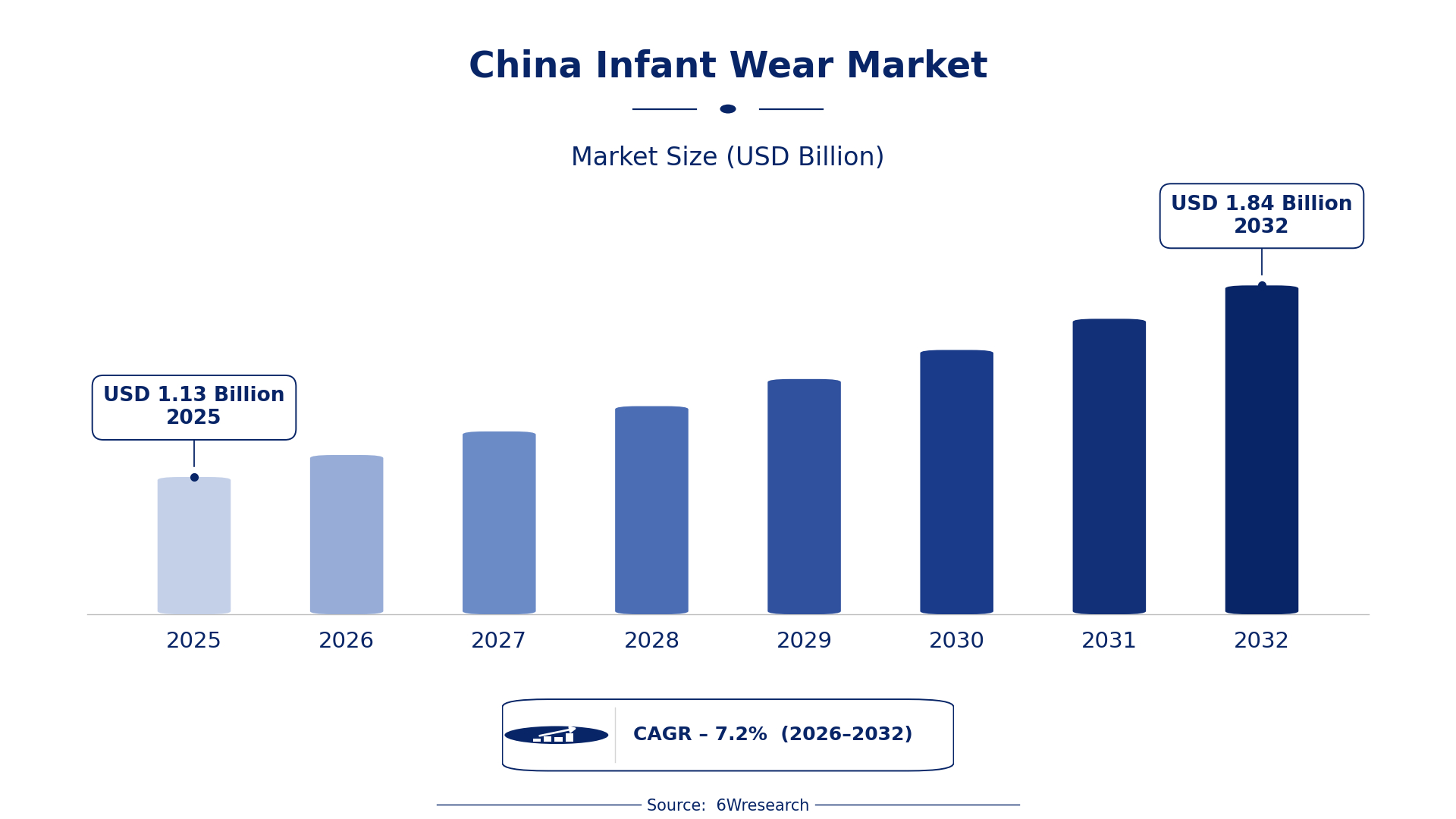
According to 6Wresearch internal database and industry insights, the China Infant Wear Market was valued at USD 1.13 billion in 2025 and is projected to reach USD 1.84 billion by 2032, growing at a CAGR of approximately 7.2% during 2026–2032.
China Infant Wear Market Highlights
| Report Metric | Details |
| Report Name | China Infant Wear Market |
| Market Size 2025 | USD 1.13 billion |
| Market Size 2032 | USD 1.84 billion |
| Absolute Growth 2025–2032 | USD 0.71 billion |
| CAGR 2026–2032 | 7.2% |
| Peak Annual Growth | 9.5% in 2026 |
| Forecast Period | 2026–2032 |
| Historical Data | 2022–2025 |
| Base Year | 2025 |
| Leading Infant Wear, 2025 | Onesies (43% share) |
| Leading Garment Type, 2025 | Bodysuits (40% share) |
| Leading Fabric Material, 2025 | Organic Cotton (44% share) |
| Leading Style Segment, 2025 | Casual Basics (38% share) |
| Leading Sales Channel, 2025 | E-commerce Sites (41% share) |
| Fastest-Growing Infant Wear | Rompers (8.5% CAGR) |
| Fastest-Growing Garment Type | Jumpsuits (9.2% CAGR) |
| Fastest-Growing Fabric Material | Bamboo Fabric (9.0% CAGR) |
| Fastest-Growing Style Segment | Partywear (9.9% CAGR) |
| Growing Sector | Infant Wear |
| Key End Users | Parents, caregivers, e-commerce retailers, infant wear manufacturers |
China Infant Wear Market Year-wise Growth Rate and Key Drivers (2022–2032)
This graph illustrates the annual growth rates of the market from 2022 to 2032, highlighting a steady upward trajectory and projected market expansion over the forecast period.
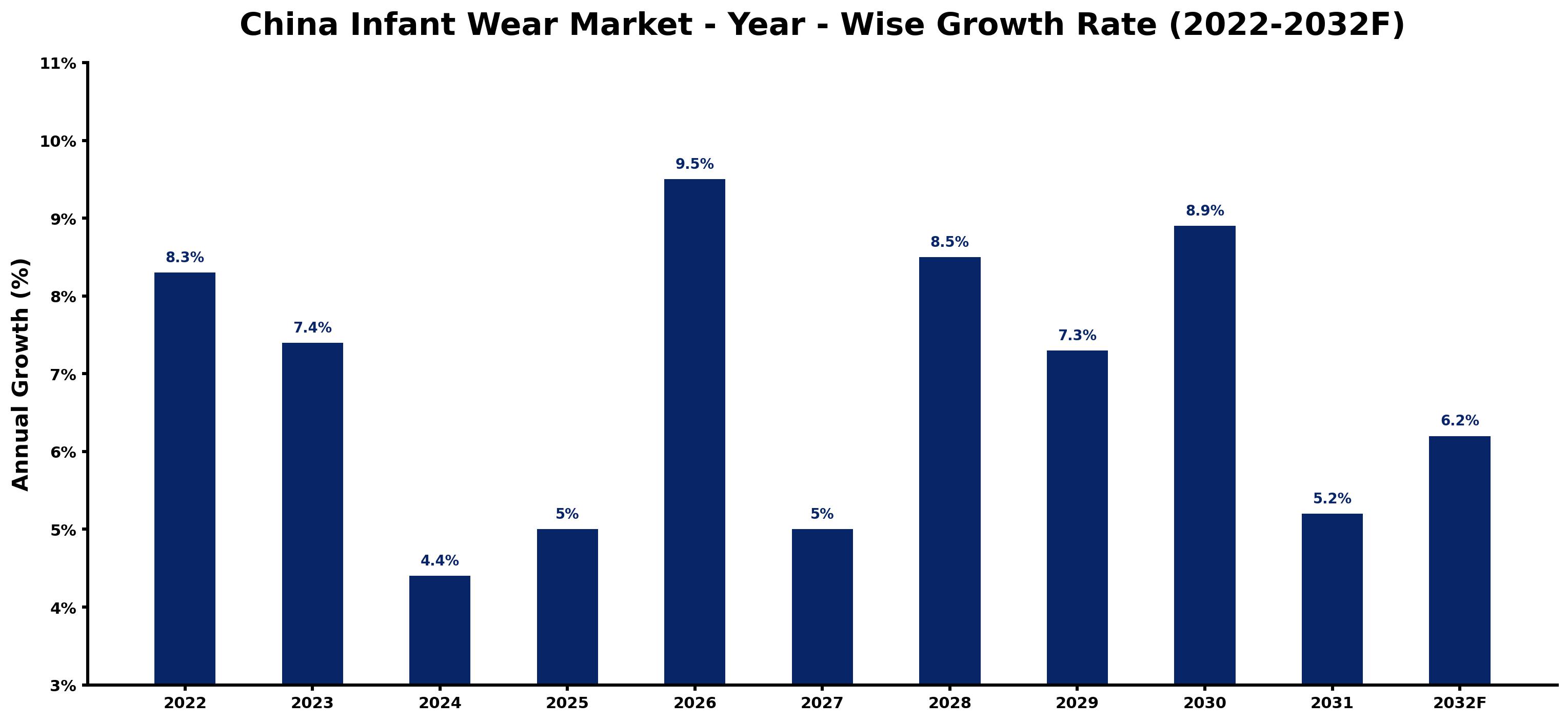
Year by year, the estimates below pair each growth rate with the development that shaped it.
| Year | Estimated Annual Growth (%) | Market Rationale |
| 2022 | 8.3 | The birth rate was stable, driving consistent demand for infant wear among parents. |
| 2023 | 7.4 | A slower growth rate reflects changing consumer preferences and economic adjustments in urban areas. |
| 2024 | 4.4 | Demand growth continued to decelerate as parents became more selective in purchases. |
| 2025 | 5.0 | An increase in disposable income among urban families led to higher spending on infant wear. |
| 2026 | 9.5 | The peak growth rate was driven by the launch of new organic cotton products appealing to parents. |
| 2027 | 5.0 | Growth slowed as market saturation began to impact purchasing decisions. |
| 2028 | 8.5 | A resurgence in demand was noted as parents sought quality products for their infants. |
| 2029 | 7.3 | Growth slowed again due to increased competition among brands in the infant wear sector. |
| 2030 | 8.9 | A renewed interest in premium infant wear emerged, boosting market activity. |
| 2031 | 5.2 | Growth decelerated as economic factors influenced consumer spending habits. |
| 2032 | 6.2 | An increase in awareness of sustainable materials is expected to drive demand further. |
Note: Market size estimations and growth projections presented in this report are based on 6Wresearch's proprietary forecasting methodology, utilizing the latest available industry data, government publications, and primary research inputs.
China Infant Wear Market Synopsis
Infant wear in China includes clothing specifically designed for babies and toddlers, focusing on comfort and safety through soft, breathable fabrics. This market encompasses daily wear, sleepwear, and special occasion outfits, with an emphasis on organic materials. The China Infant Wear Market is expanding, driven by a birth rate of approximately 9.56 million infants in 2022 and the rising popularity of e-commerce, which represents over 40% of sales in urban areas. Initiatives like the 'Healthy Growth of Infants' are promoting safe infant products, further increasing demand.
Market Dynamics Impact Analysis (2026–2032)
| Factor | Type | Impact | Primary Segment Affected |
| Growing demand for organic cotton infant wear due to health and safety concerns. | Driver | High | Organic Cotton |
| E-commerce sales channels are expanding rapidly, providing convenience for parents. | Driver | High | E-commerce Sites |
| The increasing birth rate in urban areas presents a significant opportunity for suppliers. | Opportunity | High | Onesies |
| The rise of eco-friendly materials like bamboo fabric opens new market avenues. | Opportunity | Medium | Bamboo Fabric |
| Competition from low-cost alternatives may hinder premium product sales. | Restraint | High | Onesies |
| Consumer price sensitivity can limit growth in higher-priced segments. | Restraint | Medium | Organic Cotton |
| Supply chain disruptions may affect product availability and delivery times. | Challenge | High | E-commerce Sites |
| Changing consumer preferences complicate brand loyalty and repeat purchases. | Challenge | Medium | Onesies |
Evaluation of Drivers in China Infant Wear Market (2026–2032)
The main growth drivers and the segments they affect most are set out below.
| Drivers | Primary Segment Affected | Why It Matters (Evidence) |
| Increased preference for organic materials among parents. | Organic Cotton | Organic cotton infant wear is gaining a 20% market share in 2023 as parents seek safer options. |
| The rise of online shopping convenience. | E-commerce Sites | E-commerce accounts for over 40% of infant wear sales in urban areas, driving purchases. |
| Growing awareness of infant safety standards. | Onesies | The updated 'Regulations on Infant Product Safety' in 2022 boosts consumer trust in products. |
| The increasing population of children under five years. | Onesies | With approximately 80 million children under five, demand for infant wear continues to rise. |
| The influence of first-time parents on purchasing habits. | Onesies | The average age of first-time parents in urban China is now 30 years, impacting buying patterns. |
The Infant Wear market in China is expanding due to growing demand from parents seeking safe, comfortable clothing for their infants. The rising preference for organic materials has resulted in organic cotton infant wear capturing a 20% market share in 2023. E-commerce continues to thrive, accounting for over 40% of sales in urban areas, offering convenience for parents. The large population of children under five years, approximately 80 million, drives the market as parents invest in quality infant wear.
Evaluation of Restraints in China Infant Wear Market
The main factors holding the market back are set out below.
| Market Restraint | Primary Segment Affected | Why It Matters (Evidence) |
| Intense competition from low-cost alternatives may undermine premium pricing. | Onesies | The presence of numerous budget brands pressures premium infant wear prices, affecting margins. |
| Price sensitivity among consumers limits spending on higher-priced items. | Organic Cotton | As parents look for value, the demand for premium organic cotton products may decline. |
| Supply chain disruptions can lead to stock shortages. | E-commerce Sites | Logistical challenges may affect the timely delivery of infant wear products to consumers. |
| Changing consumer preferences complicate brand loyalty. | Onesies | As trends shift, retaining customer loyalty becomes increasingly difficult for brands. |
| Limited awareness of new sustainable materials may slow adoption. | Bamboo Fabric | Despite its eco-friendly properties, bamboo fabric's market penetration remains low. |
China Infant Wear Market Challenges
The China infant wear market still has to solve a few problems, starting with high costs for buyers. The average price of a onesie is around 100 CNY, which can strain budgets for parents purchasing multiple items. Competition among brands intensifies as new entrants flood the market, making it difficult for established players to maintain their pricing strategies. Regulatory compliance introduces additional challenges; the China National Standard GB/T 22758-2008 imposes strict safety measures that increase production costs for suppliers. Rising raw material prices, particularly for organic cotton, can disrupt supply chains and reduce profit margins for producers, impacting their ability to invest in growth.
Trends in the China Infant Wear Market
Below mentioned are some of the trends shaping the China Infant Wear Market growth.
- Shift towards Sustainable Materials: Since 2020, the 'Green Textile Initiative' has promoted sustainable materials in infant clothing. This shift is reflected as bamboo fabric usage has increased by 15%, appealing to environmentally conscious parents.
- Rise of Online Shopping: In 2023, e-commerce sites have become the leading sales channel for infant wear, holding a 41% market share. This trend reflects changing consumer behaviours towards convenience and variety.
- Increased Focus on Safety Standards: The updated 'Regulations on Infant Product Safety' in 2022 have heightened consumer awareness regarding safety. This has led to a growing demand for compliant infant wear products.
- Emergence of Organic Cotton: Organic cotton infant wear captured a 20% market share in 2023, driven by health-conscious parents. This trend indicates a shift towards safer, eco-friendly clothing options.
Investment Opportunities in the China Infant Wear Market
Investors looking at the China Infant Wear Market should consider the following areas.
- Partnerships for Sustainable Production: With the rising interest in organic cotton, forming partnerships with local producers can improve supply chains. This is timely as organic cotton holds a 20% market share in 2023.
- Investment in E-commerce Platforms: Investing in e-commerce capabilities is essential now, as this channel accounts for over 40% of infant wear sales. Targeting urban parents through online platforms can yield high returns.
- Focus on Premium Product Lines: As disposable incomes rise, there is an opportunity to develop premium infant wear lines. Urban families increasingly seek high-quality options for their infants, driving demand.
- Expansion into Urban Markets: Targeting key urban areas like Shanghai and Beijing can yield high returns, given their concentration of young families. The average age of first-time parents is now 30, influencing purchasing decisions.
Government Initiatives in the China Infant Wear Market
In 2023, the 'Healthy Growth of Infants' initiative was launched to promote safe infant products, complementing existing regulations. This initiative builds on the 'Child Development Plan 2021-2030', which aimed to improve infant care services nationwide. Together, these measures ensure that infant wear producers adhere to stringent safety standards, ultimately benefiting consumers by providing safer products. The 'Green Textile Initiative' by the Ministry of Ecology and Environment has promoted the use of sustainable materials in infant clothing since 2020, encouraging manufacturers to adopt eco-friendly practices.
The State Administration for Market Regulation oversees the implementation of the updated 'Regulations on Infant Product Safety' from 2022. These regulations require manufacturers to meet specific safety criteria, ensuring that infant wear is safe for children. The Ministry of Health conducts regular inspections and approvals to maintain product quality, ensuring compliance with safety standards. In 2023, the Ministry of Industry and Information Technology also launched a scheme to support local production of infant wear, aiming to strengthen domestic brands.
Future Insight of the China Infant Wear Market
Several forward-looking factors should support the China infant wear market over the coming years. The government's 'Healthy Growth of Infants' initiative will likely promote the use of safer, organic materials, enhancing product appeal. E-commerce is expected to expand, with online sales currently accounting for over 40% of urban transactions, improving accessibility for buyers. The rising demand for eco-friendly fabrics, such as bamboo, which has seen a 15% increase in usage, will drive innovation and allow suppliers to meet changing consumer preferences.
Market Segmentation Analysis
The report offers a comprehensive study of the following market segments and their leading categories in the market.
By Infant Wear – Onesies Dominated, Rompers Expected to Grow Fastest
According to Shubham Deep, Research Manager at 6Wresearch, with a 43% revenue share in 2025, Onesies was the largest infant wear category. Onesies lead the China Infant Wear Market as they are essential for daily comfort and practicality. With approximately 9.56 million infants born in 2022, the demand for these garments remains strong among parents and caregivers. Rompers are projected to grow fastest, at a CAGR of 8.5% during 2026–2032. Rompers are swiftly becoming popular due to their ease of dressing and mobility, which resonate with modern parenting styles. The trend is bolstered by the average age of first-time parents being 30 years, driving the demand for convenient clothing options. Suppliers should focus on enhancing the variety and availability of rompers to meet the rising consumer demand.
By Garment Type – Bodysuits Dominated, Jumpsuits Expected to Grow Fastest
In 2025, Bodysuits led the garment type split with a 40% share. Bodysuits dominate the garment type segment because they provide essential coverage and ease of use for infants. Their foundational role makes them a staple in infant wardrobes across urban areas. Jumpsuits are set to record the highest CAGR in this split, 9.2% over 2026–2032. Jumpsuits are gaining traction due to their convenience as one-piece outfits, making dressing easier for busy parents. This shift aligns with the trend of urban parents seeking practical solutions for their infants. Manufacturers should consider expanding their jumpsuit offerings to cater to the growing preference for convenience among parents.
By Fabric Material – Organic Cotton Dominated, Bamboo Fabric Expected to Grow Fastest
Organic Cotton accounted for a 44% market share by fabric material in 2025. Organic cotton commands the largest share in the fabric material segment, as it is preferred for its softness and safety for delicate infant skin. This preference aligns with the growing awareness of safety standards in infant clothing, making it a top choice for parents. Over 2026–2032, Bamboo Fabric is expected to post the fastest growth, at a CAGR of 9.0%. Bamboo fabric is witnessing notable growth due to its sustainable properties and softness, appealing to environmentally conscious consumers. The government's initiative to promote sustainable textile practices is likely to further accelerate this trend. Manufacturers should explore incorporating more bamboo fabric options into their product lines to cater to the increasing demand from eco-aware parents.
By Style Segment – Casual Basics Dominated, Partywear Expected to Grow Fastest
Casual Basics held a 38% share of the China Infant Wear Market by style segment in 2025. Casual basics lead the style segment as they are essential for everyday wear, fulfilling the practical needs of parents. The high birth rate in China ensures that this segment captures a substantial market share. The quickest growth will come from Partywear, forecast to expand at a CAGR of 9.9% between 2026 and 2032. Partywear is seeing the fastest growth as parents increasingly seek stylish outfits for special occasions. This trend is likely driven by the desire to celebrate milestones and social events in urban areas. Retailers should focus on expanding their partywear collections to meet the rising demand for fashionable infant clothing for special events.
By Sales Channel – E-commerce Sites Dominated and Is Expected to Record the Fastest Growth
E-commerce Sites took a 41% share of sales channel in 2025, more than any other category. E-commerce sites dominate the sales channel segment, accounting for over 40% of infant wear sales in urban areas due to their convenience and variety. This shift reflects changing consumer buying habits towards online shopping. The same category are also set to grow fastest, at a CAGR of 9.1% during 2026–2032. E-commerce sites are also the fastest-growing channel, as parents increasingly prefer the ease of online shopping for infant wear. This trend is expected to continue, widening the lead of e-commerce in the market. Suppliers must invest in online platforms and marketing strategies to capitalise on the booming e-commerce trend in the infant wear market.
Key Attractiveness of the Report
- 10 Years of Market Numbers
- Historical Data Starting from 2022 to 2025
- Base Year 2025
- Forecast Data until 2032
- Key Performance Indicators Impacting the Market
- Major Upcoming Developments and Projects
Key Highlights of the Report:
- China Infant Wear Market Outlook
- Market Size of China Infant Wear Market, 2025
- Forecast of China Infant Wear Market, 2032
- Historical Data and Forecast of China Infant Wear Revenues & Volume for the Period 2022 - 2032F
- China Infant Wear Market Trend Evolution
- China Infant Wear Market Drivers and Challenges
- China Infant Wear Price Trends
- China Infant Wear Porter's Five Forces
- China Infant Wear Industry Life Cycle
- Historical Data and Forecast of China Infant Wear Market Revenues & Volume By Infant Wear for the Period 2022 - 2032F
- Historical Data and Forecast of China Infant Wear Market Revenues & Volume By Onesies for the Period 2022 - 2032F
- Historical Data and Forecast of China Infant Wear Market Revenues & Volume By Rompers for the Period 2022 - 2032F
- Historical Data and Forecast of China Infant Wear Market Revenues & Volume By Infant Dresses for the Period 2022 - 2032F
- Historical Data and Forecast of China Infant Wear Market Revenues & Volume By Two-Piece Sets for the Period 2022 - 2032F
- Historical Data and Forecast of China Infant Wear Market Revenues & Volume By Garment Type for the Period 2022 - 2032F
- Historical Data and Forecast of China Infant Wear Market Revenues & Volume By Bodysuits for the Period 2022 - 2032F
- Historical Data and Forecast of China Infant Wear Market Revenues & Volume By Jumpsuits for the Period 2022 - 2032F
- Historical Data and Forecast of China Infant Wear Market Revenues & Volume By Frock Styles for the Period 2022 - 2032F
- Historical Data and Forecast of China Infant Wear Market Revenues & Volume By Pajamas/T-Shirts for the Period 2022 - 2032F
- Historical Data and Forecast of China Infant Wear Market Revenues & Volume By Fabric Material for the Period 2022 - 2032F
- Historical Data and Forecast of China Infant Wear Market Revenues & Volume By Organic Cotton for the Period 2022 - 2032F
- Historical Data and Forecast of China Infant Wear Market Revenues & Volume By Bamboo Fabric for the Period 2022 - 2032F
- Historical Data and Forecast of China Infant Wear Market Revenues & Volume By Linen Blend for the Period 2022 - 2032F
- Historical Data and Forecast of China Infant Wear Market Revenues & Volume By Cotton/Poly Mix for the Period 2022 - 2032F
- Historical Data and Forecast of China Infant Wear Market Revenues & Volume By Style Segment for the Period 2022 - 2032F
- Historical Data and Forecast of China Infant Wear Market Revenues & Volume By Casual Basics for the Period 2022 - 2032F
- Historical Data and Forecast of China Infant Wear Market Revenues & Volume By Printed/Plain for the Period 2022 - 2032F
- Historical Data and Forecast of China Infant Wear Market Revenues & Volume By Partywear for the Period 2022 - 2032F
- Historical Data and Forecast of China Infant Wear Market Revenues & Volume By Sleepwear/Daywear for the Period 2022 - 2032F
- Historical Data and Forecast of China Infant Wear Market Revenues & Volume By Sales Channel for the Period 2022 - 2032F
- Historical Data and Forecast of China Infant Wear Market Revenues & Volume By Apparel Stores for the Period 2022 - 2032F
- Historical Data and Forecast of China Infant Wear Market Revenues & Volume By E-commerce Sites for the Period 2022 - 2032F
- Historical Data and Forecast of China Infant Wear Market Revenues & Volume By Baby Boutiques for the Period 2022 - 2032F
- Historical Data and Forecast of China Infant Wear Market Revenues & Volume By Supermarkets for the Period 2022 - 2032F
- China Infant Wear Import Export Trade Statistics
- Market Opportunity Assessment By Infant Wear
- Market Opportunity Assessment By Garment Type
- Market Opportunity Assessment By Fabric Material
- Market Opportunity Assessment By Style Segment
- Market Opportunity Assessment By Sales Channel
- China Infant Wear Top Companies Market Share
- China Infant Wear Competitive Benchmarking By Technical and Operational Parameters
- China Infant Wear Company Profiles
- China Infant Wear Key Strategic Recommendations
Market Covered
Segments analysed in this report are listed below.
By Infant Wear
- Onesies
- Rompers
- Infant Dresses
- Two-Piece Sets
By Garment Type
- Bodysuits
- Jumpsuits
- Frock Styles
- Pajamas/T-Shirts
By Fabric Material
- Organic Cotton
- Bamboo Fabric
- Linen Blend
- Cotton/Poly Mix
By Style Segment
- Casual Basics
- Printed/Plain
- Partywear
- Sleepwear/Daywear
By Sales Channel
- Apparel Stores
- E-commerce Sites
- Baby Boutiques
- Supermarkets































