India Infection-Resistant Fabrics Market Size & Growth Rate
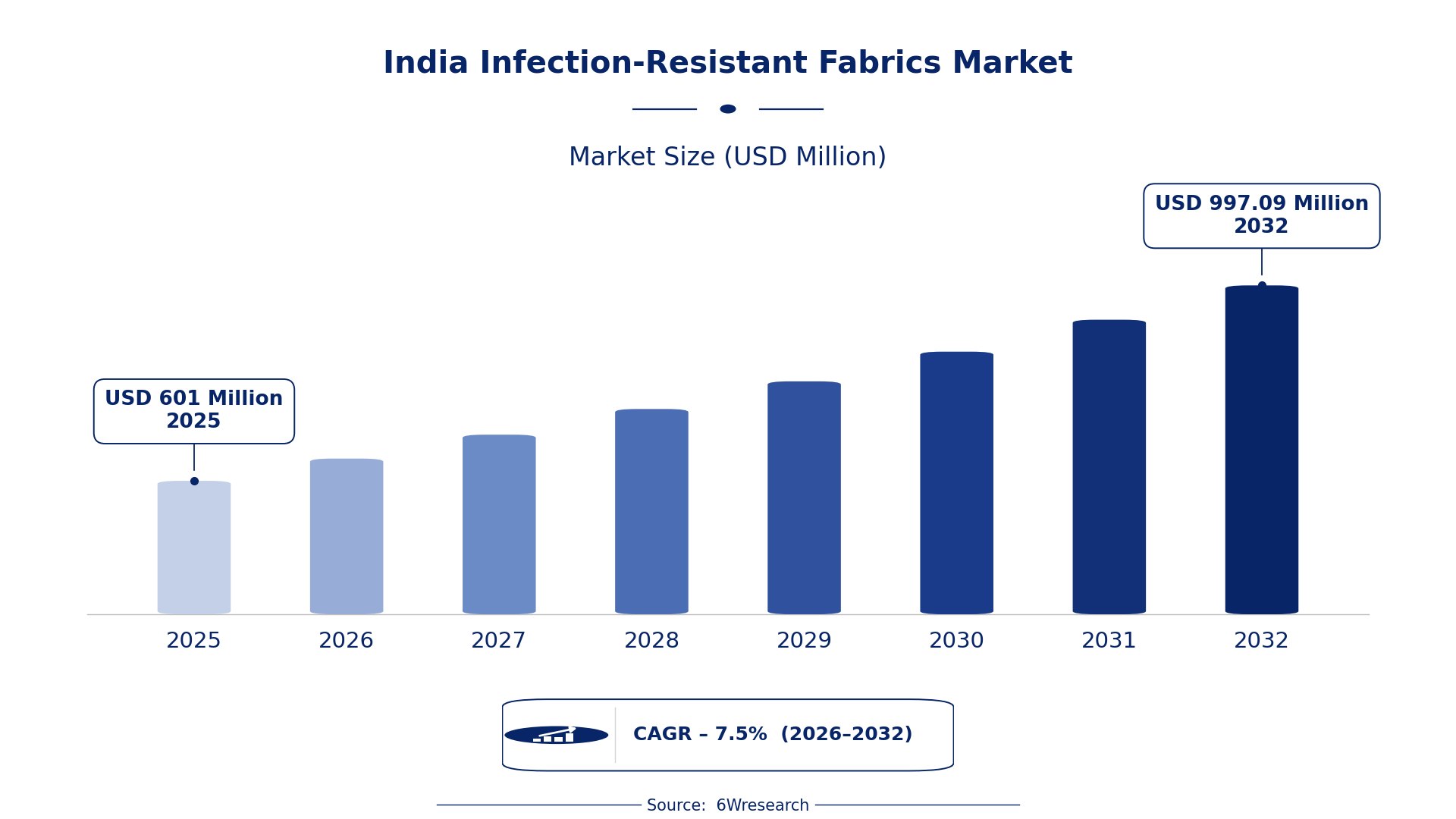
According to 6Wresearch internal database and industry insights, the India Infection-Resistant Fabrics Market was valued at USD 601.0 million in 2025 and is projected to reach USD 997.09 million by 2032, growing at a CAGR of approximately 7.5% during 2026–2032.
India Infection-Resistant Fabrics Market Highlights
| Report Metric | Details |
| Report Name | India Infection-Resistant Fabrics Market |
| Market Size 2025 | USD 601.0 million |
| Market Size 2032 | USD 997.09 million |
| Absolute Growth 2025–2032 | USD 396.09 million |
| CAGR 2026–2032 | 7.5% |
| Peak Annual Growth | 9.5% in 2027 |
| Forecast Period | 2026–2032 |
| Historical Data | 2022–2025 |
| Base Year | 2025 |
| Leading Fabric Type, 2025 | Non-Woven Polypropylene (51% share) |
| Leading Active Agent Used, 2025 | Silver / Zinc (42% share) |
| Leading End Use, 2025 | PPE & Masks (34% share) |
| Leading Distribution Channel, 2025 | Healthcare Textile Vendors (44% share) |
| Fastest-Growing Fabric Type | Smart Fabrics (9.6% CAGR) |
| Fastest-Growing Active Agent Used | Infection Shielding (10.1% CAGR) |
| Fastest-Growing End Use | Monitoring + Protection (8.9% CAGR) |
| Growing Sector | Healthcare Textiles |
| Key End Users | Hospitals, Healthcare Facilities, Textile Manufacturers, Uniform Suppliers |
India Infection-Resistant Fabrics Market Year-wise Growth Rate and Key Drivers (2022–2032)
This graph illustrates the annual growth rates of the market from 2022 to 2032, highlighting a steady upward trajectory and projected market expansion over the forecast period.
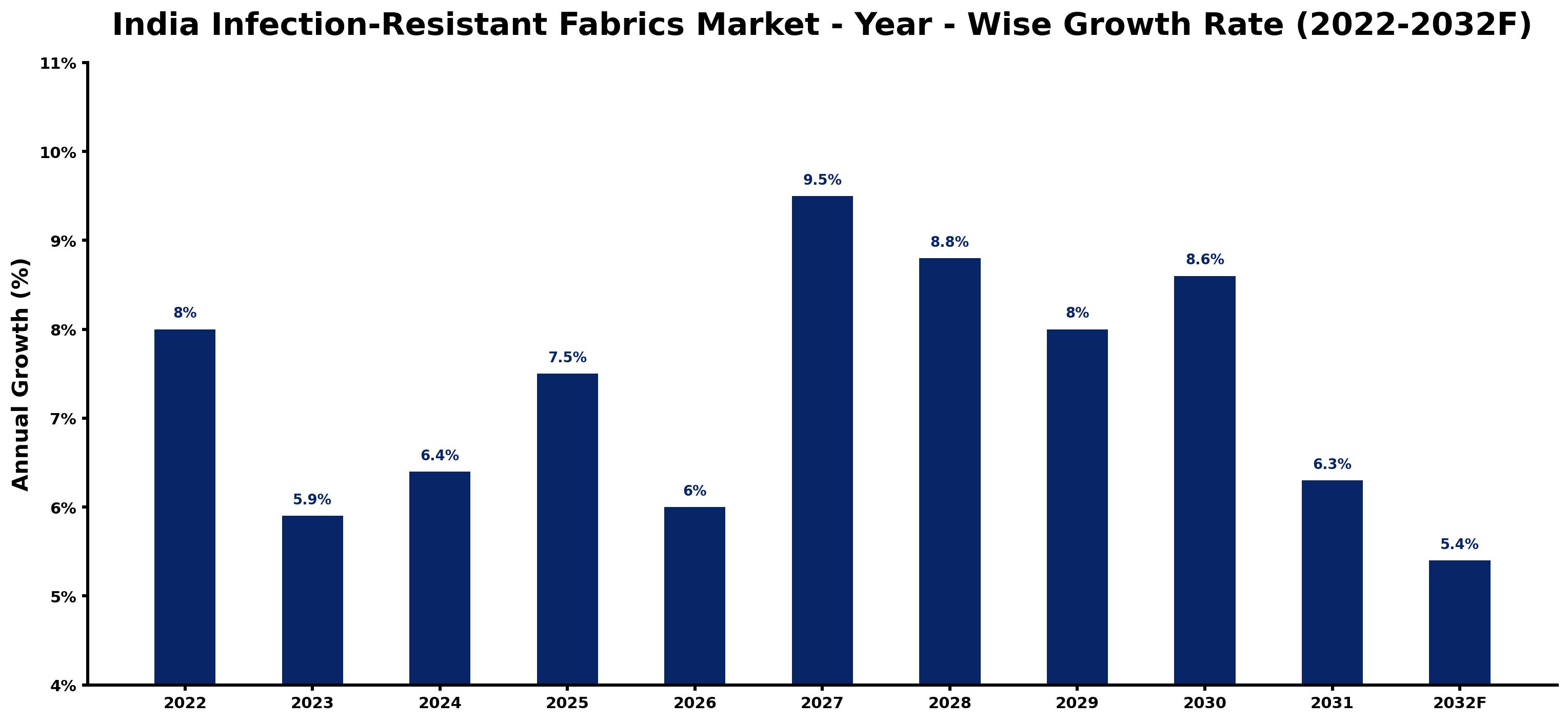
Below, each year's estimated growth is shown next to the factor that most influenced it.
| Year | Estimated Annual Growth (%) | Market Rationale |
| 2022 | 8.0 | The market experienced strong demand driven by healthcare facilities adopting infection control measures. |
| 2023 | 5.9 | Growth slowed as hospitals adjusted to the 'Infection Control in Healthcare Facilities' programme for infection-resistant fabrics. |
| 2024 | 6.4 | Increased awareness of hygiene practices led to a rise in fabric usage across healthcare settings. |
| 2025 | 7.5 | The expansion of the healthcare sector stimulated demand for infection-resistant textiles in various applications. |
| 2026 | 6.0 | Market growth is expected to slow due to regulatory adjustments affecting fabric specifications under IS 16289:2014. |
| 2027 | 9.5 | A surge in healthcare investments will boost demand for infection-resistant fabrics due to increased procurement. |
| 2028 | 8.8 | Growth is projected to moderate as the market adjusts to new production standards and competitive pressures. |
| 2029 | 8.0 | Demand is expected to remain steady as healthcare facilities continue to prioritise infection control measures. |
| 2030 | 8.6 | Increased investments in healthcare infrastructure will spur further adoption of infection-resistant fabrics. |
| 2031 | 6.3 | The market is projected to experience a slowdown as competition intensifies among local manufacturers. |
| 2032 | 5.4 | Growth is expected to decelerate as the market matures and demand stabilises. |
Note: Market size estimations and growth projections presented in this report are based on 6Wresearch's proprietary forecasting methodology, utilizing the latest available industry data, government publications, and primary research inputs.
India Infection-Resistant Fabrics Market Synopsis
Infection-resistant fabrics in India are textiles treated with antimicrobial agents to inhibit microbial growth, primarily used in healthcare settings. These fabrics incorporate active agents like silver or biocides, improving hygiene in hospitals. The India Infection-Resistant Fabrics Market is expanding due to the increasing number of hospitals adopting infection-resistant materials and the healthcare sector's projected growth to $372 billion by 2022. The launch of the 'Infection Control in Healthcare Facilities' programme in 2023 further drives demand, as over 60% of healthcare facilities are expected to adopt these fabrics by 2025.
Market Dynamics Impact Analysis (2026–2032)
| Factor | Type | Impact | Primary Segment Affected |
| Growing healthcare sector investments | Driver | High | PPE & Masks |
| Increasing adoption of infection-resistant materials in hospitals | Driver | High | Staff Uniforms |
| Rising demand for infection control in healthcare | Opportunity | High | Bed Linens & Curtains |
| Emerging market for smart fabrics in healthcare | Opportunity | Medium | Smart Fabrics |
| Regulatory challenges in fabric approvals | Restraint | High | Non-Woven Polypropylene |
| High production costs for antimicrobial textiles | Restraint | Medium | Polyester + Biocides |
| Supply chain disruptions affecting material availability | Challenge | High | Cotton-Polyester Blend |
| Intense competition among local manufacturers | Challenge | Medium | Healthcare Textile Vendors |
Evaluation of Drivers in India Infection-Resistant Fabrics Market (2026–2032)
The factors lifting demand, and the evidence behind each, are summarised below.
| Drivers | Primary Segment Affected | Why It Matters (Evidence) |
| Increased healthcare spending | PPE & Masks | The healthcare sector in India is projected to reach $372 billion by 2022, driving demand for PPE and infection-resistant fabrics. |
| Growing awareness of infection control | Staff Uniforms | Over 60% of healthcare facilities are adopting infection-resistant fabrics for uniforms by 2025, indicating a shift towards improved hygiene. |
| Investment in healthcare infrastructure | Bed Linens & Curtains | India has over 1,500 hospitals utilizing infection-resistant fabrics for patient care, increasing demand for these textiles. |
| Technological advancements in fabric treatment | Smart Fabrics | The Indian textile industry is expected to grow at a CAGR of 9% from 2021 to 2026, fostering innovation in fabric treatments. |
| Government initiatives promoting local production | Non-Woven Polypropylene | The 'Make in India' initiative encourages local production of antimicrobial textiles, increasing supply and reducing import reliance. |
Market growth in India for Infection-Resistant Fabrics rests on increased healthcare spending, growing awareness of infection control, and investment in healthcare infrastructure. The healthcare sector is expanding, stimulating demand for specialized textiles. Over 60% of healthcare facilities are adopting infection-resistant fabrics for uniforms and PPE by 2025, indicating a notable shift towards improved hygiene practices. The Indian textile industry is anticipated to grow significantly, creating opportunities for innovation in fabric treatments.
Evaluation of Restraints in India Infection-Resistant Fabrics Market
Below mentioned are some major restraints and their influence on market dynamics.
| Market Restraint | Primary Segment Affected | Why It Matters (Evidence) |
| Regulatory challenges in fabric approvals | Non-Woven Polypropylene | The Bureau of Indian Standards has set guidelines for antimicrobial textiles, complicating approval processes and delaying market entry. |
| High production costs for antimicrobial textiles | Polyester + Biocides | Manufacturers face rising costs associated with sourcing antimicrobial agents and production, impacting pricing strategies. |
| Limited availability of raw materials | Cotton-Polyester Blend | Supply chain disruptions have impacted the availability of essential materials for fabric production, affecting supply. |
| Market saturation in certain fabric types | PPE & Masks | Increased competition has led to a crowded market, affecting pricing and profitability for manufacturers. |
| Consumer price sensitivity | Staff Uniforms | Healthcare facilities are cautious about spending due to budget constraints, limiting their purchases of infection-resistant fabrics. |
India Infection-Resistant Fabrics Market Challenges
The India Infection-Resistant Fabrics Market faces intense competition among producers, which drives down prices and squeezes profit margins for manufacturers. Compliance with the Bureau of Indian Standards guidelines for antimicrobial textiles can delay product approvals, resulting in lost opportunities for producers and slowing market entry for new products. Many hospitals lack access to advanced fabric treatments, which hampers the adoption of effective infection control measures and limits options for healthcare facilities. Buyers are expected to face challenges in sourcing these fabrics, as over 1,500 hospitals will increase demand, potentially leading to shortages and higher procurement costs.
Trends in the India Infection-Resistant Fabrics Market
Buyers and suppliers in the India Infection-Resistant Fabrics Market are adjusting to the following trends.
- Shift towards Smart Fabrics: Healthcare facilities are increasingly exploring smart fabrics for patient monitoring applications. Currently, smart fabrics are being tested in 10 major hospitals in India, indicating a growing interest in advanced textile solutions.
- Adoption of Infection Control Standards: The Bureau of Indian Standards updated IS 16289 to include new antimicrobial fabric specifications in 2022. This change enhances quality control and encourages manufacturers to meet higher standards.
- Growth of Local Manufacturing: The 'Technical Textiles Mission' launched in 2021 aims to boost local production of infection-resistant fabrics. With a budget of ₹1,500 crore, this initiative is set to strengthen the domestic textile industry.
- Increased Focus on Hygiene in Healthcare: The National Health Mission has initiated a campaign to improve hygiene standards in healthcare textiles. This campaign aims to enhance the adoption of infection-resistant fabrics across healthcare facilities.
Investment Opportunities in the India Infection-Resistant Fabrics Market
The following opportunities in the India Infection-Resistant Fabrics Market pair current demand with a clear way in.
- Supply of Infection-Resistant Fabrics: There is a growing opportunity to supply infection-resistant fabrics to healthcare facilities, with over 1,500 hospitals in India currently utilizing these materials. The market is projected to reach USD 601 million by 2025.
- Investment in Healthcare Textile Vendors: Healthcare Textile Vendors are increasingly seeking local suppliers of infection-resistant fabrics. Establishing partnerships with these vendors can facilitate market entry and improve supply chain efficiency.
- Expansion of Smart Fabric Applications: Investing in the development of smart fabrics for healthcare applications presents a promising opportunity. The demand for advanced textiles is expected to grow as hospitals adopt innovative monitoring solutions.
- Entry into Emerging Markets: Targeting regional healthcare facilities in Tier 2 and Tier 3 cities can provide substantial growth opportunities. These markets are prioritising infection control measures and require reliable fabric suppliers.
Government Initiatives in the India Infection-Resistant Fabrics Market
In 2022, the Bureau of Indian Standards updated IS 16289 to include new antimicrobial fabric specifications, improving quality control for infection-resistant textiles. This update enhances previous regulations and aims to ensure higher standards in fabric production and usage across healthcare settings. The 'Atmanirbhar Bharat' scheme, launched in 2020, supports local textile manufacturers producing infection-resistant fabrics, promoting domestic production and reducing reliance on imports. This initiative is vital for encouraging innovation and competitiveness in the textile sector.
The 'Technical Textiles Mission' was launched in 2021 with a budget of ₹1,500 crore to promote innovation in infection-resistant fabrics. This mission aims to improve the capabilities of local manufacturers and enhance the quality of textiles available in the market. The National Health Mission has initiated campaigns to improve hygiene standards in healthcare textiles, which directly impacts the adoption of infection-resistant materials. These efforts are essential for ensuring that healthcare facilities meet the necessary infection control measures.
Future Insight of the India Infection-Resistant Fabrics Market
Several forward-looking factors should drive changes in the India Infection-Resistant Fabrics Market by 2032. The 'Infection Control in Healthcare Facilities' programme will encourage widespread use of these materials in hospitals, enhancing patient safety. Testing of advanced fabric technologies in major hospitals will likely lead to innovative applications in patient care. The Indian textile industry is projected to grow at a CAGR of 9% from 2021 to 2026, fostering innovation that will create new opportunities for both buyers and suppliers in the healthcare sector.
Market Segmentation Analysis
The analysis below covers each segmentation, its leading category in 2025 and its fastest-growing category through 2032.
By Fabric Type – Non-Woven Polypropylene Dominated, Smart Fabrics Expected to Grow Fastest
According to Shubham Deep, Research Manager at 6Wresearch, Non-Woven Polypropylene accounted for a 51% market share by fabric type in 2025. Non-Woven Polypropylene commands the largest market share due to its critical role in PPE manufacturing, where its barrier properties are essential for infection control. With over 1,500 hospitals in India utilising this fabric, its demand is consistently strong. Smart Fabrics are projected to grow fastest, at a CAGR of 9.6% during 2026–2032. Smart Fabrics are rapidly gaining traction as they are currently being tested in 10 major hospitals for patient monitoring applications. This emerging trend indicates a potential shift towards integrating technology with infection-resistant textiles, which could further solidify their market position. Suppliers should prioritise advancements in fabric technology to align with the growing needs of healthcare facilities.
By Active Agent Used – Silver / Zinc Dominated, Infection Shielding Expected to Grow Fastest
With a 42% revenue share in 2025, Silver / Zinc was the largest active agent used category. Silver / Zinc leads the market as the preferred active agent due to its effective antimicrobial properties, making it a common choice in various healthcare fabrics. Its widespread incorporation into infection-resistant textiles reflects the rising demand for reliable infection control solutions in medical settings. Over 2026–2032, Infection Shielding is expected to post the fastest growth, at a CAGR of 10.1%. Infection Shielding is experiencing the highest growth as it is specifically engineered for healthcare applications, directly addressing the urgent need for fabrics that effectively prevent infections. This focused approach is likely to attract more healthcare facilities seeking reliable solutions. Buyers should focus on fabrics featuring advanced active agents to ensure effective infection control in healthcare environments.
By End Use – PPE & Masks Dominated, Monitoring + Protection Expected to Grow Fastest
PPE & Masks took a 34% share of end use in 2025, more than any other category. PPE & Masks command the largest share in the market due to their critical role in infection prevention within healthcare settings. The widespread use of these items during health emergencies underscores their importance in protecting both patients and healthcare workers. Monitoring + Protection is set to record the highest CAGR in this split, 8.9% over 2026–2032. Monitoring + Protection is experiencing rapid growth, albeit its current application is limited to specialised settings. As healthcare practices advance, the integration of infection-resistant fabrics with monitoring technologies may lead to broader adoption in the future. Suppliers should explore innovative applications to tap into emerging opportunities within the end-use segment.
By Distribution Channel – Healthcare Textile Vendors Dominated and Is Expected to Record the Fastest Growth
The largest distribution channel category in 2025 was Healthcare Textile Vendors, with a 44% share of total revenue. Healthcare Textile Vendors lead the market, serving as primary suppliers to hospitals and clinics, which ensures a steady demand for infection-resistant fabrics. Their established relationships with healthcare facilities position them as crucial players in the supply chain. Its lead should widen, with a projected CAGR of 9.0% during 2026–2032, the highest in this split. Healthcare Textile Vendors are also the fastest-growing distribution channel, as their pivotal role in supplying essential textiles allows them to quickly adapt to evolving market needs. Their ongoing interactions with healthcare providers keep them aligned with market trends. Suppliers must strengthen partnerships with healthcare textile vendors to enhance distribution capabilities and capture greater market share.
Key Attractiveness of the Report
- 10 Years of Market Numbers
- Historical Data Starting from 2022 to 2025
- Base Year 2025
- Forecast Data until 2032
- Key Performance Indicators Impacting the Market
- Major Upcoming Developments and Projects
Key Highlights of the Report:
- India Infection-Resistant Fabrics Market Outlook
- Market Size of India Infection-Resistant Fabrics Market, 2025
- Forecast of India Infection-Resistant Fabrics Market, 2032
- Historical Data and Forecast of India Infection-Resistant Fabrics Revenues & Volume for the Period 2022 - 2032F
- India Infection-Resistant Fabrics Market Trend Evolution
- India Infection-Resistant Fabrics Market Drivers and Challenges
- India Infection-Resistant Fabrics Price Trends
- India Infection-Resistant Fabrics Porter's Five Forces
- India Infection-Resistant Fabrics Industry Life Cycle
- Historical Data and Forecast of India Infection-Resistant Fabrics Market Revenues & Volume By Fabric Type for the Period 2022 - 2032F
- Historical Data and Forecast of India Infection-Resistant Fabrics Market Revenues & Volume By Cotton-Polyester Blend for the Period 2022 - 2032F
- Historical Data and Forecast of India Infection-Resistant Fabrics Market Revenues & Volume By Non-Woven Polypropylene for the Period 2022 - 2032F
- Historical Data and Forecast of India Infection-Resistant Fabrics Market Revenues & Volume By Polyester + Biocides for the Period 2022 - 2032F
- Historical Data and Forecast of India Infection-Resistant Fabrics Market Revenues & Volume By Smart Fabrics for the Period 2022 - 2032F
- Historical Data and Forecast of India Infection-Resistant Fabrics Market Revenues & Volume By Active Agent Used for the Period 2022 - 2032F
- Historical Data and Forecast of India Infection-Resistant Fabrics Market Revenues & Volume By Silver / Zinc for the Period 2022 - 2032F
- Historical Data and Forecast of India Infection-Resistant Fabrics Market Revenues & Volume By Antimicrobial Spray for the Period 2022 - 2032F
- Historical Data and Forecast of India Infection-Resistant Fabrics Market Revenues & Volume By Infection Shielding for the Period 2022 - 2032F
- Historical Data and Forecast of India Infection-Resistant Fabrics Market Revenues & Volume By Sensor Integrated for the Period 2022 - 2032F
- Historical Data and Forecast of India Infection-Resistant Fabrics Market Revenues & Volume By End Use for the Period 2022 - 2032F
- Historical Data and Forecast of India Infection-Resistant Fabrics Market Revenues & Volume By Bed Linens & Curtains for the Period 2022 - 2032F
- Historical Data and Forecast of India Infection-Resistant Fabrics Market Revenues & Volume By PPE & Masks for the Period 2022 - 2032F
- Historical Data and Forecast of India Infection-Resistant Fabrics Market Revenues & Volume By Staff Uniforms for the Period 2022 - 2032F
- Historical Data and Forecast of India Infection-Resistant Fabrics Market Revenues & Volume By Monitoring + Protection for the Period 2022 - 2032F
- Historical Data and Forecast of India Infection-Resistant Fabrics Market Revenues & Volume By Distribution Channel for the Period 2022 - 2032F
- Historical Data and Forecast of India Infection-Resistant Fabrics Market Revenues & Volume By Healthcare Textile Vendors for the Period 2022 - 2032F
- Historical Data and Forecast of India Infection-Resistant Fabrics Market Revenues & Volume By Industrial Suppliers for the Period 2022 - 2032F
- Historical Data and Forecast of India Infection-Resistant Fabrics Market Revenues & Volume By Online Fabric Stores for the Period 2022 - 2032F
- Historical Data and Forecast of India Infection-Resistant Fabrics Market Revenues & Volume By Wearable Tech Integrators for the Period 2022 - 2032F
- India Infection-Resistant Fabrics Import Export Trade Statistics
- Market Opportunity Assessment By Fabric Type
- Market Opportunity Assessment By Active Agent Used
- Market Opportunity Assessment By End Use
- Market Opportunity Assessment By Distribution Channel
- India Infection-Resistant Fabrics Top Companies Market Share
- India Infection-Resistant Fabrics Competitive Benchmarking By Technical and Operational Parameters
- India Infection-Resistant Fabrics Company Profiles
- India Infection-Resistant Fabrics Key Strategic Recommendations
Market Covered
Segments analysed in this report are listed below.
By Fabric Type
- Cotton-Polyester Blend
- Non-Woven Polypropylene
- Polyester + Biocides
- Smart Fabrics
By Active Agent Used
- Silver / Zinc
- Antimicrobial Spray
- Infection Shielding
- Sensor Integrated
By End Use
- Bed Linens & Curtains
- PPE & Masks
- Staff Uniforms
- Monitoring + Protection
By Distribution Channel
- Healthcare Textile Vendors
- Industrial Suppliers
- Online Fabric Stores
- Wearable Tech Integrators































