China Infection-Resistant Fabrics Market Size & Growth Rate
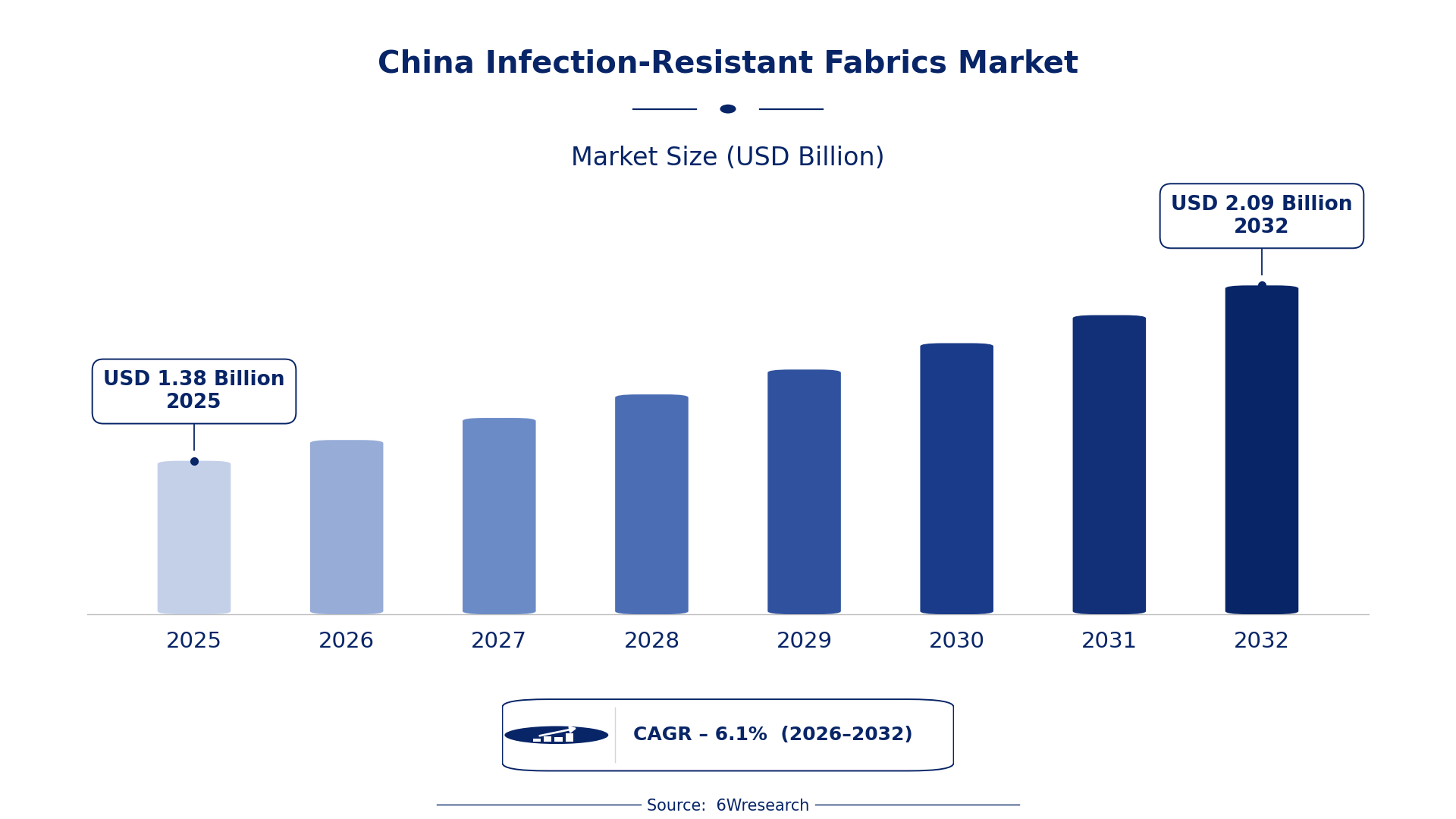
According to 6Wresearch internal database and industry insights, the China Infection-Resistant Fabrics Market was valued at USD 1.38 billion in 2025 and is projected to reach USD 2.09 billion by 2032, growing at a CAGR of approximately 6.1% during 2026–2032.
China Infection-Resistant Fabrics Market Highlights
| Report Metric | Details |
| Report Name | China Infection-Resistant Fabrics Market |
| Market Size 2025 | USD 1.38 billion |
| Market Size 2032 | USD 2.09 billion |
| Absolute Growth 2025–2032 | USD 0.71 billion |
| CAGR 2026–2032 | 6.1% |
| Peak Annual Growth | 8.1% in 2032 |
| Forecast Period | 2026–2032 |
| Historical Data | 2022–2025 |
| Base Year | 2025 |
| Leading Fabric Type, 2025 | Non-Woven Polypropylene (41% share) |
| Leading Active Agent Used, 2025 | Silver / Zinc (36% share) |
| Leading End Use, 2025 | PPE & Masks (38% share) |
| Leading Distribution Channel, 2025 | Healthcare Textile Vendors (37% share) |
| Fastest-Growing Fabric Type | Smart Fabrics (8.4% CAGR) |
| Fastest-Growing Active Agent Used | Infection Shielding (7.6% CAGR) |
| Fastest-Growing End Use | Monitoring + Protection (8.4% CAGR) |
| Fastest-Growing Distribution Channel | Wearable Tech Integrators (8.5% CAGR) |
| Growing Sector | Wearable Tech Integrators |
| Key End Users | Healthcare Textile Vendors, Industrial Suppliers, Online Fabric Stores, Wearable Tech Integrators |
China Infection-Resistant Fabrics Market Year-wise Growth Rate and Key Drivers (2022–2032)
This graph illustrates the annual growth rates of the market from 2022 to 2032, highlighting a steady upward trajectory and projected market expansion over the forecast period.
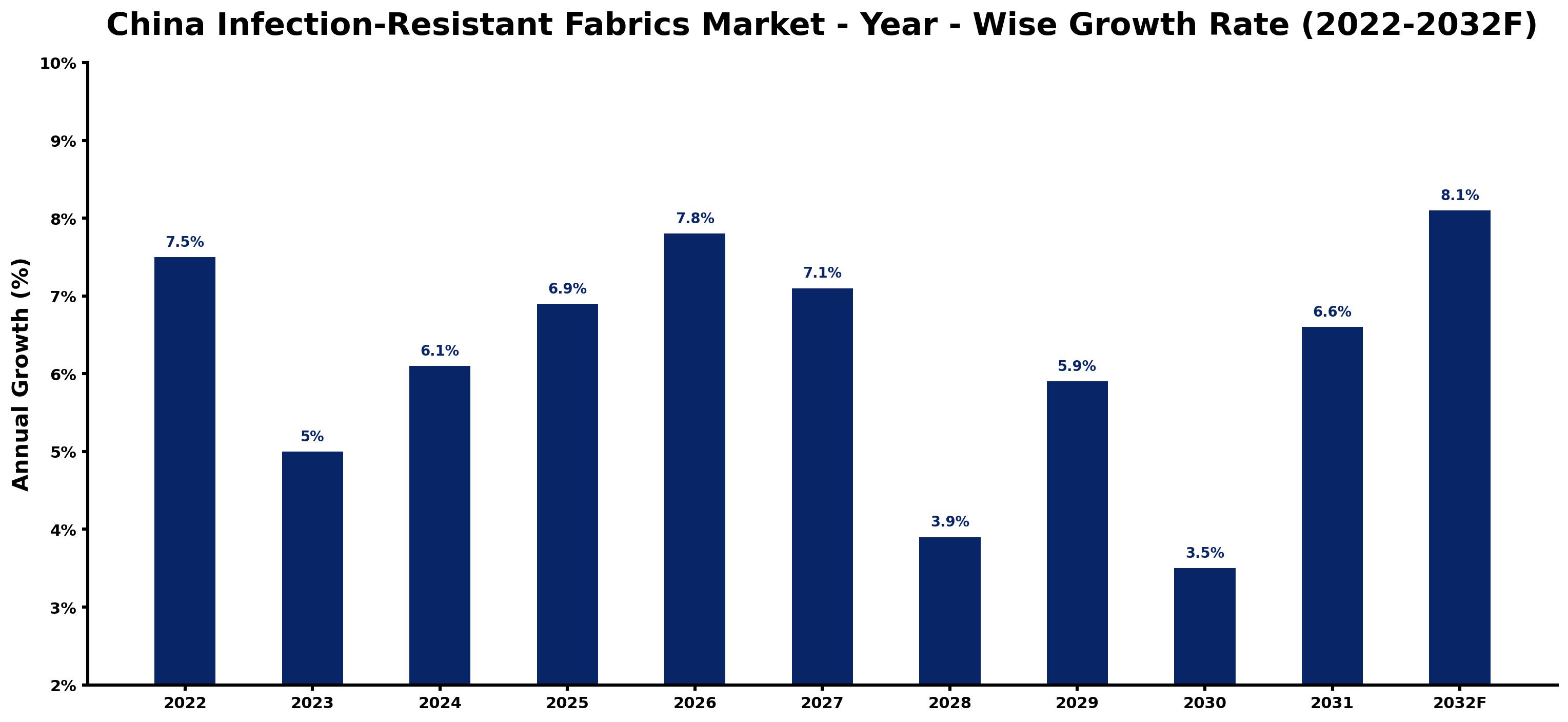
Each row of the following table gives one year's estimated growth and the event or demand shift that explains it.
| Year | Estimated Annual Growth (%) | Market Rationale |
| 2022 | 7.5 | Demand surged due to increased healthcare needs across hospitals and clinics. |
| 2023 | 5.0 | Growth slowed as supply chain disruptions affected production rates for infection-resistant fabrics. |
| 2024 | 6.1 | Rising investments in healthcare infrastructure, particularly in Jiangsu province, boosted demand for protective textiles. |
| 2025 | 6.9 | Healthcare textile vendors expanded offerings, driving higher sales of infection-resistant fabrics. |
| 2026 | 7.8 | Increased adoption of antimicrobial treatments in hospitals is projected to spur further growth. |
| 2027 | 7.1 | Demand is projected to stabilise as production efficiency improvements from the Textile Industry Development Strategy begin to take effect. |
| 2028 | 3.9 | Growth is expected to slow as market saturation in certain segments becomes apparent, particularly in PPE. |
| 2029 | 5.9 | Renewed focus on PPE for healthcare workers will lead to a resurgence in demand, especially in urban hospitals. |
| 2030 | 3.5 | Growth is projected to slow as the market adjusts to earlier rapid expansions in production capacity. |
| 2031 | 6.6 | Increased awareness of infection control measures will revitalise interest in these fabrics, driven by the National Health Commission's guidelines. |
| 2032 | 8.1 | A peak in demand is expected as new healthcare standards from the National Standard for Protective Textiles are implemented. |
Note: Market size estimations and growth projections presented in this report are based on 6Wresearch's proprietary forecasting methodology, utilizing the latest available industry data, government publications, and primary research inputs.
China Infection-Resistant Fabrics Market Synopsis
The China Infection-Resistant Fabrics Market includes textiles designed to prevent bacterial and viral growth. These fabrics incorporate antimicrobial agents and coatings, mainly used in personal protective equipment, hospital linens, and uniforms. The market is set to expand due to increasing healthcare demands, with over 1.4 billion patients annually needing infection control measures. The National Health Commission's advocacy for antimicrobial textiles in hospitals further fuels demand, alongside substantial investments in textile advancements. The healthcare sector's growing emphasis on infection control drives a robust demand for these specialised fabrics.
Market Dynamics Impact Analysis (2026–2032)
| Factor | Type | Impact | Primary Segment Affected |
| Rising healthcare needs amid the pandemic | Driver | High | PPE & Masks |
| Increased investments in healthcare infrastructure | Driver | High | Healthcare Textile Vendors |
| Growing demand for disposable PPE in hospitals | Opportunity | High | Non-Woven Polypropylene |
| Emerging technology in smart fabrics for healthcare | Opportunity | Medium | Smart Fabrics |
| Supply chain disruptions affecting production | Restraint | High | Cotton-Polyester Blend |
| Market saturation in certain segments limiting growth | Restraint | Medium | Polyester + Biocides |
| Regulatory compliance costs for manufacturers | Challenge | High | Infection Shielding |
| Competition from alternative textile technologies | Challenge | Medium | Antimicrobial Spray |
Evaluation of Drivers in China Infection-Resistant Fabrics Market (2026–2032)
Below mentioned are some major drivers and their influence on market dynamics.
| Drivers | Primary Segment Affected | Why It Matters (Evidence) |
| Increased healthcare spending | PPE & Masks | The healthcare sector's annual patient count exceeds 1.4 billion, driving demand for protective textiles. |
| Government initiatives promoting antimicrobial textiles | Healthcare Textile Vendors | The National Health Commission's guidelines encourage hospitals to adopt infection-resistant materials, boosting sales. |
| Rising awareness of infection control | Non-Woven Polypropylene | The demand for disposable PPE fabrics grew by 15% in 2023, reflecting heightened purchases from healthcare providers. |
| Technological advancements in textile production | Smart Fabrics | Pilot projects in Beijing hospitals are integrating smart textiles for monitoring, increasing demand for innovative fabric solutions. |
| Investment in textile innovation | Polyester + Biocides | The Ministry of Industry and Information Technology's program aims for a 30% improvement in production efficiency by 2023. |
The healthcare sector's annual patient count surpasses 1.4 billion, creating a strong need for protective textiles. In 2023, demand for disposable PPE fabrics increased by 15%, reflecting greater purchases from healthcare providers. The National Health Commission's guidelines promote the use of antimicrobial materials in hospitals, further propelling market growth.
Evaluation of Restraints in China Infection-Resistant Fabrics Market
The main factors holding the market back are set out below.
| Market Restraint | Primary Segment Affected | Why It Matters (Evidence) |
| Supply chain disruptions affecting production timelines | Cotton-Polyester Blend | In 2022, delays in raw material availability slowed production rates for infection-resistant fabrics. |
| Market saturation limiting growth opportunities | Polyester + Biocides | Increased competition has led to a plateau in growth for established fabric types. |
| Regulatory compliance costs for manufacturers | Infection Shielding | Compliance with updated standards has increased production costs for manufacturers by approximately 10%. |
| Limited consumer awareness of infection-resistant fabrics | Smart Fabrics | Despite innovations, consumer knowledge remains low, hindering market penetration and growth. |
| Competition from alternative textile technologies | Antimicrobial Spray | Emerging technologies are drawing attention away from traditional infection-resistant fabrics, impacting sales. |
China Infection-Resistant Fabrics Market Challenges
Buyers in the China Infection-Resistant Fabrics Market face regulatory hurdles, as the National Standard for Protective Textiles mandates strict compliance, potentially delaying product availability for hospitals by three months. Technological limitations also hinder progress; many local manufacturers lack access to advanced antimicrobial treatments, restricting their ability to innovate and compete. Competition from low-cost imports pressures domestic producers to cut prices, which can reduce profit margins by about 10%. A shortage of skilled workers in the textile industry complicates production processes, resulting in lead times extending up to four weeks for healthcare providers.
Trends in the China Infection-Resistant Fabrics Market
Below mentioned are some of the trends shaping the China Infection-Resistant Fabrics Market growth.
- Shift towards Smart Fabrics in Healthcare: Since 2022, there has been a marked shift towards incorporating smart fabrics in healthcare environments. Pilot projects in Beijing hospitals are investigating their application, with a forecasted 8.4% growth rate for this segment by 2032.
- Increased Adoption of Non-Woven Polypropylene: In 2023, demand for non-woven polypropylene surged by 15% due to its effectiveness in disposable PPE. This trend underscores the growing reliance on these materials in healthcare settings.
- Focus on Sustainable Practices: The Green Textile Development Plan initiated in 2020 promotes the use of eco-friendly antimicrobial agents in production. This shift is apparent as manufacturers pursue sustainable solutions, aligning with consumer preferences.
- Emergence of Integrated Infection Control Solutions: By 2023, integrated infection control solutions have gained momentum in hospitals, with a 20% increase in the adoption of infection-resistant materials. This trend reflects a broader commitment to improving patient safety.
Investment Opportunities in the China Infection-Resistant Fabrics Market
Below are the investment opportunities with the strongest case in the China Infection-Resistant Fabrics Market.
- Timing for Investment in PPE Fabrics: With the demand for PPE fabrics projected to grow by 15% in 2023, suppliers can take advantage of this surge by collaborating with healthcare textile vendors in major urban areas.
- Gap in Smart Fabric Technology: The anticipated 8.4% growth in smart fabrics offers an opportunity for suppliers to invest in advanced solutions, particularly in hospitals aiming to improve patient monitoring.
- Emerging Demand for Sustainable Fabrics: The Green Textile Development Plan encourages the use of eco-friendly antimicrobial agents, creating opportunities for suppliers to provide sustainable infection-resistant fabrics to healthcare providers.
- Increased Focus on Hospital Linens: As hospitals upgrade their linens to comply with new standards, there is a growing opportunity for manufacturers to supply high-quality infection-resistant bed linens and curtains.
Government Initiatives in the China Infection-Resistant Fabrics Market
In 2021, the National Health Commission launched the 'Healthcare Textile Innovation Plan' to encourage the use of infection-resistant materials in hospitals, aiming for a 20% increase in adoption by 2025. This initiative builds on the 2020 'Textile Industry Development Strategy' by the Ministry of Industry and Information Technology, which includes plans for antimicrobial fabric production, targeting a 30% improvement in production efficiency by 2023. These measures collectively strengthen the production capabilities of infection-resistant fabrics, ensuring better availability for healthcare providers.
The Ministry of Science and Technology initiated a funding program for textile solutions in 2023, allocating 500 million yuan for antimicrobial research. This funding supports hospitals and manufacturers in developing advanced infection-resistant fabrics, ensuring compliance with updated standards and improving patient safety. Agencies like the China Textile Industry Association are also involved in promoting these initiatives, facilitating the adoption of new technologies in the market.
Future Insight of the China Infection-Resistant Fabrics Market
The direction of the China Infection-Resistant Fabrics Market will shift considerably by 2032, driven by clear advancements. The National Health Commission's endorsement of antimicrobial textiles in hospitals will encourage broader adoption among healthcare providers. Government investments in research for advanced textile materials will stimulate innovation and improve product quality. The emergence of smart textiles integrated into healthcare monitoring systems will create new applications for infection-resistant fabrics, broadening their usage in various sectors and increasing overall market potential.
Market Segmentation Analysis
The report offers a comprehensive study of the following market segments and their leading categories in the market.
By Fabric Type – Non-Woven Polypropylene Dominated, Smart Fabrics Expected to Grow Fastest
According to Shubham Deep, Research Manager at 6Wresearch, Non-Woven Polypropylene held a 41% share of the China Infection-Resistant Fabrics Market by fabric type in 2025. Non-Woven Polypropylene holds the largest market share as it is extensively utilised in disposable PPE, essential for infection control in healthcare settings. This fabric type is prevalent across hospitals, addressing the needs of over 1.4 billion patients annually in China. Smart Fabrics are set to record the highest CAGR in this split, 8.4% over 2026–2032. Smart Fabrics are experiencing rapid growth due to their integration with advanced technology for healthcare monitoring, with pilot projects currently in progress in Beijing hospitals. The Ministry of Industry and Information Technology's emphasis on textile innovation further fuels this upward trend. Suppliers should prioritise the development of smart fabric technologies to align with the increasing demand for advanced infection-resistant solutions.
By Active Agent Used – Silver / Zinc Dominated, Infection Shielding Expected to Grow Fastest
Silver / Zinc accounted for a 36% market share by active agent used in 2025. Silver and Zinc hold the largest market share due to their effectiveness as antimicrobial agents in various fabric types. Their widespread application in personal protective equipment and hospital linens demonstrates their critical role in infection control within healthcare settings. Over 2026–2032, Infection Shielding is expected to post the fastest growth, at a CAGR of 7.6%. Infection Shielding is experiencing rapid growth, driven by its integration into fabrics to provide enhanced protection against pathogens. The increasing focus on advanced textile materials and ongoing research initiatives further accelerates this segment's expansion. Suppliers should prioritise the development of Infection Shielding fabrics to meet the rising demand for advanced protective textiles in healthcare.
By End Use – PPE & Masks Dominated, Monitoring + Protection Expected to Grow Fastest
In 2025, PPE & Masks led the end use split with a 38% share. PPE & Masks dominate the market share as they are critical for frontline healthcare workers, especially given the high demand for infection control measures. This segment is vital in protecting both patients and healthcare professionals in hospitals. Monitoring + Protection is projected to grow fastest, at a CAGR of 8.4% during 2026–2032. Monitoring + Protection is set to grow rapidly as technology advances, with increasing interest in fabrics that can provide real-time health monitoring. The integration of smart textiles into healthcare systems will likely drive this segment's expansion. Suppliers must innovate in the monitoring and protection space to capture the emerging opportunities presented by advanced textile technologies.
By Distribution Channel – Healthcare Textile Vendors Dominated, Wearable Tech Integrators Expected to Grow Fastest
Healthcare Textile Vendors took a 37% share of distribution channel in 2025, more than any other category. Healthcare Textile Vendors hold the largest share as primary suppliers of infection-resistant fabrics, catering directly to the needs of hospitals and healthcare facilities. Their established relationships with healthcare providers ensure a steady demand for these essential products. The quickest growth will come from Wearable Tech Integrators, forecast to expand at a CAGR of 8.5% between 2026 and 2032. Wearable Tech Integrators are experiencing rapid growth due to the rising interest in health monitoring textiles, which are increasingly being adopted in various applications. The convergence of technology and textiles is creating new market opportunities. Suppliers should explore partnerships with wearable tech integrators to tap into the growing demand for health monitoring solutions.
Key Attractiveness of the Report
- 10 Years of Market Numbers
- Historical Data Starting from 2022 to 2025
- Base Year 2025
- Forecast Data until 2032
- Key Performance Indicators Impacting the Market
- Major Upcoming Developments and Projects
Key Highlights of the Report:
- China Infection-Resistant Fabrics Market Outlook
- Market Size of China Infection-Resistant Fabrics Market, 2025
- Forecast of China Infection-Resistant Fabrics Market, 2032
- Historical Data and Forecast of China Infection-Resistant Fabrics Revenues & Volume for the Period 2022 - 2032F
- China Infection-Resistant Fabrics Market Trend Evolution
- China Infection-Resistant Fabrics Market Drivers and Challenges
- China Infection-Resistant Fabrics Price Trends
- China Infection-Resistant Fabrics Porter's Five Forces
- China Infection-Resistant Fabrics Industry Life Cycle
- Historical Data and Forecast of China Infection-Resistant Fabrics Market Revenues & Volume By Fabric Type for the Period 2022 - 2032F
- Historical Data and Forecast of China Infection-Resistant Fabrics Market Revenues & Volume By Cotton-Polyester Blend for the Period 2022 - 2032F
- Historical Data and Forecast of China Infection-Resistant Fabrics Market Revenues & Volume By Non-Woven Polypropylene for the Period 2022 - 2032F
- Historical Data and Forecast of China Infection-Resistant Fabrics Market Revenues & Volume By Polyester + Biocides for the Period 2022 - 2032F
- Historical Data and Forecast of China Infection-Resistant Fabrics Market Revenues & Volume By Smart Fabrics for the Period 2022 - 2032F
- Historical Data and Forecast of China Infection-Resistant Fabrics Market Revenues & Volume By Active Agent Used for the Period 2022 - 2032F
- Historical Data and Forecast of China Infection-Resistant Fabrics Market Revenues & Volume By Silver / Zinc for the Period 2022 - 2032F
- Historical Data and Forecast of China Infection-Resistant Fabrics Market Revenues & Volume By Antimicrobial Spray for the Period 2022 - 2032F
- Historical Data and Forecast of China Infection-Resistant Fabrics Market Revenues & Volume By Infection Shielding for the Period 2022 - 2032F
- Historical Data and Forecast of China Infection-Resistant Fabrics Market Revenues & Volume By Sensor Integrated for the Period 2022 - 2032F
- Historical Data and Forecast of China Infection-Resistant Fabrics Market Revenues & Volume By End Use for the Period 2022 - 2032F
- Historical Data and Forecast of China Infection-Resistant Fabrics Market Revenues & Volume By Bed Linens & Curtains for the Period 2022 - 2032F
- Historical Data and Forecast of China Infection-Resistant Fabrics Market Revenues & Volume By PPE & Masks for the Period 2022 - 2032F
- Historical Data and Forecast of China Infection-Resistant Fabrics Market Revenues & Volume By Staff Uniforms for the Period 2022 - 2032F
- Historical Data and Forecast of China Infection-Resistant Fabrics Market Revenues & Volume By Monitoring + Protection for the Period 2022 - 2032F
- Historical Data and Forecast of China Infection-Resistant Fabrics Market Revenues & Volume By Distribution Channel for the Period 2022 - 2032F
- Historical Data and Forecast of China Infection-Resistant Fabrics Market Revenues & Volume By Healthcare Textile Vendors for the Period 2022 - 2032F
- Historical Data and Forecast of China Infection-Resistant Fabrics Market Revenues & Volume By Industrial Suppliers for the Period 2022 - 2032F
- Historical Data and Forecast of China Infection-Resistant Fabrics Market Revenues & Volume By Online Fabric Stores for the Period 2022 - 2032F
- Historical Data and Forecast of China Infection-Resistant Fabrics Market Revenues & Volume By Wearable Tech Integrators for the Period 2022 - 2032F
- China Infection-Resistant Fabrics Import Export Trade Statistics
- Market Opportunity Assessment By Fabric Type
- Market Opportunity Assessment By Active Agent Used
- Market Opportunity Assessment By End Use
- Market Opportunity Assessment By Distribution Channel
- China Infection-Resistant Fabrics Top Companies Market Share
- China Infection-Resistant Fabrics Competitive Benchmarking By Technical and Operational Parameters
- China Infection-Resistant Fabrics Company Profiles
- China Infection-Resistant Fabrics Key Strategic Recommendations
Market Covered
This report examines the market across the segments below.
By Fabric Type
- Cotton-Polyester Blend
- Non-Woven Polypropylene
- Polyester + Biocides
- Smart Fabrics
By Active Agent Used
- Silver / Zinc
- Antimicrobial Spray
- Infection Shielding
- Sensor Integrated
By End Use
- Bed Linens & Curtains
- PPE & Masks
- Staff Uniforms
- Monitoring + Protection
By Distribution Channel
- Healthcare Textile Vendors
- Industrial Suppliers
- Online Fabric Stores
- Wearable Tech Integrators































