India Inflammatory Joint Disease Market Size & Growth Rate
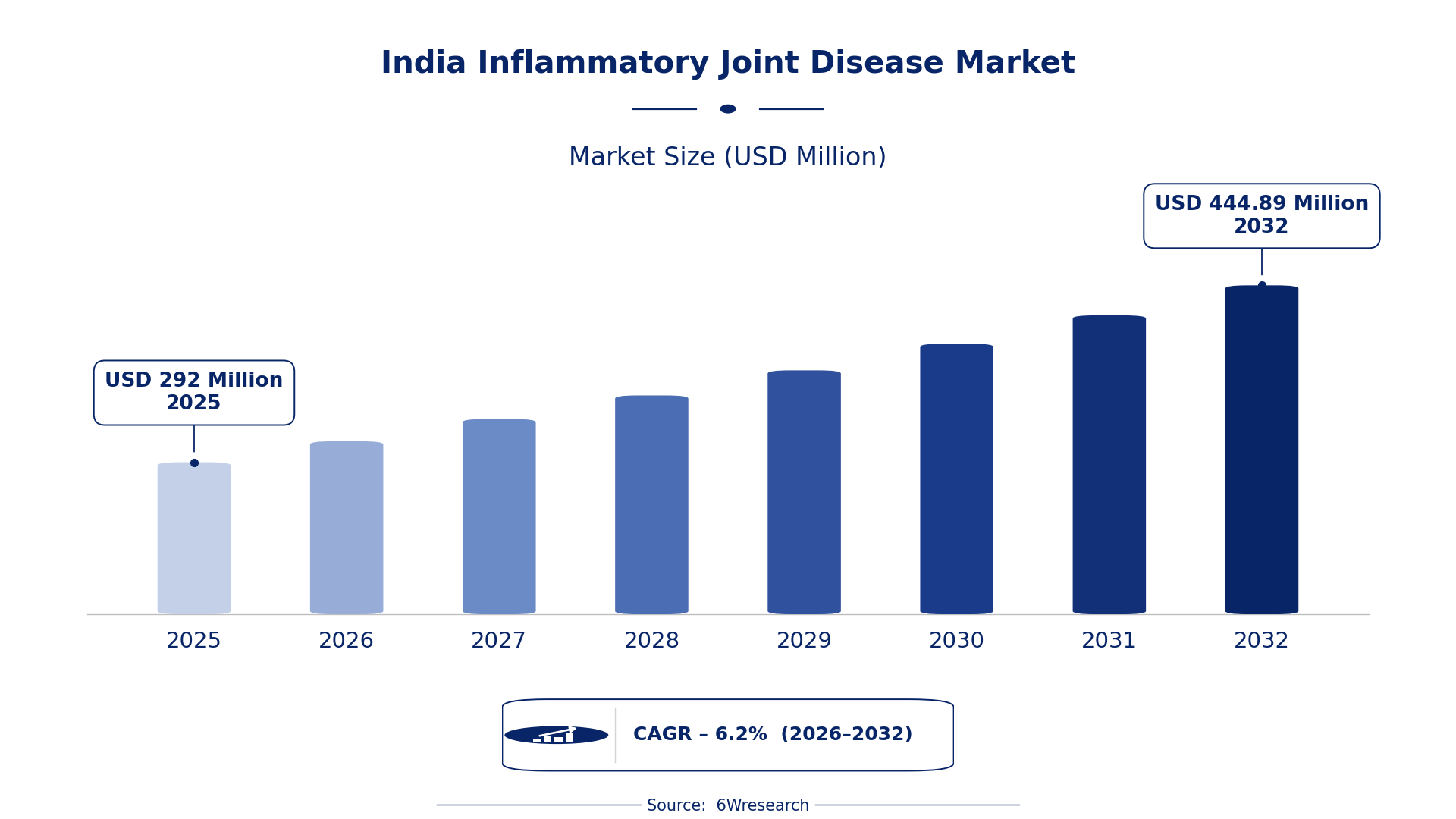
According to 6Wresearch internal database and industry insights, the India Inflammatory Joint Disease Market was valued at USD 292.0 million in 2025 and is projected to reach USD 444.89 million by 2032, growing at a CAGR of approximately 6.2% during 2026–2032.
India Inflammatory Joint Disease Market Highlights
| Report Metric | Details |
| Report Name | India Inflammatory Joint Disease Market |
| Market Size 2025 | USD 292.0 million |
| Market Size 2032 | USD 444.89 million |
| Absolute Growth 2025–2032 | USD 152.89 million |
| CAGR 2026–2032 | 6.2% |
| Peak Annual Growth | 8.0% in 2030 |
| Forecast Period | 2026–2032 |
| Historical Data | 2022–2025 |
| Base Year | 2025 |
| Leading Joint Disease Type, 2025 | Rheumatoid Arthritis (39% share) |
| Leading Treatment Strategy, 2025 | Biologics / DMARDs (36% share) |
| Leading Diagnostic Tool, 2025 | X-Ray (30% share) |
| Leading Distribution Channel, 2025 | Rheumatology Centers (40% share) |
| Fastest-Growing Joint Disease Type | Psoriatic Arthritis (7.6% CAGR) |
| Fastest-Growing Treatment Strategy | IL Inhibitors (8.5% CAGR) |
| Fastest-Growing Diagnostic Tool | Uric Acid Test (8.7% CAGR) |
| Growing Sector | Rheumatology |
| Key End Users | Healthcare providers, Rheumatology centers, Community pharmacies, Patients |
India Inflammatory Joint Disease Market Year-wise Growth Rate and Key Drivers (2022–2032)
This graph illustrates the annual growth rates of the market from 2022 to 2032, highlighting a steady upward trajectory and projected market expansion over the forecast period.
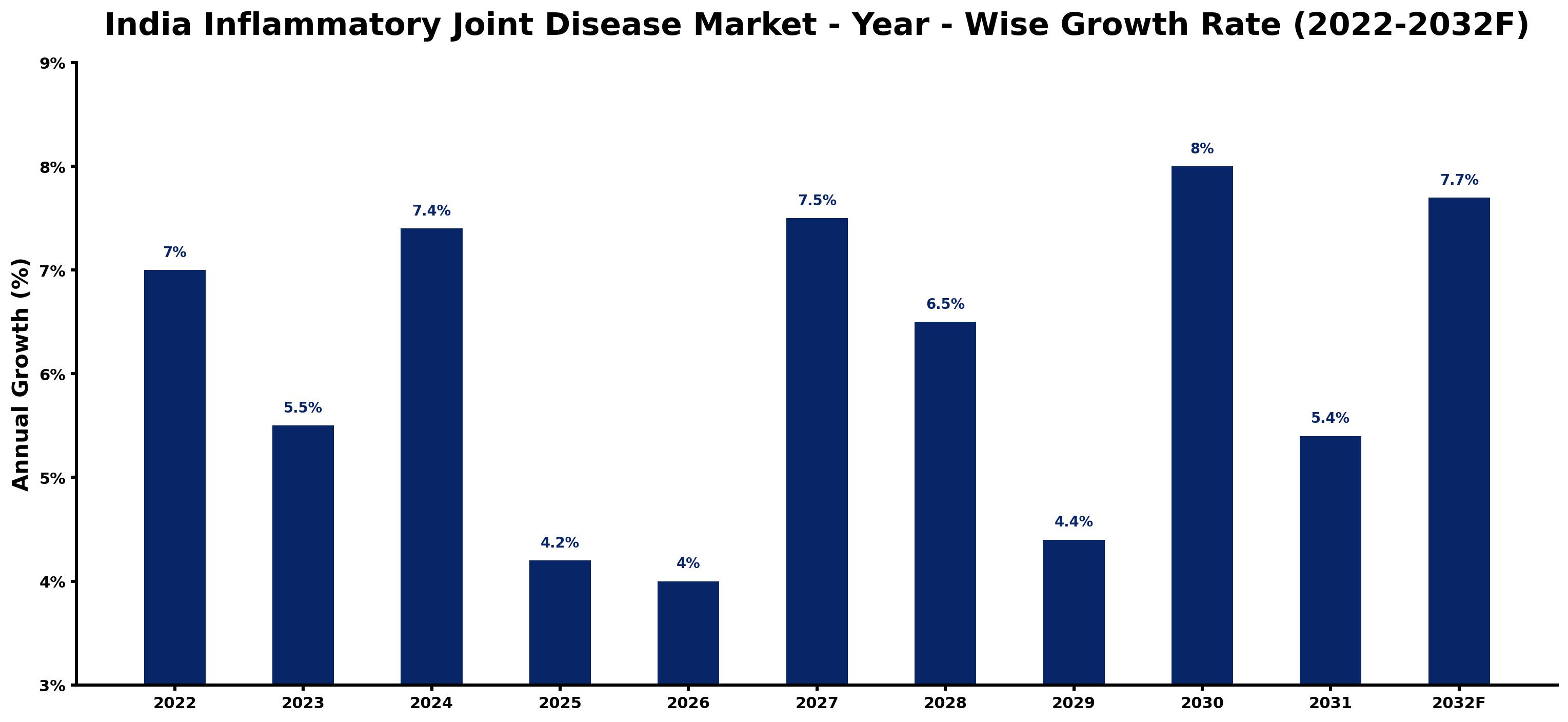
The following table presents the estimated annual growth rate for each year together with the principal factor influencing market performance.
| Year | Estimated Annual Growth (%) | Market Rationale |
| 2022 | 7.0 | The market experienced steady growth with significant patient populations seeking treatment. |
| 2023 | 5.5 | Growth slowed due to increased competition among treatment providers in urban areas. |
| 2024 | 7.4 | Demand surged as awareness campaigns by the Indian Rheumatology Association gained traction. |
| 2025 | 4.2 | Growth slowed as the market adjusted to new treatment protocols and guidelines. |
| 2026 | 4.0 | The market saw a slowdown as the adoption of biologics faced regulatory hurdles. |
| 2027 | 7.5 | Growth accelerated as more patients accessed advanced treatment options through rheumatology centers. |
| 2028 | 6.5 | Demand slowed as rural areas continued to face access challenges for treatment. |
| 2029 | 4.4 | Growth decelerated due to limited awareness of available treatment options. |
| 2030 | 8.0 | The market peaked as the introduction of new biologics expanded treatment possibilities. |
| 2031 | 5.4 | Growth slowed as the market began to stabilise with established treatment patterns. |
| 2032 | 7.7 | The market grew as ongoing public health initiatives improved treatment access. |
Note: Market size estimations and growth projections presented in this report are based on 6Wresearch's proprietary forecasting methodology, utilizing the latest available industry data, government publications, and primary research inputs.
India Inflammatory Joint Disease Market Synopsis
Inflammatory Joint Disease in India includes autoimmune conditions such as rheumatoid arthritis and gout, primarily treated with biologics and DMARDs. The market is propelled by a large patient population, with over 10 million diagnosed in 2023. Demand is increasing due to improved healthcare access through initiatives like the National Health Mission, which aims to enhance treatment availability. The rheumatology sector is growing, bolstered by heightened awareness and educational efforts from the Indian Rheumatology Association. This growth reflects a broader shift towards advanced treatment options and better patient management strategies.
Market Dynamics Impact Analysis (2026–2032)
| Factor | Type | Impact | Primary Segment Affected |
| Growing patient population seeking treatment options | Driver | High | Rheumatoid Arthritis |
| Increased adoption of biologics in treatment protocols | Driver | High | Biologics / DMARDs |
| Expansion of rheumatology centers in urban areas | Opportunity | High | Rheumatology Centers |
| Growing need for affordable treatment options among low-income patients | Opportunity | High | Biologics / DMARDs |
| Limited access to rheumatology services in rural regions | Restraint | High | Rheumatoid Arthritis |
| Regulatory challenges in the approval of new biologics | Restraint | Medium | Biologics / DMARDs |
| High treatment costs affecting patient access | Challenge | High | Rheumatoid Arthritis |
| Slow adoption of new treatment protocols among healthcare providers | Challenge | Medium | Biologics / DMARDs |
Evaluation of Drivers in India Inflammatory Joint Disease Market (2026–2032)
The factors lifting demand, and the evidence behind each, are summarised below.
| Drivers | Primary Segment Affected | Why It Matters (Evidence) |
| Increasing healthcare investments | Rheumatoid Arthritis | Healthcare investments have risen, with the National Health Mission improving access for over 10 million patients annually. |
| Growing awareness of inflammatory joint diseases | Biologics / DMARDs | Awareness campaigns by the Indian Rheumatology Association have led to increased patient consultations, resulting in higher treatment uptake. |
| Expansion of specialized rheumatology centers | Uric Acid Lowering Drugs | With an estimated prevalence of 2-3%, more patients are seeking effective gout management solutions. |
| Supportive treatment guidelines from health authorities | TNF Inhibitors | The National Institute of Arthritis and Musculoskeletal and Skin Diseases has issued guidelines promoting TNF inhibitors. |
| Enhanced patient education initiatives | Ankylosing Spondylitis | The Indian Academy of Pediatrics recommends early diagnosis and treatment, leading to increased patient engagement. |
Growth in the Inflammatory Joint Disease market in India comes from increasing healthcare investments, expanding access to treatments and rising patient awareness. The National Health Mission has improved healthcare access for over 10 million patients diagnosed with inflammatory joint diseases. Awareness campaigns have driven more patients to seek consultations, resulting in higher treatment uptake. The establishment of specialized rheumatology centers in urban areas has facilitated access to advanced treatment options. The rising prevalence of gout, estimated at 2-3% among adults, has led to increased demand for effective management solutions.
Evaluation of Restraints in India Inflammatory Joint Disease Market
The following restraints limit how fast demand can grow.
| Market Restraint | Primary Segment Affected | Why It Matters (Evidence) |
| Limited access to rheumatology services in rural areas | Rheumatoid Arthritis | Approximately 40% of patients in rural regions struggle to access specialized care, hindering treatment. |
| High costs associated with biologic treatments | Biologics / DMARDs | Many patients face financial barriers, with treatment costs reaching thousands of INR monthly. |
| Regulatory delays in the approval of new biologics | Biologics / DMARDs | The approval process can extend beyond 12 months, delaying patient access to new therapies. |
| Insufficient awareness of treatment options among healthcare providers | TNF Inhibitors | Many providers lack knowledge of the latest treatment protocols, limiting patient referrals. |
| Inconsistent quality of care across facilities | Rheumatology Centers | Quality varies across centers, with some lacking necessary equipment and trained staff. |
India Inflammatory Joint Disease Market Challenges
The India Inflammatory Joint Disease market still has to solve a few problems, starting with competition from alternative therapies that confuses patients and reduces treatment adherence. The high cost of biologics, averaging around 30% of total treatment expenses, results in delayed care for over 10 million diagnosed individuals. Limited access to advanced treatment technologies particularly affects patients in rural areas, where only 20% of rheumatology centres are located. Frequent supply chain disruptions hinder the availability of essential medications, complicating timely treatment efforts for healthcare providers across the country.
Trends in the India Inflammatory Joint Disease Market
Buyers and suppliers in the India Inflammatory Joint Disease Market are adjusting to the following trends.
- Shift Towards Advanced Biologics: The adoption of biologics in India is on the rise, with an increasing number of patients treated annually. In 2023, over 10 million patients were diagnosed with inflammatory joint diseases, underscoring the demand for advanced therapies.
- Expansion of Rheumatology Centers in Urban Areas: Rheumatology centres are being established more frequently in urban regions, improving access for patients. In 2022, the National Health Mission launched initiatives to enhance healthcare infrastructure, benefiting urban populations.
- Growing Focus on Patient Education: There is a notable increase in patient education initiatives regarding inflammatory joint diseases. The Indian Rheumatology Association's awareness campaigns have reached millions, positively influencing treatment-seeking behaviour.
- Increased Adoption of ISO Standards: Healthcare facilities are increasingly implementing ISO 9001 standards for quality management. This trend supports improved treatment protocols and patient care, with many facilities reporting better outcomes.
Investment Opportunities in the India Inflammatory Joint Disease Market
The following opportunities in the India Inflammatory Joint Disease Market pair current demand with a clear way in.
- Partnerships with Local Healthcare Providers: Establishing joint ventures with local healthcare providers can enhance access to treatments. With over 10 million patients diagnosed, there is a substantial opportunity to supply biologics.
- Investment in Rheumatology Centers: Investing in new rheumatology centres can address access issues. The concentration of these centres in urban areas highlights a gap for rural patients needing treatment.
- Supply of Affordable Uric Acid Lowering Drugs: The prevalence of gout, estimated at 2-3%, creates a demand for affordable treatment options. Collaborating with community pharmacies can facilitate distribution to patients.
- Certification for Quality Management Systems: Healthcare facilities are adopting ISO standards, creating a demand for certification services. Supporting facilities in obtaining these certifications can improve treatment quality.
Government Initiatives in the India Inflammatory Joint Disease Market
The National Health Mission, launched by the Ministry of Health and Family Welfare in 2020, aims to improve healthcare access for chronic diseases including inflammatory joint diseases. The program focuses on enhancing treatment availability and patient outreach, benefiting millions of individuals. In 2022, the Ministry established the National Arthritis Control Program to raise awareness and improve treatment access for arthritis patients, targeting underserved populations across India. This initiative is expected to have a considerable impact on patient management and care quality.
In 2021, the Indian Council of Medical Research initiated a research program focused on treatments for rheumatoid arthritis, with a budget of 50 million INR. This initiative aims to advance treatment efficacy and improve patient outcomes. In 2023, the National Institute of Health launched a public health initiative to educate healthcare providers on the latest treatment protocols for inflammatory joint diseases, ensuring that providers are equipped with current knowledge. This effort is expected to enhance the overall quality of care for patients.
Future Insight of the India Inflammatory Joint Disease Market
The India Inflammatory Joint Disease market will undergo substantial changes by 2032, driven by government initiatives to subsidise biologics for low-income patients and expand rheumatology centres into underserved rural areas. The implementation of ISO 9001 standards will elevate care quality across healthcare facilities. Telemedicine capabilities will improve patient access to specialists, facilitating timely diagnosis and management. By 2032, advanced imaging technologies are expected to enhance diagnostic accuracy, benefiting over 10 million patients with more effective treatment strategies.
Market Segmentation Analysis
The analysis below covers each segmentation, its leading category in 2025 and its fastest-growing category through 2032.
By Joint Disease Type – Rheumatoid Arthritis Dominated, Psoriatic Arthritis Expected to Grow Fastest
According to Shubham Deep, Research Manager at 6Wresearch, Rheumatoid Arthritis held a 39% share of the India Inflammatory Joint Disease Market by joint disease type in 2025. Rheumatoid arthritis holds the largest share in India due to its prevalence affecting approximately 1% of the population, leading to a substantial demand for targeted therapies. The Indian Rheumatology Association actively promotes awareness, ensuring that patients seek treatment for this chronic condition. The quickest growth will come from Psoriatic Arthritis, forecast to expand at a CAGR of 7.6% between 2026 and 2032. Psoriatic arthritis is experiencing rapid growth as awareness increases, with the Indian Academy of Pediatrics recommending early diagnosis and treatment. This heightened focus on management is likely to drive more patients towards effective therapies. Suppliers should prioritise developing targeted treatments for psoriatic arthritis to capitalise on its growing patient base.
By Treatment Strategy – Biologics / DMARDs Dominated, IL Inhibitors Expected to Grow Fastest
Biologics / DMARDs accounted for a 36% market share by treatment strategy in 2025. Biologics and DMARDs dominate the market as they are essential for treating various inflammatory joint diseases, with a growing number of patients adopting these therapies annually. The government's initiative to subsidise biologics for low-income patients further boosts their market share. IL Inhibitors are set to record the highest CAGR in this split, 8.5% over 2026–2032. IL inhibitors are gaining traction as they are increasingly incorporated into advanced treatment protocols for arthritis, reflecting a shift towards more effective management strategies. This trend suggests that biologics will continue to lead while IL inhibitors grow rapidly. Buyers will benefit from a wider range of treatment options as IL inhibitors become more prevalent in the market.
By Diagnostic Tool – X-Ray Dominated, Uric Acid Test Expected to Grow Fastest
With a 30% revenue share in 2025, X-Ray was the largest diagnostic tool category. X-ray remains the most utilised diagnostic tool in India, providing essential imaging for identifying joint diseases. Its established role in clinical practice ensures it holds a substantial market share among healthcare providers. Uric Acid Test is projected to grow fastest, at a CAGR of 8.7% during 2026–2032. The Uric Acid Test is gaining traction as a vital diagnostic method for gout, especially as the condition's prevalence increases among adults in India. This heightened focus on accurate diagnostics will likely strengthen its market position further. Healthcare providers must ensure access to advanced diagnostic tools like the Uric Acid Test to meet the rising demand for precise gout diagnosis.
By Distribution Channel – Rheumatology Centers Dominated and Is Expected to Record the Fastest Growth
The largest distribution channel category in 2025 was Rheumatology Centers, with a 40% share of total revenue. Rheumatology centers are crucial for managing inflammatory joint diseases, providing specialised care to a large urban patient population. Their established role in treatment delivery allows them to capture a substantial market share, particularly as awareness and diagnosis improve. Its lead should widen, with a projected CAGR of 8.9% during 2026–2032, the highest in this split. The rapid growth of rheumatology centers is fuelled by the rising number of patients diagnosed with inflammatory joint diseases, highlighting the increasing demand for specialised treatment. Their position as both leader and fastest indicates that their influence in the market will continue to expand. This trend suggests that suppliers must enhance collaborations with rheumatology centers to effectively cater to the growing demand for treatments.
Key Attractiveness of the Report
- 10 Years of Market Numbers
- Historical Data Starting from 2022 to 2025
- Base Year 2025
- Forecast Data until 2032
- Key Performance Indicators Impacting the Market
- Major Upcoming Developments and Projects
Key Highlights of the Report:
- India Inflammatory Joint Disease Market Outlook
- Market Size of India Inflammatory Joint Disease Market, 2025
- Forecast of India Inflammatory Joint Disease Market, 2032
- Historical Data and Forecast of India Inflammatory Joint Disease Revenues & Volume for the Period 2022 - 2032F
- India Inflammatory Joint Disease Market Trend Evolution
- India Inflammatory Joint Disease Market Drivers and Challenges
- India Inflammatory Joint Disease Price Trends
- India Inflammatory Joint Disease Porter's Five Forces
- India Inflammatory Joint Disease Industry Life Cycle
- Historical Data and Forecast of India Inflammatory Joint Disease Market Revenues & Volume By Joint Disease Type for the Period 2022 - 2032F
- Historical Data and Forecast of India Inflammatory Joint Disease Market Revenues & Volume By Rheumatoid Arthritis for the Period 2022 - 2032F
- Historical Data and Forecast of India Inflammatory Joint Disease Market Revenues & Volume By Psoriatic Arthritis for the Period 2022 - 2032F
- Historical Data and Forecast of India Inflammatory Joint Disease Market Revenues & Volume By Gout for the Period 2022 - 2032F
- Historical Data and Forecast of India Inflammatory Joint Disease Market Revenues & Volume By Ankylosing Spondylitis for the Period 2022 - 2032F
- Historical Data and Forecast of India Inflammatory Joint Disease Market Revenues & Volume By Treatment Strategy for the Period 2022 - 2032F
- Historical Data and Forecast of India Inflammatory Joint Disease Market Revenues & Volume By Biologics / DMARDs for the Period 2022 - 2032F
- Historical Data and Forecast of India Inflammatory Joint Disease Market Revenues & Volume By IL Inhibitors for the Period 2022 - 2032F
- Historical Data and Forecast of India Inflammatory Joint Disease Market Revenues & Volume By Uric Acid Lowering Drugs for the Period 2022 - 2032F
- Historical Data and Forecast of India Inflammatory Joint Disease Market Revenues & Volume By TNF Inhibitors for the Period 2022 - 2032F
- Historical Data and Forecast of India Inflammatory Joint Disease Market Revenues & Volume By Diagnostic Tool for the Period 2022 - 2032F
- Historical Data and Forecast of India Inflammatory Joint Disease Market Revenues & Volume By CRP, X-Ray for the Period 2022 - 2032F
- Historical Data and Forecast of India Inflammatory Joint Disease Market Revenues & Volume By Visual + Skin Check for the Period 2022 - 2032F
- Historical Data and Forecast of India Inflammatory Joint Disease Market Revenues & Volume By Uric Acid Test for the Period 2022 - 2032F
- Historical Data and Forecast of India Inflammatory Joint Disease Market Revenues & Volume By Spinal Imaging for the Period 2022 - 2032F
- Historical Data and Forecast of India Inflammatory Joint Disease Market Revenues & Volume By Distribution Channel for the Period 2022 - 2032F
- Historical Data and Forecast of India Inflammatory Joint Disease Market Revenues & Volume By Orthopedic Clinics for the Period 2022 - 2032F
- Historical Data and Forecast of India Inflammatory Joint Disease Market Revenues & Volume By Rheumatology Centers for the Period 2022 - 2032F
- Historical Data and Forecast of India Inflammatory Joint Disease Market Revenues & Volume By Community Pharmacies for the Period 2022 - 2032F
- Historical Data and Forecast of India Inflammatory Joint Disease Market Revenues & Volume By Specialty Drug Providers for the Period 2022 - 2032F
- India Inflammatory Joint Disease Import Export Trade Statistics
- Market Opportunity Assessment By Joint Disease Type
- Market Opportunity Assessment By Treatment Strategy
- Market Opportunity Assessment By Diagnostic Tool
- Market Opportunity Assessment By Distribution Channel
- India Inflammatory Joint Disease Top Companies Market Share
- India Inflammatory Joint Disease Competitive Benchmarking By Technical and Operational Parameters
- India Inflammatory Joint Disease Company Profiles
- India Inflammatory Joint Disease Key Strategic Recommendations
Market Covered
This report examines the market across the segments below.
By Joint Disease Type
- Rheumatoid Arthritis
- Psoriatic Arthritis
- Gout
- Ankylosing Spondylitis
By Treatment Strategy
- Biologics / DMARDs
- IL Inhibitors
- Uric Acid Lowering Drugs
- TNF Inhibitors
By Diagnostic Tool
- CRP
- X-Ray
- Visual + Skin Check
- Uric Acid Test
- Spinal Imaging
By Distribution Channel
- Orthopedic Clinics
- Rheumatology Centers
- Community Pharmacies
- Specialty Drug Providers































