India Infrastructure Development Market Size & Growth Rate
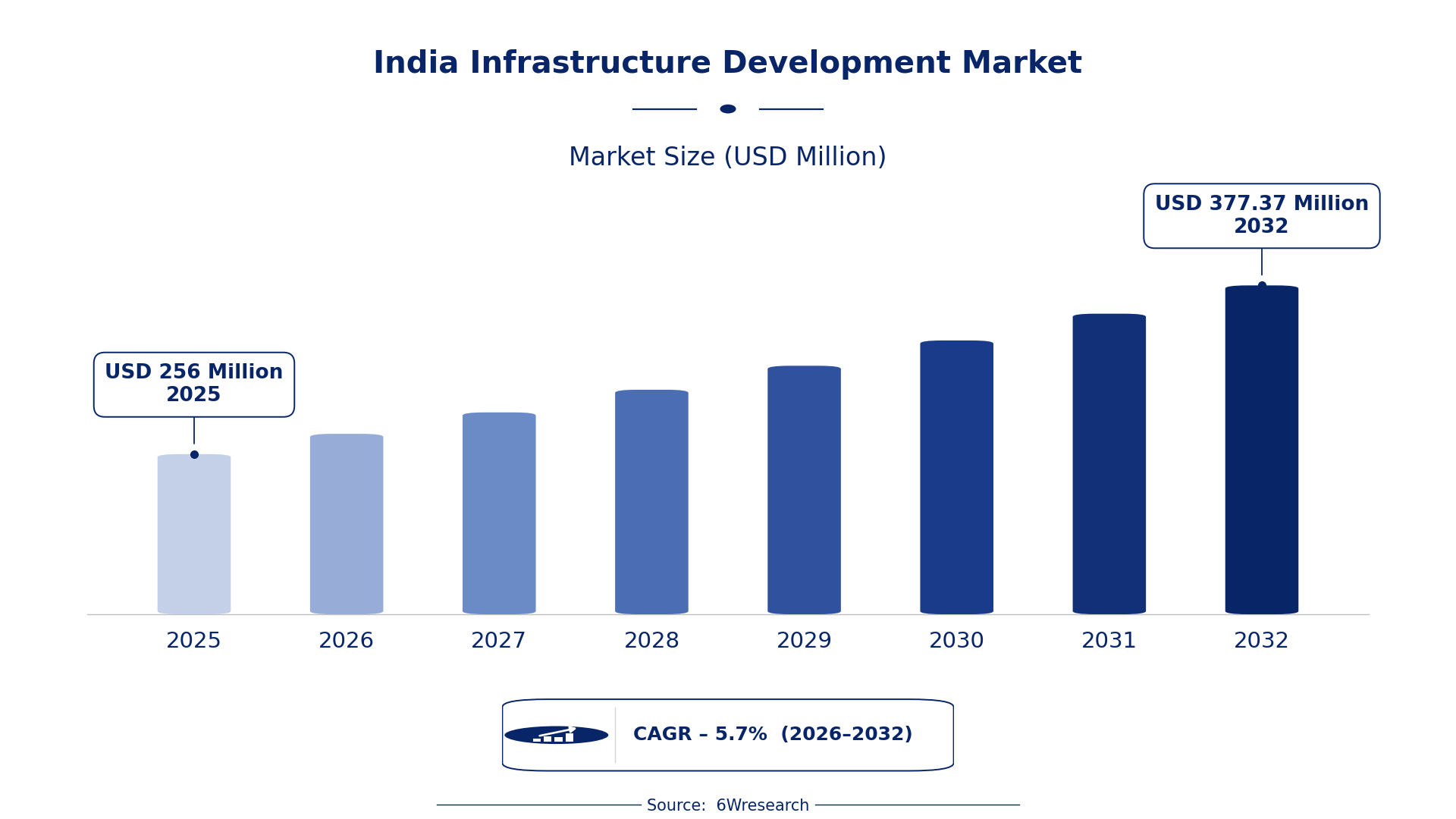
According to 6Wresearch internal database and industry insights, the India Infrastructure Development Market was valued at USD 256.0 million in 2025 and is projected to reach USD 377.37 million by 2032, growing at a CAGR of approximately 5.7% during 2026–2032.
India Infrastructure Development Market Highlights
| Report Metric | Details |
| Report Name | India Infrastructure Development Market |
| Market Size 2025 | USD 256.0 million |
| Market Size 2032 | USD 377.37 million |
| Absolute Growth 2025–2032 | USD 121.37 million |
| CAGR 2026–2032 | 5.7% |
| Peak Annual Growth | 8.1% in 2027 |
| Forecast Period | 2026–2032 |
| Historical Data | 2022–2025 |
| Base Year | 2025 |
| Leading Development Type, 2025 | Transport Infrastructure (41% share) |
| Leading Project Type, 2025 | Roads / Airports (51% share) |
| Leading End Use Sector, 2025 | Public Sector (42% share) |
| Leading Distribution Channel, 2025 | EPC Contractors (37% share) |
| Fastest-Growing Development Type | Energy Infrastructure (8.1% CAGR) |
| Fastest-Growing Project Type | Smart Cities / Housing (7.1% CAGR) |
| Fastest-Growing End Use Sector | Private Enterprises (7.6% CAGR) |
| Growing Sector | Urban Infrastructure |
| Key End Users | Public Sector, Private Enterprises, EPC Contractors, Utilities |
India Infrastructure Development Market Year-wise Growth Rate and Key Drivers (2022–2032)
This graph illustrates the annual growth rates of the market from 2022 to 2032, highlighting a steady upward trajectory and projected market expansion over the forecast period.
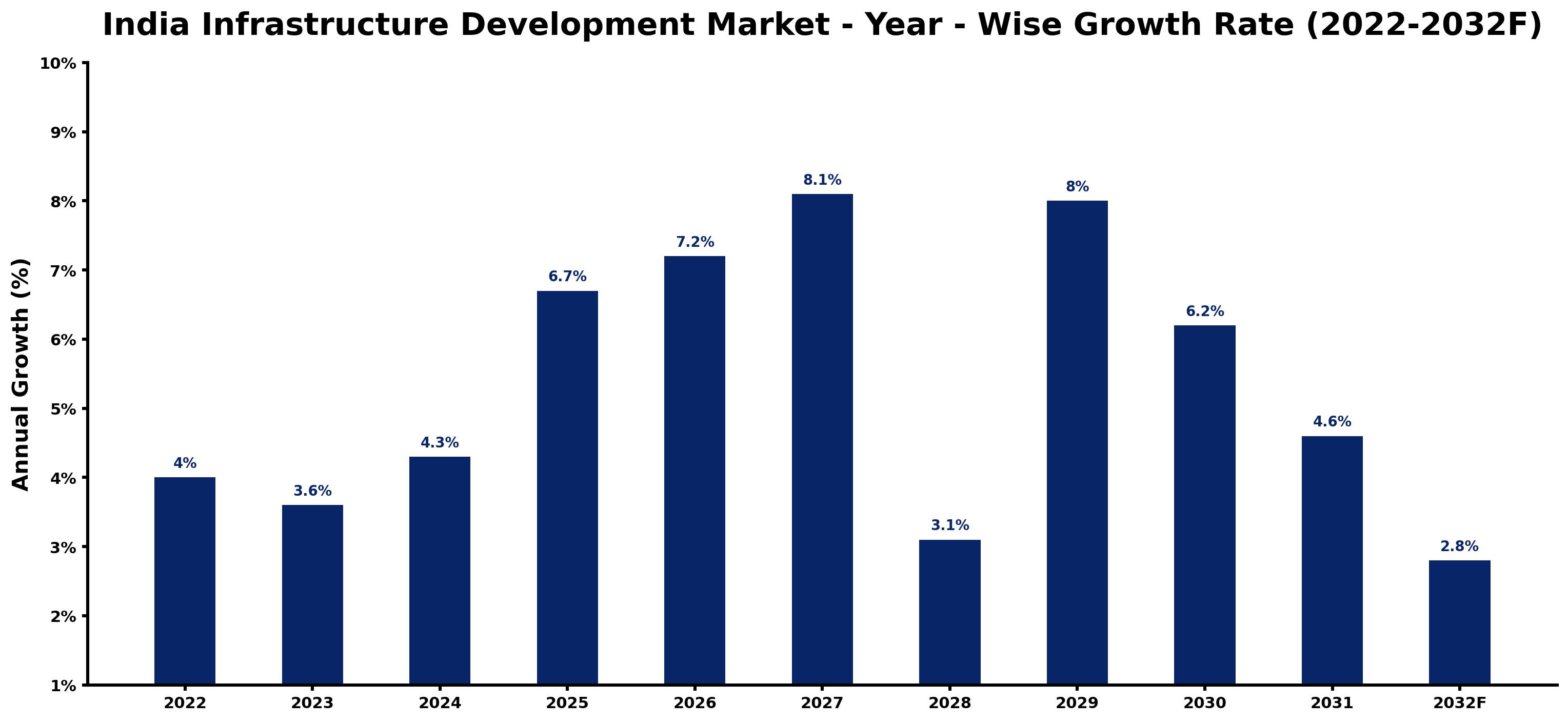
Annual growth estimates for each year appear below with the principal reason behind them, explaining the shifts that set the pace of the market.
| Year | Estimated Annual Growth (%) | Market Rationale |
| 2022 | 4.0 | Infrastructure development saw steady activity, driven by ongoing government projects and private investments. |
| 2023 | 3.6 | Growth slowed slightly as infrastructure projects faced delays due to regulatory approvals and resource allocation issues. |
| 2024 | 4.3 | Demand increased with the completion of several key projects, boosting investor confidence and funding. |
| 2025 | 6.7 | Infrastructure development accelerated with a surge in national highway construction, improving connectivity across regions. |
| 2026 | 7.2 | The market is expected to grow as urban infrastructure initiatives gain traction, backed by government funding. |
| 2027 | 8.1 | Peak growth is projected due to the implementation of major transport projects and increased private sector involvement. |
| 2028 | 3.1 | Growth is anticipated to slow as project completions surpass new starts, leading to a temporary stabilisation in demand. |
| 2029 | 8.0 | A resurgence in infrastructure projects is expected, driven by renewed government focus on urban development initiatives. |
| 2030 | 6.2 | Growth will decelerate as the market adjusts to the completion of several large-scale initiatives. |
| 2031 | 4.6 | Demand is projected to remain steady, supported by ongoing urbanisation and infrastructure needs in rapidly growing cities. |
| 2032 | 2.8 | The market is expected to grow at a slower pace as the focus shifts to maintenance and upgrades of existing infrastructure. |
Note: Market size estimations and growth projections presented in this report are based on 6Wresearch's proprietary forecasting methodology, utilizing the latest available industry data, government publications, and primary research inputs.
India Infrastructure Development Market Synopsis
Infrastructure Development in India involves the construction and enhancement of physical structures, such as transportation and urban facilities. This sector relies heavily on government initiatives and private investments. The India Infrastructure Development Market is growing due to strong government backing and ongoing projects. The National Infrastructure Pipeline plans to invest ₹111 lakh crore by 2025, which will stimulate economic growth. The Smart Cities Mission focuses on urban development in 100 cities, further driving the need for infrastructure upgrades.
Market Dynamics Impact Analysis (2026–2032)
| Factor | Type | Impact | Primary Segment Affected |
| Government initiatives and funding for infrastructure projects | Driver | High | Transport Infrastructure |
| Rising urbanisation leading to increased demand for housing and services | Driver | High | Urban Infrastructure |
| Investment in renewable energy projects to meet sustainability goals | Opportunity | High | Energy Infrastructure |
| Growing private sector involvement in infrastructure development | Opportunity | Medium | Industrial Infrastructure |
| Regulatory hurdles delaying project approvals and implementations | Restraint | High | Roads / Airports |
| Limited availability of skilled labour affecting project timelines | Restraint | Medium | Public Sector |
| Infrastructure Development in India faces challenges from bureaucratic inefficiencies | Challenge | High | Utilities |
| Competition for funding among various infrastructure projects creates delays | Challenge | Medium | Smart Cities / Housing |
Evaluation of Drivers in India Infrastructure Development Market (2026–2032)
The main growth drivers and the segments they affect most are set out below.
| Drivers | Primary Segment Affected | Why It Matters (Evidence) |
| Government funding through the National Infrastructure Pipeline | Transport Infrastructure | The National Infrastructure Pipeline aims to invest ₹111 lakh crore by 2025, increasing public sector projects. |
| Urban population growth driving housing demand | Urban Infrastructure | India's urban population is expected to reach 600 million by 2031, necessitating extensive infrastructure development. |
| Private investments in renewable energy projects | Energy Infrastructure | The Renewable Energy sector aims for 175 GW capacity by 2022, attracting private capital. |
| Public-private partnerships facilitating project execution | Industrial Infrastructure | Public-private partnerships are increasingly common, enabling faster project delivery and resource sharing. |
| Increased government focus on smart city initiatives | Smart Cities / Housing | The Smart Cities Mission targets 100 cities for development, driving demand for urban infrastructure projects. |
Urbanisation is projected to push India's urban population to 600 million by 2031, necessitating extensive infrastructure improvements. The Renewable Energy sector's target of 175 GW capacity by 2022 is attracting private investments, further stimulating demand. Public-private partnerships are facilitating faster project execution, while the Smart Cities Mission drives urban infrastructure development across 100 targeted cities. The National Infrastructure Pipeline aims to invest ₹111 lakh crore by 2025, supporting public sector projects.
Evaluation of Restraints in India Infrastructure Development Market
Below mentioned are some major restraints and their influence on market dynamics.
| Market Restraint | Primary Segment Affected | Why It Matters (Evidence) |
| Bureaucratic inefficiencies delaying project approvals | Utilities | Bureaucratic processes slow down the implementation of critical infrastructure projects, impacting timelines. |
| Shortage of skilled labour affecting project execution | Public Sector | Limited skilled labour availability hampers the timely completion of infrastructure projects. |
| Regulatory hurdles complicating project financing | Roads / Airports | Complex regulations create barriers to securing funding for essential transport infrastructure. |
| Competition for funding among various projects | Smart Cities / Housing | Limited financial resources lead to delays in the execution of urban development initiatives. |
| Rising material costs impacting project budgets | Transport Infrastructure | Increasing costs of construction materials strain budgets, affecting project feasibility and timelines. |
India Infrastructure Development Market Challenges
In the India Infrastructure Development Market, rising costs pose a major challenge for producers, as construction materials have increased by 30% in the past year. This surge results from supply chain disruptions and inflation, compelling producers to either absorb costs or transfer them to buyers, potentially delaying project timelines. Buyers face skills shortages, with a lack of trained workers in construction and engineering causing project delays that affect overall productivity. Supply chain issues trouble importers, as demand for infrastructure outstrips the current supply of materials and labour, leading to longer lead times for project completion. Regulatory hurdles complicate matters, with intricate approval processes causing delays that can extend project timelines by up to 18 months for urban development initiatives.
Trends in the India Infrastructure Development Market
The trends below show where the India Infrastructure Development Market is heading.
- Shift towards Sustainable Urban Development: Public sector initiatives are increasingly prioritising sustainable urban development, as exemplified by the Smart Cities Mission, which targets 100 cities. This initiative has a budget of ₹2.05 lakh crore, promoting eco-friendly infrastructure.
- Growing Adoption of Renewable Energy Solutions: The Renewable Energy sector is expanding rapidly, with a target of 175 GW capacity by 2022. Various states are embracing solar and wind energy projects to meet energy demands.
- Increased Investment in Smart Infrastructure: Smart infrastructure development is gaining traction, especially in urban areas. The Delhi-Mumbai Expressway project is improving connectivity with an investment of ₹1 lakh crore.
- Expansion of Public-Private Partnerships: Public-private partnerships are becoming more common in infrastructure projects, facilitating quicker execution. The Atal Mission for Rejuvenation and Urban Transformation focuses on urban infrastructure improvements.
Investment Opportunities in the India Infrastructure Development Market
The following opportunities in the India Infrastructure Development Market pair current demand with a clear way in.
- Investment in Renewable Energy Infrastructure: The Renewable Energy sector offers investment opportunities, with a target of 175 GW capacity by 2022. Private investors can engage in solar and wind projects, taking advantage of government incentives.
- Development of Urban Housing Solutions: Urban housing development is crucial as India's urban population grows. The Pradhan Mantri Awas Yojana, with a budget of ₹1.3 lakh crore, presents opportunities for construction firms to get involved.
- Transport Infrastructure Projects: Transport infrastructure is key for economic growth, with the National Infrastructure Pipeline investing ₹111 lakh crore by 2025. EPC contractors can participate in various road and airport projects.
- Focus on Smart City Initiatives: Smart city initiatives are gaining momentum, creating opportunities for technology firms. The Smart Cities Mission's budget of ₹2.05 lakh crore allows for creative solutions in urban planning.
Government Initiatives in the India Infrastructure Development Market
The National Infrastructure Pipeline, initiated by the Government of India in 2020, plans to invest ₹111 lakh crore in infrastructure projects by 2025, promoting economic growth and job creation. The Smart Cities Mission, launched in 2015, aims to develop 100 smart cities, with a budget of ₹2.05 lakh crore. The Atal Mission for Rejuvenation and Urban Transformation (AMRUT) was established in 2015 to enhance urban infrastructure in 500 cities, focusing on water supply and sewage systems. The Pradhan Mantri Awas Yojana, also launched in 2015, seeks to provide affordable housing for all by 2022, with a budget allocation of ₹1.3 lakh crore. These measures support infrastructure development across various sectors.
The Ministry of Housing and Urban Affairs oversees the Smart Cities Mission, funding urban infrastructure projects that improve living standards. The National Highways Authority of India manages national highway projects, ensuring connectivity and economic growth.
Future Insight of the India Infrastructure Development Market
The India Infrastructure Development Market will experience considerable transformation by 2032, primarily driven by the National Infrastructure Pipeline's ambitious investment of ₹111 lakh crore. Urban infrastructure will progress through the Smart Cities Mission, targeting 100 cities for development, which will enhance connectivity and public services. The push for renewable energy, aiming for 175 GW capacity, will reshape energy infrastructure, promoting sustainability. Initiatives like the PM Gati Shakti will streamline project execution across sectors, benefiting buyers and suppliers by enabling quicker project delivery and improved infrastructure quality.
Market Segmentation Analysis
The analysis below covers each segmentation, its leading category in 2025 and its fastest-growing category through 2032.
By Development Type – Transport Infrastructure Dominated, Energy Infrastructure Expected to Grow Fastest
According to Shubham Deep, Research Manager at 6Wresearch, in 2025, Transport Infrastructure led the development type split with a 41% share. Transport Infrastructure commands the largest share due to its vital role in facilitating economic growth and connectivity across India. The construction of 7,000 km of new national highways in 2021 underscores the ongoing investment in this essential segment. The quickest growth will come from Energy Infrastructure, forecast to expand at a CAGR of 8.1% between 2026 and 2032. Energy Infrastructure is experiencing rapid growth as India aims for a renewable energy capacity of 175 GW by 2022. This push towards sustainability and energy security will significantly enhance the sector's expansion, complementing the established transport infrastructure. Suppliers should prioritise energy solutions to align with the growing demands of the infrastructure development market.
By Project Type – Roads / Airports Dominated, Smart Cities / Housing Expected to Grow Fastest
Roads / Airports held a 51% share of the India Infrastructure Development Market by project type in 2025. Roads / Airports lead in market share because they are crucial for transportation and logistics, enabling efficient movement across the country. The development of key projects like the Delhi-Mumbai Expressway highlights their importance in the infrastructure framework. Smart Cities / Housing is set to record the highest CAGR in this split, 7.1% over 2026–2032. Smart Cities / Housing is the fastest-growing segment, driven by initiatives like the Smart Cities Mission, which targets urban development in 100 cities by 2023. This emphasis on modernisation will attract significant investments and interest in urban projects. Buyers should align their strategies with urban development initiatives to capitalise on the growth in smart cities and housing projects.
By End Use Sector – Public Sector Dominated, Private Enterprises Expected to Grow Fastest
Public Sector accounted for a 42% market share by end use sector in 2025. The Public Sector leads in market share as it is a major contributor to infrastructure projects and funding, particularly through government initiatives. Programmes like the National Infrastructure Pipeline illustrate the scale of public investment. Private Enterprises are projected to grow fastest, at a CAGR of 7.6% during 2026–2032. Private Enterprises are the fastest-growing segment, investing heavily in infrastructure projects to drive growth and meet increasing demands. This trend reflects a shift towards more collaborative funding models in infrastructure development. Suppliers must engage with private enterprises to tap into new opportunities arising from their increasing investments in infrastructure.
By Distribution Channel – EPC Contractors Dominated and Is Expected to Record the Fastest Growth
The largest distribution channel category in 2025 was EPC Contractors, with a 37% share of total revenue. EPC Contractors dominate the market share as they are integral to executing infrastructure projects and managing construction effectively. Their expertise ensures timely delivery and adherence to quality standards across various sectors. EPC Contractors are also forecast to expand faster than any other category, at a CAGR of 7.2% over 2026–2032. EPC Contractors are also the fastest-growing segment, as their comprehensive approach to project execution addresses the increasing complexity of infrastructure demands. Their sustained growth will further reinforce their market position. Suppliers should strengthen partnerships with EPC Contractors to leverage their market position and enhance project delivery capabilities.
Key Attractiveness of the Report
- 10 Years of Market Numbers
- Historical Data Starting from 2022 to 2025
- Base Year 2025
- Forecast Data until 2032
- Key Performance Indicators Impacting the Market
- Major Upcoming Developments and Projects
Key Highlights of the Report:
- India Infrastructure Development Market Outlook
- Market Size of India Infrastructure Development Market, 2025
- Forecast of India Infrastructure Development Market, 2032
- Historical Data and Forecast of India Infrastructure Development Revenues & Volume for the Period 2022 - 2032F
- India Infrastructure Development Market Trend Evolution
- India Infrastructure Development Market Drivers and Challenges
- India Infrastructure Development Price Trends
- India Infrastructure Development Porter's Five Forces
- India Infrastructure Development Industry Life Cycle
- Historical Data and Forecast of India Infrastructure Development Market Revenues & Volume By Development Type for the Period 2022 - 2032F
- Historical Data and Forecast of India Infrastructure Development Market Revenues & Volume By Transport Infrastructure for the Period 2022 - 2032F
- Historical Data and Forecast of India Infrastructure Development Market Revenues & Volume By Energy Infrastructure for the Period 2022 - 2032F
- Historical Data and Forecast of India Infrastructure Development Market Revenues & Volume By Urban Infrastructure for the Period 2022 - 2032F
- Historical Data and Forecast of India Infrastructure Development Market Revenues & Volume By Industrial Infrastructure for the Period 2022 - 2032F
- Historical Data and Forecast of India Infrastructure Development Market Revenues & Volume By Project Type for the Period 2022 - 2032F
- Historical Data and Forecast of India Infrastructure Development Market Revenues & Volume By Roads / Airports for the Period 2022 - 2032F
- Historical Data and Forecast of India Infrastructure Development Market Revenues & Volume By Power / Renewable for the Period 2022 - 2032F
- Historical Data and Forecast of India Infrastructure Development Market Revenues & Volume By Smart Cities / Housing for the Period 2022 - 2032F
- Historical Data and Forecast of India Infrastructure Development Market Revenues & Volume By Factories / Parks for the Period 2022 - 2032F
- Historical Data and Forecast of India Infrastructure Development Market Revenues & Volume By End Use Sector for the Period 2022 - 2032F
- Historical Data and Forecast of India Infrastructure Development Market Revenues & Volume By Public Sector for the Period 2022 - 2032F
- Historical Data and Forecast of India Infrastructure Development Market Revenues & Volume By Utilities for the Period 2022 - 2032F
- Historical Data and Forecast of India Infrastructure Development Market Revenues & Volume By Municipalities for the Period 2022 - 2032F
- Historical Data and Forecast of India Infrastructure Development Market Revenues & Volume By Private Enterprises for the Period 2022 - 2032F
- Historical Data and Forecast of India Infrastructure Development Market Revenues & Volume By Distribution Channel for the Period 2022 - 2032F
- Historical Data and Forecast of India Infrastructure Development Market Revenues & Volume By EPC Contractors for the Period 2022 - 2032F
- Historical Data and Forecast of India Infrastructure Development Market Revenues & Volume By Govt Tenders for the Period 2022 - 2032F
- Historical Data and Forecast of India Infrastructure Development Market Revenues & Volume By Infrastructure Firms for the Period 2022 - 2032F
- Historical Data and Forecast of India Infrastructure Development Market Revenues & Volume By Private Investors for the Period 2022 - 2032F
- India Infrastructure Development Import Export Trade Statistics
- Market Opportunity Assessment By Development Type
- Market Opportunity Assessment By Project Type
- Market Opportunity Assessment By End Use Sector
- Market Opportunity Assessment By Distribution Channel
- India Infrastructure Development Top Companies Market Share
- India Infrastructure Development Competitive Benchmarking By Technical and Operational Parameters
- India Infrastructure Development Company Profiles
- India Infrastructure Development Key Strategic Recommendations
Market Covered
This report examines the market across the segments below.
By Development Type
- Transport Infrastructure
- Energy Infrastructure
- Urban Infrastructure
- Industrial Infrastructure
By Project Type
- Roads / Airports
- Power / Renewable
- Smart Cities / Housing
- Factories / Parks
By End Use Sector
- Public Sector
- Utilities
- Municipalities
- Private Enterprises
By Distribution Channel
- EPC Contractors
- Govt Tenders
- Infrastructure Firms
- Private Investors































