India Inhalational Devices Market Size & Growth Rate
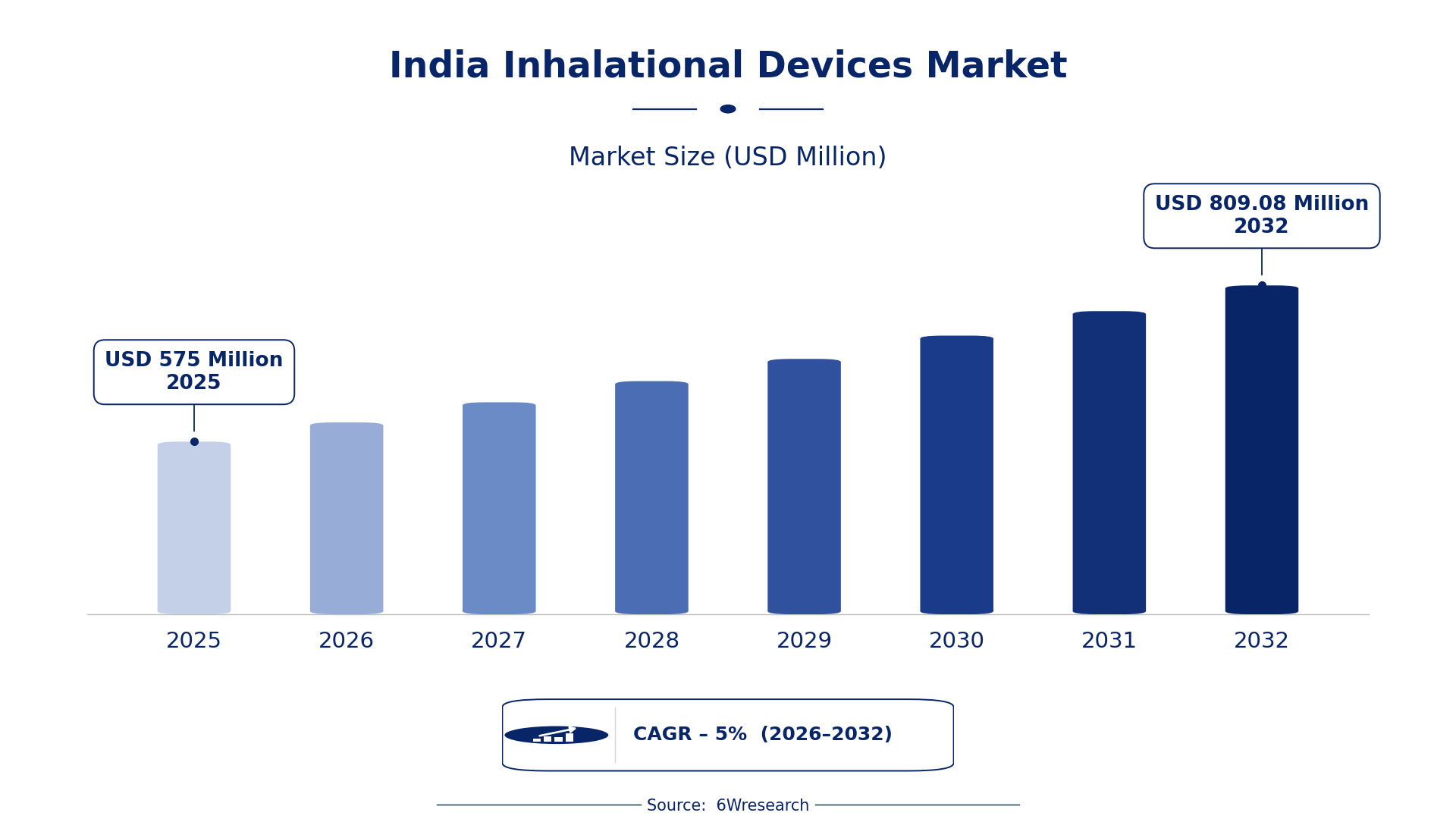
According to 6Wresearch internal database and industry insights, the India Inhalational Devices Market was valued at USD 575.0 million in 2025 and is projected to reach USD 809.08 million by 2032, growing at a CAGR of approximately 5% during 2026–2032.
India Inhalational Devices Market Highlights
| Report Metric | Details |
| Report Name | India Inhalational Devices Market |
| Market Size 2025 | USD 575.0 million |
| Market Size 2032 | USD 809.08 million |
| Absolute Growth 2025–2032 | USD 234.08 million |
| CAGR 2026–2032 | 5% |
| Peak Annual Growth | 7.3% in 2030 |
| Forecast Period | 2026–2032 |
| Historical Data | 2022–2025 |
| Base Year | 2025 |
| Leading Device Form, 2025 | Handheld Inhalers (35% share) |
| Leading Technology Base, 2025 | MDI / DPI (45% share) |
| Leading Portability, 2025 | High (40% share) |
| Leading Distribution Channel, 2025 | Pharmacy / OTC (40% share) |
| Fastest-Growing Device Form | Home Nebulizers (7.1% CAGR) |
| Fastest-Growing Technology Base | Electric Compressor (7.8% CAGR) |
| Fastest-Growing Portability | Low (6.8% CAGR) |
| Fastest-Growing Distribution Channel | Medical Equipment Stores (7.6% CAGR) |
| Growing Sector | Home Healthcare |
| Key End Users | Hospitals, Clinics, Homecare Providers, Health Tech Suppliers |
India Inhalational Devices Market Year-wise Growth Rate and Key Drivers (2022–2032)
This graph illustrates the annual growth rates of the market from 2022 to 2032, highlighting a steady upward trajectory and projected market expansion over the forecast period.
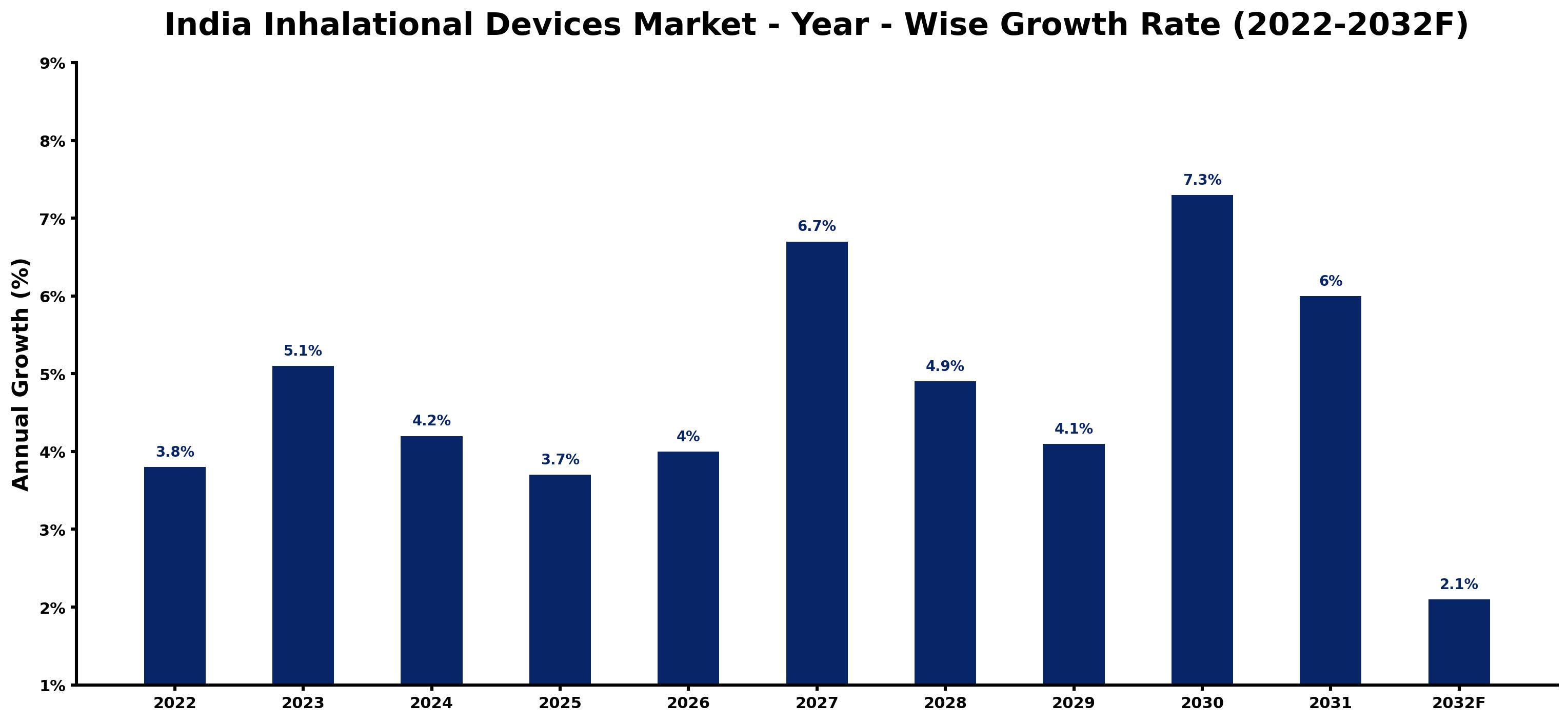
Annual growth estimates for each year appear below with the principal reason behind them, explaining the shifts that set the pace of the market.
| Year | Estimated Annual Growth (%) | Market Rationale |
| 2022 | 3.8 | The market experienced steady growth due to the 'Ayushman Bharat' scheme improving access to respiratory care. |
| 2023 | 5.1 | Demand increased as the 'National Asthma Control Program' raised awareness of asthma management among healthcare providers. |
| 2024 | 4.2 | Growth slowed slightly as the market adjusted to new healthcare initiatives and regulations. |
| 2025 | 3.7 | A further slowdown occurred due to market maturation and regulatory adjustments affecting product availability. |
| 2026 | 4.0 | Demand is expected to rise again as hospitals expand their respiratory care services and procurement efforts. |
| 2027 | 6.7 | Growth is projected to accelerate with rising public health campaigns promoting inhalational devices. |
| 2028 | 4.9 | The market is anticipated to experience a slowdown as competition intensifies among suppliers. |
| 2029 | 4.1 | Demand is expected to continue slowing as buyers become more selective in purchasing decisions. |
| 2030 | 7.3 | Growth will peak as new technologies and products enter the market, enhancing treatment options. |
| 2031 | 6.0 | A slowdown is projected as the market stabilises after rapid expansion and increased competition. |
| 2032 | 2.1 | The market is expected to grow slowly as it reaches maturity and adapts to changing consumer needs. |
Note: Market size estimations and growth projections presented in this report are based on 6Wresearch's proprietary forecasting methodology, utilizing the latest available industry data, government publications, and primary research inputs.
India Inhalational Devices Market Synopsis
Inhalational devices in India are medical tools designed for delivering medication directly to the lungs, primarily for managing respiratory conditions like asthma and COPD. These devices include metered-dose inhalers and nebulizers, which are essential for effective treatment. The India Inhalational Devices Market is growing due to a population exceeding 1.4 billion and an asthma prevalence of approximately 4-5% among adults. Increasing awareness and government initiatives, such as the 'Ayushman Bharat' scheme, are driving demand for inhalational devices across urban and rural healthcare settings.
Market Dynamics Impact Analysis (2026–2032)
| Factor | Type | Impact | Primary Segment Affected |
| High prevalence of asthma and COPD among the population drives demand for inhalers. | Driver | High | Handheld Inhalers |
| Government initiatives enhance access to respiratory care, boosting device usage. | Driver | High | Home Nebulizers |
| Growing urbanisation leads to increased respiratory issues, creating demand for devices. | Opportunity | High | Hospital-Based Units |
| Emerging technology in smart inhalers presents new market potential. | Opportunity | Medium | Smart Inhalers |
| Limited awareness in rural areas restricts device adoption. | Restraint | High | Home Nebulizers |
| High costs of advanced inhalational devices may deter buyers. | Restraint | Medium | Smart Inhalers |
| Regulatory hurdles can delay product approvals and market entry. | Challenge | High | MDI / DPI |
| Competition from alternative therapies poses a risk to market growth. | Challenge | Medium | Electric Compressor |
Evaluation of Drivers in India Inhalational Devices Market (2026–2032)
Below mentioned are some major drivers and their influence on market dynamics.
| Drivers | Primary Segment Affected | Why It Matters (Evidence) |
| High asthma prevalence among adults drives demand for inhalers. | Handheld Inhalers | Approximately 4-5% of adults are affected, resulting in increased purchases. |
| Government health initiatives promote inhalational therapy access. | Home Nebulizers | The 'Ayushman Bharat' scheme aims to provide respiratory care to over 500 million citizens. |
| Urbanisation increases respiratory conditions, boosting device demand. | Hospital-Based Units | Higher pollution levels in urban areas lead to increased respiratory issues. |
| Technological advancements improve inhaler effectiveness and adherence. | Smart Inhalers | Pilot programs in major cities are improving medication adherence rates among patients. |
| Increased healthcare access in rural areas supports device usage. | MDI / DPI | The National Health Mission is funding procurement in rural health centers, enhancing availability. |
Growth in the Inhalational Devices market in India comes from rising end-use demand driven by a high prevalence of asthma and COPD. Approximately 4-5% of adults are affected, resulting in increased purchases of handheld inhalers. The 'Ayushman Bharat' scheme aims to provide respiratory care to over 500 million citizens, improving access to home nebulizers. Urbanisation is also a factor, as higher pollution levels in cities contribute to respiratory issues, boosting demand for hospital-based units. Technological advancements in smart inhalers are improving adherence rates, encouraging more purchases among patients. Additionally, the National Health Mission's funding for rural health centers is enhancing the availability of inhalational devices.
Evaluation of Restraints in India Inhalational Devices Market
Below mentioned are some major restraints and their influence on market dynamics.
| Market Restraint | Primary Segment Affected | Why It Matters (Evidence) |
| Limited awareness in rural areas restricts device adoption. | Home Nebulizers | Many rural populations remain unaware of available treatment options, hindering growth. |
| High costs of advanced inhalational devices may deter buyers. | Smart Inhalers | The price of smart inhalers can be prohibitive for many consumers. |
| Regulatory hurdles can delay product approvals and market entry. | MDI / DPI | Strict guidelines from the Central Drugs Standard Control Organization slow down the approval process. |
| Competition from alternative therapies poses a risk to market growth. | Electric Compressor | Patients may opt for cheaper or more familiar treatment options, impacting sales. |
| Limited distribution channels in rural areas hinder access to devices. | Home Nebulizers | Many rural healthcare facilities lack the necessary supply chains to provide these devices. |
India Inhalational Devices Market Challenges
The India inhalational devices market still has to solve a few problems, and the first is technology limitations. Many producers use outdated manufacturing methods, which can increase production costs by up to 20%, ultimately raising prices for hospitals. Buyers face inconsistent availability of quality products due to regulatory delays in approvals, resulting in treatment interruptions for approximately 4-5% of patients with asthma. Competition among suppliers is intensifying as new entrants emerge, compelling established players to lower prices, which may compromise device quality for clinics. Skills shortages among healthcare providers hinder effective inhaler technique training, impacting patient adherence and outcomes significantly.
Trends in the India Inhalational Devices Market
Several trends are reshaping the India Inhalational Devices Market; the most important are set out below.
- Shift towards Smart Inhalers: The 'Digital Health Mission' launched in 2023 promotes smart inhalers for better patient management. This initiative aims to improve adherence tracking, with a projected increase in demand for these devices as digital health solutions gain traction.
- Increase in Home Nebulizer Usage: In 2023, the Indian Medical Association supported the use of nebulizers in home healthcare. This endorsement aligns with rising awareness, leading to a growth rate of 7.1% for home nebulizers.
- Growing Urban Demand for Inhalational Devices: Urban areas like Maharashtra and Delhi are experiencing increased respiratory issues due to pollution. This trend has resulted in a higher demand for inhalational devices, particularly handheld inhalers, which are expected to dominate the market.
- Expansion of Government Health Initiatives: The 'National Asthma Control Program' launched in 2022 aims to improve asthma management across India. Targeting 1 million patients by 2025, this initiative is expected to drive further growth in the inhalational devices market.
Investment Opportunities in the India Inhalational Devices Market
Some of the investment opportunities in the India Inhalational Devices Market are mentioned below.
- Healthcare Providers in Rural Areas: Healthcare providers in rural areas require better access to inhalational devices. With the 'Ayushman Bharat' scheme targeting health coverage for over 500 million citizens, suppliers can enter this market through local partnerships.
- Supply of Smart Inhalers: The demand for smart inhalers is increasing as digital health solutions gain traction. Suppliers can invest in this technology to meet the needs of urban patients, particularly in major cities.
- Urban Hospitals Expanding Respiratory Care: Urban hospitals are expanding their respiratory care services, creating a demand for inhalational devices. Suppliers can enter this market by forming joint ventures with healthcare facilities.
- Approval Pathways for New Devices: With updated guidelines from the Central Drugs Standard Control Organization, there is an opportunity to introduce new inhalational devices. Companies can seek approval to meet the growing demand.
Government Initiatives in the India Inhalational Devices Market
In 2022, the Ministry of Health and Family Welfare launched the 'National Asthma Control Program' to improve asthma management across India, targeting 1 million patients by 2025. This program complements earlier initiatives, such as the 'Ayushman Bharat' scheme, which provides health coverage for respiratory diseases to over 500 million citizens. These measures aim to improve access to inhalational devices and ensure better management of respiratory conditions across the country. Additionally, the 'Digital Health Mission' introduced in 2023 promotes smart inhalers, integrating technology into healthcare to improve patient management.
The 'Ayushman Bharat' scheme is utilised by healthcare providers to improve access to inhalational devices in rural areas. The National Health Mission allocates funds for procurement in rural health centres, enhancing treatment availability. Furthermore, the Central Drugs Standard Control Organization oversees the approval of inhalational devices, ensuring compliance with safety standards. This regulatory support facilitates the distribution of these devices to healthcare providers, ultimately benefiting patients in need of respiratory care. In 2023, the government allocated significant resources to improve respiratory health infrastructure in urban hospitals.
Future Insight of the India Inhalational Devices Market
The India inhalational devices market will undergo notable changes by 2032, primarily driven by advancements in smart inhaler technology. The government's 'Ayushman Bharat' scheme will improve access to respiratory care, particularly in rural areas, benefiting millions of patients. Increased public awareness campaigns on asthma management will drive demand for inhalational devices, with the market for nebulizers projected to grow by 15% by 2025. Enhanced training programs for healthcare providers will also support better patient outcomes and adherence to treatment.
Market Segmentation Analysis
The report offers a comprehensive study of the following market segments and their leading categories in the market.
By Device Form – Handheld Inhalers Dominated, Home Nebulizers Expected to Grow Fastest
According to Shubham Deep, Research Manager at 6Wresearch, Handheld Inhalers took a 35% share of device form in 2025, more than any other category. Handheld inhalers hold the largest market share as they are commonly used for managing asthma and COPD, particularly in urban areas like Maharashtra and Delhi. Their ease of use and effectiveness make them a preferred choice among patients and healthcare providers alike. Home Nebulizers are set to record the highest CAGR in this split, 7.1% over 2026–2032. Home nebulizers are experiencing rapid growth due to the increasing preference for convenient home treatment options for respiratory conditions, driven by heightened awareness and better access to healthcare services. Government initiatives to improve respiratory health infrastructure are further supporting this segment's growth. Suppliers should focus on increasing the availability of home nebulizers to meet the rising demand in the market.
By Technology Base – MDI / DPI Dominated, Electric Compressor Expected to Grow Fastest
MDI / DPI accounted for a 45% market share by technology base in 2025. MDI and DPI technologies dominate the market as standard devices for inhalation therapy, widely endorsed by healthcare professionals for their reliability and effectiveness. Their established presence in hospitals and clinics significantly contributes to their substantial market share. Electric Compressor is projected to grow fastest, at a CAGR of 7.8% during 2026–2032. Electric compressors are gaining traction in hospital settings, propelled by the growing need for efficient nebulization in patient care. Their rising adoption underscores the healthcare sector's commitment to improving respiratory treatment options. Suppliers must invest in electric compressor technology to capitalise on the expanding market opportunities within hospitals.
By Portability – High Dominated, Low Expected to Grow Fastest
The largest portability category in 2025 was High, with a 40% share of total revenue. High portability inhalational devices are favoured for their ease of use, making them particularly popular among patients managing chronic respiratory conditions. This trend is especially pronounced in urban areas where convenience is essential for treatment adherence. The quickest growth will come from Low, forecast to expand at a CAGR of 6.8% between 2026 and 2032. Low portability devices are experiencing growth in specific applications, particularly within hospitals where mobility is less critical. Their usage is anticipated to rise as healthcare facilities invest in advanced treatment solutions. Suppliers should explore diversifying their product offerings to include low portability devices tailored for hospital use.
By Distribution Channel – Pharmacy / OTC Dominated, Medical Equipment Stores Expected to Grow Fastest
With a 40% revenue share in 2025, Pharmacy / OTC was the largest distribution channel category. Pharmacy and OTC channels lead the market, offering extensive availability for consumer purchase, which is crucial for the effective management of respiratory conditions. This accessibility ensures that patients can easily obtain the inhalational devices they require. Over 2026–2032, Medical Equipment Stores are expected to post the fastest growth, at a CAGR of 7.6%. Medical equipment stores are rapidly emerging as a growing distribution channel, responding to the increasing demand for specialised respiratory devices. Their role as a secondary distribution channel is becoming more significant as healthcare awareness continues to rise. Suppliers should strengthen partnerships with medical equipment stores to enhance distribution and reach a wider consumer base.
Key Attractiveness of the Report
- 10 Years of Market Numbers
- Historical Data Starting from 2022 to 2025
- Base Year 2025
- Forecast Data until 2032
- Key Performance Indicators Impacting the Market
- Major Upcoming Developments and Projects
Key Highlights of the Report:
- India Inhalational Devices Market Outlook
- Market Size of India Inhalational Devices Market, 2025
- Forecast of India Inhalational Devices Market, 2032
- Historical Data and Forecast of India Inhalational Devices Revenues & Volume for the Period 2022 - 2032F
- India Inhalational Devices Market Trend Evolution
- India Inhalational Devices Market Drivers and Challenges
- India Inhalational Devices Price Trends
- India Inhalational Devices Porter's Five Forces
- India Inhalational Devices Industry Life Cycle
- Historical Data and Forecast of India Inhalational Devices Market Revenues & Volume By Device Form for the Period 2022 - 2032F
- Historical Data and Forecast of India Inhalational Devices Market Revenues & Volume By Handheld Inhalers for the Period 2022 - 2032F
- Historical Data and Forecast of India Inhalational Devices Market Revenues & Volume By Home Nebulizers for the Period 2022 - 2032F
- Historical Data and Forecast of India Inhalational Devices Market Revenues & Volume By Hospital-Based Units for the Period 2022 - 2032F
- Historical Data and Forecast of India Inhalational Devices Market Revenues & Volume By Smart Inhalers for the Period 2022 - 2032F
- Historical Data and Forecast of India Inhalational Devices Market Revenues & Volume By Technology Base for the Period 2022 - 2032F
- Historical Data and Forecast of India Inhalational Devices Market Revenues & Volume By MDI / DPI for the Period 2022 - 2032F
- Historical Data and Forecast of India Inhalational Devices Market Revenues & Volume By Electric Compressor for the Period 2022 - 2032F
- Historical Data and Forecast of India Inhalational Devices Market Revenues & Volume By High Volume Nebulizers for the Period 2022 - 2032F
- Historical Data and Forecast of India Inhalational Devices Market Revenues & Volume By IoT Connected for the Period 2022 - 2032F
- Historical Data and Forecast of India Inhalational Devices Market Revenues & Volume By Portability for the Period 2022 - 2032F
- Historical Data and Forecast of India Inhalational Devices Market Revenues & Volume By High for the Period 2022 - 2032F
- Historical Data and Forecast of India Inhalational Devices Market Revenues & Volume By Low for the Period 2022 - 2032F
- Historical Data and Forecast of India Inhalational Devices Market Revenues & Volume By Non-portable for the Period 2022 - 2032F
- Historical Data and Forecast of India Inhalational Devices Market Revenues & Volume By Moderate for the Period 2022 - 2032F
- Historical Data and Forecast of India Inhalational Devices Market Revenues & Volume By Distribution Channel for the Period 2022 - 2032F
- Historical Data and Forecast of India Inhalational Devices Market Revenues & Volume By Pharmacy / OTC for the Period 2022 - 2032F
- Historical Data and Forecast of India Inhalational Devices Market Revenues & Volume By Medical Equipment Stores for the Period 2022 - 2032F
- Historical Data and Forecast of India Inhalational Devices Market Revenues & Volume By Hospital Procurement for the Period 2022 - 2032F
- Historical Data and Forecast of India Inhalational Devices Market Revenues & Volume By Health Tech Suppliers for the Period 2022 - 2032F
- India Inhalational Devices Import Export Trade Statistics
- Market Opportunity Assessment By Device Form
- Market Opportunity Assessment By Technology Base
- Market Opportunity Assessment By Portability
- Market Opportunity Assessment By Distribution Channel
- India Inhalational Devices Top Companies Market Share
- India Inhalational Devices Competitive Benchmarking By Technical and Operational Parameters
- India Inhalational Devices Company Profiles
- India Inhalational Devices Key Strategic Recommendations
Market Covered
The report offers an extensive study of the following market segments.
By Device Form
- Handheld Inhalers
- Home Nebulizers
- Hospital-Based Units
- Smart Inhalers
By Technology Base
- MDI / DPI
- Electric Compressor
- High Volume Nebulizers
- IoT Connected
By Portability
- High
- Low
- Non-portable
- Moderate
By Distribution Channel
- Pharmacy / OTC
- Medical Equipment Stores
- Hospital Procurement
- Health Tech Suppliers































