India Injectable Drug Delivery Systems Market Size & Growth Rate
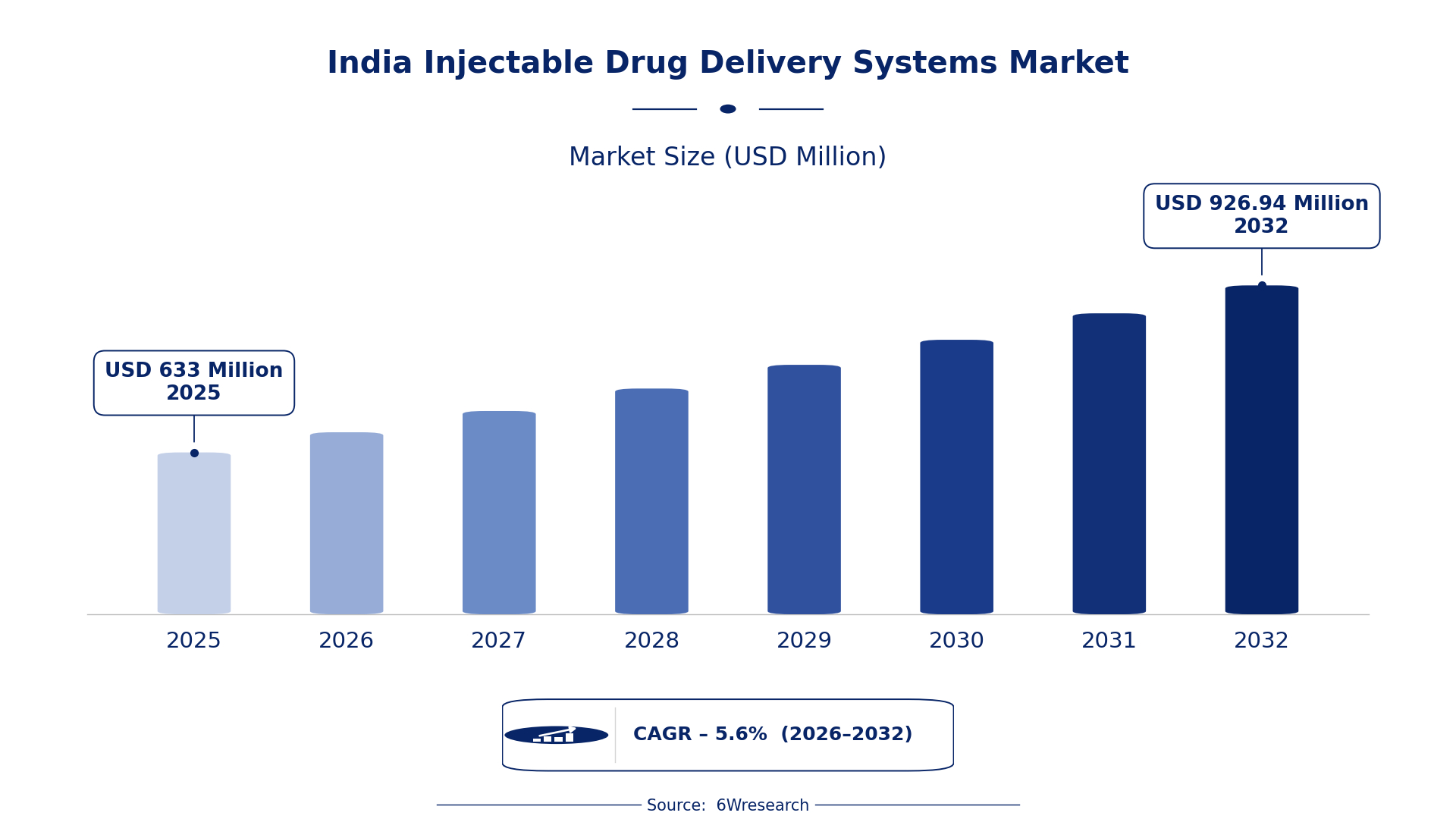
According to 6Wresearch internal database and industry insights, the India Injectable Drug Delivery Systems Market was valued at USD 633.0 million in 2025 and is projected to reach USD 926.94 million by 2032, growing at a CAGR of approximately 5.6% during 2026–2032.
India Injectable Drug Delivery Systems Market Highlights
| Report Metric | Details |
| Report Name | India Injectable Drug Delivery Systems Market |
| Market Size 2025 | USD 633.0 million |
| Market Size 2032 | USD 926.94 million |
| Absolute Growth 2025–2032 | USD 293.94 million |
| CAGR 2026–2032 | 5.6% |
| Peak Annual Growth | 7.2% in 2030 |
| Forecast Period | 2026–2032 |
| Historical Data | 2022–2025 |
| Base Year | 2025 |
| Leading System Type, 2025 | Prefilled Syringes (46% share) |
| Leading Device Design, 2025 | Disposable (48% share) |
| Leading Application Area, 2025 | Chronic Diseases (45% share) |
| Leading Drug Stability, 2025 | Biologics (41% share) |
| Leading End User, 2025 | Hospitals (44% share) |
| Fastest-Growing System Type | Auto-Injectors (8.0% CAGR) |
| Fastest-Growing Device Design | Single-Use (8.3% CAGR) |
| Fastest-Growing Application Area | Emergency Medication (7.3% CAGR) |
| Fastest-Growing Drug Stability | Long-Term Storage (8.3% CAGR) |
| Fastest-Growing End User | Clinics (6.6% CAGR) |
| Growing Sector | Chronic Diseases |
| Key End Users | Hospitals, Clinics, Homecare, Specialty Pharmacies |
India Injectable Drug Delivery Systems Market Year-wise Growth Rate and Key Drivers (2022–2032)
This graph illustrates the annual growth rates of the market from 2022 to 2032, highlighting a steady upward trajectory and projected market expansion over the forecast period.
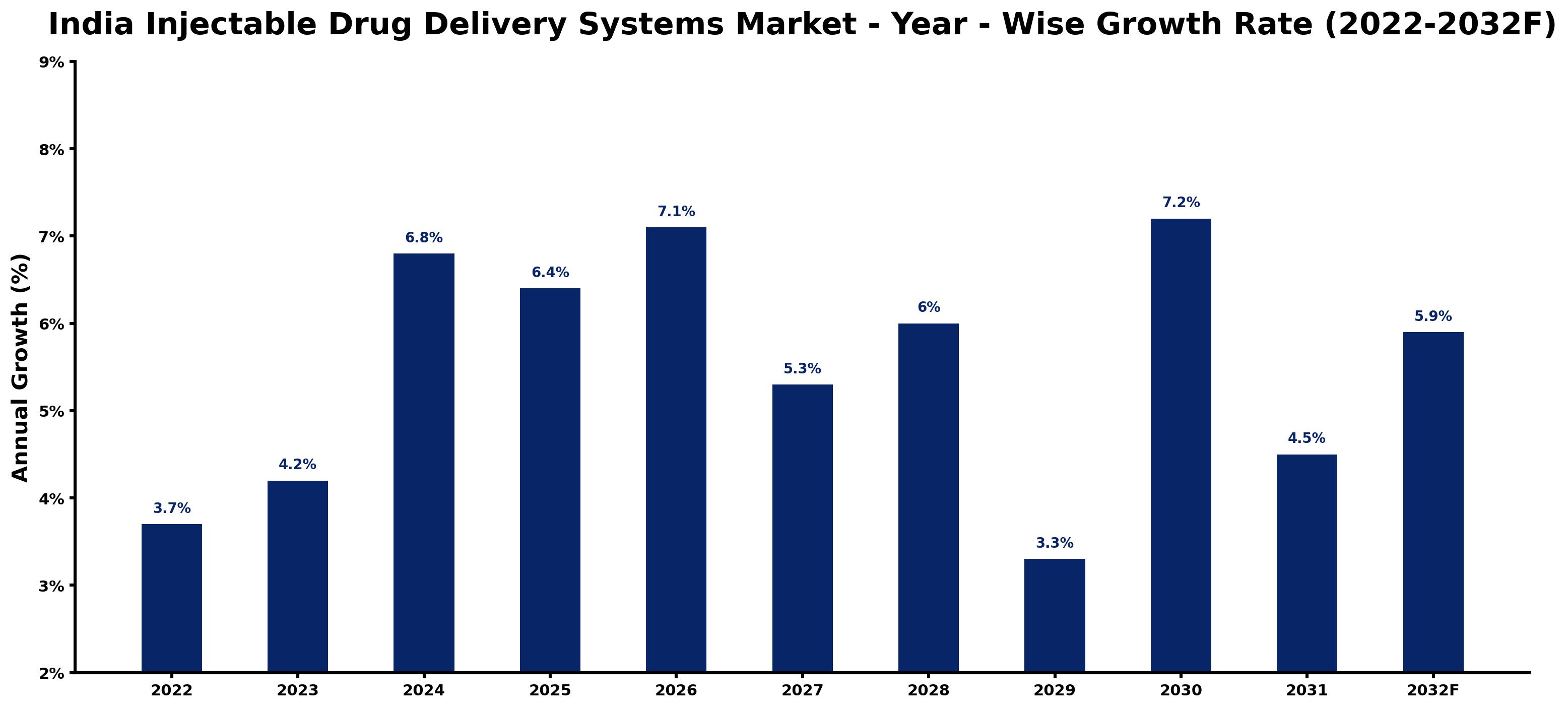
Year by year, the estimates below pair each growth rate with the development that shaped it.
| Year | Estimated Annual Growth (%) | Market Rationale |
| 2022 | 3.7 | The market experienced steady growth due to rising healthcare needs and the 'Ayushman Bharat' scheme. |
| 2023 | 4.2 | Demand increased as hospitals expanded their injectable drug delivery capabilities through new technologies. |
| 2024 | 6.8 | Growth accelerated with the introduction of new biologics and therapies, enhancing treatment options. |
| 2025 | 6.4 | The market saw a slowdown as competition intensified among suppliers in the prefilled syringes segment. |
| 2026 | 7.1 | Demand surged with advancements in auto-injector technology, improving patient convenience. |
| 2027 | 5.3 | Growth slowed as market saturation began to impact new entries in the insulin delivery market. |
| 2028 | 6.0 | Increased focus on chronic disease management drove demand higher for injectable systems. |
| 2029 | 3.3 | The market experienced a slowdown as growth stabilised amid regulatory challenges. |
| 2030 | 7.2 | A peak in growth was reached due to rising diabetes cases and the need for effective management. |
| 2031 | 4.5 | Growth decelerated as the market began to normalise with increased competition. |
| 2032 | 5.9 | Demand is expected to rise again with new healthcare initiatives and technological advancements. |
Note: Market size estimations and growth projections presented in this report are based on 6Wresearch's proprietary forecasting methodology, utilizing the latest available industry data, government publications, and primary research inputs.
India Injectable Drug Delivery Systems Market Synopsis
The Injectable Drug Delivery Systems Market in India includes advanced medical devices designed for direct medication delivery via injection. These systems are primarily employed in chronic disease management, emergency care, and hormone therapy. The market is expanding, driven by India's population of approximately 1.4 billion and the rising incidence of chronic diseases, which contribute to 60% of all deaths. Initiatives such as the 'Ayushman Bharat' scheme are improving healthcare access, further increasing demand for injectable solutions. With over 10,000 hospitals using these systems, the market is set for robust growth.
Market Dynamics Impact Analysis (2026–2032)
| Factor | Type | Impact | Primary Segment Affected |
| Rising diabetes cases drive demand for pen injectors and auto-injectors. | Driver | High | Pen Injectors |
| The expansion of chronic disease management programs increases the need for injectable systems. | Driver | High | Chronic Diseases |
| The growing insulin market presents opportunities for suppliers of pen injectors. | Opportunity | High | Pen Injectors |
| The 'Make in India' initiative encourages investment in local production of injectables. | Opportunity | High | Prefilled Syringes |
| Intense competition among suppliers may limit profit margins for producers. | Restraint | Medium | Prefilled Syringes |
| Regulatory hurdles can delay the introduction of new products to market. | Restraint | Medium | Prefilled Syringes |
| Supply chain disruptions can affect the availability of raw materials. | Challenge | High | Prefilled Syringes |
| High production costs may deter new entrants into the market. | Challenge | Medium | Prefilled Syringes |
Evaluation of Drivers in India Injectable Drug Delivery Systems Market (2026–2032)
The table below links each growth driver to the segment it affects and the evidence for it.
| Drivers | Primary Segment Affected | Why It Matters (Evidence) |
| Increasing prevalence of chronic diseases boosts demand for injectable systems. | Chronic Diseases | Chronic diseases account for 60% of all deaths in India, leading to higher demand for effective drug delivery. |
| The growth of the insulin market is driving pen injector sales. | Pen Injectors | The Indian diabetes population is projected to reach 134 million by 2045, increasing the need for insulin delivery. |
| The National Health Mission promotes the use of prefilled syringes. | Prefilled Syringes | This initiative supports vaccination drives, increasing the demand for prefilled syringes by enhancing accessibility. |
| The rise in homecare settings is increasing the use of injectable systems. | Homecare | Growing patient convenience and preference for at-home treatments are driving demand for injectable solutions. |
| Technological advancements in auto-injectors improve user experience. | Auto-Injectors | These devices are increasingly preferred for self-administration, particularly in diabetes management. |
Growth in the Injectable Drug Delivery Systems market in India is supported by escalating healthcare needs, technological progress, and a rising prevalence of chronic diseases. The Indian diabetes population is expected to reach 134 million by 2045, creating a greater demand for pen injectors. The National Health Mission advocates for the use of prefilled syringes, aiding vaccination efforts and driving their demand. The rise in homecare settings is boosting the adoption of injectable systems, as patients favour convenient at-home treatments. Advances in auto-injector technology are enhancing user experience, further encouraging the uptake of these devices.
Evaluation of Restraints in India Injectable Drug Delivery Systems Market
Below mentioned are some major restraints and their influence on market dynamics.
| Market Restraint | Primary Segment Affected | Why It Matters (Evidence) |
| Intense competition may limit profit margins for suppliers. | Prefilled Syringes | With numerous suppliers in the market, price wars can reduce profitability for manufacturers, impacting their sustainability. |
| Regulatory hurdles can delay new product introductions. | Prefilled Syringes | Stringent regulations require extensive testing and approval processes, slowing market entry and increasing costs. |
| Supply chain disruptions affect raw material availability. | Prefilled Syringes | Global supply chain issues can lead to shortages of essential materials for production, affecting delivery timelines. |
| High production costs deter new market entrants. | Prefilled Syringes | The initial investment for setting up manufacturing facilities can be prohibitively expensive, limiting competition. |
| Limited awareness about new technologies can slow adoption rates. | Wearable Injectors | Emerging technologies like wearable injectors face challenges in gaining market acceptance due to insufficient education. |
India Injectable Drug Delivery Systems Market Challenges
The India Injectable Drug Delivery Systems Market faces several practical problems, starting with high production costs for suppliers, which can reach up to 30% more than in competing countries, forcing producers to increase prices for hospitals. Regulatory hurdles complicate market entry, as compliance with ISO 13485 can delay approvals by six months, impacting the availability of new products for clinics. Technological advancements lag behind global standards, resulting in a reliance on outdated systems that can reduce efficiency for healthcare providers. Intense competition from low-cost imports pressures local manufacturers, potentially decreasing their market share and profitability.
Trends in the India Injectable Drug Delivery Systems Market
The trends below show where the India Injectable Drug Delivery Systems Market is heading.
- Shift towards Homecare Settings: Patients are increasingly choosing homecare solutions for medication administration, particularly in chronic disease management. In 2022, over 70% of injectable drug delivery systems were utilised in hospitals, suggesting a potential shift in usage patterns towards homecare.
- Growing Adoption of Auto-Injectors: Auto-injectors are gaining popularity for self-administration of medications, especially in diabetes management. The market for auto-injectors is anticipated to grow considerably due to the rising number of diabetes cases in India, with demand expected to rise sharply.
- Increase in Biologics Utilisation: The market for biologics is expanding, leading to a higher use of injectable systems. Biologics accounted for 41% of the drug stability segment in 2025, reflecting a growing trend towards advanced therapies.
- Emergence of Wearable Injectors: Wearable injectors are gaining traction in clinical trials, indicating a shift towards new drug delivery methods. This emerging technology is likely to see increased adoption as it offers convenience and improved patient compliance.
Investment Opportunities in the India Injectable Drug Delivery Systems Market
Investors looking at the India Injectable Drug Delivery Systems Market should consider the following areas.
- Rising Demand for Pen Injectors: With the Indian insulin market projected to grow, there is a pressing need for pen injectors. Collaborating with hospitals can facilitate entry into this expanding market, which is expected to reach USD 633.0 million by 2025.
- Investment in Local Manufacturing: The 'Make in India' initiative encourages investment in domestic production of medical devices. Partnering with local manufacturers can strengthen market presence and meet the growing demand for injectables, particularly in urban areas.
- Expansion in Homecare Market: The increasing trend towards homecare solutions presents a promising opportunity for suppliers of injectable systems. Targeting homecare facilities can help capture this growing segment, especially for chronic disease management, which is on the rise.
- Focus on Chronic Disease Management: Investing in technologies that support chronic disease management can yield returns. The rising prevalence of chronic diseases creates a strong demand for effective injectable solutions, particularly in urban healthcare settings.
Government Initiatives in the India Injectable Drug Delivery Systems Market
The 'Pharma Vision 2020' initiative, launched by the Department of Pharmaceuticals in 2020, aims to improve the manufacturing and delivery of injectable systems in India. This initiative encourages local production and innovation in drug delivery technologies. In 2021, the Ministry of Health and Family Welfare introduced the 'National Health Mission' to enhance healthcare infrastructure, including injectable drug delivery systems, with a focus on increasing accessibility. The 'Make in India' programme, initiated in 2020, promotes domestic manufacturing of medical devices, including injectables, to boost local production and reduce dependence on imports. In 2022, the Central Drugs Standard Control Organization updated regulations to streamline the approval process for new injectable drug delivery systems, enhancing market entry for innovative products.
The Central Drugs Standard Control Organization oversees the regulation of injectable systems in India, ensuring compliance with safety and quality standards. This regulatory framework supports the introduction of new products while maintaining high standards for patient safety. The National Institute of Pharmaceutical Education and Research focuses on advancements in drug delivery technologies, fostering research and development in the sector. The 'Ayushman Bharat' scheme, launched in 2020, aims to provide health insurance coverage, increasing the accessibility of injectable medications for the population, thus benefiting healthcare providers and patients alike. This initiative has led to a significant increase in the number of patients receiving injectable treatments.
Future Insight of the India Injectable Drug Delivery Systems Market
By 2032, buyers and suppliers in the India Injectable Drug Delivery Systems Market can expect notable advancements driven by the 'Make in India' initiative, which will enhance local production capabilities. The National Health Mission's support for prefilled syringes will optimise vaccination drives, improving healthcare delivery. The rise of digital health technologies will facilitate better patient management and monitoring. With chronic diseases accounting for 60% of all deaths in India, the demand for effective injectable solutions will continue to surge, benefiting both suppliers and healthcare providers.
Market Segmentation Analysis
The report offers a comprehensive study of the following market segments and their leading categories in the market.
By System Type – Prefilled Syringes Dominated, Auto-Injectors Expected to Grow Fastest
According to Shubham Deep, Research Manager at 6Wresearch, with a 46% revenue share in 2025, Prefilled Syringes was the largest system type category. Prefilled syringes hold the largest market share due to their widespread use in vaccination campaigns and biologics, as promoted by the National Health Mission. Their convenience and reliability make them a preferred choice among healthcare professionals in India. Over 2026–2032, Auto-Injectors are expected to post the fastest growth, at a CAGR of 8.0%. Auto-injectors are experiencing rapid growth, largely driven by the increasing diabetes prevalence, with estimates suggesting that the diabetes population in India will reach 134 million by 2045. This shift towards self-administration will likely expand their market share even further. Suppliers should focus on enhancing the availability and features of auto-injectors to meet the rising demand from patients managing chronic diseases.
By Device Design – Disposable Dominated, Single-Use Expected to Grow Fastest
In 2025, Disposable led the device design split with a 48% share. Disposable devices lead the market as they are favoured for single-use applications, ensuring safety and minimising infection risks. Their design is particularly suited to the stringent infection control protocols prevalent in hospitals across India. The quickest growth will come from Single-Use, forecast to expand at a CAGR of 8.3% between 2026 and 2032. Single-use designs are becoming increasingly popular, especially in hospital settings where infection control is critical. The growing emphasis on safety and hygiene is driving the adoption of these devices for various medical applications. Manufacturers should focus on developing single-use devices to align with the stringent safety requirements of healthcare facilities.
By Application Area – Chronic Diseases Dominated, Emergency Medication Expected to Grow Fastest
Chronic Diseases accounted for a 45% market share by application area in 2025. Chronic diseases account for a significant portion of healthcare challenges in India, making this application area the largest for injectable drug delivery systems. The ongoing treatment requirements for these conditions create a consistent demand for effective drug delivery solutions. Emergency Medication is set to record the highest CAGR in this split, 7.3% over 2026–2032. Emergency medication is rapidly gaining traction due to its critical importance in providing immediate care during acute health situations. The increasing frequency of emergencies necessitates more accessible injectable solutions for healthcare providers. Providers must ensure that emergency medication options are readily available to address the urgent needs of healthcare facilities.
By Drug Stability – Biologics Dominated, Long-Term Storage Expected to Grow Fastest
The largest drug stability category in 2025 was Biologics, with a 41% share of total revenue. Biologics represent the largest share in the market due to the increasing development of new therapies that require advanced drug delivery systems. The growing focus on biologics in healthcare is driving demand for stable delivery methods. Long-Term Storage is projected to grow fastest, at a CAGR of 8.3% during 2026–2032. Long-term storage solutions are rapidly gaining popularity as they are essential for effective supply chain management in the pharmaceutical industry. This trend is becoming more pronounced as the market for biologics expands. Suppliers should invest in long-term storage solutions to support the growing biologics market and ensure product stability.
By End User – Hospitals Dominated, Clinics Expected to Grow Fastest
Hospitals took a 44% share of end user in 2025, more than any other category. Hospitals are the leading users of injectable drug delivery systems, representing over 70% of the market share due to their integral role in patient care and treatment protocols. Their extensive infrastructure supports the widespread adoption of these systems. Over 2026–2032, Clinics are expected to post the fastest growth, at a CAGR of 6.6%. Clinics are witnessing a notable increase in the use of injectable systems as they adapt to meet the needs of outpatient care. This trend reflects a shift towards more accessible healthcare services, driving demand for injectable solutions. Suppliers should consider targeting clinics to expand their market reach and meet the evolving needs of healthcare providers.
Key Attractiveness of the Report
- 10 Years of Market Numbers
- Historical Data Starting from 2022 to 2025
- Base Year 2025
- Forecast Data until 2032
- Key Performance Indicators Impacting the Market
- Major Upcoming Developments and Projects
Key Highlights of the Report:
- India Injectable Drug Delivery Systems Market Outlook
- Market Size of India Injectable Drug Delivery Systems Market, 2025
- Forecast of India Injectable Drug Delivery Systems Market, 2032
- Historical Data and Forecast of India Injectable Drug Delivery Systems Revenues & Volume for the Period 2022 - 2032F
- India Injectable Drug Delivery Systems Market Trend Evolution
- India Injectable Drug Delivery Systems Market Drivers and Challenges
- India Injectable Drug Delivery Systems Price Trends
- India Injectable Drug Delivery Systems Porter's Five Forces
- India Injectable Drug Delivery Systems Industry Life Cycle
- Historical Data and Forecast of India Injectable Drug Delivery Systems Market Revenues & Volume By System Type for the Period 2022 - 2032F
- Historical Data and Forecast of India Injectable Drug Delivery Systems Market Revenues & Volume By Prefilled Syringes for the Period 2022 - 2032F
- Historical Data and Forecast of India Injectable Drug Delivery Systems Market Revenues & Volume By Auto-Injectors for the Period 2022 - 2032F
- Historical Data and Forecast of India Injectable Drug Delivery Systems Market Revenues & Volume By Pen Injectors for the Period 2022 - 2032F
- Historical Data and Forecast of India Injectable Drug Delivery Systems Market Revenues & Volume By Wearable Injectors for the Period 2022 - 2032F
- Historical Data and Forecast of India Injectable Drug Delivery Systems Market Revenues & Volume By Device Design for the Period 2022 - 2032F
- Historical Data and Forecast of India Injectable Drug Delivery Systems Market Revenues & Volume By Disposable for the Period 2022 - 2032F
- Historical Data and Forecast of India Injectable Drug Delivery Systems Market Revenues & Volume By Single-Use for the Period 2022 - 2032F
- Historical Data and Forecast of India Injectable Drug Delivery Systems Market Revenues & Volume By Reusable for the Period 2022 - 2032F
- Historical Data and Forecast of India Injectable Drug Delivery Systems Market Revenues & Volume By On-body Delivery for the Period 2022 - 2032F
- Historical Data and Forecast of India Injectable Drug Delivery Systems Market Revenues & Volume By Application Area for the Period 2022 - 2032F
- Historical Data and Forecast of India Injectable Drug Delivery Systems Market Revenues & Volume By Chronic Diseases for the Period 2022 - 2032F
- Historical Data and Forecast of India Injectable Drug Delivery Systems Market Revenues & Volume By Emergency Medication for the Period 2022 - 2032F
- Historical Data and Forecast of India Injectable Drug Delivery Systems Market Revenues & Volume By Hormone Therapy for the Period 2022 - 2032F
- Historical Data and Forecast of India Injectable Drug Delivery Systems Market Revenues & Volume By Cancer, Diabetes for the Period 2022 - 2032F
- Historical Data and Forecast of India Injectable Drug Delivery Systems Market Revenues & Volume By Drug Stability for the Period 2022 - 2032F
- Historical Data and Forecast of India Injectable Drug Delivery Systems Market Revenues & Volume By Biologics for the Period 2022 - 2032F
- Historical Data and Forecast of India Injectable Drug Delivery Systems Market Revenues & Volume By Long-Term Storage for the Period 2022 - 2032F
- Historical Data and Forecast of India Injectable Drug Delivery Systems Market Revenues & Volume By Temp-Controlled for the Period 2022 - 2032F
- Historical Data and Forecast of India Injectable Drug Delivery Systems Market Revenues & Volume By Continuous Release for the Period 2022 - 2032F
- Historical Data and Forecast of India Injectable Drug Delivery Systems Market Revenues & Volume By End User for the Period 2022 - 2032F
- Historical Data and Forecast of India Injectable Drug Delivery Systems Market Revenues & Volume By Hospitals for the Period 2022 - 2032F
- Historical Data and Forecast of India Injectable Drug Delivery Systems Market Revenues & Volume By Clinics for the Period 2022 - 2032F
- Historical Data and Forecast of India Injectable Drug Delivery Systems Market Revenues & Volume By Homecare for the Period 2022 - 2032F
- Historical Data and Forecast of India Injectable Drug Delivery Systems Market Revenues & Volume By Specialty Pharmacies for the Period 2022 - 2032F
- India Injectable Drug Delivery Systems Import Export Trade Statistics
- Market Opportunity Assessment By System Type
- Market Opportunity Assessment By Device Design
- Market Opportunity Assessment By Application Area
- Market Opportunity Assessment By Drug Stability
- Market Opportunity Assessment By End User
- India Injectable Drug Delivery Systems Top Companies Market Share
- India Injectable Drug Delivery Systems Competitive Benchmarking By Technical and Operational Parameters
- India Injectable Drug Delivery Systems Company Profiles
- India Injectable Drug Delivery Systems Key Strategic Recommendations
Market Covered
The report offers an extensive study of the following market segments.
By System Type
- Prefilled Syringes
- Auto-Injectors
- Pen Injectors
- Wearable Injectors
By Device Design
- Disposable
- Single-Use
- Reusable
- On-body Delivery
By Application Area
- Chronic Diseases
- Emergency Medication
- Hormone Therapy
- Cancer
- Diabetes
By Drug Stability
- Biologics
- Long-Term Storage
- Temp-Controlled
- Continuous Release
By End User
- Hospitals
- Clinics
- Homecare
- Specialty Pharmacies































