India Injectable Drug Packaging Market Size & Growth Rate
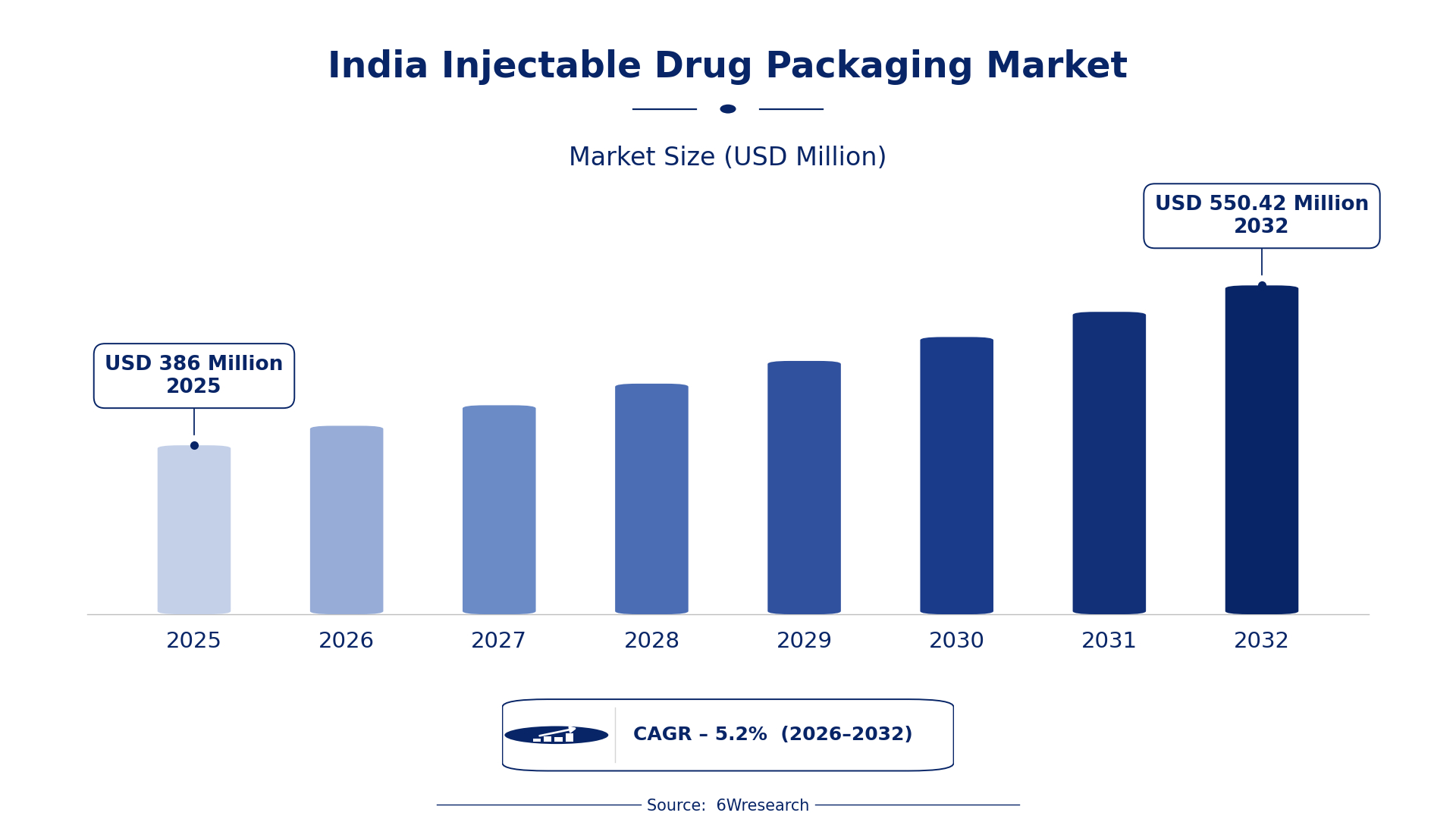
According to 6Wresearch internal database and industry insights, the India Injectable Drug Packaging Market was valued at USD 386.0 million in 2025 and is projected to reach USD 550.42 million by 2032, growing at a CAGR of approximately 5.2% during 2026–2032.
India Injectable Drug Packaging Market Highlights
| Report Metric | Details |
| Report Name | India Injectable Drug Packaging Market |
| Market Size 2025 | USD 386.0 million |
| Market Size 2032 | USD 550.42 million |
| Absolute Growth 2025–2032 | USD 164.42 million |
| CAGR 2026–2032 | 5.2% |
| Peak Annual Growth | 7.5% in 2027 |
| Forecast Period | 2026–2032 |
| Historical Data | 2022–2025 |
| Base Year | 2025 |
| Leading Packaging Type, 2025 | Glass Vials (44% share) |
| Leading Material Used, 2025 | Borosilicate Glass (40% share) |
| Leading Capacity Range, 2025 | 1–20 ml (46% share) |
| Leading Compatibility, 2025 | Biopharmaceuticals (40% share) |
| Leading Application, 2025 | Oncology (31% share) |
| Fastest-Growing Packaging Type | Prefilled Syringes (7.4% CAGR) |
| Fastest-Growing Material Used | COC/COP/Glass (7.0% CAGR) |
| Fastest-Growing Capacity Range | 0.5–2 ml (6.5% CAGR) |
| Fastest-Growing Compatibility | Hormones (7.8% CAGR) |
| Fastest-Growing Application | Vaccines (7.9% CAGR) |
| Growing Sector | Vaccines |
| Key End Users | Oncology, Vaccines, Diabetes, Anemia |
India Injectable Drug Packaging Market Year-wise Growth Rate and Key Drivers (2022–2032)
This graph illustrates the annual growth rates of the market from 2022 to 2032, highlighting a steady upward trajectory and projected market expansion over the forecast period.
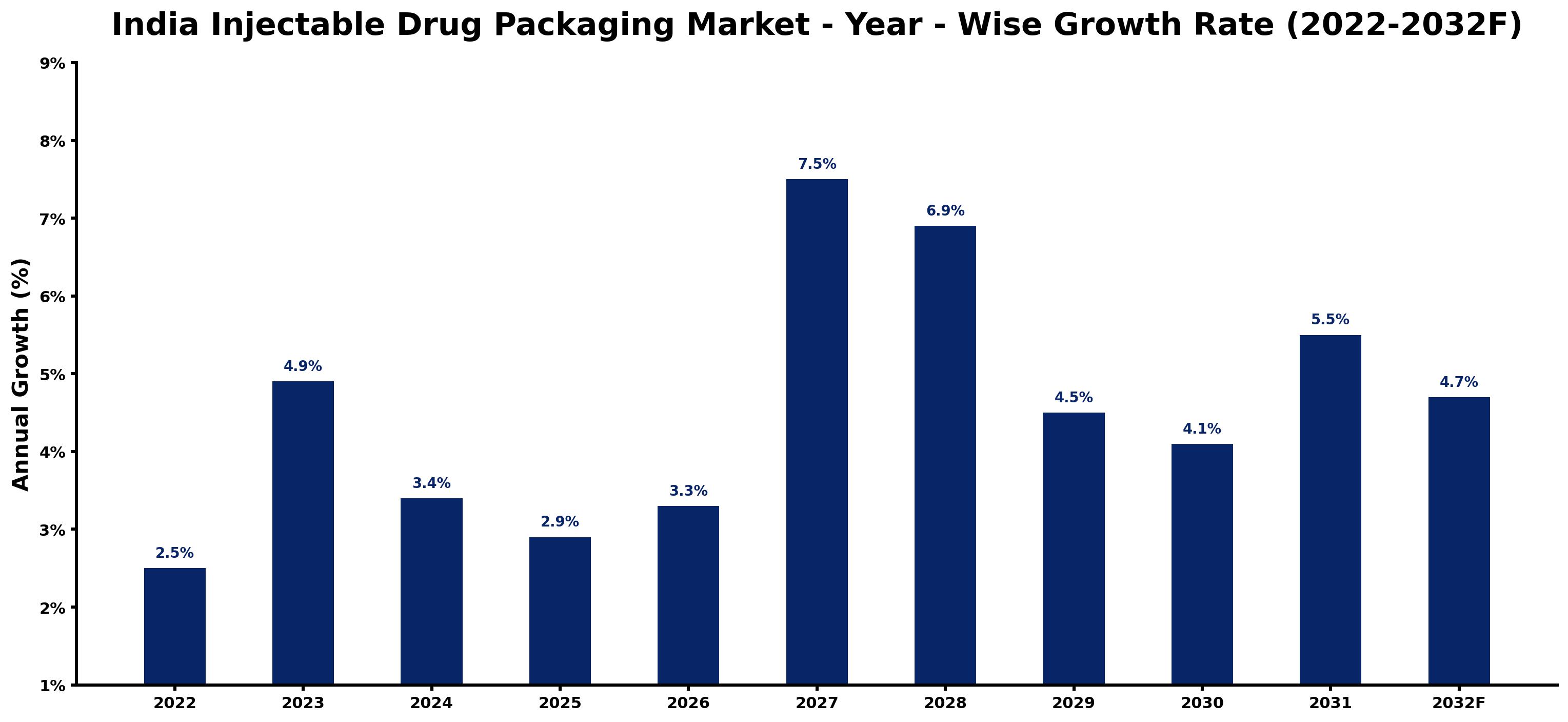
The table below sets out the estimated growth rate for each year and the main factor behind it.
| Year | Estimated Annual Growth (%) | Market Rationale |
| 2022 | 2.5 | The market showed steady growth due to rising healthcare demands. |
| 2023 | 4.9 | Growth accelerated as domestic pharmaceutical production expanded significantly. |
| 2024 | 3.4 | Growth slowed as the market adjusted to previous peaks in demand. |
| 2025 | 2.9 | The market continued to grow, albeit at a slower pace than before. |
| 2026 | 3.3 | Demand increased again as healthcare expenditures rose across the country. |
| 2027 | 7.5 | The market peaked due to heightened vaccine production and biopharmaceuticals. |
| 2028 | 6.9 | Growth slowed following the peak, but demand remained strong. |
| 2029 | 4.5 | Market growth decelerated as competition intensified among suppliers. |
| 2030 | 4.1 | The market continued to grow, driven by ongoing healthcare investments. |
| 2031 | 5.5 | Demand picked up again as new healthcare initiatives were launched. |
| 2032 | 4.7 | Growth slowed as the market stabilised, reflecting mature demand. |
Note: Market size estimations and growth projections presented in this report are based on 6Wresearch's proprietary forecasting methodology, utilizing the latest available industry data, government publications, and primary research inputs.
India Injectable Drug Packaging Market Synopsis
Injectable Drug Packaging in India encompasses containers specifically designed for liquid medications intended for injection, primarily crafted from glass or plastic. This packaging is crucial for vaccines, hormones, and biopharmaceuticals. The India Injectable Drug Packaging Market is expanding, driven by a population exceeding 1.4 billion and rising healthcare expenditures. The 'Pharma Vision 2020' initiative aims to boost drug production, further stimulating demand. With over 300 FDA-approved facilities, the market is positioned for sustained growth.
Market Dynamics Impact Analysis (2026–2032)
| Factor | Type | Impact | Primary Segment Affected |
| Rising healthcare expenditures drive demand for injectable drug packaging. | Driver | High | Glass Vials |
| The increasing number of biopharmaceutical companies enhances packaging needs. | Driver | High | Prefilled Syringes |
| The growing focus on vaccine production creates new opportunities for suppliers. | Opportunity | High | Ampoules |
| The demand for hormone therapies is rising, leading to increased packaging requirements. | Opportunity | High | Cartridges |
| Competition among suppliers may limit profit margins in the market. | Restraint | Medium | Borosilicate Glass |
| Regulatory compliance costs can burden manufacturers, affecting pricing strategies. | Restraint | Medium | Type I Glass |
| Supply chain disruptions can delay packaging availability for manufacturers. | Challenge | High | Prefilled Syringes |
| Technological advancements require continuous investment in production facilities. | Challenge | High | Glass Vials |
Evaluation of Drivers in India Injectable Drug Packaging Market (2026–2032)
Key forces behind demand, with the segment each one moves most, are listed below.
| Drivers | Primary Segment Affected | Why It Matters (Evidence) |
| Increased healthcare spending fuels demand for injectable products. | Borosilicate Glass | The Indian pharmaceutical sector was valued at approximately $50 billion in 2022, driving demand for packaging solutions. |
| A rise in biopharmaceutical companies increases packaging needs. | Prefilled Syringes | India has over 300 biopharmaceutical companies focusing on injectables, driving demand for packaging solutions. |
| Growing vaccine production drives demand for specific packaging solutions. | Ampoules | Vaccines accounted for a notable share of the injectable drug packaging market in 2022, increasing demand for packaging. |
| The rise in hormone therapies increases demand for packaging. | Cartridges | Hormones are in high demand due to increasing healthcare needs, leading to more packaging requirements. |
| The expansion of FDA-approved facilities boosts local production capabilities. | Glass Vials | India has over 300 FDA-approved facilities for injectable drug manufacturing, enhancing production capacity. |
Market growth in India for Injectable Drug Packaging rests on rising healthcare expenditures, an expanding number of biopharmaceutical companies, and increased vaccine production. The Indian pharmaceutical sector was valued at approximately $50 billion in 2022, driving demand for injectable products. The presence of over 300 FDA-approved facilities strengthens local production capabilities, leading to more purchases. The growing focus on hormone therapies further increases demand for specific packaging solutions, while the rise in vaccine production creates new opportunities for suppliers. These factors contribute to a dynamic market environment with significant growth potential.
Evaluation of Restraints in India Injectable Drug Packaging Market
The following restraints limit how fast demand can grow.
| Market Restraint | Primary Segment Affected | Why It Matters (Evidence) |
| Intense competition among suppliers can limit profit margins. | Borosilicate Glass | Numerous players are vying for market share, affecting pricing and profitability in the sector. |
| Regulatory compliance can increase operational costs for manufacturers. | Type I Glass | Manufacturers must adhere to stringent standards, raising production costs and impacting pricing. |
| Supply chain disruptions may delay packaging availability. | Prefilled Syringes | Global logistics issues impact timely delivery of materials, affecting production schedules and availability. |
| Technological advancements require ongoing investment in production. | Glass Vials | Keeping up with innovations demands financial resources from manufacturers, impacting profitability and growth potential. |
| Fluctuating raw material prices can affect packaging costs. | Cartridges | Variability in material costs can lead to unpredictable pricing, affecting supplier margins and stability. |
India Injectable Drug Packaging Market Challenges
Producers in the India injectable drug packaging market face stringent regulatory standards that can delay product approvals, increasing compliance costs for manufacturers by approximately 15%. Buyers encounter limited availability of borosilicate glass, which is preferred for over 70% of packaging, raising costs and risking supply shortages. Technology adoption remains slow, hindering suppliers' ability to innovate and meet the growing demand for injectable products. Intense competition among local manufacturers results in price wars, eroding profit margins for producers and threatening their long-term viability.
Trends in the India Injectable Drug Packaging Market
Buyers and suppliers in the India Injectable Drug Packaging Market are adjusting to the following trends.
- Shift from Traditional to Prefilled Syringes: Since 2022, the market has experienced a shift towards prefilled syringes, which provide ease of use and minimise contamination risks. This trend is reflected in a projected CAGR of 7.4% for prefilled syringes from 2026 to 2032.
- Transition to Biopharmaceutical Packaging: There is an increasing emphasis on biopharmaceuticals, with over 40% of injectable packaging now allocated to this segment. This shift indicates heightened investment in biologics and their packaging needs, creating new opportunities for suppliers.
- Emergence of Customizable Packaging Solutions: Customizable packaging solutions are gaining popularity, especially for niche applications. This trend is driven by a rising demand for tailored solutions to meet specific client requirements, particularly in the biopharmaceutical sector.
- Growth in Vaccine Packaging Demand: The demand for vaccine packaging has surged, with a projected CAGR of 7.9% for vaccines from 2026 to 2032. This growth aligns with national immunization initiatives and public health campaigns, creating opportunities for suppliers.
Investment Opportunities in the India Injectable Drug Packaging Market
Investors looking at the India Injectable Drug Packaging Market should consider the following areas.
- Investment in Biopharmaceutical Packaging Solutions: Now is an opportune time to invest in biopharmaceutical packaging solutions, as this segment is projected to grow substantially. The focus on biologics presents opportunities for suppliers to cater to biopharmaceutical companies in India.
- Expansion of Production Facilities: Investing in new production facilities is vital as the market grows. Collaborating with local manufacturers can help meet the increasing demand for injectable drug packaging in India.
- Supply Chain Improvements: Enhancing supply chain logistics is essential for timely delivery of materials. Investing in local partnerships will facilitate smoother operations and reduce delays in packaging availability.
- Development of Customizable Solutions: There is a rising need for customizable packaging solutions tailored to specific requirements. Suppliers can capitalise on this trend by offering innovative designs and materials to meet client needs.
Government Initiatives in the India Injectable Drug Packaging Market
The regulatory framework for injectable drug packaging in India is shaped by several key measures. The 'Pharmaceuticals Production Linked Incentive Scheme' launched in 2021 aims to promote domestic manufacturing of essential drugs, including injectables. The 'National Health Policy 2017' targets an increase in public health expenditure to 2.5% of GDP by 2025, enhancing healthcare infrastructure and drug availability. Additionally, the 'Atmanirbhar Bharat' initiative supports local production, positively influencing injectable drug packaging and its market availability.
Buyers in the injectable drug packaging market benefit from various government schemes and initiatives. The Department of Pharmaceuticals oversees the implementation of the 'Pharmaceuticals Production Linked Incentive Scheme', which provides financial incentives to manufacturers. This scheme aims to improve the availability of injectable products in the market. Furthermore, the National Health Mission focuses on enhancing healthcare access, which directly impacts the demand for injectable drug packaging, with a target to significantly increase public health investment.
Future Insight of the India Injectable Drug Packaging Market
Several forward-looking factors are expected to support the India injectable drug packaging market in the coming years. The 'Pharma Vision 2020' initiative aims to strengthen drug production capabilities, enabling suppliers to better meet rising healthcare demands. By 2032, healthcare expenditures are projected to increase notably, driving the need for more efficient packaging solutions. The National Health Mission is likely to improve healthcare access, further elevating the demand for injectable products and their packaging solutions.
Market Segmentation Analysis
The report offers a comprehensive study of the following market segments and their leading categories in the market.
By Packaging Type – Glass Vials Dominated, Prefilled Syringes Expected to Grow Fastest
According to Shubham Deep, Research Manager at 6Wresearch, Glass Vials accounted for a 44% market share by packaging type in 2025. Glass vials dominate the market due to their extensive use in over 300 FDA-approved facilities across India, making them a trusted choice for injectable drug storage. Their compatibility with various formulations solidifies their position as the preferred packaging solution among pharmaceutical manufacturers. Prefilled Syringes are projected to grow fastest, at a CAGR of 7.4% during 2026–2032. Prefilled syringes are rapidly gaining popularity as they offer ease of use and significantly lower contamination risks. The growing focus on patient-centric delivery methods is propelling demand for this packaging type, ensuring its continued growth in the market. Suppliers should prioritise expanding their prefilled syringe offerings to align with the growing market demand.
By Material Used – Borosilicate Glass Dominated, COC/COP/Glass Expected to Grow Fastest
In 2025, Borosilicate Glass led the material used split with a 40% share. Borosilicate glass holds the largest market share due to its excellent chemical resistance and thermal stability, making it ideal for injectable drug packaging. Its widespread adoption in the pharmaceutical sector reinforces its leading position. COC/COP/Glass is set to record the highest CAGR in this split, 7.0% over 2026–2032. COC/COP/glass materials are experiencing growth as they cater to specific applications that require lower leachables. This trend is driven by heightened regulatory scrutiny and the need for safer packaging solutions. Manufacturers should invest in developing COC/COP/glass options to capture the growing demand for specialised packaging.
By Capacity Range – 1–20 ml Dominated, 0.5–2 ml Expected to Grow Fastest
1–20 ml took a 46% share of capacity range in 2025, more than any other category. The 1–20 ml capacity range holds the largest share as it caters to a wide array of injectable formulations, essential for addressing diverse therapeutic needs. This capacity range is crucial for manufacturers aiming to meet the broad spectrum of requirements in the Indian pharmaceutical market. The quickest growth will come from 0.5–2 ml, forecast to expand at a CAGR of 6.5% between 2026 and 2032. The 0.5–2 ml capacity range is witnessing rapid growth, particularly driven by the rising demand for vaccines and small volume injections. The surge in vaccination campaigns significantly contributes to the increasing popularity of this segment. Manufacturers should enhance their production capabilities for the 0.5–2 ml range to meet the increasing demand from healthcare providers.
By Compatibility – Biopharmaceuticals Dominated, Hormones Expected to Grow Fastest
Biopharmaceuticals held a 40% share of the India Injectable Drug Packaging Market by compatibility in 2025. Biopharmaceuticals lead the compatibility segment, reflecting the growing focus on research and development in biologics within the Indian market. This trend indicates a shift towards advanced therapeutic solutions, reinforcing the importance of biopharmaceutical packaging. Over 2026–2032, Hormones are expected to post the fastest growth, at a CAGR of 7.8%. Hormones are experiencing the fastest growth due to a surge in demand for hormone therapies, particularly for chronic conditions. This trend underscores the evolving healthcare needs of the Indian population, creating opportunities for specialised packaging solutions. Suppliers should focus on developing hormone-compatible packaging solutions to seize this emerging market opportunity.
By Application – Oncology Dominated, Vaccines Expected to Grow Fastest
The largest application category in 2025 was Oncology, with a 31% share of total revenue. Oncology is the leading application segment, driven by the increasing demand for effective cancer treatments in India. The rising prevalence of cancer necessitates specialised injectable drug packaging solutions tailored to this critical area of healthcare. Vaccines are projected to grow fastest, at a CAGR of 7.9% during 2026–2032. Vaccines represent the fastest-growing application area, propelled by essential public health initiatives and immunisation programs. The ongoing efforts to enhance healthcare access are significantly driving this segment's rapid expansion. Manufacturers should concentrate on enhancing their vaccine packaging capabilities to support urgent public health initiatives.
Key Attractiveness of the Report
- 10 Years of Market Numbers
- Historical Data Starting from 2022 to 2025
- Base Year 2025
- Forecast Data until 2032
- Key Performance Indicators Impacting the Market
- Major Upcoming Developments and Projects
Key Highlights of the Report:
- India Injectable Drug Packaging Market Outlook
- Market Size of India Injectable Drug Packaging Market, 2025
- Forecast of India Injectable Drug Packaging Market, 2032
- Historical Data and Forecast of India Injectable Drug Packaging Revenues & Volume for the Period 2022 - 2032F
- India Injectable Drug Packaging Market Trend Evolution
- India Injectable Drug Packaging Market Drivers and Challenges
- India Injectable Drug Packaging Price Trends
- India Injectable Drug Packaging Porter's Five Forces
- India Injectable Drug Packaging Industry Life Cycle
- Historical Data and Forecast of India Injectable Drug Packaging Market Revenues & Volume By Packaging Type for the Period 2022 - 2032F
- Historical Data and Forecast of India Injectable Drug Packaging Market Revenues & Volume By Glass Vials for the Period 2022 - 2032F
- Historical Data and Forecast of India Injectable Drug Packaging Market Revenues & Volume By Prefilled Syringes for the Period 2022 - 2032F
- Historical Data and Forecast of India Injectable Drug Packaging Market Revenues & Volume By Ampoules for the Period 2022 - 2032F
- Historical Data and Forecast of India Injectable Drug Packaging Market Revenues & Volume By Cartridges for the Period 2022 - 2032F
- Historical Data and Forecast of India Injectable Drug Packaging Market Revenues & Volume By Material Used for the Period 2022 - 2032F
- Historical Data and Forecast of India Injectable Drug Packaging Market Revenues & Volume By Borosilicate Glass for the Period 2022 - 2032F
- Historical Data and Forecast of India Injectable Drug Packaging Market Revenues & Volume By COC/COP/Glass for the Period 2022 - 2032F
- Historical Data and Forecast of India Injectable Drug Packaging Market Revenues & Volume By Type I Glass for the Period 2022 - 2032F
- Historical Data and Forecast of India Injectable Drug Packaging Market Revenues & Volume By Polypropylene/Glass for the Period 2022 - 2032F
- Historical Data and Forecast of India Injectable Drug Packaging Market Revenues & Volume By Capacity Range for the Period 2022 - 2032F
- Historical Data and Forecast of India Injectable Drug Packaging Market Revenues & Volume By 1 20 ml for the Period 2022 - 2032F
- Historical Data and Forecast of India Injectable Drug Packaging Market Revenues & Volume By 0.5 2 ml for the Period 2022 - 2032F
- Historical Data and Forecast of India Injectable Drug Packaging Market Revenues & Volume By 1 10 ml for the Period 2022 - 2032F
- Historical Data and Forecast of India Injectable Drug Packaging Market Revenues & Volume By Customizable for the Period 2022 - 2032F
- Historical Data and Forecast of India Injectable Drug Packaging Market Revenues & Volume By Compatibility for the Period 2022 - 2032F
- Historical Data and Forecast of India Injectable Drug Packaging Market Revenues & Volume By Biopharmaceuticals for the Period 2022 - 2032F
- Historical Data and Forecast of India Injectable Drug Packaging Market Revenues & Volume By Hormones, Vaccines for the Period 2022 - 2032F
- Historical Data and Forecast of India Injectable Drug Packaging Market Revenues & Volume By Small Molecules for the Period 2022 - 2032F
- Historical Data and Forecast of India Injectable Drug Packaging Market Revenues & Volume By Insulin Delivery for the Period 2022 - 2032F
- Historical Data and Forecast of India Injectable Drug Packaging Market Revenues & Volume By Application for the Period 2022 - 2032F
- Historical Data and Forecast of India Injectable Drug Packaging Market Revenues & Volume By Oncology, Vaccines for the Period 2022 - 2032F
- Historical Data and Forecast of India Injectable Drug Packaging Market Revenues & Volume By Diabetes, Anemia for the Period 2022 - 2032F
- Historical Data and Forecast of India Injectable Drug Packaging Market Revenues & Volume By Antibiotics, Analgesics for the Period 2022 - 2032F
- Historical Data and Forecast of India Injectable Drug Packaging Market Revenues & Volume By Chronic Therapies for the Period 2022 - 2032F
- India Injectable Drug Packaging Import Export Trade Statistics
- Market Opportunity Assessment By Packaging Type
- Market Opportunity Assessment By Material Used
- Market Opportunity Assessment By Capacity Range
- Market Opportunity Assessment By Compatibility
- Market Opportunity Assessment By Application
- India Injectable Drug Packaging Top Companies Market Share
- India Injectable Drug Packaging Competitive Benchmarking By Technical and Operational Parameters
- India Injectable Drug Packaging Company Profiles
- India Injectable Drug Packaging Key Strategic Recommendations
Market Covered
The report offers an extensive study of the following market segments.
By Packaging Type
- Glass Vials
- Prefilled Syringes
- Ampoules
- Cartridges
By Material Used
- Borosilicate Glass
- COC/COP/Glass
- Type I Glass
- Polypropylene/Glass
By Capacity Range
- 1–20 ml
- 0.5–2 ml
- 1–10 ml
- Customizable
By Compatibility
- Biopharmaceuticals
- Hormones
- Vaccines
- Small Molecules
- Insulin Delivery
By Application
- Oncology
- Vaccines
- Diabetes
- Anemia
- Antibiotics
- Analgesics
- Chronic Therapies































