India Insurtech SaaS Market Size & Growth Rate
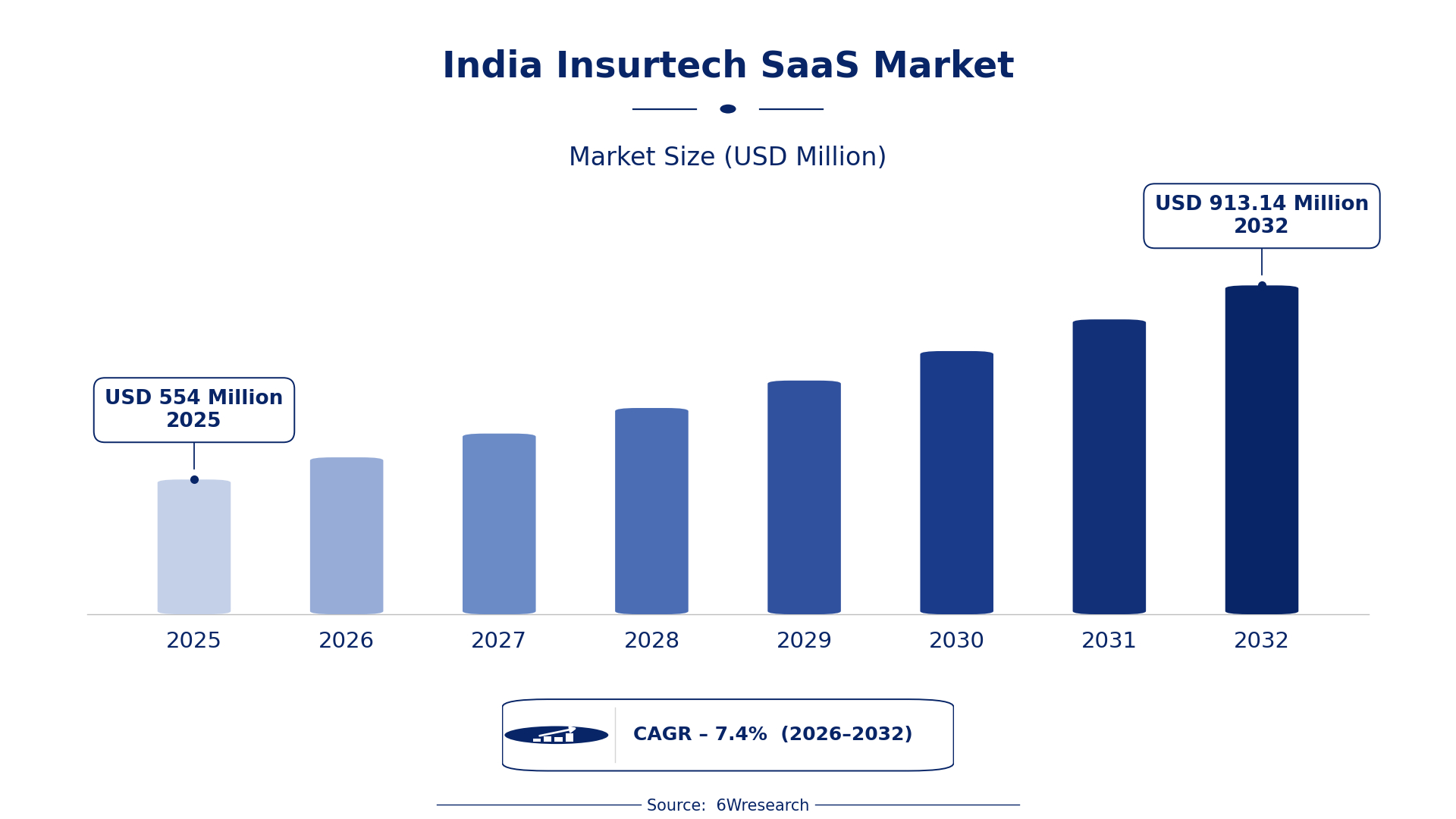
According to 6Wresearch internal database and industry insights, the India Insurtech SaaS Market was valued at USD 554.0 million in 2025 and is projected to reach USD 913.14 million by 2032, growing at a CAGR of approximately 7.4% during 2026–2032.
India Insurtech SaaS Market Highlights
| Report Metric | Details |
| Report Name | India Insurtech SaaS Market |
| Market Size 2025 | USD 554.0 million |
| Market Size 2032 | USD 913.14 million |
| Absolute Growth 2025–2032 | USD 359.14 million |
| CAGR 2026–2032 | 7.4% |
| Peak Annual Growth | 8.7% in 2026 |
| Forecast Period | 2026–2032 |
| Historical Data | 2022–2025 |
| Base Year | 2025 |
| Leading Software Type, 2025 | Policy Management (39% share) |
| Leading Deployment Mode, 2025 | Cloud-Based (53% share) |
| Leading Application Area, 2025 | Life & Health Insurance (40% share) |
| Leading End User Type, 2025 | Insurers (35% share) |
| Leading Distribution Channel, 2025 | SaaS Platforms (43% share) |
| Fastest-Growing Software Type | Claims Automation (8.5% CAGR) |
| Fastest-Growing Deployment Mode | On-Premise (9.5% CAGR) |
| Fastest-Growing Application Area | Auto & Property (9.3% CAGR) |
| Fastest-Growing End User Type | Brokers (9.8% CAGR) |
| Fastest-Growing Distribution Channel | IT Solution Providers (9.7% CAGR) |
| Growing Sector | Auto & Property |
| Key End Users | Life & Health Insurance, Auto & Property, General Insurance, Omnichannel Support |
India Insurtech SaaS Market Year-wise Growth Rate and Key Drivers (2022–2032)
This graph illustrates the annual growth rates of the market from 2022 to 2032, highlighting a steady upward trajectory and projected market expansion over the forecast period.
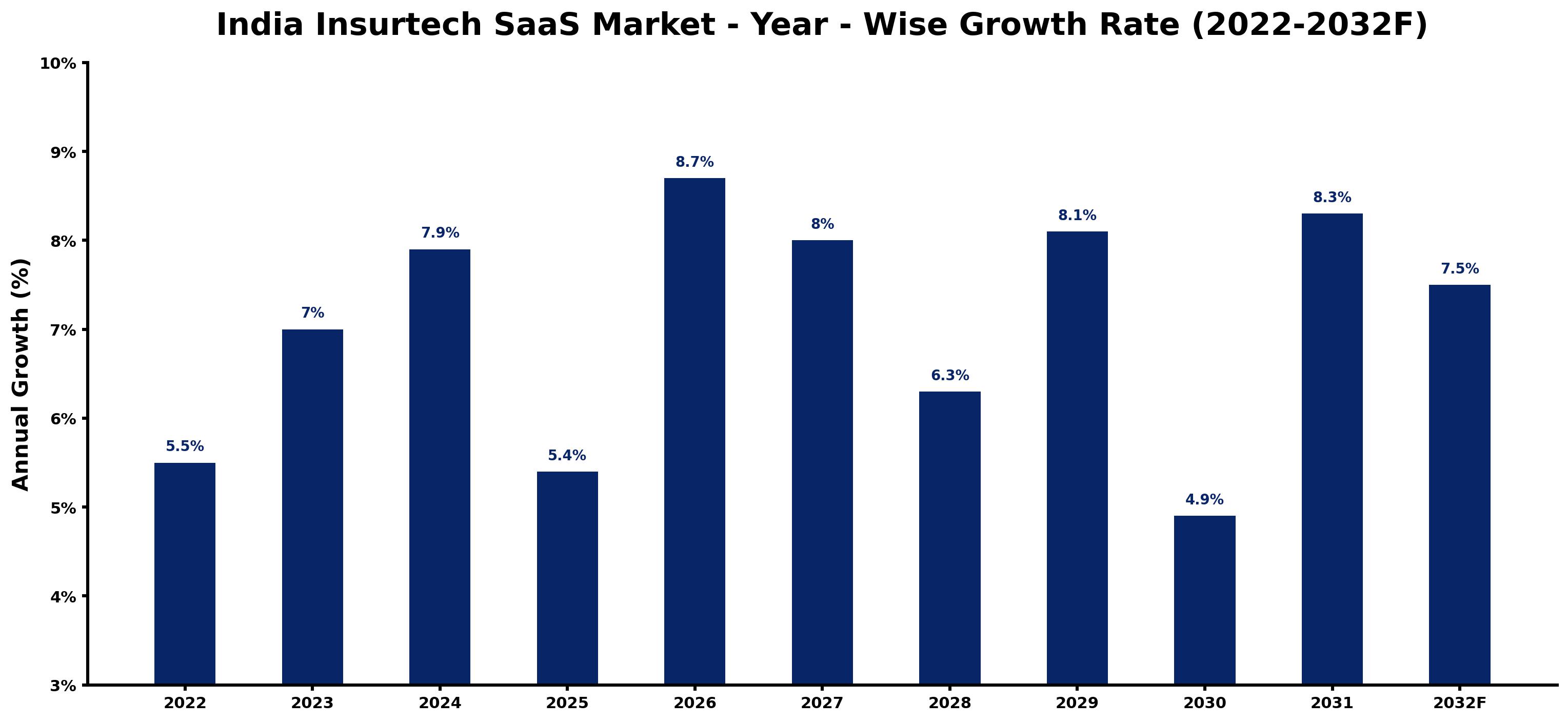
Annual growth estimates for each year appear below with the principal reason behind them, explaining the shifts that set the pace of the market.
| Year | Estimated Annual Growth (%) | Market Rationale |
| 2022 | 5.5 | The market experienced steady growth with increasing digital transformation initiatives. |
| 2023 | 7.0 | Demand surged due to the growing number of insurtech startups in the country. |
| 2024 | 7.9 | The rise in digital insurance sales contributed to higher market activity. |
| 2025 | 5.4 | Growth slowed as the market adjusted to evolving regulatory frameworks. |
| 2026 | 8.7 | The introduction of the 'Insurtech Sandbox' spurred innovation and investment. |
| 2027 | 8.0 | A slight slowdown occurred as companies focused on operational efficiencies. |
| 2028 | 6.3 | Market growth decelerated as competition intensified among existing players. |
| 2029 | 8.1 | Demand accelerated again, driven by advancements in AI and machine learning. |
| 2030 | 4.9 | Growth slowed as market maturity began to set in with established players. |
| 2031 | 8.3 | Increased investments in customer experience tools boosted market performance. |
| 2032 | 7.5 | A further slowdown is expected as the market stabilises and matures. |
Note: Market size estimations and growth projections presented in this report are based on 6Wresearch's proprietary forecasting methodology, utilizing the latest available industry data, government publications, and primary research inputs.
India Insurtech SaaS Market Synopsis
Insurtech SaaS in India refers to software solutions that optimise insurance processes through technology. The India Insurtech SaaS Market is expanding due to strong demand from domestic insurers and brokers, alongside increasing investments in digital transformation. In 2022, the total premium collected by life insurers reached ₹6.2 trillion, indicating a thriving insurance sector. The 'Digital India' initiative further supports this growth by improving digital infrastructure across various sectors, including insurance.
Market Dynamics Impact Analysis (2026–2032)
| Factor | Type | Impact | Primary Segment Affected |
| Growing investments in digital transformation initiatives among insurers | Driver | High | Policy Management |
| Increased demand for automation in claims processing | Driver | High | Claims Automation |
| Significant gap in digital insurance solutions for underserved markets | Opportunity | High | Risk & Fraud Analytics |
| Rising demand for customer experience tools in the insurance sector | Opportunity | High | Customer Experience Tools |
| Regulatory challenges in implementing new technologies | Restraint | High | Claims Automation |
| Limited awareness of insurtech solutions among traditional insurers | Restraint | Medium | Policy Management |
| Insurtech SaaS in India faces challenges with data privacy regulations | Challenge | High | Risk & Fraud Analytics |
| The high cost of technology adoption can deter smaller insurers | Challenge | Medium | Customer Experience Tools |
Evaluation of Drivers in India Insurtech SaaS Market (2026–2032)
Key forces behind demand, with the segment each one moves most, are listed below.
| Drivers | Primary Segment Affected | Why It Matters (Evidence) |
| Increasing investment in digital transformation | Policy Management | Over 200 insurtech startups are currently operational in India, driving demand for effective solutions. |
| Rising demand for efficient claims processing | Claims Automation | Digital insurance sales have surged by 40% in the last year, prompting automation needs. |
| Growing need for risk assessment tools | Risk & Fraud Analytics | The average claim settlement time for health insurance has reduced to 15 days due to automation. |
| Demand for enhanced customer interactions | Customer Experience Tools | The Indian population is approximately 1.4 billion, leading to increased insurance penetration. |
| Cloud-based solutions preferred for scalability | Cloud-Based | Cloud-based solutions account for over 60% of the insurtech deployments in India. |
Market growth for Insurtech SaaS in India is driven by escalating investment in digital transformation, an increasing need for efficient claims processing, and a heightened demand for risk assessment tools. More than 200 insurtech startups are currently active in India, fuelling the need for effective solutions. Digital insurance sales have surged by 40% over the past year, creating a pressing need for automation among insurers. The average claim settlement time for health insurance has decreased to 15 days due to automation, boosting customer satisfaction. Furthermore, with a population of around 1.4 billion, India is experiencing greater insurance penetration and demand for customer experience tools.
Evaluation of Restraints in India Insurtech SaaS Market
The table below lists the restraints and the evidence behind each.
| Market Restraint | Primary Segment Affected | Why It Matters (Evidence) |
| Regulatory challenges in implementing new technologies | Claims Automation | The Insurance Regulatory and Development Authority of India has issued guidelines for digital insurance platforms, complicating compliance. |
| Limited awareness of insurtech solutions among traditional insurers | Policy Management | Many traditional insurers are hesitant to adopt new technologies, impacting their operational efficiency. |
| Concerns regarding data privacy regulations | Risk & Fraud Analytics | The Financial Services Regulatory Commission oversees insurtech regulations, creating compliance burdens. |
| High costs of technology adoption for smaller insurers | Customer Experience Tools | Smaller insurers may struggle to invest in necessary technologies, limiting their competitiveness. |
| Competition from established insurance players | Claims Automation | Established insurers may have more resources to invest in technology, overshadowing smaller firms. |
India Insurtech SaaS Market Challenges
The India Insurtech SaaS market encounters several practical obstacles, beginning with regulatory challenges that hinder innovation. Guidelines from the Insurance Regulatory and Development Authority of India can postpone product launches by up to six months for startups, restricting their competitive edge. Integration issues with existing legacy systems lead to inefficiencies, raising operational costs by 20% for insurers and affecting profitability. A shortage of skilled professionals in data analytics and cloud computing complicates recruitment, resulting in project delays that impact service delivery for clients. Intense competition among over 200 startups compels many to reduce prices, squeezing profit margins for providers.
Trends in the India Insurtech SaaS Market
Below mentioned are some of the trends shaping the India Insurtech SaaS Market growth.
- Shift from Traditional to Digital Insurance Solutions: India is experiencing a transition towards digital insurance solutions, particularly with the launch of the 'Digital India' initiative in 2015. This initiative aims to enhance digital infrastructure, benefiting insurtech operations, as demonstrated by a 40% rise in digital insurance sales.
- Transition from On-Premise to Cloud-Based Solutions: Cloud-based solutions are gaining traction among insurers, with over 60% of deployments now cloud-based. This shift facilitates greater scalability and accessibility, aligning with the increasing demand for flexible technology solutions.
- Emergence of AI and Machine Learning in Insurtech: The Indian insurance market is projected to adopt AI and machine learning technologies extensively by 2025. This trend stems from the need for improved risk assessment and customer experience, boosting overall operational efficiency.
- Focus on Customer Experience Enhancement: Insurers are prioritising customer experience tools to enhance interactions, with a marked increase in demand. The average premium for health insurance in India is approximately ₹3,000 annually, underscoring the necessity for improved service delivery.
Investment Opportunities in the India Insurtech SaaS Market
Investors looking at the India Insurtech SaaS Market should consider the following areas.
- Investment in Automation Technologies: With digital insurance sales increasing by 40%, there is a strong opportunity to invest in automation technologies. Insurers and brokers can improve their operational efficiency by adopting these solutions, particularly in urban areas.
- Supply of Customer Experience Tools: The demand for customer experience tools is rising, with a growing population seeking better insurance services. Investing in innovative customer engagement solutions can attract insurers looking to improve their service delivery.
- Expansion into Underserved Markets: With the Indian population of approximately 1.4 billion, there is a gap in digital insurance solutions for underserved markets. Targeting rural areas with tailored insurtech products can drive significant growth.
- Partnerships with Insurtech Startups: Collaborating with the over 200 operational insurtech startups can provide established insurers with effective solutions. This partnership approach can improve service offerings and enhance market competitiveness.
Government Initiatives in the India Insurtech SaaS Market
The Insurance Act of 1938 governs the insurance industry in India, setting the regulatory framework for insurtech solutions. The Insurance Regulatory and Development Authority of India (IRDAI) has issued guidelines for digital insurance platforms, ensuring compliance and encouraging innovation. These measures have stimulated the growth of insurtech startups, contributing to the overall market expansion. Additionally, the 'Startup India' initiative supports insurtech startups with funding and mentorship, enhancing their capabilities and market reach. In 2022, the initiative allocated ₹1 billion to support over 100 startups, enabling them to develop innovative solutions.
The 'Insurtech Sandbox' launched by the IRDAI aims to promote innovation in insurance technology, allowing startups to test their solutions in a controlled environment. This initiative has seen significant participation, with numerous startups benefiting from the framework. The Financial Services Regulatory Commission oversees insurtech regulations, ensuring compliance and creating a conducive environment for growth. The agency has approved several projects aimed at improving digital infrastructure, which is critical for the success of insurtech solutions.
Future Insight of the India Insurtech SaaS Market
By 2032, transformative changes are anticipated in the India Insurtech SaaS market, influenced by several key initiatives. The 'Digital India' initiative will enhance digital infrastructure, enabling smoother operations for insurtech firms. The adoption of AI and machine learning technologies will improve risk assessment and claims processing, increasing efficiency across the sector. The IRDAI's 'Insurtech Sandbox' will promote innovation, allowing startups to trial new solutions in a supportive environment. With the total premium collected by life insurers reaching ₹6.2 trillion, the market is set for substantial growth.
Market Segmentation Analysis
The report offers a comprehensive study of the following market segments and their leading categories in the market.
By Software Type – Policy Management Dominated, Claims Automation Expected to Grow Fastest
According to Shubham Deep, Research Manager at 6Wresearch, with a 39% revenue share in 2025, Policy Management was the largest software type category. Policy Management holds the largest share in the India Insurtech SaaS Market as it is essential for efficiently managing insurance policies, which is crucial for insurers. The high demand for streamlined policy processes among over 200 operational insurtech startups in India reinforces this segment's dominance. The quickest growth will come from Claims Automation, forecast to expand at a CAGR of 8.5% between 2026 and 2032. Claims Automation is experiencing rapid growth due to its ability to streamline claims processing, significantly reducing settlement times to an average of 15 days. This efficiency encourages insurers to adopt these solutions more widely, further boosting the segment's growth. Suppliers should focus on enhancing claims automation features to capture the growing demand from insurers.
By Deployment Mode – Cloud-Based Dominated, On-Premise Expected to Grow Fastest
Cloud-Based accounted for a 53% market share by deployment mode in 2025. Cloud-Based solutions dominate the India Insurtech SaaS Market, accounting for over 60% of deployments due to their scalability and accessibility for users. This preference is evident among a wide range of insurers looking to modernise their operations. On-Premise is projected to grow fastest, at a CAGR of 9.5% during 2026–2032. On-Premise deployments are witnessing growth as traditional insurers seek greater control over their data, reflecting a shift towards customised solutions. This trend indicates a diversification in deployment preferences within the market. Buyers may benefit from exploring both cloud and on-premise solutions to find the best fit for their operational needs.
By Application Area – Life & Health Insurance Dominated, Auto & Property Expected to Grow Fastest
In 2025, Life & Health Insurance led the application area split with a 40% share. Life & Health Insurance represents the largest application area in the India Insurtech SaaS Market, catering to the needs of a vast population. The increasing insurance penetration in India further solidifies this segment's leading position. Auto & Property is set to record the highest CAGR in this split, 9.3% over 2026–2032. Auto & Property insurance is the fastest-growing area, utilising insurtech to enhance efficiency in claims and policy management. The growing number of insured vehicles and properties in India drives this segment's rapid expansion. Insurers should consider investing in insurtech solutions tailored for the auto and property sectors to capitalise on this growth.
By End User Type – Insurers Dominated, Brokers Expected to Grow Fastest
The largest end user type category in 2025 was Insurers, with a 35% share of total revenue. Insurers are the primary users of insurtech solutions, leveraging these technologies to optimise their operations and improve customer service. The substantial number of registered insurance agents in India indicates a robust ecosystem supporting this segment. Over 2026–2032, Brokers are expected to post the fastest growth, at a CAGR of 9.8%. Brokers are rapidly adopting insurtech technologies to enhance their efficiency in managing client relationships and policy placements. This trend highlights the increasing reliance on technology among intermediaries in the insurance sector. Suppliers must tailor their offerings to meet the specific needs of brokers as they become more integral to the insurtech landscape.
By Distribution Channel – SaaS Platforms Dominated, IT Solution Providers Expected to Grow Fastest
SaaS Platforms held a 43% share of the India Insurtech SaaS Market by distribution channel in 2025. SaaS Platforms lead the distribution channel in the India Insurtech SaaS Market, serving as the core delivery model for solutions essential for modernising insurance processes. The widespread adoption of these platforms among insurers underscores their importance in the market. The quickest growth will come from IT Solution Providers, forecast to expand at a CAGR of 9.7% between 2026 and 2032. IT Solution Providers are witnessing rapid growth as they support the implementation of insurtech solutions, catering to the needs of traditional insurers. This trend reflects a growing recognition of the value of specialised IT support in the insurance industry. Suppliers should consider partnerships with IT solution providers to enhance their market reach and implementation capabilities.
Key Attractiveness of the Report
- 10 Years of Market Numbers
- Historical Data Starting from 2022 to 2025
- Base Year 2025
- Forecast Data until 2032
- Key Performance Indicators Impacting the Market
- Major Upcoming Developments and Projects
Key Highlights of the Report:
- India Insurtech SaaS Market Outlook
- Market Size of India Insurtech SaaS Market, 2025
- Forecast of India Insurtech SaaS Market, 2032
- Historical Data and Forecast of India Insurtech SaaS Revenues & Volume for the Period 2022 - 2032F
- India Insurtech SaaS Market Trend Evolution
- India Insurtech SaaS Market Drivers and Challenges
- India Insurtech SaaS Price Trends
- India Insurtech SaaS Porter's Five Forces
- India Insurtech SaaS Industry Life Cycle
- Historical Data and Forecast of India Insurtech SaaS Market Revenues & Volume By Software Type for the Period 2022 - 2032F
- Historical Data and Forecast of India Insurtech SaaS Market Revenues & Volume By Policy Management for the Period 2022 - 2032F
- Historical Data and Forecast of India Insurtech SaaS Market Revenues & Volume By Claims Automation for the Period 2022 - 2032F
- Historical Data and Forecast of India Insurtech SaaS Market Revenues & Volume By Risk & Fraud Analytics for the Period 2022 - 2032F
- Historical Data and Forecast of India Insurtech SaaS Market Revenues & Volume By Customer Experience Tools for the Period 2022 - 2032F
- Historical Data and Forecast of India Insurtech SaaS Market Revenues & Volume By Deployment Mode for the Period 2022 - 2032F
- Historical Data and Forecast of India Insurtech SaaS Market Revenues & Volume By Cloud-Based for the Period 2022 - 2032F
- Historical Data and Forecast of India Insurtech SaaS Market Revenues & Volume By On-Premise for the Period 2022 - 2032F
- Historical Data and Forecast of India Insurtech SaaS Market Revenues & Volume By Hybrid for the Period 2022 - 2032F
- Historical Data and Forecast of India Insurtech SaaS Market Revenues & Volume By Web-Based for the Period 2022 - 2032F
- Historical Data and Forecast of India Insurtech SaaS Market Revenues & Volume By Application Area for the Period 2022 - 2032F
- Historical Data and Forecast of India Insurtech SaaS Market Revenues & Volume By Life & Health Insurance for the Period 2022 - 2032F
- Historical Data and Forecast of India Insurtech SaaS Market Revenues & Volume By Auto & Property for the Period 2022 - 2032F
- Historical Data and Forecast of India Insurtech SaaS Market Revenues & Volume By General Insurance for the Period 2022 - 2032F
- Historical Data and Forecast of India Insurtech SaaS Market Revenues & Volume By Omnichannel Support for the Period 2022 - 2032F
- Historical Data and Forecast of India Insurtech SaaS Market Revenues & Volume By End User Type for the Period 2022 - 2032F
- Historical Data and Forecast of India Insurtech SaaS Market Revenues & Volume By Insurers for the Period 2022 - 2032F
- Historical Data and Forecast of India Insurtech SaaS Market Revenues & Volume By Brokers for the Period 2022 - 2032F
- Historical Data and Forecast of India Insurtech SaaS Market Revenues & Volume By TPAs for the Period 2022 - 2032F
- Historical Data and Forecast of India Insurtech SaaS Market Revenues & Volume By Agents/Agencies for the Period 2022 - 2032F
- Historical Data and Forecast of India Insurtech SaaS Market Revenues & Volume By Distribution Channel for the Period 2022 - 2032F
- Historical Data and Forecast of India Insurtech SaaS Market Revenues & Volume By SaaS Platforms for the Period 2022 - 2032F
- Historical Data and Forecast of India Insurtech SaaS Market Revenues & Volume By IT Solution Providers for the Period 2022 - 2032F
- Historical Data and Forecast of India Insurtech SaaS Market Revenues & Volume By Direct Sales for the Period 2022 - 2032F
- Historical Data and Forecast of India Insurtech SaaS Market Revenues & Volume By Digital Marketplaces for the Period 2022 - 2032F
- India Insurtech SaaS Import Export Trade Statistics
- Market Opportunity Assessment By Software Type
- Market Opportunity Assessment By Deployment Mode
- Market Opportunity Assessment By Application Area
- Market Opportunity Assessment By End User Type
- Market Opportunity Assessment By Distribution Channel
- India Insurtech SaaS Top Companies Market Share
- India Insurtech SaaS Competitive Benchmarking By Technical and Operational Parameters
- India Insurtech SaaS Company Profiles
- India Insurtech SaaS Key Strategic Recommendations
Market Covered
The report offers an extensive study of the following market segments.
By Software Type
- Policy Management
- Claims Automation
- Risk & Fraud Analytics
- Customer Experience Tools
By Deployment Mode
- Cloud-Based
- On-Premise
- Hybrid
- Web-Based
By Application Area
- Life & Health Insurance
- Auto & Property
- General Insurance
- Omnichannel Support
By End User Type
- Insurers
- Brokers
- TPAs
- Agents/Agencies
By Distribution Channel
- SaaS Platforms
- IT Solution Providers
- Direct Sales
- Digital Marketplaces































