India Integrated Avionics Market Size & Growth Rate
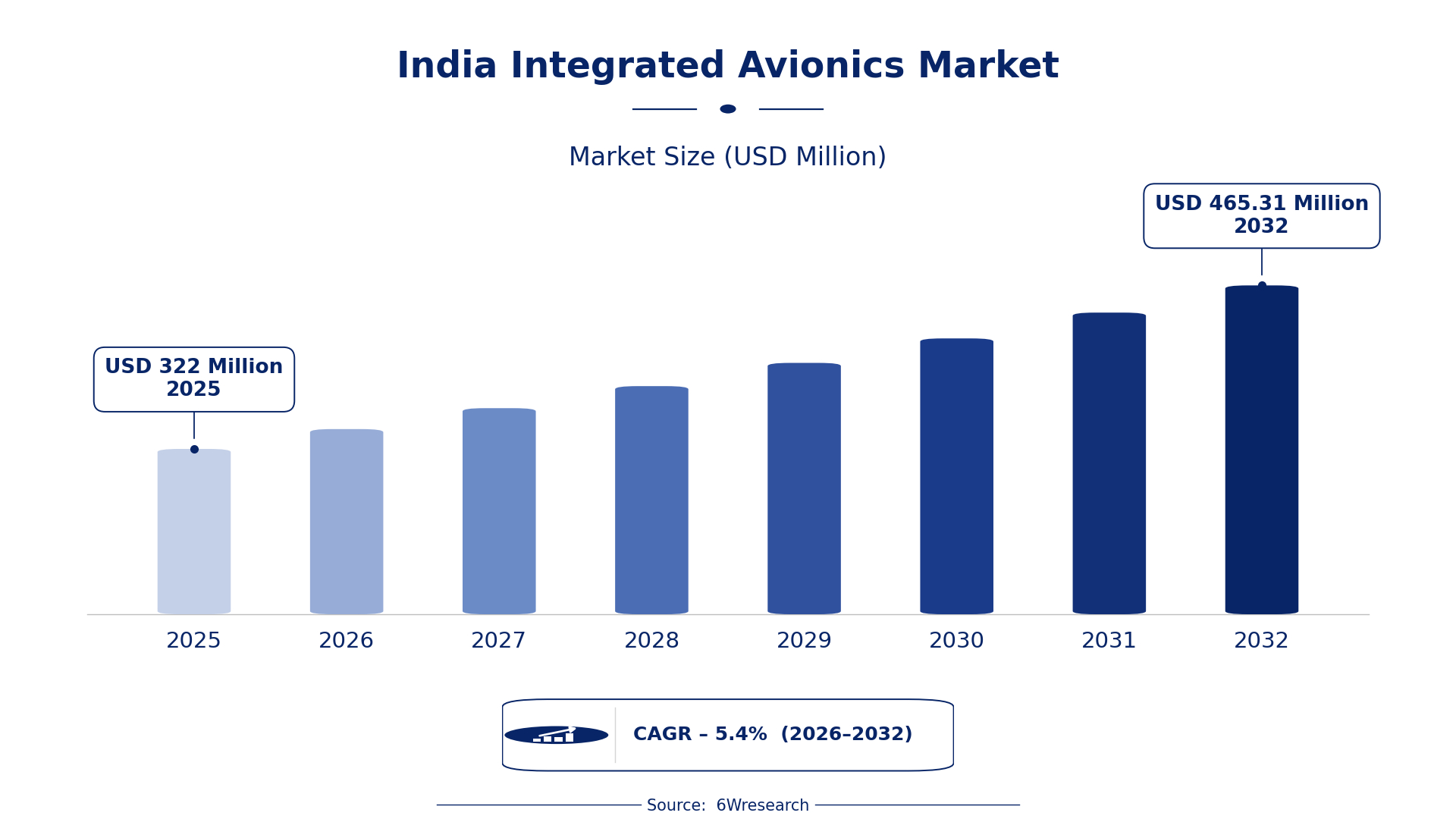
According to 6Wresearch internal database and industry insights, the India Integrated Avionics Market was valued at USD 322.0 million in 2025 and is projected to reach USD 465.31 million by 2032, growing at a CAGR of approximately 5.4% during 2026–2032.
India Integrated Avionics Market Highlights
| Report Metric | Details |
| Report Name | India Integrated Avionics Market |
| Market Size 2025 | USD 322.0 million |
| Market Size 2032 | USD 465.31 million |
| Absolute Growth 2025–2032 | USD 143.31 million |
| CAGR 2026–2032 | 5.4% |
| Peak Annual Growth | 8.0% in 2030 |
| Forecast Period | 2026–2032 |
| Historical Data | 2022–2025 |
| Base Year | 2025 |
| Leading Platform Type, 2025 | Commercial Aircraft (46% share) |
| Leading Integration Level, 2025 | Fully Integrated (44% share) |
| Leading System Type, 2025 | Navigation (43% share) |
| Leading End User, 2025 | OEMs (47% share) |
| Leading Distribution Channel, 2025 | Tier 1 Suppliers (43% share) |
| Fastest-Growing Platform Type | UAVs (7.6% CAGR) |
| Fastest-Growing System Type | Mission Systems (8.2% CAGR) |
| Fastest-Growing End User | Aerospace Startups (7.0% CAGR) |
| Fastest-Growing Distribution Channel | Direct Sales (7.9% CAGR) |
| Growing Sector | Military Aircraft |
| Key End Users | OEMs, Defense Contractors, Avionics Manufacturers, Aerospace Startups |
India Integrated Avionics Market Year-wise Growth Rate and Key Drivers (2022–2032)
This graph illustrates the annual growth rates of the market from 2022 to 2032, highlighting a steady upward trajectory and projected market expansion over the forecast period.
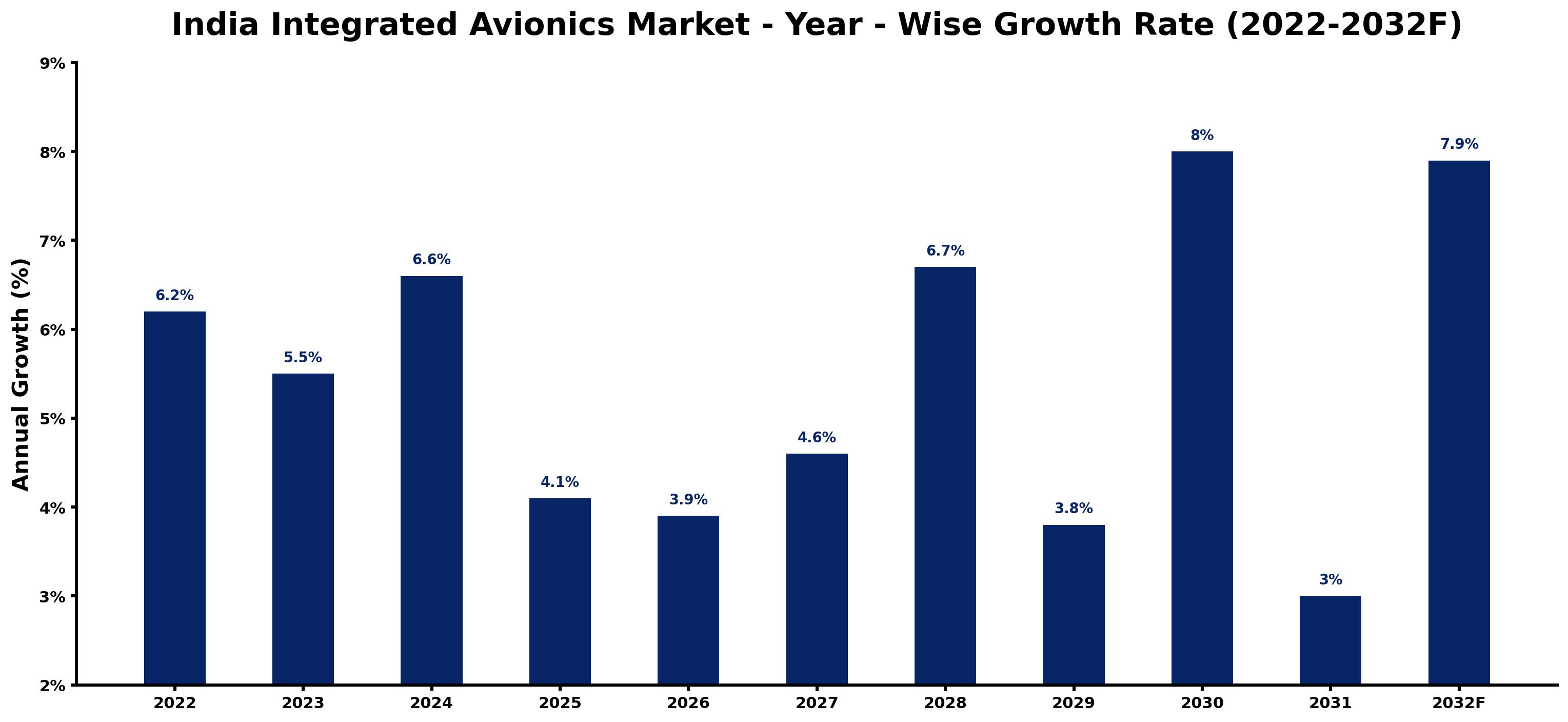
Below, each year's estimated growth is shown next to the factor that most influenced it.
| Year | Estimated Annual Growth (%) | Market Rationale |
| 2022 | 6.2 | The market experienced steady growth due to ongoing demand from domestic users and defense contractors. |
| 2023 | 5.5 | Growth slowed as the impact of the 'Make in India' initiative began to stabilise production levels. |
| 2024 | 6.6 | The market saw accelerated growth driven by increased modernization efforts in military aircraft. |
| 2025 | 4.1 | Growth slowed again as the focus shifted towards upgrading existing systems rather than new investments. |
| 2026 | 3.9 | A further slowdown is expected as demand stabilises following the completion of several key projects. |
| 2027 | 4.6 | Demand will increase as the Indian Air Force's modernization plan begins to take effect. |
| 2028 | 6.7 | Growth is projected to accelerate as UAVs gain traction for surveillance and logistics applications. |
| 2029 | 3.8 | A slowdown is anticipated as the market adjusts to the previous years' rapid growth. |
| 2030 | 8.0 | The market is expected to peak due to heightened investments in advanced avionics systems by the defense sector. |
| 2031 | 3.0 | Growth will slow as the market begins to stabilise after reaching peak demand levels. |
| 2032 | 7.9 | A resurgence in demand is projected as new projects are initiated under the 'Digital India' initiative. |
Note: Market size estimations and growth projections presented in this report are based on 6Wresearch's proprietary forecasting methodology, utilizing the latest available industry data, government publications, and primary research inputs.
India Integrated Avionics Market Synopsis
The Integrated Avionics Market in India includes electronic systems that oversee flight operations, such as navigation and communication. These systems enhance flight safety and operational efficiency, catering mainly to domestic users and defence contractors. The India Integrated Avionics Market is expanding due to substantial investments in modernisation and initiatives like 'Make in India', which encourages local production.
Market Dynamics Impact Analysis (2026–2032)
| Factor | Type | Impact | Primary Segment Affected |
| Investment in modernization of military aircraft | Driver | High | Military Aircraft |
| Growing demand for UAVs in surveillance | Driver | High | UAVs |
| Increased allocations in the defense budget for avionics upgrades | Opportunity | High | Military Aircraft |
| Rising demand for integrated systems in commercial aviation | Opportunity | High | Commercial Aircraft |
| Challenges in meeting stringent DGCA standards | Restraint | High | Commercial Aircraft |
| Dependence on imported components for advanced systems | Restraint | Medium | Commercial Aircraft |
| High costs associated with R&D for new technologies | Challenge | High | Commercial Aircraft |
| Limited skilled workforce for advanced avionics production | Challenge | Medium | Commercial Aircraft |
Evaluation of Drivers in India Integrated Avionics Market (2026–2032)
The factors lifting demand, and the evidence behind each, are summarised below.
| Drivers | Primary Segment Affected | Why It Matters (Evidence) |
| Investment in the 'UDAN' scheme to improve regional connectivity | Commercial Aircraft | This initiative has increased demand for integrated avionics systems in regional aircraft, resulting in a rise in orders from OEMs. |
| The Indian Air Force's modernization plan includes advanced avionics systems by 2025 | Military Aircraft | This plan is projected to drive demand for upgraded avionics, resulting in increased procurement from defense contractors. |
| The 'Make in India' initiative encourages domestic production of avionics components | Commercial Aircraft | This initiative reduces reliance on imports and stimulates local manufacturing, leading to greater availability of integrated avionics. |
| Growing utilization of UAVs for various applications by the Indian Space Research Organisation | UAVs | The demand for UAVs has surged, driving the need for advanced avionics to support surveillance and logistics operations. |
| The 'Digital India' initiative promotes technology adoption in aviation | Commercial Aircraft | This initiative encourages the integration of digital technologies in avionics, improving operational efficiency and safety. |
Market growth in India for Integrated Avionics rests on strong investments in modernization and expanding end-use demand. The 'UDAN' scheme has improved regional connectivity, increasing orders for integrated avionics systems in regional aircraft. The Indian Air Force's modernization plan includes advanced avionics systems by 2025, driving procurement from defense contractors. The rising focus on UAVs for various applications is driving demand for advanced avionics systems.
Evaluation of Restraints in India Integrated Avionics Market
The following restraints limit how fast demand can grow.
| Market Restraint | Primary Segment Affected | Why It Matters (Evidence) |
| Challenges in meeting stringent DGCA standards | Commercial Aircraft | Compliance with DGCA standards requires extensive testing and certification, delaying product launches and increasing costs. |
| Dependence on imported components for advanced systems | Commercial Aircraft | This dependence can lead to supply chain disruptions, affecting production timelines and costs for manufacturers. |
| High costs associated with R&D for new technologies | Commercial Aircraft | Investments in R&D are substantial, limiting the ability of smaller firms to compete in the advanced avionics market. |
| Limited skilled workforce for advanced avionics production | Commercial Aircraft | The shortage of skilled professionals hampers production capabilities and innovation in the avionics sector. |
| Regulatory hurdles for new entrants in the market | Commercial Aircraft | Navigating complex regulations can delay market entry for new companies, impacting overall competition. |
India Integrated Avionics Market Challenges
Buyers in the India Integrated Avionics market encounter regulatory hurdles due to stringent DGCA standards, complicating product approvals and delaying the introduction of new systems. This situation affects producers who struggle to meet the demand for timely access to advanced technology, crucial for operational efficiency. Local manufacturers face intense competition from international suppliers, forcing them to reduce prices and limiting their ability to invest in research and development. Furthermore, rapid technological advancements often leave buyers with outdated systems, increasing operational costs as they rush to upgrade within tight budgets.
Trends in the India Integrated Avionics Market
Four trends stand out in the India Integrated Avionics Market.
- Shift towards Fully Integrated Systems: The market is increasingly embracing fully integrated avionics systems, driven by the need for enhanced operational efficiency. The 'Make in India' initiative has facilitated this transition, with a projected growth of 7.8% in this segment by 2032.
- Growing Demand for UAV Avionics: The demand for UAVs is on the rise, particularly for surveillance and logistics applications. The Indian Space Research Organisation's focus on UAV development is expected to drive growth in this segment by 7.6% through 2032.
- Increased Focus on Digital Technologies: The aviation sector is prioritising digital technologies, influenced by the 'Digital India' initiative. This trend is anticipated to improve the integration of avionics systems, promoting efficiency and safety in operations.
- Expansion of Military Avionics Capabilities: The Indian Air Force's modernisation plan is broadening military avionics capabilities, with substantial investments planned by 2025. This focus is expected to boost the military aircraft segment.
Investment Opportunities in the India Integrated Avionics Market
The following opportunities in the India Integrated Avionics Market pair current demand with a clear way in.
- Timing for Increased Domestic Production: With the 'Make in India' initiative in full swing, there is an opportunity to invest in local avionics manufacturing. This initiative aims to boost domestic production by reducing import reliance, targeting 50% local sourcing by 2025.
- Gap in Advanced Avionics Supply: The market currently lacks sufficient advanced avionics systems, presenting a gap for suppliers. The defence budget for 2023 allocates substantial funds for avionics upgrades, creating opportunities for new entrants.
- UAV Development in Aerospace Hubs: Aerospace hubs in India are concentrating on UAV development, providing opportunities for suppliers of integrated avionics. The Indian Space Research Organisation is actively developing UAVs for various applications, driving demand for advanced systems.
- Investment in Training and Development: There is a pressing need for skilled professionals in the avionics sector, creating an opportunity for training institutions. Establishing partnerships with educational institutions can help bridge the skills gap in this growing market.
Government Initiatives in the India Integrated Avionics Market
The 'National Civil Aviation Policy', established by the Ministry of Civil Aviation in 2016, aims to improve air connectivity and infrastructure. This policy facilitates the growth of integrated avionics by promoting investments in aviation infrastructure and ensuring compliance with safety standards. It encourages the development of advanced avionics systems, supporting both commercial and military applications. The 'Aerospace and Defence Manufacturing Policy', launched in 2020, aims to promote indigenous manufacturing and innovation in avionics systems, targeting a 50% increase in local production by 2025.
The 'Make in India' initiative, launched in 2014, focuses on increasing domestic production of avionics components. This initiative is implemented by various agencies, including the Ministry of Defence, which funds projects aimed at improving local manufacturing capabilities. It encourages collaboration between local manufacturers and international firms, promoting innovation and reducing reliance on imports. The 'Digital India' programme, launched in 2015, promotes the adoption of digital technologies in the aviation sector, further supporting the integration of advanced avionics systems.
Future Insight of the India Integrated Avionics Market
Several forward-looking factors are expected to support the India Integrated Avionics market in the coming years. The 'Make in India' initiative will enhance local manufacturing capabilities, improving supply chain efficiency and reducing reliance on imports. By 2023, the defence budget includes substantial allocations for avionics upgrades, which will drive demand for advanced systems. The government's commitment to the 'UDAN' scheme will further enhance regional connectivity, creating a greater need for modern avionics in commercial aviation.
Market Segmentation Analysis
The report offers a comprehensive study of the following market segments and their leading categories in the market.
By Platform Type – Commercial Aircraft Dominated, UAVs Expected to Grow Fastest
According to Shubham Deep, Research Manager at 6Wresearch, Commercial Aircraft accounted for a 46% market share by platform type in 2025. Commercial aircraft hold the largest market share in India due to their essential role in flight operations, supported by a strong installed base. The government's 'UDAN' scheme, initiated in 2017, has significantly boosted demand for these aircraft, enhancing regional connectivity. UAVs are projected to grow fastest, at a CAGR of 7.6% during 2026–2032. UAVs are experiencing rapid growth driven by increasing demand for surveillance and logistics applications, particularly illustrated by the Indian Space Research Organisation's UAV development initiatives. This trend suggests a promising future for UAVs within the integrated avionics market. Suppliers should focus on enhancing UAV capabilities to capture the growing interest from various sectors.
By Integration Level – Fully Integrated Dominated and Is Expected to Record the Fastest Growth
Fully Integrated took a 44% share of integration level in 2025, more than any other category. Fully integrated systems command the largest share as modern aircraft rely on these advanced avionics for seamless operations, enhancing flight safety and efficiency. This reliance reflects the industry's transition towards more sophisticated technologies that fully integrate various functions. Fully Integrated is also forecast to expand faster than any other category, at a CAGR of 7.8% over 2026–2032. The fully integrated segment is also the fastest-growing due to its essential role in modern aircraft, which increasingly depend on advanced avionics for optimal performance. As technology continues to advance, the demand for fully integrated systems is expected to rise. Suppliers must prioritise the development of fully integrated solutions to meet the evolving demands of the aviation sector.
By System Type – Navigation Dominated, Mission Systems Expected to Grow Fastest
With a 43% revenue share in 2025, Navigation was the largest system type category. Navigation systems lead the market share as they are vital for all flight operations, ensuring safety and efficiency in aircraft movement. Established standards set by the DGCA reinforce the critical importance of navigation systems in the Indian aviation framework. The quickest growth will come from Mission Systems, forecast to expand at a CAGR of 8.2% between 2026 and 2032. Mission systems represent the fastest-growing segment, driven by their crucial role in military operations, especially in light of the Indian Air Force's modernization plans. The increasing defence budget allocations for avionics upgrades underscore the urgent need for enhanced mission capabilities. Suppliers should invest in mission system technologies to align with the growing focus on military avionics.
By End User – OEMs Dominated, Aerospace Startups Expected to Grow Fastest
The largest end user category in 2025 was OEMs, with a 47% share of total revenue. OEMs are the leading end users in the integrated avionics market, serving as primary producers and driving demand for advanced avionics solutions. Their established relationships with suppliers ensure a steady flow of orders, particularly as new aircraft models are developed. Over 2026–2032, Aerospace Startups are expected to post the fastest growth, at a CAGR of 7.0%. Aerospace startups are the fastest-growing end user segment, emerging with innovative solutions and technologies in the aviation sector. Their agility and focus on niche markets enable them to rapidly adapt to changing demands and opportunities. Suppliers should consider partnerships with aerospace startups to tap into new opportunities in the market.
By Distribution Channel – Tier 1 Suppliers Dominated, Direct Sales Expected to Grow Fastest
Tier 1 Suppliers held a 43% share of the India Integrated Avionics Market by distribution channel in 2025. Tier 1 suppliers dominate the distribution channel, acting as key suppliers to OEMs and ensuring the availability of integrated avionics systems. Their established networks and industry expertise facilitate a reliable supply chain that meets the needs of the market. Direct Sales is projected to grow fastest, at a CAGR of 7.9% during 2026–2032. Direct sales are the fastest-growing distribution channel, primarily due to the increasing preference for direct engagement between manufacturers and end users. This trend allows for tailored solutions and quicker response times to customer needs. Suppliers should enhance their direct sales strategies to better connect with end users and address specific requirements.
Key Attractiveness of the Report
- 10 Years of Market Numbers
- Historical Data Starting from 2022 to 2025
- Base Year 2025
- Forecast Data until 2032
- Key Performance Indicators Impacting the Market
- Major Upcoming Developments and Projects
Key Highlights of the Report:
- India Integrated Avionics Market Outlook
- Market Size of India Integrated Avionics Market, 2025
- Forecast of India Integrated Avionics Market, 2032
- Historical Data and Forecast of India Integrated Avionics Revenues & Volume for the Period 2022 - 2032F
- India Integrated Avionics Market Trend Evolution
- India Integrated Avionics Market Drivers and Challenges
- India Integrated Avionics Price Trends
- India Integrated Avionics Porter's Five Forces
- India Integrated Avionics Industry Life Cycle
- Historical Data and Forecast of India Integrated Avionics Market Revenues & Volume By Platform Type for the Period 2022 - 2032F
- Historical Data and Forecast of India Integrated Avionics Market Revenues & Volume By Commercial Aircraft for the Period 2022 - 2032F
- Historical Data and Forecast of India Integrated Avionics Market Revenues & Volume By Military Aircraft for the Period 2022 - 2032F
- Historical Data and Forecast of India Integrated Avionics Market Revenues & Volume By UAVs for the Period 2022 - 2032F
- Historical Data and Forecast of India Integrated Avionics Market Revenues & Volume By Business Jets for the Period 2022 - 2032F
- Historical Data and Forecast of India Integrated Avionics Market Revenues & Volume By Integration Level for the Period 2022 - 2032F
- Historical Data and Forecast of India Integrated Avionics Market Revenues & Volume By Federated to Integrated for the Period 2022 - 2032F
- Historical Data and Forecast of India Integrated Avionics Market Revenues & Volume By Fully Integrated for the Period 2022 - 2032F
- Historical Data and Forecast of India Integrated Avionics Market Revenues & Volume By Semi-Integrated for the Period 2022 - 2032F
- Historical Data and Forecast of India Integrated Avionics Market Revenues & Volume By Modular Integrated for the Period 2022 - 2032F
- Historical Data and Forecast of India Integrated Avionics Market Revenues & Volume By System Type for the Period 2022 - 2032F
- Historical Data and Forecast of India Integrated Avionics Market Revenues & Volume By Navigation for the Period 2022 - 2032F
- Historical Data and Forecast of India Integrated Avionics Market Revenues & Volume By Mission Systems for the Period 2022 - 2032F
- Historical Data and Forecast of India Integrated Avionics Market Revenues & Volume By Communication for the Period 2022 - 2032F
- Historical Data and Forecast of India Integrated Avionics Market Revenues & Volume By Flight Management for the Period 2022 - 2032F
- Historical Data and Forecast of India Integrated Avionics Market Revenues & Volume By End User for the Period 2022 - 2032F
- Historical Data and Forecast of India Integrated Avionics Market Revenues & Volume By OEMs for the Period 2022 - 2032F
- Historical Data and Forecast of India Integrated Avionics Market Revenues & Volume By Defense Contractors for the Period 2022 - 2032F
- Historical Data and Forecast of India Integrated Avionics Market Revenues & Volume By Aerospace Startups for the Period 2022 - 2032F
- Historical Data and Forecast of India Integrated Avionics Market Revenues & Volume By Avionics Manufacturers for the Period 2022 - 2032F
- Historical Data and Forecast of India Integrated Avionics Market Revenues & Volume By Distribution Channel for the Period 2022 - 2032F
- Historical Data and Forecast of India Integrated Avionics Market Revenues & Volume By Tier 1 Suppliers for the Period 2022 - 2032F
- Historical Data and Forecast of India Integrated Avionics Market Revenues & Volume By Direct Sales for the Period 2022 - 2032F
- Historical Data and Forecast of India Integrated Avionics Market Revenues & Volume By Online Platforms for the Period 2022 - 2032F
- Historical Data and Forecast of India Integrated Avionics Market Revenues & Volume By OEM Alliances for the Period 2022 - 2032F
- India Integrated Avionics Import Export Trade Statistics
- Market Opportunity Assessment By Platform Type
- Market Opportunity Assessment By Integration Level
- Market Opportunity Assessment By System Type
- Market Opportunity Assessment By End User
- Market Opportunity Assessment By Distribution Channel
- India Integrated Avionics Top Companies Market Share
- India Integrated Avionics Competitive Benchmarking By Technical and Operational Parameters
- India Integrated Avionics Company Profiles
- India Integrated Avionics Key Strategic Recommendations
Market Covered
The report offers an extensive study of the following market segments.
By Platform Type
- Commercial Aircraft
- Military Aircraft
- UAVs
- Business Jets
By Integration Level
- Federated to Integrated
- Fully Integrated
- Semi-Integrated
- Modular Integrated
By System Type
- Navigation
- Mission Systems
- Communication
- Flight Management
By End User
- OEMs
- Defense Contractors
- Aerospace Startups
- Avionics Manufacturers
By Distribution Channel
- Tier 1 Suppliers
- Direct Sales
- Online Platforms
- OEM Alliances































