India Integrated Circuit Automotive Application Market Size & Growth Rate
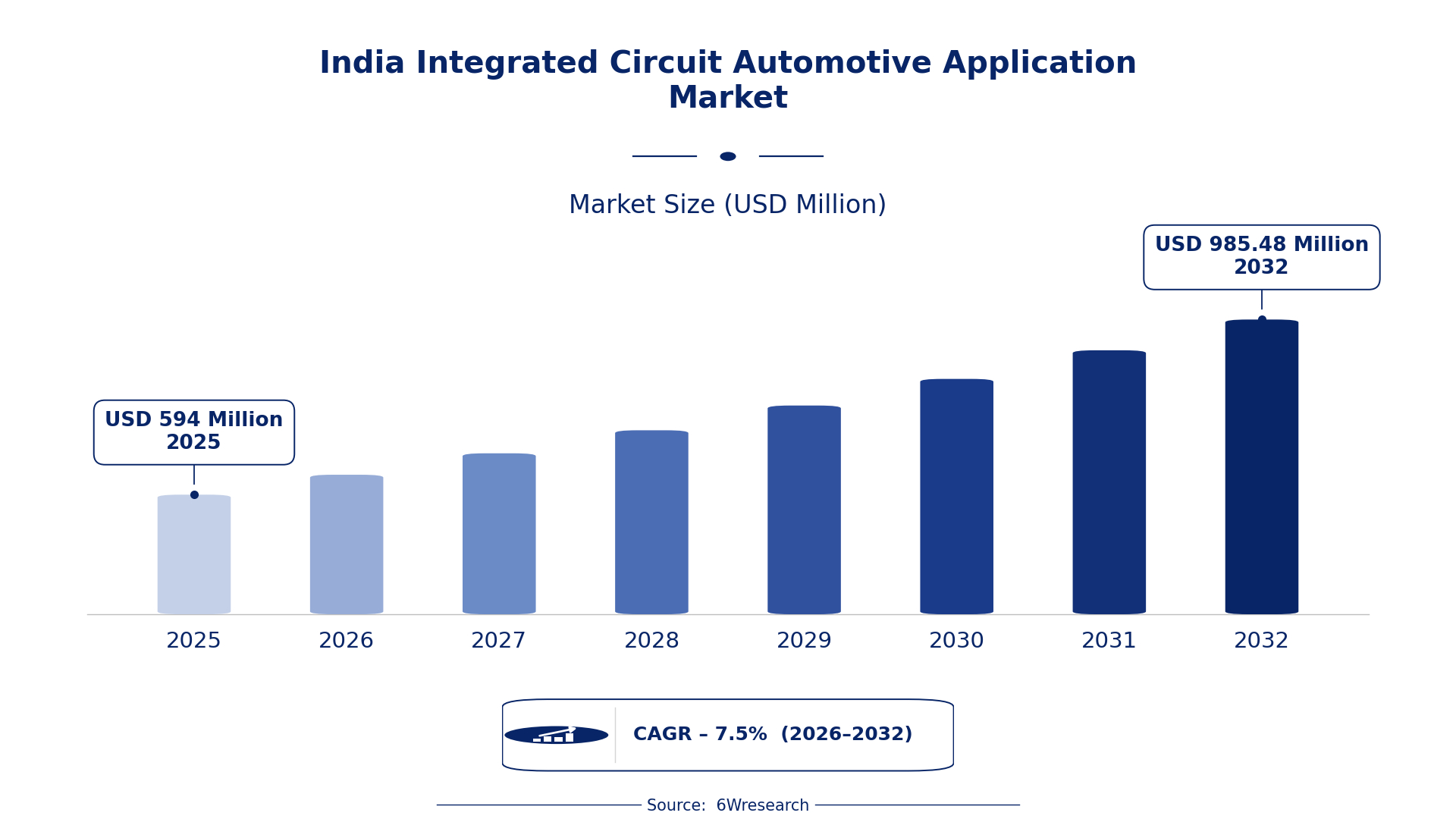
According to 6Wresearch internal database and industry insights, the India Integrated Circuit Automotive Application Market was valued at USD 594.0 million in 2025 and is projected to reach USD 985.48 million by 2032, growing at a CAGR of approximately 7.5% during 2026–2032.
India Integrated Circuit Automotive Application Market Highlights
| Report Metric | Details |
| Report Name | India Integrated Circuit Automotive Application Market |
| Market Size 2025 | USD 594.0 million |
| Market Size 2032 | USD 985.48 million |
| Absolute Growth 2025–2032 | USD 391.48 million |
| CAGR 2026–2032 | 7.5% |
| Peak Annual Growth | 9.7% in 2030 |
| Forecast Period | 2026–2032 |
| Historical Data | 2022–2025 |
| Base Year | 2025 |
| Leading IC Type, 2025 | Power Management ICs (47% share) |
| Leading Application Area, 2025 | ADAS (48% share) |
| Leading Vehicle Type, 2025 | Passenger Cars (50% share) |
| Leading Distribution Channel, 2025 | Tier-1 Suppliers (40% share) |
| Leading End User, 2025 | Automotive OEMs (44% share) |
| Fastest-Growing IC Type | Sensor ICs (9.9% CAGR) |
| Fastest-Growing Vehicle Type | Electric Vehicles (8.9% CAGR) |
| Fastest-Growing Distribution Channel | Distributors (9.1% CAGR) |
| Fastest-Growing End User | Telematics Providers (9.0% CAGR) |
| Growing Sector | ADAS |
| Key End Users | ADAS, Battery Management, Engine Control Units, Infotainment |
India Integrated Circuit Automotive Application Market Year-wise Growth Rate and Key Drivers (2022–2032)
This graph illustrates the annual growth rates of the market from 2022 to 2032, highlighting a steady upward trajectory and projected market expansion over the forecast period.
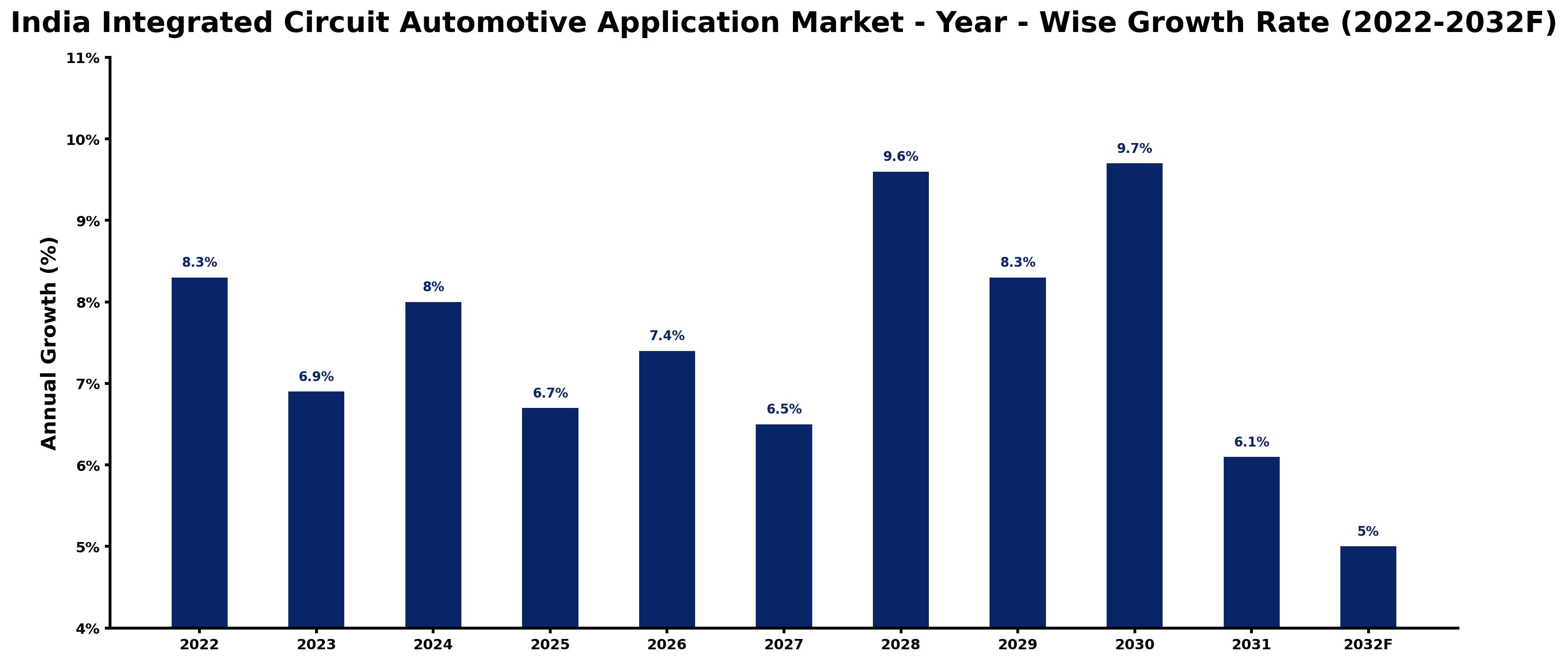
Annual growth estimates for each year appear below with the principal reason behind them, explaining the shifts that set the pace of the market.
| Year | Estimated Annual Growth (%) | Market Rationale |
| 2022 | 8.3 | The market experienced strong demand from automotive OEMs and increased production of passenger vehicles. |
| 2023 | 6.9 | Growth slowed due to supply chain disruptions affecting semiconductor availability for automotive applications. |
| 2024 | 8.0 | Demand increased as manufacturers adapted to supply chain challenges and ramped up production. |
| 2025 | 6.7 | Growth slowed again as the market adjusted to previous high demand levels and production constraints. |
| 2026 | 7.4 | An uptick in electric vehicle production is expected to boost demand for integrated circuits in automotive applications. |
| 2027 | 6.5 | Demand growth is projected to slow as manufacturers face challenges in sourcing raw materials for production. |
| 2028 | 9.6 | A surge in electric vehicle adoption will lead to increased demand for advanced integrated circuits. |
| 2029 | 8.3 | Growth is expected to moderate as the market stabilises after the rapid expansion of electric vehicle technologies. |
| 2030 | 9.7 | The market is projected to peak as electric vehicle penetration reaches new heights, driving demand for automotive ICs. |
| 2031 | 6.1 | Growth will slow as the market begins to normalise after the peak in electric vehicle sales. |
| 2032 | 5.0 | Demand is expected to continue growing but at a slower rate as the market adjusts to new production capacities. |
Note: Market size estimations and growth projections presented in this report are based on 6Wresearch's proprietary forecasting methodology, utilizing the latest available industry data, government publications, and primary research inputs.
India Integrated Circuit Automotive Application Market Synopsis
The India Integrated Circuit Automotive Application Market encompasses semiconductor devices designed to manage various vehicle functions, including power management and communication. These integrated circuits are essential for vehicle performance, safety, and entertainment systems. The market is growing due to rising investments in electric vehicles and increased production of passenger vehicles, with over 4 million units produced in 2022. The National Electric Mobility Mission Plan aims for 30% electric vehicle penetration by 2030, further driving demand for automotive ICs.
Market Dynamics Impact Analysis (2026–2032)
| Factor | Type | Impact | Primary Segment Affected |
| Rising investments in electric vehicles are boosting demand for integrated circuits essential for performance and safety features. | Driver | High | ADAS |
| The growing automotive electronics market, projected to grow at a CAGR of 12% from 2021 to 2026, is driving demand for ICs. | Driver | High | Passenger Cars |
| The increasing demand for electric vehicles creates opportunities for suppliers of advanced integrated circuits. | Opportunity | High | Electric Vehicles |
| The expanding automotive manufacturing hub in Maharashtra offers growth potential for integrated circuit suppliers. | Opportunity | Medium | Tier-1 Suppliers |
| Supply chain disruptions have impacted the availability of semiconductor components for automotive applications. | Restraint | High | Power Management ICs |
| The high cost of advanced semiconductor manufacturing limits the entry of new players in the market. | Restraint | Medium | Communication ICs |
| The market still has to solve a few problems, including supply chain issues affecting production timelines. | Challenge | High | Microcontrollers |
| Competition from international suppliers poses challenges for local manufacturers in pricing and technology. | Challenge | Medium | Sensor ICs |
Evaluation of Drivers in India Integrated Circuit Automotive Application Market (2026–2032)
Below mentioned are some major drivers and their influence on market dynamics.
| Drivers | Primary Segment Affected | Why It Matters (Evidence) |
| Rising investments in electric vehicles are increasing the demand for integrated circuits. | Electric Vehicles | The demand for electric vehicles is expected to reach 10 million units by 2030, driving purchases of automotive ICs. |
| The automotive electronics market is projected to grow, boosting demand for integrated circuits. | Passenger Cars | The automotive electronics market in India is expected to grow at a CAGR of 12% from 2021 to 2026, leading to more purchases. |
| The National Electric Mobility Mission Plan aims for 30% electric vehicle penetration by 2030, increasing demand for ICs. | ADAS | This initiative encourages manufacturers to invest in advanced safety features, increasing IC purchases. |
| The production-linked incentive scheme for the auto sector supports manufacturers achieving production targets, boosting demand. | Tier-1 Suppliers | The $3 billion scheme approved in 2021 incentivises production, leading to higher demand for automotive ICs. |
| The growing population in India drives demand for vehicles, increasing the need for integrated circuits. | Commercial Vehicles | With a population of approximately 1.4 billion, the automotive market continues to expand, boosting IC sales. |
Growth in the Integrated Circuit Automotive Application market in India comes from rising investments in electric vehicles, which boosts demand for advanced integrated circuits. The automotive electronics market is expected to grow significantly, increasing purchases of integrated circuits. The National Electric Mobility Mission Plan aims for 30% electric vehicle penetration by 2030, prompting manufacturers to invest in safety features. The $3 billion production-linked incentive scheme approved in 2021 supports manufacturers and increases demand for automotive ICs. India's large population continues to drive vehicle demand, creating a greater need for integrated circuits.
Evaluation of Restraints in India Integrated Circuit Automotive Application Market
The following restraints limit how fast demand can grow.
| Market Restraint | Primary Segment Affected | Why It Matters (Evidence) |
| Supply chain disruptions have affected the availability of semiconductor components for automotive applications. | Power Management ICs | The automotive industry produced over 4 million passenger vehicles in 2022, but supply chain issues limited IC availability. |
| The high cost of advanced semiconductor manufacturing limits the entry of new players in the market. | Communication ICs | Manufacturers face high costs in developing advanced ICs, restricting competition and innovation. |
| Limited local manufacturing capabilities hinder the supply of integrated circuits for the automotive sector. | Microcontrollers | The reliance on imports for semiconductor components can delay production timelines for automotive manufacturers. |
| Competition from international suppliers affects pricing strategies for local manufacturers. | Sensor ICs | Local manufacturers struggle to compete with lower-priced imports, impacting their market share. |
| The slow adoption of new technologies in traditional vehicles limits the demand for advanced ICs. | ADAS | Many manufacturers continue to focus on conventional technologies, reducing the urgency for advanced IC integration. |
India Integrated Circuit Automotive Application Market Challenges
The India Integrated Circuit Automotive Application Market still has to solve a few problems, starting with skills shortages among producers. Many manufacturers struggle to find qualified engineers, which delays product development and increases costs by up to 15% for those companies. Next, technology gaps hinder the adoption of advanced semiconductor processes, causing inefficiencies that can slow production by 20% for importers. Competition from global players pressures local firms to lower prices, often resulting in reduced margins of around 10% for buyers. Finally, fluctuating demand from buyers complicates inventory management, leading to delays in fulfilling orders and impacting the overall supply chain.
Trends in the India Integrated Circuit Automotive Application Market
The trends below show where the India Integrated Circuit Automotive Application Market is heading.
- Shift towards Electric Vehicles: The National Electric Mobility Mission Plan initiated a shift towards electric vehicles, aiming for 30% penetration by 2030. This change is driving demand for integrated circuits, with expectations of 10 million electric vehicles by 2030.
- Transition to Advanced Driver Assistance Systems: Since 2021, the automotive industry has increasingly focused on ADAS, improving vehicle safety and performance. This trend is reflected in the 48% share of ADAS in the application area of automotive ICs.
- Growth of Telematics in Vehicles: The rise of connectivity solutions in vehicles has led to increased demand for telematics providers. This segment is projected to grow at a CAGR of 9.0% from 2026 to 2032, indicating a shift in consumer preferences.
- Expansion of Tier-1 Suppliers: Maharashtra is becoming a hub for automotive manufacturing, with Tier-1 suppliers playing a key role in the supply chain. This region hosts numerous OEMs and suppliers, contributing to the growth of the integrated circuit market.
Investment Opportunities in the India Integrated Circuit Automotive Application Market
Investors looking at the India Integrated Circuit Automotive Application Market should consider the following areas.
- Maharashtra as a Manufacturing Hub: Maharashtra, hosting numerous OEMs, presents opportunities for integrated circuit suppliers to expand their reach. The automotive industry produced over 4 million passenger vehicles in 2022, highlighting the demand for ICs.
- Investment in Electric Vehicle Infrastructure: With the target of 10 million electric vehicles by 2030, there is a gap in infrastructure. Suppliers can invest in charging stations and related technologies to meet this demand.
- Supply of Advanced ICs for ADAS: The growing focus on safety features in vehicles creates opportunities for suppliers of advanced integrated circuits. Automotive OEMs are increasingly seeking solutions to improve vehicle safety.
- Partnerships with Automotive OEMs: Collaborating with automotive OEMs can provide access to the expanding market. Establishing joint ventures or partnerships can facilitate entry into the growing integrated circuit automotive application market.
Government Initiatives in the India Integrated Circuit Automotive Application Market
The National Electric Mobility Mission Plan 2021 promotes electric vehicle adoption with a target of 30% by 2030. This initiative encourages manufacturers to invest in electric vehicle technologies, increasing the demand for integrated circuits. Additionally, the Production-Linked Incentive Scheme for the Auto Sector offers incentives to manufacturers achieving specified production targets, supporting the automotive sector's growth.
The Bureau of Indian Standards oversees various schemes, including the FAME India Phase II, which provides subsidies for electric vehicle purchases. This scheme aims to increase the adoption of electric vehicles, directly impacting the demand for automotive integrated circuits. Furthermore, the Automotive Component Manufacturers Association of India represents over 800 manufacturers, facilitating collaboration and innovation within the sector.
Future Insight of the India Integrated Circuit Automotive Application Market
The India Integrated Circuit Automotive Application Market will see substantial changes by 2032, driven by the National Electric Mobility Mission Plan aiming for 30% electric vehicle adoption. This initiative will encourage local manufacturers to innovate and adopt advanced semiconductor technologies, improving vehicle performance and safety. The production-linked incentive scheme worth $3 billion will enhance manufacturing capabilities significantly. Demand for electric vehicles is projected to reach 10 million units by 2030, creating new opportunities for suppliers and expanding product offerings for buyers.
Market Segmentation Analysis
The report offers a comprehensive study of the following market segments and their leading categories in the market.
By IC Type – Power Management ICs Dominated, Sensor ICs Expected to Grow Fastest
According to Shubham Deep, Research Manager at 6Wresearch, Power Management ICs held a 47% share of the India Integrated Circuit Automotive Application Market by ic type in 2025. Power Management ICs dominate the market due to their essential function in regulating power within vehicles, which directly influences performance and efficiency. The substantial production of over 4 million passenger vehicles in 2022 highlights the ongoing demand for these critical components. The quickest growth will come from Sensor ICs, forecast to expand at a CAGR of 9.9% between 2026 and 2032. Sensor ICs are experiencing rapid growth as their importance in monitoring vehicle parameters becomes increasingly recognised, particularly with the rising focus on safety features. The expected demand for electric vehicles, projected to reach 10 million units by 2030, is likely to further drive this segment's expansion. Suppliers should focus on enhancing sensor technologies to meet the automotive market's evolving requirements.
By Application Area – ADAS Dominated and Is Expected to Record the Fastest Growth
ADAS took a 48% share of application area in 2025, more than any other category. ADAS leads the application area segment due to its crucial role in improving safety features in modern vehicles. Compliance with safety standards, such as those set by the Bureau of Indian Standards, significantly fuels the demand for ADAS solutions. The same category is also set to grow fastest, at a CAGR of 8.9% during 2026–2032. ADAS is also the fastest-growing application area, spurred by the automotive industry's heightened focus on safety and connectivity. Government initiatives promoting electric vehicles will likely accelerate the integration of ADAS technologies into these models. Suppliers must invest in ADAS technologies to stay competitive in the rapidly changing automotive landscape.
By Vehicle Type – Passenger Cars Dominated, Electric Vehicles Expected to Grow Fastest
In 2025, Passenger Cars led the vehicle type split with a 50% share. Passenger Cars dominate the vehicle type segment, largely due to their widespread acceptance among consumers and manufacturers. The substantial production figure of over 4 million passenger vehicles in 2022 highlights their significance in the automotive IC market. Over 2026–2032, Electric Vehicles are expected to post the fastest growth, at a CAGR of 8.9%. Electric Vehicles represent the fastest-growing segment, reflecting a shift towards sustainable transportation solutions. The National Electric Mobility Mission Plan's goal of achieving 30% electric vehicle penetration by 2030 indicates strong future growth potential. Suppliers should recalibrate their strategies to meet the rising demand for components tailored for electric vehicles.
By Distribution Channel – Tier-1 Suppliers Dominated, Distributors Expected to Grow Fastest
The largest distribution channel category in 2025 was Tier-1 Suppliers, with a 40% share of total revenue. Tier-1 Suppliers are the main distributors of integrated circuits to original equipment manufacturers, making them a vital part of the supply chain. Their established relationships with OEMs ensure a steady demand for automotive ICs across the industry. Distributors are projected to grow fastest, at a CAGR of 9.1% during 2026–2032. Distributors are witnessing the fastest growth as they are crucial in linking manufacturers with end-users, thereby enhancing the supply chain for automotive ICs. Their role in facilitating these connections is becoming increasingly important in a growing market. This trend indicates that suppliers may need to strengthen their partnerships with distributors to enhance market access.
By End User – Automotive OEMs Dominated, Telematics Providers Expected to Grow Fastest
With a 44% revenue share in 2025, Automotive OEMs was the largest end user category. Automotive OEMs are the leading end users of automotive integrated circuits, as they directly incorporate these components into their vehicle designs. The large scale of the automotive industry, employing over 37 million people, ensures a consistent demand for ICs. The quickest growth will come from Telematics Providers, forecast to expand at a CAGR of 9.0% between 2026 and 2032. Telematics Providers are experiencing the fastest growth, driven by the rising demand for connectivity solutions in vehicles. The increasing integration of telematics in both traditional and electric vehicles highlights the need for advanced ICs. This shift indicates that suppliers should focus on developing products tailored for telematics applications.
Key Attractiveness of the Report
- 10 Years of Market Numbers
- Historical Data Starting from 2022 to 2025
- Base Year 2025
- Forecast Data until 2032
- Key Performance Indicators Impacting the Market
- Major Upcoming Developments and Projects
Key Highlights of the Report:
- India Integrated Circuit Automotive Application Market Outlook
- Market Size of India Integrated Circuit Automotive Application Market, 2025
- Forecast of India Integrated Circuit Automotive Application Market, 2032
- Historical Data and Forecast of India Integrated Circuit Automotive Application Revenues & Volume for the Period 2022 - 2032F
- India Integrated Circuit Automotive Application Market Trend Evolution
- India Integrated Circuit Automotive Application Market Drivers and Challenges
- India Integrated Circuit Automotive Application Price Trends
- India Integrated Circuit Automotive Application Porter's Five Forces
- India Integrated Circuit Automotive Application Industry Life Cycle
- Historical Data and Forecast of India Integrated Circuit Automotive Application Market Revenues & Volume By IC Type for the Period 2022 - 2032F
- Historical Data and Forecast of India Integrated Circuit Automotive Application Market Revenues & Volume By Power Management ICs for the Period 2022 - 2032F
- Historical Data and Forecast of India Integrated Circuit Automotive Application Market Revenues & Volume By Sensor ICs for the Period 2022 - 2032F
- Historical Data and Forecast of India Integrated Circuit Automotive Application Market Revenues & Volume By Communication ICs for the Period 2022 - 2032F
- Historical Data and Forecast of India Integrated Circuit Automotive Application Market Revenues & Volume By Microcontrollers for the Period 2022 - 2032F
- Historical Data and Forecast of India Integrated Circuit Automotive Application Market Revenues & Volume By Application Area for the Period 2022 - 2032F
- Historical Data and Forecast of India Integrated Circuit Automotive Application Market Revenues & Volume By Battery Management for the Period 2022 - 2032F
- Historical Data and Forecast of India Integrated Circuit Automotive Application Market Revenues & Volume By ADAS for the Period 2022 - 2032F
- Historical Data and Forecast of India Integrated Circuit Automotive Application Market Revenues & Volume By Infotainment for the Period 2022 - 2032F
- Historical Data and Forecast of India Integrated Circuit Automotive Application Market Revenues & Volume By Engine Control Units for the Period 2022 - 2032F
- Historical Data and Forecast of India Integrated Circuit Automotive Application Market Revenues & Volume By Vehicle Type for the Period 2022 - 2032F
- Historical Data and Forecast of India Integrated Circuit Automotive Application Market Revenues & Volume By Electric Vehicles for the Period 2022 - 2032F
- Historical Data and Forecast of India Integrated Circuit Automotive Application Market Revenues & Volume By SUVs for the Period 2022 - 2032F
- Historical Data and Forecast of India Integrated Circuit Automotive Application Market Revenues & Volume By Passenger Cars for the Period 2022 - 2032F
- Historical Data and Forecast of India Integrated Circuit Automotive Application Market Revenues & Volume By Commercial Vehicles for the Period 2022 - 2032F
- Historical Data and Forecast of India Integrated Circuit Automotive Application Market Revenues & Volume By Distribution Channel for the Period 2022 - 2032F
- Historical Data and Forecast of India Integrated Circuit Automotive Application Market Revenues & Volume By Tier-1 Suppliers for the Period 2022 - 2032F
- Historical Data and Forecast of India Integrated Circuit Automotive Application Market Revenues & Volume By Distributors for the Period 2022 - 2032F
- Historical Data and Forecast of India Integrated Circuit Automotive Application Market Revenues & Volume By Online Platforms for the Period 2022 - 2032F
- Historical Data and Forecast of India Integrated Circuit Automotive Application Market Revenues & Volume By Semiconductor Vendors for the Period 2022 - 2032F
- Historical Data and Forecast of India Integrated Circuit Automotive Application Market Revenues & Volume By End User for the Period 2022 - 2032F
- Historical Data and Forecast of India Integrated Circuit Automotive Application Market Revenues & Volume By Automotive OEMs for the Period 2022 - 2032F
- Historical Data and Forecast of India Integrated Circuit Automotive Application Market Revenues & Volume By Electronics Assemblers for the Period 2022 - 2032F
- Historical Data and Forecast of India Integrated Circuit Automotive Application Market Revenues & Volume By ECU Manufacturers for the Period 2022 - 2032F
- Historical Data and Forecast of India Integrated Circuit Automotive Application Market Revenues & Volume By Telematics Providers for the Period 2022 - 2032F
- India Integrated Circuit Automotive Application Import Export Trade Statistics
- Market Opportunity Assessment By IC Type
- Market Opportunity Assessment By Application Area
- Market Opportunity Assessment By Vehicle Type
- Market Opportunity Assessment By Distribution Channel
- Market Opportunity Assessment By End User
- India Integrated Circuit Automotive Application Top Companies Market Share
- India Integrated Circuit Automotive Application Competitive Benchmarking By Technical and Operational Parameters
- India Integrated Circuit Automotive Application Company Profiles
- India Integrated Circuit Automotive Application Key Strategic Recommendations
Market Covered
Segments analysed in this report are listed below.
By IC Type
- Power Management ICs
- Sensor ICs
- Communication ICs
- Microcontrollers
By Application Area
- Battery Management
- ADAS
- Infotainment
- Engine Control Units
By Vehicle Type
- Electric Vehicles
- SUVs
- Passenger Cars
- Commercial Vehicles
By Distribution Channel
- Tier-1 Suppliers
- Distributors
- Online Platforms
- Semiconductor Vendors
By End User
- Automotive OEMs
- Electronics Assemblers
- ECU Manufacturers
- Telematics Providers































