India IoT Antenna Market Size & Growth Rate
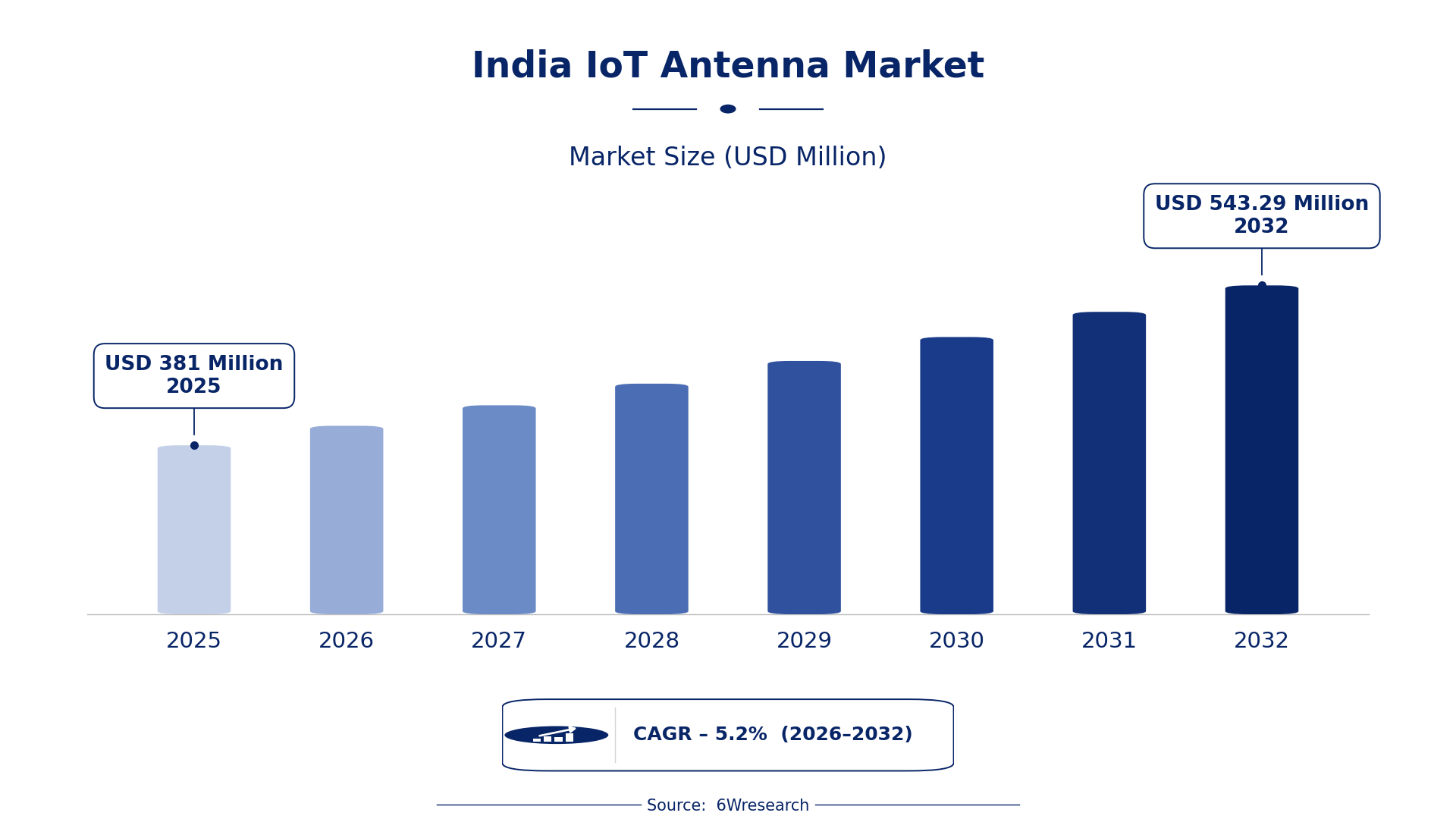
According to 6Wresearch internal database and industry insights, the India IoT Antenna Market was valued at USD 381.0 million in 2025 and is projected to reach USD 543.29 million by 2032, growing at a CAGR of approximately 5.2% during 2026–2032.
India IoT Antenna Market Highlights
| Report Metric | Details |
| Report Name | India IoT Antenna Market |
| Market Size 2025 | USD 381.0 million |
| Market Size 2032 | USD 543.29 million |
| Absolute Growth 2025–2032 | USD 162.29 million |
| CAGR 2026–2032 | 5.2% |
| Peak Annual Growth | 7.5% in 2026 |
| Forecast Period | 2026–2032 |
| Historical Data | 2022–2025 |
| Base Year | 2025 |
| Leading Antenna Type, 2025 | PCB Antennas (53% share) |
| Leading Frequency Band, 2025 | Sub-GHz (48% share) |
| Leading Application Area, 2025 | Industrial IoT (45% share) |
| Leading Connectivity Standard, 2025 | LoRaWAN (39% share) |
| Leading End User, 2025 | IoT Device Makers (49% share) |
| Fastest-Growing Antenna Type | Chip Antennas (7.4% CAGR) |
| Fastest-Growing Frequency Band | NB-IoT (6.4% CAGR) |
| Fastest-Growing Connectivity Standard | Bluetooth (7.3% CAGR) |
| Fastest-Growing End User | Industrial Integrators (6.3% CAGR) |
| Growing Sector | Industrial IoT |
| Key End Users | Industrial IoT, Smart Meters, Wearables, Asset Tracking Devices |
India IoT Antenna Market Year-wise Growth Rate and Key Drivers (2022–2032)
This graph illustrates the annual growth rates of the market from 2022 to 2032, highlighting a steady upward trajectory and projected market expansion over the forecast period.
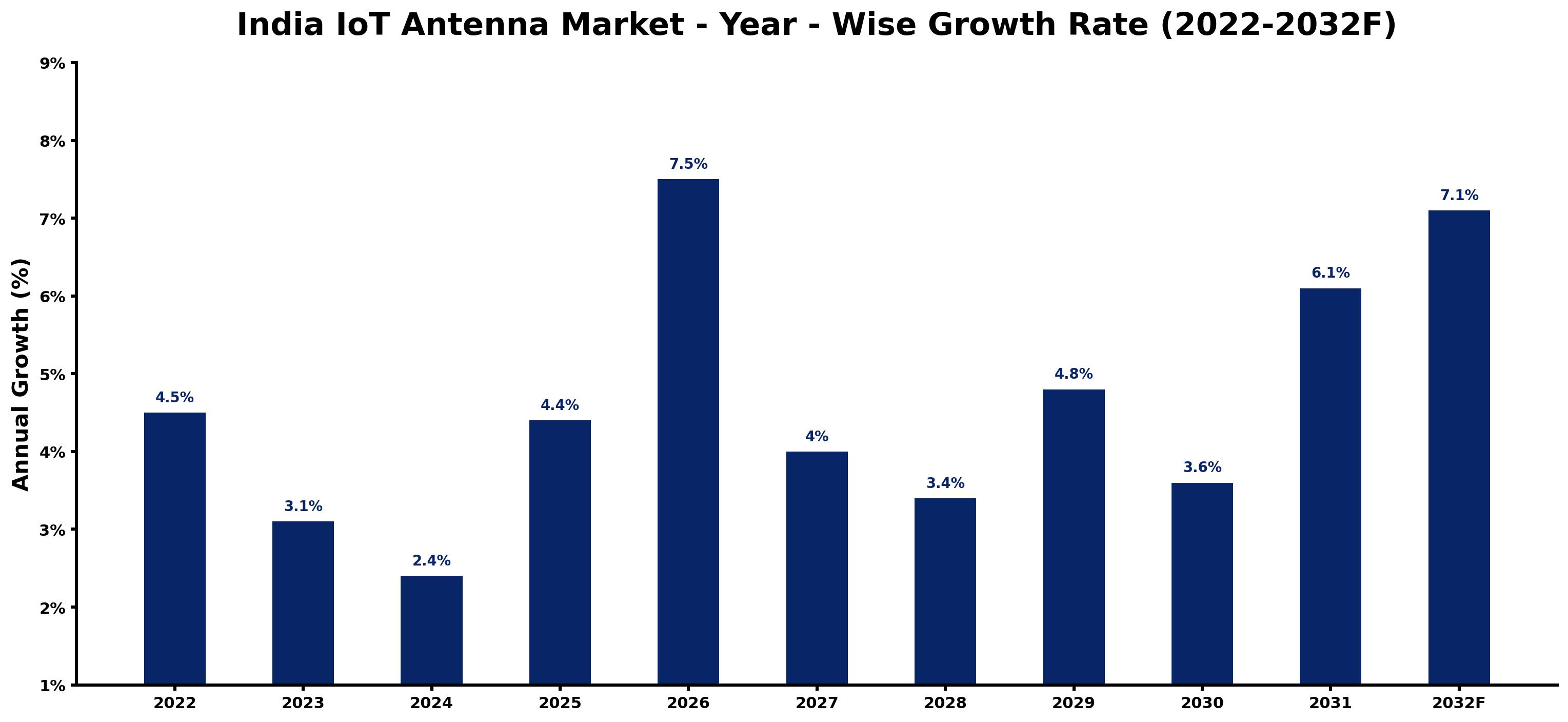
Year by year, the estimates below pair each growth rate with the development that shaped it.
| Year | Estimated Annual Growth (%) | Market Rationale |
| 2022 | 4.5 | The market experienced steady growth, driven by increasing demand from IoT device makers. |
| 2023 | 3.1 | Growth slowed due to market adjustments and the impact of global supply chain challenges. |
| 2024 | 2.4 | The market continued to grow, albeit at a slower pace, influenced by ongoing technological advancements. |
| 2025 | 4.4 | Demand surged as the smart meter market expanded, boosting antenna requirements significantly. |
| 2026 | 7.5 | The market peaked with accelerated growth, driven by increased adoption in industrial IoT applications. |
| 2027 | 4.0 | Growth slowed as the market began to stabilise following the rapid expansion of the previous year. |
| 2028 | 3.4 | The market experienced further deceleration, reflecting a normalisation after peak demand. |
| 2029 | 4.8 | Demand rebounded, supported by renewed investments in smart city projects across India. |
| 2030 | 3.6 | Growth slowed again, as market dynamics adjusted to the evolving technology landscape. |
| 2031 | 6.1 | The market saw a resurgence in growth, driven by increasing demand from industrial integrators. |
| 2032 | 7.1 | Growth accelerated once more, fuelled by the ongoing expansion of IoT connectivity across sectors. |
Note: Market size estimations and growth projections presented in this report are based on 6Wresearch's proprietary forecasting methodology, utilizing the latest available industry data, government publications, and primary research inputs.
India IoT Antenna Market Synopsis
The IoT Antenna Market in India includes specialized devices that facilitate wireless communication for Internet of Things applications. These antennas play a key role in transmitting data for smart meters, wearables, and industrial IoT applications. The market is expanding rapidly, driven by the increasing deployment of IoT devices, with over 100 million expected by 2025. Initiatives like the Smart Cities Mission and rising investments in industrial automation are propelling growth. The average internet penetration of around 50% further supports this upward trend.
Market Dynamics Impact Analysis (2026–2032)
| Factor | Type | Impact | Primary Segment Affected |
| Increasing deployment of IoT devices in smart cities | Driver | High | IoT Device Makers |
| Growing demand for industrial automation solutions | Driver | High | Industrial IoT |
| Expansion of smart meter installations | Opportunity | High | Smart Meters |
| Rising need for low-power wide-area network solutions | Opportunity | High | NB-IoT |
| Challenges in supply chain logistics affecting production | Restraint | High | PCB Antennas |
| Limited availability of skilled professionals in IoT | Restraint | Medium | Chip Antennas |
| Regulatory hurdles impacting deployment timelines | Challenge | High | Embedded Antennas |
| Competition from alternative communication technologies | Challenge | Medium | Patch Antennas |
Evaluation of Drivers in India IoT Antenna Market (2026–2032)
The factors lifting demand, and the evidence behind each, are summarised below.
| Drivers | Primary Segment Affected | Why It Matters (Evidence) |
| Rising investments in smart city projects | Industrial IoT | This investment increases demand for IoT antennas, particularly in urban infrastructure, with a budget of $1.2 billion. |
| Expansion of smart meter installations | Smart Meters | This growth raises the need for antennas in utility applications, projected to grow at a CAGR of 30%. |
| Growing adoption of low-power wide-area networks | NB-IoT | This trend improves connectivity in remote areas, increasing antenna purchases by telecommunications providers. |
| Increased focus on industrial automation | IoT Device Makers | As industries automate, the need for reliable IoT antennas rises, leading to increased purchases. |
| Development of new IoT standards | LoRaWAN | The adoption of these standards drives demand for compatible antennas across various applications. |
The IoT Antenna market in India is growing on the back of rising investments in smart city projects, expanding industrial automation, and increasing adoption of low-power wide-area networks. The smart meter market is projected to grow at a CAGR of 30%, boosting antenna demand significantly. The focus on industrial automation is driving IoT device makers to invest in reliable antennas, leading to more purchases. The development of new IoT standards is also contributing to this growth by creating demand for compatible antennas across various applications. With over 100 million IoT devices expected by 2025, the market is positioned for substantial expansion.
Evaluation of Restraints in India IoT Antenna Market
The main factors holding the market back are set out below.
| Market Restraint | Primary Segment Affected | Why It Matters (Evidence) |
| Supply chain disruptions affecting component availability | PCB Antennas | These disruptions have led to delays in production schedules, impacting delivery timelines. |
| Shortage of skilled professionals in the IoT sector | Chip Antennas | This shortage hampers the ability to meet growing demand for IoT solutions, potentially reducing output by 20%. |
| Regulatory hurdles impacting deployment timelines | Embedded Antennas | Complex regulations can delay the introduction of new IoT products to the market, affecting rollout schedules. |
| Competition from alternative communication technologies | Patch Antennas | Emerging technologies may divert attention and investment from traditional IoT solutions, limiting market share. |
| High costs associated with advanced antenna technologies | NB-IoT | These costs can limit adoption among smaller manufacturers and startups, restricting market growth. |
India IoT Antenna Market Challenges
The India IoT Antenna Market faces several practical issues, starting with intense competition among manufacturers. This competition drives prices down, making it challenging for producers to maintain profit margins and invest in product development. The rapid pace of technology evolution creates challenges for suppliers who must continuously upgrade their offerings, resulting in delays and increasing costs by up to 15% for manufacturers. A shortage of skilled professionals hampers production capabilities, with training programs still being developed, potentially leading to a 20% reduction in output for some producers. Evolving regulatory guidelines from the Telecom Regulatory Authority of India can slow deployment timelines for buyers, affecting their ability to roll out IoT solutions efficiently.
Trends in the India IoT Antenna Market
Below mentioned are some of the trends shaping the India IoT Antenna Market growth.
- Smart Cities Mission Accelerating IoT Integration: The Smart Cities Mission, initiated in 2015, is enhancing the integration of IoT solutions in urban infrastructure. With a budget of $1.2 billion, this initiative aims to improve connectivity and services across cities.
- Shift Towards Low-Power Wide-Area Networks: There is a growing shift towards low-power wide-area networks, particularly NB-IoT, for IoT applications. This trend supports the deployment of over 100 million IoT devices by 2025.
- Increased Focus on Industrial IoT: The industrial IoT sector is gaining momentum, with significant investments aimed at improving automation and efficiency. This area is projected to grow at a CAGR of 6.3% through 2032.
- Rise of Bluetooth in Consumer Electronics: Bluetooth technology is emerging as a leading connectivity standard for consumer electronics. Its adoption is expected to grow at a CAGR of 7.3%, reflecting its increasing use in wearables.
Investment Opportunities in the India IoT Antenna Market
The following opportunities in the India IoT Antenna Market pair current demand with a clear way in.
- Supply of IoT Antennas for Smart Meters: With the smart meter market expected to grow at a CAGR of 30%, there is an opportunity to supply IoT antennas. Targeting utilities and energy companies can facilitate market entry.
- Investment in NB-IoT Solutions: The anticipated deployment of over 100 million IoT devices by 2025 presents an opportunity to invest in NB-IoT solutions. Targeting telecommunications providers can create strategic partnerships.
- Creating Training Programs for IoT Professionals: With a shortage of skilled professionals, there is an opportunity to develop training programs. Collaborating with educational institutions can improve workforce capabilities in the IoT sector.
- Expansion of Industrial IoT Solutions: The growing demand for industrial IoT applications offers opportunities for suppliers. Focusing on manufacturing hubs can facilitate entry into this expanding market.
Government Initiatives in the India IoT Antenna Market
The National IoT Policy, launched by the Ministry of Electronics and Information Technology in 2021, aims to promote IoT innovation and development across various sectors. The Digital India initiative, started in 2015, also focuses on improving digital infrastructure and services, which includes IoT technologies. The Smart Cities Mission, initiated in 2015 with a budget of $1.2 billion, aims to integrate IoT solutions into urban infrastructure. These measures support the growth of the IoT antenna market by creating an environment conducive to innovation and investment.
The Ministry of Electronics and Information Technology (MeitY) is responsible for approving and funding initiatives that improve IoT connectivity and infrastructure development. The Electronics Sector Skill Council of India (ESSCI) launched a training program in 2022 to address the skills gap in the sector, ensuring a workforce capable of supporting the increasing need for IoT solutions. The Bureau of Indian Standards (BIS) is developing standards for IoT devices and antennas, which will help ensure quality and reliability in the market.
Future Insight of the India IoT Antenna Market
The India IoT Antenna Market is set for substantial growth by 2032, driven by several key factors. The government's Smart Cities Mission will continue to promote IoT solutions, facilitating deployment across urban areas. By 2025, over 100 million IoT devices are expected to be operational, creating strong demand for antennas. Training initiatives by the Electronics Sector Skill Council of India will help bridge the skills gap, ensuring a steady supply of qualified professionals. The establishment of standards by the Bureau of Indian Standards will improve product reliability and safety, providing assurance for both buyers and suppliers.
Market Segmentation Analysis
The report offers a comprehensive study of the following market segments and their leading categories in the market.
By Antenna Type – PCB Antennas Dominated, Chip Antennas Expected to Grow Fastest
According to Shubham Deep, Research Manager at 6Wresearch, in 2025, PCB Antennas led the antenna type split with a 53% share. PCB antennas hold the largest market share due to their widespread use in various IoT devices, particularly for compact designs. Their versatility makes them ideal for applications ranging from smart meters to industrial automation. The quickest growth will come from Chip Antennas, forecast to expand at a CAGR of 7.4% between 2026 and 2032. Chip antennas are experiencing rapid growth because they are preferred for small form factor applications, especially in wearables. With over 100 million IoT devices expected to be deployed in India by 2025, the demand for compact solutions will continue to rise. Suppliers should focus on developing compact antenna solutions to meet the increasing demand from IoT device manufacturers.
By Frequency Band – Sub-GHz Dominated, NB-IoT Expected to Grow Fastest
The largest frequency band category in 2025 was Sub-GHz, with a 48% share of total revenue. Sub-GHz frequency bands hold the largest market share due to their critical role in long-range IoT communications, particularly in applications like smart agriculture. This frequency band is essential for ensuring extensive coverage in regions where connectivity is paramount. Over 2026–2032, NB-IoT is expected to post the fastest growth, at a CAGR of 6.4%. NB-IoT is experiencing rapid growth as it is essential for low-power wide-area network applications, aligning with the government's goal to connect 1 billion devices by 2025. This focus on connectivity will further solidify NB-IoT's position in the market. Suppliers should prioritise NB-IoT solutions to align with the government's ambitious connectivity goals.
By Application Area – Industrial IoT Dominated and Is Expected to Record the Fastest Growth
Industrial IoT took a 45% share of application area in 2025, more than any other category. Industrial IoT holds the largest market share due to its critical role in enhancing operational efficiency across various sectors. The growing demand for antennas in industrial applications, particularly in manufacturing and logistics, showcases the sector's robust adoption of IoT technologies. Industrial IoT is also forecast to expand faster than any other category, at a CAGR of 6.3% over 2026–2032. Industrial IoT is also experiencing the fastest growth, propelled by substantial investments in automation and smart technologies. As industries increasingly adopt IoT solutions, the demand for reliable antennas will continue to expand this segment's market position. Suppliers should focus on developing advanced antenna solutions tailored for industrial IoT applications to seize the growing opportunities.
By Connectivity Standard – LoRaWAN Dominated, Bluetooth Expected to Grow Fastest
LoRaWAN accounted for a 39% market share by connectivity standard in 2025. LoRaWAN leads in market share as it is a preferred connectivity standard for long-range IoT applications, essential for sectors needing extensive coverage. Its ability to facilitate communication over large distances makes it a vital choice for smart city initiatives and industrial applications. Bluetooth is set to record the highest CAGR in this split, 7.3% over 2026–2032. Bluetooth is the fastest-growing connectivity standard, largely due to its widespread use in consumer electronics and wearables. The increasing integration of Bluetooth technology in IoT devices will significantly boost growth in this segment. Suppliers should prioritise the development of Bluetooth-compatible antennas to align with the rising demand from consumer electronics and IoT applications.
By End User – IoT Device Makers Dominated, Industrial Integrators Expected to Grow Fastest
With a 49% revenue share in 2025, IoT Device Makers was the largest end user category. IoT device makers command the largest market share as they are the primary users of IoT antennas, underscoring their essential role in the IoT ecosystem. The anticipated surge in IoT device deployments in India highlights the significance of this user segment for antenna suppliers. The quickest growth will come from Industrial Integrators, forecast to expand at a CAGR of 6.3% between 2026 and 2032. Industrial integrators represent the fastest-growing end user group, as they are pivotal in implementing IoT solutions across various sectors. The ongoing push for smart technologies in industries will further accelerate the growth of this segment, reinforcing the dominance of IoT device makers. Suppliers should strategically engage with industrial integrators to ensure their antenna solutions meet the specific requirements of the evolving IoT landscape.
Key Attractiveness of the Report
- 10 Years of Market Numbers
- Historical Data Starting from 2022 to 2025
- Base Year 2025
- Forecast Data until 2032
- Key Performance Indicators Impacting the Market
- Major Upcoming Developments and Projects
Key Highlights of the Report:
- India IoT Antenna Market Outlook
- Market Size of India IoT Antenna Market, 2025
- Forecast of India IoT Antenna Market, 2032
- Historical Data and Forecast of India IoT Antenna Revenues & Volume for the Period 2022 - 2032F
- India IoT Antenna Market Trend Evolution
- India IoT Antenna Market Drivers and Challenges
- India IoT Antenna Price Trends
- India IoT Antenna Porter's Five Forces
- India IoT Antenna Industry Life Cycle
- Historical Data and Forecast of India IoT Antenna Market Revenues & Volume By Antenna Type for the Period 2022 - 2032F
- Historical Data and Forecast of India IoT Antenna Market Revenues & Volume By PCB Antennas for the Period 2022 - 2032F
- Historical Data and Forecast of India IoT Antenna Market Revenues & Volume By Chip Antennas for the Period 2022 - 2032F
- Historical Data and Forecast of India IoT Antenna Market Revenues & Volume By Patch Antennas for the Period 2022 - 2032F
- Historical Data and Forecast of India IoT Antenna Market Revenues & Volume By Embedded Antennas for the Period 2022 - 2032F
- Historical Data and Forecast of India IoT Antenna Market Revenues & Volume By Frequency Band for the Period 2022 - 2032F
- Historical Data and Forecast of India IoT Antenna Market Revenues & Volume By Sub-GHz for the Period 2022 - 2032F
- Historical Data and Forecast of India IoT Antenna Market Revenues & Volume By 2.4 GHz for the Period 2022 - 2032F
- Historical Data and Forecast of India IoT Antenna Market Revenues & Volume By 5 GHz for the Period 2022 - 2032F
- Historical Data and Forecast of India IoT Antenna Market Revenues & Volume By NB-IoT for the Period 2022 - 2032F
- Historical Data and Forecast of India IoT Antenna Market Revenues & Volume By Application Area for the Period 2022 - 2032F
- Historical Data and Forecast of India IoT Antenna Market Revenues & Volume By Smart Meters for the Period 2022 - 2032F
- Historical Data and Forecast of India IoT Antenna Market Revenues & Volume By Wearables for the Period 2022 - 2032F
- Historical Data and Forecast of India IoT Antenna Market Revenues & Volume By Industrial IoT for the Period 2022 - 2032F
- Historical Data and Forecast of India IoT Antenna Market Revenues & Volume By Asset Tracking Devices for the Period 2022 - 2032F
- Historical Data and Forecast of India IoT Antenna Market Revenues & Volume By Connectivity Standard for the Period 2022 - 2032F
- Historical Data and Forecast of India IoT Antenna Market Revenues & Volume By LoRaWAN for the Period 2022 - 2032F
- Historical Data and Forecast of India IoT Antenna Market Revenues & Volume By Bluetooth, Zigbee for the Period 2022 - 2032F
- Historical Data and Forecast of India IoT Antenna Market Revenues & Volume By Wi-Fi for the Period 2022 - 2032F
- Historical Data and Forecast of India IoT Antenna Market Revenues & Volume By Cellular IoT for the Period 2022 - 2032F
- Historical Data and Forecast of India IoT Antenna Market Revenues & Volume By End User for the Period 2022 - 2032F
- Historical Data and Forecast of India IoT Antenna Market Revenues & Volume By IoT Device Makers for the Period 2022 - 2032F
- Historical Data and Forecast of India IoT Antenna Market Revenues & Volume By Consumer OEMs for the Period 2022 - 2032F
- Historical Data and Forecast of India IoT Antenna Market Revenues & Volume By Industrial Integrators for the Period 2022 - 2032F
- Historical Data and Forecast of India IoT Antenna Market Revenues & Volume By GPS Equipment Vendors for the Period 2022 - 2032F
- India IoT Antenna Import Export Trade Statistics
- Market Opportunity Assessment By Antenna Type
- Market Opportunity Assessment By Frequency Band
- Market Opportunity Assessment By Application Area
- Market Opportunity Assessment By Connectivity Standard
- Market Opportunity Assessment By End User
- India IoT Antenna Top Companies Market Share
- India IoT Antenna Competitive Benchmarking By Technical and Operational Parameters
- India IoT Antenna Company Profiles
- India IoT Antenna Key Strategic Recommendations
Market Covered
Segments analysed in this report are listed below.
By Antenna Type
- PCB Antennas
- Chip Antennas
- Patch Antennas
- Embedded Antennas
By Frequency Band
- Sub-GHz
- 2.4 GHz
- 5 GHz
- NB-IoT
By Application Area
- Smart Meters
- Wearables
- Industrial IoT
- Asset Tracking Devices
By Connectivity Standard
- LoRaWAN
- Bluetooth
- Zigbee
- Wi-Fi
- Cellular IoT
By End User
- IoT Device Makers
- Consumer OEMs
- Industrial Integrators
- GPS Equipment Vendors































