India IoT-Based Transit Monitoring Market Size & Growth Rate
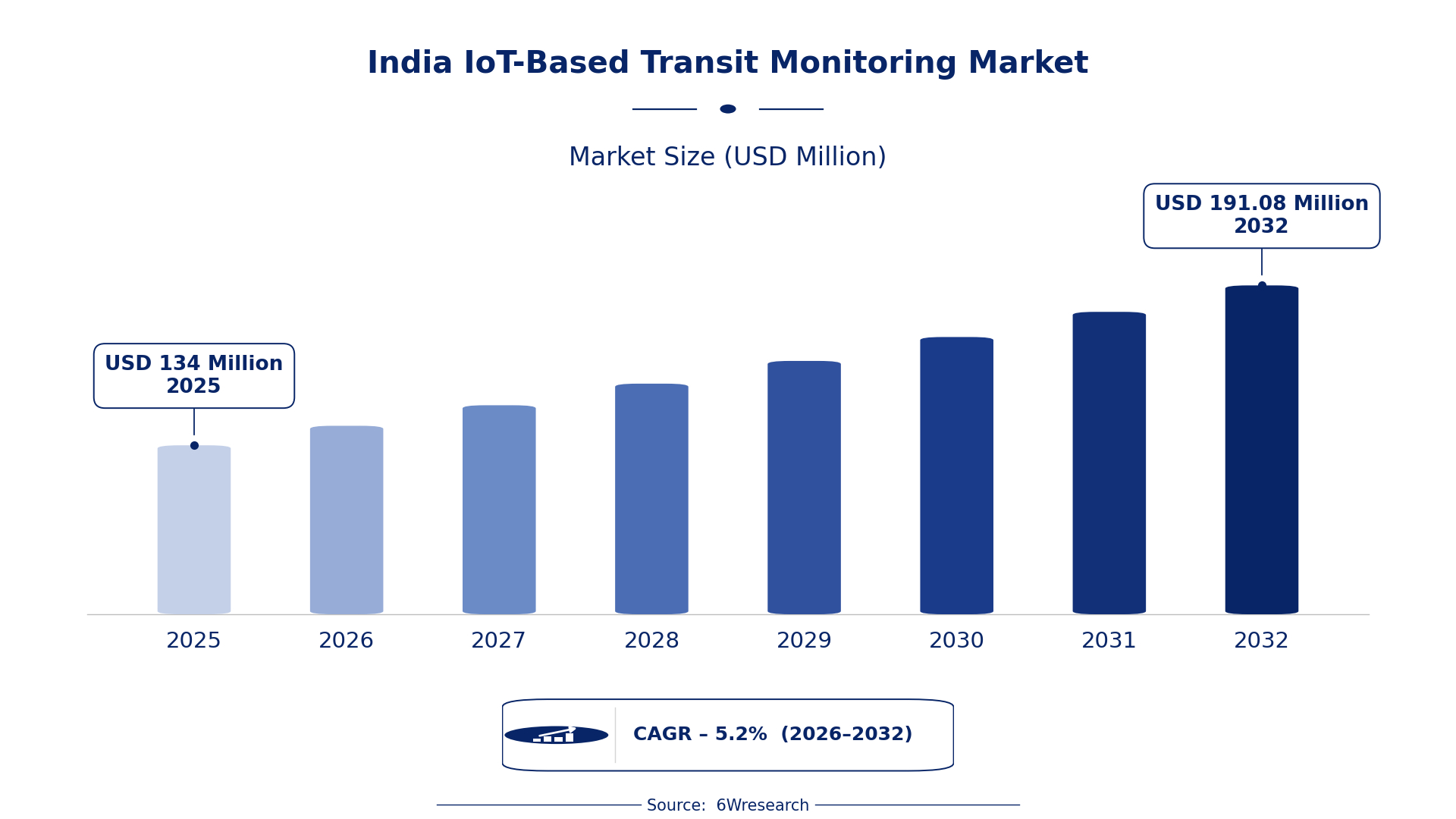
According to 6Wresearch internal database and industry insights, the India IoT-Based Transit Monitoring Market was valued at USD 134.0 million in 2025 and is projected to reach USD 191.08 million by 2032, growing at a CAGR of approximately 5.2% during 2026–2032.
India IoT-Based Transit Monitoring Market Highlights
| Report Metric | Details |
| Report Name | India IoT-Based Transit Monitoring Market |
| Market Size 2025 | USD 134.0 million |
| Market Size 2032 | USD 191.08 million |
| Absolute Growth 2025–2032 | USD 57.08 million |
| CAGR 2026–2032 | 5.2% |
| Peak Annual Growth | 7.3% in 2028 |
| Forecast Period | 2026–2032 |
| Historical Data | 2022–2025 |
| Base Year | 2025 |
| Leading Monitoring Type, 2025 | GPS + Video Analytics (40% share) |
| Leading Connectivity Method, 2025 | LTE/5G (42% share) |
| Leading Vehicle Type, 2025 | Public Buses (48% share) |
| Leading Data Usage, 2025 | Real-Time Navigation (38% share) |
| Leading End User, 2025 | Transit Authorities (50% share) |
| Fastest-Growing Monitoring Type | Telematics Tracking (6.6% CAGR) |
| Fastest-Growing Vehicle Type | School Buses (7.9% CAGR) |
| Fastest-Growing Data Usage | Speed/Route Tracking (6.6% CAGR) |
| Fastest-Growing End User | Fleet Managers (7.3% CAGR) |
| Growing Sector | Fleet Managers |
| Key End Users | Transit Authorities, Metro Operators, Fleet Managers, School Districts |
India IoT-Based Transit Monitoring Market Year-wise Growth Rate and Key Drivers (2022–2032)
This graph illustrates the annual growth rates of the market from 2022 to 2032, highlighting a steady upward trajectory and projected market expansion over the forecast period.
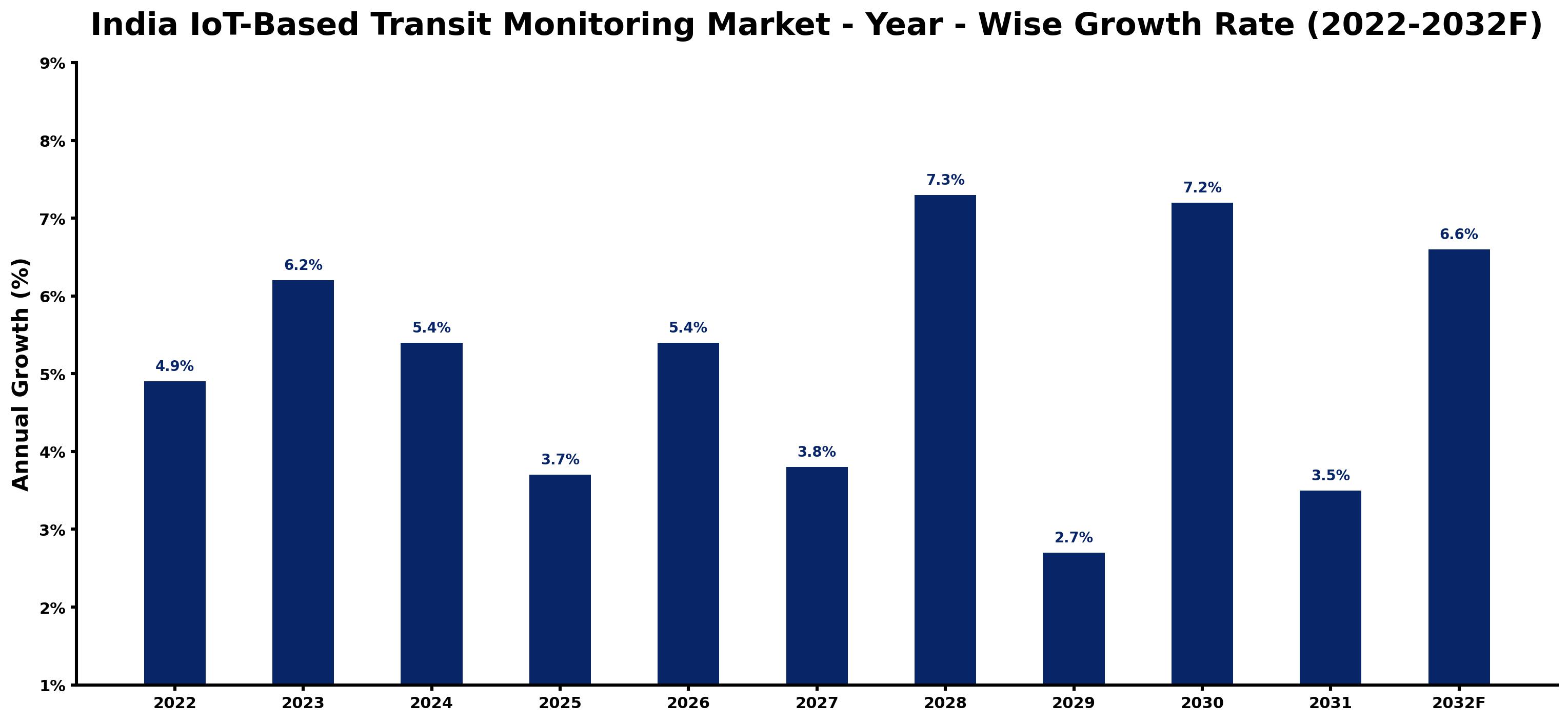
Year by year, the estimates below pair each growth rate with the development that shaped it.
| Year | Estimated Annual Growth (%) | Market Rationale |
| 2022 | 4.9 | The market showed steady growth due to increasing urbanisation and demand for smart transport solutions. |
| 2023 | 6.2 | Growth accelerated as the Smart Cities Mission gained traction, promoting IoT solutions in urban transport. |
| 2024 | 5.4 | A slight slowdown occurred as the market adjusted to previous rapid expansions and ongoing project implementations. |
| 2025 | 3.7 | Continued urbanisation and government initiatives maintained growth, although at a slower pace than before. |
| 2026 | 5.4 | Growth rebounded as more public transport projects integrated IoT solutions, enhancing operational efficiency. |
| 2027 | 3.8 | A slowdown was observed as some projects faced delays in implementation and funding allocation. |
| 2028 | 7.3 | The market peaked with the highest growth rate driven by widespread adoption of advanced monitoring technologies. |
| 2029 | 2.7 | Growth slowed as market maturity set in, with existing solutions becoming standardised across transit systems. |
| 2030 | 7.2 | A resurgence in growth occurred as new technologies and upgrades to existing systems were initiated. |
| 2031 | 3.5 | Growth decelerated as the market approached saturation, with many systems already in place. |
| 2032 | 6.6 | The market rebounded with renewed interest in innovative IoT applications for transit efficiency. |
Note: Market size estimations and growth projections presented in this report are based on 6Wresearch's proprietary forecasting methodology, utilizing the latest available industry data, government publications, and primary research inputs.
India IoT-Based Transit Monitoring Market Synopsis
IoT-Based Transit Monitoring in India encompasses the use of interconnected devices to track and manage transit systems in real-time. This technology combines hardware like sensors and cameras with software for analytics. The India IoT-Based Transit Monitoring Market is expanding due to urbanisation and government initiatives promoting smart transportation. The Smart Cities Mission, with a budget of ₹48,000 crores, is a key driver of this growth, enhancing urban transport systems through IoT solutions. As a result, demand is increasing from transit authorities and fleet managers seeking operational efficiency and safety improvements.
Market Dynamics Impact Analysis (2026–2032)
| Factor | Type | Impact | Primary Segment Affected |
| Increasing urbanisation drives demand for efficient transit solutions. | Driver | High | Public Buses |
| Government initiatives for smart transport systems create new opportunities. | Driver | High | Transit Authorities |
| The shift towards smart city projects offers significant investment opportunities. | Opportunity | High | Metro Operators |
| Growing demand for real-time data analytics in transit systems presents a gap. | Opportunity | High | Fleet Managers |
| Limited infrastructure in rural areas hampers IoT deployment. | Restraint | Medium | Private Fleet Vehicles |
| High initial investment costs deter some transit authorities from adopting IoT solutions. | Restraint | Medium | School Buses |
| The IoT-Based Transit Monitoring market in India faces a few practical problems, including limited connectivity in remote regions. | Challenge | High | Telematics Tracking |
| Competition from alternative transport solutions may impact market growth. | Challenge | Medium | RFID-Based Monitoring |
Evaluation of Drivers in India IoT-Based Transit Monitoring Market (2026–2032)
The table below links each growth driver to the segment it affects and the evidence for it.
| Drivers | Primary Segment Affected | Why It Matters (Evidence) |
| Urbanisation increases the need for efficient transit monitoring systems. | Public Buses | With over 50% of public buses adopting IoT monitoring, demand for these systems is rising. |
| Government initiatives like the Smart Cities Mission promote IoT integration in transport. | Transit Authorities | The ₹1,000 crores allocated for smart transport initiatives boosts demand for IoT solutions. |
| Real-time data analytics enhances operational efficiency for transit systems. | Telematics Tracking | The integration of IoT in 70% of new public transport projects drives demand for advanced tracking. |
| Safety concerns in public transport necessitate advanced monitoring solutions. | School Buses | More than 60% of school districts are investing in bus monitoring systems for enhanced safety. |
| Technological advancements in IoT connectivity improve system performance. | LTE/5G | The adoption of LTE/5G is projected to grow at 7.2%, enhancing real-time monitoring capabilities. |
The IoT-Based Transit Monitoring market in India is expanding as urbanisation accelerates, driving demand for efficient public transport systems. More than 50% of public buses are adopting IoT monitoring systems, which improves operational efficiency and safety. The integration of IoT in 70% of new public transport projects is creating demand for advanced tracking solutions. Consequently, transit authorities and fleet managers are increasingly investing in these technologies to optimise their operations and improve service delivery.
Evaluation of Restraints in India IoT-Based Transit Monitoring Market
The table below lists the restraints and the evidence behind each.
| Market Restraint | Primary Segment Affected | Why It Matters (Evidence) |
| Limited connectivity in rural areas restricts the deployment of IoT solutions. | Telematics Tracking | This affects the operational efficiency of transit systems in less accessible regions, leading to a 20% decrease in service reliability. |
| High initial costs deter some transit authorities from adopting IoT technologies. | RFID-Based Monitoring | Such budget constraints limit investment in advanced monitoring systems, with costs exceeding ₹5 crores for full implementation. |
| Lack of skilled personnel to manage IoT systems hampers effective implementation. | Public Buses | This leads to suboptimal use of technology and reduced operational efficiency, affecting up to 30% of projects. |
| Fragmented regulatory framework creates uncertainty for IoT investments. | School Buses | This affects the willingness of stakeholders to invest in new technologies, causing delays of up to 6 months in project timelines. |
| Concerns over data privacy may hinder the adoption of IoT solutions. | Transit Authorities | This affects public trust and willingness to use smart transit systems, potentially reducing user adoption by 15%. |
India IoT-Based Transit Monitoring Market Challenges
Buyers in the India IoT-Based Transit Monitoring market face immediate technology integration issues, as many existing transit systems lack the infrastructure needed for IoT solutions, delaying implementation by up to six months. Skills shortages compound this problem, with over 40% of transit agencies unable to find qualified personnel, leading to operational inefficiencies that can cost agencies up to ₹50 crores annually. Supply chain disruptions are common, as reliance on imported sensors and cameras can inflate costs by 15% during global shortages, straining budgets for transit authorities. Regulatory hurdles also persist, as compliance with the Bureau of Indian Standards guidelines requires additional investment, extending project timelines for producers.
Trends in the India IoT-Based Transit Monitoring Market
Four trends stand out in the India IoT-Based Transit Monitoring Market.
- Shift towards Real-Time Navigation Systems: Transit authorities are increasingly implementing real-time navigation systems to boost operational efficiency. In 2022, over 38% of data usage in transit monitoring was dedicated to real-time navigation, highlighting its growing significance.
- Growing Adoption of Telematics Tracking: Telematics tracking is becoming more popular among fleet managers, with a projected CAGR of 6.6% from 2026 to 2032. This trend reflects the rising demand for detailed vehicle performance data in urban transport.
- Increased Investment in School Bus Monitoring: School districts are focusing on safety by investing in bus monitoring systems. More than 60% of urban school districts are now implementing these systems to ensure student safety during transport.
- Expansion of LTE/5G Connectivity: The adoption of LTE/5G connectivity is accelerating in public transport systems, with a projected growth rate of 7.2%. This transition enhances real-time data transmission capabilities for transit monitoring.
Investment Opportunities in the India IoT-Based Transit Monitoring Market
Below are the investment opportunities with the strongest case in the India IoT-Based Transit Monitoring Market.
- Market Gap in IoT Solutions: With the public transport sector expected to grow significantly, there exists a gap in IoT solutions. Transit authorities are seeking advanced monitoring systems to improve operational efficiency.
- Investment in Smart Fleet Management: The Ministry of Road Transport and Highways is advocating for smart fleet management solutions. This opens avenues for suppliers to offer IoT-based systems to fleet managers.
- Expansion of School Bus Monitoring Systems: With over 60% of urban school districts investing in bus monitoring systems, suppliers have the opportunity to enter this market by collaborating with local authorities to provide tailored solutions.
- Growth in Real-Time Navigation Technologies: The demand for real-time navigation is increasing, with over 38% of data usage in transit monitoring. Suppliers can focus on developing advanced navigation systems for transit authorities.
Government Initiatives in the India IoT-Based Transit Monitoring Market
The National Policy on Electronics 2019 promotes the development of IoT solutions in transportation, aiming for a self-reliant electronics sector. This policy encourages domestic manufacturing of IoT devices, which is crucial for reducing dependency on imports and lowering costs for producers. Additionally, the National Digital Communications Policy 2018 supports the use of 5G for smart transportation solutions, enhancing connectivity for transit monitoring. This policy aims to ensure that transit systems can utilise high-speed data transmission for improved efficiency.
The Smart Cities Mission, with a budget of ₹48,000 crores, seeks to enhance urban transport systems through IoT technologies. The Ministry of Housing and Urban Affairs oversees this initiative, funding projects that integrate smart technologies into public transport. Furthermore, the Atal Mission for Rejuvenation and Urban Transformation (AMRUT) backs smart mobility projects, focusing on IoT integration in urban transport systems. This initiative encourages cities to adopt solutions that improve transit efficiency and safety.
Future Insight of the India IoT-Based Transit Monitoring Market
The India IoT-Based Transit Monitoring market is set to undergo transformative changes by 2032, primarily driven by the Smart Cities Mission, which aims to enhance urban transport through IoT solutions. Over 1,000 operational metro stations are expected to adopt these systems, improving efficiency and safety. The Ministry of Road Transport and Highways will likely promote smart fleet management solutions, integrating advanced technology into public transport. As urbanization accelerates, the demand for real-time monitoring will rise, making IoT essential in new transit projects.
Market Segmentation Analysis
The analysis below covers each segmentation, its leading category in 2025 and its fastest-growing category through 2032.
By Monitoring Type – GPS + Video Analytics Dominated, Telematics Tracking Expected to Grow Fastest
According to Shubham Deep, Research Manager at 6Wresearch, GPS + Video Analytics held a 40% share of the India IoT-Based Transit Monitoring Market by monitoring type in 2025. GPS and video analytics hold the largest share in India's IoT-based transit monitoring market as they provide essential real-time tracking and analytics for transit systems. This technology is particularly crucial for urban transport initiatives, especially in cities with extensive metro networks, enhancing operational efficiency. Over 2026–2032, Telematics Tracking is expected to post the fastest growth, at a CAGR of 6.6%. Telematics tracking is rapidly gaining traction due to its ability to deliver detailed vehicle performance and location data, which are vital for optimising transit operations. The integration of telematics in new public transport projects is a key factor propelling this growth. Suppliers should focus on developing advanced GPS and video analytics solutions to meet the increasing demand from transit authorities.
By Connectivity Method – LTE/5G Dominated and Is Expected to Record the Fastest Growth
The largest connectivity method category in 2025 was LTE/5G, with a 42% share of total revenue. LTE and 5G technologies dominate the market share as they enable high-speed data transmission necessary for real-time monitoring of transit systems. This is particularly important for smart transport initiatives backed by government funding. Its lead should widen, with a projected CAGR of 7.2% during 2026–2032, the highest in this split. The growth of LTE and 5G will continue to accelerate as they are integral to the implementation of advanced IoT solutions in public transport. Their ability to support real-time data exchange ensures they remain at the forefront of connectivity methods. Buyers must invest in LTE and 5G solutions to ensure their transit systems remain competitive and efficient.
By Vehicle Type – Public Buses Dominated, School Buses Expected to Grow Fastest
With a 48% revenue share in 2025, Public Buses was the largest vehicle type category. Public buses represent the largest share of the market as they are the primary vehicles employing IoT-based transit monitoring systems in urban areas. With over half of public buses adopting these systems, their impact on improving operational efficiency is clear. The quickest growth will come from School Buses, forecast to expand at a CAGR of 7.9% between 2026 and 2032. School buses are experiencing the fastest growth driven by increased investments in monitoring systems that ensure safety and track student transport effectively. This trend highlights the growing emphasis on child safety within urban transportation frameworks. Suppliers should tailor their offerings to meet the specific needs of school bus monitoring to capitalise on this expanding segment.
By Data Usage – Real-Time Navigation Dominated, Speed/Route Tracking Expected to Grow Fastest
Real-Time Navigation accounted for a 38% market share by data usage in 2025. Real-time navigation commands the largest market share as it is essential for route optimisation and effective traffic management in urban transit systems. This capability is increasingly critical for transit authorities navigating the complexities of urban environments. Speed/Route Tracking is set to record the highest CAGR in this split, 6.6% over 2026–2032. Speed and route tracking is witnessing rapid growth as it is crucial for compliance and operational efficiency, particularly with the rising focus on performance metrics. This trend signifies a broader shift towards data-driven decision-making in transit management. Buyers should prioritise solutions that enhance speed and route tracking to improve compliance and operational efficiency.
By End User – Transit Authorities Dominated, Fleet Managers Expected to Grow Fastest
In 2025, Transit Authorities led the end user split with a 50% share. Transit authorities hold the largest market share as they are the key users of IoT-based monitoring systems for managing public transport effectively. Their role is critical in implementing smart transport initiatives across urban areas. Over 2026–2032, Fleet Managers are expected to post the fastest growth, at a CAGR of 7.3%. Fleet managers are experiencing the fastest growth in adoption of monitoring systems, as they rely heavily on these technologies for improving operational efficiency. The increasing complexity of fleet operations is driving this segment's rapid expansion. Suppliers should focus on developing tailored solutions for fleet managers to address their unique operational challenges.
Key Attractiveness of the Report
- 10 Years of Market Numbers
- Historical Data Starting from 2022 to 2025
- Base Year 2025
- Forecast Data until 2032
- Key Performance Indicators Impacting the Market
- Major Upcoming Developments and Projects
Key Highlights of the Report:
- India IoT-Based Transit Monitoring Market Outlook
- Market Size of India IoT-Based Transit Monitoring Market, 2025
- Forecast of India IoT-Based Transit Monitoring Market, 2032
- Historical Data and Forecast of India IoT-Based Transit Monitoring Revenues & Volume for the Period 2022 - 2032F
- India IoT-Based Transit Monitoring Market Trend Evolution
- India IoT-Based Transit Monitoring Market Drivers and Challenges
- India IoT-Based Transit Monitoring Price Trends
- India IoT-Based Transit Monitoring Porter's Five Forces
- India IoT-Based Transit Monitoring Industry Life Cycle
- Historical Data and Forecast of India IoT-Based Transit Monitoring Market Revenues & Volume By Monitoring Type for the Period 2022 - 2032F
- Historical Data and Forecast of India IoT-Based Transit Monitoring Market Revenues & Volume By GPS + Video Analytics for the Period 2022 - 2032F
- Historical Data and Forecast of India IoT-Based Transit Monitoring Market Revenues & Volume By RFID-Based Monitoring for the Period 2022 - 2032F
- Historical Data and Forecast of India IoT-Based Transit Monitoring Market Revenues & Volume By Telematics Tracking for the Period 2022 - 2032F
- Historical Data and Forecast of India IoT-Based Transit Monitoring Market Revenues & Volume By Sensor-Driven Alerts for the Period 2022 - 2032F
- Historical Data and Forecast of India IoT-Based Transit Monitoring Market Revenues & Volume By Connectivity Method for the Period 2022 - 2032F
- Historical Data and Forecast of India IoT-Based Transit Monitoring Market Revenues & Volume By LTE/5G for the Period 2022 - 2032F
- Historical Data and Forecast of India IoT-Based Transit Monitoring Market Revenues & Volume By Wi-Fi for the Period 2022 - 2032F
- Historical Data and Forecast of India IoT-Based Transit Monitoring Market Revenues & Volume By Cellular for the Period 2022 - 2032F
- Historical Data and Forecast of India IoT-Based Transit Monitoring Market Revenues & Volume By Zigbee for the Period 2022 - 2032F
- Historical Data and Forecast of India IoT-Based Transit Monitoring Market Revenues & Volume By Vehicle Type for the Period 2022 - 2032F
- Historical Data and Forecast of India IoT-Based Transit Monitoring Market Revenues & Volume By Public Buses for the Period 2022 - 2032F
- Historical Data and Forecast of India IoT-Based Transit Monitoring Market Revenues & Volume By Trains for the Period 2022 - 2032F
- Historical Data and Forecast of India IoT-Based Transit Monitoring Market Revenues & Volume By School Buses for the Period 2022 - 2032F
- Historical Data and Forecast of India IoT-Based Transit Monitoring Market Revenues & Volume By Private Fleet Vehicles for the Period 2022 - 2032F
- Historical Data and Forecast of India IoT-Based Transit Monitoring Market Revenues & Volume By Data Usage for the Period 2022 - 2032F
- Historical Data and Forecast of India IoT-Based Transit Monitoring Market Revenues & Volume By Real-Time Navigation for the Period 2022 - 2032F
- Historical Data and Forecast of India IoT-Based Transit Monitoring Market Revenues & Volume By Entry/Exit Logs for the Period 2022 - 2032F
- Historical Data and Forecast of India IoT-Based Transit Monitoring Market Revenues & Volume By Speed/Route Tracking for the Period 2022 - 2032F
- Historical Data and Forecast of India IoT-Based Transit Monitoring Market Revenues & Volume By Engine/Condition Status for the Period 2022 - 2032F
- Historical Data and Forecast of India IoT-Based Transit Monitoring Market Revenues & Volume By End User for the Period 2022 - 2032F
- Historical Data and Forecast of India IoT-Based Transit Monitoring Market Revenues & Volume By Transit Authorities for the Period 2022 - 2032F
- Historical Data and Forecast of India IoT-Based Transit Monitoring Market Revenues & Volume By Metro Operators for the Period 2022 - 2032F
- Historical Data and Forecast of India IoT-Based Transit Monitoring Market Revenues & Volume By School Districts for the Period 2022 - 2032F
- Historical Data and Forecast of India IoT-Based Transit Monitoring Market Revenues & Volume By Fleet Managers for the Period 2022 - 2032F
- India IoT-Based Transit Monitoring Import Export Trade Statistics
- Market Opportunity Assessment By Monitoring Type
- Market Opportunity Assessment By Connectivity Method
- Market Opportunity Assessment By Vehicle Type
- Market Opportunity Assessment By Data Usage
- Market Opportunity Assessment By End User
- India IoT-Based Transit Monitoring Top Companies Market Share
- India IoT-Based Transit Monitoring Competitive Benchmarking By Technical and Operational Parameters
- India IoT-Based Transit Monitoring Company Profiles
- India IoT-Based Transit Monitoring Key Strategic Recommendations
Market Covered
This report examines the market across the segments below.
By Monitoring Type
- GPS + Video Analytics
- RFID-Based Monitoring
- Telematics Tracking
- Sensor-Driven Alerts
By Connectivity Method
- LTE/5G
- Wi-Fi
- Cellular
- Zigbee
By Vehicle Type
- Public Buses
- Trains
- School Buses
- Private Fleet Vehicles
By Data Usage
- Real-Time Navigation
- Entry/Exit Logs
- Speed/Route Tracking
- Engine/Condition Status
By End User
- Transit Authorities
- Metro Operators
- School Districts
- Fleet Managers































