India IoT Battery Market Size & Growth Rate
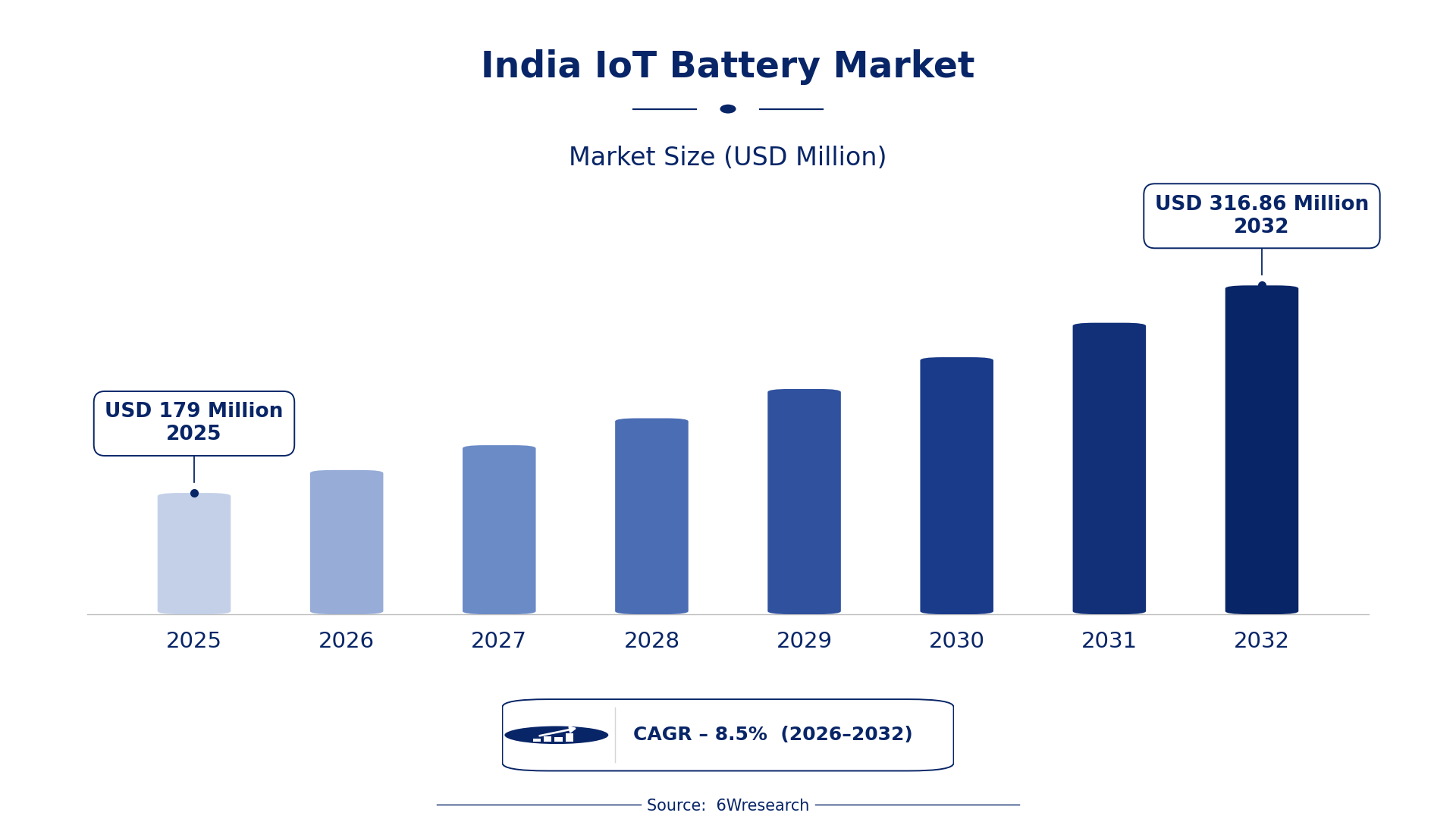
According to 6Wresearch internal database and industry insights, the India IoT Battery Market was valued at USD 179.0 million in 2025 and is projected to reach USD 316.86 million by 2032, growing at a CAGR of approximately 8.5% during 2026–2032.
India IoT Battery Market Highlights
| Report Metric | Details |
| Report Name | India IoT Battery Market |
| Market Size 2025 | USD 179.0 million |
| Market Size 2032 | USD 316.86 million |
| Absolute Growth 2025–2032 | USD 137.86 million |
| CAGR 2026–2032 | 8.5% |
| Peak Annual Growth | 11.3% in 2032 |
| Forecast Period | 2026–2032 |
| Historical Data | 2022–2025 |
| Base Year | 2025 |
| Leading Battery Type, 2025 | Rechargeable IoT Cells (43% share) |
| Leading Chemistry, 2025 | Li-Ion (41% share) |
| Leading Application Area, 2025 | Wearables (42% share) |
| Leading Voltage Rating, 2025 | <3V (49% share) |
| Leading End User, 2025 | Consumer Electronics (45% share) |
| Fastest-Growing Chemistry | Lithium Polymer (10.0% CAGR) |
| Fastest-Growing Application Area | Medical Devices (9.7% CAGR) |
| Fastest-Growing Voltage Rating | 3–5V (10.7% CAGR) |
| Fastest-Growing End User | MedTech OEMs (10.1% CAGR) |
| Growing Sector | Medical Devices |
| Key End Users | Wearable Manufacturers, Healthcare Providers, Consumer Electronics Producers, Automotive Manufacturers |
India IoT Battery Market Year-wise Growth Rate and Key Drivers (2022–2032)
This graph illustrates the annual growth rates of the market from 2022 to 2032, highlighting a steady upward trajectory and projected market expansion over the forecast period.
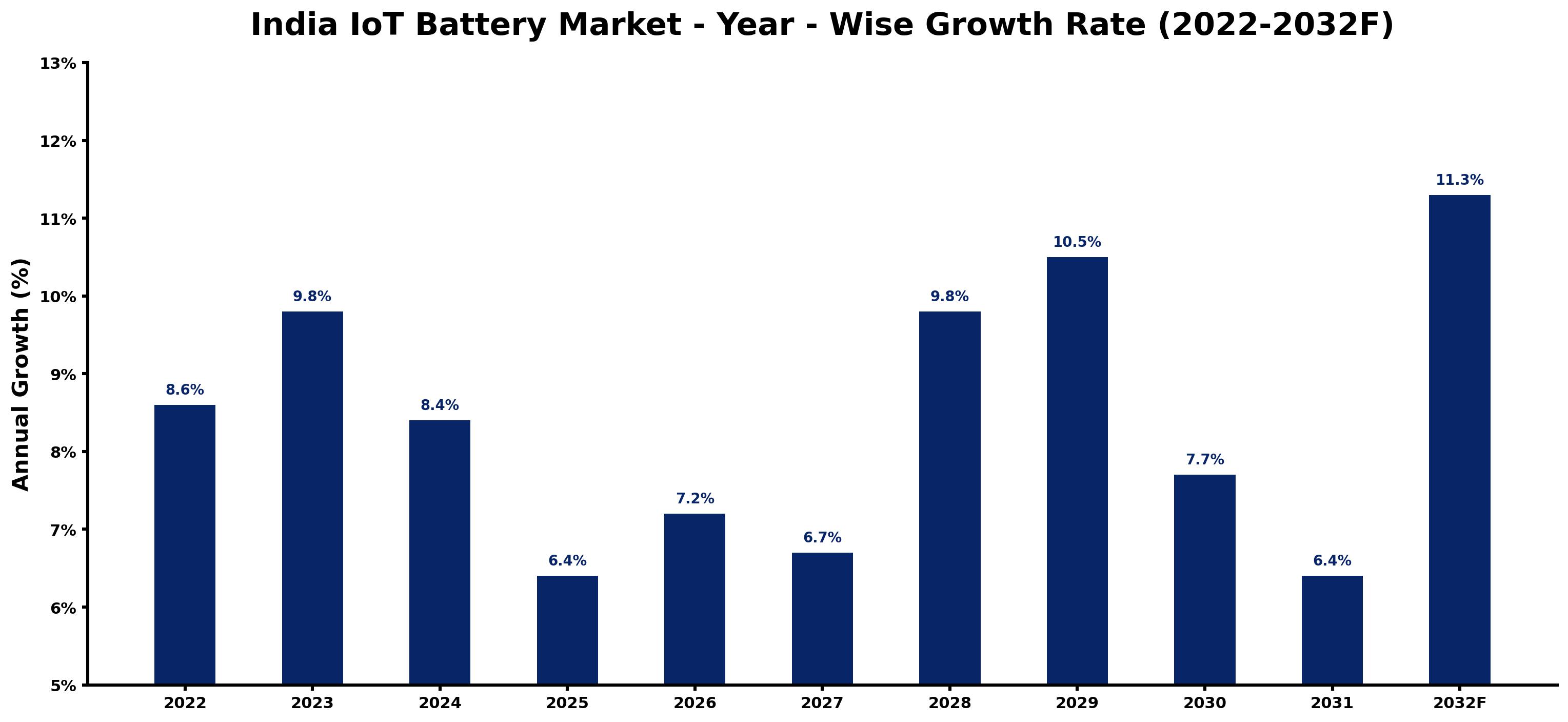
Below, each year's estimated growth is shown next to the factor that most influenced it.
| Year | Estimated Annual Growth (%) | Market Rationale |
| 2022 | 8.6 | Demand from wearables and healthcare sectors drove substantial growth in IoT battery usage. |
| 2023 | 9.8 | Increased adoption of smart devices contributed to a faster growth rate compared to the previous year. |
| 2024 | 8.4 | Growth slowed due to rising component costs impacting production timelines. |
| 2025 | 6.4 | The market continued to grow, albeit at a slower pace, influenced by maturing technology and market saturation. |
| 2026 | 7.2 | A resurgence in demand for rechargeable IoT cells spurred growth, reflecting changing consumer preferences. |
| 2027 | 6.7 | Growth decelerated as market conditions shifted, influenced by pricing pressures. |
| 2028 | 9.8 | Renewed interest in medical devices drove demand, resulting in a faster growth rate than the previous year. |
| 2029 | 10.5 | Technological advancements in battery efficiency contributed to increased market activity and growth. |
| 2030 | 7.7 | Growth slowed again as the market stabilised, reflecting a more mature phase in IoT battery applications. |
| 2031 | 6.4 | Demand remained steady, but growth slowed due to market saturation and evolving consumer needs. |
| 2032 | 11.3 | A significant surge in electric vehicle adoption is projected to drive growth, marking a peak in market activity. |
Note: Market size estimations and growth projections presented in this report are based on 6Wresearch's proprietary forecasting methodology, utilizing the latest available industry data, government publications, and primary research inputs.
India IoT Battery Market Synopsis
The IoT Battery Market in India encompasses specialized energy storage devices designed for Internet of Things applications, including wearables and medical devices. These batteries, often lithium-ion or polymer-based, are essential for powering smart sensors and portable electronics. The market is expected to reach 1.5 billion units by 2025, driven by domestic demand across sectors like healthcare and industrial automation. Key initiatives such as the Smart Cities Mission and the National Policy on Electronics 2019 are boosting the adoption of IoT technologies, further increasing battery demand.
Market Dynamics Impact Analysis (2026–2032)
| Factor | Type | Impact | Primary Segment Affected |
| Growing demand for wearables and medical devices drives battery usage. | Driver | High | Wearables |
| Increasing healthcare sector growth boosts demand for medical IoT devices. | Driver | High | Medical Devices |
| The gap in battery recycling solutions presents a significant opportunity. | Opportunity | High | Rechargeable IoT Cells |
| The expected growth of the Indian automotive sector creates a demand for IoT batteries. | Opportunity | High | Consumer Electronics |
| High costs of raw materials constrain production capabilities. | Restraint | High | Li-Ion |
| Regulatory compliance for battery safety standards can delay market entry. | Restraint | High | Lithium Polymer |
| Supply chain disruptions can impact timely delivery of components. | Challenge | High | Rechargeable IoT Cells |
| Technological advancements may outpace current manufacturing capabilities. | Challenge | High | Consumer Electronics |
Evaluation of Drivers in India IoT Battery Market (2026–2032)
The factors lifting demand, and the evidence behind each, are summarised below.
| Drivers | Primary Segment Affected | Why It Matters (Evidence) |
| Increased adoption of smart wearables drives demand for compact batteries. | Wearables | The wearables segment is expected to account for 35% of the IoT battery demand in India. |
| Growing healthcare sector boosts the need for medical IoT devices. | Medical Devices | The healthcare sector in India is projected to reach $372 billion by 2022. |
| The rise of smart cities increases demand for efficient battery technologies. | Rechargeable IoT Cells | The Smart Cities Mission aims to integrate IoT solutions, increasing battery needs. |
| The automotive sector's shift towards IoT solutions boosts battery requirements. | Consumer Electronics | India's automotive sector is increasingly adopting IoT solutions, driving battery demand. |
| Government initiatives promote local battery manufacturing, increasing supply. | Li-Ion | The National Policy on Electronics 2019 aims to enhance domestic battery production. |
Market growth in India for IoT Battery rests on the increasing adoption of smart wearables, medical devices, and automotive IoT solutions. The wearables segment is expected to account for 35% of the IoT battery demand in India, driving higher purchases from manufacturers. The healthcare sector's growth is substantial, necessitating advanced battery solutions for medical devices. The Smart Cities Mission encourages investment in efficient battery technologies, further driving demand. Additionally, the automotive sector's shift towards IoT solutions is projected to increase battery requirements, leading to greater purchases from manufacturers.
Evaluation of Restraints in India IoT Battery Market
The table below lists the restraints and the evidence behind each.
| Market Restraint | Primary Segment Affected | Why It Matters (Evidence) |
| High raw material costs limit production scalability. | Li-Ion | The cost of lithium and other materials has seen increases, affecting pricing strategies. |
| Regulatory compliance can delay product launches. | Lithium Polymer | Compliance with the Bureau of Indian Standards' guidelines for battery safety can prolong approval processes. |
| Supply chain disruptions hinder timely delivery of components. | Rechargeable IoT Cells | Global supply chain issues have affected the availability of critical components for battery production. |
| Limited recycling infrastructure constrains market growth. | Consumer Electronics | The lack of efficient battery recycling solutions limits sustainable practices in the market. |
| Market saturation leads to intense competition and price pressures. | Wearables | As the wearables market matures, competition increases, impacting profit margins for manufacturers. |
India IoT Battery Market Challenges
Buyers in the India IoT battery market encounter regulatory challenges, as compliance with the Bureau of Indian Standards can delay product launches by up to six months, affecting timely access to essential IoT devices. Rising costs pose another issue; manufacturers have reported a 15% increase in lithium polymer material prices over the past year, which tightens profit margins for suppliers. Many producers face technological hurdles, as implementing advanced battery efficiency innovations can be expensive, diminishing their competitiveness. Supply chain disruptions, particularly in sourcing critical raw materials, can lead to production delays, forcing buyers to wait longer for important components.
Trends in the India IoT Battery Market
Buyers and suppliers in the India IoT Battery Market are adjusting to the following trends.
- Shift towards Sustainable Battery Solutions: The Ministry of Electronics and Information Technology introduced a scheme in 2023 to promote battery recycling, addressing sustainability concerns. This initiative aims to enhance recycling rates and lessen environmental impact, encouraging manufacturers to adopt greener practices.
- Rise of Medical IoT Applications: Since 2022, the medical devices segment has seen notable growth, driven by increasing healthcare investments. The Indian Medical Device Industry is projected to reach $50 billion by 2025, underscoring the demand for advanced battery solutions.
- Transition to Lightweight Battery Technologies: As of 2023, lithium polymer batteries are becoming popular in consumer electronics due to their lightweight characteristics. This shift is influencing design preferences among manufacturers, leading to broader adoption in various applications.
- Expansion of Smart City Initiatives: The Smart Cities Mission, launched in 2015, is promoting the integration of IoT solutions across urban areas. This initiative is anticipated to boost the demand for efficient battery technologies, creating new opportunities for suppliers.
Investment Opportunities in the India IoT Battery Market
Some of the investment opportunities in the India IoT Battery Market are mentioned below.
- Growing Need for Battery Recycling Solutions: With India's emphasis on sustainability, the battery recycling market is expected to grow. The government has allocated ₹10,000 crores for battery manufacturing, presenting opportunities for recycling service providers and manufacturers.
- Increasing Demand from the Automotive Sector: The automotive sector is on the verge of rapid adoption of IoT solutions, creating a gap in battery supply. Forming partnerships with automotive manufacturers can facilitate entry into this growing market.
- Emerging Market for Medical IoT Devices: The healthcare sector's growth to $372 billion by 2022 offers a substantial opportunity for battery suppliers. Collaborating with MedTech OEMs can help access this expanding market.
- Expansion of Smart Labels in Retail: The rise of smart labels for inventory management is driving demand for efficient battery technologies. Suppliers can enter this market by partnering with RFID device makers to meet increasing needs.
Government Initiatives in the India IoT Battery Market
The National Policy on Electronics 2019, introduced by the Ministry of Electronics and Information Technology, aims to boost domestic battery production and reduce imports by 2025. This policy encourages local manufacturing and seeks to create a self-reliant battery environment. Additionally, the Production Linked Incentive Scheme for Advanced Chemistry Cell Battery Storage, launched in 2021, aims to incentivise ₹18,000 crores in battery manufacturing investments, promoting innovation and production capacity in the sector.
The Bureau of Indian Standards oversees the implementation of various initiatives, including the approval of safety and performance standards for batteries, ensuring compliance and quality in the market. The Electronics Sector Skill Council of India is developing training programmes to support advancements in battery technology, benefiting manufacturers and enhancing workforce skills.
Future Insight of the India IoT Battery Market
The India IoT battery market will experience notable changes by 2032, driven by key factors that will reshape its environment. The National Policy on Electronics aims to bolster domestic manufacturing, potentially increasing local production capacity by 25%. The healthcare sector is expected to expand to $372 billion, creating a robust market for medical IoT devices and their power solutions. The Smart Cities Mission will further integrate IoT applications, increasing the demand for efficient energy storage technologies. Training initiatives by the Electronics Sector Skill Council will cultivate a skilled workforce to support these advancements.
Market Segmentation Analysis
The report offers a comprehensive study of the following market segments and their leading categories in the market.
By Battery Type – Rechargeable IoT Cells Dominated and Is Expected to Record the Fastest Growth
According to Shubham Deep, Research Manager at 6Wresearch, Rechargeable IoT Cells accounted for a 43% market share by battery type in 2025. Rechargeable IoT Cells dominate India's IoT battery market due to their critical function in powering devices that require regular recharging. Their extensive application in wearables and smart sensors drives consistent demand across multiple sectors. Its lead should widen, with a projected CAGR of 10.8% during 2026–2032, the highest in this split. The rapid growth of Rechargeable IoT Cells is propelled by the increasing adoption of smart devices, especially in healthcare and consumer electronics. This segment's lead will continue to widen as it remains vital for powering emerging IoT technologies. Suppliers should prioritise the production of Rechargeable IoT Cells to align with the rising demand in the Indian IoT battery market.
By Chemistry – Li-Ion Dominated, Lithium Polymer Expected to Grow Fastest
The largest chemistry category in 2025 was Li-Ion, with a 41% share of total revenue. Li-Ion batteries hold a substantial share in the market as they are widely used in consumer electronics and IoT devices, providing reliable energy storage. Their established presence and performance make them the preferred choice for many manufacturers in India. Lithium Polymer is projected to grow fastest, at a CAGR of 10.0% during 2026–2032. Lithium Polymer batteries are experiencing rapid growth due to their lightweight and flexible design, which is ideal for portable devices. This segment's expansion is facilitated by the increasing demand for compact and efficient energy solutions in consumer electronics. Buyers should consider the advantages of Lithium Polymer batteries for their lightweight applications while suppliers may need to diversify their offerings to include this growing chemistry.
By Application Area – Wearables Dominated, Medical Devices Expected to Grow Fastest
Wearables held a 42% share of the India IoT Battery Market by application area in 2025. Wearables lead the application area of the IoT battery market, holding a substantial share due to the popularity of fitness trackers and smartwatches. The heightened health awareness among consumers fuels robust demand for these devices, reinforcing the segment's strong position. Medical Devices are set to record the highest CAGR in this split, 9.7% over 2026–2032. Medical Devices are witnessing the fastest growth, primarily driven by the surging need for portable medical equipment and health monitoring solutions. As the healthcare sector expands, the requirement for dependable battery solutions in this field will persist. Suppliers should explore specialised battery solutions designed for medical devices to capitalise on emerging opportunities in the healthcare sector.
By Voltage Rating – <3V Dominated, 3–5V Expected to Grow Fastest
<3V took a 49% share of voltage rating in 2025, more than any other category. Batteries with a voltage rating of <3V are widely used in many small IoT devices, making them the leading segment in the market. Their compatibility with a broad range of applications, including wearables and smart sensors, ensures consistent demand. The quickest growth will come from 3–5V, forecast to expand at a CAGR of 10.7% between 2026 and 2032. The 3–5V voltage rating segment is experiencing rapid growth as it is increasingly utilised in diverse consumer and industrial applications. This expansion is linked to the rising adoption of IoT technologies requiring higher voltage capabilities without sacrificing size. Suppliers should concentrate on developing 3–5V battery solutions to meet the growing demand from both consumer and industrial sectors.
By End User – Consumer Electronics Dominated, MedTech OEMs Expected to Grow Fastest
In 2025, Consumer Electronics led the end user split with a 45% share. Consumer Electronics represent the largest share of the IoT battery market, mainly due to the widespread utilisation of IoT-enabled devices like smartphones and wearables. This segment benefits from a vast consumer base and ongoing technological advancements that stimulate battery demand. Over 2026–2032, MedTech OEMs are expected to post the fastest growth, at a CAGR of 10.1%. MedTech OEMs are the fastest-growing end-user segment, driven by the increasing need for medical IoT solutions and portable health monitoring devices. As the healthcare industry evolves, the demand for reliable battery solutions in this sector will continue to escalate. Suppliers should prioritise partnerships with MedTech OEMs to leverage the expanding opportunities in the medical IoT market.
Key Attractiveness of the Report
- 10 Years of Market Numbers
- Historical Data Starting from 2022 to 2025
- Base Year 2025
- Forecast Data until 2032
- Key Performance Indicators Impacting the Market
- Major Upcoming Developments and Projects
Key Highlights of the Report:
- India IoT Battery Market Outlook
- Market Size of India IoT Battery Market, 2025
- Forecast of India IoT Battery Market, 2032
- Historical Data and Forecast of India IoT Battery Revenues & Volume for the Period 2022 - 2032F
- India IoT Battery Market Trend Evolution
- India IoT Battery Market Drivers and Challenges
- India IoT Battery Price Trends
- India IoT Battery Porter's Five Forces
- India IoT Battery Industry Life Cycle
- Historical Data and Forecast of India IoT Battery Market Revenues & Volume By Battery Type for the Period 2022 - 2032F
- Historical Data and Forecast of India IoT Battery Market Revenues & Volume By Coin Cell for the Period 2022 - 2032F
- Historical Data and Forecast of India IoT Battery Market Revenues & Volume By Thin Film for the Period 2022 - 2032F
- Historical Data and Forecast of India IoT Battery Market Revenues & Volume By Rechargeable IoT Cells for the Period 2022 - 2032F
- Historical Data and Forecast of India IoT Battery Market Revenues & Volume By Zinc-Air for the Period 2022 - 2032F
- Historical Data and Forecast of India IoT Battery Market Revenues & Volume By Chemistry for the Period 2022 - 2032F
- Historical Data and Forecast of India IoT Battery Market Revenues & Volume By Lithium-MnO2 for the Period 2022 - 2032F
- Historical Data and Forecast of India IoT Battery Market Revenues & Volume By Lithium Polymer for the Period 2022 - 2032F
- Historical Data and Forecast of India IoT Battery Market Revenues & Volume By Li-Ion for the Period 2022 - 2032F
- Historical Data and Forecast of India IoT Battery Market Revenues & Volume By Primary Non-Rechargeable for the Period 2022 - 2032F
- Historical Data and Forecast of India IoT Battery Market Revenues & Volume By Application Area for the Period 2022 - 2032F
- Historical Data and Forecast of India IoT Battery Market Revenues & Volume By Wearables for the Period 2022 - 2032F
- Historical Data and Forecast of India IoT Battery Market Revenues & Volume By Smart Labels for the Period 2022 - 2032F
- Historical Data and Forecast of India IoT Battery Market Revenues & Volume By Industrial Sensors for the Period 2022 - 2032F
- Historical Data and Forecast of India IoT Battery Market Revenues & Volume By Medical Devices for the Period 2022 - 2032F
- Historical Data and Forecast of India IoT Battery Market Revenues & Volume By Voltage Rating for the Period 2022 - 2032F
- Historical Data and Forecast of India IoT Battery Market Revenues & Volume By 3V for the Period 2022 - 2032F
- Historical Data and Forecast of India IoT Battery Market Revenues & Volume By 3 5V for the Period 2022 - 2032F
- Historical Data and Forecast of India IoT Battery Market Revenues & Volume By 5 12V for the Period 2022 - 2032F
- Historical Data and Forecast of India IoT Battery Market Revenues & Volume By Low-Drain for the Period 2022 - 2032F
- Historical Data and Forecast of India IoT Battery Market Revenues & Volume By End User for the Period 2022 - 2032F
- Historical Data and Forecast of India IoT Battery Market Revenues & Volume By Consumer Electronics for the Period 2022 - 2032F
- Historical Data and Forecast of India IoT Battery Market Revenues & Volume By RFID Device Makers for the Period 2022 - 2032F
- Historical Data and Forecast of India IoT Battery Market Revenues & Volume By IIoT Integrators for the Period 2022 - 2032F
- Historical Data and Forecast of India IoT Battery Market Revenues & Volume By MedTech OEMs for the Period 2022 - 2032F
- India IoT Battery Import Export Trade Statistics
- Market Opportunity Assessment By Battery Type
- Market Opportunity Assessment By Chemistry
- Market Opportunity Assessment By Application Area
- Market Opportunity Assessment By Voltage Rating
- Market Opportunity Assessment By End User
- India IoT Battery Top Companies Market Share
- India IoT Battery Competitive Benchmarking By Technical and Operational Parameters
- India IoT Battery Company Profiles
- India IoT Battery Key Strategic Recommendations
Market Covered
Segments analysed in this report are listed below.
By Battery Type
- Coin Cell
- Thin Film
- Rechargeable IoT Cells
- Zinc-Air
By Chemistry
- Lithium-MnO2
- Lithium Polymer
- Li-Ion
- Primary Non-Rechargeable
By Application Area
- Wearables
- Smart Labels
- Industrial Sensors
- Medical Devices
By Voltage Rating
- <3V
- 3–5V
- 5–12V
- Low-Drain
By End User
- Consumer Electronics
- RFID Device Makers
- IIoT Integrators
- MedTech OEMs































