India IoT-Enabled Appliances Market Size & Growth Rate
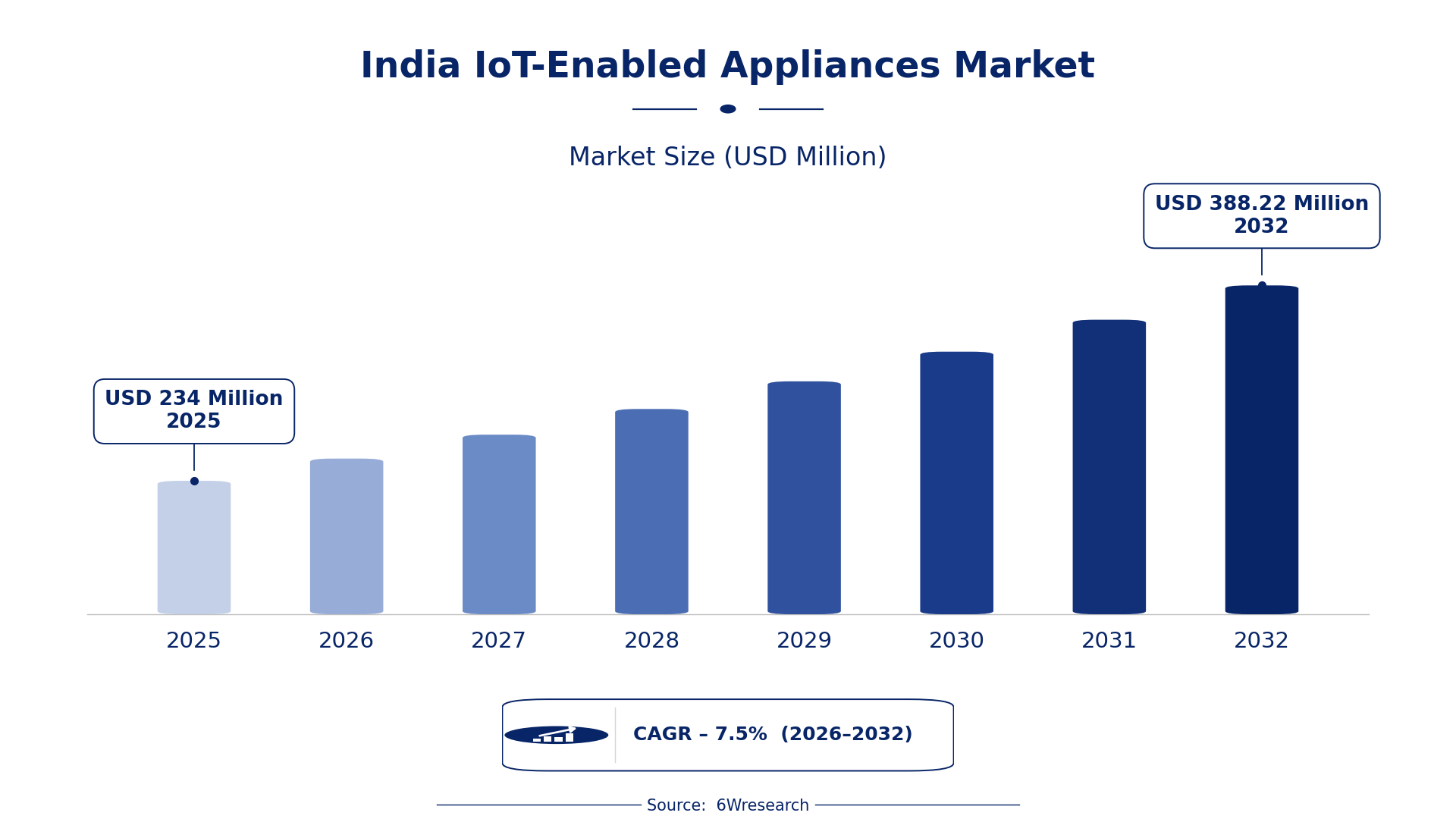
According to 6Wresearch internal database and industry insights, the India IoT-Enabled Appliances Market was valued at USD 234.0 million in 2025 and is projected to reach USD 388.22 million by 2032, growing at a CAGR of approximately 7.5% during 2026–2032.
India IoT-Enabled Appliances Market Highlights
| Report Metric | Details |
| Report Name | India IoT-Enabled Appliances Market |
| Market Size 2025 | USD 234.0 million |
| Market Size 2032 | USD 388.22 million |
| Absolute Growth 2025–2032 | USD 154.22 million |
| CAGR 2026–2032 | 7.5% |
| Peak Annual Growth | 9.3% in 2027 |
| Forecast Period | 2026–2032 |
| Historical Data | 2022–2025 |
| Base Year | 2025 |
| Leading Appliance Type, 2025 | Smart Refrigerators (50% share) |
| Leading Connectivity Type, 2025 | Wi-Fi (45% share) |
| Leading Control Interface, 2025 | App-Based Scheduling (43% share) |
| Leading Energy Efficiency, 2025 | Energy Star Rated (41% share) |
| Leading End User, 2025 | Urban Households (36% share) |
| Fastest-Growing Appliance Type | Smart Washing Machines (8.6% CAGR) |
| Fastest-Growing Connectivity Type | Bluetooth + Wi-Fi (9.0% CAGR) |
| Fastest-Growing Control Interface | Voice + App (10.2% CAGR) |
| Fastest-Growing Energy Efficiency | Timer/Auto Shutoff (9.6% CAGR) |
| Fastest-Growing End User | Smart Kitchen Users (9.9% CAGR) |
| Growing Sector | Smart Home Appliances |
| Key End Users | Urban Households, Smart Kitchen Users, Hospitality Sector |
India IoT-Enabled Appliances Market Year-wise Growth Rate and Key Drivers (2022–2032)
This graph illustrates the annual growth rates of the market from 2022 to 2032, highlighting a steady upward trajectory and projected market expansion over the forecast period.
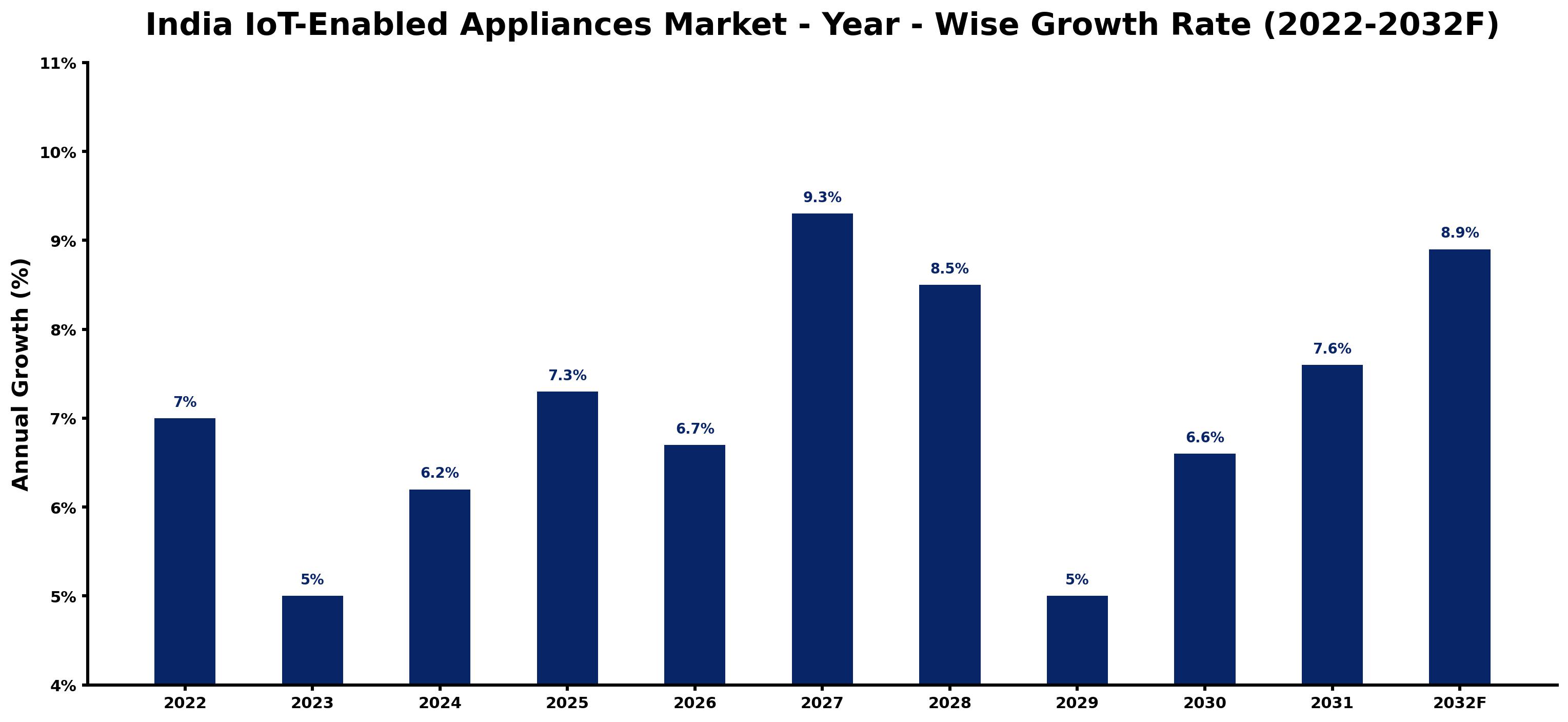
Year by year, the estimates below pair each growth rate with the development that shaped it.
| Year | Estimated Annual Growth (%) | Market Rationale |
| 2022 | 7.0 | The market exhibited steady growth, driven by increasing urbanisation and consumer interest in smart technologies. |
| 2023 | 5.0 | Growth slowed as consumers became more selective in their appliance purchases amidst economic uncertainties. |
| 2024 | 6.2 | A rebound occurred due to heightened awareness of energy efficiency and smart home benefits among buyers. |
| 2025 | 7.3 | The market peaked as urban households increasingly adopted smart appliances for convenience and energy management. |
| 2026 | 6.7 | Growth slowed again as competition intensified and consumers evaluated product features more critically. |
| 2027 | 9.3 | A surge in demand was noted due to the introduction of innovative smart appliance features and enhanced connectivity. |
| 2028 | 8.5 | Growth decelerated as market saturation began to set in among early adopters of smart appliances. |
| 2029 | 5.0 | A further slowdown was observed as the market stabilised, with consumers focusing on value and efficiency. |
| 2030 | 6.6 | Growth picked up again as new technologies and features attracted a broader consumer base. |
| 2031 | 7.6 | The market continued to grow as more households integrated smart appliances into their daily routines. |
| 2032 | 8.9 | An increase in demand is anticipated due to ongoing urbanisation and government support for smart technologies. |
Note: Market size estimations and growth projections presented in this report are based on 6Wresearch's proprietary forecasting methodology, utilizing the latest available industry data, government publications, and primary research inputs.
India IoT-Enabled Appliances Market Synopsis
IoT-Enabled Appliances Market in India includes smart home devices that connect to the internet, enabling remote control by users. These appliances feature advanced sensors and software, primarily aimed at energy management and convenience. The market is growing as India's urban population surpasses 460 million, alongside the increasing trend of smart homes. Government initiatives like the Smart Cities Mission are propelling this growth by encouraging technology adoption. Consequently, demand for IoT-enabled appliances is projected to rise sharply in the coming years.
Market Dynamics Impact Analysis (2026–2032)
| Factor | Type | Impact | Primary Segment Affected |
| Rising urban population increases demand for smart home solutions. | Driver | High | Urban Households |
| Consumer interest in automation drives purchases of smart kitchen appliances. | Driver | High | Smart Kitchen Users |
| Growing interest in energy-efficient appliances creates investment opportunities. | Opportunity | High | Energy Star Rated |
| The ongoing Smart Cities Mission promotes the adoption of smart technologies. | Opportunity | High | Smart Refrigerators |
| High import dependency may affect pricing and availability. | Restraint | Medium | Smart Refrigerators |
| Consumer awareness of IoT appliances is still developing, limiting market penetration. | Restraint | Medium | Connected Ovens |
| Technological integration challenges may hinder appliance compatibility. | Challenge | High | Smart Washing Machines |
| Competition from traditional appliances may slow market adoption rates. | Challenge | Medium | IoT Dishwashers |
Evaluation of Drivers in India IoT-Enabled Appliances Market (2026–2032)
The table below links each growth driver to the segment it affects and the evidence for it.
| Drivers | Primary Segment Affected | Why It Matters (Evidence) |
| Rising urbanisation | Smart Refrigerators | The urban population exceeding 460 million drives demand for energy-efficient food storage solutions, leading to increased purchases of smart refrigerators. |
| Consumer interest in automation | Connected Ovens | As consumers seek convenience in cooking, the popularity of connected ovens is rising, resulting in higher sales. |
| Government initiatives promoting energy efficiency | Energy Star Rated | The Bureau of Energy Efficiency's promotion of energy-efficient appliances encourages consumers to choose Energy Star rated models, boosting their market presence. |
| Technological advancements in smart features | Smart Washing Machines | Innovations in smart washing machines enhance their appeal, leading to increased adoption among urban households. |
| Growing awareness of sustainability | IoT Dishwashers | Consumer education programs on water conservation are driving demand for IoT dishwashers, as buyers seek eco-friendly solutions. |
Market growth in India for IoT-Enabled Appliances rests on rising urbanisation, increasing consumer interest in automation, and support for energy-efficient technologies. The urban population exceeds 460 million, which leads to higher demand for smart solutions. Consumer interest in automation is driving the growth of smart kitchen devices, as buyers seek advanced cooking solutions. Technological advancements are improving the functionality of these devices, making them more appealing to a broader audience.
Evaluation of Restraints in India IoT-Enabled Appliances Market
Below mentioned are some major restraints and their influence on market dynamics.
| Market Restraint | Primary Segment Affected | Why It Matters (Evidence) |
| High import dependency affects pricing and availability of smart appliances. | Smart Refrigerators | Imports supplement domestic manufacturing, impacting costs for consumers. |
| Limited consumer awareness of IoT appliances restricts market penetration. | Connected Ovens | Many consumers remain unaware of the benefits and functionalities of smart appliances. |
| Integration challenges with existing home systems may hinder adoption. | Smart Washing Machines | Compatibility issues with traditional appliances can deter potential buyers. |
| Competition from traditional appliances slows the adoption of smart devices. | IoT Dishwashers | Price sensitivity among consumers leads them to prefer conventional options. |
| Market saturation among early adopters may limit further growth. | Smart Refrigerators | As early adopters have already purchased, demand from this segment may decline. |
India IoT-Enabled Appliances Market Challenges
Buyers in the India IoT-Enabled Appliances Market face intense competition from numerous local and international brands, which drives down prices and reduces profit margins for retailers. Suppliers struggle with outdated technology, as many manufacturers have not adopted the latest smart features, leading to delays in product launches that limit market reach. Supply chain issues arise from reliance on imported components, causing lead times that frustrate both retailers and consumers. Rising costs for essential materials, such as advanced sensors, are squeezing margins for producers, making it difficult for them to offer competitive pricing while maintaining quality.
Trends in the India IoT-Enabled Appliances Market
Buyers and suppliers in the India IoT-Enabled Appliances Market are adjusting to the following trends.
- Shift towards Energy Efficiency in Appliances: The Indian appliance market is moving towards energy-efficient models, spurred by government initiatives. Energy Star rated appliances held a 41% share in 2025, raising consumer awareness of sustainability.
- Rise of Smart Kitchen Solutions: In metropolitan areas like Bangalore, the demand for smart kitchen appliances is increasing. The Smart Kitchen segment is expected to expand significantly, reflecting growing consumer interest in automation.
- Emergence of App-Based Control Interfaces: With a 43% share in 2025, App-Based Scheduling is becoming the preferred control interface for IoT appliances. This trend enhances user convenience and encourages automation in household tasks.
- Growth of Smart Home Technology Initiatives: The Smart Cities Mission, launched in 2015, is promoting the adoption of smart technologies in urban areas. This initiative supports the integration of IoT-enabled appliances, improving urban living.
Investment Opportunities in the India IoT-Enabled Appliances Market
Below are the investment opportunities with the strongest case in the India IoT-Enabled Appliances Market.
- Investment in Energy Star Rated Appliances: With government initiatives advocating energy efficiency, there is a chance to invest in Energy Star rated appliances. Urban households are increasingly seeking these products to lower their carbon footprints.
- Supply of Smart Kitchen Devices: Now is an opportune time to supply smart kitchen appliances, as consumer interest in automation is on the rise. The Smart Kitchen segment is expected to grow significantly, appealing to urban households.
- Local Manufacturing of IoT Appliances: The Make in India initiative opens avenues for local manufacturing of smart appliances. Collaborating with local manufacturers can ease market entry and strengthen supply chains.
- Development of App-Based Control Solutions: The growing popularity of App-Based Scheduling presents an opportunity for developers to create inventive control solutions. Urban households are seeking convenient methods to manage their appliances.
Government Initiatives in the India IoT-Enabled Appliances Market
The Smart Cities Mission, launched by the Ministry of Housing and Urban Affairs in 2015, promotes the adoption of smart technologies in urban areas. This initiative supports the market for IoT-enabled appliances by providing infrastructure and support for technology integration. Additionally, the National Policy on Electronics 2019 aims to increase domestic manufacturing of electronics, including IoT appliances, with a target of $400 billion by 2025. This policy is projected to boost local production and reduce reliance on imports.
Urban households benefit from government schemes like the Digital India initiative, which promotes the use of digital technologies, including IoT. This initiative supports the market for smart appliances by encouraging the adoption of smart home technologies. The Bureau of Energy Efficiency also conducts consumer awareness programs to educate users on the benefits of energy-efficient appliances. These programs aim to increase the adoption of Energy Star rated appliances among consumers, promoting energy conservation.
Future Insight of the India IoT-Enabled Appliances Market
By 2032, the India IoT-Enabled Appliances Market is poised for substantial evolution, driven by key developments. The Smart Cities Mission will facilitate the integration of advanced technologies, enhancing urban living and boosting demand for connected devices. Consumer education initiatives will improve understanding of IoT appliances, encouraging broader acceptance among households. By 2025, the average household is expected to own at least three smart appliances, indicating a clear trend towards automation and energy efficiency that will benefit both buyers and suppliers.
Market Segmentation Analysis
The report offers a comprehensive study of the following market segments and their leading categories in the market.
By Appliance Type – Smart Refrigerators Dominated, Smart Washing Machines Expected to Grow Fastest
According to Shubham Deep, Research Manager at 6Wresearch, with a 50% revenue share in 2025, Smart Refrigerators was the largest appliance type category. Smart Refrigerators lead the market share due to their essential role in energy-efficient food storage, appealing to a broad urban consumer base. Their popularity is particularly evident in major cities, where the demand for smart home solutions is high. Smart Washing Machines are projected to grow fastest, at a CAGR of 8.6% during 2026–2032. Smart Washing Machines are rapidly growing as consumers prioritise efficiency in laundry tasks, with projections suggesting that households will have at least three smart appliances by 2025. This growth is further fuelled by increasing consumer interest in automation within the Smart Kitchen segment. Suppliers should enhance Smart Washing Machines to meet the rising consumer demand for efficient laundry solutions.
By Connectivity Type – Wi-Fi Dominated, Bluetooth + Wi-Fi Expected to Grow Fastest
Wi-Fi took a 45% share of connectivity type in 2025, more than any other category. Wi-Fi dominates the market share as the primary connectivity method for IoT-enabled appliances, allowing users to remotely access their devices. This method is especially prevalent in urban households where reliable connectivity is crucial for smart home integration. Bluetooth + Wi-Fi is set to record the highest CAGR in this split, 9.0% over 2026–2032. Bluetooth + Wi-Fi is experiencing swift growth as it supports appliances needing local connectivity, complementing the established Wi-Fi infrastructure. This combination is increasingly favoured in metropolitan areas where seamless multi-device connectivity is essential. Suppliers should consider integrating Bluetooth + Wi-Fi capabilities to cater to changing consumer connectivity preferences.
By Control Interface – App-Based Scheduling Dominated, Voice + App Expected to Grow Fastest
App-Based Scheduling accounted for a 43% market share by control interface in 2025. App-Based Scheduling holds the largest market share as it enables users to automate appliance operations, significantly improving convenience in daily tasks. This feature resonates particularly well with urban households seeking efficient management of their smart devices. The quickest growth will come from Voice + App, forecast to expand at a CAGR of 10.2% between 2026 and 2032. Voice + App control is quickly gaining traction due to its hands-free operation, appealing to tech-savvy consumers who want advanced control options. The rise of smart home assistants further accelerates this segment's growth. Suppliers must invest in voice control features to align with consumer preferences for hands-free technology.
By Energy Efficiency – Energy Star Rated Dominated, Timer/Auto Shutoff Expected to Grow Fastest
Energy Star Rated held a 41% share of the India IoT-Enabled Appliances Market by energy efficiency in 2025. Energy Star Rated appliances capture the largest market share as they signify energy efficiency, a key concern for environmentally conscious consumers. Government initiatives promoting energy-efficient appliances bolster their appeal in the market. Over 2026–2032, Timer/Auto Shutoff is expected to post the fastest growth, at a CAGR of 9.6%. Timer/Auto Shutoff features are gaining popularity as they encourage energy savings and enhance safety, aligning with consumer demands for smarter energy management solutions. This trend is supported by the National Smart Grid Mission's emphasis on energy efficiency. Suppliers should highlight energy-saving features in their marketing strategies to attract environmentally aware buyers.
By End User – Urban Households Dominated, Smart Kitchen Users Expected to Grow Fastest
The largest end user category in 2025 was Urban Households, with a 36% share of total revenue. Urban Households account for the largest market share as they are the primary users of smart appliances, driven by the rising trend of smart home technology. The ongoing urbanisation in India positions this segment for sustained growth. Smart Kitchen Users are projected to grow fastest, at a CAGR of 9.9% during 2026–2032. Smart Kitchen Users represent the fastest-growing segment, actively seeking advanced cooking solutions that integrate with their smart home setups. This shift is driven by increasing consumer interest in automation and efficiency in kitchen tasks. Suppliers should tailor their product offerings to meet the specific needs of Smart Kitchen Users, capitalising on the rising demand for advanced cooking technologies.
Key Attractiveness of the Report
- 10 Years of Market Numbers
- Historical Data Starting from 2022 to 2025
- Base Year 2025
- Forecast Data until 2032
- Key Performance Indicators Impacting the Market
- Major Upcoming Developments and Projects
Key Highlights of the Report:
- India IoT-Enabled Appliances Market Outlook
- Market Size of India IoT-Enabled Appliances Market, 2025
- Forecast of India IoT-Enabled Appliances Market, 2032
- Historical Data and Forecast of India IoT-Enabled Appliances Revenues & Volume for the Period 2022 - 2032F
- India IoT-Enabled Appliances Market Trend Evolution
- India IoT-Enabled Appliances Market Drivers and Challenges
- India IoT-Enabled Appliances Price Trends
- India IoT-Enabled Appliances Porter's Five Forces
- India IoT-Enabled Appliances Industry Life Cycle
- Historical Data and Forecast of India IoT-Enabled Appliances Market Revenues & Volume By Appliance Type for the Period 2022 - 2032F
- Historical Data and Forecast of India IoT-Enabled Appliances Market Revenues & Volume By Smart Refrigerators for the Period 2022 - 2032F
- Historical Data and Forecast of India IoT-Enabled Appliances Market Revenues & Volume By Connected Ovens for the Period 2022 - 2032F
- Historical Data and Forecast of India IoT-Enabled Appliances Market Revenues & Volume By Smart Washing Machines for the Period 2022 - 2032F
- Historical Data and Forecast of India IoT-Enabled Appliances Market Revenues & Volume By IoT Dishwashers for the Period 2022 - 2032F
- Historical Data and Forecast of India IoT-Enabled Appliances Market Revenues & Volume By Connectivity Type for the Period 2022 - 2032F
- Historical Data and Forecast of India IoT-Enabled Appliances Market Revenues & Volume By Wi-Fi for the Period 2022 - 2032F
- Historical Data and Forecast of India IoT-Enabled Appliances Market Revenues & Volume By Bluetooth + Wi-Fi for the Period 2022 - 2032F
- Historical Data and Forecast of India IoT-Enabled Appliances Market Revenues & Volume By Zigbee + App for the Period 2022 - 2032F
- Historical Data and Forecast of India IoT-Enabled Appliances Market Revenues & Volume By NFC + Wi-Fi for the Period 2022 - 2032F
- Historical Data and Forecast of India IoT-Enabled Appliances Market Revenues & Volume By Control Interface for the Period 2022 - 2032F
- Historical Data and Forecast of India IoT-Enabled Appliances Market Revenues & Volume By Touchscreen + App for the Period 2022 - 2032F
- Historical Data and Forecast of India IoT-Enabled Appliances Market Revenues & Volume By Voice + App for the Period 2022 - 2032F
- Historical Data and Forecast of India IoT-Enabled Appliances Market Revenues & Volume By App-Based Scheduling for the Period 2022 - 2032F
- Historical Data and Forecast of India IoT-Enabled Appliances Market Revenues & Volume By Remote Control for the Period 2022 - 2032F
- Historical Data and Forecast of India IoT-Enabled Appliances Market Revenues & Volume By Energy Efficiency for the Period 2022 - 2032F
- Historical Data and Forecast of India IoT-Enabled Appliances Market Revenues & Volume By Energy Star Rated for the Period 2022 - 2032F
- Historical Data and Forecast of India IoT-Enabled Appliances Market Revenues & Volume By Timer/Auto Shutoff for the Period 2022 - 2032F
- Historical Data and Forecast of India IoT-Enabled Appliances Market Revenues & Volume By Load-Sensitive Mode for the Period 2022 - 2032F
- Historical Data and Forecast of India IoT-Enabled Appliances Market Revenues & Volume By Water Monitoring for the Period 2022 - 2032F
- Historical Data and Forecast of India IoT-Enabled Appliances Market Revenues & Volume By End User for the Period 2022 - 2032F
- Historical Data and Forecast of India IoT-Enabled Appliances Market Revenues & Volume By Urban Households for the Period 2022 - 2032F
- Historical Data and Forecast of India IoT-Enabled Appliances Market Revenues & Volume By Smart Kitchen Users for the Period 2022 - 2032F
- Historical Data and Forecast of India IoT-Enabled Appliances Market Revenues & Volume By Multi-Family Units for the Period 2022 - 2032F
- Historical Data and Forecast of India IoT-Enabled Appliances Market Revenues & Volume By Hospitality Sector for the Period 2022 - 2032F
- India IoT-Enabled Appliances Import Export Trade Statistics
- Market Opportunity Assessment By Appliance Type
- Market Opportunity Assessment By Connectivity Type
- Market Opportunity Assessment By Control Interface
- Market Opportunity Assessment By Energy Efficiency
- Market Opportunity Assessment By End User
- India IoT-Enabled Appliances Top Companies Market Share
- India IoT-Enabled Appliances Competitive Benchmarking By Technical and Operational Parameters
- India IoT-Enabled Appliances Company Profiles
- India IoT-Enabled Appliances Key Strategic Recommendations
Market Covered
This report examines the market across the segments below.
By Appliance Type
- Smart Refrigerators
- Connected Ovens
- Smart Washing Machines
- IoT Dishwashers
By Connectivity Type
- Wi-Fi
- Bluetooth + Wi-Fi
- Zigbee + App
- NFC + Wi-Fi
By Control Interface
- Touchscreen + App
- Voice + App
- App-Based Scheduling
- Remote Control
By Energy Efficiency
- Energy Star Rated
- Timer/Auto Shutoff
- Load-Sensitive Mode
- Water Monitoring
By End User
- Urban Households
- Smart Kitchen Users
- Multi-Family Units
- Hospitality Sector































