India IoT-Enabled Crop Protection Market Size & Growth Rate
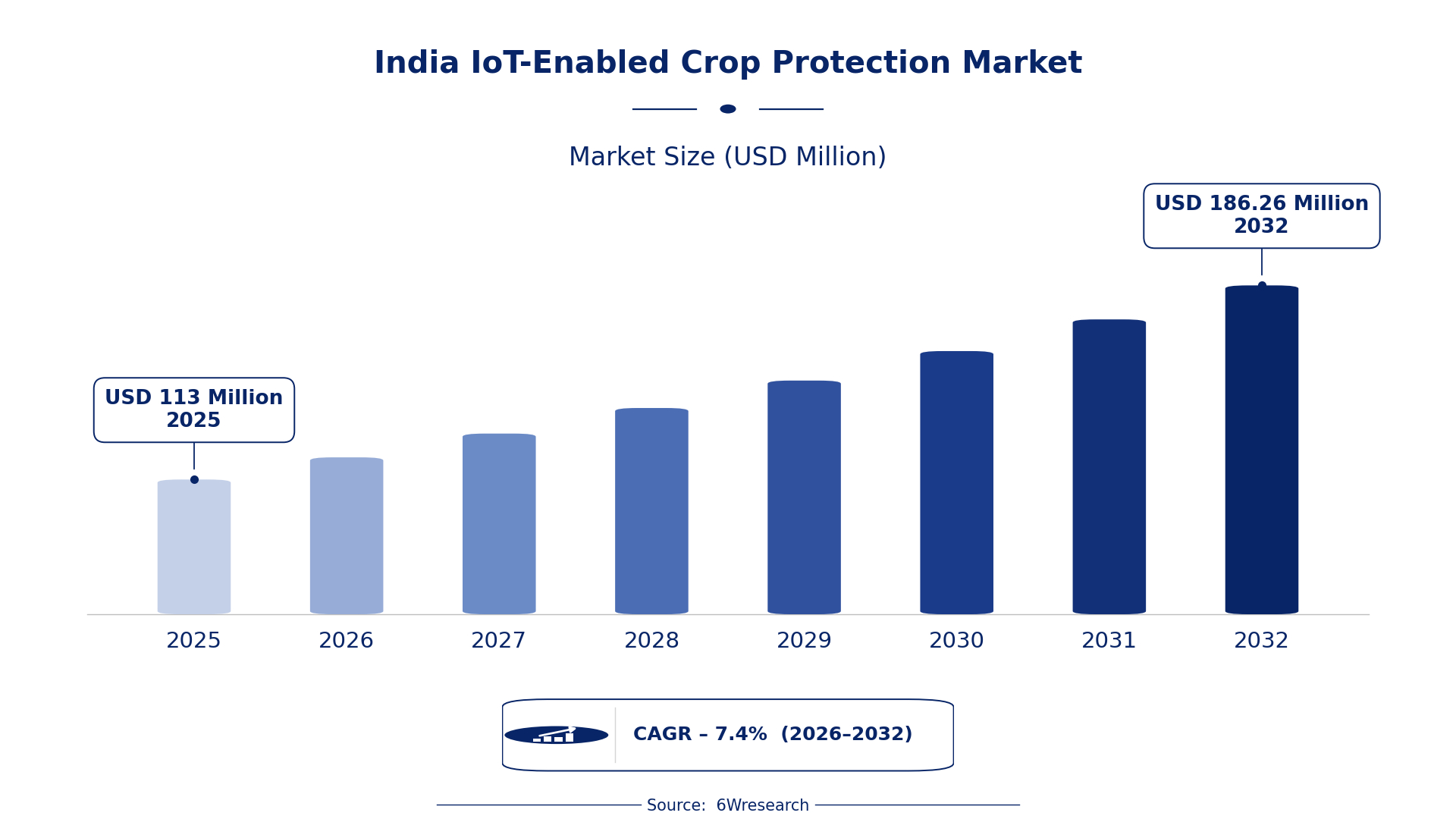
According to 6Wresearch internal database and industry insights, the India IoT-Enabled Crop Protection Market was valued at USD 113.0 million in 2025 and is projected to reach USD 186.26 million by 2032, growing at a CAGR of approximately 7.4% during 2026–2032.
India IoT-Enabled Crop Protection Market Highlights
| Report Metric | Details |
| Report Name | India IoT-Enabled Crop Protection Market |
| Market Size 2025 | USD 113.0 million |
| Market Size 2032 | USD 186.26 million |
| Absolute Growth 2025–2032 | USD 73.26 million |
| CAGR 2026–2032 | 7.4% |
| Peak Annual Growth | 9.4% in 2028 |
| Forecast Period | 2026–2032 |
| Historical Data | 2022–2025 |
| Base Year | 2025 |
| Leading Protection Method, 2025 | Pest Detection (49% share) |
| Leading Sensor Type, 2025 | Environmental Sensors (48% share) |
| Leading Delivery System, 2025 | Drone Sprayers (38% share) |
| Leading Connectivity, 2025 | Cellular/LoRaWAN (39% share) |
| Leading End User, 2025 | AgriTech Firms (44% share) |
| Fastest-Growing Protection Method | Pesticide Scheduling (9.6% CAGR) |
| Fastest-Growing Delivery System | Automated Dispensers (9.7% CAGR) |
| Fastest-Growing Connectivity | LPWAN (8.6% CAGR) |
| Fastest-Growing End User | Large Farm Operators (9.5% CAGR) |
| Growing Sector | AgriTech |
| Key End Users | AgriTech Firms, Large Farm Operators, Greenhouse Farmers, Row Crop Growers |
India IoT-Enabled Crop Protection Market Year-wise Growth Rate and Key Drivers (2022–2032)
This graph illustrates the annual growth rates of the market from 2022 to 2032, highlighting a steady upward trajectory and projected market expansion over the forecast period.
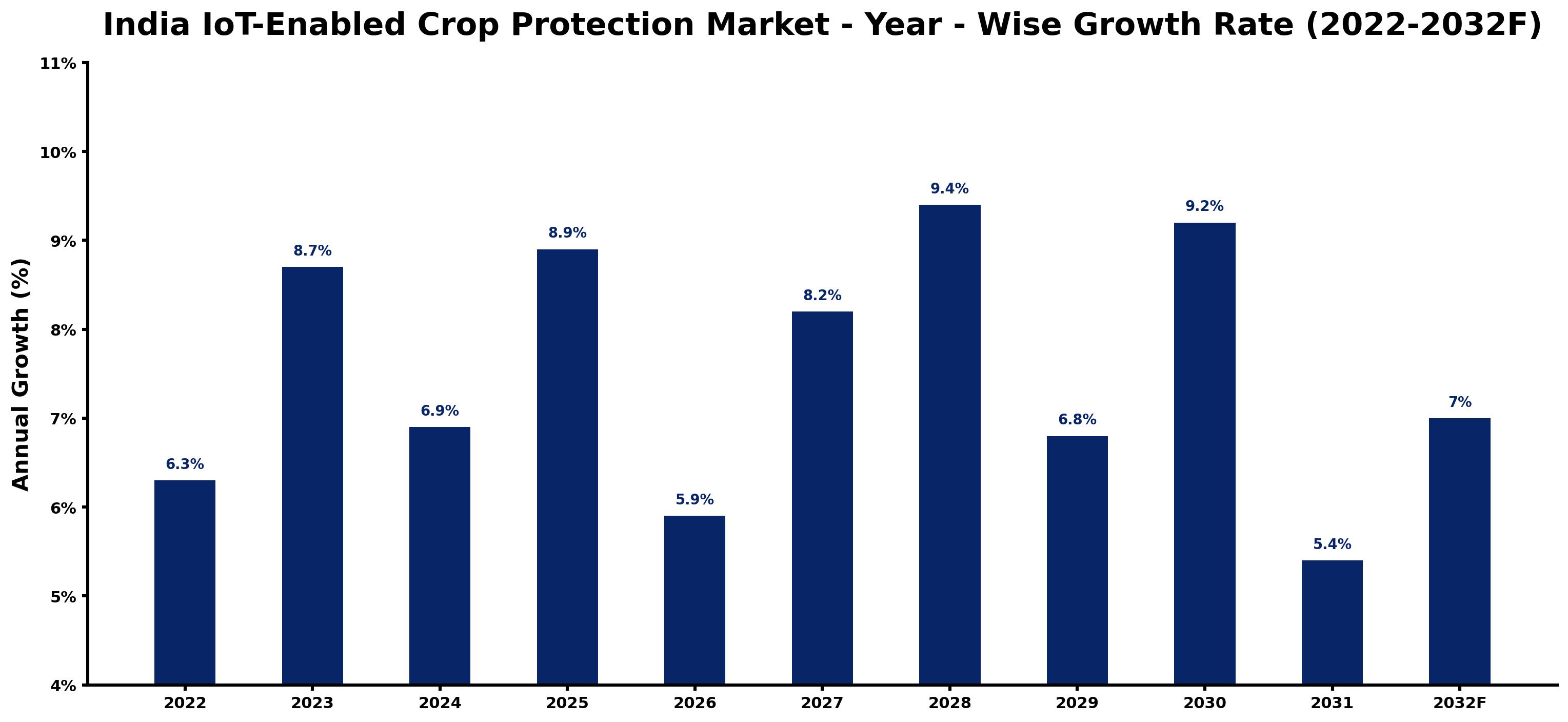
Below, each year's estimated growth is shown next to the factor that most influenced it.
| Year | Estimated Annual Growth (%) | Market Rationale |
| 2022 | 6.3 | The market experienced steady growth as AgriTech firms began adopting IoT solutions. |
| 2023 | 8.7 | Demand surged due to increased adoption of precision farming techniques among farmers. |
| 2024 | 6.9 | Growth slowed as the Soil Health Card Scheme encouraged farmers to adopt advanced technologies. |
| 2025 | 8.9 | The market rebounded with heightened interest in pest detection technologies among users. |
| 2026 | 5.9 | A slowdown was noted as the Digital India initiative improved connectivity for farmers. |
| 2027 | 8.2 | Demand rose again as large farm operators sought efficient solutions for pest management. |
| 2028 | 9.4 | The market peaked as new technologies in pesticide scheduling gained traction. |
| 2029 | 6.8 | Growth decelerated as market saturation began to set in for existing solutions. |
| 2030 | 9.2 | An uptick in demand occurred as large farm operators adopted advanced technologies. |
| 2031 | 5.4 | Growth slowed again as the market stabilised after several years of rapid expansion. |
| 2032 | 7.0 | Demand increased as farmers continued to invest in IoT-enabled solutions. |
Note: Market size estimations and growth projections presented in this report are based on 6Wresearch's proprietary forecasting methodology, utilizing the latest available industry data, government publications, and primary research inputs.
India IoT-Enabled Crop Protection Market Synopsis
IoT-Enabled Crop Protection in India combines advanced technologies like sensors and data analytics for agricultural productivity. This approach is vital for pest detection, disease monitoring, and optimizing pesticide application. The India IoT-Enabled Crop Protection Market is expanding due to rising food demand and increased adoption of precision farming techniques. AgriTech firms are at the forefront of this trend, supported by government initiatives aimed at improving agricultural efficiency. With over 600,000 registered farmers using IoT technologies, the market is set for substantial growth.
Market Dynamics Impact Analysis (2026–2032)
| Factor | Type | Impact | Primary Segment Affected |
| Increased adoption of precision farming techniques | Driver | High | Pest Detection |
| Growing demand for efficient pest management solutions | Driver | High | Disease Monitoring |
| Rising food demand due to population growth | Opportunity | High | Pesticide Scheduling |
| Expansion of AgriTech firms in rural areas | Opportunity | High | Smart Sprayers |
| High initial investment costs for IoT technologies | Restraint | High | Drone Sprayers |
| Limited awareness among farmers about IoT benefits | Restraint | Medium | Environmental Sensors |
| Access to reliable internet connectivity remains a challenge | Challenge | High | Cellular/LoRaWAN |
| Regulatory compliance can be complex and time-consuming | Challenge | Medium | Automated Dispensers |
Evaluation of Drivers in India IoT-Enabled Crop Protection Market (2026–2032)
Below mentioned are some major drivers and their influence on market dynamics.
| Drivers | Primary Segment Affected | Why It Matters (Evidence) |
| Increased adoption of precision farming techniques | Pest Detection | This trend drives demand for early pest threat identification, with the agricultural sector contributing approximately 18% to GDP. |
| Growing demand for efficient pest management solutions | Disease Monitoring | Farmers are investing more in technologies that ensure crop health, with the agricultural sector contributing significantly to economic growth. |
| Rising food demand due to population growth | Pesticide Scheduling | India's population is projected to reach 1.5 billion by 2030, increasing the need for effective crop protection. |
| Expansion of AgriTech firms in rural areas | Smart Sprayers | These firms are adopting IoT solutions, improving productivity and efficiency in farming practices. |
| Government initiatives supporting agricultural technology | Drone Sprayers | The Smart Agriculture Mission promotes technology use, resulting in higher adoption of advanced delivery methods. |
The agricultural sector contributes approximately 18% to the GDP, driving investments in pest detection technologies. With India's population expected to reach 1.5 billion by 2030, the need for effective crop protection solutions is paramount. The Smart Agriculture Mission has further accelerated the adoption of IoT technologies, resulting in greater efficiency in pest management. As a consequence, large farm operators are increasingly investing in practical solutions, boosting overall agricultural productivity.
Evaluation of Restraints in India IoT-Enabled Crop Protection Market
The following restraints limit how fast demand can grow.
| Market Restraint | Primary Segment Affected | Why It Matters (Evidence) |
| High initial investment costs for IoT technologies | Drone Sprayers | Many farmers find the upfront costs prohibitive, limiting technology adoption and affecting purchasing decisions. |
| Limited awareness among farmers about IoT benefits | Environmental Sensors | This lack of knowledge hampers the widespread adoption of advanced agricultural technologies. |
| Access to reliable internet connectivity remains a challenge | Cellular/LoRaWAN | Poor connectivity in rural areas restricts the effective use of IoT solutions for crop protection. |
| Regulatory compliance can be complex and time-consuming | Automated Dispensers | Farmers face delays and additional costs in meeting compliance requirements, impacting their purchasing decisions. |
| Market saturation for existing solutions | Pesticide Scheduling | As the market matures, growth opportunities may diminish, affecting new investments. |
India IoT-Enabled Crop Protection Market Challenges
The India IoT-Enabled Crop Protection market still faces several challenges, beginning with high costs for farmers. The integration of IoT technologies can raise initial investment by up to 30%, which limits adoption among smallholders. Regulatory barriers also create delays; the Bureau of Indian Standards' stringent quality requirements can postpone product launches by up to six months, frustrating AgriTech firms. A lack of skills in data analytics hampers effective implementation, as many farmers lack training, which restricts the full use of IoT solutions. Supply chain inefficiencies lead to delays in accessing IoT devices, causing setbacks in pest detection and disease monitoring for producers.
Trends in the India IoT-Enabled Crop Protection Market
Below mentioned are some of the trends shaping the India IoT-Enabled Crop Protection Market growth.
- Shift from Traditional to IoT-Enabled Solutions: Since 2020, AgriTech firms have increasingly adopted IoT solutions, with over 600,000 registered farmers using these technologies. This shift improves agricultural productivity and efficiency, allowing for more precise pest management.
- Transition to Automated Pest Management: In 2023, the adoption of automated dispensers has grown, with a projected CAGR of 9.7%. This trend reflects the need for efficient pesticide application methods among large farm operators.
- Emergence of Smart Agriculture Practices: The Smart Agriculture Mission, launched in 2021, promotes the integration of technology in farming. This initiative has led to a 30% increase in the use of IoT solutions among farmers.
- Prioritisation of Environmental Monitoring: Since 2021, environmental sensors have gained traction, with a CAGR of 8.8%. This trend is driven by the need for real-time data on crop conditions, improving decision-making for farmers.
Investment Opportunities in the India IoT-Enabled Crop Protection Market
Investors looking at the India IoT-Enabled Crop Protection Market should consider the following areas.
- AgriTech Firms Seeking Advanced Solutions: With the agricultural sector contributing 18% to GDP, AgriTech firms are increasingly looking for IoT-enabled crop protection solutions. The market is set to grow as these firms expand their offerings.
- Growing Demand for Automated Spraying Systems: As the market for automated dispensers expands, large farm operators are seeking efficient solutions. This presents an opportunity for suppliers, with a projected growth rate of 9.7%.
- Investment in Precision Agriculture Technologies: The Indian government's allocation of ₹1,000 crores for agricultural technology development in 2023 creates opportunities for new entrants. Collaborating with local AgriTech firms can facilitate market entry.
- Expansion of IoT Solutions in Rural Areas: With over 140 million hectares of arable land, there is a significant gap in IoT adoption. Partnering with local agricultural cooperatives can help suppliers penetrate this market effectively.
Government Initiatives in the India IoT-Enabled Crop Protection Market
The Pradhan Mantri Kisan Samman Nidhi scheme, launched in 2019, provides direct income support to farmers, increasing their purchasing power for technologies. This initiative encourages farmers to invest in IoT-enabled crop protection solutions, thereby boosting market demand. The National Mission on Agricultural Extension and Technology, initiated in 2020, aims to strengthen agricultural extension services and promote modern practices, facilitating the adoption of advanced technologies among farmers.
The Ministry of Agriculture and Farmers' Welfare oversees the implementation of various agricultural schemes, including the Soil Health Card Scheme, which provides farmers with essential information on soil health. This scheme promotes the use of IoT-based soil monitoring technologies, encouraging sustainable practices. The Digital India initiative, launched in 2015, improves connectivity and access to information for farmers, further supporting the adoption of IoT solutions in agriculture.
Future Insight of the India IoT-Enabled Crop Protection Market
The India IoT-Enabled Crop Protection market is expected to transform by 2032, driven by increased government support for agricultural technology. The allocation of ₹1,000 crores for agricultural technology development in 2023 will improve infrastructure for IoT adoption. The Smart Agriculture Mission will facilitate the integration of advanced technologies, enabling farmers to optimise crop management. As India's population approaches 1.5 billion by 2030, the demand for efficient farming practices will rise, creating opportunities for both buyers and suppliers in this evolving market.
Market Segmentation Analysis
Each segment group is reviewed below, with the leader by share and the fastest grower by CAGR.
By Protection Method – Pest Detection Dominated, Pesticide Scheduling Expected to Grow Fastest
According to Shubham Deep, Research Manager at 6Wresearch, with a 49% revenue share in 2025, Pest Detection was the largest protection method category. Pest Detection holds the largest market share as it is essential for identifying pest threats early, which is crucial for maintaining crop health. With over 600,000 registered farmers using IoT technologies, this method is a primary focus for many agricultural practices in India. Pesticide Scheduling is set to record the highest CAGR in this split, 9.6% over 2026–2032. Pesticide Scheduling is experiencing rapid growth as it facilitates timely application of pesticides, which is crucial for optimising crop yields. The increasing adoption of IoT solutions by AgriTech firms is significantly driving this method's expansion. This indicates that suppliers should concentrate on enhancing pest detection technologies to meet the rising demands of the agricultural sector.
By Sensor Type – Environmental Sensors Dominated and Is Expected to Record the Fastest Growth
In 2025, Environmental Sensors led the sensor type split with a 48% share. Environmental Sensors dominate the market share due to their critical role in monitoring various environmental factors that significantly impact crop productivity. Their widespread adoption among farmers illustrates their importance in precision agriculture practices across India. Its lead should widen, with a projected CAGR of 8.8% during 2026–2032, the highest in this split. The growth of Environmental Sensors is propelled by their dual role in monitoring and data collection, essential for effective crop management. As farmers increasingly rely on data-driven decisions, demand for these sensors will continue to rise. Suppliers must prioritise the development of advanced environmental sensors to cater to the evolving needs of farmers.
By Delivery System – Drone Sprayers Dominated, Automated Dispensers Expected to Grow Fastest
Drone Sprayers took a 38% share of delivery system in 2025, more than any other category. Drone Sprayers capture the largest market share because they revolutionise pesticide delivery methods, enabling efficient and precise application across vast agricultural areas. Their effectiveness in reaching difficult terrains makes them a preferred choice among farmers in India. Automated Dispensers are projected to grow fastest, at a CAGR of 9.7% during 2026–2032. Automated Dispensers are witnessing the fastest growth as they ensure accurate pesticide dispensing, aligning with the trend towards precision farming. This technology's ability to reduce waste and improve application efficiency is attracting significant interest from large-scale operators. This suggests that suppliers should invest in automated dispensing technologies to meet the increasing demand for precision in crop protection.
By Connectivity – Cellular/LoRaWAN Dominated, LPWAN Expected to Grow Fastest
The largest connectivity category in 2025 was Cellular/LoRaWAN, with a 39% share of total revenue. Cellular/LoRaWAN leads the market share due to its capability for real-time data transmission, essential for effective monitoring and management of agricultural practices. The reliability of this connectivity option is critical for farmers implementing IoT solutions in their operations. Over 2026–2032, LPWAN is expected to post the fastest growth, at a CAGR of 8.6%. LPWAN is growing rapidly as it is ideal for long-range IoT applications, making it particularly suitable for large agricultural areas. Its efficiency in maintaining connectivity over vast distances is driving its adoption among farm operators. This highlights the need for suppliers to enhance LPWAN solutions to support the expanding IoT ecosystem in agriculture.
By End User – AgriTech Firms Dominated, Large Farm Operators Expected to Grow Fastest
AgriTech Firms held a 44% share of the India IoT-Enabled Crop Protection Market by end user in 2025. AgriTech Firms hold the largest market share as they are the primary users of IoT solutions, integrating advanced technologies into their services to improve agricultural productivity. Their investment in IoT is crucial for the development of modern farming techniques in India. Large Farm Operators are set to record the highest CAGR in this split, 9.5% over 2026–2032. Large Farm Operators are experiencing the fastest growth as they increasingly implement advanced technologies for efficiency in their operations. The rising food demand due to India's growing population is pushing these operators to adopt IoT solutions more rapidly. This means that suppliers should tailor their offerings to meet the specific needs of large farm operators, who are crucial for future agricultural advancements.
Key Attractiveness of the Report
- 10 Years of Market Numbers
- Historical Data Starting from 2022 to 2025
- Base Year 2025
- Forecast Data until 2032
- Key Performance Indicators Impacting the Market
- Major Upcoming Developments and Projects
Key Highlights of the Report:
- India IoT-Enabled Crop Protection Market Outlook
- Market Size of India IoT-Enabled Crop Protection Market, 2025
- Forecast of India IoT-Enabled Crop Protection Market, 2032
- Historical Data and Forecast of India IoT-Enabled Crop Protection Revenues & Volume for the Period 2022 - 2032F
- India IoT-Enabled Crop Protection Market Trend Evolution
- India IoT-Enabled Crop Protection Market Drivers and Challenges
- India IoT-Enabled Crop Protection Price Trends
- India IoT-Enabled Crop Protection Porter's Five Forces
- India IoT-Enabled Crop Protection Industry Life Cycle
- Historical Data and Forecast of India IoT-Enabled Crop Protection Market Revenues & Volume By Protection Method for the Period 2022 - 2032F
- Historical Data and Forecast of India IoT-Enabled Crop Protection Market Revenues & Volume By Pest Detection for the Period 2022 - 2032F
- Historical Data and Forecast of India IoT-Enabled Crop Protection Market Revenues & Volume By Disease Monitoring for the Period 2022 - 2032F
- Historical Data and Forecast of India IoT-Enabled Crop Protection Market Revenues & Volume By Pesticide Scheduling for the Period 2022 - 2032F
- Historical Data and Forecast of India IoT-Enabled Crop Protection Market Revenues & Volume By Smart Sprayers for the Period 2022 - 2032F
- Historical Data and Forecast of India IoT-Enabled Crop Protection Market Revenues & Volume By Sensor Type for the Period 2022 - 2032F
- Historical Data and Forecast of India IoT-Enabled Crop Protection Market Revenues & Volume By Optical Cameras for the Period 2022 - 2032F
- Historical Data and Forecast of India IoT-Enabled Crop Protection Market Revenues & Volume By Humidity Sensors for the Period 2022 - 2032F
- Historical Data and Forecast of India IoT-Enabled Crop Protection Market Revenues & Volume By Environmental Sensors for the Period 2022 - 2032F
- Historical Data and Forecast of India IoT-Enabled Crop Protection Market Revenues & Volume By Infrared + GPS Sensors for the Period 2022 - 2032F
- Historical Data and Forecast of India IoT-Enabled Crop Protection Market Revenues & Volume By Delivery System for the Period 2022 - 2032F
- Historical Data and Forecast of India IoT-Enabled Crop Protection Market Revenues & Volume By Drone Sprayers for the Period 2022 - 2032F
- Historical Data and Forecast of India IoT-Enabled Crop Protection Market Revenues & Volume By Automated Dispensers for the Period 2022 - 2032F
- Historical Data and Forecast of India IoT-Enabled Crop Protection Market Revenues & Volume By Soil-Triggered System for the Period 2022 - 2032F
- Historical Data and Forecast of India IoT-Enabled Crop Protection Market Revenues & Volume By Vehicle-Mounted for the Period 2022 - 2032F
- Historical Data and Forecast of India IoT-Enabled Crop Protection Market Revenues & Volume By Connectivity for the Period 2022 - 2032F
- Historical Data and Forecast of India IoT-Enabled Crop Protection Market Revenues & Volume By Cellular/LoRaWAN for the Period 2022 - 2032F
- Historical Data and Forecast of India IoT-Enabled Crop Protection Market Revenues & Volume By Wi-Fi + Zigbee for the Period 2022 - 2032F
- Historical Data and Forecast of India IoT-Enabled Crop Protection Market Revenues & Volume By LPWAN for the Period 2022 - 2032F
- Historical Data and Forecast of India IoT-Enabled Crop Protection Market Revenues & Volume By Bluetooth for the Period 2022 - 2032F
- Historical Data and Forecast of India IoT-Enabled Crop Protection Market Revenues & Volume By End User for the Period 2022 - 2032F
- Historical Data and Forecast of India IoT-Enabled Crop Protection Market Revenues & Volume By AgriTech Firms for the Period 2022 - 2032F
- Historical Data and Forecast of India IoT-Enabled Crop Protection Market Revenues & Volume By Greenhouse Farmers for the Period 2022 - 2032F
- Historical Data and Forecast of India IoT-Enabled Crop Protection Market Revenues & Volume By Row Crop Growers for the Period 2022 - 2032F
- Historical Data and Forecast of India IoT-Enabled Crop Protection Market Revenues & Volume By Large Farm Operators for the Period 2022 - 2032F
- India IoT-Enabled Crop Protection Import Export Trade Statistics
- Market Opportunity Assessment By Protection Method
- Market Opportunity Assessment By Sensor Type
- Market Opportunity Assessment By Delivery System
- Market Opportunity Assessment By Connectivity
- Market Opportunity Assessment By End User
- India IoT-Enabled Crop Protection Top Companies Market Share
- India IoT-Enabled Crop Protection Competitive Benchmarking By Technical and Operational Parameters
- India IoT-Enabled Crop Protection Company Profiles
- India IoT-Enabled Crop Protection Key Strategic Recommendations
Market Covered
The report offers an extensive study of the following market segments.
By Protection Method
- Pest Detection
- Disease Monitoring
- Pesticide Scheduling
- Smart Sprayers
By Sensor Type
- Optical Cameras
- Humidity Sensors
- Environmental Sensors
- Infrared + GPS Sensors
By Delivery System
- Drone Sprayers
- Automated Dispensers
- Soil-Triggered System
- Vehicle-Mounted
By Connectivity
- Cellular/LoRaWAN
- Wi-Fi + Zigbee
- LPWAN
- Bluetooth
By End User
- AgriTech Firms
- Greenhouse Farmers
- Row Crop Growers
- Large Farm Operators































