India IoT-Enabled Home Decor Market Size & Growth Rate
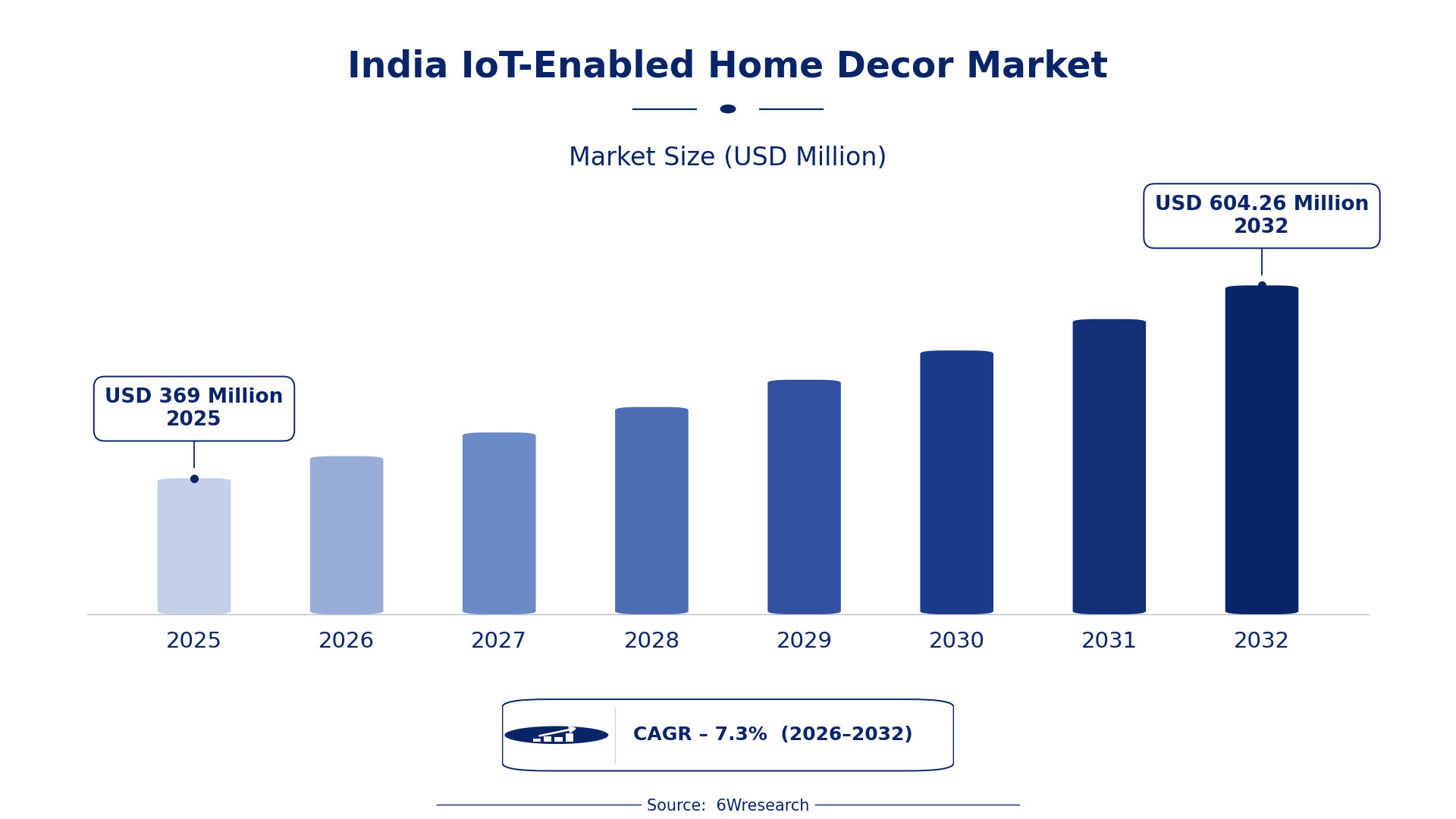
According to 6Wresearch internal database and industry insights, the India IoT-Enabled Home Decor Market was valued at USD 369.0 million in 2025 and is projected to reach USD 604.26 million by 2032, growing at a CAGR of approximately 7.3% during 2026–2032.
India IoT-Enabled Home Decor Market Highlights
| Report Metric | Details |
| Report Name | India IoT-Enabled Home Decor Market |
| Market Size 2025 | USD 369.0 million |
| Market Size 2032 | USD 604.26 million |
| Absolute Growth 2025–2032 | USD 235.26 million |
| CAGR 2026–2032 | 7.3% |
| Peak Annual Growth | 9.6% in 2032 |
| Forecast Period | 2026–2032 |
| Historical Data | 2022–2025 |
| Base Year | 2025 |
| Leading Decor Product Type, 2025 | Smart Lighting Fixtures (41% share) |
| Leading Smart Feature, 2025 | App-Controlled Scenes (44% share) |
| Leading Connectivity, 2025 | Wi-Fi (49% share) |
| Leading Power Source, 2025 | Hardwired (35% share) |
| Leading End User, 2025 | Homeowners (40% share) |
| Fastest-Growing Decor Product Type | Ambient Wall Panels (9.9% CAGR) |
| Fastest-Growing Smart Feature | Voice Assistant Enabled (9.8% CAGR) |
| Fastest-Growing Connectivity | Bluetooth + Wi-Fi (9.9% CAGR) |
| Fastest-Growing Power Source | USB/Rechargeable (9.2% CAGR) |
| Fastest-Growing End User | Interior Designers (8.4% CAGR) |
| Growing Sector | Smart Home Products |
| Key End Users | Homeowners, Interior Designers, Urban Dwellers |
India IoT-Enabled Home Decor Market Year-wise Growth Rate and Key Drivers (2022–2032)
This graph illustrates the annual growth rates of the market from 2022 to 2032, highlighting a steady upward trajectory and projected market expansion over the forecast period.
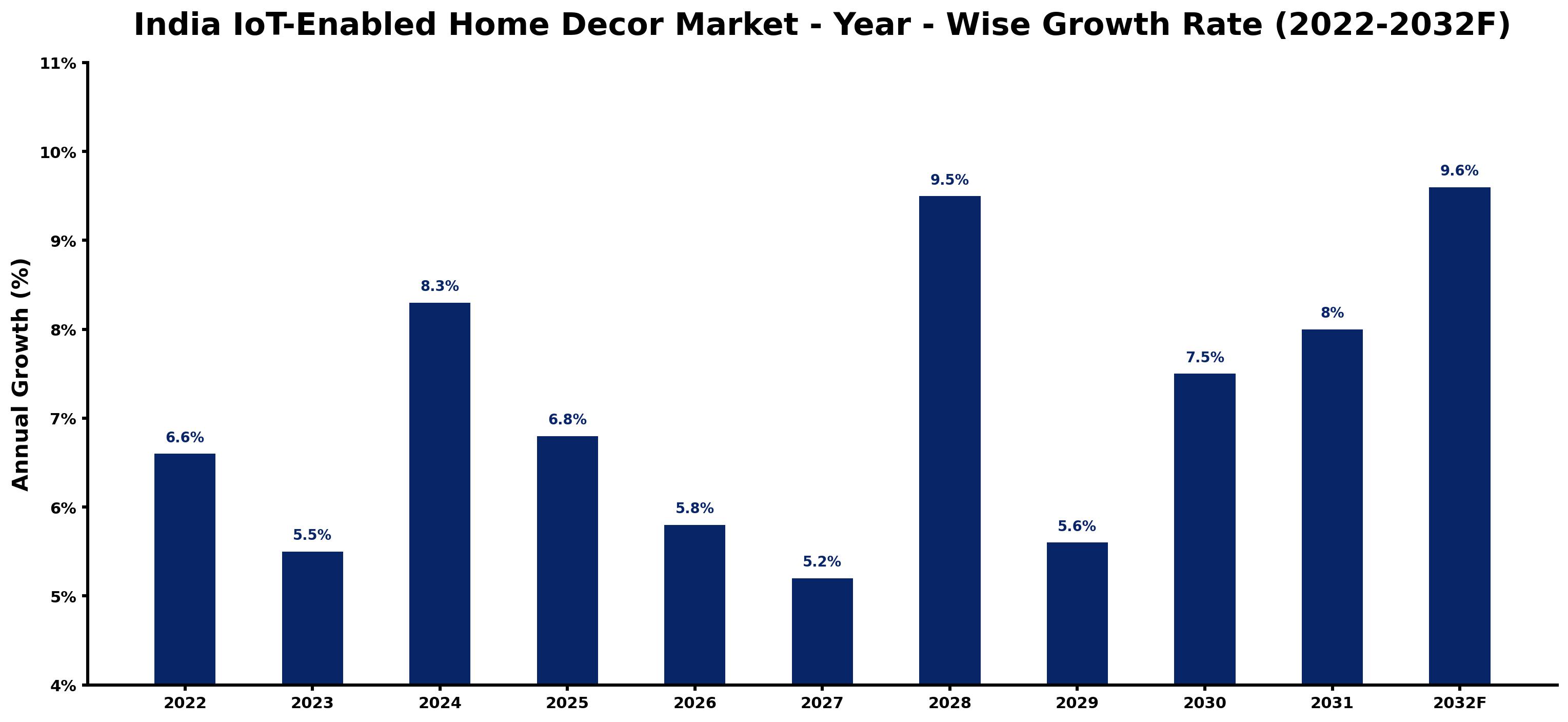
The table below sets out the estimated growth rate for each year and the main factor behind it.
| Year | Estimated Annual Growth (%) | Market Rationale |
| 2022 | 6.6 | The market experienced steady demand from urban homeowners and interior designers. |
| 2023 | 5.5 | Growth slowed due to market adjustments and a focus on product integration. |
| 2024 | 8.3 | Demand surged as smart lighting fixtures gained popularity among homeowners. |
| 2025 | 6.8 | Growth slowed again as buyers became more selective in their purchases. |
| 2026 | 5.8 | The market faced slower growth as competition intensified among suppliers. |
| 2027 | 5.2 | Demand continued to slow as consumers evaluated their smart home investments. |
| 2028 | 9.5 | A resurgence in interest for smart decor led to faster growth rates. |
| 2029 | 5.6 | Growth slowed as market saturation began to affect new purchases. |
| 2030 | 7.5 | Demand picked up again as new smart home technologies were introduced. |
| 2031 | 8.0 | Growth accelerated as urban areas adopted more IoT-enabled solutions. |
| 2032 | 9.6 | The market peaked as consumer interest in smart home aesthetics surged. |
Note: Market size estimations and growth projections presented in this report are based on 6Wresearch's proprietary forecasting methodology, utilizing the latest available industry data, government publications, and primary research inputs.
India IoT-Enabled Home Decor Market Synopsis
IoT-Enabled Home Decor in India includes smart home products that elevate user experience through internet connectivity. These items, equipped with advanced sensors and software, enhance home aesthetics, convenience, and energy efficiency. The India IoT-Enabled Home Decor Market is expanding due to rising disposable incomes and urbanisation. The Digital India initiative supports smart technologies, and over 60% of urban residents show interest in IoT-enabled solutions. This blend of factors is generating strong demand from homeowners and interior designers alike.
Market Dynamics Impact Analysis (2026–2032)
| Factor | Type | Impact | Primary Segment Affected |
| Growing urbanization and rising disposable incomes are driving demand for smart home solutions. | Driver | High | Smart Lighting Fixtures |
| The increasing popularity of smart home products creates opportunities for innovative designs. | Opportunity | High | Ambient Wall Panels |
| Consumer hesitance due to high initial costs can limit market penetration. | Restraint | High | Decorative Smart Mirrors |
| Limited awareness about the benefits of IoT-enabled products restrains growth. | Restraint | Medium | Smart Clocks |
| Technological advancements in smart home devices are driving market growth. | Driver | High | Smart Lighting Fixtures |
| The trend towards energy efficiency in homes opens new market avenues. | Opportunity | Medium | Ambient Wall Panels |
| Competition among manufacturers can lead to price wars affecting profitability. | Challenge | High | Smart Lighting Fixtures |
| Supply chain disruptions can delay product availability for consumers. | Challenge | Medium | Decorative Smart Mirrors |
Evaluation of Drivers in India IoT-Enabled Home Decor Market (2026–2032)
The table below links each growth driver to the segment it affects and the evidence for it.
| Drivers | Primary Segment Affected | Why It Matters (Evidence) |
| Increasing urbanisation leads to higher demand for smart home products. | Smart Lighting Fixtures | Urban areas like Bangalore are rapidly adopting smart technologies, with the smart lighting market projected to reach 1.5 million units by 2025. |
| Rising disposable incomes enable homeowners to invest in smart decor. | Ambient Wall Panels | The average urban household in India has 3-5 smart home devices, reflecting the willingness to spend on home aesthetics. |
| Technological advancements increase the appeal of smart home solutions. | Decorative Smart Mirrors | Features in mirrors provide functionality and style, attracting urban dwellers. |
| Government initiatives promote the adoption of smart technologies. | Smart Clocks | The Digital India initiative encourages technology integration in homes, increasing demand for smart devices. |
| Growing interest in energy efficiency drives purchases of smart decor. | Smart Lighting Fixtures | The National Smart Grid Mission aims to enhance energy efficiency, encouraging homeowners to invest in smart lighting. |
Market growth for IoT-Enabled Home Decor in India is underpinned by rising urbanisation, increasing disposable incomes, and technological advancements. Urban areas are rapidly adopting smart technologies, with the smart lighting market projected to reach 1.5 million units by 2025. The average urban household now owns 3-5 smart home devices, reflecting a willingness to invest in decor. The focus on energy efficiency is driving demand for smart lighting fixtures, appealing to environmentally conscious consumers.
Evaluation of Restraints in India IoT-Enabled Home Decor Market
The main factors holding the market back are set out below.
| Market Restraint | Primary Segment Affected | Why It Matters (Evidence) |
| High initial costs of smart home products limit consumer adoption. | Decorative Smart Mirrors | Many consumers are hesitant to invest in smart decor due to the perceived high costs associated with these products. |
| Limited awareness about the benefits of IoT-enabled products restrains growth. | Smart Clocks | Consumers often lack understanding of how smart clocks can improve their daily routines, affecting sales. |
| Supply chain disruptions can delay product availability for consumers. | Smart Lighting Fixtures | Manufacturers face challenges in sourcing components, causing potential delays in product launches. |
| Intense competition among manufacturers can lead to price wars affecting profitability. | Ambient Wall Panels | Competition may drive prices down, impacting profit margins for suppliers. |
| Consumer hesitance due to high initial costs can limit market penetration. | Decorative Smart Mirrors | The upfront investment required for smart decor can deter potential buyers. |
India IoT-Enabled Home Decor Market Challenges
The India IoT-Enabled Home Decor market still has to solve a few problems, starting with fierce competition. An influx of local and international players is driving prices down, which reduces profit margins for producers. Technology integration is another hurdle; urban households typically own 3-5 smart devices, yet compatibility issues can delay installations for buyers, leading to dissatisfaction. Regulatory challenges arise from new standards under IS 16444, which can increase compliance costs for suppliers. High costs of IoT-enabled products also limit access for many potential buyers, especially in tier-2 cities, where affordability remains a pressing issue.
Trends in the India IoT-Enabled Home Decor Market
The trends below show where the India IoT-Enabled Home Decor Market is heading.
- Shift towards Smart Lighting Solutions: Since 2020, urban areas in India have seen a shift towards smart lighting solutions. The smart lighting market is projected to reach 1.5 million units by 2025, indicating a growing preference for energy-efficient options among homeowners.
- Emergence of Smart Mirrors in Luxury Homes: Smart mirrors have gained popularity in luxury apartments across metropolitan areas. In 2023, over 60% of urban dwellers expressed interest in IoT-enabled home solutions, highlighting the trend towards integrating smart features into home decor.
- Transition to Energy-Efficient Home Decor: The focus on energy efficiency has led to increased demand for smart home products. The National Smart Grid Mission aims to improve energy efficiency in urban areas, encouraging homeowners to invest in smart decor.
- Rise of App-Controlled Home Decor: Since 2022, app-controlled scenes have become a leading feature in smart home products. With a 44% market share, they are driving consumer interest in customizable home environments.
Investment Opportunities in the India IoT-Enabled Home Decor Market
The following opportunities in the India IoT-Enabled Home Decor Market pair current demand with a clear way in.
- Supply Smart Lighting Fixtures: With the smart lighting market projected to reach 1.5 million units by 2025, suppliers can focus on appealing designs to attract urban homeowners. Collaborating with local manufacturers can facilitate market entry.
- Invest in Ambient Wall Panels: Urban areas are seeking aesthetic smart decor solutions. Suppliers can enter this market by partnering with interior designers to create tailored offerings.
- Develop Advanced Smart Clocks: As consumer interest in smart decor rises, suppliers can invest in creating advanced smart clocks. Obtaining certifications under the Bureau of Indian Standards can ease market entry.
- Focus on Decorative Smart Mirrors: With the growing popularity of smart mirrors in luxury apartments, suppliers can target this niche market. Collaborating with real estate developers can provide direct access to potential buyers.
Government Initiatives in the India IoT-Enabled Home Decor Market
The 'Digital India' initiative by the Ministry of Electronics and Information Technology, launched in 2020, aims to promote the adoption of smart technologies across sectors. This initiative complements the Bureau of Indian Standards, which established guidelines for smart home devices in 2022 to ensure safety and interoperability among products. These measures build consumer confidence and encourage manufacturers to comply with standards, supporting growth in the IoT-enabled home decor market. The Smart Cities Mission, initiated in 2015, continues to improve urban living standards through technology integration, including IoT-enabled home decor solutions.
The Ministry of Housing and Urban Affairs approved ₹1,000 crores for smart city projects in 2021, which includes funding for IoT integration in home decor. Agencies involved in these projects ensure that smart technologies meet safety standards and are effectively implemented in urban areas. This ongoing support creates a conducive environment for the growth of IoT-enabled home decor. The National Policy on Electronics aims to increase domestic manufacturing of electronics, including smart home devices, with a target of $400 billion by 2025, further strengthening the market.
Future Insight of the India IoT-Enabled Home Decor Market
Several forward-looking factors should support the India IoT-Enabled Home Decor market over the coming years. By 2025, smart lighting is projected to reach 1.5 million units, indicating a growing acceptance of smart technologies. The 'Digital India' initiative will facilitate the integration of smart devices into homes, improving user experience. The 'Make in India' initiative will encourage local manufacturing, potentially lowering costs for suppliers and making products more accessible for buyers. Urban areas like Delhi and Mumbai will continue to lead in smart home adoption, driving demand for advanced home decor solutions.
Market Segmentation Analysis
The report offers a comprehensive study of the following market segments and their leading categories in the market.
By Decor Product Type – Smart Lighting Fixtures Dominated, Ambient Wall Panels Expected to Grow Fastest
According to Shubham Deep, Research Manager at 6Wresearch, Smart Lighting Fixtures accounted for a 41% market share by decor product type in 2025. Smart lighting fixtures lead the market due to their dual role in enhancing home aesthetics and improving energy efficiency. Urban areas like Delhi and Mumbai are at the forefront of installations, driving substantial demand for these fixtures. The quickest growth will come from Ambient Wall Panels, forecast to expand at a CAGR of 9.9% between 2026 and 2032. Ambient wall panels are quickly gaining popularity as they combine aesthetic appeal with smart features, catering to the modern homeowner's desire for stylish yet functional decor. This growing emphasis on home aesthetics ensures their rapid ascent in the market. Suppliers should focus on the design and functionality of ambient wall panels to meet the increasing demand from urban homeowners.
By Smart Feature – App-Controlled Scenes Dominated, Voice Assistant Enabled Expected to Grow Fastest
App-Controlled Scenes took a 44% share of smart feature in 2025, more than any other category. App-controlled scenes dominate the market, significantly enhancing user experience through customisation and convenience. Their integration into smart home systems has become a standard expectation among consumers, solidifying their leading position. Voice Assistant Enabled is projected to grow fastest, at a CAGR of 9.8% during 2026–2032. Voice assistant enabled features are witnessing rapid growth due to their hands-free control capabilities, aligning with the increasing adoption of voice technology in homes. This trend is expected to continue as consumers seek seamless interactions with their devices. Manufacturers should ensure compatibility with voice assistants to align with user preferences in the smart home market.
By Connectivity – Wi-Fi Dominated, Bluetooth + Wi-Fi Expected to Grow Fastest
The largest connectivity category in 2025 was Wi-Fi, with a 49% share of total revenue. Wi-Fi is the leading connectivity method in smart home products, providing essential internet access for seamless operation. Its widespread availability in urban households makes it the preferred choice among consumers seeking reliable connectivity. Bluetooth + Wi-Fi is set to record the highest CAGR in this split, 9.9% over 2026–2032. Bluetooth + Wi-Fi is experiencing accelerated growth as it offers flexible connectivity options for various smart home devices. This combination appeals to tech-savvy users looking for versatile solutions for their homes. Suppliers must ensure their products support both Wi-Fi and Bluetooth connectivity to cater to the diverse needs of consumers.
By Power Source – Hardwired Dominated, USB/Rechargeable Expected to Grow Fastest
In 2025, Hardwired led the power source split with a 35% share. Hardwired power sources are prevalent in the market, especially for permanent installations where reliability is essential. This method is commonly preferred in urban homes, where permanent smart decor installations are becoming standard. Over 2026–2032, USB/Rechargeable is expected to post the fastest growth, at a CAGR of 9.2%. USB/rechargeable power sources are gaining popularity as they cater to the demand for portable smart decor items, appealing to younger homeowners who value flexibility. This trend aligns with the growing interest in multifunctional home products. Manufacturers should consider expanding their product lines to include USB/rechargeable options to attract younger, mobile-oriented consumers.
By End User – Homeowners Dominated, Interior Designers Expected to Grow Fastest
Homeowners held a 40% share of the India IoT-Enabled Home Decor Market by end user in 2025. Homeowners represent the largest segment in the market, as they are the primary consumers investing in smart home decor for enhanced aesthetics and convenience. The average age of homeowners adopting these products is around 30-45 years, indicating a tech-savvy demographic eager for smart solutions. The quickest growth will come from Interior Designers, forecast to expand at a CAGR of 8.4% between 2026 and 2032. Interior designers are rapidly becoming the fastest-growing segment, as they increasingly specify smart decor products in their designs, driven by client demand for modern aesthetics. Their influence is expected to significantly shape market trends in the coming years. Suppliers should develop targeted marketing strategies to engage interior designers, as they play a crucial role in the adoption of smart home decor.
Key Attractiveness of the Report
- 10 Years of Market Numbers
- Historical Data Starting from 2022 to 2025
- Base Year 2025
- Forecast Data until 2032
- Key Performance Indicators Impacting the Market
- Major Upcoming Developments and Projects
Key Highlights of the Report:
- India IoT-Enabled Home Decor Market Outlook
- Market Size of India IoT-Enabled Home Decor Market, 2025
- Forecast of India IoT-Enabled Home Decor Market, 2032
- Historical Data and Forecast of India IoT-Enabled Home Decor Revenues & Volume for the Period 2022 - 2032F
- India IoT-Enabled Home Decor Market Trend Evolution
- India IoT-Enabled Home Decor Market Drivers and Challenges
- India IoT-Enabled Home Decor Price Trends
- India IoT-Enabled Home Decor Porter's Five Forces
- India IoT-Enabled Home Decor Industry Life Cycle
- Historical Data and Forecast of India IoT-Enabled Home Decor Market Revenues & Volume By Decor Product Type for the Period 2022 - 2032F
- Historical Data and Forecast of India IoT-Enabled Home Decor Market Revenues & Volume By Smart Lighting Fixtures for the Period 2022 - 2032F
- Historical Data and Forecast of India IoT-Enabled Home Decor Market Revenues & Volume By Ambient Wall Panels for the Period 2022 - 2032F
- Historical Data and Forecast of India IoT-Enabled Home Decor Market Revenues & Volume By Decorative Smart Mirrors for the Period 2022 - 2032F
- Historical Data and Forecast of India IoT-Enabled Home Decor Market Revenues & Volume By Smart Clocks for the Period 2022 - 2032F
- Historical Data and Forecast of India IoT-Enabled Home Decor Market Revenues & Volume By Smart Feature for the Period 2022 - 2032F
- Historical Data and Forecast of India IoT-Enabled Home Decor Market Revenues & Volume By App-Controlled Scenes for the Period 2022 - 2032F
- Historical Data and Forecast of India IoT-Enabled Home Decor Market Revenues & Volume By Color + Motion Sensing for the Period 2022 - 2032F
- Historical Data and Forecast of India IoT-Enabled Home Decor Market Revenues & Volume By Voice Assistant Enabled for the Period 2022 - 2032F
- Historical Data and Forecast of India IoT-Enabled Home Decor Market Revenues & Volume By IoT Time Sync + Alarms for the Period 2022 - 2032F
- Historical Data and Forecast of India IoT-Enabled Home Decor Market Revenues & Volume By Connectivity for the Period 2022 - 2032F
- Historical Data and Forecast of India IoT-Enabled Home Decor Market Revenues & Volume By Wi-Fi for the Period 2022 - 2032F
- Historical Data and Forecast of India IoT-Enabled Home Decor Market Revenues & Volume By Zigbee for the Period 2022 - 2032F
- Historical Data and Forecast of India IoT-Enabled Home Decor Market Revenues & Volume By Bluetooth + Wi-Fi for the Period 2022 - 2032F
- Historical Data and Forecast of India IoT-Enabled Home Decor Market Revenues & Volume By Cellular/NTP for the Period 2022 - 2032F
- Historical Data and Forecast of India IoT-Enabled Home Decor Market Revenues & Volume By Power Source for the Period 2022 - 2032F
- Historical Data and Forecast of India IoT-Enabled Home Decor Market Revenues & Volume By Hardwired for the Period 2022 - 2032F
- Historical Data and Forecast of India IoT-Enabled Home Decor Market Revenues & Volume By USB/Rechargeable for the Period 2022 - 2032F
- Historical Data and Forecast of India IoT-Enabled Home Decor Market Revenues & Volume By Wired for the Period 2022 - 2032F
- Historical Data and Forecast of India IoT-Enabled Home Decor Market Revenues & Volume By Battery for the Period 2022 - 2032F
- Historical Data and Forecast of India IoT-Enabled Home Decor Market Revenues & Volume By End User for the Period 2022 - 2032F
- Historical Data and Forecast of India IoT-Enabled Home Decor Market Revenues & Volume By Interior Designers for the Period 2022 - 2032F
- Historical Data and Forecast of India IoT-Enabled Home Decor Market Revenues & Volume By Homeowners for the Period 2022 - 2032F
- Historical Data and Forecast of India IoT-Enabled Home Decor Market Revenues & Volume By Apartment Residents for the Period 2022 - 2032F
- Historical Data and Forecast of India IoT-Enabled Home Decor Market Revenues & Volume By Urban Dwellers for the Period 2022 - 2032F
- India IoT-Enabled Home Decor Import Export Trade Statistics
- Market Opportunity Assessment By Decor Product Type
- Market Opportunity Assessment By Smart Feature
- Market Opportunity Assessment By Connectivity
- Market Opportunity Assessment By Power Source
- Market Opportunity Assessment By End User
- India IoT-Enabled Home Decor Top Companies Market Share
- India IoT-Enabled Home Decor Competitive Benchmarking By Technical and Operational Parameters
- India IoT-Enabled Home Decor Company Profiles
- India IoT-Enabled Home Decor Key Strategic Recommendations
Market Covered
Segments analysed in this report are listed below.
By Decor Product Type
- Smart Lighting Fixtures
- Ambient Wall Panels
- Decorative Smart Mirrors
- Smart Clocks
By Smart Feature
- App-Controlled Scenes
- Color + Motion Sensing
- Voice Assistant Enabled
- IoT Time Sync + Alarms
By Connectivity
- Wi-Fi
- Zigbee
- Bluetooth + Wi-Fi
- Cellular/NTP
By Power Source
- Hardwired
- USB/Rechargeable
- Wired
- Battery
By End User
- Interior Designers
- Homeowners
- Apartment Residents
- Urban Dwellers































