India IoT in Aerospace Market Size & Growth Rate
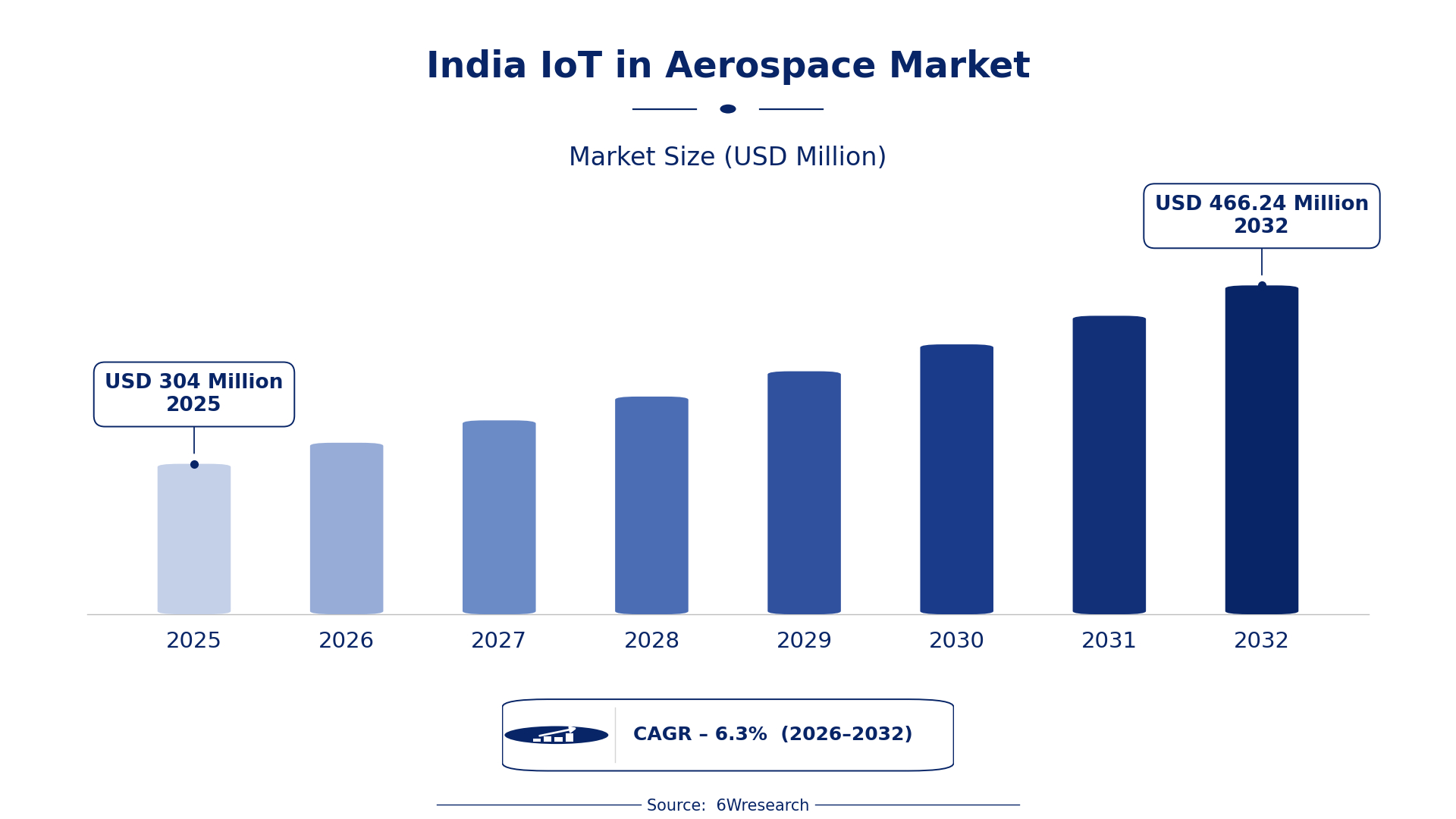
According to 6Wresearch internal database and industry insights, the India IoT in Aerospace Market was valued at USD 304.0 million in 2025 and is projected to reach USD 466.24 million by 2032, growing at a CAGR of approximately 6.3% during 2026–2032.
India IoT in Aerospace Market Highlights
| Report Metric | Details |
| Report Name | India IoT in Aerospace Market |
| Market Size 2025 | USD 304.0 million |
| Market Size 2032 | USD 466.24 million |
| Absolute Growth 2025–2032 | USD 162.24 million |
| CAGR 2026–2032 | 6.3% |
| Peak Annual Growth | 8.4% in 2026 |
| Forecast Period | 2026–2032 |
| Historical Data | 2022–2025 |
| Base Year | 2025 |
| Leading Application Type, 2025 | Predictive Maintenance (43% share) |
| Leading Sensor Type, 2025 | Vibration/Temp Sensors (49% share) |
| Leading Platform, 2025 | Commercial Aircraft (50% share) |
| Leading Use Case, 2025 | Engine Health Monitoring (39% share) |
| Leading End User, 2025 | Airlines (47% share) |
| Fastest-Growing Application Type | Cabin Monitoring (8.7% CAGR) |
| Fastest-Growing Sensor Type | Environmental Sensors (9.0% CAGR) |
| Fastest-Growing Platform | Drones (8.6% CAGR) |
| Fastest-Growing Use Case | Navigation Efficiency (7.9% CAGR) |
| Fastest-Growing End User | Drone OEMs (8.7% CAGR) |
| Growing Sector | Aerospace |
| Key End Users | Airlines, Defense Forces, Drone OEMs, Luxury Jet Owners |
India IoT in Aerospace Market Year-wise Growth Rate and Key Drivers (2022–2032)
This graph illustrates the annual growth rates of the market from 2022 to 2032, highlighting a steady upward trajectory and projected market expansion over the forecast period.
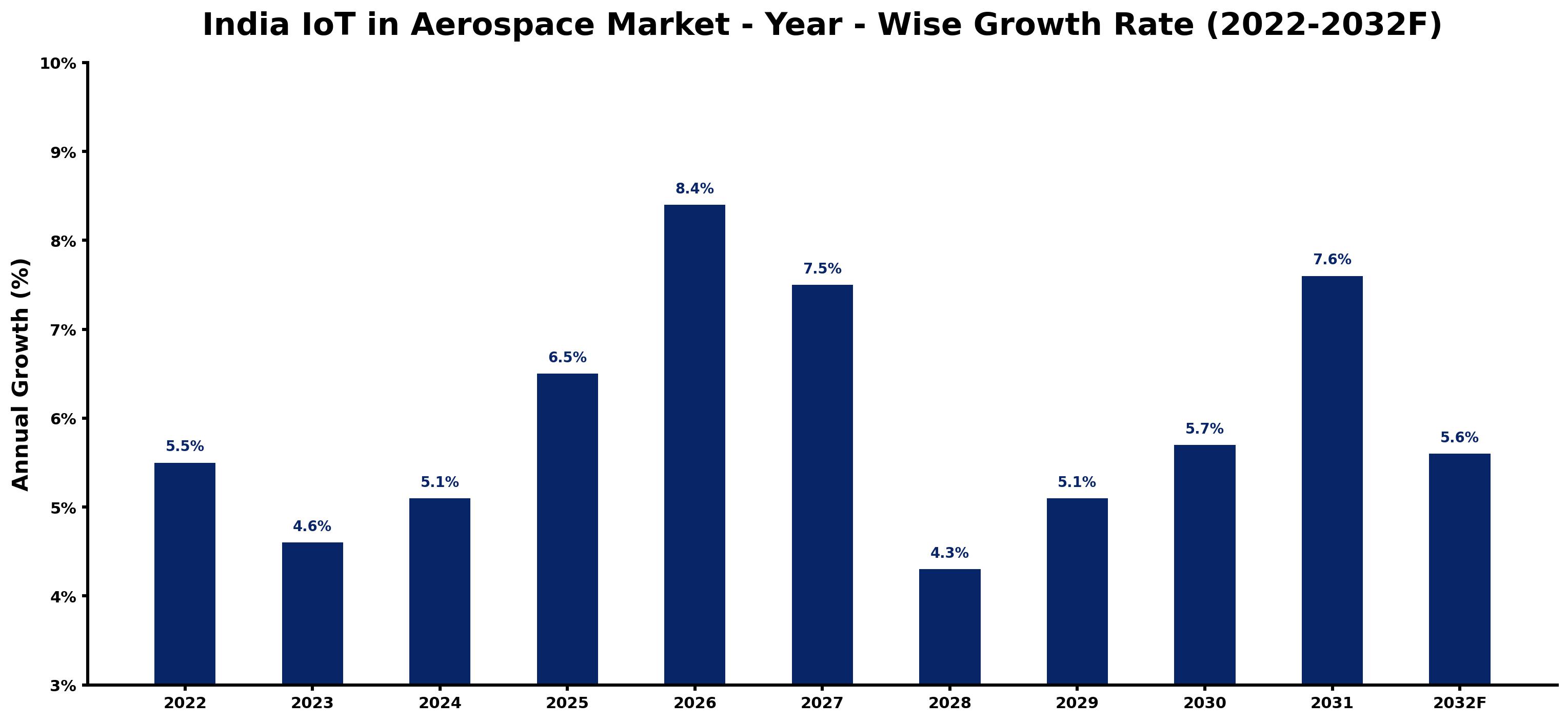
Year by year, the estimates below pair each growth rate with the development that shaped it.
| Year | Estimated Annual Growth (%) | Market Rationale |
| 2022 | 5.5 | The market showed steady growth due to increasing investments in smart technologies and the 'Digital India' initiative. |
| 2023 | 4.6 | Growth slowed as the sector adjusted to new regulatory standards set by the Bureau of Civil Aviation Security. |
| 2024 | 5.1 | Demand picked up with the implementation of the National Civil Aviation Policy, promoting smart technology adoption. |
| 2025 | 6.5 | The market peaked as airlines expanded their fleets and adopted IoT solutions for operational efficiency. |
| 2026 | 8.4 | A surge in demand for predictive maintenance solutions is expected to drive growth in the market. |
| 2027 | 7.5 | Growth is projected to slow as the market begins to stabilise after rapid expansion. |
| 2028 | 4.3 | The market is expected to experience a further slowdown as investments normalise following the peak. |
| 2029 | 5.1 | Demand is projected to increase again as airlines seek to enhance operational efficiency through IoT. |
| 2030 | 5.7 | Growth is expected to continue with rising investments in digital technologies and the 'Atmanirbhar Bharat' initiative. |
| 2031 | 7.6 | The market is projected to see a boost as the Indian Air Force modernises its fleet with IoT technologies. |
| 2032 | 5.6 | Growth is expected to slow slightly as the market matures and competition intensifies. |
Note: Market size estimations and growth projections presented in this report are based on 6Wresearch's proprietary forecasting methodology, utilizing the latest available industry data, government publications, and primary research inputs.
India IoT in Aerospace Market Synopsis
The IoT in Aerospace Market in India encompasses the integration of Internet of Things technology within the aerospace sector, enabling real-time data collection and analysis. This technology improves operational efficiency, safety, and passenger experience through various applications. The market is expanding due to rising demand from domestic airlines and defense forces, along with international collaborations. The government aims to increase the aerospace sector's GDP share to 1% by 2030, driving investments in smart technologies and innovation.
Market Dynamics Impact Analysis (2026–2032)
| Factor | Type | Impact | Primary Segment Affected |
| Increasing demand for predictive maintenance solutions | Driver | High | Predictive Maintenance |
| Expansion of commercial aircraft fleets | Driver | High | Commercial Aircraft |
| Rising investments in smart technologies | Opportunity | High | Cabin Monitoring |
| Growing focus on self-reliance in defense manufacturing | Opportunity | High | Military Aircraft |
| High costs associated with IoT implementation | Restraint | Medium | Component Tracking |
| Limited awareness among smaller airlines | Restraint | Medium | Cabin Monitoring |
| Buyers face challenges in integrating new technologies | Challenge | High | Commercial Aircraft |
| Suppliers struggle with regulatory compliance and standards | Challenge | High | Military Aircraft |
Evaluation of Drivers in India IoT in Aerospace Market (2026–2032)
The table below links each growth driver to the segment it affects and the evidence for it.
| Drivers | Primary Segment Affected | Why It Matters (Evidence) |
| Growing adoption of predictive maintenance technologies | Predictive Maintenance | This trend is driven by airlines seeking to reduce downtime and maintenance costs, with the market expected to reach a 43% share by 2025. |
| Expansion of commercial aircraft fleets | Commercial Aircraft | With over 1,000 commercial aircraft in India, airlines are investing in IoT to improve operational efficiency. |
| Increasing focus on passenger safety and comfort | Cabin Monitoring | As airlines improve passenger experience, demand for cabin monitoring solutions is projected to rise as well. |
| Government initiatives promoting indigenous manufacturing | Military Aircraft | The 'Make in India' initiative encourages local suppliers, boosting production capabilities in the aerospace sector. |
| Rising demand for efficient inventory management | Component Tracking | Efficient tracking solutions are critical as airlines aim to optimise their operations and reduce costs. |
The IoT in Aerospace market in India is expanding as end-use demand from airlines and defense forces rises, alongside substantial investments in smart technologies. With over 400 airports, the need for efficient operations and safety measures drives the adoption of IoT solutions. The focus on predictive maintenance solutions is clear, as the market for this segment is expected to reach a 43% share by 2025.
Evaluation of Restraints in India IoT in Aerospace Market
The table below lists the restraints and the evidence behind each.
| Market Restraint | Primary Segment Affected | Why It Matters (Evidence) |
| High implementation costs for IoT solutions | Predictive Maintenance | The initial investment can deter smaller airlines, limiting their ability to adopt new technologies. |
| Lack of awareness among smaller airlines | Cabin Monitoring | Many smaller operators are unaware of the benefits of IoT, hindering market growth. |
| Regulatory compliance challenges | Component Tracking | Strict regulations can complicate the integration of new technologies, slowing adoption rates. |
| Limited infrastructure for advanced technologies | Military Aircraft | Inadequate infrastructure can delay the implementation of IoT solutions in defense operations. |
| Concerns over data security and privacy | Commercial Aircraft | Airlines are cautious about data breaches, which can hinder the adoption of IoT technologies. |
India IoT in Aerospace Market Challenges
Buyers and suppliers in the India IoT in Aerospace market contend with fierce competition from a rapidly increasing number of domestic airlines and defense forces, compelling producers to lower prices and squeezing profit margins. Many aerospace companies face challenges with technology integration, as the complexity of deploying IoT solutions results in delays in operational efficiency, costing firms valuable time and resources. Buyers often struggle to access real-time data due to insufficient infrastructure, which hampers decision-making and operational performance. High initial costs of implementing IoT systems deter potential buyers, limiting their ability to modernise and compete effectively in the market.
Trends in the India IoT in Aerospace Market
Buyers and suppliers in the India IoT in Aerospace Market are adjusting to the following trends.
- Launch of the National Civil Aviation Policy: The updated National Civil Aviation Policy in 2021 aims to promote growth and safety standards in the aerospace sector. This initiative is expected to drive investments in IoT technologies, positively impacting the market.
- Increase in Commercial Aircraft Fleet: India's commercial aircraft fleet has exceeded 1,000 as of 2023, indicating a growing demand for passenger transport. This expansion drives the adoption of IoT solutions to enhance operational efficiency.
- Focus on Smart Technologies in Airports: The Smart Cities Mission includes plans for integrating smart technologies in urban air mobility. This initiative seeks to improve airport operations and passenger experiences, with significant investments on the horizon.
- Rise of Environmental Sensors: Environmental sensors are becoming increasingly popular in the aerospace sector, with a projected CAGR of 9.0% from 2026 to 2032. This trend highlights the industry's commitment to improving cabin air quality and passenger comfort.
Investment Opportunities in the India IoT in Aerospace Market
Below are the investment opportunities with the strongest case in the India IoT in Aerospace Market.
- Partnerships with Local Suppliers: Now is an opportune moment to invest in partnerships with local suppliers to enhance IoT capabilities in aerospace. The 'Make in India' initiative supports local manufacturing, with the market expected to grow significantly.
- Investment in Cabin Monitoring Solutions: With a growing emphasis on passenger experience, there is a considerable opportunity to invest in cabin monitoring technologies. Airlines are increasingly seeking solutions to improve safety and comfort.
- Development of Predictive Maintenance Technologies: The demand for predictive maintenance is on the rise, with a projected market share of 43% by 2025. Investing in this area can yield substantial returns as airlines modernise their fleets.
- Expansion into Military Aircraft IoT Solutions: The Indian defense sector is modernising its fleet, creating opportunities for IoT solutions. The government's focus on self-reliance presents a chance to supply advanced technologies.
Government Initiatives in the India IoT in Aerospace Market
The 'National Civil Aviation Policy' was updated in 2021 by the Ministry of Civil Aviation to improve growth and safety standards in the aerospace sector. This measure builds on previous regulations to promote investment and innovation in IoT technologies. By establishing clearer guidelines, it encourages airlines to adopt smart technologies that improve operational efficiency and safety. The government aims to increase the aerospace sector's GDP share to 1% by 2030, driving further investments.
The Ministry of Defence oversees the 'Aerospace and Defense Manufacturing Policy', which promotes indigenous manufacturing and reduces imports. This initiative supports funding for local suppliers and encourages the development of advanced technologies in the aerospace sector, ensuring that domestic producers can compete effectively in the market.
Future Insight of the India IoT in Aerospace Market
Several forward-looking factors are expected to support the growth of the India IoT in Aerospace market by 2032. The government's objective to boost the aerospace sector's GDP contribution to 1% by 2030 will encourage investments in IoT technologies, facilitating advancements. The 'Make in India' initiative will strengthen local manufacturing capabilities, enhancing supply chain resilience. The Indian Air Force's focus on upgrading its fleet with IoT technologies will create substantial demand for innovative solutions, opening new avenues for suppliers and buyers.
Market Segmentation Analysis
The analysis below covers each segmentation, its leading category in 2025 and its fastest-growing category through 2032.
By Application Type – Predictive Maintenance Dominated, Cabin Monitoring Expected to Grow Fastest
According to Shubham Deep, Research Manager at 6Wresearch, in 2025, Predictive Maintenance led the application type split with a 43% share. Predictive Maintenance holds the largest share as it directly enables proactive repairs and reduces downtime, which is essential for airlines managing extensive fleets. With over 1,000 commercial aircraft in India, the demand for predictive maintenance solutions is substantial and vital for operational efficiency. Cabin Monitoring is projected to grow fastest, at a CAGR of 8.7% during 2026–2032. Cabin Monitoring is experiencing rapid growth due to its critical role in enhancing passenger experience and safety, especially as airlines prioritise in-flight services. The increasing number of airports in India further fuels the demand for advanced cabin monitoring systems. This trend indicates that suppliers should prioritise developing advanced predictive maintenance and cabin monitoring solutions to meet the growing demands of the aerospace sector.
By Sensor Type – Vibration/Temp Sensors Dominated, Environmental Sensors Expected to Grow Fastest
With a 49% revenue share in 2025, Vibration/Temp Sensors was the largest sensor type category. Vibration/Temp Sensors dominate the market as they are essential for monitoring aircraft health, ensuring safety and operational efficiency. Their extensive use in the maintenance of India's growing fleet of commercial aircraft underscores their significance in the aerospace sector. The quickest growth will come from Environmental Sensors, forecast to expand at a CAGR of 9.0% between 2026 and 2032. Environmental Sensors are the fastest-growing segment, driven by the rising focus on cabin air quality management, particularly in light of heightened health and safety standards. This growth aligns with the broader push for smart technologies in aviation. Suppliers should focus on enhancing the capabilities of environmental sensors to capitalise on the increasing demand for improved cabin conditions.
By Platform – Commercial Aircraft Dominated, Drones Expected to Grow Fastest
The largest platform category in 2025 was Commercial Aircraft, with a 50% share of total revenue. Commercial Aircraft lead the market due to their role as the primary segment for passenger transport, making up a significant portion of the aerospace sector in India. The ongoing expansion of the airline industry, bolstered by government initiatives, further solidifies their position. Over 2026–2032, Drones are expected to post the fastest growth, at a CAGR of 8.6%. Drones are the fastest-growing platform, gaining traction for various applications, including logistics and surveillance, as the aerospace sector embraces new technologies. The rise of smart cities in India is also contributing to the demand for drone solutions. This suggests that suppliers should invest in drone technology and applications to stay competitive in the evolving aerospace market.
By Use Case – Engine Health Monitoring Dominated, Navigation Efficiency Expected to Grow Fastest
Engine Health Monitoring accounted for a 39% market share by use case in 2025. Engine Health Monitoring is the leading use case, as it is crucial for ensuring engine performance and safety in commercial aviation. With the Indian aerospace market expanding, the focus on engine health is paramount for airlines aiming for operational efficiency. Navigation Efficiency is set to record the highest CAGR in this split, 7.9% over 2026–2032. Navigation Efficiency is the fastest-growing use case, driven by the need to enhance flight safety and performance amidst increasing air traffic. The emphasis on smart technologies in aviation is propelling this growth. This indicates that suppliers should enhance solutions for navigation efficiency to meet the rising demands of the aerospace sector.
By End User – Airlines Dominated, Drone OEMs Expected to Grow Fastest
Airlines held a 47% share of the India IoT in Aerospace Market by end user in 2025. Airlines represent the largest end user segment, as they require advanced IoT solutions to optimise operations and enhance passenger experiences. The substantial investment in the aerospace sector by domestic airlines underscores their pivotal role in driving market share. Drone OEMs are projected to grow fastest, at a CAGR of 8.7% during 2026–2032. Drone OEMs are the fastest-growing end user group, reflecting the increasing relevance of drones in the aerospace sector for various applications. This trend is supported by the government's push for innovation in aerospace technologies. This trend suggests that suppliers should tailor their offerings to meet the specific needs of both airlines and drone manufacturers.
Key Attractiveness of the Report
- 10 Years of Market Numbers
- Historical Data Starting from 2022 to 2025
- Base Year 2025
- Forecast Data until 2032
- Key Performance Indicators Impacting the Market
- Major Upcoming Developments and Projects
Key Highlights of the Report:
- India IoT in Aerospace Market Outlook
- Market Size of India IoT in Aerospace Market, 2025
- Forecast of India IoT in Aerospace Market, 2032
- Historical Data and Forecast of India IoT in Aerospace Revenues & Volume for the Period 2022 - 2032F
- India IoT in Aerospace Market Trend Evolution
- India IoT in Aerospace Market Drivers and Challenges
- India IoT in Aerospace Price Trends
- India IoT in Aerospace Porter's Five Forces
- India IoT in Aerospace Industry Life Cycle
- Historical Data and Forecast of India IoT in Aerospace Market Revenues & Volume By Application Type for the Period 2022 - 2032F
- Historical Data and Forecast of India IoT in Aerospace Market Revenues & Volume By Predictive Maintenance for the Period 2022 - 2032F
- Historical Data and Forecast of India IoT in Aerospace Market Revenues & Volume By Cabin Monitoring for the Period 2022 - 2032F
- Historical Data and Forecast of India IoT in Aerospace Market Revenues & Volume By Component Tracking for the Period 2022 - 2032F
- Historical Data and Forecast of India IoT in Aerospace Market Revenues & Volume By Flight Path Optimization for the Period 2022 - 2032F
- Historical Data and Forecast of India IoT in Aerospace Market Revenues & Volume By Sensor Type for the Period 2022 - 2032F
- Historical Data and Forecast of India IoT in Aerospace Market Revenues & Volume By Vibration/Temp Sensors for the Period 2022 - 2032F
- Historical Data and Forecast of India IoT in Aerospace Market Revenues & Volume By Environmental Sensors for the Period 2022 - 2032F
- Historical Data and Forecast of India IoT in Aerospace Market Revenues & Volume By RFID Tags for the Period 2022 - 2032F
- Historical Data and Forecast of India IoT in Aerospace Market Revenues & Volume By GNSS/Barometric Sensors for the Period 2022 - 2032F
- Historical Data and Forecast of India IoT in Aerospace Market Revenues & Volume By Platform for the Period 2022 - 2032F
- Historical Data and Forecast of India IoT in Aerospace Market Revenues & Volume By Commercial Aircraft for the Period 2022 - 2032F
- Historical Data and Forecast of India IoT in Aerospace Market Revenues & Volume By Business Jets for the Period 2022 - 2032F
- Historical Data and Forecast of India IoT in Aerospace Market Revenues & Volume By Military Aircraft for the Period 2022 - 2032F
- Historical Data and Forecast of India IoT in Aerospace Market Revenues & Volume By Drones for the Period 2022 - 2032F
- Historical Data and Forecast of India IoT in Aerospace Market Revenues & Volume By Use Case for the Period 2022 - 2032F
- Historical Data and Forecast of India IoT in Aerospace Market Revenues & Volume By Engine Health Monitoring for the Period 2022 - 2032F
- Historical Data and Forecast of India IoT in Aerospace Market Revenues & Volume By Passenger Comfort for the Period 2022 - 2032F
- Historical Data and Forecast of India IoT in Aerospace Market Revenues & Volume By Parts Lifecycle Tracking for the Period 2022 - 2032F
- Historical Data and Forecast of India IoT in Aerospace Market Revenues & Volume By Navigation Efficiency for the Period 2022 - 2032F
- Historical Data and Forecast of India IoT in Aerospace Market Revenues & Volume By End User for the Period 2022 - 2032F
- Historical Data and Forecast of India IoT in Aerospace Market Revenues & Volume By Airlines for the Period 2022 - 2032F
- Historical Data and Forecast of India IoT in Aerospace Market Revenues & Volume By Luxury Jet Owners for the Period 2022 - 2032F
- Historical Data and Forecast of India IoT in Aerospace Market Revenues & Volume By Defense Forces for the Period 2022 - 2032F
- Historical Data and Forecast of India IoT in Aerospace Market Revenues & Volume By Drone OEMs for the Period 2022 - 2032F
- India IoT in Aerospace Import Export Trade Statistics
- Market Opportunity Assessment By Application Type
- Market Opportunity Assessment By Sensor Type
- Market Opportunity Assessment By Platform
- Market Opportunity Assessment By Use Case
- Market Opportunity Assessment By End User
- India IoT in Aerospace Top Companies Market Share
- India IoT in Aerospace Competitive Benchmarking By Technical and Operational Parameters
- India IoT in Aerospace Company Profiles
- India IoT in Aerospace Key Strategic Recommendations
Market Covered
Segments analysed in this report are listed below.
By Application Type
- Predictive Maintenance
- Cabin Monitoring
- Component Tracking
- Flight Path Optimization
By Sensor Type
- Vibration/Temp Sensors
- Environmental Sensors
- RFID Tags
- GNSS/Barometric Sensors
By Platform
- Commercial Aircraft
- Business Jets
- Military Aircraft
- Drones
By Use Case
- Engine Health Monitoring
- Passenger Comfort
- Parts Lifecycle Tracking
- Navigation Efficiency
By End User
- Airlines
- Luxury Jet Owners
- Defense Forces
- Drone OEMs































