India IoT Protocol Market Size & Growth Rate
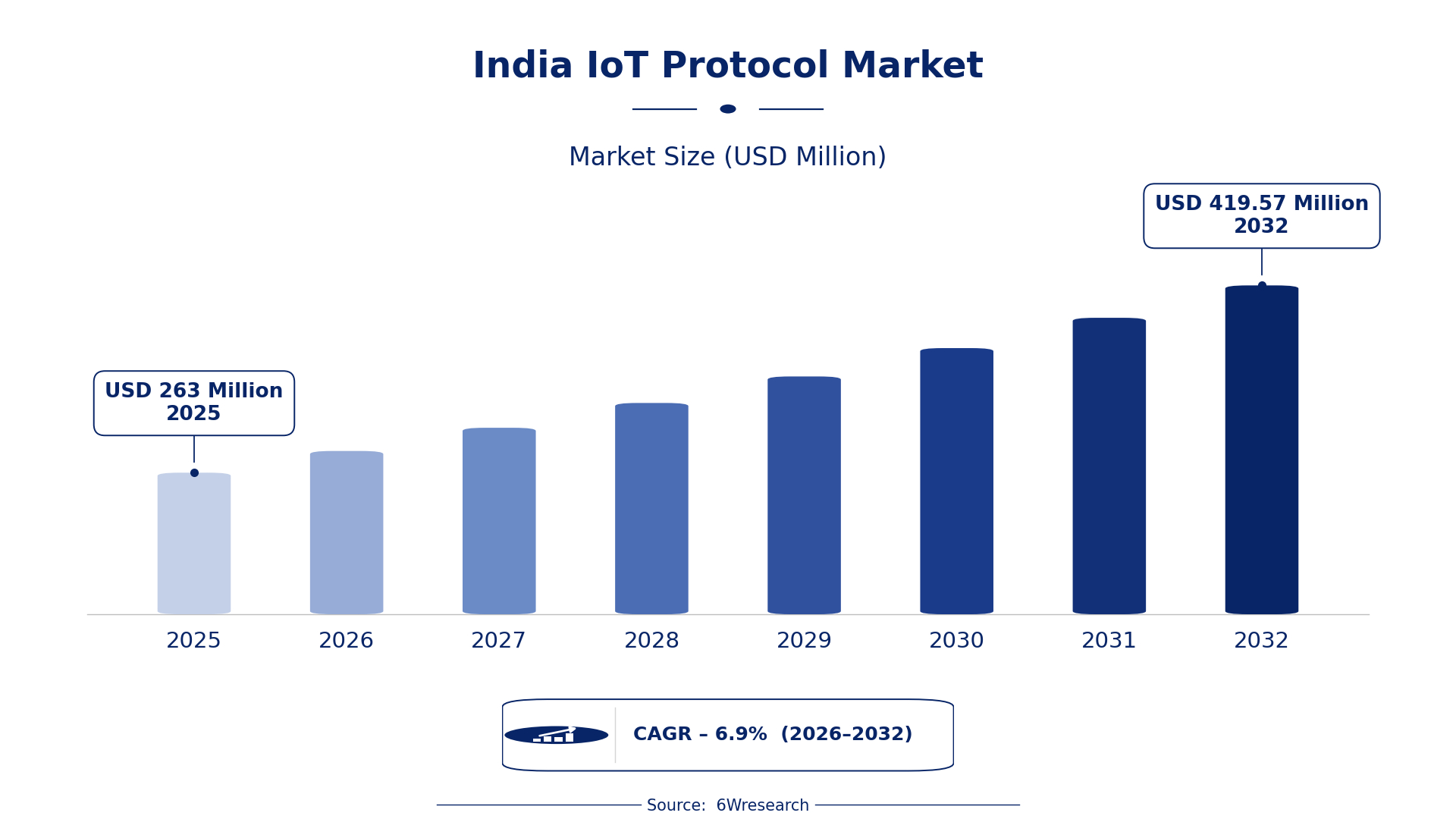
According to 6Wresearch internal database and industry insights, the India IoT Protocol Market was valued at USD 263.0 million in 2025 and is projected to reach USD 419.57 million by 2032, growing at a CAGR of approximately 6.9% during 2026–2032.
India IoT Protocol Market Highlights
| Report Metric | Details |
| Report Name | India IoT Protocol Market |
| Market Size 2025 | USD 263.0 million |
| Market Size 2032 | USD 419.57 million |
| Absolute Growth 2025–2032 | USD 156.57 million |
| CAGR 2026–2032 | 6.9% |
| Peak Annual Growth | 9.4% in 2032 |
| Forecast Period | 2026–2032 |
| Historical Data | 2022–2025 |
| Base Year | 2025 |
| Leading Protocol Type, 2025 | MQTT (52% share) |
| Leading Communication Mode, 2025 | Publish-Subscribe (38% share) |
| Leading Application Area, 2025 | Smart Homes (42% share) |
| Leading Bandwidth Level, 2025 | Low (47% share) |
| Leading End User, 2025 | IoT Developers (49% share) |
| Fastest-Growing Protocol Type | CoAP (9.7% CAGR) |
| Fastest-Growing Communication Mode | Request-Response (8.3% CAGR) |
| Fastest-Growing Application Area | Industrial IoT (8.1% CAGR) |
| Fastest-Growing Bandwidth Level | Very Low (8.4% CAGR) |
| Fastest-Growing End User | Manufacturing Firms (7.9% CAGR) |
| Growing Sector | Smart Homes |
| Key End Users | IoT Developers, Manufacturing Firms, AgriTech Companies, Consumer OEMs |
India IoT Protocol Market Year-wise Growth Rate and Key Drivers (2022–2032)
This graph illustrates the annual growth rates of the market from 2022 to 2032, highlighting a steady upward trajectory and projected market expansion over the forecast period.
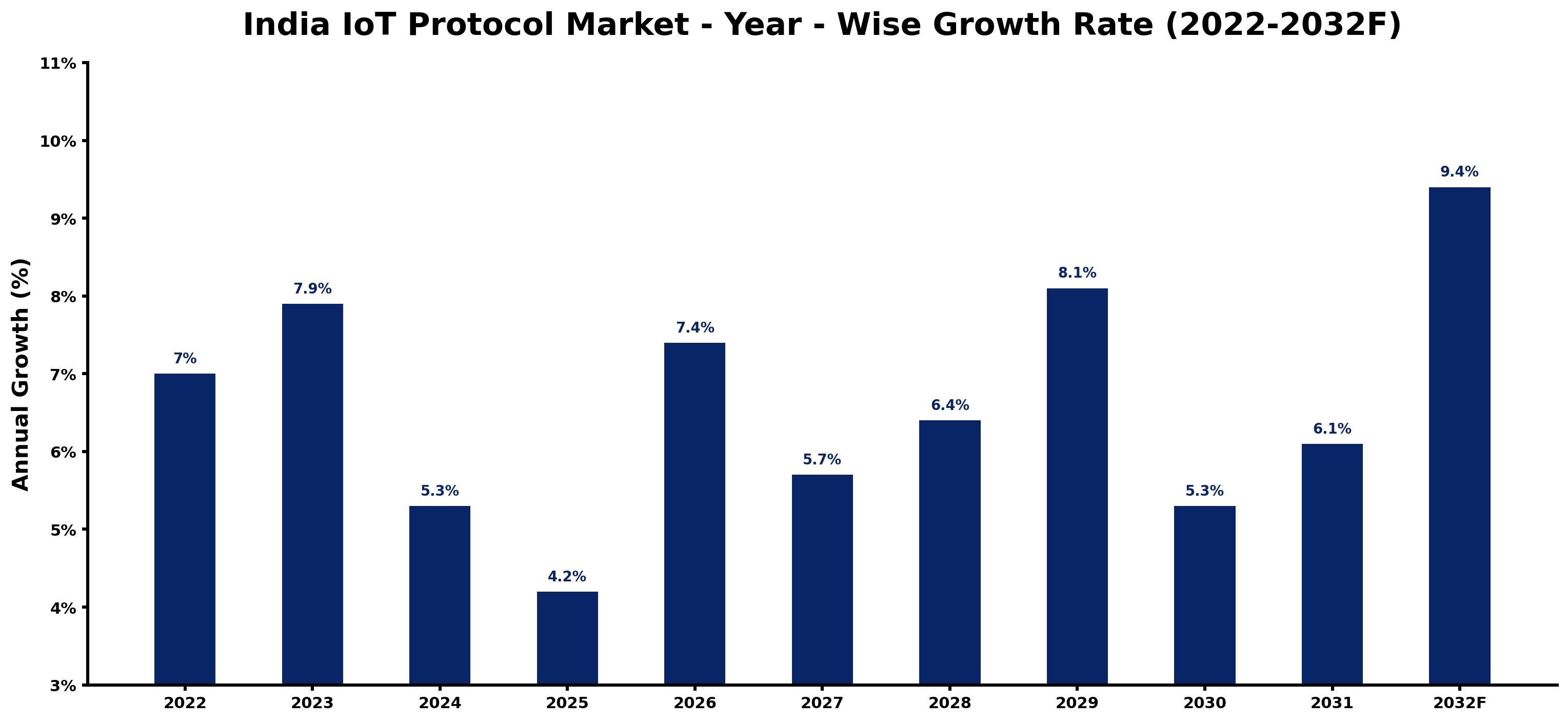
Year by year, the estimates below pair each growth rate with the development that shaped it.
| Year | Estimated Annual Growth (%) | Market Rationale |
| 2022 | 7.0 | The market experienced steady growth due to increasing IoT adoption across sectors. |
| 2023 | 7.9 | Growth accelerated as more manufacturers integrated IoT technologies into their operations. |
| 2024 | 5.3 | A slowdown occurred as investments in IoT infrastructure faced temporary challenges. |
| 2025 | 4.2 | The Smart Cities Mission continued to promote IoT solutions, affecting new investments. |
| 2026 | 7.4 | Demand for IoT protocols increased again as smart city initiatives gained momentum. |
| 2027 | 5.7 | A slowdown in growth was noted as competition intensified among IoT developers. |
| 2028 | 6.4 | Growth picked up as new applications in agriculture drove further adoption. |
| 2029 | 8.1 | A surge in demand was observed as industrial IoT applications expanded rapidly. |
| 2030 | 5.3 | Growth slowed again as market maturity began to set in for certain segments. |
| 2031 | 6.1 | A resurgence in growth was noted as the Bureau of Indian Standards implemented new IoT security standards. |
| 2032 | 9.4 | The market peaked with substantial investments in IoT infrastructure and applications. |
Note: Market size estimations and growth projections presented in this report are based on 6Wresearch's proprietary forecasting methodology, utilizing the latest available industry data, government publications, and primary research inputs.
India IoT Protocol Market Synopsis
The India IoT Protocol Market includes communication standards that facilitate the connection and data exchange among devices over the internet. Developed through principles of software engineering and networking, these protocols support smart devices in various sectors such as homes, industries, and agriculture. The market is expanding due to rising domestic demand and investments in IoT technologies. Initiatives like the Smart Cities Mission and the Digital India programme are propelling this growth, with an anticipated 1.5 billion connected devices by 2025. Key buyers, including IoT developers and manufacturing firms, are increasingly integrating these protocols to improve their operations.
Market Dynamics Impact Analysis (2026–2032)
| Factor | Type | Impact | Primary Segment Affected |
| Increasing adoption of IoT technologies in manufacturing sectors drives demand for protocols. | Driver | High | IoT Developers |
| The expansion of smart city initiatives promotes the need for efficient IoT communication standards. | Driver | High | Smart Homes |
| Emerging agricultural technologies present opportunities for IoT protocol integration. | Opportunity | High | Agriculture Monitoring |
| Growing interest in smart home solutions creates demand for specific IoT protocols. | Opportunity | Medium | Home Automation |
| Challenges in IoT security standards may hinder user trust and adoption. | Restraint | High | Zigbee Protocol |
| Market saturation in certain sectors limits new investments in IoT protocols. | Restraint | Medium | LoRaWAN |
| Supply chain disruptions affect the availability of IoT components and devices. | Challenge | High | Manufacturing Firms |
| Limited awareness of IoT benefits among smaller businesses restricts market growth. | Challenge | Medium | AgriTech Companies |
Evaluation of Drivers in India IoT Protocol Market (2026–2032)
The main growth drivers and the segments they affect most are set out below.
| Drivers | Primary Segment Affected | Why It Matters (Evidence) |
| Rising investments in smart city projects increase demand for IoT protocols. | Smart Homes | The Smart Cities Mission aims to implement IoT solutions across 100 cities, improving urban infrastructure. |
| Growing adoption of IoT technologies by manufacturers boosts protocol usage. | IoT Developers | Over 60% of Indian manufacturers are adopting IoT technologies, increasing demand for protocols. |
| Increased focus on agriculture monitoring drives demand for specific IoT protocols. | Agriculture Monitoring | IoT in agriculture is projected to increase yield by 20-30%, prompting more farmers to adopt IoT solutions. |
| Consumer interest in smart homes fuels the growth of IoT protocols. | Home Automation | Zigbee is widely used in smart home devices, holding an estimated 30% market share. |
| The push for IoT security standards boosts protocol adoption. | Zigbee Protocol | The Bureau of Indian Standards developed guidelines for IoT security in 2022, improving consumer trust. |
Market growth for IoT Protocol in India is underpinned by rising investments in smart city projects, alongside growing adoption of IoT technologies by manufacturers. The Smart Cities Mission is driving the implementation of IoT solutions across 100 cities, improving urban infrastructure. Over 60% of Indian manufacturers are adopting IoT technologies, which increases demand for protocols. IoT in agriculture is expected to increase yield by 20-30%, prompting more farmers to adopt IoT solutions. The push for IoT security standards further supports protocol adoption, ensuring user trust.
Evaluation of Restraints in India IoT Protocol Market
Below mentioned are some major restraints and their influence on market dynamics.
| Market Restraint | Primary Segment Affected | Why It Matters (Evidence) |
| Challenges in IoT security standards may hinder user trust and adoption. | Zigbee Protocol | The Bureau of Indian Standards established a committee in 2022 to develop IoT security standards, which may take time to implement. |
| Market saturation in certain sectors limits new investments in IoT protocols. | LoRaWAN | As the market matures, fewer new projects are being initiated, resulting in slower growth. |
| Supply chain disruptions affect the availability of IoT components and devices. | Manufacturing Firms | Global supply chain issues have delayed the delivery of essential IoT hardware, impacting production timelines. |
| Limited awareness of IoT benefits among smaller businesses restricts market growth. | AgriTech Companies | Many small-scale farmers remain unaware of the advantages of IoT technologies, hindering adoption. |
| Regulatory hurdles may slow down the implementation of IoT solutions. | Smart Homes | Compliance with new IoT security standards can delay product launches and increase costs. |
India IoT Protocol Market Challenges
The India IoT Protocol Market encounters several practical challenges, starting with supply chain disruptions that prevent producers from acquiring essential components, leading to product launch delays of up to six months. Many manufacturers face difficulties in finding qualified personnel, with over 60% reporting skills shortages that raise training costs and strain budgets for companies looking to implement IoT solutions. Regulatory compliance adds complexity, as evolving standards necessitate constant updates, consuming valuable resources for suppliers. Buyers face higher costs, as these delays and compliance issues often result in increased prices for IoT solutions in the market.
Trends in the India IoT Protocol Market
Four trends stand out in the India IoT Protocol Market.
- Shift from Traditional to Smart Agriculture: India is experiencing a transformation towards smart agriculture, with IoT technologies being integrated into farming practices. LoRaWAN technology is being deployed in over 50 cities for smart agriculture applications, improving monitoring capabilities.
- Transition from Conventional to Smart Homes: Consumers are increasingly demanding IoT-enabled devices, resulting in a rise in smart homes. Zigbee is widely used in smart home devices, holding an estimated 30% market share, indicating a growing trend in home automation.
- Emergence of IoT Security Standards: The establishment of IoT security standards is gaining importance, aimed at protecting consumer data. The Bureau of Indian Standards has developed guidelines for IoT security in 2022, building trust in IoT devices.
- Growth in Industrial IoT Applications: Industrial IoT applications are rapidly expanding, driven by the need for automation. The Industrial IoT sector is expected to grow significantly, with an increasing number of manufacturers adopting IoT technologies.
Investment Opportunities in the India IoT Protocol Market
Investors looking at the India IoT Protocol Market should consider the following areas.
- Timing for Smart City Investments: Now is an ideal time for investments in smart city projects, with a budget of ₹48,000 crores allocated. Urban developers can use IoT protocols to improve city infrastructure.
- Gap in Agricultural IoT Solutions: With agriculture projected to increase yield by 20-30%, there is a gap in IoT solutions. AgriTech companies can invest in IoT technologies to support farmers and improve productivity.
- Facility Upgrades for Smart Homes: The demand for smart home solutions is rising, creating a prime opportunity for suppliers. Home automation providers can partner with local developers to create innovative IoT products.
- Growing Need for IoT in Manufacturing: Manufacturers are increasingly adopting IoT technologies, creating a demand for specific protocols. Collaborating with manufacturing firms can provide opportunities for IoT protocol developers.
Government Initiatives in the India IoT Protocol Market
The National Policy on Electronics 2020 aims to strengthen the IoT ecosystem, targeting the creation of 1 million jobs by 2025, overseen by the Ministry of Electronics and Information Technology. This policy encourages investment in IoT manufacturing and development, establishing a strong framework for growth in the sector. Additionally, the Digital India initiative promotes IoT adoption across various sectors, focusing on smart cities and rural development, further supporting the market.
The Smart Cities Mission, launched in 2015, incorporates IoT solutions for urban infrastructure, with a budget of ₹48,000 crores designated for development. The Ministry of Agriculture initiated the Digital Agriculture Mission in 2021 to integrate IoT technologies into farming practices, aiming to reach 10 million farmers by 2025. These initiatives provide funding and support for IoT projects, facilitating widespread adoption and integration of IoT solutions across sectors.
Future Insight of the India IoT Protocol Market
The India IoT Protocol Market is set for substantial transformation by 2032, driven by several key factors. The Smart Cities Mission will improve urban infrastructure, promoting IoT solutions across 100 cities. The National Policy on Electronics aims to boost local manufacturing, reducing reliance on imports. With over 200 IoT startups innovating across various applications, the competitive environment will encourage technological advancements. IoT in agriculture is anticipated to increase yield by 25%, providing significant benefits to farmers and improving food production efficiency.
Market Segmentation Analysis
Each segment group is reviewed below, with the leader by share and the fastest grower by CAGR.
By Protocol Type – MQTT Dominated, CoAP Expected to Grow Fastest
According to Shubham Deep, Research Manager at 6Wresearch, MQTT took a 52% share of protocol type in 2025, more than any other category. MQTT holds the largest share in the India IoT Protocol Market due to its widespread application in lightweight messaging across diverse IoT scenarios. Its effectiveness is particularly notable in smart home environments, where reliable communication is essential for device interoperability. CoAP is projected to grow fastest, at a CAGR of 9.7% during 2026–2032. CoAP is experiencing rapid growth as it is tailored for constrained devices, making it ideal for low-power IoT applications. The increasing emphasis on smart agriculture solutions is significantly driving its adoption in the market. This indicates that suppliers should enhance their MQTT offerings while also developing compatible solutions for CoAP to address market demands.
By Communication Mode – Publish-Subscribe Dominated, Request-Response Expected to Grow Fastest
With a 38% revenue share in 2025, Publish-Subscribe was the largest communication mode category. The Publish-Subscribe mode leads the market by facilitating efficient data distribution among numerous IoT devices, which is crucial for applications in smart cities. Its capacity to handle large volumes of data traffic effectively solidifies its dominant position in the market. The quickest growth will come from Request-Response, forecast to expand at a CAGR of 8.3% between 2026 and 2032. Request-Response mode is witnessing swift growth as it is commonly used in device interactions, particularly within industrial settings where precise communication is essential. This trend is expected to persist as more devices are integrated into existing systems, further driving demand. Suppliers should expand their capabilities in the Request-Response mode to capture the increasing demand from various sectors.
By Application Area – Smart Homes Dominated, Industrial IoT Expected to Grow Fastest
The largest application area category in 2025 was Smart Homes, with a 42% share of total revenue. Smart Homes dominate the market share, driven by significant consumer interest and the rising adoption of smart devices in urban areas. The Smart Cities Mission accelerates this growth by promoting IoT solutions in residential environments, further solidifying its leading position. Industrial IoT is set to record the highest CAGR in this split, 8.1% over 2026–2032. Industrial IoT is the fastest-growing segment, primarily due to the push for automation in manufacturing processes. The fact that over 60% of Indian manufacturers are adopting IoT technologies underscores this trend, highlighting the sector's increasing reliance on IoT solutions. This indicates that suppliers should prioritise solutions tailored for industrial applications to capitalise on the rapid growth in this area.
By Bandwidth Level – Low Dominated, Very Low Expected to Grow Fastest
Low held a 47% share of the India IoT Protocol Market by bandwidth level in 2025. Low bandwidth protocols lead the market, as they are suitable for various IoT applications requiring minimal data transmission, making them ideal for many smart devices. Their efficiency in resource-constrained environments reinforces their strong position in the market. Over 2026–2032, Very Low is expected to post the fastest growth, at a CAGR of 8.4%. Very Low bandwidth protocols are experiencing rapid growth, essential for ultra-low power devices that are increasingly common in IoT applications. The rising demand for energy-efficient solutions is a key factor driving this trend, especially in smart device deployment. Suppliers should invest in developing Very Low bandwidth solutions to meet the needs of energy-conscious consumers.
By End User – IoT Developers Dominated, Manufacturing Firms Expected to Grow Fastest
IoT Developers accounted for a 49% market share by end user in 2025. IoT Developers hold the largest share as they are the primary users of IoT protocols, leveraging them to create diverse applications across multiple sectors. Their ongoing innovation drives the demand for effective communication standards, ensuring a robust market presence. Manufacturing Firms are projected to grow fastest, at a CAGR of 7.9% during 2026–2032. Manufacturing Firms represent the fastest-growing segment, extensively utilising IoT protocols for automation and efficiency enhancements. The significant shift towards smart manufacturing practices is a major contributor to this growth, indicating a strong future demand. This indicates that suppliers should focus on providing tailored solutions that meet the specific needs of manufacturing firms.
Key Attractiveness of the Report
- 10 Years of Market Numbers
- Historical Data Starting from 2022 to 2025
- Base Year 2025
- Forecast Data until 2032
- Key Performance Indicators Impacting the Market
- Major Upcoming Developments and Projects
Key Highlights of the Report:
- India IoT Protocol Market Outlook
- Market Size of India IoT Protocol Market, 2025
- Forecast of India IoT Protocol Market, 2032
- Historical Data and Forecast of India IoT Protocol Revenues & Volume for the Period 2022 - 2032F
- India IoT Protocol Market Trend Evolution
- India IoT Protocol Market Drivers and Challenges
- India IoT Protocol Price Trends
- India IoT Protocol Porter's Five Forces
- India IoT Protocol Industry Life Cycle
- Historical Data and Forecast of India IoT Protocol Market Revenues & Volume By Protocol Type for the Period 2022 - 2032F
- Historical Data and Forecast of India IoT Protocol Market Revenues & Volume By MQTT for the Period 2022 - 2032F
- Historical Data and Forecast of India IoT Protocol Market Revenues & Volume By CoAP for the Period 2022 - 2032F
- Historical Data and Forecast of India IoT Protocol Market Revenues & Volume By Zigbee Protocol for the Period 2022 - 2032F
- Historical Data and Forecast of India IoT Protocol Market Revenues & Volume By LoRaWAN for the Period 2022 - 2032F
- Historical Data and Forecast of India IoT Protocol Market Revenues & Volume By Communication Mode for the Period 2022 - 2032F
- Historical Data and Forecast of India IoT Protocol Market Revenues & Volume By Publish-Subscribe for the Period 2022 - 2032F
- Historical Data and Forecast of India IoT Protocol Market Revenues & Volume By Request-Response for the Period 2022 - 2032F
- Historical Data and Forecast of India IoT Protocol Market Revenues & Volume By Mesh Network for the Period 2022 - 2032F
- Historical Data and Forecast of India IoT Protocol Market Revenues & Volume By Star Topology for the Period 2022 - 2032F
- Historical Data and Forecast of India IoT Protocol Market Revenues & Volume By Application Area for the Period 2022 - 2032F
- Historical Data and Forecast of India IoT Protocol Market Revenues & Volume By Smart Homes for the Period 2022 - 2032F
- Historical Data and Forecast of India IoT Protocol Market Revenues & Volume By Industrial IoT for the Period 2022 - 2032F
- Historical Data and Forecast of India IoT Protocol Market Revenues & Volume By Home Automation for the Period 2022 - 2032F
- Historical Data and Forecast of India IoT Protocol Market Revenues & Volume By Agriculture Monitoring for the Period 2022 - 2032F
- Historical Data and Forecast of India IoT Protocol Market Revenues & Volume By Bandwidth Level for the Period 2022 - 2032F
- Historical Data and Forecast of India IoT Protocol Market Revenues & Volume By Low for the Period 2022 - 2032F
- Historical Data and Forecast of India IoT Protocol Market Revenues & Volume By Very Low for the Period 2022 - 2032F
- Historical Data and Forecast of India IoT Protocol Market Revenues & Volume By Moderate for the Period 2022 - 2032F
- Historical Data and Forecast of India IoT Protocol Market Revenues & Volume By Low Power for the Period 2022 - 2032F
- Historical Data and Forecast of India IoT Protocol Market Revenues & Volume By End User for the Period 2022 - 2032F
- Historical Data and Forecast of India IoT Protocol Market Revenues & Volume By IoT Developers for the Period 2022 - 2032F
- Historical Data and Forecast of India IoT Protocol Market Revenues & Volume By Manufacturing Firms for the Period 2022 - 2032F
- Historical Data and Forecast of India IoT Protocol Market Revenues & Volume By Consumer OEMs for the Period 2022 - 2032F
- Historical Data and Forecast of India IoT Protocol Market Revenues & Volume By AgriTech Companies for the Period 2022 - 2032F
- India IoT Protocol Import Export Trade Statistics
- Market Opportunity Assessment By Protocol Type
- Market Opportunity Assessment By Communication Mode
- Market Opportunity Assessment By Application Area
- Market Opportunity Assessment By Bandwidth Level
- Market Opportunity Assessment By End User
- India IoT Protocol Top Companies Market Share
- India IoT Protocol Competitive Benchmarking By Technical and Operational Parameters
- India IoT Protocol Company Profiles
- India IoT Protocol Key Strategic Recommendations
Market Covered
The report offers an extensive study of the following market segments.
By Protocol Type
- MQTT
- CoAP
- Zigbee Protocol
- LoRaWAN
By Communication Mode
- Publish-Subscribe
- Request-Response
- Mesh Network
- Star Topology
By Application Area
- Smart Homes
- Industrial IoT
- Home Automation
- Agriculture Monitoring
By Bandwidth Level
- Low
- Very Low
- Moderate
- Low Power
By End User
- IoT Developers
- Manufacturing Firms
- Consumer OEMs
- AgriTech Companies































