India IoT Window Treatment Market Size & Growth Rate
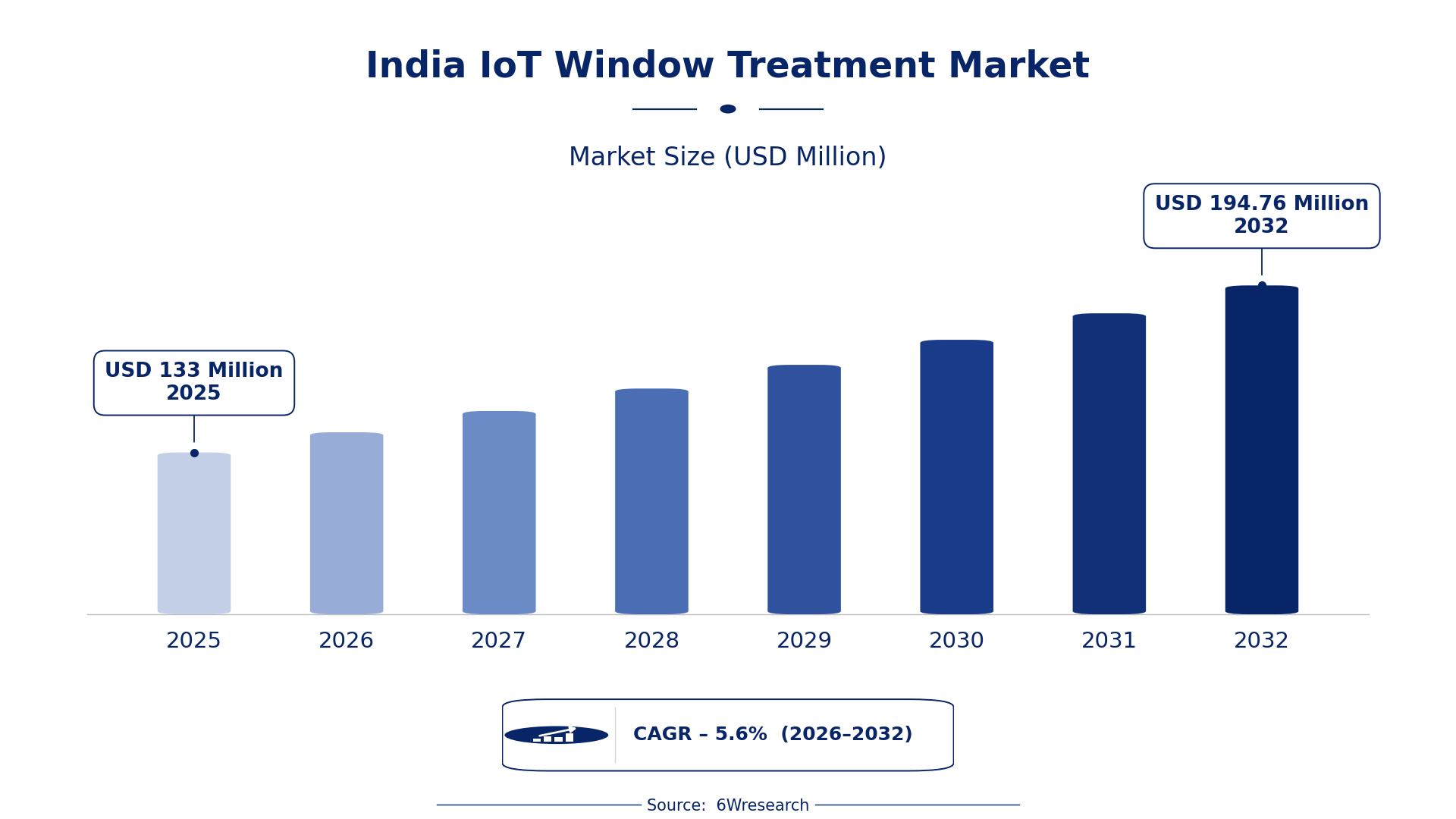
According to 6Wresearch internal database and industry insights, the India IoT Window Treatment Market was valued at USD 133.0 million in 2025 and is projected to reach USD 194.76 million by 2032, growing at a CAGR of approximately 5.6% during 2026–2032.
India IoT Window Treatment Market Highlights
| Report Metric | Details |
| Report Name | India IoT Window Treatment Market |
| Market Size 2025 | USD 133.0 million |
| Market Size 2032 | USD 194.76 million |
| Absolute Growth 2025–2032 | USD 61.76 million |
| CAGR 2026–2032 | 5.6% |
| Peak Annual Growth | 8.0% in 2029 |
| Forecast Period | 2026–2032 |
| Historical Data | 2022–2025 |
| Base Year | 2025 |
| Leading Product Type, 2025 | Smart Blinds (48% share) |
| Leading Control Interface, 2025 | Mobile App (46% share) |
| Leading Connectivity Type, 2025 | Wi-Fi (48% share) |
| Leading Power Source, 2025 | Battery Operated (52% share) |
| Leading End User, 2025 | Residential Users (43% share) |
| Fastest-Growing Product Type | Smart Curtains (6.6% CAGR) |
| Fastest-Growing Connectivity Type | Zigbee (7.5% CAGR) |
| Fastest-Growing Power Source | Solar Powered (8.2% CAGR) |
| Fastest-Growing End User | Smart Home Builders (8.1% CAGR) |
| Growing Sector | Residential sector |
| Key End Users | Residential Users, Smart Home Builders, Homeowners, Office Spaces |
India IoT Window Treatment Market Year-wise Growth Rate and Key Drivers (2022–2032)
This graph illustrates the annual growth rates of the market from 2022 to 2032, highlighting a steady upward trajectory and projected market expansion over the forecast period.
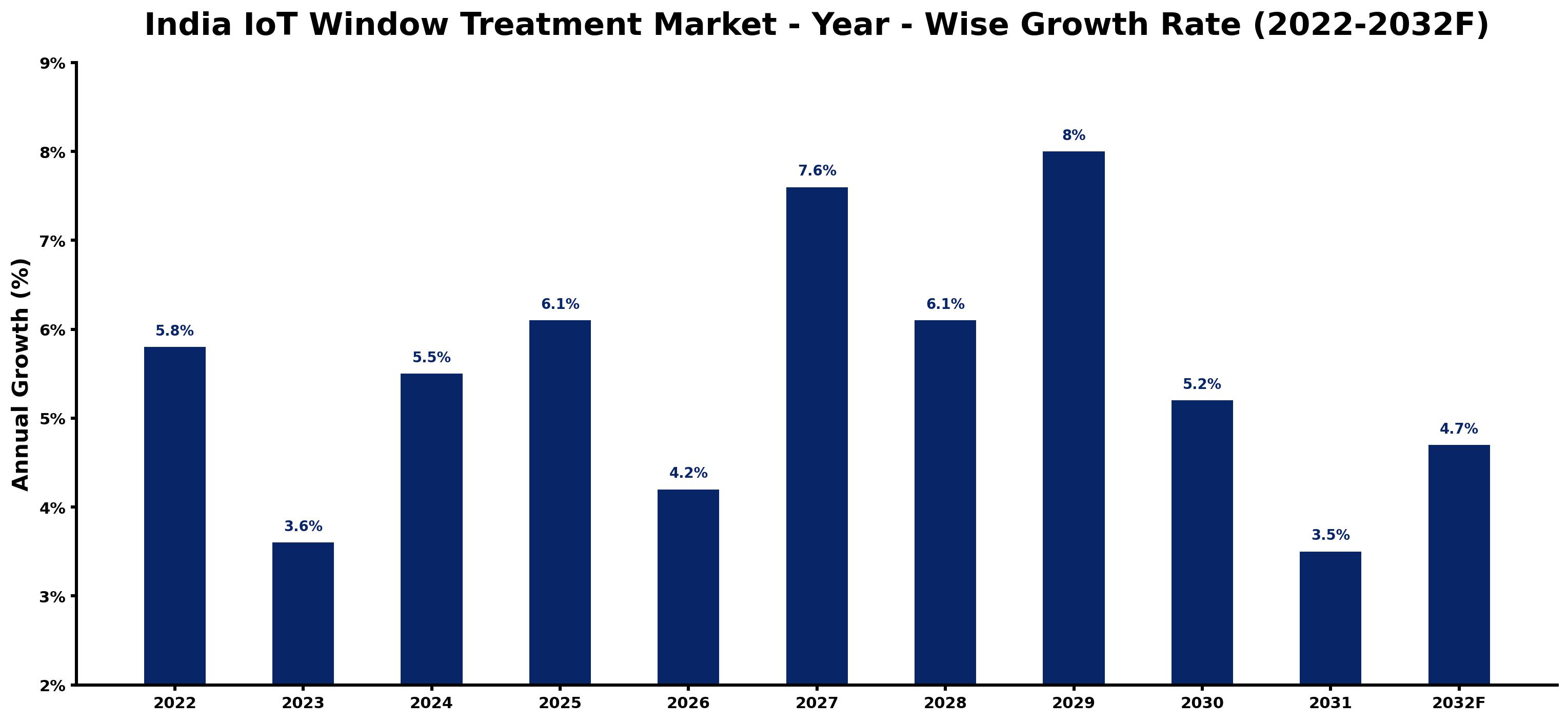
Each row of the following table gives one year's estimated growth and the event or demand shift that explains it.
| Year | Estimated Annual Growth (%) | Market Rationale |
| 2022 | 5.8 | The market experienced steady growth due to increasing interest in smart home solutions. |
| 2023 | 3.6 | Demand slowed following the launch of the Smart Cities Mission, which promoted urban smart technologies. |
| 2024 | 5.5 | Consumer interest in energy-efficient solutions grew as the Bureau of Energy Efficiency updated guidelines. |
| 2025 | 6.1 | The adoption of smart window treatments surged, driven by rising energy costs and consumer awareness. |
| 2026 | 4.2 | Growth moderated as manufacturers faced challenges integrating advanced technologies into existing products. |
| 2027 | 7.6 | Demand rose with the expansion of smart home builders in urban areas, enhancing market penetration. |
| 2028 | 6.1 | Growth slowed as consumer preferences stabilised following the Smart Cities Mission's impact. |
| 2029 | 8.0 | The market peaked as innovations in smart window technologies attracted more buyers, particularly in metropolitan regions. |
| 2030 | 5.2 | Growth moderated as the market began to stabilise after rapid advancements in technology. |
| 2031 | 3.5 | Demand continued to slow as consumer awareness reached a plateau, limiting new purchases. |
| 2032 | 4.7 | Growth accelerated again as new energy efficiency standards were implemented, encouraging further investment. |
Note: Market size estimations and growth projections presented in this report are based on 6Wresearch's proprietary forecasting methodology, utilizing the latest available industry data, government publications, and primary research inputs.
India IoT Window Treatment Market Synopsis
IoT Window Treatment in India includes smart window coverings that combine technology for better control and energy efficiency. These products offer convenience and privacy in both residential and commercial settings. The India IoT Window Treatment Market is growing swiftly, supported by a projected smart home market of 9.57 million units by 2025 and a residential sector demand of around 70%. The rising adoption of smart technologies and energy-efficient solutions is driving growth in this sector, especially among residential users and smart home builders.
Market Dynamics Impact Analysis (2026–2032)
| Factor | Type | Impact | Primary Segment Affected |
| Growing residential sector demand for energy-efficient solutions | Driver | High | Smart Blinds |
| Rising interest in smart home technologies among consumers | Driver | High | Smart Curtains |
| Increased investment in smart home infrastructure | Opportunity | High | Motorized Shades |
| Emerging trends in urban living promoting smart technologies | Opportunity | High | Light-Sensing Blinds |
| High initial costs of smart window treatments | Restraint | Medium | Smart Blinds |
| Limited consumer awareness about IoT benefits | Restraint | Medium | Smart Curtains |
| Competition from alternative energy-efficient solutions | Challenge | High | Motorized Shades |
| Technological integration challenges for manufacturers | Challenge | Medium | Light-Sensing Blinds |
Evaluation of Drivers in India IoT Window Treatment Market (2026–2032)
Below mentioned are some major drivers and their influence on market dynamics.
| Drivers | Primary Segment Affected | Why It Matters (Evidence) |
| Increasing energy costs prompting homeowners to seek solutions | Smart Blinds | Smart blinds can reduce energy costs by up to 30% when integrated with home automation systems. |
| Rising consumer interest in smart home technology | Smart Curtains | The adoption of IoT technologies in Indian homes is increasing at a rate of 25% annually. |
| Government initiatives promoting energy-efficient technologies | Motorized Shades | The National Smart Grid Mission aims to improve energy efficiency in residential buildings, boosting demand. |
| Urbanisation leading to higher demand for smart solutions | Light-Sensing Blinds | Smart curtains are gaining popularity in urban areas, especially in metropolitan cities like Delhi and Mumbai. |
| Increased investment by smart home builders | Smart Blinds | The average Indian household is expected to invest around INR 15,000 in smart home solutions by 2025. |
Smart blinds can reduce energy costs by up to 30% when integrated with home automation systems, driving demand from homeowners seeking savings. The adoption of IoT technologies in homes is increasing at a rate of 25% annually, encouraging manufacturers to innovate. Urbanisation is also driving higher demand for smart solutions, particularly in metropolitan areas where smart curtains are gaining popularity. Households are projected to invest significantly in smart home solutions, further boosting market growth.
Evaluation of Restraints in India IoT Window Treatment Market
The following restraints limit how fast demand can grow.
| Market Restraint | Primary Segment Affected | Why It Matters (Evidence) |
| High initial costs of smart window treatments | Smart Blinds | The average Indian household's investment in smart home solutions is around INR 15,000, which can be a barrier. |
| Limited consumer awareness about IoT benefits | Smart Curtains | Many consumers remain unaware of the advantages offered by smart window treatments, limiting market growth. |
| Competition from alternative energy-efficient solutions | Motorized Shades | The market faces competition from traditional energy-efficient window coverings, impacting sales. |
| Technological integration challenges for manufacturers | Light-Sensing Blinds | Manufacturers struggle with integrating advanced technologies into existing product lines, delaying launches. |
| Slow adoption rates in rural areas | Smart Blinds | Rural consumers often lack access to smart home technologies and related infrastructure. |
India IoT Window Treatment Market Challenges
The India IoT Window Treatment Market encounters several practical issues, with regulatory hurdles being the foremost. Compliance with the Energy Conservation Building Code can delay product launches for manufacturers, affecting their ability to meet the growing demand in the residential sector, which accounts for about 70% of the market. Intense competition among suppliers leads to price wars, squeezing profit margins for producers and impacting product quality. Rapid technological advancements create a gap between current offerings and consumer expectations, making buyers hesitant in their purchasing decisions. High initial costs associated with smart window treatments deter residential users, limiting market penetration as the average household is expected to invest around INR 15,000 by 2025.
Trends in the India IoT Window Treatment Market
The trends below show where the India IoT Window Treatment Market is heading.
- Shift towards Energy-Efficient Solutions: A growing preference for energy-efficient home solutions is emerging in India, driven by rising energy costs. The National Smart Grid Mission supports this shift, aiming to improve energy efficiency in residential buildings.
- Emergence of Smart Home Builders: Smart home builders are increasingly adopting IoT technologies to improve residential projects. The residential sector accounts for approximately 70% of IoT window treatment demand in India, reflecting this trend.
- Growth of Urban Demand for Smart Curtains: Urban areas are experiencing a surge in demand for smart curtains, particularly in cities like Delhi and Mumbai. The adoption of smart technologies in these regions is expected to grow significantly, with smart curtains gaining popularity.
- Increasing Connectivity Options: The use of Wi-Fi and Zigbee connectivity types is becoming more prevalent in smart window treatments. Zigbee is anticipated to grow at a CAGR of 7.5% from 2026 to 2032, indicating a shift in consumer preferences.
Investment Opportunities in the India IoT Window Treatment Market
Below are the investment opportunities with the strongest case in the India IoT Window Treatment Market.
- Supply of Smart Blinds: With the residential sector projected to account for 70% of demand, investing in smart blinds offers substantial potential. Urban areas like Delhi are key markets for this opportunity, with growing interest in energy-efficient solutions.
- Expansion in Smart Home Builders: Smart home builders are increasingly adopting IoT technologies, creating opportunities for suppliers. Focusing on metropolitan regions can yield substantial returns as demand for smart solutions rises.
- Partnerships for Smart Window Technologies: Establishing joint ventures with local manufacturers can facilitate entry into the growing market for smart window treatments. Collaborating with smart home builders can improve market penetration.
- Investment in Energy-Efficient Solutions: Households are expected to invest significantly in smart home solutions by 2025. Suppliers can target this growing market by offering affordable energy-efficient products.
Government Initiatives in the India IoT Window Treatment Market
The National Policy on Electronics, launched by the Ministry of Electronics and Information Technology in 2021, promotes smart technologies including IoT solutions for homes. This policy encourages manufacturers to innovate and invest in smart window treatments. The Smart Cities Mission, initiated by the Ministry of Housing and Urban Affairs in 2015, aims to improve urban living through smart technologies, including window treatments. The updated Energy Conservation Building Code in 2022 includes guidelines for smart window technologies, further supporting market growth. Additionally, the Ministry of New and Renewable Energy announced a subsidy scheme in 2023 to promote solar-powered smart home devices, making them more accessible to consumers.
The Bureau of Energy Efficiency has launched campaigns promoting smart energy solutions for homes, directly benefiting buyers of IoT window treatments. The subsidy scheme announced by the Ministry of New and Renewable Energy in 2023 supports solar-powered smart home devices, making them more accessible to consumers. These initiatives help reduce costs for buyers while encouraging the adoption of smart technologies in residential buildings. The Bureau also funds projects that improve energy efficiency, allowing producers to innovate and expand their offerings.
Future Insight of the India IoT Window Treatment Market
The India IoT Window Treatment Market will undergo transformative changes by 2032, primarily driven by the integration of advanced home automation technologies. The National Smart Grid Mission will enhance energy efficiency, encouraging consumers to adopt these solutions. Urban areas will see increased demand as innovative window coverings gain popularity, particularly in metropolitan cities. The Bureau of Energy Efficiency's campaigns will actively promote energy-efficient products, creating a supportive environment for market expansion.
Market Segmentation Analysis
The report offers a comprehensive study of the following market segments and their leading categories in the market.
By Product Type – Smart Blinds Dominated, Smart Curtains Expected to Grow Fastest
According to Shubham Deep, Research Manager at 6Wresearch, Smart Blinds held a 48% share of the India IoT Window Treatment Market by product type in 2025. Smart Blinds hold the largest market share due to their effectiveness in energy management and convenience for users. They are particularly favoured by residential consumers looking to integrate smart solutions into their homes, especially in urban areas. Over 2026–2032, Smart Curtains are expected to post the fastest growth, at a CAGR of 6.6%. Smart Curtains are experiencing rapid growth as they provide enhanced automation for light control and privacy, appealing to tech-savvy homeowners. Their increasing adoption is especially notable in metropolitan areas like Delhi and Mumbai, signalling a shift in consumer preferences. Suppliers should prioritise the development of smart curtain solutions to meet the rising demand in urban residential markets.
By Control Interface – Mobile App Dominated and Is Expected to Record the Fastest Growth
In 2025, Mobile App led the control interface split with a 46% share. Mobile Apps lead the market share as they offer a user-friendly interface for controlling smart window treatments remotely. This convenience aligns with the growing trend of smart home automation, making them essential for consumers. Its lead should widen, with a projected CAGR of 7.3% during 2026–2032, the highest in this split. The Mobile App segment is also the fastest-growing, as more users seek seamless control over their smart devices. This trend is expected to persist as the smart home market expands, underscoring the critical role of mobile applications in enhancing user experience. For suppliers, investing in mobile app development will be vital to satisfy the increasing expectations of consumers in the smart home ecosystem.
By Connectivity Type – Wi-Fi Dominated, Zigbee Expected to Grow Fastest
With a 48% revenue share in 2025, Wi-Fi was the largest connectivity type category. Wi-Fi is the leading connectivity type, crucial for enabling remote operation of smart window treatments in homes. Its widespread availability and compatibility with various devices make it a preferred choice among consumers. Zigbee is projected to grow fastest, at a CAGR of 7.5% during 2026–2032. Zigbee is the fastest-growing connectivity type, driven by its efficiency in smart home environments. As more consumers embrace IoT technologies, Zigbee's role in connecting devices will become increasingly important, enhancing the overall user experience. Suppliers should consider incorporating Zigbee technology into their products to align with the evolving preferences of tech-savvy consumers.
By Power Source – Battery Operated Dominated, Solar Powered Expected to Grow Fastest
Battery Operated took a 52% share of power source in 2025, more than any other category. Battery Operated systems are the most common power source for smart window treatments, providing flexibility and ease of installation for users. This convenience makes them particularly appealing for residential applications where wiring may be challenging. The quickest growth will come from Solar Powered, forecast to expand at a CAGR of 8.2% between 2026 and 2032. Solar Powered solutions are emerging as the fastest-growing option, driven by a rising awareness of energy efficiency and sustainability. As consumers become more eco-conscious, the demand for solar-powered window treatments is expected to rise. Suppliers should explore solar power options to align with the growing consumer preference for sustainable home solutions.
By End User – Residential Users Dominated, Smart Home Builders Expected to Grow Fastest
Residential Users accounted for a 43% market share by end user in 2025. Residential Users represent the largest share of the market, primarily due to the increasing adoption of smart home technologies in households. Their demand is further supported by initiatives promoting energy efficiency in residential buildings. Over 2026–2032, Smart Home Builders are expected to post the fastest growth, at a CAGR of 8.1%. Smart Home Builders are the fastest-growing segment, as they actively incorporate IoT window treatments into new constructions. This trend is expected to accelerate as more builders focus on smart solutions to attract buyers. Suppliers must engage with smart home builders to ensure their products are included in new residential developments, tapping into this expanding market.
Key Attractiveness of the Report
- 10 Years of Market Numbers
- Historical Data Starting from 2022 to 2025
- Base Year 2025
- Forecast Data until 2032
- Key Performance Indicators Impacting the Market
- Major Upcoming Developments and Projects
Key Highlights of the Report:
- India IoT Window Treatment Market Outlook
- Market Size of India IoT Window Treatment Market, 2025
- Forecast of India IoT Window Treatment Market, 2032
- Historical Data and Forecast of India IoT Window Treatment Revenues & Volume for the Period 2022 - 2032F
- India IoT Window Treatment Market Trend Evolution
- India IoT Window Treatment Market Drivers and Challenges
- India IoT Window Treatment Price Trends
- India IoT Window Treatment Porter's Five Forces
- India IoT Window Treatment Industry Life Cycle
- Historical Data and Forecast of India IoT Window Treatment Market Revenues & Volume By Product Type for the Period 2022 - 2032F
- Historical Data and Forecast of India IoT Window Treatment Market Revenues & Volume By Smart Blinds for the Period 2022 - 2032F
- Historical Data and Forecast of India IoT Window Treatment Market Revenues & Volume By Smart Curtains for the Period 2022 - 2032F
- Historical Data and Forecast of India IoT Window Treatment Market Revenues & Volume By Motorized Shades for the Period 2022 - 2032F
- Historical Data and Forecast of India IoT Window Treatment Market Revenues & Volume By Light-Sensing Blinds for the Period 2022 - 2032F
- Historical Data and Forecast of India IoT Window Treatment Market Revenues & Volume By Control Interface for the Period 2022 - 2032F
- Historical Data and Forecast of India IoT Window Treatment Market Revenues & Volume By Mobile App for the Period 2022 - 2032F
- Historical Data and Forecast of India IoT Window Treatment Market Revenues & Volume By Voice-Controlled for the Period 2022 - 2032F
- Historical Data and Forecast of India IoT Window Treatment Market Revenues & Volume By Remote Control for the Period 2022 - 2032F
- Historical Data and Forecast of India IoT Window Treatment Market Revenues & Volume By Sensor-Based Automation for the Period 2022 - 2032F
- Historical Data and Forecast of India IoT Window Treatment Market Revenues & Volume By Connectivity Type for the Period 2022 - 2032F
- Historical Data and Forecast of India IoT Window Treatment Market Revenues & Volume By Wi-Fi for the Period 2022 - 2032F
- Historical Data and Forecast of India IoT Window Treatment Market Revenues & Volume By Zigbee for the Period 2022 - 2032F
- Historical Data and Forecast of India IoT Window Treatment Market Revenues & Volume By Bluetooth for the Period 2022 - 2032F
- Historical Data and Forecast of India IoT Window Treatment Market Revenues & Volume By LoRa for the Period 2022 - 2032F
- Historical Data and Forecast of India IoT Window Treatment Market Revenues & Volume By Power Source for the Period 2022 - 2032F
- Historical Data and Forecast of India IoT Window Treatment Market Revenues & Volume By Battery Operated for the Period 2022 - 2032F
- Historical Data and Forecast of India IoT Window Treatment Market Revenues & Volume By Solar Powered for the Period 2022 - 2032F
- Historical Data and Forecast of India IoT Window Treatment Market Revenues & Volume By Wired for the Period 2022 - 2032F
- Historical Data and Forecast of India IoT Window Treatment Market Revenues & Volume By Rechargeable Battery for the Period 2022 - 2032F
- Historical Data and Forecast of India IoT Window Treatment Market Revenues & Volume By End User for the Period 2022 - 2032F
- Historical Data and Forecast of India IoT Window Treatment Market Revenues & Volume By Residential Users for the Period 2022 - 2032F
- Historical Data and Forecast of India IoT Window Treatment Market Revenues & Volume By Homeowners for the Period 2022 - 2032F
- Historical Data and Forecast of India IoT Window Treatment Market Revenues & Volume By Office Spaces for the Period 2022 - 2032F
- Historical Data and Forecast of India IoT Window Treatment Market Revenues & Volume By Smart Home Builders for the Period 2022 - 2032F
- India IoT Window Treatment Import Export Trade Statistics
- Market Opportunity Assessment By Product Type
- Market Opportunity Assessment By Control Interface
- Market Opportunity Assessment By Connectivity Type
- Market Opportunity Assessment By Power Source
- Market Opportunity Assessment By End User
- India IoT Window Treatment Top Companies Market Share
- India IoT Window Treatment Competitive Benchmarking By Technical and Operational Parameters
- India IoT Window Treatment Company Profiles
- India IoT Window Treatment Key Strategic Recommendations
Market Covered
This report examines the market across the segments below.
By Product Type
- Smart Blinds
- Smart Curtains
- Motorized Shades
- Light-Sensing Blinds
By Control Interface
- Mobile App
- Voice-Controlled
- Remote Control
- Sensor-Based Automation
By Connectivity Type
- Wi-Fi
- Zigbee
- Bluetooth
- LoRa
By Power Source
- Battery Operated
- Solar Powered
- Wired
- Rechargeable Battery
By End User
- Residential Users
- Homeowners
- Office Spaces
- Smart Home Builders































