India Self-Piloted Aircraft Market Size & Growth Rate
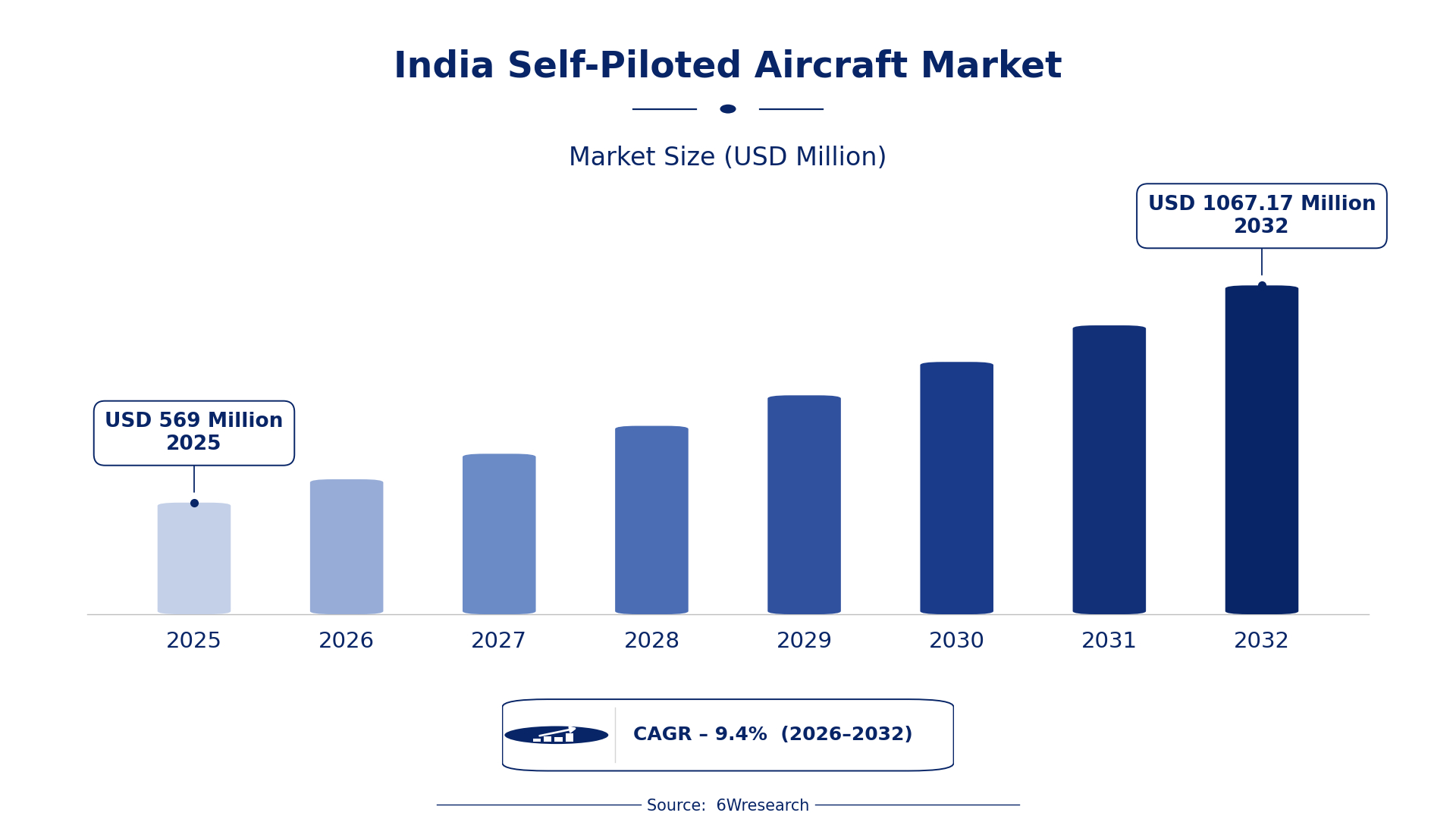
According to 6Wresearch internal database and industry insights, the India Self-Piloted Aircraft Market was valued at USD 569.0 million in 2025 and is projected to reach USD 1,067.17 million by 2032, growing at a CAGR of approximately 9.4% during 2026–2032.
India Self-Piloted Aircraft Market Highlights
| Report Metric | Details |
| Report Name | India Self-Piloted Aircraft Market |
| Market Size 2025 | USD 569.0 million |
| Market Size 2032 | USD 1,067.17 million |
| Absolute Growth 2025–2032 | USD 498.17 million |
| CAGR 2026–2032 | 9.4% |
| Peak Annual Growth | 10.8% in 2032 |
| Forecast Period | 2026–2032 |
| Historical Data | 2022–2025 |
| Base Year | 2025 |
| Leading Aircraft Type, 2025 | eVTOL Aircraft (43% share) |
| Leading Autonomy Level, 2025 | Full Autonomous (43% share) |
| Leading Power Source, 2025 | Electric Battery (36% share) |
| Leading End User, 2025 | Urban Air Mobility Firms (44% share) |
| Fastest-Growing Autonomy Level | Semi-Autonomous (12.0% CAGR) |
| Fastest-Growing Power Source | Hybrid (11.4% CAGR) |
| Fastest-Growing End User | Civil Aviation Startups (11.9% CAGR) |
| Growing Sector | Urban Air Mobility |
| Key End Users | Urban Air Mobility Firms, Military Agencies, Civil Aviation Startups, Defense Forces |
India Self-Piloted Aircraft Market Year-wise Growth Rate and Key Drivers (2022–2032)
This graph illustrates the annual growth rates of the market from 2022 to 2032, highlighting a steady upward trajectory and projected market expansion over the forecast period.
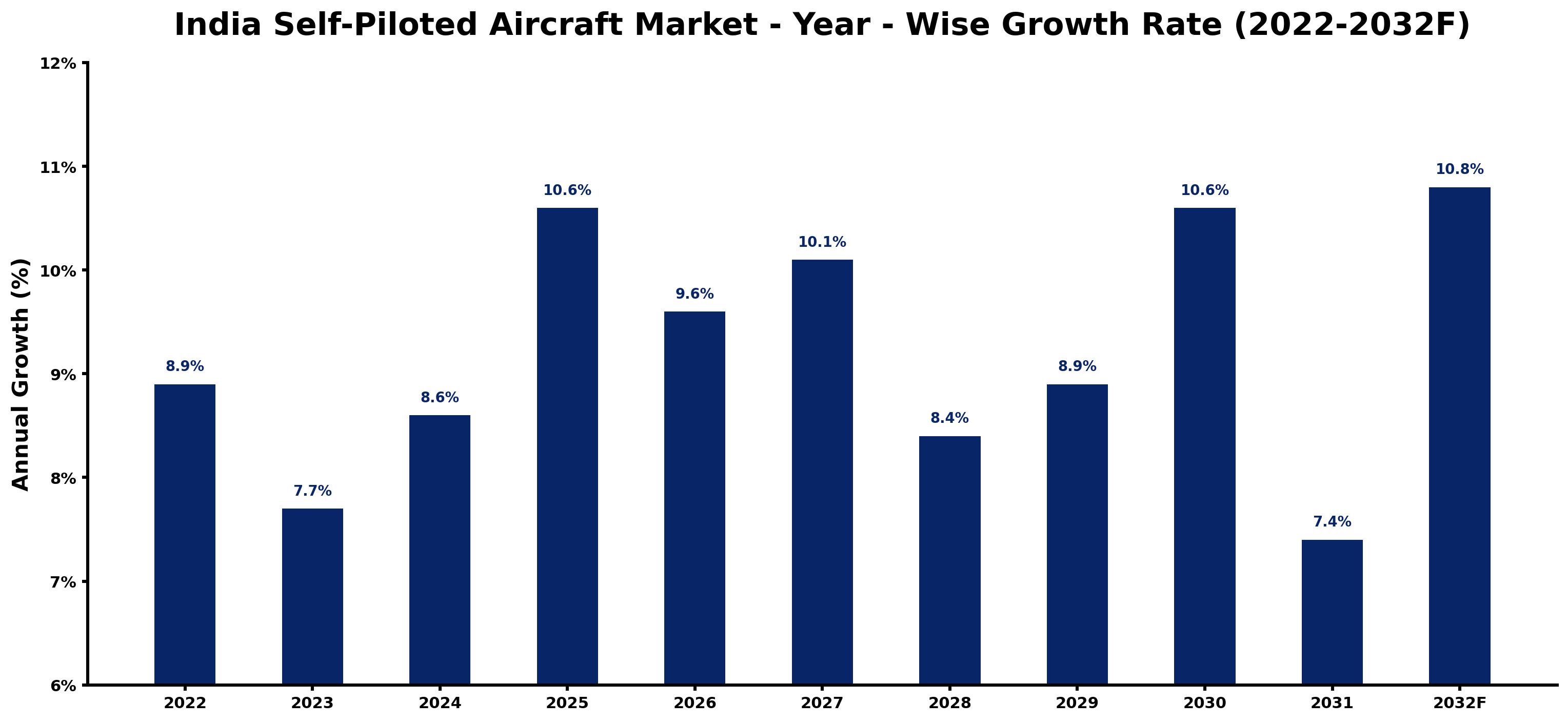
Annual growth estimates for each year appear below with the principal reason behind them, explaining the shifts that set the pace of the market.
| Year | Estimated Annual Growth (%) | Market Rationale |
| 2022 | 8.9 | Demand was strong as urban air mobility solutions gained traction in India. |
| 2023 | 7.7 | Growth slowed due to regulatory adjustments following the implementation of the 'Drone Policy 2.0'. |
| 2024 | 8.6 | Increased investments in drone technology spurred faster growth in the market. |
| 2025 | 10.6 | Urban air mobility solutions expanded, driving demand for self-piloted aircraft. |
| 2026 | 9.6 | Market growth slowed as military budgets were realigned to other priorities. |
| 2027 | 10.1 | Demand rebounded as urban air mobility firms increased their operational fleets. |
| 2028 | 8.4 | Growth slowed again as regulatory frameworks required further adjustments. |
| 2029 | 8.9 | Interest from civil aviation startups boosted market activity. |
| 2030 | 10.6 | Demand surged as urban air mobility routes began to be established. |
| 2031 | 7.4 | Growth slowed as the market adjusted to new operational standards. |
| 2032 | 10.8 | A peak in demand is projected as urban air mobility routes are fully developed. |
Note: Market size estimations and growth projections presented in this report are based on 6Wresearch's proprietary forecasting methodology, utilizing the latest available industry data, government publications, and primary research inputs.
India Self-Piloted Aircraft Market Synopsis
The Self-Piloted Aircraft in India includes advanced autonomous flight technologies, such as eVTOLs and drones, primarily utilised for urban air mobility, surveillance, and military applications. The Indian military's focus on modernisation and the government's initiatives to establish urban air mobility routes are key factors propelling this growth. Civil aviation startups are increasingly adopting self-piloted aircraft, further stimulating demand.
Market Dynamics Impact Analysis (2026–2032)
| Factor | Type | Impact | Primary Segment Affected |
| Growing urban population driving demand for air mobility solutions | Driver | High | Urban Air Mobility Firms |
| Increased military investments in drone technology | Driver | High | Military Agencies |
| Emerging demand for urban air mobility solutions | Opportunity | High | Urban Air Mobility Firms |
| Rising interest from civil aviation startups | Opportunity | High | Civil Aviation Startups |
| Regulatory hurdles affecting drone operations | Restraint | High | Surveillance Drones |
| High development costs for advanced drone technologies | Restraint | High | eVTOL Aircraft |
| Approval delays for new drone models | Challenge | Medium | Air Taxis |
| Limited infrastructure for urban air mobility operations | Challenge | Medium | Urban Air Mobility Firms |
Evaluation of Drivers in India Self-Piloted Aircraft Market (2026–2032)
The table below links each growth driver to the segment it affects and the evidence for it.
| Drivers | Primary Segment Affected | Why It Matters (Evidence) |
| Urban population growth | Urban Air Mobility Firms | India's urban population is projected to reach 600 million by 2031, increasing the need for urban air mobility solutions. |
| Military modernization budget | Military Agencies | The Indian military's budget includes investments in drone technology for surveillance and operational capabilities. |
| Drone Policy 2.0 implementation | Civil Aviation Startups | The Ministry of Civil Aviation's 'Drone Policy 2.0' promotes drone usage across various sectors, creating new market opportunities. |
| Indigenous drone development | Military Agencies | The Defense Research and Development Organization is developing indigenous drones, increasing demand for local production and technology. |
| Urban Air Mobility routes establishment | Urban Air Mobility Firms | The government aims to establish 100 urban air mobility routes by 2035, driving demand for self-piloted aircraft. |
The urban population is projected to reach 600 million by 2031, increasing the need for urban air mobility solutions. The military's modernisation budget includes substantial investments in drone technology, improving operational capabilities. Establishing 100 urban air mobility routes by 2035 will further stimulate demand for self-piloted aircraft.
Evaluation of Restraints in India Self-Piloted Aircraft Market
The main factors holding the market back are set out below.
| Market Restraint | Primary Segment Affected | Why It Matters (Evidence) |
| Regulatory complexities surrounding drone operations | Surveillance Drones | The Bureau of Civil Aviation Security has set strict standards for drone operations, complicating compliance for manufacturers. |
| High costs associated with advanced drone development | eVTOL Aircraft | Development costs for eVTOL aircraft are substantial, limiting investment from smaller firms. |
| Delays in approval processes for new drone models | Air Taxis | Approval delays can hinder the timely introduction of new air taxi services to the market. |
| Limited infrastructure for urban air mobility | Urban Air Mobility Firms | Insufficient infrastructure for urban air mobility operations restricts the growth potential of this segment. |
| Market volatility due to changing regulations | Civil Aviation Startups | Frequent regulatory changes can create uncertainty for startups investing in drone technology. |
India Self-Piloted Aircraft Market Challenges
India's self-piloted aircraft market faces a skills shortage, as the workforce lacks adequate training in advanced aviation technologies, resulting in project delays for producers that can extend timelines by up to six months. Increased competition from international manufacturers compels local suppliers to reduce prices, which erodes profit margins and restricts their ability to invest in necessary innovations. Compliance costs with the Bureau of Civil Aviation Security's standards can reach INR 50 lakh, deterring new entrants and limiting options for buyers seeking diverse solutions. Rapid technological advancements necessitate constant updates, imposing financial burdens on startups and clinics striving to stay competitive.
Trends in the India Self-Piloted Aircraft Market
Four trends stand out in the India Self-Piloted Aircraft Market.
- Start of Urban Air Mobility Initiatives: India aims to establish 100 urban air mobility routes by 2035, promoting the use of self-piloted aircraft. This initiative will drive urban transport solutions.
- Growth of Indigenous Drone Development: The Defense Research and Development Organization has been developing indigenous drones since 2020, strengthening military capabilities. This focus on local production is likely to increase market participation.
- Rise of Drone Policy Frameworks: The 'Drone Policy 2.0' was launched in 2021 to streamline regulations, promoting the adoption of drones across sectors. This policy is essential for ensuring safe and efficient operations.
- Increased Military Budget Allocations: In 2022, the Indian Ministry of Defense approved a budget of INR 1,000 crore for indigenous drone development. This funding will enhance the capabilities of military agencies.
Investment Opportunities in the India Self-Piloted Aircraft Market
Several openings in the India Self-Piloted Aircraft Market merit attention from investors.
- Supply of Electric Battery Technology: With the rising need for electric-powered self-piloted aircraft, investment in electric battery technology is essential. Urban Air Mobility Firms are seeking reliable battery solutions to improve operational efficiency.
- Development of Urban Air Mobility Infrastructure: Now is the time to invest in infrastructure for urban air mobility. The Indian government is establishing routes, creating opportunities for firms involved in infrastructure development.
- Manufacturing of Indigenous Drones: The push for local manufacturing under the 'Atmanirbhar Bharat' initiative presents opportunities for suppliers. Military Agencies are looking for local partners to produce drones and components.
- Expansion of Drone Services: The growing interest in drone services offers a chance to invest in service provision. Civil Aviation Startups are actively seeking innovative solutions for urban transport.
Government Initiatives in the India Self-Piloted Aircraft Market
The 'Drone Policy 2.0', launched by the Ministry of Civil Aviation in 2021, streamlines regulations for drone operations and promotes their use across various sectors. This policy introduces clear guidelines and safety standards, encouraging manufacturers to comply with new regulations. It supports the growth of the drone industry by providing a regulatory framework for operators and users alike. The 'Atmanirbhar Bharat' initiative, introduced in 2020, aims to boost local manufacturing of drones and related technologies, further strengthening the domestic market.
In 2022, the Indian government allocated INR 1,500 crore for drone technology development under the 'Make in India' initiative, supporting local manufacturers and innovators. The Ministry of Defense is actively funding projects to develop indigenous drones, enhancing military capabilities. The Digital Sky Platform, launched in 2020, facilitates drone registration and airspace management, streamlining the approval process for operators. This platform is key for ensuring safe and efficient drone operations across the country.
Future Insight of the India Self-Piloted Aircraft Market
The self-piloted aircraft market in India is set to transform by 2032, supported by several key factors. The government's goal to establish 100 urban air mobility routes will open new avenues for buyers and suppliers alike. Investment in drone technology development, with INR 1,500 crore allocated under the 'Make in India' initiative, will strengthen local manufacturing capabilities. Ongoing advancements in indigenous drone technology by the Defense Research and Development Organization will enhance military applications and operational efficiency. The implementation of 'Drone Policy 2.0' will encourage broader adoption across various sectors.
Market Segmentation Analysis
Each segment group is reviewed below, with the leader by share and the fastest grower by CAGR.
By Aircraft Type – eVTOL Aircraft Dominated and Is Expected to Record the Fastest Growth
According to Shubham Padhi, Research Analyst at 6Wresearch, with a 43% revenue share in 2025, eVTOL Aircraft was the largest aircraft type category. eVTOL Aircraft hold the largest share in the India Self-Piloted Aircraft Market due to their direct application in urban air mobility solutions. As India's urban population is projected to reach 600 million by 2031, the demand for efficient transport options is escalating. eVTOL Aircraft is also forecast to expand faster than any other category, at a CAGR of 12.0% over 2026–2032. The eVTOL Aircraft segment is also the fastest-growing, propelled by the Indian government's initiative to establish 100 urban air mobility routes by 2035. This strategic direction will likely widen the lead of eVTOLs as they become essential to urban transport. Suppliers should focus on developing eVTOL technologies to capitalise on the expanding urban air mobility market.
By Autonomy Level – Full Autonomous Dominated, Semi-Autonomous Expected to Grow Fastest
The largest autonomy level category in 2025 was Full Autonomous, with a 43% share of total revenue. Full Autonomous systems hold the largest market share due to their essential role in enabling self-piloted operations without human intervention. The Indian military's focus on drone technology for surveillance further amplifies the demand for these systems, solidifying their market position. Semi-Autonomous is projected to grow fastest, at a CAGR of 12.0% during 2026–2032. Semi-Autonomous systems are witnessing rapid growth as they effectively support operations with human oversight, particularly in surveillance applications. This trend highlights a growing acceptance of advanced technologies in various sectors, which will likely continue to expand. Suppliers should focus on developing both Full and Semi-Autonomous technologies to meet the diverse needs of the market.
By Power Source – Electric Battery Dominated, Hybrid Expected to Grow Fastest
In 2025, Electric Battery led the power source split with a 36% share. Electric Battery technology commands the largest market share as the primary power source for many self-piloted aircraft. The emphasis on sustainable aviation solutions aligns with the growing interest in electric-powered flight. Over 2026–2032, Hybrid is expected to post the fastest growth, at a CAGR of 11.4%. Hybrid power sources are the fastest-growing segment, as they offer extended range capabilities for self-piloted aircraft. This trend reflects the industry's push for versatility in power options to meet diverse operational needs. Suppliers should consider hybrid solutions to meet the evolving demands of the self-piloted aircraft market.
By End User – Urban Air Mobility Firms Dominated, Civil Aviation Startups Expected to Grow Fastest
Urban Air Mobility Firms accounted for a 44% market share by end user in 2025. Urban Air Mobility Firms dominate the market share as they are pivotal end users in the urban transport sector, addressing the increasing demand for efficient aerial transport solutions. The projected growth of India's urban population significantly propels the need for these services. The quickest growth will come from Civil Aviation Startups, forecast to expand at a CAGR of 11.9% between 2026 and 2032. Civil Aviation Startups are rapidly growing by leveraging self-piloted technology to innovate and enhance air transport solutions. This reflects a broader trend towards modernising the aviation industry in India, indicating substantial future opportunities. Engaging with civil aviation startups will be crucial for suppliers aiming to capitalise on the expanding market for self-piloted aircraft.
Key Attractiveness of the Report
- 10 Years of Market Numbers
- Historical Data Starting from 2022 to 2025
- Base Year 2025
- Forecast Data until 2032
- Key Performance Indicators Impacting the Market
- Major Upcoming Developments and Projects
Key Highlights of the Report:
- India Self-Piloted Aircraft Market Outlook
- Market Size of India Self-Piloted Aircraft Market, 2025
- Forecast of India Self-Piloted Aircraft Market, 2032
- Historical Data and Forecast of India Self-Piloted Aircraft Revenues & Volume for the Period 2022 - 2032F
- India Self-Piloted Aircraft Market Trend Evolution
- India Self-Piloted Aircraft Market Drivers and Challenges
- India Self-Piloted Aircraft Price Trends
- India Self-Piloted Aircraft Porter's Five Forces
- India Self-Piloted Aircraft Industry Life Cycle
- Historical Data and Forecast of India Self-Piloted Aircraft Market Revenues & Volume By Aircraft Type for the Period 2022 - 2032F
- Historical Data and Forecast of India Self-Piloted Aircraft Market Revenues & Volume By eVTOL Aircraft for the Period 2022 - 2032F
- Historical Data and Forecast of India Self-Piloted Aircraft Market Revenues & Volume By Surveillance Drones for the Period 2022 - 2032F
- Historical Data and Forecast of India Self-Piloted Aircraft Market Revenues & Volume By Air Taxis for the Period 2022 - 2032F
- Historical Data and Forecast of India Self-Piloted Aircraft Market Revenues & Volume By Reconnaissance Aircraft for the Period 2022 - 2032F
- Historical Data and Forecast of India Self-Piloted Aircraft Market Revenues & Volume By Autonomy Level for the Period 2022 - 2032F
- Historical Data and Forecast of India Self-Piloted Aircraft Market Revenues & Volume By Full Autonomous for the Period 2022 - 2032F
- Historical Data and Forecast of India Self-Piloted Aircraft Market Revenues & Volume By Semi-Autonomous for the Period 2022 - 2032F
- Historical Data and Forecast of India Self-Piloted Aircraft Market Revenues & Volume By AI Flight Control for the Period 2022 - 2032F
- Historical Data and Forecast of India Self-Piloted Aircraft Market Revenues & Volume By Remote/AI Navigation for the Period 2022 - 2032F
- Historical Data and Forecast of India Self-Piloted Aircraft Market Revenues & Volume By Power Source for the Period 2022 - 2032F
- Historical Data and Forecast of India Self-Piloted Aircraft Market Revenues & Volume By Electric Battery for the Period 2022 - 2032F
- Historical Data and Forecast of India Self-Piloted Aircraft Market Revenues & Volume By Hybrid for the Period 2022 - 2032F
- Historical Data and Forecast of India Self-Piloted Aircraft Market Revenues & Volume By Hydrogen for the Period 2022 - 2032F
- Historical Data and Forecast of India Self-Piloted Aircraft Market Revenues & Volume By Jet-Fueled for the Period 2022 - 2032F
- Historical Data and Forecast of India Self-Piloted Aircraft Market Revenues & Volume By End User for the Period 2022 - 2032F
- Historical Data and Forecast of India Self-Piloted Aircraft Market Revenues & Volume By Urban Air Mobility Firms for the Period 2022 - 2032F
- Historical Data and Forecast of India Self-Piloted Aircraft Market Revenues & Volume By Military Agencies for the Period 2022 - 2032F
- Historical Data and Forecast of India Self-Piloted Aircraft Market Revenues & Volume By Civil Aviation Startups for the Period 2022 - 2032F
- Historical Data and Forecast of India Self-Piloted Aircraft Market Revenues & Volume By Defense Forces for the Period 2022 - 2032F
- India Self-Piloted Aircraft Import Export Trade Statistics
- Market Opportunity Assessment By Aircraft Type
- Market Opportunity Assessment By Autonomy Level
- Market Opportunity Assessment By Power Source
- Market Opportunity Assessment By End User
- India Self-Piloted Aircraft Top Companies Market Share
- India Self-Piloted Aircraft Competitive Benchmarking By Technical and Operational Parameters
- India Self-Piloted Aircraft Company Profiles
- India Self-Piloted Aircraft Key Strategic Recommendations
Market Covered
Segments analysed in this report are listed below.
By Aircraft Type
- eVTOL Aircraft
- Surveillance Drones
- Air Taxis
- Reconnaissance Aircraft
By Autonomy Level
- Full Autonomous
- Semi-Autonomous
- AI Flight Control
- Remote/AI Navigation
By Power Source
- Electric Battery
- Hybrid
- Hydrogen
- Jet-Fueled
By End User
- Urban Air Mobility Firms
- Military Agencies
- Civil Aviation Startups
- Defense Forces































