China Self-Piloted Aircraft Market Size & Growth Rate
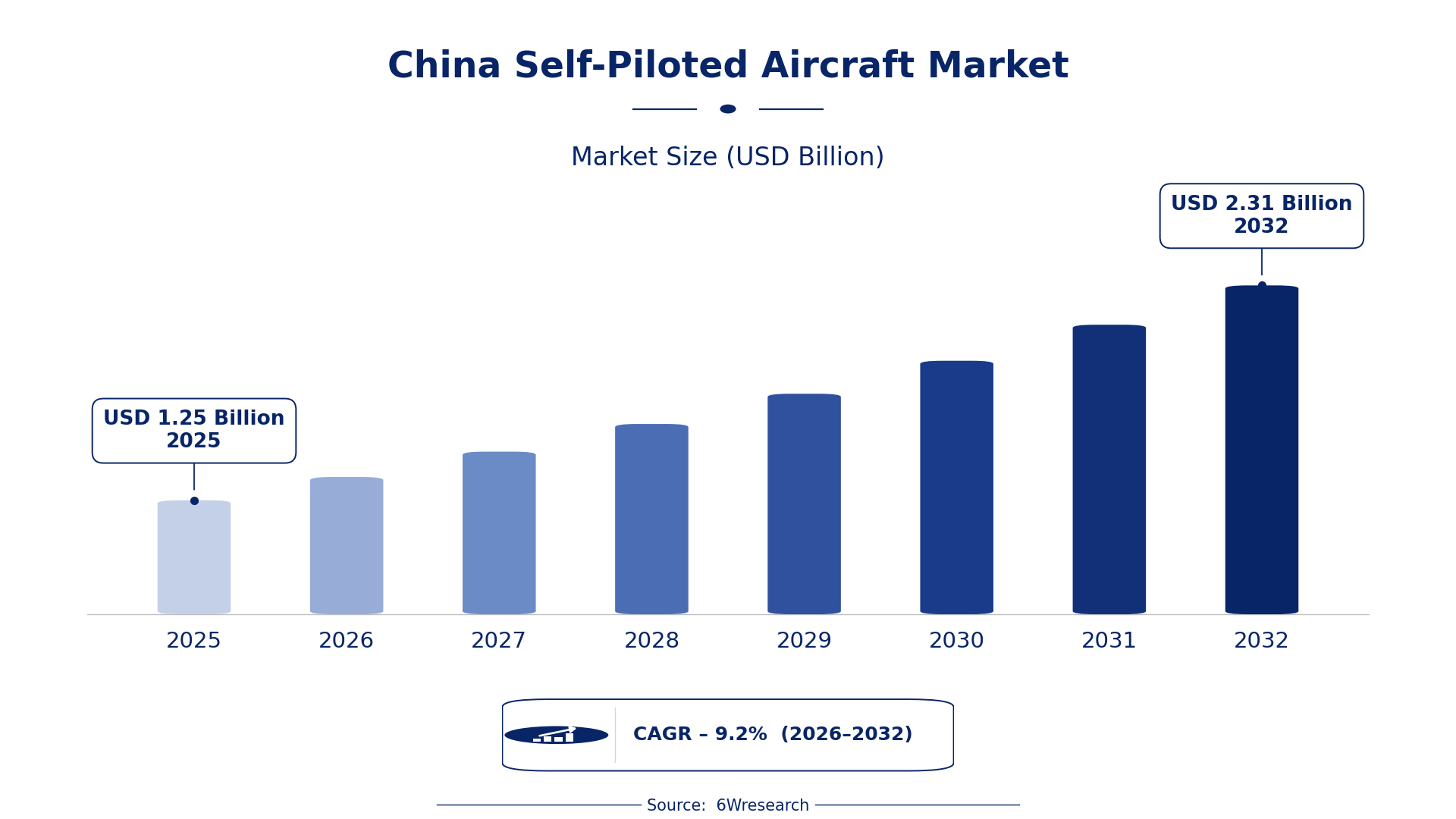
According to 6Wresearch internal database and industry insights, the China Self-Piloted Aircraft Market was valued at USD 1.25 billion in 2025 and is projected to reach USD 2.31 billion by 2032, growing at a CAGR of approximately 9.2% during 2026–2032.
China Self-Piloted Aircraft Market Highlights
| Report Metric | Details |
| Report Name | China Self-Piloted Aircraft Market |
| Market Size 2025 | USD 1.25 billion |
| Market Size 2032 | USD 2.31 billion |
| Absolute Growth 2025–2032 | USD 1.06 billion |
| CAGR 2026–2032 | 9.2% |
| Peak Annual Growth | 11.5% in 2026 |
| Forecast Period | 2026–2032 |
| Historical Data | 2022–2025 |
| Base Year | 2025 |
| Leading Aircraft Type, 2025 | eVTOL Aircraft (50% share) |
| Leading Autonomy Level, 2025 | Full Autonomous (44% share) |
| Leading Power Source, 2025 | Electric Battery (37% share) |
| Leading End User, 2025 | Urban Air Mobility Firms (35% share) |
| Fastest-Growing Aircraft Type | Surveillance Drones (11.0% CAGR) |
| Fastest-Growing Autonomy Level | Semi-Autonomous (10.7% CAGR) |
| Fastest-Growing Power Source | Hybrid (10.6% CAGR) |
| Fastest-Growing End User | Military Agencies (11.3% CAGR) |
| Growing Sector | Military Agencies |
| Key End Users | Urban Air Mobility Firms, Military Agencies, Civil Aviation Startups, Defense Forces |
China Self-Piloted Aircraft Market Year-wise Growth Rate and Key Drivers (2022–2032)
This graph illustrates the annual growth rates of the market from 2022 to 2032, highlighting a steady upward trajectory and projected market expansion over the forecast period.
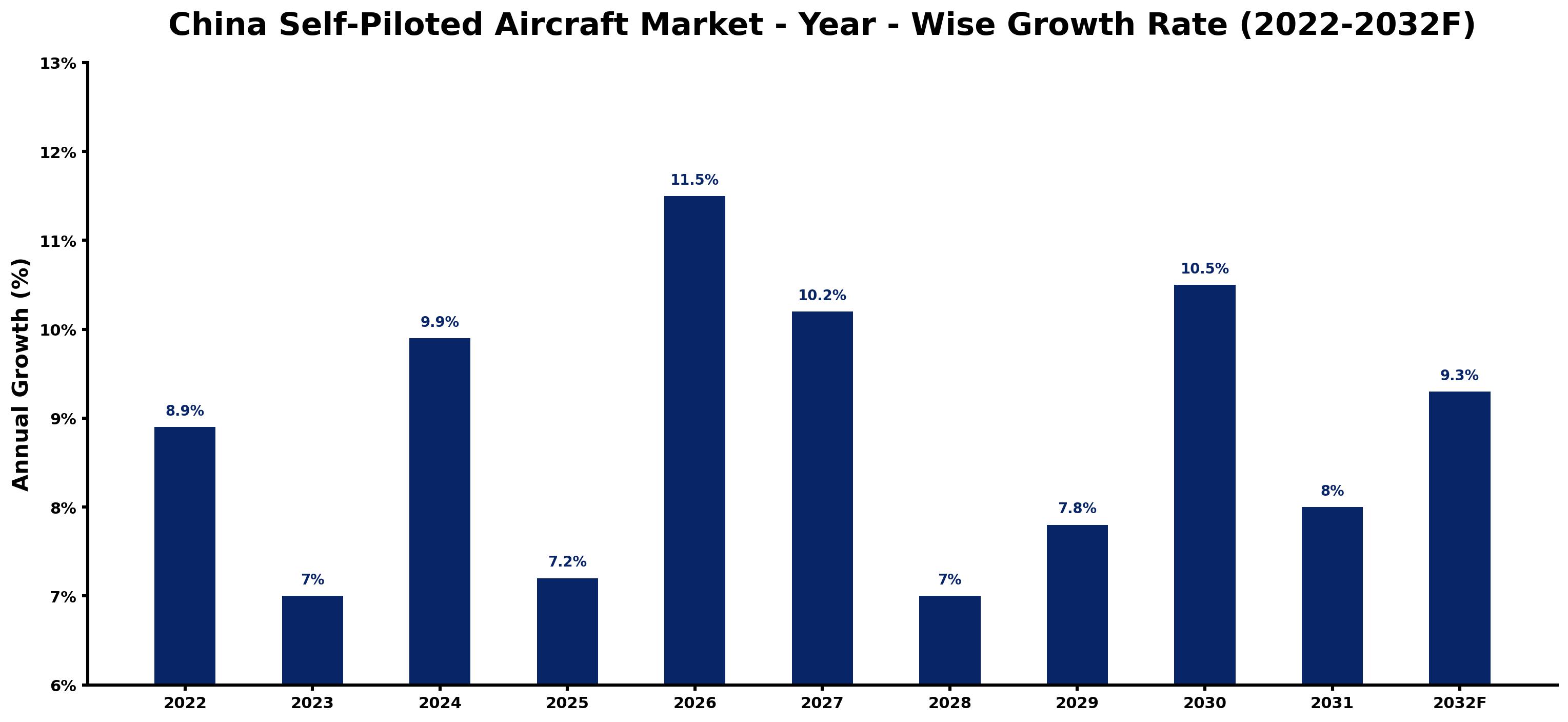
Annual growth estimates for each year appear below with the principal reason behind them, explaining the shifts that set the pace of the market.
| Year | Estimated Annual Growth (%) | Market Rationale |
| 2022 | 8.9 | The market experienced steady growth due to increasing investments in urban air mobility initiatives. |
| 2023 | 7.0 | Growth slowed as regulatory frameworks were still being established for eVTOL operations. |
| 2024 | 9.9 | Demand accelerated with successful testing of eVTOL aircraft in multiple cities. |
| 2025 | 7.2 | A slight slowdown occurred as the market adjusted to new operational standards. |
| 2026 | 11.5 | Investment surged as the government launched the Urban Air Mobility Development Plan. |
| 2027 | 10.2 | Growth decelerated slightly due to the maturation of the initial urban air mobility projects. |
| 2028 | 7.0 | The market continued to grow at a slower pace as competition intensified among manufacturers. |
| 2029 | 7.8 | Demand picked up again with rising interest from military agencies in reconnaissance drones. |
| 2030 | 10.5 | Growth accelerated as urban air mobility firms expanded their operational fleets significantly. |
| 2031 | 8.0 | A slowdown was noted as the market began to stabilise after rapid expansion. |
| 2032 | 9.3 | Demand increased again, driven by advancements in AI flight control systems. |
Note: Market size estimations and growth projections presented in this report are based on 6Wresearch's proprietary forecasting methodology, utilizing the latest available industry data, government publications, and primary research inputs.
China Self-Piloted Aircraft Market Synopsis
The Self-Piloted Aircraft Market in China includes drones and eVTOLs that utilise AI and automation for navigation. These aircraft serve various purposes, such as urban air mobility, surveillance, and military reconnaissance. The market is expanding due to substantial domestic investments, with more than 10 cities currently testing eVTOLs for public transport. Initiatives from the National Development and Reform Commission are improving manufacturing capabilities and infrastructure essential for this sector. By 2030, China aims to have 1,000 eVTOLs operational as part of its urban transport strategy.
Market Dynamics Impact Analysis (2026–2032)
| Factor | Type | Impact | Primary Segment Affected |
| Increasing urban air mobility initiatives are driving demand for eVTOLs. | Driver | High | eVTOL Aircraft |
| Growing military investments in reconnaissance drones are expanding market opportunities. | Driver | High | Surveillance Drones |
| High demand for urban air mobility solutions presents investment opportunities. | Opportunity | High | Air Taxis |
| The increasing need for advanced surveillance capabilities in urban areas creates demand. | Opportunity | Medium | Reconnaissance Aircraft |
| Regulatory hurdles can delay the deployment of new aircraft types. | Restraint | High | eVTOL Aircraft |
| Limited infrastructure for eVTOL operations can hinder market growth. | Restraint | Medium | Air Taxis |
| Buyers face challenges in navigating complex regulatory environments for drone operations. | Challenge | High | Surveillance Drones |
| Suppliers struggle with high development costs for advanced autonomous systems. | Challenge | Medium | Full Autonomous |
Evaluation of Drivers in China Self-Piloted Aircraft Market (2026–2032)
Below mentioned are some major drivers and their influence on market dynamics.
| Drivers | Primary Segment Affected | Why It Matters (Evidence) |
| Increased investment in urban air mobility initiatives boosts demand for eVTOLs. | eVTOL Aircraft | The National Development and Reform Commission's plan aims to develop infrastructure, resulting in higher purchases of eVTOLs. |
| Military agencies are expanding their drone fleets for reconnaissance purposes. | Surveillance Drones | China's military increased investment in reconnaissance drones by 30% since 2021, driving procurement. |
| The rise of urban air mobility firms is creating new market opportunities. | Air Taxis | With over 10 cities testing eVTOL aircraft, demand from urban air mobility firms is rising. |
| Advancements in AI flight control systems are improving operational efficiency. | Full Autonomous | The Ministry of Industry and Information Technology supports AI development, increasing demand for autonomous aircraft. |
| Growing public interest in transportation solutions is driving market expansion. | Reconnaissance Aircraft | The Shanghai International Airport's eVTOL program is attracting investment and interest from various sectors. |
Market growth for Self-Piloted Aircraft in China is underpinned by increased investment in urban air mobility and military demand for reconnaissance drones. Public interest in new transportation solutions continues to grow, further enhancing market potential as urban air mobility firms expand their operational fleets significantly.
Evaluation of Restraints in China Self-Piloted Aircraft Market
The key brakes on demand, and where they bite hardest, are shown below.
| Market Restraint | Primary Segment Affected | Why It Matters (Evidence) |
| Regulatory hurdles delay project approvals for new aircraft models. | eVTOL Aircraft | The Civil Aviation Administration of China has stringent guidelines that can delay project approvals by up to six months. |
| Fierce competition leads to price wars among manufacturers. | Surveillance Drones | Over 200 registered drone manufacturers create pressure that can reduce profit margins by 15% annually. |
| Supply chain issues arise due to reliance on imported components. | Air Taxis | Delays in component delivery can extend production timelines by 30% for manufacturers. |
| A shortage of skilled workers hampers production capabilities. | Full Autonomous | This shortage can result in a potential 20% decrease in output for producers. |
| Limited infrastructure for eVTOL operations restricts market growth. | Reconnaissance Aircraft | Insufficient charging stations and landing zones hinder the deployment of eVTOLs. |
China Self-Piloted Aircraft Market Challenges
Buyers in the China self-piloted aircraft market face regulatory hurdles, as the Civil Aviation Administration of China enforces strict guidelines that can delay project approvals by six months. Suppliers encounter intense competition, with over 200 registered drone manufacturers driving price wars that can reduce profit margins by 15% annually. Supply chain challenges arise from reliance on imported components, resulting in delivery delays of up to 30% for manufacturers. A shortage of skilled workers in AI flight control systems limits production capabilities, potentially leading to a 20% decrease in output for producers.
Trends in the China Self-Piloted Aircraft Market
Several trends are reshaping the China Self-Piloted Aircraft Market; the most important are set out below.
- Transition from Traditional to Autonomous Operations: Since 2022, the shift towards fully autonomous operations has gained momentum, with the Ministry of Industry and Information Technology promoting AI flight control systems. This change is improving safety and efficiency in operations.
- Rise of Urban Air Mobility Initiatives: The National Development and Reform Commission's Urban Air Mobility Development Plan, initiated in 2022, has spurred investment in eVTOL technology. This programme aims to integrate eVTOLs into public transport, improving urban connectivity.
- Increased Military Investment in Drones: In 2023, China's military increased its investment in reconnaissance drones, reflecting a growing focus on advanced surveillance capabilities. This trend is driving demand for new drone technologies.
- Expansion of Testing Regions for eVTOLs: As of 2023, over 10 cities in China are actively testing eVTOL aircraft for public transport. This expansion is paving the way for broader adoption and operational integration.
Investment Opportunities in the China Self-Piloted Aircraft Market
Some of the investment opportunities in the China Self-Piloted Aircraft Market are mentioned below.
- Urban Air Mobility Firms Seeking Advanced Solutions: Urban air mobility firms are pursuing advanced self-piloted aircraft solutions as the market is projected to reach USD 2.31 billion by 2032. Collaborating with local manufacturers can facilitate market entry.
- Investment in Drone Technology Development: The Guangdong province is making substantial investments in drone technology, with funding surpassing USD 100 million. Suppliers can enter this market by partnering with local firms to develop advanced drone systems.
- Growth in Military Drone Applications: Military agencies are increasingly focused on reconnaissance drones, with a 30% rise in investment since 2021. Suppliers can target this sector by offering advanced surveillance technologies.
- Integration of AI Flight Control Systems: The Ministry of Industry and Information Technology's AI Flight Control Enhancement Program supports the development of autonomous navigation technologies. Suppliers can benefit by providing advanced AI solutions.
Government Initiatives in the China Self-Piloted Aircraft Market
In 2022, the Civil Aviation Administration of China (CAAC) launched the 'Urban Air Mobility Development Plan' to promote eVTOL technology and infrastructure development. This initiative builds on the National Strategy for Drone Innovation approved in 2021, which aimed to improve domestic drone manufacturing capabilities and standards. The plan is expected to facilitate the integration of eVTOLs into urban transport systems, benefiting both producers and buyers.
In 2023, the Ministry of Industry and Information Technology initiated the 'AI Flight Control Enhancement Program' to support the development of autonomous navigation technologies. This programme aims to streamline regulatory frameworks and pilot projects across major cities, allowing producers to innovate and expand their offerings. The CAAC and NDRC are collaborating to ensure compliance and safety standards, which will enhance market confidence.
Future Insight of the China Self-Piloted Aircraft Market
Several forward-looking factors should support the self-piloted aircraft market in China over the coming years. The National Development and Reform Commission's plan to promote urban air mobility will drive innovation and funding. The target of having 1,000 eVTOLs operational by 2030 will create new opportunities for buyers seeking advanced transport options. The Shanghai International Airport's eVTOL operations program, expected to launch by 2024, will enhance urban connectivity, benefiting both suppliers and users.
Market Segmentation Analysis
Each segment group is reviewed below, with the leader by share and the fastest grower by CAGR.
By Aircraft Type – eVTOL Aircraft Dominated, Surveillance Drones Expected to Grow Fastest
According to Shubham Padhi, Research Analyst at 6Wresearch, with a 50% revenue share in 2025, eVTOL Aircraft was the largest aircraft type category. eVTOL aircraft dominate the market share due to their essential role in the burgeoning urban air mobility sector, with over 10 cities in China actively testing these aircraft for public transport. The Shanghai International Airport's upcoming eVTOL operations by 2024 further solidify this segment's importance. The quickest growth will come from Surveillance Drones, forecast to expand at a CAGR of 11.0% between 2026 and 2032. Surveillance drones are experiencing rapid growth, primarily driven by increased military investments in reconnaissance capabilities, which have surged by 30% since 2021. This trend indicates a growing demand for advanced security and monitoring solutions across various applications. Suppliers should focus on enhancing eVTOL capabilities while also catering to the rising need for surveillance drones in both military and civilian markets.
By Autonomy Level – Full Autonomous Dominated, Semi-Autonomous Expected to Grow Fastest
Full Autonomous accounted for a 44% market share by autonomy level in 2025. Full autonomous systems capture a significant market share as they are vital for operational efficiency in self-piloted aircraft, enabling smooth navigation and control. This feature is particularly crucial for urban air mobility firms that seek to enhance safety and streamline operations. Semi-Autonomous is set to record the highest CAGR in this split, 10.7% over 2026–2032. Semi-autonomous systems are the fastest-growing segment, largely due to their applicability in scenarios where complete autonomy is impractical. This shift suggests a growing acceptance and integration of semi-autonomous technologies in various sectors, including military and commercial. Buyers should consider investing in both full and semi-autonomous technologies to stay competitive in the advancing self-piloted aircraft market.
By Power Source – Electric Battery Dominated, Hybrid Expected to Grow Fastest
Electric Battery took a 37% share of power source in 2025, more than any other category. Electric battery technology leads the market share as it serves as the primary power source for eVTOLs, aligning with the industry's push towards sustainable aviation solutions. The growing focus on urban air mobility further solidifies the electric battery's position as the preferred power source. Hybrid is projected to grow fastest, at a CAGR of 10.6% during 2026–2032. Hybrid power sources are experiencing the fastest growth, particularly in military applications where versatility and extended range are essential. This shift indicates a potential trend towards integrating hybrid systems in various self-piloted aircraft to meet diverse operational needs. Suppliers should prioritise the development of electric and hybrid power solutions to meet the demands of both urban air mobility and military applications.
By End User – Urban Air Mobility Firms Dominated, Military Agencies Expected to Grow Fastest
The largest end user category in 2025 was Urban Air Mobility Firms, with a 35% share of total revenue. Urban air mobility firms hold the largest market share as they lead innovation and drive the growth of self-piloted aircraft in China. Their commitment to developing new urban transport solutions is supported by initiatives like the National Development and Reform Commission's urban air mobility promotion plan. Over 2026–2032, Military Agencies are expected to post the fastest growth, at a CAGR of 11.3%. Military agencies are the fastest-growing end user segment, propelled by their increasing reliance on advanced reconnaissance aircraft for national security purposes. This trend reflects a broader movement towards modernising military operations with cutting-edge technologies. Suppliers should engage with urban air mobility firms while also recognising the expanding opportunities within the military sector for self-piloted aircraft.
Key Attractiveness of the Report
- 10 Years of Market Numbers
- Historical Data Starting from 2022 to 2025
- Base Year 2025
- Forecast Data until 2032
- Key Performance Indicators Impacting the Market
- Major Upcoming Developments and Projects
Key Highlights of the Report:
- China Self-Piloted Aircraft Market Outlook
- Market Size of China Self-Piloted Aircraft Market, 2025
- Forecast of China Self-Piloted Aircraft Market, 2032
- Historical Data and Forecast of China Self-Piloted Aircraft Revenues & Volume for the Period 2022 - 2032F
- China Self-Piloted Aircraft Market Trend Evolution
- China Self-Piloted Aircraft Market Drivers and Challenges
- China Self-Piloted Aircraft Price Trends
- China Self-Piloted Aircraft Porter's Five Forces
- China Self-Piloted Aircraft Industry Life Cycle
- Historical Data and Forecast of China Self-Piloted Aircraft Market Revenues & Volume By Aircraft Type for the Period 2022 - 2032F
- Historical Data and Forecast of China Self-Piloted Aircraft Market Revenues & Volume By eVTOL Aircraft for the Period 2022 - 2032F
- Historical Data and Forecast of China Self-Piloted Aircraft Market Revenues & Volume By Surveillance Drones for the Period 2022 - 2032F
- Historical Data and Forecast of China Self-Piloted Aircraft Market Revenues & Volume By Air Taxis for the Period 2022 - 2032F
- Historical Data and Forecast of China Self-Piloted Aircraft Market Revenues & Volume By Reconnaissance Aircraft for the Period 2022 - 2032F
- Historical Data and Forecast of China Self-Piloted Aircraft Market Revenues & Volume By Autonomy Level for the Period 2022 - 2032F
- Historical Data and Forecast of China Self-Piloted Aircraft Market Revenues & Volume By Full Autonomous for the Period 2022 - 2032F
- Historical Data and Forecast of China Self-Piloted Aircraft Market Revenues & Volume By Semi-Autonomous for the Period 2022 - 2032F
- Historical Data and Forecast of China Self-Piloted Aircraft Market Revenues & Volume By AI Flight Control for the Period 2022 - 2032F
- Historical Data and Forecast of China Self-Piloted Aircraft Market Revenues & Volume By Remote/AI Navigation for the Period 2022 - 2032F
- Historical Data and Forecast of China Self-Piloted Aircraft Market Revenues & Volume By Power Source for the Period 2022 - 2032F
- Historical Data and Forecast of China Self-Piloted Aircraft Market Revenues & Volume By Electric Battery for the Period 2022 - 2032F
- Historical Data and Forecast of China Self-Piloted Aircraft Market Revenues & Volume By Hybrid for the Period 2022 - 2032F
- Historical Data and Forecast of China Self-Piloted Aircraft Market Revenues & Volume By Hydrogen for the Period 2022 - 2032F
- Historical Data and Forecast of China Self-Piloted Aircraft Market Revenues & Volume By Jet-Fueled for the Period 2022 - 2032F
- Historical Data and Forecast of China Self-Piloted Aircraft Market Revenues & Volume By End User for the Period 2022 - 2032F
- Historical Data and Forecast of China Self-Piloted Aircraft Market Revenues & Volume By Urban Air Mobility Firms for the Period 2022 - 2032F
- Historical Data and Forecast of China Self-Piloted Aircraft Market Revenues & Volume By Military Agencies for the Period 2022 - 2032F
- Historical Data and Forecast of China Self-Piloted Aircraft Market Revenues & Volume By Civil Aviation Startups for the Period 2022 - 2032F
- Historical Data and Forecast of China Self-Piloted Aircraft Market Revenues & Volume By Defense Forces for the Period 2022 - 2032F
- China Self-Piloted Aircraft Import Export Trade Statistics
- Market Opportunity Assessment By Aircraft Type
- Market Opportunity Assessment By Autonomy Level
- Market Opportunity Assessment By Power Source
- Market Opportunity Assessment By End User
- China Self-Piloted Aircraft Top Companies Market Share
- China Self-Piloted Aircraft Competitive Benchmarking By Technical and Operational Parameters
- China Self-Piloted Aircraft Company Profiles
- China Self-Piloted Aircraft Key Strategic Recommendations
Market Covered
The report offers an extensive study of the following market segments.
By Aircraft Type
- eVTOL Aircraft
- Surveillance Drones
- Air Taxis
- Reconnaissance Aircraft
By Autonomy Level
- Full Autonomous
- Semi-Autonomous
- AI Flight Control
- Remote/AI Navigation
By Power Source
- Electric Battery
- Hybrid
- Hydrogen
- Jet-Fueled
By End User
- Urban Air Mobility Firms
- Military Agencies
- Civil Aviation Startups
- Defense Forces































