India Self-Service Banking Systems Market Size & Growth Rate
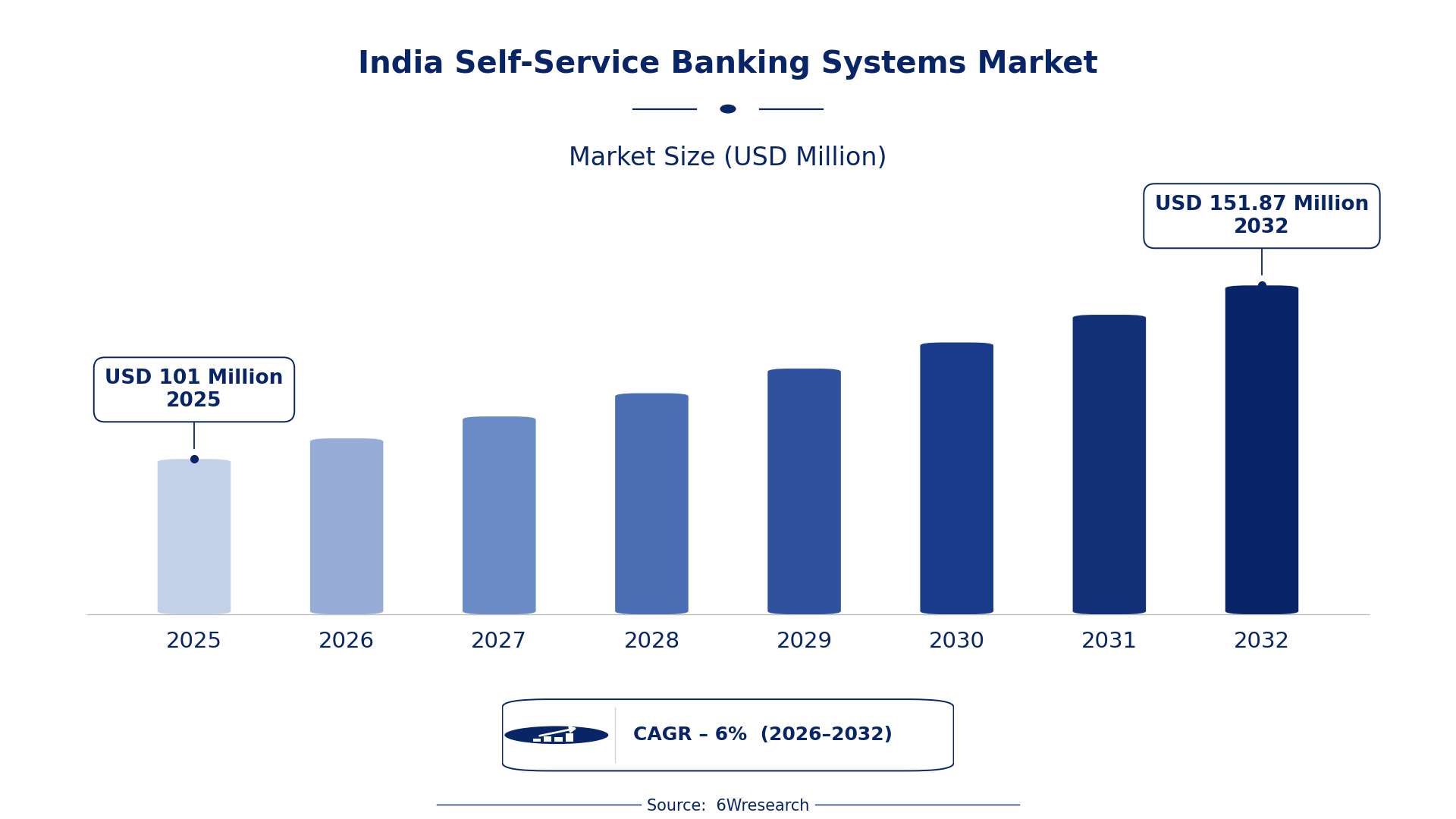
According to 6Wresearch internal database and industry insights, the India Self-Service Banking Systems Market was valued at USD 101.0 million in 2025 and is projected to reach USD 151.87 million by 2032, growing at a CAGR of approximately 6% during 2026–2032.
India Self-Service Banking Systems Market Highlights
| Report Metric | Details |
| Report Name | India Self-Service Banking Systems Market |
| Market Size 2025 | USD 101.0 million |
| Market Size 2032 | USD 151.87 million |
| Absolute Growth 2025–2032 | USD 50.87 million |
| CAGR 2026–2032 | 6% |
| Peak Annual Growth | 8.2% in 2029 |
| Forecast Period | 2026–2032 |
| Historical Data | 2022–2025 |
| Base Year | 2025 |
| Leading Machine Type, 2025 | ATM Machines (41% share) |
| Leading Services Offered, 2025 | Cash/Balance Inquiry (48% share) |
| Leading Access Mode, 2025 | Card-Based (39% share) |
| Leading End User, 2025 | General Public (48% share) |
| Fastest-Growing Machine Type | Kiosk Banking (8.7% CAGR) |
| Fastest-Growing Services Offered | Loan (7.7% CAGR) |
| Fastest-Growing Access Mode | Touchscreen/QR (7.3% CAGR) |
| Fastest-Growing End User | Tech-Enabled Banks (8.1% CAGR) |
| Growing Sector | Self-Service Banking |
| Key End Users | General Public, Rural Customers, Urban Banks, Tech-Enabled Banks |
India Self-Service Banking Systems Market Year-wise Growth Rate and Key Drivers (2022–2032)
This graph illustrates the annual growth rates of the market from 2022 to 2032, highlighting a steady upward trajectory and projected market expansion over the forecast period.
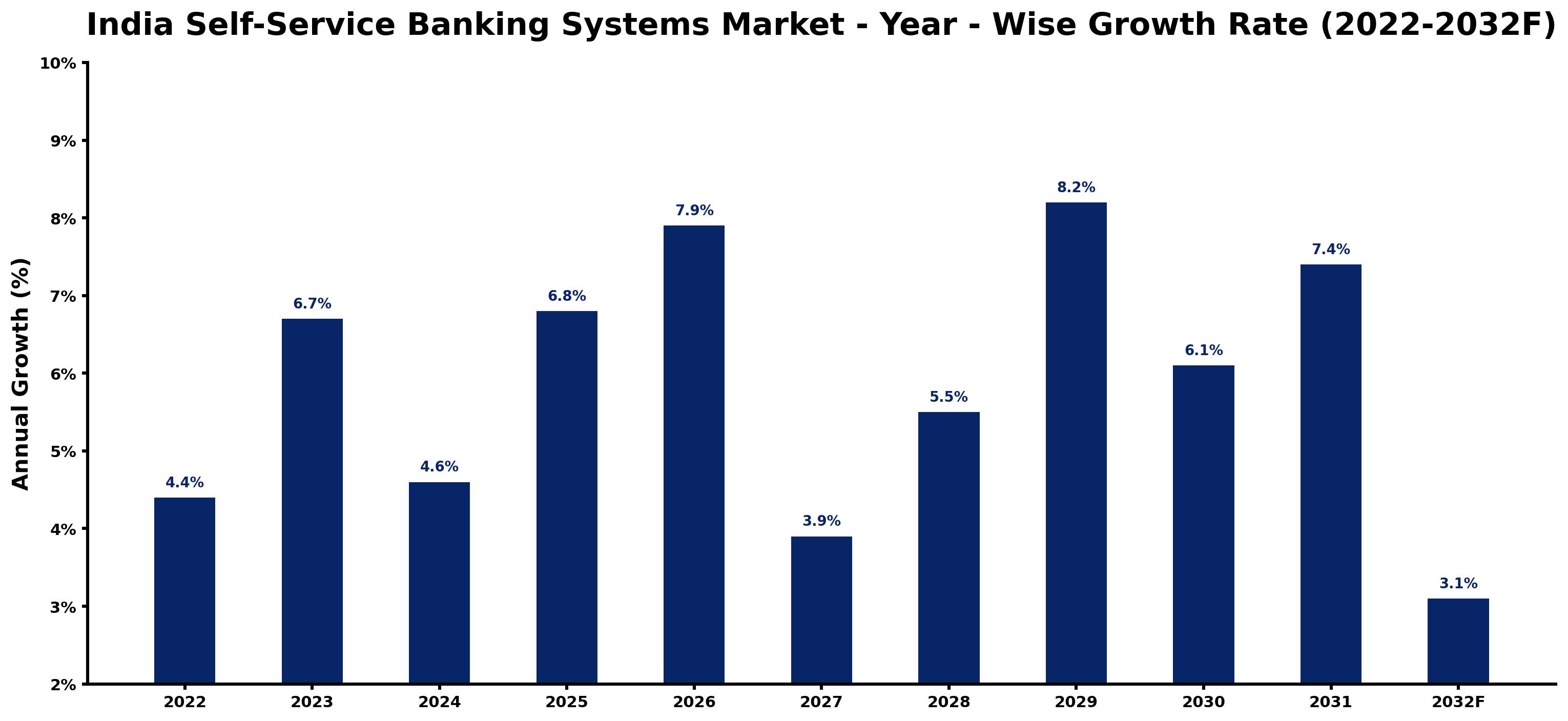
The table below sets out the estimated growth rate for each year and the main factor behind it.
| Year | Estimated Annual Growth (%) | Market Rationale |
| 2022 | 4.4 | The market showed steady growth amid increasing adoption of self-service technologies. |
| 2023 | 6.7 | Expansion of cash withdrawal services boosted market performance significantly this year. |
| 2024 | 4.6 | Growth slowed as the market adjusted to increased competition among service providers. |
| 2025 | 6.8 | A surge in cash/balance inquiry services led to a peak in market growth. |
| 2026 | 7.9 | Investment in mobile self-service terminals accelerated demand for banking solutions. |
| 2027 | 3.9 | Market growth slowed due to saturation in urban areas and limited rural expansion. |
| 2028 | 5.5 | Increased deployment of kiosks in rural areas revitalised market growth. |
| 2029 | 8.2 | The introduction of Interactive Teller Machines spurred a significant rise in demand. |
| 2030 | 6.1 | Growth slowed as market maturity began to set in, particularly in urban regions. |
| 2031 | 7.4 | A renewed focus on technology integration led to a resurgence in market activity. |
| 2032 | 3.1 | Market growth is expected to slow as competition intensifies and innovation stabilises. |
Note: Market size estimations and growth projections presented in this report are based on 6Wresearch's proprietary forecasting methodology, utilizing the latest available industry data, government publications, and primary research inputs.
India Self-Service Banking Systems Market Synopsis
Self-Service Banking Systems in India encompass technology-driven solutions that allow customers to conduct banking transactions without direct human interaction. These systems include ATMs, kiosks, and mobile terminals, facilitating services like cash withdrawal and balance inquiries. The India Self-Service Banking Systems Market is expanding due to increasing demand from both urban and rural populations. The Digital India initiative and the Pradhan Mantri Jan Dhan Yojana are key factors driving this growth, aiming to enhance banking access for millions. As traditional banking methods decline, self-service solutions are becoming essential for modern banking needs.
Market Dynamics Impact Analysis (2026–2032)
| Factor | Type | Impact | Primary Segment Affected |
| Growing urbanisation and increased financial inclusion drive demand for self-service banking solutions. | Driver | High | ATM Machines |
| Expansion of banking services in rural areas creates opportunities for self-service kiosks. | Opportunity | High | Kiosk Banking |
| Limited access to technology in remote regions restrains market growth. | Restraint | Medium | Mobile Self-Service Terminals |
| The rise of fintech startups presents new opportunities for self-service banking technologies. | Opportunity | High | Interactive Teller Machines |
| High operational costs for maintaining self-service systems can limit profitability. | Restraint | Medium | ATM Machines |
| Regulatory compliance can delay the deployment of new self-service technologies. | Challenge | High | Kiosk Banking |
| Competition from traditional banking methods poses a challenge to market expansion. | Challenge | Medium | Mobile Self-Service Terminals |
| Increased demand for biometric systems enhances security in banking transactions. | Driver | High | Biometric |
Evaluation of Drivers in India Self-Service Banking Systems Market (2026–2032)
Below mentioned are some major drivers and their influence on market dynamics.
| Drivers | Primary Segment Affected | Why It Matters (Evidence) |
| The Digital India initiative promotes technology adoption in banking, driving demand. | General Public | This programme encourages the use of self-service banking technologies, increasing user engagement. |
| The Pradhan Mantri Jan Dhan Yojana aims to provide banking access to millions, driving demand. | General Public | The programme targets 500 million citizens by 2025, increasing the need for self-service banking solutions. |
| Investment in mobile self-service terminals is accelerating demand for banking solutions. | Tech-Enabled Banks | Fintech startups are increasingly adopting these technologies to enhance customer experiences. |
| Increased deployment of kiosks in rural areas is revitalising market growth. | Rural Customers | With over 5,000 locations established, access to banking services is improving. |
| The introduction of Interactive Teller Machines is spurring demand for enhanced customer service. | Urban Banks | This technology allows real-time interaction with bank tellers, improving user satisfaction. |
Market growth for Self-Service Banking Systems in India is underpinned by investments in technology infrastructure, increasing demand for cash withdrawal services, and the push for digital banking solutions. In 2023, India had over 200,000 ATMs installed nationwide, facilitating over 1.5 billion transactions annually. The expansion of kiosk banking services to over 5,000 locations in rural areas increases user access. Additionally, the Pradhan Mantri Jan Dhan Yojana aims to provide banking access to 500 million citizens by 2025, further driving demand for self-service solutions.
Evaluation of Restraints in India Self-Service Banking Systems Market
The following restraints limit how fast demand can grow.
| Market Restraint | Primary Segment Affected | Why It Matters (Evidence) |
| Fierce competition among providers pressures pricing. | ATM Machines | This rivalry can limit suppliers' ability to invest in necessary technology upgrades. |
| Regulatory hurdles slow down system introductions. | ATM Machines | Compliance with the Banking Regulation Act can delay service improvements for banks. |
| High operational costs burden smaller banks. | ATM Machines | Maintaining over 200,000 ATMs incurs significant expenses, impacting financial viability. |
| Limited access to services in rural areas. | Kiosk Banking | With only 5,000 kiosks available, rural customers struggle to access banking services. |
| Technological upgrades require substantial investment. | Interactive Teller Machines | The costs associated with deploying new systems can deter smaller banks from modernising. |
India Self-Service Banking Systems Market Challenges
The India Self-Service Banking Systems market encounters several practical issues, starting with fierce competition among providers. This rivalry pressures suppliers to lower prices, which can stifle necessary investments in technology upgrades. Regulatory hurdles pose another challenge, as adherence to the Banking Regulation Act can slow down the introduction of new systems for banks, delaying service improvements. High operational costs also weigh heavily; for instance, maintaining over 200,000 ATMs incurs significant expenses, impacting smaller banks' financial viability. Buyers, particularly in rural areas, often struggle with limited access to services, as only 5,000 kiosks are available, hindering their banking experience.
Trends in the India Self-Service Banking Systems Market
Four trends stand out in the India Self-Service Banking Systems Market.
- Shift from Traditional to Self-Service Banking: In 2023, the trend towards self-service banking has intensified, with over 200,000 ATMs installed across the country. This shift mirrors changing consumer preferences for convenience and efficiency in banking.
- Expansion of Kiosk Banking in Rural Areas: Kiosk banking services have grown considerably, reaching over 5,000 locations in rural India. This expansion improves banking access for underserved populations, promoting financial inclusion.
- Increase in Interactive Teller Machines Deployment: The deployment of Interactive Teller Machines in urban banks in Maharashtra is increasing. This technology facilitates real-time interaction with bank tellers, enhancing customer service.
- Growth in Mobile Self-Service Terminals Adoption: Mobile self-service terminals are being adopted more widely by fintech startups throughout India. This trend responds to the rising demand for on-the-go banking solutions.
Investment Opportunities in the India Self-Service Banking Systems Market
The following opportunities in the India Self-Service Banking Systems Market pair current demand with a clear way in.
- Rural Banking Expansion: Rural customers are increasingly targeted for banking access, with over 5,000 kiosk locations established. This presents an opportunity for banks to invest in self-service technologies to enhance access to services.
- Partnerships with Fintech Startups: Collaboration with fintech startups is vital for banks looking to improve self-service capabilities. This is particularly relevant now as mobile self-service terminals gain traction among tech-savvy users.
- Investment in Biometric Security Solutions: With the Reserve Bank of India promoting biometric authentication, there is a significant investment opportunity in security technology. This can build trust in self-service banking and attract more users.
- Integration of Touchscreen/QR Access Modes: The rise of touchscreen and QR-based access modes presents a gap in the market. Banks can invest in these technologies to attract tech-savvy customers seeking convenience.
Government Initiatives in the India Self-Service Banking Systems Market
The 'Digital Banking Policy' launched by the Reserve Bank of India in 2021 improves digital banking infrastructure and security measures, directly influencing self-service banking systems. This policy requires banks to enhance their digital offerings, ensuring better access and security for users. Additionally, the 'Digital India' programme initiated by the Ministry of Electronics and Information Technology in 2020 promotes digital literacy and access, further supporting the growth of self-service banking. By prioritising technology integration, these measures aim to increase user engagement and streamline banking processes across the nation.
The Reserve Bank of India oversees the approval of guidelines related to ATM installation, ensuring they comply with accessibility and security standards. In 2023, updated guidelines were issued to improve the user experience and safety of self-service banking systems. The Ministry of Finance also plays a key role, funding initiatives that encourage rural banks to adopt self-service technologies. These efforts aim to bridge the banking gap in underserved areas, facilitating greater financial inclusion for rural populations.
Future Insight of the India Self-Service Banking Systems Market
The India Self-Service Banking Systems market is poised for transformation by 2032, driven by several key factors. The Digital India initiative will significantly enhance technology adoption in finance, improving service delivery. The deployment of Interactive Teller Machines in urban banks will modernise customer interactions, while the Ministry of Finance's incentives for rural banks will promote broader access to self-service solutions. By 2025, the Pradhan Mantri Jan Dhan Yojana aims to extend banking access to an additional 500 million citizens, further expanding the market's reach.
Market Segmentation Analysis
The report offers a comprehensive study of the following market segments and their leading categories in the market.
By Machine Type – ATM Machines Dominated, Kiosk Banking Expected to Grow Fastest
According to Shubham Padhi, Research Analyst at 6Wresearch, ATM Machines accounted for a 41% market share by machine type in 2025. ATM Machines hold the largest market share due to their extensive presence with over 200,000 units installed across India, serving a diverse user base. Their primary functions, such as cash withdrawals and balance inquiries, make them indispensable in both urban and rural settings. Kiosk Banking is set to record the highest CAGR in this split, 8.7% over 2026–2032. Kiosk Banking is rapidly expanding, with services now available in over 5,000 rural locations, making banking more accessible to underserved populations. This growth is expected to continue as rural banks increasingly adopt self-service technologies to cater to local needs. Suppliers should prioritise the development of kiosk solutions to effectively tap into the rising demand in rural markets.
By Services Offered – Cash/Balance Inquiry Dominated, Loan Expected to Grow Fastest
Cash/Balance Inquiry took a 48% share of services offered in 2025, more than any other category. Cash/Balance Inquiry services hold the largest share as they are vital for customers checking their account status, leading to frequent engagement with self-service banking systems. This essential function ensures consistent demand across diverse demographics, reinforcing its dominant position in the market. Over 2026–2032, Loan is expected to post the fastest growth, at a CAGR of 7.7%. Loan services are experiencing rapid growth as an increasing number of customers opt to apply for loans through self-service channels, reflecting a shift towards digital banking solutions. As banks improve and simplify loan application processes, this segment is set for substantial growth. Providers should prioritise enhancing loan application features to cater to evolving consumer preferences.
By Access Mode – Card-Based Dominated, Touchscreen/QR Expected to Grow Fastest
In 2025, Card-Based led the access mode split with a 39% share. Card-Based access remains the most common method for transactions, as it is widely accepted and familiar to users. This established method ensures convenience for customers engaging with self-service banking systems, solidifying its leading market share. Touchscreen/QR is projected to grow fastest, at a CAGR of 7.3% during 2026–2032. Touchscreen and QR code access modes are gaining traction, especially among tech-savvy users, due to their intuitive and engaging interfaces. This trend indicates a growing preference for modern interaction methods in banking, suggesting further growth in this area. Vendors should invest in improving touchscreen and QR capabilities to meet evolving user expectations.
By End User – General Public Dominated, Tech-Enabled Banks Expected to Grow Fastest
General Public held a 48% share of the India Self-Service Banking Systems Market by end user in 2025. The General Public represents the largest user group for self-service banking, utilising these systems for daily transactions and banking needs. Their extensive adoption significantly contributes to the overall market share in this segment, underscoring the demand for accessible banking solutions. The quickest growth will come from Tech-Enabled Banks, forecast to expand at a CAGR of 8.1% between 2026 and 2032. Tech-Enabled Banks are quickly adopting self-service solutions to improve customer experiences and streamline operations, indicating a shift towards digital-first banking. This trend suggests that these banks will increasingly capture market share as technology progresses. Suppliers should customise their offerings to address the specific requirements of tech-enabled banks to seize this growth opportunity.
Key Attractiveness of the Report
- 10 Years of Market Numbers
- Historical Data Starting from 2022 to 2025
- Base Year 2025
- Forecast Data until 2032
- Key Performance Indicators Impacting the Market
- Major Upcoming Developments and Projects
Key Highlights of the Report:
- India Self-Service Banking Systems Market Outlook
- Market Size of India Self-Service Banking Systems Market, 2025
- Forecast of India Self-Service Banking Systems Market, 2032
- Historical Data and Forecast of India Self-Service Banking Systems Revenues & Volume for the Period 2022 - 2032F
- India Self-Service Banking Systems Market Trend Evolution
- India Self-Service Banking Systems Market Drivers and Challenges
- India Self-Service Banking Systems Price Trends
- India Self-Service Banking Systems Porter's Five Forces
- India Self-Service Banking Systems Industry Life Cycle
- Historical Data and Forecast of India Self-Service Banking Systems Market Revenues & Volume By Machine Type for the Period 2022 - 2032F
- Historical Data and Forecast of India Self-Service Banking Systems Market Revenues & Volume By ATM Machines for the Period 2022 - 2032F
- Historical Data and Forecast of India Self-Service Banking Systems Market Revenues & Volume By Kiosk Banking for the Period 2022 - 2032F
- Historical Data and Forecast of India Self-Service Banking Systems Market Revenues & Volume By Interactive Teller Machines for the Period 2022 - 2032F
- Historical Data and Forecast of India Self-Service Banking Systems Market Revenues & Volume By Mobile Self-Service Terminals for the Period 2022 - 2032F
- Historical Data and Forecast of India Self-Service Banking Systems Market Revenues & Volume By Services Offered for the Period 2022 - 2032F
- Historical Data and Forecast of India Self-Service Banking Systems Market Revenues & Volume By Cash/Balance Inquiry for the Period 2022 - 2032F
- Historical Data and Forecast of India Self-Service Banking Systems Market Revenues & Volume By Loan, Insurance for the Period 2022 - 2032F
- Historical Data and Forecast of India Self-Service Banking Systems Market Revenues & Volume By Remote Teller for the Period 2022 - 2032F
- Historical Data and Forecast of India Self-Service Banking Systems Market Revenues & Volume By Biometric for the Period 2022 - 2032F
- Historical Data and Forecast of India Self-Service Banking Systems Market Revenues & Volume By Access Mode for the Period 2022 - 2032F
- Historical Data and Forecast of India Self-Service Banking Systems Market Revenues & Volume By Card-Based for the Period 2022 - 2032F
- Historical Data and Forecast of India Self-Service Banking Systems Market Revenues & Volume By Touchscreen/QR for the Period 2022 - 2032F
- Historical Data and Forecast of India Self-Service Banking Systems Market Revenues & Volume By Video + Voice for the Period 2022 - 2032F
- Historical Data and Forecast of India Self-Service Banking Systems Market Revenues & Volume By Fingerprint/Face for the Period 2022 - 2032F
- Historical Data and Forecast of India Self-Service Banking Systems Market Revenues & Volume By End User for the Period 2022 - 2032F
- Historical Data and Forecast of India Self-Service Banking Systems Market Revenues & Volume By General Public for the Period 2022 - 2032F
- Historical Data and Forecast of India Self-Service Banking Systems Market Revenues & Volume By Rural Customers for the Period 2022 - 2032F
- Historical Data and Forecast of India Self-Service Banking Systems Market Revenues & Volume By Urban Banks for the Period 2022 - 2032F
- Historical Data and Forecast of India Self-Service Banking Systems Market Revenues & Volume By Tech-Enabled Banks for the Period 2022 - 2032F
- India Self-Service Banking Systems Import Export Trade Statistics
- Market Opportunity Assessment By Machine Type
- Market Opportunity Assessment By Services Offered
- Market Opportunity Assessment By Access Mode
- Market Opportunity Assessment By End User
- India Self-Service Banking Systems Top Companies Market Share
- India Self-Service Banking Systems Competitive Benchmarking By Technical and Operational Parameters
- India Self-Service Banking Systems Company Profiles
- India Self-Service Banking Systems Key Strategic Recommendations
Market Covered
The report offers an extensive study of the following market segments.
By Machine Type
- ATM Machines
- Kiosk Banking
- Interactive Teller Machines
- Mobile Self-Service Terminals
By Services Offered
- Cash/Balance Inquiry
- Loan
- Insurance
- Remote Teller
- Biometric
By Access Mode
- Card-Based
- Touchscreen/QR
- Video + Voice
- Fingerprint/Face
By End User
- General Public
- Rural Customers
- Urban Banks
- Tech-Enabled Banks































