China Self-Service Banking Systems Market Size & Growth Rate
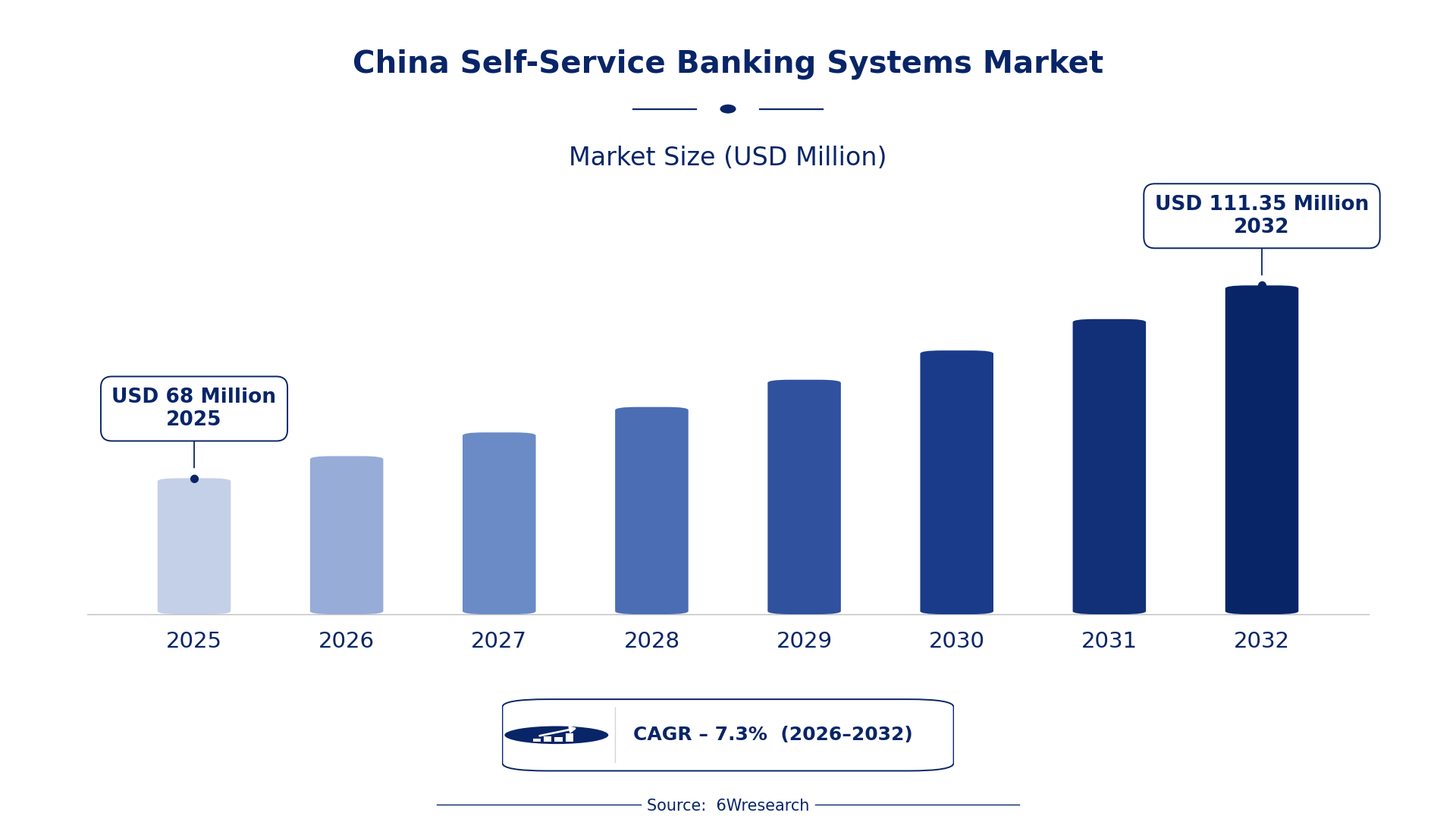
According to 6Wresearch internal database and industry insights, the China Self-Service Banking Systems Market was valued at USD 68.0 million in 2025 and is projected to reach USD 111.35 million by 2032, growing at a CAGR of approximately 7.3% during 2026–2032.
China Self-Service Banking Systems Market Highlights
| Report Metric | Details |
| Report Name | China Self-Service Banking Systems Market |
| Market Size 2025 | USD 68.0 million |
| Market Size 2032 | USD 111.35 million |
| Absolute Growth 2025–2032 | USD 43.35 million |
| CAGR 2026–2032 | 7.3% |
| Peak Annual Growth | 9.5% in 2031 |
| Forecast Period | 2026–2032 |
| Historical Data | 2022–2025 |
| Base Year | 2025 |
| Leading Machine Type, 2025 | ATM Machines (39% share) |
| Leading Services Offered, 2025 | Cash/Balance Inquiry (42% share) |
| Leading Access Mode, 2025 | Card-Based (45% share) |
| Leading End User, 2025 | General Public (47% share) |
| Fastest-Growing Machine Type | Kiosk Banking (9.4% CAGR) |
| Fastest-Growing Services Offered | Remote Teller (9.5% CAGR) |
| Fastest-Growing Access Mode | Touchscreen/QR (9.5% CAGR) |
| Fastest-Growing End User | Tech-Enabled Banks (9.9% CAGR) |
| Growing Sector | Self-Service Banking |
| Key End Users | Urban Banks, Rural Customers, General Public, Tech-Enabled Banks |
China Self-Service Banking Systems Market Year-wise Growth Rate and Key Drivers (2022–2032)
This graph illustrates the annual growth rates of the market from 2022 to 2032, highlighting a steady upward trajectory and projected market expansion over the forecast period.
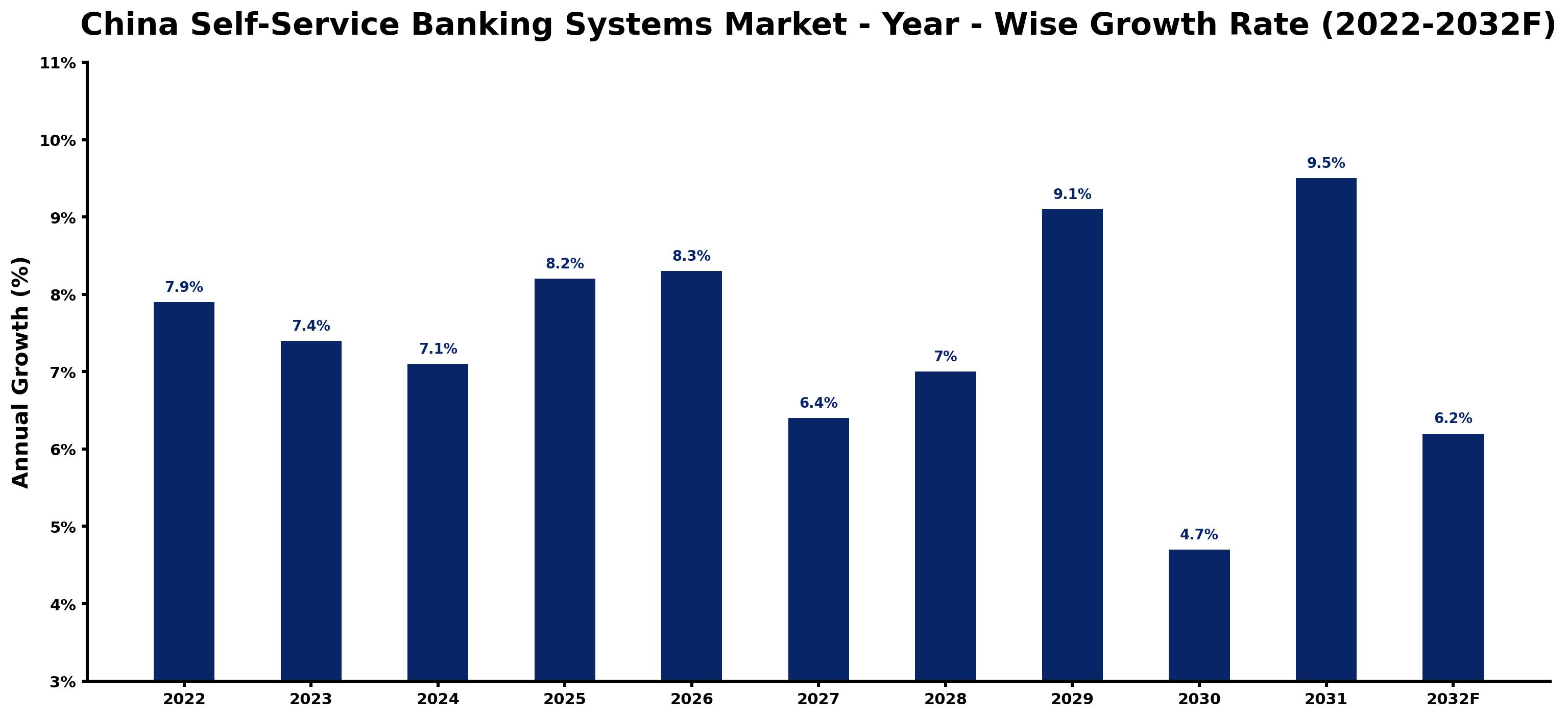
Below, each year's estimated growth is shown next to the factor that most influenced it.
| Year | Estimated Annual Growth (%) | Market Rationale |
| 2022 | 7.9 | The market experienced solid growth due to increased adoption of self-service technologies in urban banks. |
| 2023 | 7.4 | Growth slowed as urban banks focused on upgrading existing systems rather than expanding new installations. |
| 2024 | 7.1 | Demand continued to grow, albeit at a slower pace, as users became accustomed to self-service options. |
| 2025 | 8.2 | An uptick in installations was driven by urban banks enhancing their self-service offerings to meet customer expectations. |
| 2026 | 8.3 | Investment in mobile self-service terminals is expected to rise, catering to the needs of rural customers. |
| 2027 | 6.4 | Growth is projected to slow as the market adjusts to the saturation of self-service options in urban areas. |
| 2028 | 7.0 | A renewed interest in self-service solutions is expected, driven by improvements in technology and user experience. |
| 2029 | 9.1 | The market is projected to rebound with significant growth as urban customers increasingly prefer self-service banking options. |
| 2030 | 4.7 | Growth is expected to slow as the market stabilises, with banks focusing on improving service quality rather than expanding infrastructure. |
| 2031 | 9.5 | A surge in demand is projected due to the introduction of advanced self-service technologies and user-friendly interfaces. |
| 2032 | 6.2 | Growth is expected to slow as the market matures, with a focus on maintaining existing systems and improving efficiency. |
Note: Market size estimations and growth projections presented in this report are based on 6Wresearch's proprietary forecasting methodology, utilizing the latest available industry data, government publications, and primary research inputs.
China Self-Service Banking Systems Market Synopsis
The China Self-Service Banking Systems Market includes advanced technological solutions that enable banking transactions without human interaction. These systems, such as ATMs, kiosks, and interactive teller machines, serve both urban and rural populations. The market is growing due to rising demand for tech-enabled banking solutions, with over 1 million ATMs and 500,000 kiosks installed by 2023. The 14th Five-Year Plan supports the growth of self-service banking technologies, promoting financial inclusion and enhancing customer convenience.
Market Dynamics Impact Analysis (2026–2032)
| Factor | Type | Impact | Primary Segment Affected |
| Increased urbanisation and tech adoption drive demand for self-service banking solutions. | Driver | High | ATM Machines |
| Growing preference for contactless transactions boosts demand for self-service kiosks. | Driver | High | Kiosk Banking |
| Urban banks are investing in self-service technologies to enhance customer experience. | Opportunity | High | Interactive Teller Machines |
| Rural customers require improved access to banking services, creating demand for mobile terminals. | Opportunity | Medium | Mobile Self-Service Terminals |
| High initial investment costs can deter smaller banks from adopting new technologies. | Restraint | High | Interactive Teller Machines |
| Limited awareness among rural populations restricts the adoption of self-service banking. | Restraint | Medium | Kiosk Banking |
| Buyers face challenges in integrating new technologies with existing banking systems. | Challenge | High | Mobile Self-Service Terminals |
| Suppliers struggle with regulatory compliance, affecting the speed of product deployment. | Challenge | Medium | ATM Machines |
Evaluation of Drivers in China Self-Service Banking Systems Market (2026–2032)
The factors lifting demand, and the evidence behind each, are summarised below.
| Drivers | Primary Segment Affected | Why It Matters (Evidence) |
| The installation of over 1 million ATMs increases access to banking services for urban customers. | ATM Machines | This widespread availability encourages more users to opt for self-service transactions. |
| The rapid deployment of kiosks in urban areas meets the growing demand for diverse banking services. | Kiosk Banking | Urban populations increasingly seek convenient banking options, leading to higher usage rates. |
| Investment in Interactive Teller Machines improves customer service and operational efficiency in banks. | Interactive Teller Machines | Better service capabilities attract more customers to use self-service banking. |
| Mobile self-service terminals are being adopted to reach underserved rural populations. | Mobile Self-Service Terminals | This expansion allows banks to cater to a wider customer base, increasing transaction volumes. |
| The integration of biometric authentication in 30% of new machines increases security and user trust. | ATM Machines | Higher security measures encourage users to adopt self-service banking solutions. |
Expansion of the Self-Service Banking Systems market in China is backed by growing investments in technology and increasing end-use demand. The installation of over 1 million ATMs across the country increases access to banking services, encouraging urban customers to opt for self-service transactions. The rapid deployment of kiosks in urban areas meets the rising need for diverse banking services, resulting in higher usage rates. Investment in advanced technologies improves customer service, attracting more users to self-service banking. Mobile self-service terminals are being adopted to reach underserved rural populations, allowing banks to cater to a wider customer base and increase transaction volumes.
Evaluation of Restraints in China Self-Service Banking Systems Market
The table below lists the restraints and the evidence behind each.
| Market Restraint | Primary Segment Affected | Why It Matters (Evidence) |
| High initial investment costs deter smaller banks from adopting self-service technologies. | Interactive Teller Machines | This financial barrier limits the number of banks that can implement advanced self-service solutions. |
| Limited awareness among rural populations restricts the adoption of self-service banking solutions. | Kiosk Banking | Without proper education on these systems, potential users may not engage with available services. |
| Integration challenges with existing banking systems can slow down the deployment of new technologies. | Mobile Self-Service Terminals | These complexities can lead to delays and increased costs for banks. |
| Regulatory compliance issues create hurdles for suppliers in the self-service banking market. | ATM Machines | These challenges can affect the speed and efficiency of product deployment. |
| Security concerns may deter users from fully embracing self-service banking options. | Kiosk Banking | Potential users might fear fraud or data breaches, impacting overall adoption rates. |
China Self-Service Banking Systems Market Challenges
Strict regulations from the Banking Regulatory Commission create compliance burdens for suppliers in the China Self-Service Banking Systems market, resulting in delays in deployment timelines and higher operational costs. High integration expenses arise from advanced technologies; for example, biometric authentication, which is included in 30% of new machines, can increase costs for buyers. Supply chain disruptions occur as manufacturers face challenges in sourcing essential components for self-service kiosks, causing postponed installations for urban banks. Intense competition among suppliers drives prices down, forcing producers to compromise on quality, which can affect service reliability for users.
Trends in the China Self-Service Banking Systems Market
Buyers and suppliers in the China Self-Service Banking Systems Market are adjusting to the following trends.
- Shift to Mobile Self-Service Terminals: A shift towards mobile self-service terminals is occurring, with 70% of urban banks adopting these technologies by 2023. This transition improves banking access in remote areas, allowing for greater financial inclusion.
- Increase in Biometric Authentication: The integration of biometric authentication in 30% of new self-service machines is becoming standard practice. This trend improves security and user trust, encouraging more customers to use self-service banking options.
- Expansion of Kiosk Banking in Urban Areas: Kiosk banking is rapidly expanding in urban areas, with a total of 500,000 kiosks installed by 2023. This growth provides convenient banking services in public spaces, catering to the needs of busy urban customers.
- Growing Preference for Self-Service Options: In 2023, 60% of urban customers preferred self-service banking options over traditional methods. This trend reflects an increasing demand for convenience and efficiency in banking transactions.
Investment Opportunities in the China Self-Service Banking Systems Market
Below are the investment opportunities with the strongest case in the China Self-Service Banking Systems Market.
- Urban Banks Seeking Advanced Solutions: Urban banks are actively seeking advanced self-service banking solutions to improve customer experience. With over 1 million ATMs installed, there is a significant opportunity to supply innovative technologies.
- Rural Banking Expansion: Rural customers require improved access to banking services, creating a demand for mobile self-service terminals. Investing in these technologies can help bridge the banking gap in underserved areas.
- Growth in Kiosk Banking: The increasing number of self-service kiosks presents an opportunity for suppliers to invest in this segment. Urban areas are rapidly adopting kiosks, providing a lucrative market for innovative solutions.
- Focus on Biometric Solutions: With 30% of new machines incorporating biometric authentication, there is a pressing need for suppliers to develop secure solutions. This trend aligns with the increasing emphasis on security in banking.
Government Initiatives in the China Self-Service Banking Systems Market
The 14th Five-Year Plan for Economic and Social Development, issued by the National Development and Reform Commission in 2021, emphasises the growth of self-service banking technologies to improve financial inclusion. This plan aims to integrate advanced banking solutions into everyday transactions, ensuring broader access for all citizens. The Financial Stability and Development Committee introduced the 'Fintech Development Plan' in 2021, focusing on enhancing self-service banking infrastructure nationwide. This initiative supports technological advancements in banking, facilitating smoother transactions and better customer satisfaction. The China Banking and Insurance Regulatory Commission updated the 'Guidelines for Self-Service Banking Operations' in 2023 to ensure security and efficiency in transactions, promoting safe and reliable banking experiences.
The Ministry of Industry and Information Technology oversees the implementation of the 'Smart Banking Development Strategy', which funds technological innovation in banking services. This strategy aims to improve the capabilities of self-service banking systems, ensuring they meet the evolving needs of consumers. The agency also approves projects that align with the goals of enhancing financial accessibility and security, further supporting the growth of self-service banking technologies.
Future Insight of the China Self-Service Banking Systems Market
By 2032, buyers and suppliers in the China Self-Service Banking Systems market can anticipate a notable shift towards advanced technology integration, driven by the National Development and Reform Commission's initiatives. The adoption of ISO 20022 standards will streamline transaction processing, reducing average transaction times to under 30 seconds. Increased deployment of Interactive Teller Machines will improve customer service capabilities in urban banks. With 70% of urban banks offering mobile self-service terminals, the market will better meet the demands of China's growing population, currently around 1.4 billion.
Market Segmentation Analysis
The report offers a comprehensive study of the following market segments and their leading categories in the market.
By Machine Type – ATM Machines Dominated, Kiosk Banking Expected to Grow Fastest
According to Shubham Padhi, Research Analyst at 6Wresearch, in 2025, ATM Machines led the machine type split with a 39% share. ATM Machines dominate the market share as they are extensively used for essential banking tasks like cash withdrawals and balance inquiries. With over 1 million ATMs installed in China, they ensure widespread accessibility for a diverse user base. The quickest growth will come from Kiosk Banking, forecast to expand at a CAGR of 9.4% between 2026 and 2032. Kiosk Banking is experiencing rapid growth due to its ability to provide a range of banking services in public spaces, reflecting the rising demand for tech-enabled solutions. The deployment of 500,000 self-service kiosks in urban areas by 2023 underscores this shift towards more interactive banking options. This suggests that suppliers should enhance their kiosk offerings to meet the increasing consumer preference for diverse self-service banking solutions.
By Services Offered – Cash/Balance Inquiry Dominated, Remote Teller Expected to Grow Fastest
Cash/Balance Inquiry accounted for a 42% market share by services offered in 2025. Cash/Balance Inquiry holds the largest market share as it is crucial for everyday banking, enabling users to quickly access their account information. This service is fundamental to self-service banking systems, driving high engagement among consumers. Over 2026–2032, Remote Teller is expected to post the fastest growth, at a CAGR of 9.5%. Remote Teller is the fastest-growing service, significantly improving accessibility to banking services, particularly in urban areas. The convenience of remote interactions appeals to users seeking efficient and streamlined banking experiences. Suppliers should focus on developing remote teller services to address the rising consumer demand for accessible banking options.
By Access Mode – Card-Based Dominated, Touchscreen/QR Expected to Grow Fastest
Card-Based took a 45% share of access mode in 2025, more than any other category. Card-Based access methods lead the market share due to their common use for transactions, providing a familiar and secure way for users to interact with self-service systems. This method is widely accepted and trusted among the general public, ensuring consistent usage. Touchscreen/QR is projected to grow fastest, at a CAGR of 9.5% during 2026–2032. Touchscreen/QR access modes are growing rapidly as they offer user-friendly interactions that appeal to tech-savvy consumers. The increasing integration of these technologies is reshaping how users engage with banking services. Vendors should invest in touchscreen and QR technologies to cater to the evolving preferences of users in self-service banking.
By End User – General Public Dominated, Tech-Enabled Banks Expected to Grow Fastest
General Public held a 47% share of the China Self-Service Banking Systems Market by end user in 2025. The General Public represents the largest market share as the primary user group for self-service systems, utilising these technologies for routine banking transactions. Their widespread adoption across various demographics ensures a consistent demand for self-service solutions. Tech-Enabled Banks are set to record the highest CAGR in this split, 9.9% over 2026–2032. Tech-Enabled Banks are the fastest-growing end-user segment, being early adopters of advanced banking solutions that enhance customer experience. Their commitment to integrating cutting-edge technologies positions them as leaders in the self-service banking market. This indicates that suppliers need to tailor their offerings to meet the specific requirements of tech-enabled banks to remain competitive in the market.
Key Attractiveness of the Report
- 10 Years of Market Numbers
- Historical Data Starting from 2022 to 2025
- Base Year 2025
- Forecast Data until 2032
- Key Performance Indicators Impacting the Market
- Major Upcoming Developments and Projects
Key Highlights of the Report:
- China Self-Service Banking Systems Market Outlook
- Market Size of China Self-Service Banking Systems Market, 2025
- Forecast of China Self-Service Banking Systems Market, 2032
- Historical Data and Forecast of China Self-Service Banking Systems Revenues & Volume for the Period 2022 - 2032F
- China Self-Service Banking Systems Market Trend Evolution
- China Self-Service Banking Systems Market Drivers and Challenges
- China Self-Service Banking Systems Price Trends
- China Self-Service Banking Systems Porter's Five Forces
- China Self-Service Banking Systems Industry Life Cycle
- Historical Data and Forecast of China Self-Service Banking Systems Market Revenues & Volume By Machine Type for the Period 2022 - 2032F
- Historical Data and Forecast of China Self-Service Banking Systems Market Revenues & Volume By ATM Machines for the Period 2022 - 2032F
- Historical Data and Forecast of China Self-Service Banking Systems Market Revenues & Volume By Kiosk Banking for the Period 2022 - 2032F
- Historical Data and Forecast of China Self-Service Banking Systems Market Revenues & Volume By Interactive Teller Machines for the Period 2022 - 2032F
- Historical Data and Forecast of China Self-Service Banking Systems Market Revenues & Volume By Mobile Self-Service Terminals for the Period 2022 - 2032F
- Historical Data and Forecast of China Self-Service Banking Systems Market Revenues & Volume By Services Offered for the Period 2022 - 2032F
- Historical Data and Forecast of China Self-Service Banking Systems Market Revenues & Volume By Cash/Balance Inquiry for the Period 2022 - 2032F
- Historical Data and Forecast of China Self-Service Banking Systems Market Revenues & Volume By Loan, Insurance for the Period 2022 - 2032F
- Historical Data and Forecast of China Self-Service Banking Systems Market Revenues & Volume By Remote Teller for the Period 2022 - 2032F
- Historical Data and Forecast of China Self-Service Banking Systems Market Revenues & Volume By Biometric for the Period 2022 - 2032F
- Historical Data and Forecast of China Self-Service Banking Systems Market Revenues & Volume By Access Mode for the Period 2022 - 2032F
- Historical Data and Forecast of China Self-Service Banking Systems Market Revenues & Volume By Card-Based for the Period 2022 - 2032F
- Historical Data and Forecast of China Self-Service Banking Systems Market Revenues & Volume By Touchscreen/QR for the Period 2022 - 2032F
- Historical Data and Forecast of China Self-Service Banking Systems Market Revenues & Volume By Video + Voice for the Period 2022 - 2032F
- Historical Data and Forecast of China Self-Service Banking Systems Market Revenues & Volume By Fingerprint/Face for the Period 2022 - 2032F
- Historical Data and Forecast of China Self-Service Banking Systems Market Revenues & Volume By End User for the Period 2022 - 2032F
- Historical Data and Forecast of China Self-Service Banking Systems Market Revenues & Volume By General Public for the Period 2022 - 2032F
- Historical Data and Forecast of China Self-Service Banking Systems Market Revenues & Volume By Rural Customers for the Period 2022 - 2032F
- Historical Data and Forecast of China Self-Service Banking Systems Market Revenues & Volume By Urban Banks for the Period 2022 - 2032F
- Historical Data and Forecast of China Self-Service Banking Systems Market Revenues & Volume By Tech-Enabled Banks for the Period 2022 - 2032F
- China Self-Service Banking Systems Import Export Trade Statistics
- Market Opportunity Assessment By Machine Type
- Market Opportunity Assessment By Services Offered
- Market Opportunity Assessment By Access Mode
- Market Opportunity Assessment By End User
- China Self-Service Banking Systems Top Companies Market Share
- China Self-Service Banking Systems Competitive Benchmarking By Technical and Operational Parameters
- China Self-Service Banking Systems Company Profiles
- China Self-Service Banking Systems Key Strategic Recommendations
Market Covered
Segments analysed in this report are listed below.
By Machine Type
- ATM Machines
- Kiosk Banking
- Interactive Teller Machines
- Mobile Self-Service Terminals
By Services Offered
- Cash/Balance Inquiry
- Loan
- Insurance
- Remote Teller
- Biometric
By Access Mode
- Card-Based
- Touchscreen/QR
- Video + Voice
- Fingerprint/Face
By End User
- General Public
- Rural Customers
- Urban Banks
- Tech-Enabled Banks































