India Self-Testing Kits Market Size & Growth Rate
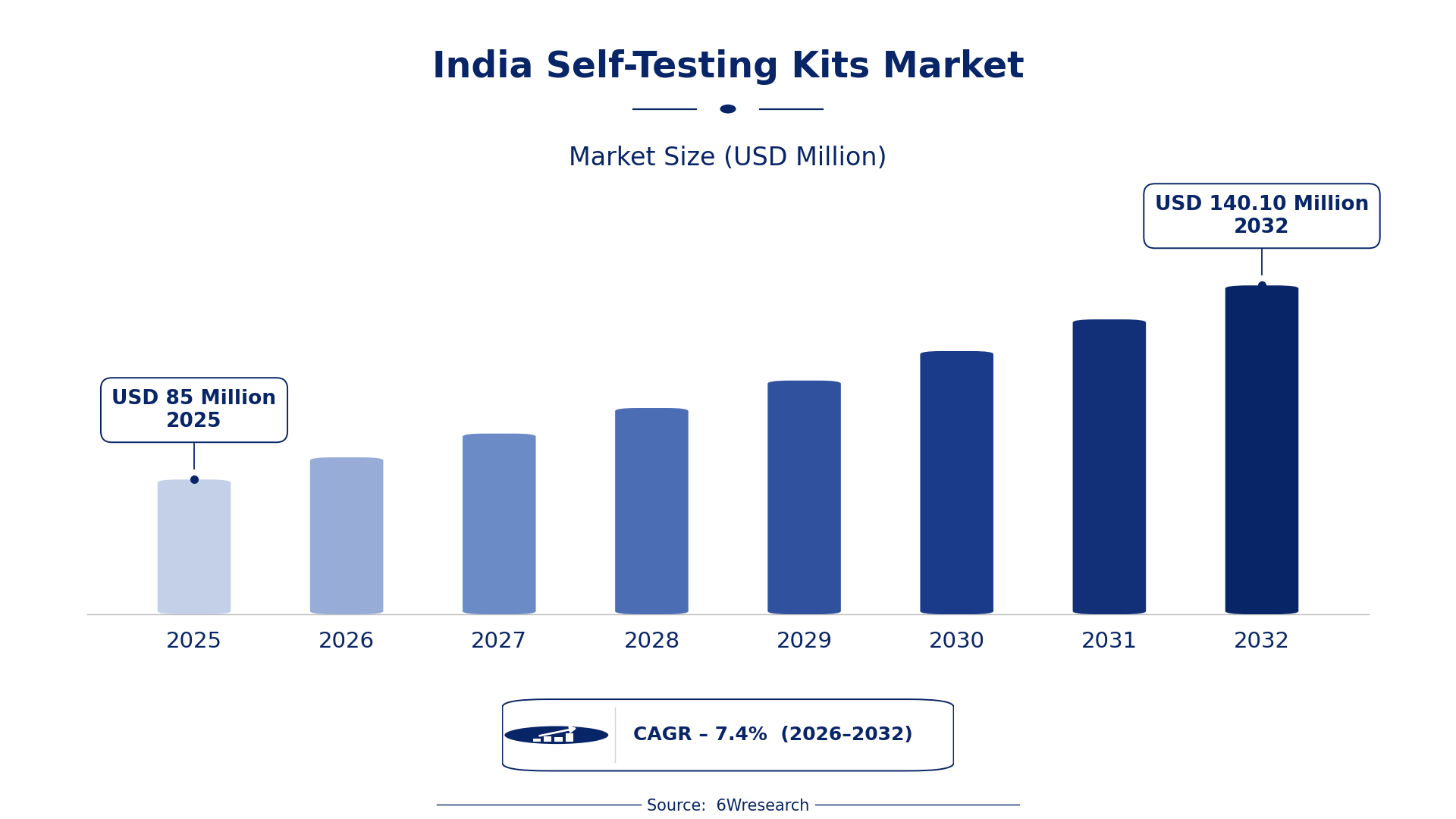
According to 6Wresearch internal database and industry insights, the India Self-Testing Kits Market was valued at USD 85.0 million in 2025 and is projected to reach USD 140.10 million by 2032, growing at a CAGR of approximately 7.4% during 2026–2032.
India Self-Testing Kits Market Highlights
| Report Metric | Details |
| Report Name | India Self-Testing Kits Market |
| Market Size 2025 | USD 85.0 million |
| Market Size 2032 | USD 140.10 million |
| Absolute Growth 2025–2032 | USD 55.10 million |
| CAGR 2026–2032 | 7.4% |
| Peak Annual Growth | 9.9% in 2027 |
| Forecast Period | 2026–2032 |
| Historical Data | 2022–2025 |
| Base Year | 2025 |
| Leading Test Type, 2025 | COVID-19 Test Kits (41% share) |
| Leading Sample Type, 2025 | Blood Drop (40% share) |
| Leading Distribution Channel, 2025 | Retail Pharmacies (45% share) |
| Leading End User, 2025 | General Consumers (36% share) |
| Fastest-Growing Test Type | Diabetes Test Kits (9.7% CAGR) |
| Fastest-Growing Distribution Channel | Online Pharmacies (9.0% CAGR) |
| Fastest-Growing End User | Diabetic Patients (9.5% CAGR) |
| Growing Sector | Health Monitoring |
| Key End Users | General Consumers, Diabetic Patients, Women of Reproductive Age, At-Risk Groups |
India Self-Testing Kits Market Year-wise Growth Rate and Key Drivers (2022–2032)
This graph illustrates the annual growth rates of the market from 2022 to 2032, highlighting a steady upward trajectory and projected market expansion over the forecast period.
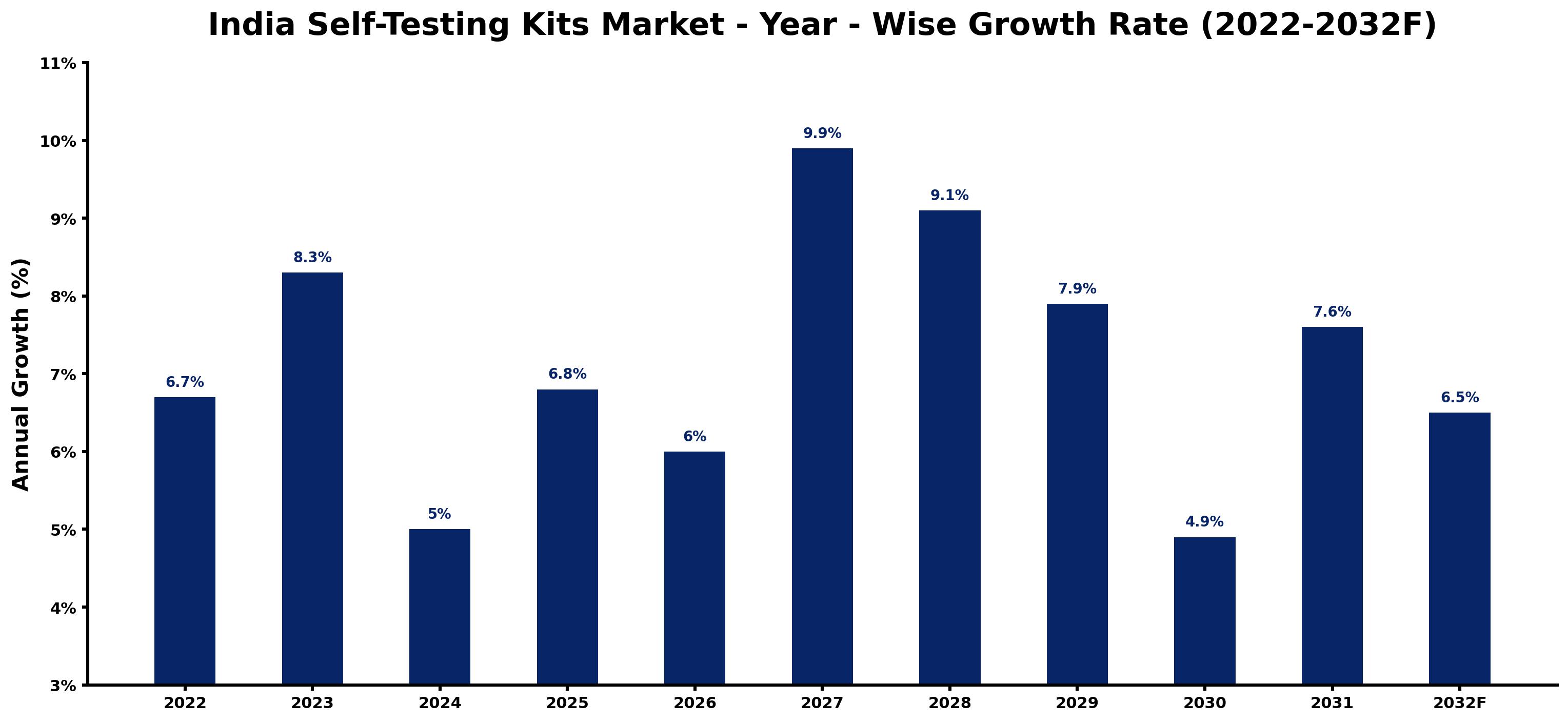
The table below sets out the estimated growth rate for each year and the main factor behind it.
| Year | Estimated Annual Growth (%) | Market Rationale |
| 2022 | 6.7 | The market experienced steady growth, driven by increasing consumer interest in health monitoring solutions. |
| 2023 | 8.3 | Demand surged as the prevalence of diabetes prompted more individuals to seek self-testing options. |
| 2024 | 5.0 | Growth slowed due to supply chain challenges affecting the availability of testing kits. |
| 2025 | 6.8 | An increase in health awareness led to a rise in purchases of self-testing kits among consumers. |
| 2026 | 6.0 | Market growth decelerated as regulatory hurdles complicated the entry of new suppliers. |
| 2027 | 9.9 | A significant spike in demand occurred, driven by the introduction of new diabetes testing kits. |
| 2028 | 9.1 | Growth moderated as competition intensified, leading to price adjustments in the market. |
| 2029 | 7.9 | The market continued to grow, supported by ongoing health education initiatives from NGOs. |
| 2030 | 4.9 | A slowdown in growth was observed as consumer confidence remained cautious amid regulatory changes. |
| 2031 | 7.6 | Increased investments in online pharmacies boosted accessibility, driving higher sales of self-testing kits. |
| 2032 | 6.5 | Growth decelerated as the market stabilised, reflecting a maturing landscape for self-testing products. |
Note: Market size estimations and growth projections presented in this report are based on 6Wresearch's proprietary forecasting methodology, utilizing the latest available industry data, government publications, and primary research inputs.
India Self-Testing Kits Market Synopsis
The India Self-Testing Kits Market includes diagnostic tools that allow individuals to test for health conditions from the comfort of their homes. These kits, such as diabetes and pregnancy tests, utilise immunoassay or molecular techniques. The market is growing, driven by a population exceeding 1.4 billion and initiatives like the Ayushman Bharat Digital Mission, which encourages self-testing for various health conditions. The rising prevalence of diabetes, which affects approximately 77 million people, further fuels the demand for diabetes self-testing kits, leading to increased investments in this area.
Market Dynamics Impact Analysis (2026–2032)
| Factor | Type | Impact | Primary Segment Affected |
| Growing prevalence of diabetes among the population. | Driver | High | Diabetes Test Kits |
| Increasing consumer preference for at-home health monitoring. | Driver | High | COVID-19 Test Kits |
| Rising demand for self-testing kits in rural areas. | Opportunity | Medium | HIV Self-Test Kits |
| Expansion of online pharmacies as a distribution channel. | Opportunity | Medium | Online Pharmacies |
| Regulatory challenges in the approval of new test kits. | Restraint | High | Pregnancy Test Kits |
| Limited awareness about the benefits of self-testing kits. | Restraint | Medium | General Consumers |
| Market competition leading to price wars among suppliers. | Challenge | High | COVID-19 Test Kits |
| Supply chain disruptions affecting availability of kits. | Challenge | Medium | COVID-19 Test Kits |
Evaluation of Drivers in India Self-Testing Kits Market (2026–2032)
The main growth drivers and the segments they affect most are set out below.
| Drivers | Primary Segment Affected | Why It Matters (Evidence) |
| Rising diabetes prevalence necessitates regular monitoring. | Diabetes Test Kits | With around 77 million diabetic patients in India, demand for diabetes self-testing kits is increasing. |
| Growing consumer preference for convenient health solutions. | HIV Self-Test Kits | The National AIDS Control Program supports distribution, increasing accessibility for at-risk populations. |
| Expansion of online pharmacies facilitating easier access. | Online Pharmacies | Online pharmacy sales of self-testing kits are projected to grow by 9.0%, improving consumer access. |
| Increased health awareness among the general population. | General Consumers | Awareness campaigns and health education initiatives are driving demand for pregnancy self-testing kits. |
| Rising demand for preventive health measures. | General Consumers | The Ayushman Bharat Digital Mission promotes self-testing kits, leading to increased consumer interest. |
The Self-Testing Kits market in India is expanding as consumer demand rises for convenient health monitoring solutions. The increasing prevalence of diabetes, impacting around 77 million individuals, drives the need for diabetes self-testing kits, resulting in more purchases among diabetic patients. The growth of online pharmacies makes it easier for consumers to access these products, encouraging purchases. Heightened health awareness is prompting more individuals to seek self-testing kits for various health conditions, resulting in a more informed consumer base.
Evaluation of Restraints in India Self-Testing Kits Market
The table below lists the restraints and the evidence behind each.
| Market Restraint | Primary Segment Affected | Why It Matters (Evidence) |
| Regulatory hurdles delay the approval of new self-testing kits. | HIV Self-Test Kits | Strict regulations can prolong the time it takes for new kits to reach the market, affecting availability. |
| Limited public knowledge about self-testing benefits hampers growth. | General Consumers | Many consumers remain unaware of the advantages of self-testing, restricting market expansion. |
| High competition leading to price wars among suppliers. | Diabetes Test Kits | Intense competition drives prices down, impacting profitability for manufacturers. |
| Supply chain disruptions can limit availability of kits. | Pregnancy Test Kits | Logistical challenges can affect the distribution and availability of essential self-testing kits. |
| Consumer hesitance to trust self-testing results. | Diabetes Test Kits | Skepticism about the accuracy of self-testing kits may deter potential buyers. |
India Self-Testing Kits Market Challenges
The India Self-Testing Kits Market still has to solve a few problems, starting with supply chain inefficiencies. Many suppliers struggle to obtain raw materials, causing delays that can extend delivery times by up to three weeks for healthcare providers. Technology adoption is also a concern, as only 60% of self-testing kits meet the accuracy guidelines set by the Indian Council of Medical Research, which undermines consumer confidence. Regulatory challenges persist, with new online sales regulations complicating market entry for smaller players, potentially limiting choices for buyers. Competition is intensifying, as over 50 new entrants have emerged in the past year, driving prices down and squeezing margins for established suppliers.
Trends in the India Self-Testing Kits Market
The trends below show where the India Self-Testing Kits Market is heading.
- Shift towards Online Purchases: General Consumers are increasingly choosing to buy self-testing kits online, motivated by convenience. The rise of e-commerce platforms has resulted in a 9.0% growth in online pharmacy sales of these kits.
- Increased Focus on Preventive Health: The Ayushman Bharat Digital Mission, launched in 2020, promotes preventive healthcare, including self-testing kits. This initiative has led to a notable rise in awareness and usage among consumers.
- Expansion of Health Education Initiatives: Health education campaigns are prioritising awareness of self-testing kits, particularly in rural areas. This focus has resulted in a significant increase in kit distribution through NGOs and community health workers.
- Regulatory Changes Improving Market Access: In 2023, new regulations for online sales of self-testing kits were approved, streamlining the process. This change is expected to greatly enhance market accessibility for consumers.
Investment Opportunities in the India Self-Testing Kits Market
Investors looking at the India Self-Testing Kits Market should consider the following areas.
- Partnerships with Local NGOs: Collaborating with local NGOs can improve distribution of self-testing kits in rural areas, addressing a significant gap. With a population exceeding 1.4 billion, this presents a substantial market opportunity.
- Investment in Online Distribution Channels: Investing in online pharmacies is essential as they are projected to grow by 9.0%. This channel is becoming increasingly popular among consumers seeking convenience.
- Health Awareness Initiatives: Now is the time to invest in health education initiatives to raise awareness about self-testing kits. Increased education can drive demand, particularly among at-risk groups.
- Expansion into Rural Markets: With a significant gap in access to self-testing kits in rural areas, targeting this demographic can yield high returns. The Pradhan Mantri Jan Arogya Yojana supports health initiatives in these regions.
Government Initiatives in the India Self-Testing Kits Market
The National Health Policy 2017 emphasises preventive healthcare, promoting self-testing kits as essential for health management. This policy encourages the adoption of self-testing kits among consumers and healthcare providers. Additionally, the Ayushman Bharat Digital Mission, launched in 2020, improves digital health services, including the promotion of self-testing kits. This initiative aims to increase accessibility and awareness of self-testing options across the country. The National Program for Prevention and Control of Cancer, Diabetes, Cardiovascular Diseases and Stroke, approved in 2021, includes self-testing kits for early detection, funded to improve health outcomes.
The Ministry of Health and Family Welfare oversees the implementation of various health initiatives, including the National Program for Prevention and Control of Cancer, Diabetes, Cardiovascular Diseases and Stroke. This program includes self-testing kits for early detection, funded to improve health outcomes. Furthermore, the National AIDS Control Program supports the distribution of HIV self-test kits to at-risk groups, ensuring access to essential testing services. In 2022, the Pradhan Mantri Swasthya Suraksha Yojana was updated to improve access to health services, including self-testing kits for rural populations.
Future Insight of the India Self-Testing Kits Market
The India Self-Testing Kits Market will experience substantial changes by 2032, primarily due to enhanced government initiatives focused on health improvement. The Ayushman Bharat Digital Mission will broaden access to self-testing kits, making them more available to consumers. Technological advancements in diagnostic accuracy are anticipated to improve consumer trust in these products by 30%. The adoption of ISO 13485 standards will elevate the quality of self-testing kits, benefiting both buyers and suppliers by reducing product recalls and improving market credibility.
Market Segmentation Analysis
The analysis below covers each segmentation, its leading category in 2025 and its fastest-growing category through 2032.
By Test Type – COVID-19 Test Kits Dominated, Diabetes Test Kits Expected to Grow Fastest
According to Shubham Padhi, Research Analyst at 6Wresearch, COVID-19 Test Kits accounted for a 41% market share by test type in 2025. COVID-19 test kits dominate the market due to their critical role in early detection of infections, especially during the pandemic. Their widespread use has led to a substantial installed base among consumers and healthcare facilities across India. Diabetes Test Kits are projected to grow fastest, at a CAGR of 9.7% during 2026–2032. Diabetes test kits are experiencing rapid growth as the prevalence of diabetes in India reaches approximately 77 million individuals. This rising health concern drives demand for convenient monitoring solutions, ensuring that diabetes test kits will continue to gain market share. Suppliers should focus on expanding their diabetes test kit offerings to capture the growing consumer base.
By Sample Type – Blood Drop Dominated and Is Expected to Record the Fastest Growth
Blood Drop took a 40% share of sample type in 2025, more than any other category. Blood drop samples dominate the self-testing kit market due to their simplicity and effectiveness, particularly in glucose monitoring. This method is widely accepted among users, ensuring a strong market share driven by the high prevalence of diabetes in India. The same category is also set to grow fastest, at a CAGR of 10.1% during 2026–2032. As the leading sample type, blood drop kits are experiencing rapid growth due to their critical role in diabetes management. Their proven accuracy and user-friendliness will likely reinforce their market position and stimulate further expansion. Suppliers should focus on blood drop sample kits to meet the rising demand from health-conscious consumers.
By Distribution Channel – Retail Pharmacies Dominated, Online Pharmacies Expected to Grow Fastest
With a 45% revenue share in 2025, Retail Pharmacies was the largest distribution channel category. Retail pharmacies serve as the main distribution channel for self-testing kits, offering consumers a trusted and easily accessible point of purchase. Their widespread presence across both urban and rural regions solidifies their leading market share in this sector. The quickest growth will come from Online Pharmacies, forecast to expand at a CAGR of 9.0% between 2026 and 2032. Online pharmacies are rapidly emerging as the fastest-growing distribution channel, driven by the surge in online shopping and the convenience of home delivery options. This trend indicates a shift in consumer preferences towards digital purchasing of health products. Suppliers should prioritise online distribution strategies to effectively engage with the increasing number of consumers opting for e-commerce.
By End User – General Consumers Dominated, Diabetic Patients Expected to Grow Fastest
The largest end user category in 2025 was General Consumers, with a 36% share of total revenue. General consumers represent the largest end user segment for self-testing kits, as they seek convenient solutions for monitoring their health across various conditions. This diverse group ensures a steady demand, significantly influencing the market share. Over 2026–2032, Diabetic Patients are expected to post the fastest growth, at a CAGR of 9.5%. Diabetic patients are the fastest-growing end user segment, propelled by the rising prevalence of diabetes in India. The increasing need for consistent monitoring in this demographic suggests substantial growth potential in the near future. Suppliers must tailor their products to meet the specific needs of diabetic patients, as this segment will be pivotal in driving future market developments.
Key Attractiveness of the Report
- 10 Years of Market Numbers
- Historical Data Starting from 2022 to 2025
- Base Year 2025
- Forecast Data until 2032
- Key Performance Indicators Impacting the Market
- Major Upcoming Developments and Projects
Key Highlights of the Report:
- India Self-Testing Kits Market Outlook
- Market Size of India Self-Testing Kits Market, 2025
- Forecast of India Self-Testing Kits Market, 2032
- Historical Data and Forecast of India Self-Testing Kits Revenues & Volume for the Period 2022 - 2032F
- India Self-Testing Kits Market Trend Evolution
- India Self-Testing Kits Market Drivers and Challenges
- India Self-Testing Kits Price Trends
- India Self-Testing Kits Porter's Five Forces
- India Self-Testing Kits Industry Life Cycle
- Historical Data and Forecast of India Self-Testing Kits Market Revenues & Volume By Test Type for the Period 2022 - 2032F
- Historical Data and Forecast of India Self-Testing Kits Market Revenues & Volume By COVID-19 Test Kits for the Period 2022 - 2032F
- Historical Data and Forecast of India Self-Testing Kits Market Revenues & Volume By Diabetes Test Kits for the Period 2022 - 2032F
- Historical Data and Forecast of India Self-Testing Kits Market Revenues & Volume By Pregnancy Test Kits for the Period 2022 - 2032F
- Historical Data and Forecast of India Self-Testing Kits Market Revenues & Volume By HIV Self-Test Kits for the Period 2022 - 2032F
- Historical Data and Forecast of India Self-Testing Kits Market Revenues & Volume By Sample Type for the Period 2022 - 2032F
- Historical Data and Forecast of India Self-Testing Kits Market Revenues & Volume By Nasal Swab for the Period 2022 - 2032F
- Historical Data and Forecast of India Self-Testing Kits Market Revenues & Volume By Blood Drop for the Period 2022 - 2032F
- Historical Data and Forecast of India Self-Testing Kits Market Revenues & Volume By Urine for the Period 2022 - 2032F
- Historical Data and Forecast of India Self-Testing Kits Market Revenues & Volume By Oral Swab for the Period 2022 - 2032F
- Historical Data and Forecast of India Self-Testing Kits Market Revenues & Volume By Distribution Channel for the Period 2022 - 2032F
- Historical Data and Forecast of India Self-Testing Kits Market Revenues & Volume By Online Pharmacies for the Period 2022 - 2032F
- Historical Data and Forecast of India Self-Testing Kits Market Revenues & Volume By Retail Pharmacies for the Period 2022 - 2032F
- Historical Data and Forecast of India Self-Testing Kits Market Revenues & Volume By Supermarkets for the Period 2022 - 2032F
- Historical Data and Forecast of India Self-Testing Kits Market Revenues & Volume By Clinics & NGOs for the Period 2022 - 2032F
- Historical Data and Forecast of India Self-Testing Kits Market Revenues & Volume By End User for the Period 2022 - 2032F
- Historical Data and Forecast of India Self-Testing Kits Market Revenues & Volume By General Consumers for the Period 2022 - 2032F
- Historical Data and Forecast of India Self-Testing Kits Market Revenues & Volume By Diabetic Patients for the Period 2022 - 2032F
- Historical Data and Forecast of India Self-Testing Kits Market Revenues & Volume By Women of Reproductive Age for the Period 2022 - 2032F
- Historical Data and Forecast of India Self-Testing Kits Market Revenues & Volume By At-Risk Groups for the Period 2022 - 2032F
- India Self-Testing Kits Import Export Trade Statistics
- Market Opportunity Assessment By Test Type
- Market Opportunity Assessment By Sample Type
- Market Opportunity Assessment By Distribution Channel
- Market Opportunity Assessment By End User
- India Self-Testing Kits Top Companies Market Share
- India Self-Testing Kits Competitive Benchmarking By Technical and Operational Parameters
- India Self-Testing Kits Company Profiles
- India Self-Testing Kits Key Strategic Recommendations
Market Covered
This report examines the market across the segments below.
By Test Type
- COVID-19 Test Kits
- Diabetes Test Kits
- Pregnancy Test Kits
- HIV Self-Test Kits
By Sample Type
- Nasal Swab
- Blood Drop
- Urine
- Oral Swab
By Distribution Channel
- Online Pharmacies
- Retail Pharmacies
- Supermarkets
- Clinics & NGOs
By End User
- General Consumers
- Diabetic Patients
- Women of Reproductive Age
- At-Risk Groups































