China Self-Testing Kits Market Size & Growth Rate
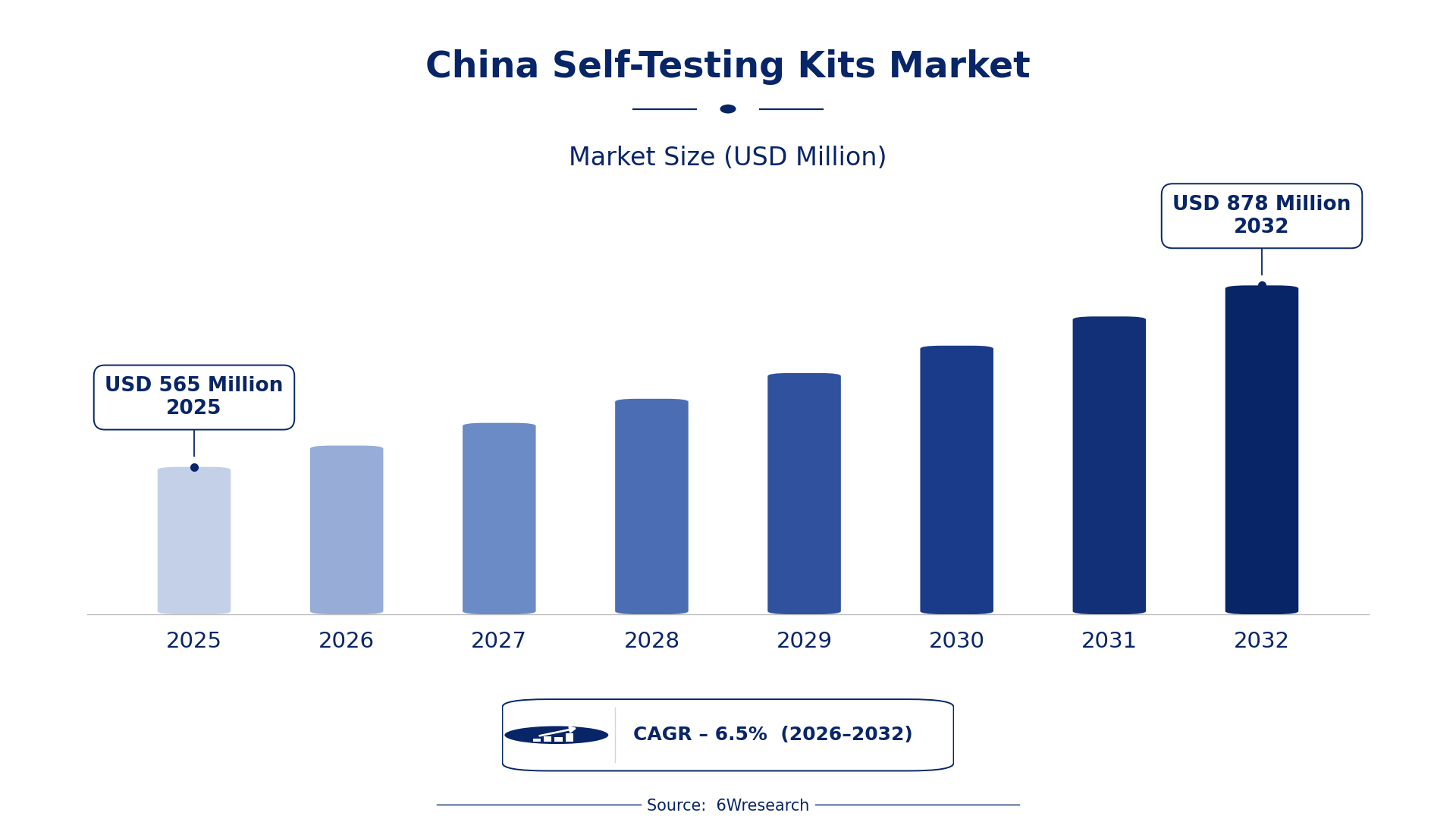
According to 6Wresearch internal database and industry insights, the China Self-Testing Kits Market was valued at USD 565.0 million in 2025 and is projected to reach USD 878 million by 2032, growing at a CAGR of approximately 6.5% during 2026–2032.
China Self-Testing Kits Market Highlights
| Report Metric | Details |
| Report Name | China Self-Testing Kits Market |
| Market Size 2025 | USD 565.0 million |
| Market Size 2032 | USD 878 million |
| Absolute Growth 2025–2032 | USD 313 million |
| CAGR 2026–2032 | 6.5% |
| Peak Annual Growth | 8.3% in 2027 |
| Forecast Period | 2026–2032 |
| Historical Data | 2022–2025 |
| Base Year | 2025 |
| Leading Test Type, 2025 | COVID-19 Test Kits (45% share) |
| Leading Sample Type, 2025 | Blood Drop (49% share) |
| Leading Distribution Channel, 2025 | Retail Pharmacies (49% share) |
| Leading End User, 2025 | General Consumers (45% share) |
| Fastest-Growing Test Type | Diabetes Test Kits (8.6% CAGR) |
| Fastest-Growing Distribution Channel | Online Pharmacies (8.8% CAGR) |
| Fastest-Growing End User | Diabetic Patients (8.3% CAGR) |
| Growing Sector | Chronic Disease Management |
| Key End Users | General Consumers, Diabetic Patients, Women of Reproductive Age, At-Risk Groups |
China Self-Testing Kits Market Year-wise Growth Rate and Key Drivers (2022–2032)
This graph illustrates the annual growth rates of the market from 2022 to 2032, highlighting a steady upward trajectory and projected market expansion over the forecast period.
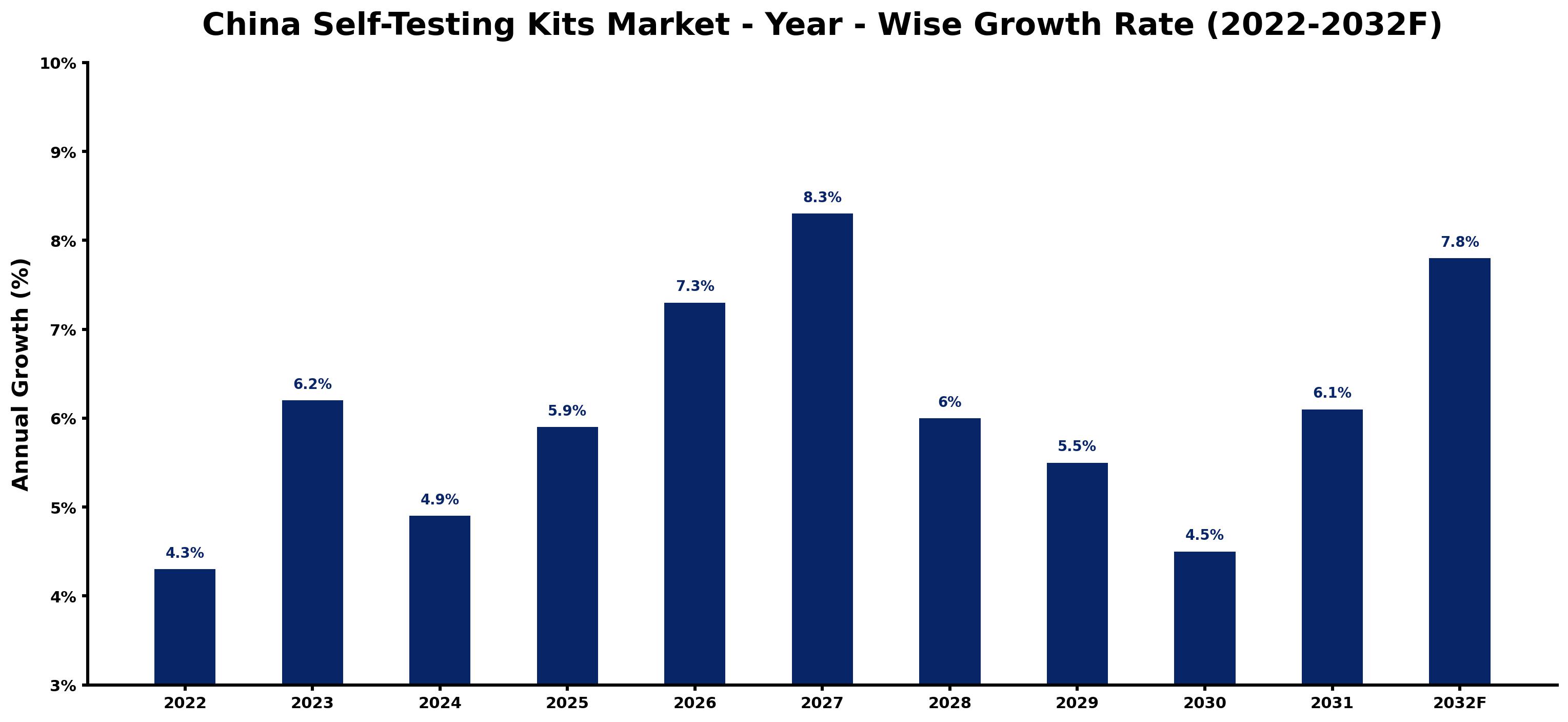
Year by year, the estimates below pair each growth rate with the development that shaped it.
| Year | Estimated Annual Growth (%) | Market Rationale |
| 2022 | 4.3 | The market experienced steady growth, reflecting increasing consumer interest in health monitoring solutions. |
| 2023 | 6.2 | Demand surged due to heightened awareness of health issues,. |
| 2024 | 4.9 | Growth slowed as consumers faced challenges with product quality and regulatory compliance issues. |
| 2025 | 5.9 | A resurgence in demand occurred as public health campaigns promoted self-testing kits more widely. |
| 2026 | 7.3 | The market continued to expand, driven by rising diabetes prevalence and increased health awareness initiatives. |
| 2027 | 8.3 | Peak growth was achieved as technological advancements improved the usability and accuracy of testing kits. |
| 2028 | 6.0 | Growth decelerated as market saturation began to affect new product introductions and consumer choices. |
| 2029 | 5.5 | A further slowdown was noted as competition intensified, leading to price pressures and quality concerns. |
| 2030 | 4.5 | Continued growth was supported by the integration of self-testing kits into national health insurance schemes. |
| 2031 | 6.1 | Demand increased again as public health initiatives reinforced the importance of self-testing for chronic diseases. |
| 2032 | 7.8 | The market is projected to grow significantly as awareness and accessibility of self-testing kits improve. |
Note: Market size estimations and growth projections presented in this report are based on 6Wresearch's proprietary forecasting methodology, utilizing the latest available industry data, government publications, and primary research inputs.
China Self-Testing Kits Market Synopsis
Self-Testing Kits in China are diagnostic tools enabling individuals to perform tests at home without professional supervision. These kits are essential for monitoring conditions like diabetes and pregnancy. The China Self-Testing Kits Market is growing due to rising health awareness and government initiatives. Approximately 1.4 billion people are potential users, with diabetes prevalence at 11.6%. The National Health Commission's promotion of self-testing drives demand among consumers.
Market Dynamics Impact Analysis (2026–2032)
| Factor | Type | Impact | Primary Segment Affected |
| Rising health awareness among consumers drives demand for self-testing kits. | Driver | High | Diabetes Test Kits |
| Increasing prevalence of chronic diseases boosts the need for regular health monitoring. | Driver | High | Pregnancy Test Kits |
| The growing online pharmacy sector offers new distribution channels for self-testing kits. | Opportunity | High | Online Pharmacies |
| The expansion of clinics offering self-testing services increases accessibility for consumers. | Opportunity | High | Clinics & NGOs |
| Regulatory hurdles can delay the introduction of new self-testing kits to the market. | Restraint | Medium | COVID-19 Test Kits |
| Consumer hesitance to adopt new testing methods can limit market growth. | Restraint | Medium | General Consumers |
| Limited awareness in rural areas poses challenges for widespread adoption. | Challenge | Medium | General Consumers |
| Competition among suppliers may lead to price wars, affecting profitability. | Challenge | Medium | Diabetic Patients |
Evaluation of Drivers in China Self-Testing Kits Market (2026–2032)
Key forces behind demand, with the segment each one moves most, are listed below.
| Drivers | Primary Segment Affected | Why It Matters (Evidence) |
| Increased prevalence of diabetes drives demand for diabetes test kits. | Diabetes Test Kits | Around 11.6% of the population is diabetic, necessitating regular monitoring for effective management. |
| Government health campaigns promote self-testing for early disease detection. | Pregnancy Test Kits | The National Health Commission's initiatives encourage consumer adoption of health monitoring practices. |
| The rise of online pharmacies facilitates easier access to self-testing kits. | Online Pharmacies | Sales of self-testing kits through online channels increased by 25% in 2023, reflecting changing purchasing behaviour. |
| Retail pharmacies remain a key distribution channel for self-testing kits. | Retail Pharmacies | Over 80% of retail pharmacies nationwide stock pregnancy test kits, ensuring widespread availability. |
| The introduction of new guidelines improves the quality control of self-testing kits. | COVID-19 Test Kits | New regulations ensure safety and efficacy, boosting consumer confidence in self-testing products. |
Market growth in China for Self-Testing Kits relies on rising health awareness, increasing prevalence of chronic diseases, and the expansion of online pharmacies. Approximately 14% of the population is expected to be diabetic by 2030, driving demand for diabetes test kits. In 2023, online pharmacies saw a 25% increase in sales of self-testing kits, reflecting changing purchasing behaviour. Retail pharmacies, with over 80% availability of pregnancy test kits, continue to play a key role in distribution.
Evaluation of Restraints in China Self-Testing Kits Market
Below mentioned are some major restraints and their influence on market dynamics.
| Market Restraint | Primary Segment Affected | Why It Matters (Evidence) |
| Regulatory challenges can delay the approval of new self-testing kits. | COVID-19 Test Kits | New regulations require extensive testing and documentation, slowing market entry and affecting availability. |
| Consumer hesitance limits the adoption of new self-testing methods. | General Consumers | Many potential users remain unaware of the benefits of self-testing, hindering market growth. |
| Limited access to self-testing kits in rural areas restricts market growth. | General Consumers | Distribution networks are less developed in remote regions, affecting product availability. |
| High competition among suppliers can lead to price wars. | Diabetic Patients | Price reductions may affect product quality and supplier margins, impacting consumer trust. |
| Market saturation in urban areas may slow growth rates. | Pregnancy Test Kits | A high number of existing products creates intense competition, limiting new entrants. |
China Self-Testing Kits Market Challenges
The China Self-Testing Kits Market faces several practical problems, starting with buyers struggling with inconsistent product quality. This issue arises from varying compliance with ISO 13485 standards among producers, leading to potential health risks for consumers. Technology limitations also hinder progress, as many self-testing kits lack advanced features, resulting in a 15% slower adoption rate among users. Fierce competition exists, with numerous manufacturers driving prices down, which can compromise quality and make it difficult for buyers to find reliable products. Regulatory challenges persist, as the approval process by the China Food and Drug Administration can take up to six months, delaying new product availability for consumers.
Trends in the China Self-Testing Kits Market
Buyers and suppliers in the China Self-Testing Kits Market are adjusting to the following trends.
- Shift from In-Store to Online Purchases: Since 2023, there has been a notable shift towards online pharmacies for self-testing kits, with a 25% increase in sales. This trend indicates a growing preference for convenience among consumers.
- Increased Focus on Chronic Disease Management: The 'Chronic Disease Prevention and Control Strategy' has emphasised diabetes management, targeting a 30% increase in self-monitoring by 2025. This focus drives demand for diabetes test kits.
- Expansion of Self-Testing Services in Clinics: In 2023, the Guangdong province saw a rise in clinics offering self-testing services, enhancing accessibility for consumers. This trend supports the growth of the self-testing kits market.
- Growth in Health Awareness Campaigns: Health awareness campaigns across urban areas have increased the visibility of self-testing kits. In 2023, the Ministry of Health reported a 15% increase in usage among consumers.
Investment Opportunities in the China Self-Testing Kits Market
The following opportunities in the China Self-Testing Kits Market pair current demand with a clear way in.
- Self-Testing Kits for Chronic Disease Management: With diabetes prevalence expected to rise to 14% by 2030, there is an opportunity to supply diabetes test kits. Targeting diabetic patients in urban areas can enhance market penetration.
- Expansion of Online Pharmacy Offerings: Online pharmacies are in high demand, with a 25% increase in sales in 2023. Collaborating with these platforms can help suppliers reach a broader consumer base effectively.
- Increasing Demand for Pregnancy Test Kits: With over 50% of women of reproductive age using pregnancy test kits, there is a growing market. Focusing on retail pharmacies in urban centres can facilitate entry into this segment.
- Investment in Health Awareness Campaigns: The 'Healthy China 2030' initiative allocates 500 million yuan for public health campaigns. Engaging in partnerships with local health authorities can enhance visibility and sales.
Government Initiatives in the China Self-Testing Kits Market
In 2021, the National Health Commission launched the 'Self-Testing Promotion Plan' to improve public health awareness and access to self-testing kits. This initiative aims to increase consumer knowledge and adoption of self-testing methods. Following this, the 'Chronic Disease Prevention and Control Strategy' was introduced in 2022 to boost diabetes self-monitoring by 30% by 2025. The updated 'Regulations on Medical Device Registration' in 2022 streamlined the approval process for self-testing kits, facilitating market entry for new products.
In 2023, the National Medical Products Administration introduced new guidelines for quality control of self-testing kits, ensuring safety and efficacy. These guidelines help maintain high standards for products in the market. The Ministry of Health oversees the implementation of health initiatives, providing funding for public health campaigns that promote self-testing kits. Their efforts aim to increase accessibility and awareness among consumers, particularly in underserved regions.
Future Insight of the China Self-Testing Kits Market
The China Self-Testing Kits Market is expected to transform by 2032, driven by key initiatives and trends. The 'Healthy China 2030' initiative will boost health awareness, increasing demand for self-testing solutions among the population. Technological advancements will enhance the accuracy and user-friendliness of these products, facilitating wider adoption. Integration into national health insurance in certain provinces will improve accessibility for buyers. With diabetes prevalence projected to rise to 14% by 2030, the need for effective testing solutions will become even more critical.
Market Segmentation Analysis
The analysis below covers each segmentation, its leading category in 2025 and its fastest-growing category through 2032.
By Test Type – COVID-19 Test Kits Dominated, Diabetes Test Kits Expected to Grow Fastest
According to Shubham Padhi, Research Analyst at 6Wresearch, with a 45% revenue share in 2025, COVID-19 Test Kits was the largest test type category. COVID-19 test kits hold the largest market share as they are crucial for immediate health assessments during outbreaks, especially in densely populated areas. Their widespread use is supported by government health initiatives aimed at controlling the spread of infectious diseases. The quickest growth will come from Diabetes Test Kits, forecast to expand at a CAGR of 8.6% between 2026 and 2032. Diabetes test kits are experiencing rapid growth due to the anticipated increase in diabetes prevalence to 14% by 2030, which will drive the need for regular monitoring. This surge is further supported by national health strategies focusing on chronic disease management, ensuring a sustained demand for these testing solutions. Suppliers should focus on enhancing the availability of diabetes test kits to meet the rising consumer demand.
By Sample Type – Blood Drop Dominated and Is Expected to Record the Fastest Growth
In 2025, Blood Drop led the sample type split with a 49% share. Blood drop samples hold the largest market share as they are the preferred method for glucose monitoring, especially among diabetic individuals who require consistent testing. This method's convenience and reliability make it a fundamental component of self-testing kits across various healthcare environments. The same category is also set to grow fastest, at a CAGR of 9.0% during 2026–2032. The blood drop sample type is also the fastest-growing segment, as its user-friendly nature and accuracy attract more individuals, particularly in diabetes management. The increasing adoption of self-testing practices will likely lead to a greater reliance on blood drop samples moving forward. Buyers will gain from the convenience and precision of blood drop testing, highlighting the need for suppliers to maintain high-quality standards.
By Distribution Channel – Retail Pharmacies Dominated, Online Pharmacies Expected to Grow Fastest
Retail Pharmacies took a 49% share of distribution channel in 2025, more than any other category. Retail pharmacies dominate the market share as they serve as the traditional source for obtaining self-testing kits, ensuring easy access for consumers across China. Their extensive presence, particularly in urban regions, facilitates widespread distribution of health products. Over 2026–2032, Online Pharmacies are expected to post the fastest growth, at a CAGR of 8.8%. Online pharmacies are the fastest-growing distribution channel, with a remarkable 25% increase in sales of self-testing kits in 2023. This growth is fuelled by the convenience of online shopping and a rising consumer preference for purchasing health products digitally. Suppliers must improve their online presence to effectively reach the growing segment of consumers choosing online pharmacies.
By End User – General Consumers Dominated, Diabetic Patients Expected to Grow Fastest
General Consumers accounted for a 45% market share by end user in 2025. General consumers represent the largest market share as they encompass a broad user base for various health tests, including pregnancy and diabetes monitoring. This wide-ranging demographic ensures a steady demand for self-testing kits across the country. Diabetic Patients are projected to grow fastest, at a CAGR of 8.3% during 2026–2032. Diabetic patients are the fastest-growing end-user segment, driven by the rising prevalence of diabetes and the need for regular monitoring. As healthcare initiatives increasingly focus on chronic disease management, this group will continue to expand, further elevating the demand for diabetes test kits. Suppliers should tailor their marketing strategies to address the specific needs of diabetic patients to capitalise on this growing segment.
Key Attractiveness of the Report
- 10 Years of Market Numbers
- Historical Data Starting from 2022 to 2025
- Base Year 2025
- Forecast Data until 2032
- Key Performance Indicators Impacting the Market
- Major Upcoming Developments and Projects
Key Highlights of the Report:
- China Self-Testing Kits Market Outlook
- Market Size of China Self-Testing Kits Market, 2025
- Forecast of China Self-Testing Kits Market, 2032
- Historical Data and Forecast of China Self-Testing Kits Revenues & Volume for the Period 2022 - 2032F
- China Self-Testing Kits Market Trend Evolution
- China Self-Testing Kits Market Drivers and Challenges
- China Self-Testing Kits Price Trends
- China Self-Testing Kits Porter's Five Forces
- China Self-Testing Kits Industry Life Cycle
- Historical Data and Forecast of China Self-Testing Kits Market Revenues & Volume By Test Type for the Period 2022 - 2032F
- Historical Data and Forecast of China Self-Testing Kits Market Revenues & Volume By COVID-19 Test Kits for the Period 2022 - 2032F
- Historical Data and Forecast of China Self-Testing Kits Market Revenues & Volume By Diabetes Test Kits for the Period 2022 - 2032F
- Historical Data and Forecast of China Self-Testing Kits Market Revenues & Volume By Pregnancy Test Kits for the Period 2022 - 2032F
- Historical Data and Forecast of China Self-Testing Kits Market Revenues & Volume By HIV Self-Test Kits for the Period 2022 - 2032F
- Historical Data and Forecast of China Self-Testing Kits Market Revenues & Volume By Sample Type for the Period 2022 - 2032F
- Historical Data and Forecast of China Self-Testing Kits Market Revenues & Volume By Nasal Swab for the Period 2022 - 2032F
- Historical Data and Forecast of China Self-Testing Kits Market Revenues & Volume By Blood Drop for the Period 2022 - 2032F
- Historical Data and Forecast of China Self-Testing Kits Market Revenues & Volume By Urine for the Period 2022 - 2032F
- Historical Data and Forecast of China Self-Testing Kits Market Revenues & Volume By Oral Swab for the Period 2022 - 2032F
- Historical Data and Forecast of China Self-Testing Kits Market Revenues & Volume By Distribution Channel for the Period 2022 - 2032F
- Historical Data and Forecast of China Self-Testing Kits Market Revenues & Volume By Online Pharmacies for the Period 2022 - 2032F
- Historical Data and Forecast of China Self-Testing Kits Market Revenues & Volume By Retail Pharmacies for the Period 2022 - 2032F
- Historical Data and Forecast of China Self-Testing Kits Market Revenues & Volume By Supermarkets for the Period 2022 - 2032F
- Historical Data and Forecast of China Self-Testing Kits Market Revenues & Volume By Clinics & NGOs for the Period 2022 - 2032F
- Historical Data and Forecast of China Self-Testing Kits Market Revenues & Volume By End User for the Period 2022 - 2032F
- Historical Data and Forecast of China Self-Testing Kits Market Revenues & Volume By General Consumers for the Period 2022 - 2032F
- Historical Data and Forecast of China Self-Testing Kits Market Revenues & Volume By Diabetic Patients for the Period 2022 - 2032F
- Historical Data and Forecast of China Self-Testing Kits Market Revenues & Volume By Women of Reproductive Age for the Period 2022 - 2032F
- Historical Data and Forecast of China Self-Testing Kits Market Revenues & Volume By At-Risk Groups for the Period 2022 - 2032F
- China Self-Testing Kits Import Export Trade Statistics
- Market Opportunity Assessment By Test Type
- Market Opportunity Assessment By Sample Type
- Market Opportunity Assessment By Distribution Channel
- Market Opportunity Assessment By End User
- China Self-Testing Kits Top Companies Market Share
- China Self-Testing Kits Competitive Benchmarking By Technical and Operational Parameters
- China Self-Testing Kits Company Profiles
- China Self-Testing Kits Key Strategic Recommendations
Market Covered
This report examines the market across the segments below.
By Test Type
- COVID-19 Test Kits
- Diabetes Test Kits
- Pregnancy Test Kits
- HIV Self-Test Kits
By Sample Type
- Nasal Swab
- Blood Drop
- Urine
- Oral Swab
By Distribution Channel
- Online Pharmacies
- Retail Pharmacies
- Supermarkets
- Clinics & NGOs
By End User
- General Consumers
- Diabetic Patients
- Women of Reproductive Age
- At-Risk Groups































