India Semiconductor Dopant Market Size & Growth Rate
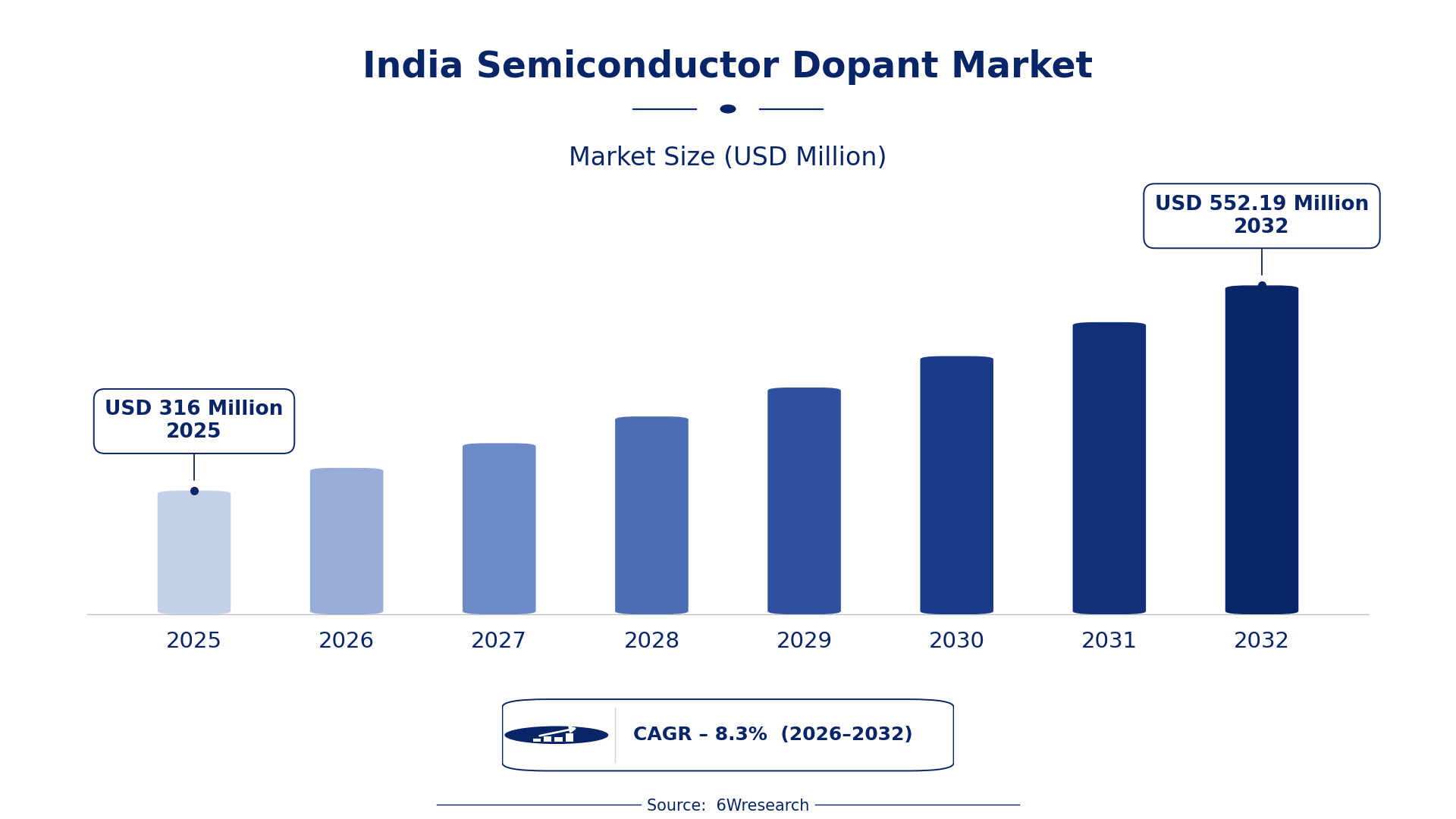
According to 6Wresearch internal database and industry insights, the India Semiconductor Dopant Market was valued at USD 316.0 million in 2025 and is projected to reach USD 552.19 million by 2032, growing at a CAGR of approximately 8.3% during 2026–2032.
India Semiconductor Dopant Market Highlights
| Report Metric | Details |
| Report Name | India Semiconductor Dopant Market |
| Market Size 2025 | USD 316.0 million |
| Market Size 2032 | USD 552.19 million |
| Absolute Growth 2025–2032 | USD 236.19 million |
| CAGR 2026–2032 | 8.3% |
| Peak Annual Growth | 10.7% in 2031 |
| Forecast Period | 2026–2032 |
| Historical Data | 2022–2025 |
| Base Year | 2025 |
| Leading Dopant Type, 2025 | Phosphorus (50% share) |
| Leading Conductivity Type, 2025 | N-type (41% share) |
| Leading Application Stage, 2025 | Ion Implantation (37% share) |
| Leading End User, 2025 | Semiconductor Manufacturers (52% share) |
| Fastest-Growing Dopant Type | Arsenic (10.4% CAGR) |
| Fastest-Growing Conductivity Type | N-type (High Density) (10.9% CAGR) |
| Fastest-Growing Application Stage | Doping Process (9.8% CAGR) |
| Fastest-Growing End User | Logic Chip Producers (9.9% CAGR) |
| Growing Sector | Electronics |
| Key End Users | Semiconductor Manufacturers, Logic Chip Producers, Silicon Foundries |
India Semiconductor Dopant Market Year-wise Growth Rate and Key Drivers (2022–2032)
This graph illustrates the annual growth rates of the market from 2022 to 2032, highlighting a steady upward trajectory and projected market expansion over the forecast period.
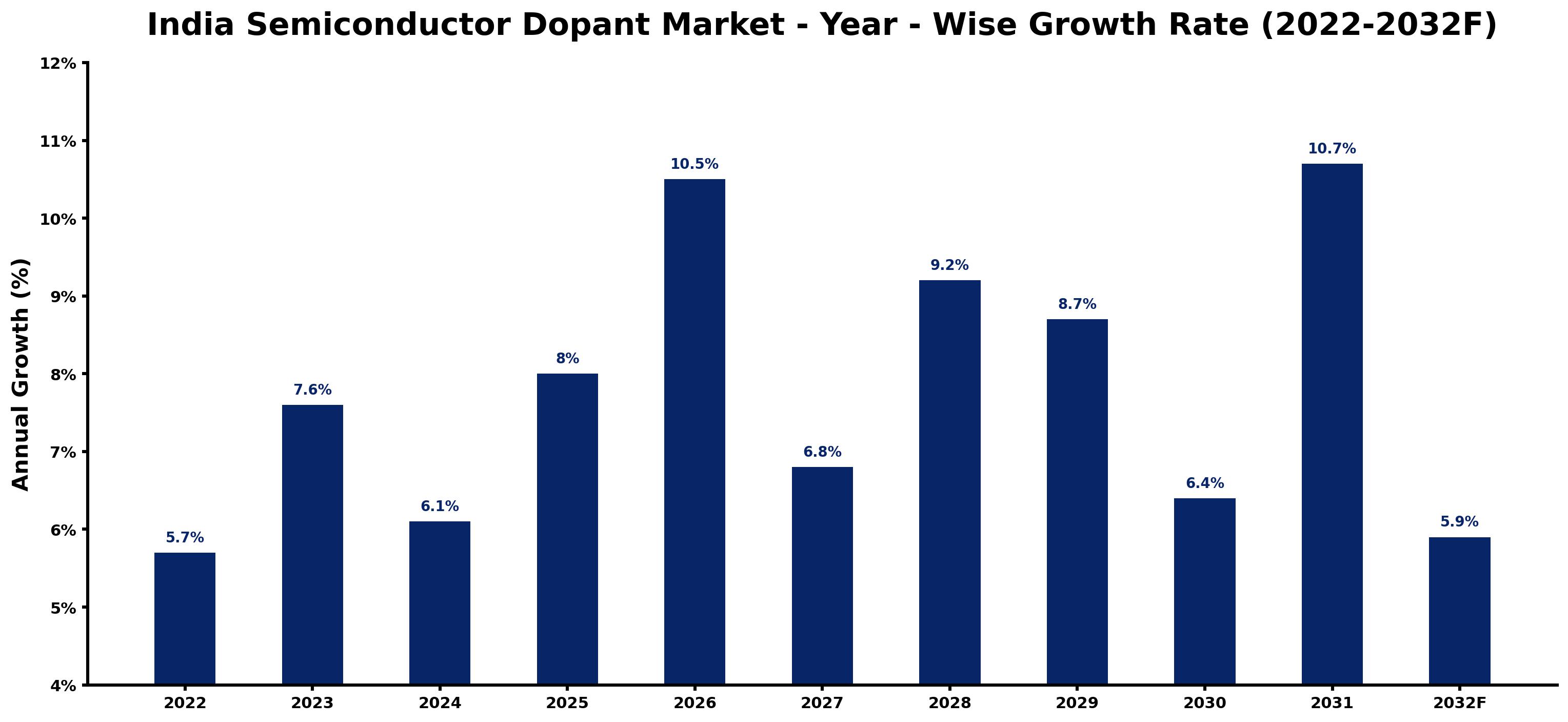
Below, each year's estimated growth is shown next to the factor that most influenced it.
| Year | Estimated Annual Growth (%) | Market Rationale |
| 2022 | 5.7 | The market experienced steady growth, reflecting increasing demand for semiconductor devices driven by local manufacturers. |
| 2023 | 7.6 | Growth accelerated as local manufacturers expanded production capabilities to meet rising electronics demand from the Semiconductor Mission. |
| 2024 | 6.1 | The growth rate slowed slightly due to adjustments in production following rapid expansion in previous years. |
| 2025 | 8.0 | The market rebounded with faster growth, driven by investments in semiconductor manufacturing facilities and local production initiatives. |
| 2026 | 10.5 | Demand is expected to surge as the need for advanced semiconductor technologies increases, supported by local manufacturing efforts. |
| 2027 | 6.8 | The market will see a slowdown as manufacturers adjust to the previous year's rapid growth and rising costs. |
| 2028 | 9.2 | Growth is projected to pick up again as new technologies and applications emerge in the semiconductor sector, boosting demand for dopants. |
| 2029 | 8.7 | The market will experience a slowdown, yet continue to grow as demand remains strong from semiconductor manufacturers. |
| 2030 | 6.4 | Growth is expected to slow further as the market stabilises after several years of rapid expansion and increased competition. |
| 2031 | 10.7 | The market will peak with accelerated growth due to heightened investments in semiconductor capabilities and local production. |
| 2032 | 5.9 | Growth is projected to slow as the market begins to stabilise after reaching peak levels, influenced by quality control standards. |
Note: Market size estimations and growth projections presented in this report are based on 6Wresearch's proprietary forecasting methodology, utilizing the latest available industry data, government publications, and primary research inputs.
India Semiconductor Dopant Market Synopsis
The India Semiconductor Dopant Market encompasses materials used to modify the electrical properties of semiconductors. These dopants, such as Boron and Phosphorus, are essential for controlling conductivity in semiconductor devices. The market is growing due to strong demand from domestic semiconductor manufacturers and the expanding electronics sector. Initiatives like the Semiconductor Mission launched in 2021 aim to boost local manufacturing and attract substantial investments. This combination of factors is driving the market forward, positioning India as a key player in the semiconductor landscape.
Market Dynamics Impact Analysis (2026–2032)
| Factor | Type | Impact | Primary Segment Affected |
| Increasing investments in semiconductor manufacturing facilities | Driver | High | Phosphorus |
| Rising demand for electronic devices in India | Driver | High | Phosphorus |
| Growing semiconductor research and development initiatives | Opportunity | High | Phosphorus |
| Expansion of semiconductor manufacturing units in Karnataka and Tamil Nadu | Opportunity | Medium | Phosphorus |
| Quality control challenges in semiconductor production | Restraint | High | Phosphorus |
| Limited availability of advanced dopants for high-density applications | Restraint | Medium | Phosphorus |
| Supply chain disruptions affecting semiconductor production | Challenge | High | Phosphorus |
| High initial investment costs for semiconductor fabs | Challenge | Medium | Phosphorus |
Evaluation of Drivers in India Semiconductor Dopant Market (2026–2032)
Below mentioned are some major drivers and their influence on market dynamics.
| Drivers | Primary Segment Affected | Why It Matters (Evidence) |
| Increased investments in semiconductor fabs | Phosphorus | This drives demand for dopants as new facilities require substantial quantities for production. |
| Growing electronics sector in India | Phosphorus | The expansion of the electronics market leads to higher consumption of semiconductor devices and their dopants. |
| Rising demand for advanced semiconductor technologies | Phosphorus | This creates a need for high-density dopants, improving the performance of semiconductor devices. |
| Government initiatives promoting local manufacturing | Phosphorus | Programs like the Semiconductor Mission stimulate demand for dopants used in local production. |
| Development of skilled workforce in semiconductor technology | Phosphorus | A growing pool of engineers improves the capability of manufacturers to innovate and expand production. |
Expansion of the Semiconductor Dopant market in India is backed by increased investments in semiconductor manufacturing facilities and strong demand for electronic devices. The electronics sector is projected to grow to $400 billion by 2025, driving consumption of semiconductor devices. The development of a skilled workforce in semiconductor technology supports innovation and production capacity. As a result, semiconductor manufacturers are increasingly sourcing dopants to meet market needs and enhance product offerings.
Evaluation of Restraints in India Semiconductor Dopant Market
The following restraints limit how fast demand can grow.
| Market Restraint | Primary Segment Affected | Why It Matters (Evidence) |
| Quality control challenges in semiconductor production | Phosphorus | Inconsistent quality can lead to production delays, affecting manufacturers' ability to meet market demand. |
| Limited availability of advanced dopants for high-density applications | Phosphorus | This restricts the ability of manufacturers to produce advanced semiconductor devices, impacting overall production efficiency. |
| Supply chain disruptions affecting semiconductor production | Phosphorus | Disruptions can lead to delays in sourcing essential materials, impacting production schedules and costs. |
| High initial investment costs for semiconductor fabs | Phosphorus | These costs can deter new entrants from establishing manufacturing facilities, limiting market growth opportunities. |
| Regulatory compliance issues in semiconductor manufacturing | Phosphorus | Navigating complex regulations can slow down production processes and increase operational costs for manufacturers. |
India Semiconductor Dopant Market Challenges
Buyers and suppliers in the India Semiconductor Dopant Market face challenges with outdated technology, particularly in doping processes, which limits production efficiency. This issue stems from insufficient local research and development, resulting in manufacturing costs rising by 15% for producers. A lack of skilled engineers further complicates matters, as the talent pool does not meet industry demands, leading companies to spend up to 30% more on recruitment and training. Additionally, fluctuating raw material costs can inflate production expenses, impacting pricing strategies for buyers in the electronics sector.
Trends in the India Semiconductor Dopant Market
Buyers and suppliers in the India Semiconductor Dopant Market are adjusting to the following trends.
- Shift towards Advanced Node Fabs: Semiconductor manufacturers are increasingly adopting advanced node fabrication techniques to improve performance. By 2025, over 50% of new fabs will focus on these technologies, reflecting a shift in production capabilities.
- Growing Demand for N-type Dopants: N-type dopants are becoming more prevalent in semiconductor applications, driven by their essential role in device performance. The segment is expected to grow at a CAGR of 10.9% through 2032, indicating a trend towards advanced semiconductor technologies.
- Increase in Local Semiconductor Manufacturing Units: India has seen a rise in semiconductor manufacturing units, with over 20 facilities established across various states. This expansion supports the local supply chain and reduces dependency on imports, boosting market resilience.
- Focus on Quality Control Standards: The Bureau of Indian Standards has implemented guidelines for semiconductor quality control, improving product reliability. This initiative is essential for maintaining competitiveness in the global semiconductor market.
Investment Opportunities in the India Semiconductor Dopant Market
Some of the investment opportunities in the India Semiconductor Dopant Market are mentioned below.
- Semiconductor Manufacturers Seeking Local Suppliers: With the electronics sector anticipated to reach $400 billion by 2025, semiconductor manufacturers are actively seeking local suppliers of dopants. Forming partnerships with local firms can facilitate market entry and create growth opportunities.
- Investment in Semiconductor Research Facilities: The increase in semiconductor research and development initiatives opens doors for investment in specialised facilities. Regions like Karnataka and Tamil Nadu are well-suited for establishing such facilities due to their existing infrastructure and skilled workforce.
- Joint Ventures for Semiconductor Production: This is an ideal time for joint ventures to expand semiconductor production capabilities. Collaborating with local manufacturers can streamline operations and enhance market access for suppliers.
- Government Incentives for Semiconductor Projects: The updated Production Linked Incentive Scheme offers financial incentives for semiconductor fabs. This initiative promotes investment in local manufacturing, creating opportunities for suppliers to participate in the growing market.
Government Initiatives in the India Semiconductor Dopant Market
The 'Semiconductor Mission' launched by the Ministry of Electronics and Information Technology in 2021 aims to attract $10 billion in investments for semiconductor manufacturing. This initiative seeks to improve local production capabilities and reduce dependency on imports. The mission supports various facets of semiconductor production, including research and development, infrastructure development, and workforce training. Additionally, the National Policy on Electronics 2019 aims to position India as a global hub for electronics manufacturing, further strengthening the semiconductor sector.
The updated 'Production Linked Incentive Scheme' is overseen by the Ministry of Electronics and provides incentives for semiconductor fabs and display manufacturing units. This scheme aims to enhance domestic production capabilities and attract investments. The Department of Science and Technology has also initiated funding for semiconductor research projects under the 'National Research Foundation' established in 2020, supporting innovation and development in semiconductor technologies. These measures enable producers to improve their capabilities and meet growing market demands.
Future Insight of the India Semiconductor Dopant Market
The India Semiconductor Dopant Market is set to evolve significantly by 2032, driven by government initiatives like the 'Semiconductor Mission' and the 'Production Linked Incentive Scheme' that will strengthen local manufacturing. The electronics sector is projected to grow, reaching $400 billion, which will elevate the demand for semiconductor dopants. Improved quality control standards from the Bureau of Indian Standards will enhance product reliability, providing suppliers with a competitive edge and delivering greater value to buyers.
Market Segmentation Analysis
The analysis below covers each segmentation, its leading category in 2025 and its fastest-growing category through 2032.
By Dopant Type – Phosphorus Dominated, Arsenic Expected to Grow Fastest
According to Shubham Padhi, Research Analyst at 6Wresearch, the largest dopant type category in 2025 was Phosphorus, with a 50% share of total revenue. Phosphorus commands the largest share in the Indian Semiconductor Dopant Market due to its essential role in forming N-type semiconductors, which are vital for numerous electronic devices. Its widespread adoption among semiconductor manufacturers in India highlights its importance in enhancing conductivity. Arsenic is set to record the highest CAGR in this split, 10.4% over 2026–2032. Arsenic is witnessing rapid growth because of its targeted applications in advanced semiconductor technologies, which are increasingly sought after as the electronics sector expands. The surge in investment for semiconductor research and development in India is a key factor driving this growth. Suppliers should focus on enhancing their arsenic offerings to cater to the rising demand in specialised applications.
By Conductivity Type – N-type Dominated, N-type (High Density) Expected to Grow Fastest
With a 41% revenue share in 2025, N-type was the largest conductivity type category. N-type semiconductors hold the largest market share in India, as they are fundamental to a vast array of semiconductor applications, making them essential for manufacturers. Their extensive utilisation in the expanding electronics sector solidifies their leading position. Over 2026–2032, N-type (High Density) is expected to post the fastest growth, at a CAGR of 10.9%. N-type (High Density) is the fastest-growing segment, propelled by the increasing demand for advanced semiconductor technologies requiring higher performance and efficiency. As the electronics sector continues to grow, the need for high-density N-type materials will escalate. Suppliers should prioritise the development of high-density N-type materials to seize this growth opportunity.
By Application Stage – Ion Implantation Dominated, Doping Process Expected to Grow Fastest
Ion Implantation took a 37% share of application stage in 2025, more than any other category. Ion Implantation commands the largest share in the market as it is the primary method for introducing dopants into silicon wafers, ensuring precision and effectiveness in semiconductor manufacturing. Its established use among semiconductor manufacturers solidifies its leading position. The quickest growth will come from Doping Process, forecast to expand at a CAGR of 9.8% between 2026 and 2032. The Doping Process is the fastest-growing segment, as it encompasses all methods of adding dopants, reflecting the industry's shift towards more versatile approaches. This growth is further fuelled by the increasing complexity of semiconductor devices. This suggests that suppliers should diversify their offerings to include a wider range of doping methods to meet evolving industry needs.
By End User – Semiconductor Manufacturers Dominated, Logic Chip Producers Expected to Grow Fastest
Semiconductor Manufacturers held a 52% share of the India Semiconductor Dopant Market by end user in 2025. Semiconductor Manufacturers represent the largest share in the market because they directly employ dopants in the production of various semiconductor devices, ensuring steady demand. Their critical role in the electronics supply chain reinforces their dominant position in the market. Logic Chip Producers are projected to grow fastest, at a CAGR of 9.9% during 2026–2032. Logic Chip Producers are the fastest-growing segment, as they necessitate specific dopants for the fabrication of logic chips, which are essential for advanced electronic applications. The increasing demand for sophisticated logic chips within the electronics sector fuels this growth. This underscores the need for suppliers to customise their products to meet the specific needs of logic chip producers.
Key Attractiveness of the Report
- 10 Years of Market Numbers
- Historical Data Starting from 2022 to 2025
- Base Year 2025
- Forecast Data until 2032
- Key Performance Indicators Impacting the Market
- Major Upcoming Developments and Projects
Key Highlights of the Report:
- India Semiconductor Dopant Market Outlook
- Market Size of India Semiconductor Dopant Market, 2025
- Forecast of India Semiconductor Dopant Market, 2032
- Historical Data and Forecast of India Semiconductor Dopant Revenues & Volume for the Period 2022 - 2032F
- India Semiconductor Dopant Market Trend Evolution
- India Semiconductor Dopant Market Drivers and Challenges
- India Semiconductor Dopant Price Trends
- India Semiconductor Dopant Porter's Five Forces
- India Semiconductor Dopant Industry Life Cycle
- Historical Data and Forecast of India Semiconductor Dopant Market Revenues & Volume By Dopant Type for the Period 2022 - 2032F
- Historical Data and Forecast of India Semiconductor Dopant Market Revenues & Volume By Boron for the Period 2022 - 2032F
- Historical Data and Forecast of India Semiconductor Dopant Market Revenues & Volume By Phosphorus for the Period 2022 - 2032F
- Historical Data and Forecast of India Semiconductor Dopant Market Revenues & Volume By Arsenic for the Period 2022 - 2032F
- Historical Data and Forecast of India Semiconductor Dopant Market Revenues & Volume By Antimony for the Period 2022 - 2032F
- Historical Data and Forecast of India Semiconductor Dopant Market Revenues & Volume By Conductivity Type for the Period 2022 - 2032F
- Historical Data and Forecast of India Semiconductor Dopant Market Revenues & Volume By P-type for the Period 2022 - 2032F
- Historical Data and Forecast of India Semiconductor Dopant Market Revenues & Volume By N-type for the Period 2022 - 2032F
- Historical Data and Forecast of India Semiconductor Dopant Market Revenues & Volume By N-type (High Density) for the Period 2022 - 2032F
- Historical Data and Forecast of India Semiconductor Dopant Market Revenues & Volume By N-type (Precision) for the Period 2022 - 2032F
- Historical Data and Forecast of India Semiconductor Dopant Market Revenues & Volume By Application Stage for the Period 2022 - 2032F
- Historical Data and Forecast of India Semiconductor Dopant Market Revenues & Volume By Ion Implantation for the Period 2022 - 2032F
- Historical Data and Forecast of India Semiconductor Dopant Market Revenues & Volume By Diffusion for the Period 2022 - 2032F
- Historical Data and Forecast of India Semiconductor Dopant Market Revenues & Volume By Doping Process for the Period 2022 - 2032F
- Historical Data and Forecast of India Semiconductor Dopant Market Revenues & Volume By Thermal Diffusion for the Period 2022 - 2032F
- Historical Data and Forecast of India Semiconductor Dopant Market Revenues & Volume By End User for the Period 2022 - 2032F
- Historical Data and Forecast of India Semiconductor Dopant Market Revenues & Volume By Silicon Foundries for the Period 2022 - 2032F
- Historical Data and Forecast of India Semiconductor Dopant Market Revenues & Volume By Semiconductor Manufacturers for the Period 2022 - 2032F
- Historical Data and Forecast of India Semiconductor Dopant Market Revenues & Volume By Logic Chip Producers for the Period 2022 - 2032F
- Historical Data and Forecast of India Semiconductor Dopant Market Revenues & Volume By Advanced Node Fabs for the Period 2022 - 2032F
- India Semiconductor Dopant Import Export Trade Statistics
- Market Opportunity Assessment By Dopant Type
- Market Opportunity Assessment By Conductivity Type
- Market Opportunity Assessment By Application Stage
- Market Opportunity Assessment By End User
- India Semiconductor Dopant Top Companies Market Share
- India Semiconductor Dopant Competitive Benchmarking By Technical and Operational Parameters
- India Semiconductor Dopant Company Profiles
- India Semiconductor Dopant Key Strategic Recommendations
Market Covered
The report offers an extensive study of the following market segments.
By Dopant Type
- Boron
- Phosphorus
- Arsenic
- Antimony
By Conductivity Type
- P-type
- N-type
- N-type (High Density)
- N-type (Precision)
By Application Stage
- Ion Implantation
- Diffusion
- Doping Process
- Thermal Diffusion
By End User
- Silicon Foundries
- Semiconductor Manufacturers
- Logic Chip Producers
- Advanced Node Fabs































