China Semiconductor Dopant Market Size & Growth Rate
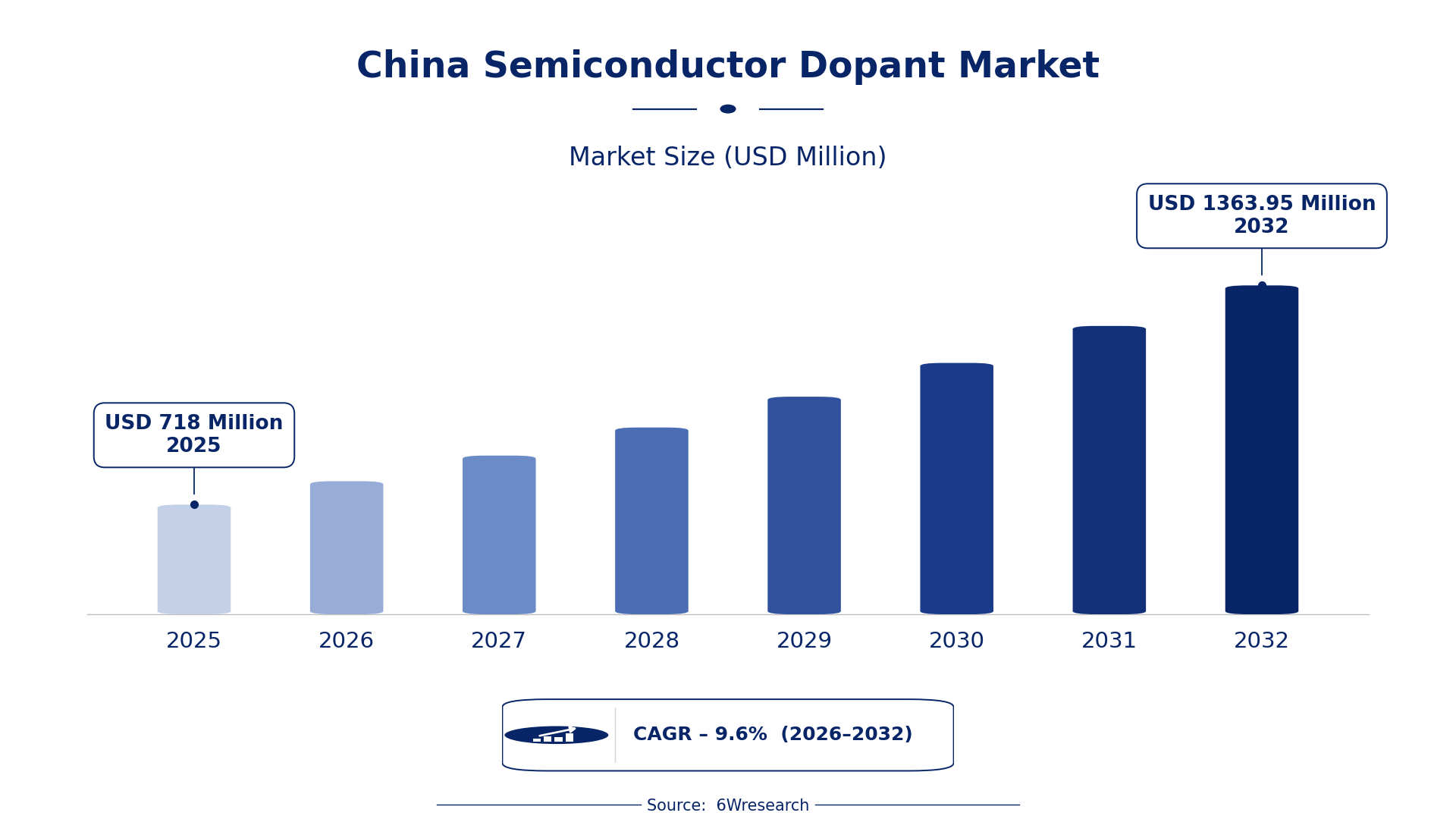
According to 6Wresearch internal database and industry insights, the China Semiconductor Dopant Market was valued at USD 718.0 million in 2025 and is projected to reach USD 1,363.95 million by 2032, growing at a CAGR of approximately 9.6% during 2026–2032.
China Semiconductor Dopant Market Highlights
| Report Metric | Details |
| Report Name | China Semiconductor Dopant Market |
| Market Size 2025 | USD 718.0 million |
| Market Size 2032 | USD 1,363.95 million |
| Absolute Growth 2025–2032 | USD 645.95 million |
| CAGR 2026–2032 | 9.6% |
| Peak Annual Growth | 11.1% in 2029 |
| Forecast Period | 2026–2032 |
| Historical Data | 2022–2025 |
| Base Year | 2025 |
| Leading Dopant Type, 2025 | Boron (41% share) |
| Leading Conductivity Type, 2025 | P-type (49% share) |
| Leading Application Stage, 2025 | Ion Implantation (39% share) |
| Leading End User, 2025 | Silicon Foundries (41% share) |
| Fastest-Growing Dopant Type | Phosphorus (11.7% CAGR) |
| Fastest-Growing Conductivity Type | N-type (12.2% CAGR) |
| Fastest-Growing Application Stage | Diffusion (11.6% CAGR) |
| Fastest-Growing End User | Semiconductor Manufacturers (12.3% CAGR) |
| Growing Sector | Diffusion |
| Key End Users | Ion Implantation, Diffusion, Doping Process, Thermal Diffusion |
China Semiconductor Dopant Market Year-wise Growth Rate and Key Drivers (2022–2032)
This graph illustrates the annual growth rates of the market from 2022 to 2032, highlighting a steady upward trajectory and projected market expansion over the forecast period.
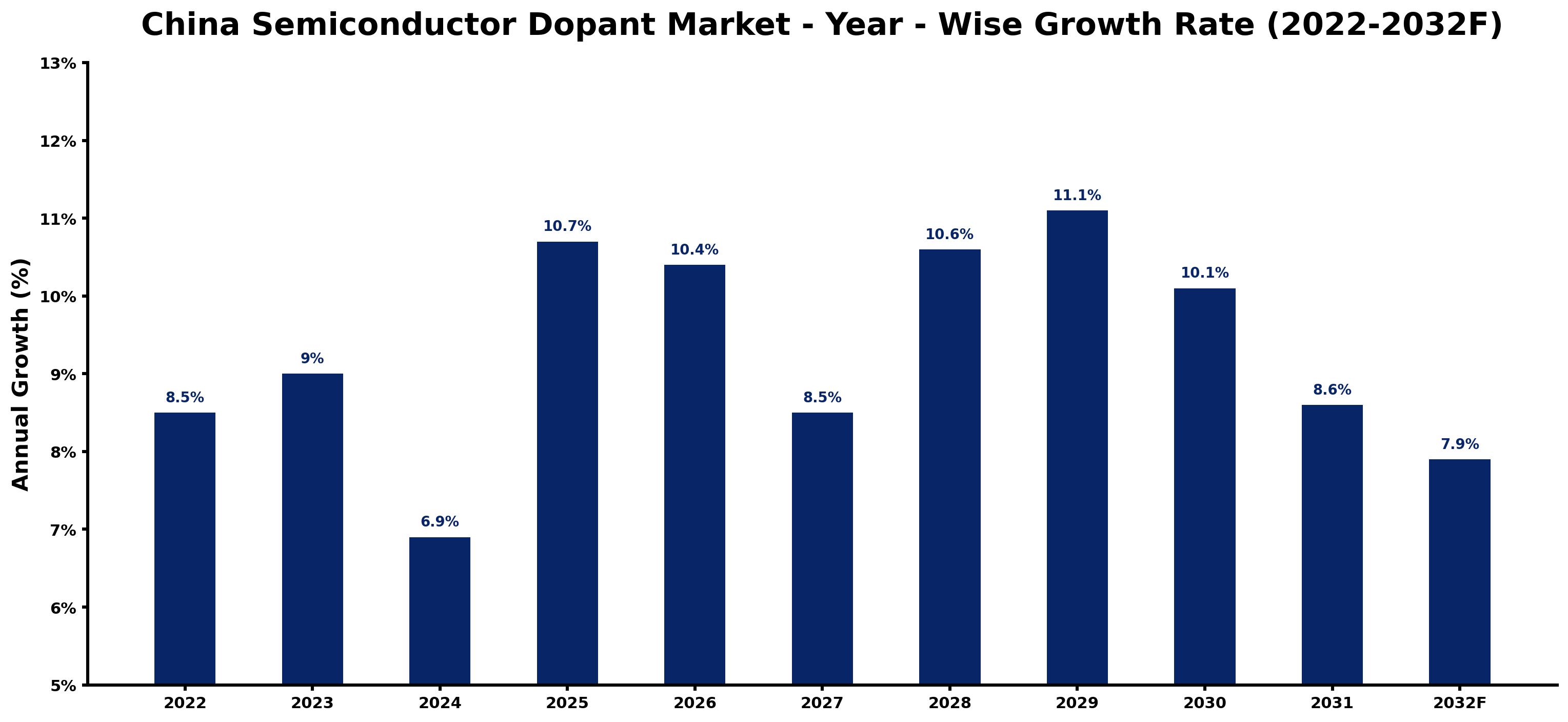
Each row of the following table gives one year's estimated growth and the event or demand shift that explains it.
| Year | Estimated Annual Growth (%) | Market Rationale |
| 2022 | 8.5 | The market experienced solid growth due to ongoing domestic semiconductor production. |
| 2023 | 9.0 | Growth accelerated as the semiconductor industry expanded in response to rising global demand. |
| 2024 | 6.9 | Growth slowed as companies adjusted to market fluctuations and supply chain challenges. |
| 2025 | 10.7 | A surge in semiconductor production capacity led to substantial growth in the market. |
| 2026 | 10.4 | Growth is expected to decelerate as the market normalises after the previous peak. |
| 2027 | 8.5 | Demand will remain strong, but growth is projected to slow due to market saturation in certain areas. |
| 2028 | 10.6 | An increase in advanced semiconductor technologies will spur faster growth again. |
| 2029 | 11.1 | The market will peak as the demand for high-performance semiconductors surges. |
| 2030 | 10.1 | Growth is expected to slow as the market stabilises after reaching its peak. |
| 2031 | 8.6 | Demand will continue to grow, but at a slower rate as the market matures. |
| 2032 | 7.9 | The market is projected to maintain steady growth as new technologies emerge. |
Note: Market size estimations and growth projections presented in this report are based on 6Wresearch's proprietary forecasting methodology, utilizing the latest available industry data, government publications, and primary research inputs.
China Semiconductor Dopant Market Synopsis
The Semiconductor Dopant Market in China covers materials that modify the electrical properties of semiconductors, primarily used in silicon wafers for electronic devices. These dopants, including boron and phosphorus, are vital for improving conductivity. The market is growing due to increased domestic manufacturing and exports, with the semiconductor industry projected to reach $1 trillion by 2030. The 'Integrated Circuit Industry Development Plan' is driving new demand, promoting innovation and self-reliance in semiconductor production.
Market Dynamics Impact Analysis (2026–2032)
| Factor | Type | Impact | Primary Segment Affected |
| Rising demand for advanced semiconductor technologies drives the need for high-quality dopants. | Driver | High | Boron |
| The expansion of semiconductor manufacturing capacity in Jiangsu and Guangdong provinces supports increased production. | Driver | High | Boron |
| Investment in semiconductor R&D presents opportunities for suppliers of advanced dopants. | Opportunity | High | Boron |
| Growing demand from Silicon Foundries for high-performance dopants creates market entry points. | Opportunity | High | Silicon Foundries |
| Quality compliance with the National Standard GB/T 31212-2014 can limit supplier options. | Restraint | Medium | Boron |
| High competition among over 1,000 semiconductor companies may drive prices down. | Restraint | Medium | Boron |
| Supply chain disruptions can delay production timelines for buyers and suppliers. | Challenge | High | Boron |
| Technological advancements require continuous investment, posing challenges for smaller suppliers. | Challenge | Medium | Boron |
Evaluation of Drivers in China Semiconductor Dopant Market (2026–2032)
The table below links each growth driver to the segment it affects and the evidence for it.
| Drivers | Primary Segment Affected | Why It Matters (Evidence) |
| Increased production of silicon wafers drives demand for boron and phosphorus dopants. | Phosphorus | China produced 1.2 million tons of silicon in 2022, leading to higher dopant usage. |
| The growth of semiconductor manufacturers boosts the need for dopants in chip fabrication. | Semiconductor Manufacturers | With over 1,000 semiconductor companies in China, demand for dopants is rising. |
| The push for self-sufficiency in semiconductor production boosts the market for dopants. | Boron | The 'Made in China 2025' initiative supports domestic semiconductor projects. |
| Innovation in semiconductor technologies increases the demand for high-density dopants. | Boron | The semiconductor industry is projected to reach $1 trillion by 2030. |
| The adoption of ion implantation techniques increases the need for specific dopants. | Ion Implantation | Ion Implantation held a 39% share in 2025, indicating strong demand. |
The Semiconductor Dopant market in China is expanding due to increasing end-use demand from semiconductor manufacturers and growing production capacity. In 2022, China produced 1.2 million tons of silicon, heightening the need for boron and phosphorus dopants. The semiconductor industry is forecasted to reach $1 trillion by 2030, further driving demand for dopants. The 'National Semiconductor Industry Development Strategy' backs domestic projects, encouraging innovation and self-sufficiency. The adoption of ion implantation techniques, which represented 39% of the market in 2025, shows strong ongoing demand for these materials.
Evaluation of Restraints in China Semiconductor Dopant Market
The table below lists the restraints and the evidence behind each.
| Market Restraint | Primary Segment Affected | Why It Matters (Evidence) |
| Compliance with the National Standard GB/T 31212-2014 increases production costs for suppliers. | Boron | Producers must meet stringent quality requirements, impacting pricing. |
| Intense competition among semiconductor manufacturers can lead to price wars. | Semiconductor Manufacturers | With over 1,000 companies, price pressure may affect profitability. |
| Supply chain disruptions can delay the delivery of essential materials for production. | Boron | Global supply chain issues have affected timely access to dopants. |
| Technological advancements require continuous investment, which may strain smaller suppliers. | Boron | Smaller firms may struggle to keep pace with larger competitors. |
| Market saturation in certain segments may limit growth opportunities for new entrants. | Boron | Established players dominate the market, making entry challenging. |
China Semiconductor Dopant Market Challenges
In 2022, China produced 1.2 million tons of silicon, yet a shortage of skilled workers in semiconductor fabrication hampers production efficiency, delaying output for manufacturers. The technology gap in semiconductor dopant production limits innovation, causing suppliers to lag behind global standards and affecting product quality for buyers. Compliance with the National Standard GB/T 31212-2014 incurs high costs for manufacturers, leading to increased prices for end users. Intense competition among over 1,000 semiconductor companies in China pressures profit margins, compelling suppliers to cut costs, which can compromise product quality for buyers.
Trends in the China Semiconductor Dopant Market
The trends below show where the China Semiconductor Dopant Market is heading.
- Shift from Traditional to Advanced Semiconductor Technologies: Since 2022, China has experienced a shift towards advanced semiconductor technologies, driven by the 'Integrated Circuit Industry Development Plan'. This has resulted in a 10% annual growth in the semiconductor market, creating new opportunities for dopant suppliers.
- Transition from N-type to P-type Semiconductor Applications: In 2023, the demand for P-type semiconductors rose, with a projected share of 49% in 2025. This transition is driven by the increasing need for efficient electronic devices, influencing supplier strategies.
- Emergence of High-Density Dopants in N-type Applications: The growing complexity of semiconductor devices has led to a heightened focus on high-density dopants. In 2023, the market for N-type (High Density) dopants is anticipated to grow, reflecting technological advancements.
- Prioritisation of Ion Implantation Techniques: Starting in 2023, ion implantation has emerged as the preferred method for doping semiconductors, with a 39% market share. This trend highlights the industry's shift towards precision and efficiency in semiconductor manufacturing.
Investment Opportunities in the China Semiconductor Dopant Market
Investors looking at the China Semiconductor Dopant Market should consider the following areas.
- Supply of High-Density Dopants: With the increasing complexity of semiconductor devices, there is a rising demand for high-density dopants. Semiconductor manufacturers in Jiangsu are seeking reliable suppliers to meet this growing need.
- Investment in Advanced Doping Techniques: The surge in advanced semiconductor technologies presents opportunities for suppliers of cutting-edge doping techniques. Collaborating with semiconductor manufacturers in Guangdong can facilitate market entry and expansion.
- Expansion of Ion Implantation Services: As ion implantation becomes the preferred doping method, there is a demand for specialised services. Companies focusing on ion implantation techniques can partner with silicon foundries to capture this market.
- Development of N-type Semiconductor Applications: The increasing demand for N-type semiconductors offers opportunities for suppliers to develop tailored solutions. Engaging with logic chip producers can help address specific needs in this expanding segment.
Government Initiatives in the China Semiconductor Dopant Market
The '14th Five-Year Plan for the Development of the Integrated Circuit Industry', approved in 2021, targets a 20% increase in domestic production by 2025. This plan promotes investments in semiconductor manufacturing and encourages self-sufficiency, benefiting both dopant producers and buyers. The 'National Semiconductor Industry Development Strategy', launched in 2022, emphasises innovation and self-reliance, further supporting the growth of the semiconductor dopant market.
In 2023, the National Development and Reform Commission introduced subsidies for semiconductor R&D, with a budget of $5 billion. This funding aims to boost innovation in semiconductor technologies, benefiting both manufacturers and suppliers. The 'China Semiconductor Innovation Fund', established in 2022, supports startups in the semiconductor sector, providing initial investments to enhance production capabilities and drive market growth.
Future Insight of the China Semiconductor Dopant Market
The China Semiconductor Dopant Market is set to undergo transformative changes by 2032, driven by the 'Integrated Circuit Industry Development Plan' that seeks to strengthen domestic production capabilities. The government's $30 billion investment in semiconductor technology will promote advancements in dopant manufacturing processes. By 2030, the semiconductor industry in China is projected to reach $1 trillion, creating new opportunities for suppliers to solidify their market position. As self-sufficiency becomes a priority, buyers will benefit from a more reliable supply chain and improved product quality.
Market Segmentation Analysis
Each segment group is reviewed below, with the leader by share and the fastest grower by CAGR.
By Dopant Type – Boron Dominated, Phosphorus Expected to Grow Fastest
According to Shubham Padhi, Research Analyst at 6Wresearch, the largest dopant type category in 2025 was Boron, with a 41% share of total revenue. Boron holds the largest share in the China Semiconductor Dopant Market due to its critical role in producing P-type semiconductors, which are widely utilised in electronic devices. Its strong presence in silicon wafers across numerous semiconductor fabrication facilities in Jiangsu and Guangdong provinces solidifies its leading position. Phosphorus is set to record the highest CAGR in this split, 11.7% over 2026–2032. Phosphorus is experiencing the fastest growth in this market as it is essential for N-type semiconductor applications, increasingly required for advanced electronic devices. The rise in silicon wafer production, which necessitates phosphorus for improved conductivity, drives this rapid expansion. Suppliers should focus on enhancing their phosphorus product lines to capitalise on the growing demand in the semiconductor sector.
By Conductivity Type – P-type Dominated, N-type Expected to Grow Fastest
P-type took a 49% share of conductivity type in 2025, more than any other category. P-type conductivity commands the largest market share due to its extensive use in semiconductor fabrication, making it vital for a variety of electronic components. The high volume of P-type semiconductors in consumer electronics significantly supports its dominant position in the market. The quickest growth will come from N-type, forecast to expand at a CAGR of 12.2% between 2026 and 2032. N-type conductivity is witnessing rapid growth as it is essential for most semiconductor devices, which are becoming more complex and performance-driven. The increasing demand for high-performance chips in sectors like telecommunications is a key factor behind this growth. Buyers should consider diversifying their sourcing strategies to include N-type dopants to stay aligned with technological advancements.
By Application Stage – Ion Implantation Dominated, Diffusion Expected to Grow Fastest
Ion Implantation held a 39% share of the China Semiconductor Dopant Market by application stage in 2025. Ion Implantation commands the largest market share as it is the primary method for doping semiconductors, providing precise control over the process. Its widespread use in semiconductor manufacturing facilities solidifies its leading position in the market. Over 2026–2032, Diffusion is expected to post the fastest growth, at a CAGR of 11.6%. Diffusion is the fastest-growing application stage due to its standard utilisation in semiconductor processing, which is vital for producing a range of semiconductor devices. The increasing complexity of semiconductor designs necessitates more efficient diffusion techniques. Suppliers must improve their diffusion process capabilities to align with the rising demand for advanced semiconductor applications.
By End User – Silicon Foundries Dominated, Semiconductor Manufacturers Expected to Grow Fastest
Silicon Foundries accounted for a 41% market share by end user in 2025. Silicon Foundries command the largest share in the market as they are the primary users of semiconductor dopants, essential for producing various semiconductor products. The concentration of silicon foundries in regions like Jiangsu and Guangdong reinforces their dominant market position. Semiconductor Manufacturers are projected to grow fastest, at a CAGR of 12.3% during 2026–2032. Semiconductor Manufacturers are experiencing the fastest growth as they are major consumers of dopants needed for production, driven by the expanding semiconductor industry in China. The projected growth of the semiconductor market to $1 trillion by 2030 further accelerates this trend. Suppliers should focus on building strong relationships with semiconductor manufacturers to capture the growing demand for dopants.
Key Attractiveness of the Report
- 10 Years of Market Numbers
- Historical Data Starting from 2022 to 2025
- Base Year 2025
- Forecast Data until 2032
- Key Performance Indicators Impacting the Market
- Major Upcoming Developments and Projects
Key Highlights of the Report:
- China Semiconductor Dopant Market Outlook
- Market Size of China Semiconductor Dopant Market, 2025
- Forecast of China Semiconductor Dopant Market, 2032
- Historical Data and Forecast of China Semiconductor Dopant Revenues & Volume for the Period 2022 - 2032F
- China Semiconductor Dopant Market Trend Evolution
- China Semiconductor Dopant Market Drivers and Challenges
- China Semiconductor Dopant Price Trends
- China Semiconductor Dopant Porter's Five Forces
- China Semiconductor Dopant Industry Life Cycle
- Historical Data and Forecast of China Semiconductor Dopant Market Revenues & Volume By Dopant Type for the Period 2022 - 2032F
- Historical Data and Forecast of China Semiconductor Dopant Market Revenues & Volume By Boron for the Period 2022 - 2032F
- Historical Data and Forecast of China Semiconductor Dopant Market Revenues & Volume By Phosphorus for the Period 2022 - 2032F
- Historical Data and Forecast of China Semiconductor Dopant Market Revenues & Volume By Arsenic for the Period 2022 - 2032F
- Historical Data and Forecast of China Semiconductor Dopant Market Revenues & Volume By Antimony for the Period 2022 - 2032F
- Historical Data and Forecast of China Semiconductor Dopant Market Revenues & Volume By Conductivity Type for the Period 2022 - 2032F
- Historical Data and Forecast of China Semiconductor Dopant Market Revenues & Volume By P-type for the Period 2022 - 2032F
- Historical Data and Forecast of China Semiconductor Dopant Market Revenues & Volume By N-type for the Period 2022 - 2032F
- Historical Data and Forecast of China Semiconductor Dopant Market Revenues & Volume By N-type (High Density) for the Period 2022 - 2032F
- Historical Data and Forecast of China Semiconductor Dopant Market Revenues & Volume By N-type (Precision) for the Period 2022 - 2032F
- Historical Data and Forecast of China Semiconductor Dopant Market Revenues & Volume By Application Stage for the Period 2022 - 2032F
- Historical Data and Forecast of China Semiconductor Dopant Market Revenues & Volume By Ion Implantation for the Period 2022 - 2032F
- Historical Data and Forecast of China Semiconductor Dopant Market Revenues & Volume By Diffusion for the Period 2022 - 2032F
- Historical Data and Forecast of China Semiconductor Dopant Market Revenues & Volume By Doping Process for the Period 2022 - 2032F
- Historical Data and Forecast of China Semiconductor Dopant Market Revenues & Volume By Thermal Diffusion for the Period 2022 - 2032F
- Historical Data and Forecast of China Semiconductor Dopant Market Revenues & Volume By End User for the Period 2022 - 2032F
- Historical Data and Forecast of China Semiconductor Dopant Market Revenues & Volume By Silicon Foundries for the Period 2022 - 2032F
- Historical Data and Forecast of China Semiconductor Dopant Market Revenues & Volume By Semiconductor Manufacturers for the Period 2022 - 2032F
- Historical Data and Forecast of China Semiconductor Dopant Market Revenues & Volume By Logic Chip Producers for the Period 2022 - 2032F
- Historical Data and Forecast of China Semiconductor Dopant Market Revenues & Volume By Advanced Node Fabs for the Period 2022 - 2032F
- China Semiconductor Dopant Import Export Trade Statistics
- Market Opportunity Assessment By Dopant Type
- Market Opportunity Assessment By Conductivity Type
- Market Opportunity Assessment By Application Stage
- Market Opportunity Assessment By End User
- China Semiconductor Dopant Top Companies Market Share
- China Semiconductor Dopant Competitive Benchmarking By Technical and Operational Parameters
- China Semiconductor Dopant Company Profiles
- China Semiconductor Dopant Key Strategic Recommendations
Market Covered
Segments analysed in this report are listed below.
By Dopant Type
- Boron
- Phosphorus
- Arsenic
- Antimony
By Conductivity Type
- P-type
- N-type
- N-type (High Density)
- N-type (Precision)
By Application Stage
- Ion Implantation
- Diffusion
- Doping Process
- Thermal Diffusion
By End User
- Silicon Foundries
- Semiconductor Manufacturers
- Logic Chip Producers
- Advanced Node Fabs































