India Soil Microbiome Market Size & Growth Rate
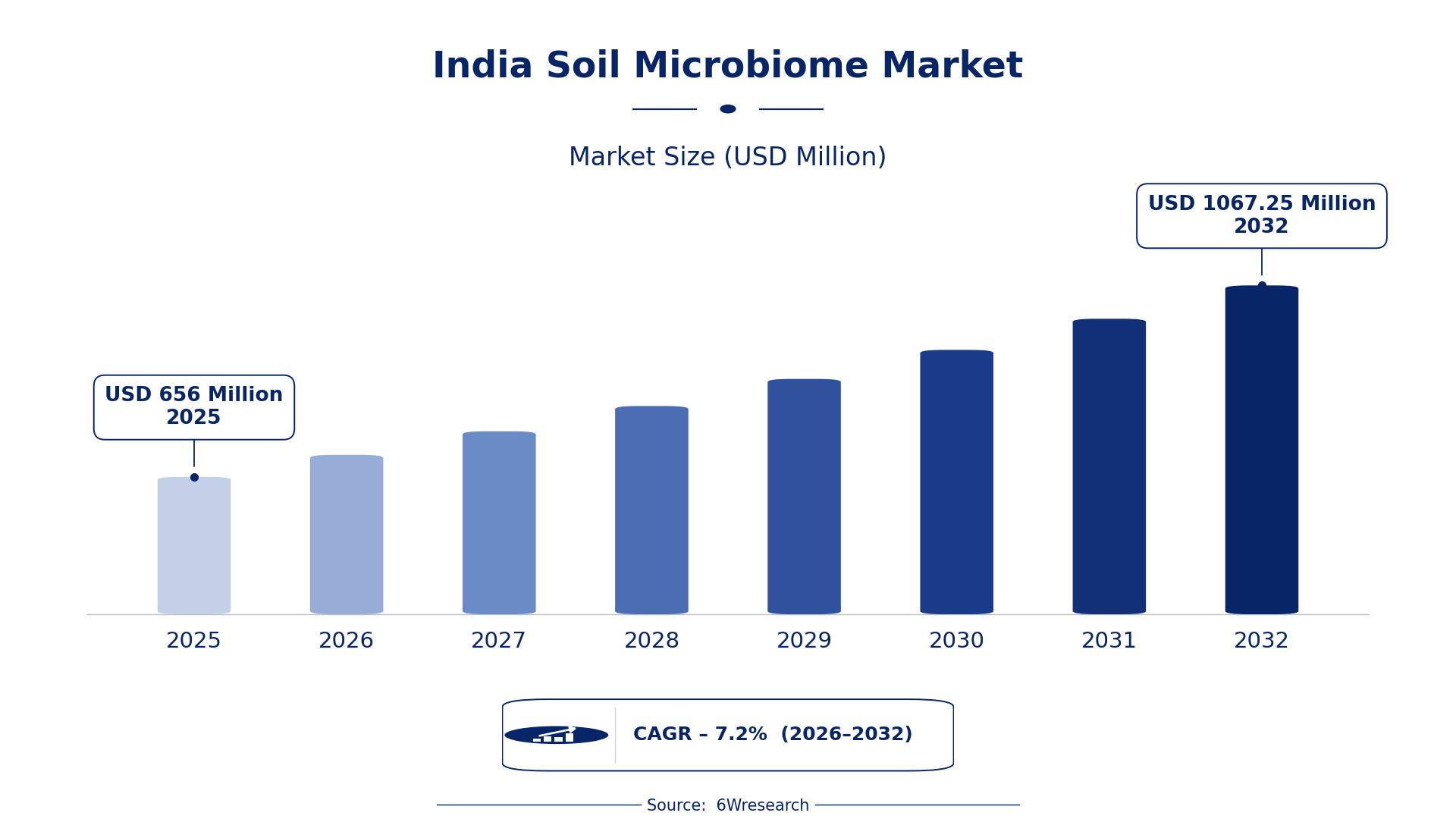
According to 6Wresearch internal database and industry insights, the India Soil Microbiome Market was valued at USD 656.0 million in 2025 and is projected to reach USD 1,067.25 million by 2032, growing at a CAGR of approximately 7.2% during 2026–2032.
India Soil Microbiome Market Highlights
| Report Metric | Details |
| Report Name | India Soil Microbiome Market |
| Market Size 2025 | USD 656.0 million |
| Market Size 2032 | USD 1,067.25 million |
| Absolute Growth 2025–2032 | USD 411.25 million |
| CAGR 2026–2032 | 7.2% |
| Peak Annual Growth | 9.5% in 2030 |
| Forecast Period | 2026–2032 |
| Historical Data | 2022–2025 |
| Base Year | 2025 |
| Leading Microbiome Element, 2025 | Rhizospheric Microbiome (52% share) |
| Leading Study Focus, 2025 | Plant-Microbe Interactions (42% share) |
| Leading Research Tool, 2025 | Genomic Sequencing (47% share) |
| Leading End User, 2025 | Soil Scientists (42% share) |
| Fastest-Growing Microbiome Element | Endophytes (9.9% CAGR) |
| Fastest-Growing Study Focus | Crop Productivity (9.6% CAGR) |
| Fastest-Growing Research Tool | Bioinformatics (8.7% CAGR) |
| Fastest-Growing End User | Crop Breeders (8.7% CAGR) |
| Growing Sector | Crop Breeders |
| Key End Users | Soil Scientists, Crop Breeders, Ag-Biotech Companies, Environmental NGOs |
India Soil Microbiome Market Year-wise Growth Rate and Key Drivers (2022–2032)
This graph illustrates the annual growth rates of the market from 2022 to 2032, highlighting a steady upward trajectory and projected market expansion over the forecast period.
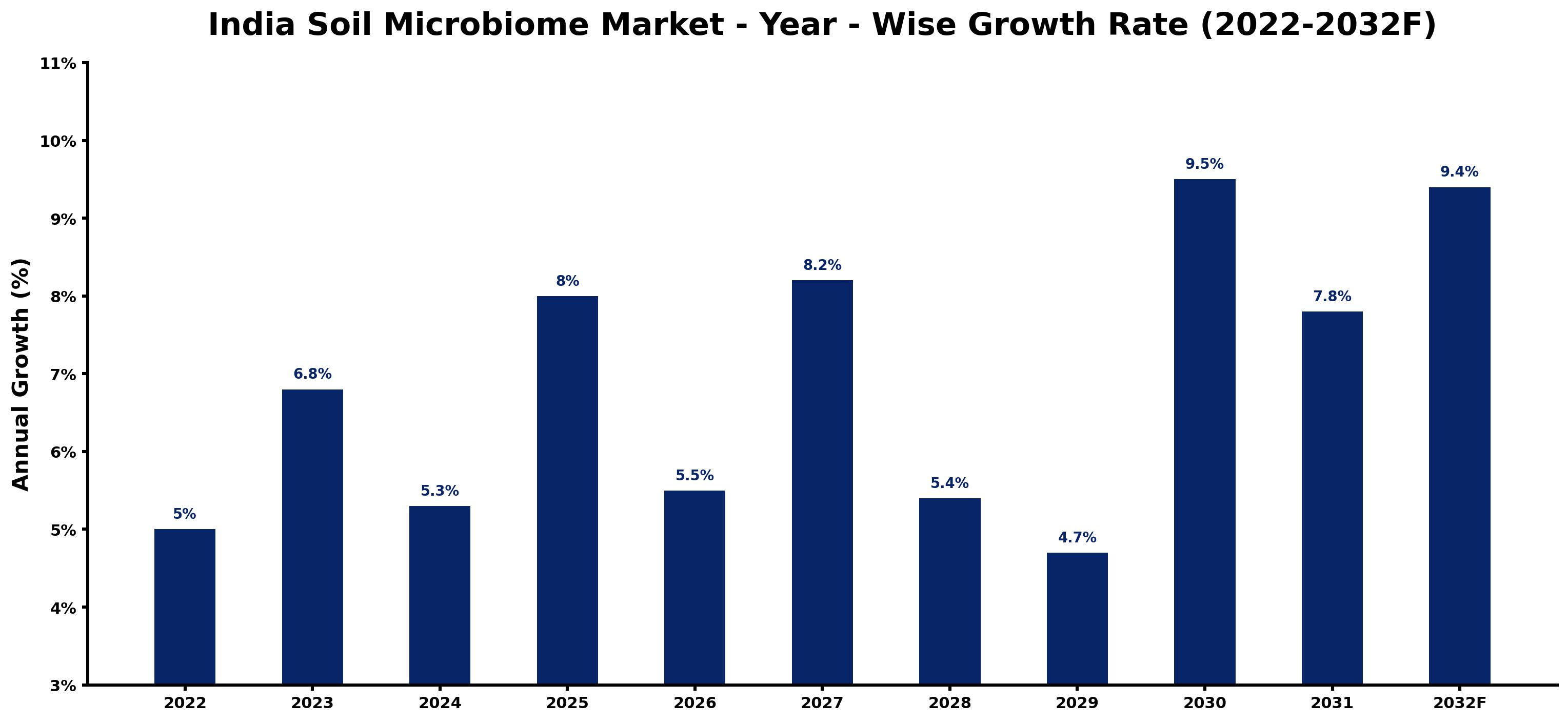
Annual growth estimates for each year appear below with the principal reason behind them, explaining the shifts that set the pace of the market.
| Year | Estimated Annual Growth (%) | Market Rationale |
| 2022 | 5.0 | The market showed steady growth due to the National Mission on Sustainable Agriculture promoting sustainable practices. |
| 2023 | 6.8 | Increased adoption of biofertilizers boosted demand for soil microbiome applications among farmers. |
| 2024 | 5.3 | Research advancements in microbiome technologies led to a slowdown in growth compared to the previous year. |
| 2025 | 8.0 | The market experienced a surge as farmers adopted biofertilizers derived from soil microbiomes. |
| 2026 | 5.5 | Growth slowed as the market adjusted to new regulations affecting microbiome research. |
| 2027 | 8.2 | Rising interest in crop resilience drove demand for endophytes and other microbiomes. |
| 2028 | 5.4 | The market grew at a slower pace as the focus shifted to regulatory compliance and training. |
| 2029 | 4.7 | Demand continued to slow as farmers awaited clearer guidelines on microbiome use from authorities. |
| 2030 | 9.5 | An increase in funding for soil health initiatives spurred rapid market growth in microbiome applications. |
| 2031 | 7.8 | Growth slowed as the market stabilised following peak investments in microbiome research. |
| 2032 | 9.4 | The market is expected to grow as new technologies and practices are adopted widely. |
Note: Market size estimations and growth projections presented in this report are based on 6Wresearch's proprietary forecasting methodology, utilizing the latest available industry data, government publications, and primary research inputs.
India Soil Microbiome Market Synopsis
Soil Microbiome in India includes a variety of microorganisms that contribute to nutrient cycling and boost crop yields. These microorganisms are crucial for maintaining soil health and supporting sustainable agricultural practices. The India Soil Microbiome Market is growing as agriculture increasingly relies on sustainable methods, with more than 60% of the population engaged in farming. Initiatives such as the National Mission on Sustainable Agriculture are driving demand for microbiome applications, resulting in considerable investments in research and development. The emphasis on biofertilizers and nitrogen-fixing bacteria is anticipated to improve agricultural productivity nationwide.
Market Dynamics Impact Analysis (2026–2032)
| Factor | Type | Impact | Primary Segment Affected |
| Increased demand for sustainable agriculture practices | Driver | High | Rhizospheric Microbiome |
| Growing interest in biofertilizers derived from soil microbiomes | Driver | High | Endophytes |
| Rising investments in agricultural research | Opportunity | High | Soil Scientists |
| Expansion of soil health initiatives across states | Opportunity | Medium | Ag-Biotech Companies |
| Limited awareness among farmers about microbiome benefits | Restraint | High | Symbiotic Bacteria |
| Regulatory challenges in microbiome research and application | Restraint | Medium | Mycorrhiza |
| High costs associated with advanced microbiome research | Challenge | High | Crop Breeders |
| Delays in regulatory approvals for microbiome products | Challenge | Medium | Environmental NGOs |
Evaluation of Drivers in India Soil Microbiome Market (2026–2032)
The main growth drivers and the segments they affect most are set out below.
| Drivers | Primary Segment Affected | Why It Matters (Evidence) |
| Growing adoption of biofertilizers | Rhizospheric Microbiome | This trend is driven by the need for sustainable farming, with over 140 million hectares of arable land in India. |
| Increased funding for agricultural research | Endophytes | The Indian Council of Agricultural Research supports projects that improve crop resilience through microbiomes. |
| Rising awareness of soil health benefits | Symbiotic Bacteria | Farmers are increasingly recognising the importance of nitrogen-fixing bacteria for sustainable agriculture, leading to greater adoption. |
| Expansion of soil health initiatives | Mycorrhiza | The Pradhan Mantri Krishi Sinchai Yojana promotes better irrigation and soil health practices, boosting demand for mycorrhizal technologies. |
| Technological advancements in genomic sequencing | Genomic Sequencing | Soil microbiome studies are increasingly utilising genomic techniques for better analysis and understanding of microbial diversity. |
Growth across the Soil Microbiome market in India is anchored in rising awareness of sustainable agriculture, increased funding for agricultural research, and the adoption of biofertilizers. The agricultural sector contributes approximately 18% to the national GDP, driving demand for soil microbiome applications. In 2022, over 60% of the population relied on agriculture for their livelihood, highlighting the sector's significance. The Indian Council of Agricultural Research supports projects that improve crop resilience through microbiome technologies. Additionally, the Pradhan Mantri Krishi Sinchai Yojana promotes better irrigation practices, further boosting demand for soil microbiomes.
Evaluation of Restraints in India Soil Microbiome Market
The following restraints limit how fast demand can grow.
| Market Restraint | Primary Segment Affected | Why It Matters (Evidence) |
| Limited awareness among farmers | Symbiotic Bacteria | Many farmers lack knowledge about the benefits of using nitrogen-fixing bacteria, hindering adoption. |
| Regulatory hurdles in microbiome research | Mycorrhiza | Strict regulations delay the development and application of mycorrhizal technologies in agriculture, impacting farmers' access. |
| High costs of advanced microbiome research | Crop Breeders | Research and development expenses can deter investment in microbiome applications for crop improvement, limiting options for buyers. |
| Slow adoption of new technologies | Endophytes | Farmers may be hesitant to adopt new practices without clear evidence of benefits, affecting overall productivity. |
| Insufficient training for soil scientists | Rhizospheric Microbiome | A lack of training limits the effective application of microbiome research in agricultural practices, reducing crop yields. |
India Soil Microbiome Market Challenges
The India Soil Microbiome Market encounters strict regulatory hurdles that delay product approvals, complicating compliance for producers and restricting the availability of soil microbiome solutions for farmers. This regulatory landscape can extend time-to-market by up to six months, causing farmers to miss optimal planting windows. Supply chain disruptions pose challenges, as sourcing quality microbial products remains inconsistent, leaving buyers without essential inputs during critical agricultural periods. Skills shortages in the agricultural workforce impede the effective application of microbiome technologies, resulting in diminished crop yields for over 60% of the population reliant on agriculture.
Trends in the India Soil Microbiome Market
Below mentioned are some of the trends shaping the India Soil Microbiome Market growth.
- Shift Towards Sustainable Farming Practices: Farmers are increasingly adopting sustainable practices, supported by the National Mission on Sustainable Agriculture, with over 60% of the population relying on agriculture for their livelihoods.
- Growing Use of Biofertilizers: Biofertilizers derived from soil microbiomes are gaining popularity among farmers, improving crop yields. In 2023, the use of these products increased by 15%, reflecting a shift in agricultural practices.
- Increased Research in Soil Microbiomes: Research institutions are focusing more on soil microbiome studies, with genomic sequencing becoming a standard tool. In 2023, the Soil Health Management Programme was updated to include microbiome research initiatives.
- Expansion of Soil Health Initiatives: The Indian government is promoting soil health through various initiatives, including the issuance of soil health cards. In 2022, over 140 million hectares of arable land were monitored for soil conditions.
Investment Opportunities in the India Soil Microbiome Market
Below are the investment opportunities with the strongest case in the India Soil Microbiome Market.
- Investment in Biofertilizer Production: With rising demand for biofertilizers, there is a chance to invest in production facilities. Farmers in Punjab are increasingly seeking these products to enhance soil health, with a market potential of USD 100 million.
- Development of Training Programs for Farmers: There is a demand for training programs to inform farmers about microbiome benefits. Agricultural NGOs can play a key role in delivering these initiatives, improving farmer knowledge and adoption rates.
- Research Collaborations with Universities: Partnering with universities for microbiome research can lead to innovative solutions. The Indian Institute of Soil Science is a prominent player in this research area, facilitating advancements in agricultural practices.
- Supply of Genomic Sequencing Tools: The demand for genomic sequencing tools is increasing as research expands. Agricultural research institutions require advanced tools to investigate microbial diversity, creating opportunities for suppliers.
Government Initiatives in the India Soil Microbiome Market
The National Biodiversity Action Plan (2003) highlighted the importance of preserving soil biodiversity. More recently, the Soil Health Management Programme (2023) was revised to include microbiome research initiatives, bolstering support for sustainable practices. Additionally, the Pradhan Mantri Krishi Sinchai Yojana (2015) aims to enhance irrigation and soil health, promoting the use of microbiomes in agriculture. These measures support sustainable farming practices and encourage the use of soil microbiomes in India.
In 2023, the Soil Health Management Programme received increased funding of INR 500 million to support microbiome research, administered by the Ministry of Agriculture and Farmers' Welfare. This programme focuses on improving soil health through various initiatives, including the issuance of soil health cards. The Indian Council of Agricultural Research (ICAR) also plays a significant role in funding research projects that explore the applications of soil microbiomes in agriculture. These agencies facilitate the development of standards and practices that benefit producers and buyers alike.
Future Insight of the India Soil Microbiome Market
The India Soil Microbiome Market is set to develop by 2032, driven by advancements in genomic techniques that enhance understanding of soil health. The updated Soil Health Management Programme will integrate microbiome research, equipping farmers with better tools for sustainable practices. The promotion of biofertilizers and nitrogen-fixing bacteria will enhance agricultural productivity across various states. With over 140 million hectares of arable land, the focus on soil microbiomes will likely lead to improved crop yields and increased farmer profitability.
Market Segmentation Analysis
The report offers a comprehensive study of the following market segments and their leading categories in the market.
By Microbiome Element – Rhizospheric Microbiome Dominated, Endophytes Expected to Grow Fastest
According to Summon Dutta, Assistant Manager at 6Wresearch, Rhizospheric Microbiome accounted for a 52% market share by microbiome element in 2025. The Rhizospheric Microbiome commands the largest market share due to its critical role in nutrient uptake and supporting plant health, which are essential for agricultural success. Farmers in Punjab, for instance, rely heavily on this microbiome to enhance crop yields and improve soil quality. Endophytes are set to record the highest CAGR in this split, 9.9% over 2026–2032. The Endophytes segment is witnessing rapid growth as awareness of their benefits in promoting plant growth and resilience to stress increases. Research initiatives are increasingly focusing on harnessing endophytes to improve crop resilience across various regions in India. Suppliers should focus on developing products that enhance rhizospheric microbiome health to meet the rising demands of farmers.
By Study Focus – Plant-Microbe Interactions Dominated, Crop Productivity Expected to Grow Fastest
In 2025, Plant-Microbe Interactions led the study focus split with a 42% share. Plant-Microbe Interactions hold the largest market share because they are vital for understanding the complex relationships that influence plant health and productivity. Research institutions are increasingly prioritising this area to support sustainable agricultural practices in India. Crop Productivity is projected to grow fastest, at a CAGR of 9.6% during 2026–2032. The Crop Productivity segment is growing the fastest, driven by its direct impact on agricultural output as farmers seek to maximise yields amid changing climatic conditions. This trend is supported by government initiatives aimed at enhancing crop production through microbiome applications. Buyers will benefit from investing in research that improves crop productivity through effective plant-microbe interactions.
By Research Tool – Genomic Sequencing Dominated, Bioinformatics Expected to Grow Fastest
With a 47% revenue share in 2025, Genomic Sequencing was the largest research tool category. Genomic Sequencing leads the market share as it is widely used for studying microbial diversity, providing essential insights into soil health. This method is increasingly adopted by research institutions to understand the complexities of soil microbiomes. Over 2026–2032, Bioinformatics are expected to post the fastest growth, at a CAGR of 8.7%. Bioinformatics is the fastest-growing segment, as it supports data analysis in microbiome research, allowing for more efficient interpretation of genomic data. The surge in genomic studies necessitates advanced bioinformatics tools to analyse the vast amounts of data generated. Suppliers should invest in bioinformatics solutions to cater to the increasing demand for data analysis in microbiome studies.
By End User – Soil Scientists Dominated, Crop Breeders Expected to Grow Fastest
Soil Scientists held a 42% share of the India Soil Microbiome Market by end user in 2025. Soil Scientists dominate the market share as they are key users in both research and practical applications of soil microbiomes, significantly influencing agricultural practices. Their expertise is crucial for implementing effective soil health strategies across India. The quickest growth will come from Crop Breeders, forecast to expand at a CAGR of 8.7% between 2026 and 2032. Crop Breeders are the fastest-growing segment, utilising microbiomes to develop resilient crops that can withstand environmental stresses. The demand for advanced breeding techniques, spurred by climate change impacts on agriculture, is driving this growth. Buyers should collaborate with crop breeders to leverage soil microbiomes for developing more resilient crop varieties.
Key Attractiveness of the Report
- 10 Years of Market Numbers
- Historical Data Starting from 2022 to 2025
- Base Year 2025
- Forecast Data until 2032
- Key Performance Indicators Impacting the Market
- Major Upcoming Developments and Projects
Key Highlights of the Report:
- India Soil Microbiome Market Outlook
- Market Size of India Soil Microbiome Market, 2025
- Forecast of India Soil Microbiome Market, 2032
- Historical Data and Forecast of India Soil Microbiome Revenues & Volume for the Period 2022 - 2032F
- India Soil Microbiome Market Trend Evolution
- India Soil Microbiome Market Drivers and Challenges
- India Soil Microbiome Price Trends
- India Soil Microbiome Porter's Five Forces
- India Soil Microbiome Industry Life Cycle
- Historical Data and Forecast of India Soil Microbiome Market Revenues & Volume By Microbiome Element for the Period 2022 - 2032F
- Historical Data and Forecast of India Soil Microbiome Market Revenues & Volume By Rhizospheric Microbiome for the Period 2022 - 2032F
- Historical Data and Forecast of India Soil Microbiome Market Revenues & Volume By Endophytes for the Period 2022 - 2032F
- Historical Data and Forecast of India Soil Microbiome Market Revenues & Volume By Symbiotic Bacteria for the Period 2022 - 2032F
- Historical Data and Forecast of India Soil Microbiome Market Revenues & Volume By Mycorrhiza for the Period 2022 - 2032F
- Historical Data and Forecast of India Soil Microbiome Market Revenues & Volume By Study Focus for the Period 2022 - 2032F
- Historical Data and Forecast of India Soil Microbiome Market Revenues & Volume By Plant-Microbe Interactions for the Period 2022 - 2032F
- Historical Data and Forecast of India Soil Microbiome Market Revenues & Volume By Crop Productivity for the Period 2022 - 2032F
- Historical Data and Forecast of India Soil Microbiome Market Revenues & Volume By Nitrogen Fixation for the Period 2022 - 2032F
- Historical Data and Forecast of India Soil Microbiome Market Revenues & Volume By Root Health for the Period 2022 - 2032F
- Historical Data and Forecast of India Soil Microbiome Market Revenues & Volume By Research Tool for the Period 2022 - 2032F
- Historical Data and Forecast of India Soil Microbiome Market Revenues & Volume By Genomic Sequencing for the Period 2022 - 2032F
- Historical Data and Forecast of India Soil Microbiome Market Revenues & Volume By Bioinformatics for the Period 2022 - 2032F
- Historical Data and Forecast of India Soil Microbiome Market Revenues & Volume By Culturing + qPCR for the Period 2022 - 2032F
- Historical Data and Forecast of India Soil Microbiome Market Revenues & Volume By Imaging + Profiling for the Period 2022 - 2032F
- Historical Data and Forecast of India Soil Microbiome Market Revenues & Volume By End User for the Period 2022 - 2032F
- Historical Data and Forecast of India Soil Microbiome Market Revenues & Volume By Soil Scientists for the Period 2022 - 2032F
- Historical Data and Forecast of India Soil Microbiome Market Revenues & Volume By Crop Breeders for the Period 2022 - 2032F
- Historical Data and Forecast of India Soil Microbiome Market Revenues & Volume By Ag-Biotech Companies for the Period 2022 - 2032F
- Historical Data and Forecast of India Soil Microbiome Market Revenues & Volume By Environmental NGOs for the Period 2022 - 2032F
- India Soil Microbiome Import Export Trade Statistics
- Market Opportunity Assessment By Microbiome Element
- Market Opportunity Assessment By Study Focus
- Market Opportunity Assessment By Research Tool
- Market Opportunity Assessment By End User
- India Soil Microbiome Top Companies Market Share
- India Soil Microbiome Competitive Benchmarking By Technical and Operational Parameters
- India Soil Microbiome Company Profiles
- India Soil Microbiome Key Strategic Recommendations
Market Covered
The report offers an extensive study of the following market segments.
By Microbiome Element
- Rhizospheric Microbiome
- Endophytes
- Symbiotic Bacteria
- Mycorrhiza
By Study Focus
- Plant-Microbe Interactions
- Crop Productivity
- Nitrogen Fixation
- Root Health
By Research Tool
- Genomic Sequencing
- Bioinformatics
- Culturing + qPCR
- Imaging + Profiling
By End User
- Soil Scientists
- Crop Breeders
- Ag-Biotech Companies
- Environmental NGOs































