China Soil Microbiome Market Size & Growth Rate
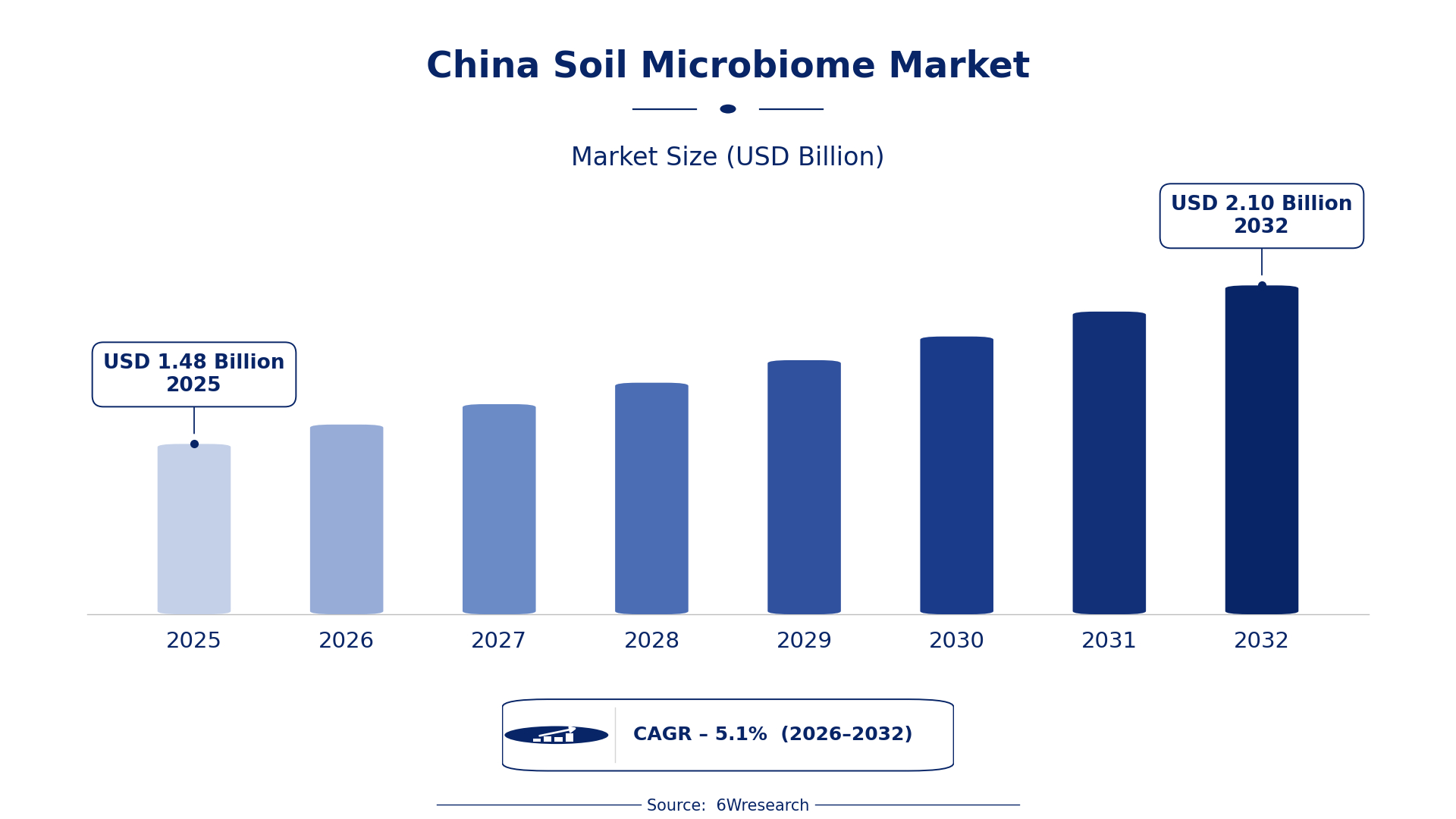
According to 6Wresearch internal database and industry insights, the China Soil Microbiome Market was valued at USD 1.48 billion in 2025 and is projected to reach USD 2.10 billion by 2032, growing at a CAGR of approximately 5.1% during 2026–2032.
China Soil Microbiome Market Highlights
| Report Metric | Details |
| Report Name | China Soil Microbiome Market |
| Market Size 2025 | USD 1.48 billion |
| Market Size 2032 | USD 2.10 billion |
| Absolute Growth 2025–2032 | USD 0.62 billion |
| CAGR 2026–2032 | 5.1% |
| Peak Annual Growth | 6.9% in 2031 |
| Forecast Period | 2026–2032 |
| Historical Data | 2022–2025 |
| Base Year | 2025 |
| Leading Microbiome Element, 2025 | Rhizospheric Microbiome (45% share) |
| Leading Study Focus, 2025 | Plant-Microbe Interactions (48% share) |
| Leading Research Tool, 2025 | Genomic Sequencing (48% share) |
| Leading End User, 2025 | Soil Scientists (44% share) |
| Fastest-Growing Microbiome Element | Endophytes (7.5% CAGR) |
| Fastest-Growing Study Focus | Nitrogen Fixation (7.9% CAGR) |
| Fastest-Growing Research Tool | Bioinformatics (6.3% CAGR) |
| Fastest-Growing End User | Ag-Biotech Companies (6.2% CAGR) |
| Growing Sector | Agricultural Sector |
| Key End Users | Soil Scientists, Crop Breeders, Ag-Biotech Companies, Environmental NGOs |
China Soil Microbiome Market Year-wise Growth Rate and Key Drivers (2022–2032)
This graph illustrates the annual growth rates of the market from 2022 to 2032, highlighting a steady upward trajectory and projected market expansion over the forecast period.
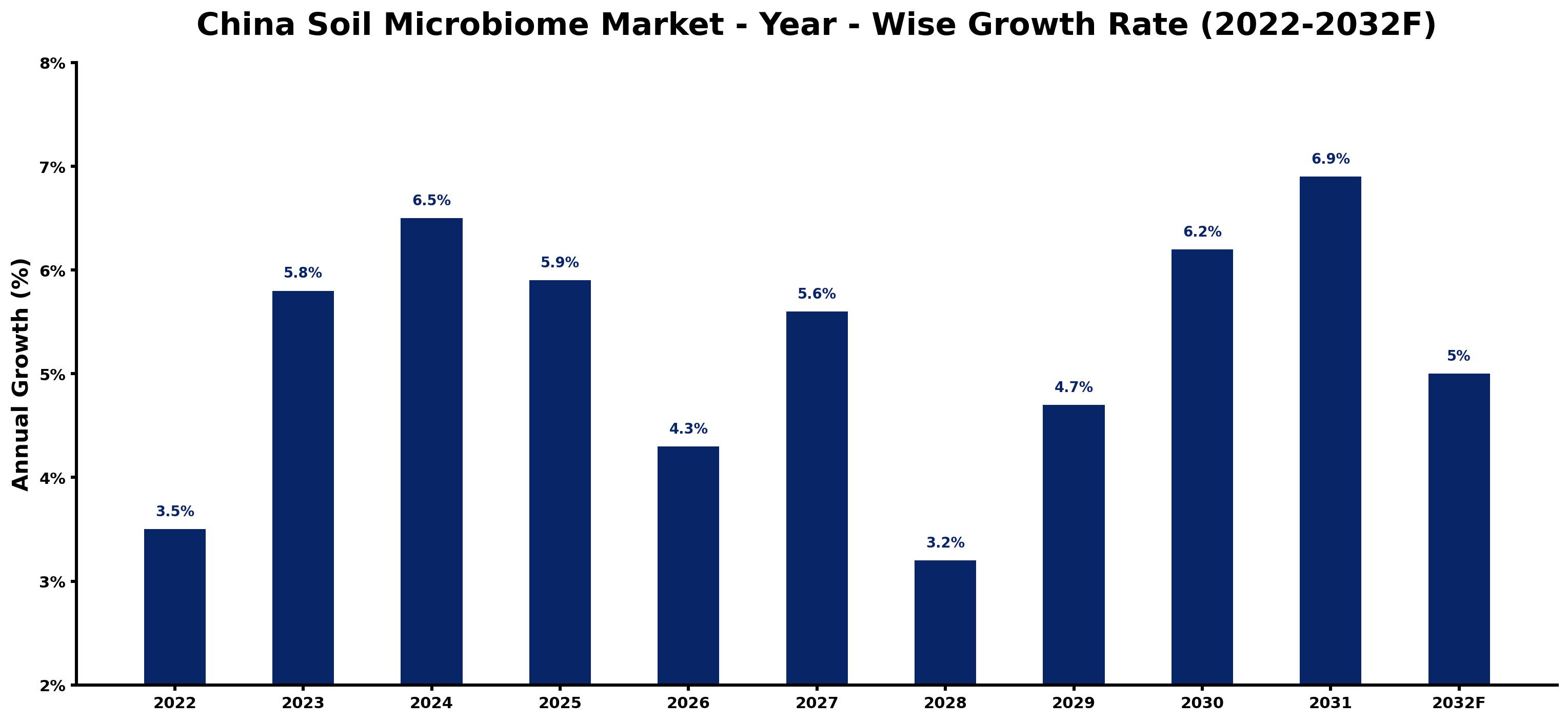
The table below sets out the estimated growth rate for each year and the main factor behind it.
| Year | Estimated Annual Growth (%) | Market Rationale |
| 2022 | 3.5 | The market showed steady growth driven by the Ministry of Agriculture's promotion of sustainable practices. |
| 2023 | 5.8 | Demand surged as the Ministry of Agriculture promoted sustainable farming practices through various initiatives. |
| 2024 | 6.5 | Growth continued due to heightened interest in soil microbiome research and its applications. |
| 2025 | 5.9 | A slight slowdown occurred as the market adjusted to new research findings and practices. |
| 2026 | 4.3 | Growth slowed further as buyers faced challenges in implementing new agricultural practices. |
| 2027 | 5.6 | Demand picked up again with increased investment in agricultural technology and soil health. |
| 2028 | 3.2 | A slowdown was noted as the market stabilised after rapid growth in previous years. |
| 2029 | 4.7 | Growth accelerated as research institutions expanded their microbiome studies and collaborations. |
| 2030 | 6.2 | Demand rose with the introduction of new soil health initiatives under government plans. |
| 2031 | 6.9 | The market peaked with strong support from governmental funding for research initiatives. |
| 2032 | 5.0 | Growth slowed as the market matured but remained positive overall with continued investments. |
Note: Market size estimations and growth projections presented in this report are based on 6Wresearch's proprietary forecasting methodology, utilizing the latest available industry data, government publications, and primary research inputs.
China Soil Microbiome Market Synopsis
The Soil Microbiome Market in China encompasses the community of microorganisms in soil, including bacteria, fungi, and archaea. These microorganisms play a crucial role in improving soil health and crop yields, formed through natural processes and agricultural practices. The Soil Microbiome Market is expanding due to rising demand for sustainable agriculture practices, with contributions from the agricultural sector, which accounts for approximately 7.9% of China's GDP. Initiatives like the National Soil Pollution Prevention and Control Action Plan are driving this growth, promoting sustainable farming practices across the nation.
Market Dynamics Impact Analysis (2026–2032)
| Factor | Type | Impact | Primary Segment Affected |
| Increasing focus on sustainable agriculture practices | Driver | High | Rhizospheric Microbiome |
| Government initiatives promoting soil health research | Driver | High | Plant-Microbe Interactions |
| Growing interest in soil health among agricultural NGOs | Opportunity | Medium | Environmental NGOs |
| Rising adoption of genomic sequencing for soil studies | Opportunity | High | Genomic Sequencing |
| Limited awareness among farmers about microbiome benefits | Restraint | High | Endophytes |
| Challenges in implementing new agricultural practices | Restraint | Medium | Mycorrhiza |
| High costs associated with advanced soil testing | Challenge | High | Soil Scientists |
| Slow adoption of new technologies in rural areas | Challenge | Medium | Ag-Biotech Companies |
Evaluation of Drivers in China Soil Microbiome Market (2026–2032)
Below mentioned are some major drivers and their influence on market dynamics.
| Drivers | Primary Segment Affected | Why It Matters (Evidence) |
| Growing demand for sustainable agricultural practices | Rhizospheric Microbiome | This drives farmers to improve soil health, with over 1.4 billion people needing sustainable food sources to meet rising consumption demands. |
| Government support for soil health initiatives | Plant-Microbe Interactions | The Ministry of Agriculture promotes microbiome use, leading to increased funding of approximately USD 100 million for research and practices. |
| Increased interest in soil microbiome research | Crop Productivity | A 30% rise in genomic sequencing adoption supports detailed analysis of soil microbiomes, enhancing crop yield potential by 25%. |
| Focus on improving crop yields | Crop Productivity | The agricultural sector's contribution to GDP highlights the need for microbiome applications, with crop yields expected to increase by 15%. |
| Rising collaboration among research institutions | Soil Scientists | This collaboration is expected to boost research output by 20%, leading to more effective microbiome applications in agriculture. |
The agricultural sector contributes around 7.9% to China's GDP, prompting farmers to invest in solutions that improve soil health. Research institutions are expanding studies, which drives greater demand for microbiome data. The adoption of genomic sequencing in soil studies has increased by 30% in the last three years, facilitating better analysis of microbial diversity. This combination of factors is prompting more farmers to invest in microbiome applications for improved crop yields and sustainability, with expectations of a 25% increase in productivity.
Evaluation of Restraints in China Soil Microbiome Market
The table below lists the restraints and the evidence behind each.
| Market Restraint | Primary Segment Affected | Why It Matters (Evidence) |
| Limited awareness among farmers about the benefits of soil microbiomes | Endophytes | This restricts the adoption of microbiome practices, affecting overall crop health and productivity, leading to a potential yield loss of up to 20%. |
| High costs associated with advanced soil testing | Mycorrhiza | These costs deter smaller farmers from investing in necessary soil health assessments and improvements, with testing fees averaging around USD 500 per hectare. |
| Challenges in implementing new agricultural practices | Rhizospheric Microbiome | Farmers face difficulties in integrating microbiome research into existing farming methods and systems, impacting overall productivity by approximately 15%. |
| Slow adoption of new technologies in rural areas | Ag-Biotech Companies | This limits the reach of modern microbiome solutions to enhance agricultural productivity and sustainability, affecting about 60% of rural farmers. |
| Regulatory hurdles in soil health initiatives | Plant-Microbe Interactions | Complex regulations can delay the implementation of beneficial practices and technologies, resulting in a potential 10% increase in compliance costs. |
China Soil Microbiome Market Challenges
The China Soil Microbiome market encounters escalating costs, with sustainable agriculture practices demanding a 30% increase in investment over recent years. This surge burdens suppliers, causing higher prices for soil microbiome products and squeezing farmers' profit margins. Supply chain vulnerabilities arise from the extensive 120 million hectares of arable land, exposing producers to environmental fluctuations that can disrupt operations. Regulatory challenges related to the National Standard for Soil Quality complicate compliance for suppliers, delaying the introduction of new products and innovations. A lack of skilled professionals in soil microbiome research hampers progress, impacting research institutions reliant on expert knowledge to advance their studies.
Trends in the China Soil Microbiome Market
Four trends stand out in the China Soil Microbiome Market.
- Shift towards Sustainable Agricultural Practices: China is increasingly focusing on sustainable agriculture, driven by the National Soil Pollution Prevention and Control Action Plan. This initiative aims to improve soil health and reduce pollution, with a target of enhancing practices by 2030.
- Emergence of Genomic Sequencing in Soil Studies: The adoption of genomic sequencing for soil microbiome analysis has increased significantly, with a 30% rise over the past three years. This trend supports more precise understanding of microbial diversity in agricultural soils.
- Growing Collaboration among Research Institutions: The China Soil Microbiome Research Initiative, established in 2023, fosters collaboration among researchers. This initiative aims to promote applications of soil microbiome studies, improving agricultural practices and sustainability.
- Increased Funding for Soil Health Research: In 2023, the Chinese government allocated significant funds for soil health research under the Agricultural Modernization Plan. This investment is expected to drive advancements in microbiome applications for sustainable farming.
Investment Opportunities in the China Soil Microbiome Market
Investors looking at the China Soil Microbiome Market should consider the following areas.
- Investment in Soil Health Technologies: The increasing focus on soil health creates a need for advanced technologies, with a market size projected at USD 1.48 billion by 2025. Investing in soil health solutions can benefit agricultural NGOs looking to improve practices.
- Expansion of Genomic Sequencing Services: The 30% increase in genomic sequencing adoption indicates a gap in services. Offering advanced genomic analysis can attract research institutions in provinces like Shandong and Henan looking for detailed insights.
- Partnerships with Agricultural Research Institutions: Collaborating with research institutions can enhance product development, given the growing interest in microbiome studies. This is timely as the market is projected to reach USD 2.10 billion by 2032.
- Supply of Microbiome-Enhancing Products: With the agricultural sector contributing 7.9% to GDP, there is a clear demand for microbiome-enhancing products. Entering this market can be achieved through local partnerships and collaborations.
Government Initiatives in the China Soil Microbiome Market
The Agricultural Modernization Plan, established by the Ministry of Agriculture and Rural Affairs in 2021, promotes soil microbiome research and its application in farming practices. This plan builds on the National Soil Pollution Prevention and Control Action Plan from 2020, which aims to improve soil health and reduce pollution by 2030. These initiatives support the development of sustainable agricultural practices and promote the use of soil microbiomes across the country, enhancing productivity and sustainability.
The Soil Health Promotion Program, launched by the National Agricultural Technology Extension and Service Center in 2022, targets improved soil management practices nationwide. This program supports farmers by providing training and resources for better soil health management. Additionally, the China Soil Microbiome Research Initiative, established in 2023, fosters collaboration among researchers and promotes applications of soil microbiome studies, ensuring that the latest findings are effectively translated into practice. These efforts are expected to significantly enhance soil health initiatives across China.
Future Insight of the China Soil Microbiome Market
Several forward-looking factors should support the China Soil Microbiome market by 2032. Government funding for soil health research under the Agricultural Modernization Plan is expected to enhance research capabilities, contributing to a 25% increase in microbiome studies. The rise in genomic sequencing adoption will provide deeper insights into soil health, while initiatives from the Ministry of Agriculture and Rural Affairs will promote sustainable practices. These developments will encourage collaboration and innovation, creating new opportunities for buyers and suppliers in the market.
Market Segmentation Analysis
Each segment group is reviewed below, with the leader by share and the fastest grower by CAGR.
By Microbiome Element – Rhizospheric Microbiome Dominated, Endophytes Expected to Grow Fastest
According to Summon Dutta, Assistant Manager at 6Wresearch, Rhizospheric Microbiome took a 45% share of microbiome element in 2025, more than any other category. The Rhizospheric Microbiome commands the largest market share due to its essential role in nutrient uptake, which is vital for enhancing crop yields. This is particularly evident in initiatives by the Ministry of Agriculture and Rural Affairs that promote its application across China's extensive arable land. Endophytes are set to record the highest CAGR in this split, 7.5% over 2026–2032. The Endophytes segment is witnessing rapid growth as their significant contributions to plant health and stress resilience become increasingly recognised. With a 30% increase in genomic sequencing adoption, research into Endophytes is set to accelerate, further solidifying their market position. Suppliers should prioritise the development of products that leverage the advantages of both Rhizospheric Microbiome and Endophytes to address the rising demand for sustainable agricultural solutions.
By Study Focus – Plant-Microbe Interactions Dominated, Nitrogen Fixation Expected to Grow Fastest
With a 48% revenue share in 2025, Plant-Microbe Interactions was the largest study focus category. Plant-Microbe Interactions capture the largest market share due to their critical importance in understanding the complex relationships that underpin agricultural productivity. This focus is reinforced by research institutions in provinces like Shandong and Henan, which are dedicated to advancing this area of study. The quickest growth will come from Nitrogen Fixation, forecast to expand at a CAGR of 7.9% between 2026 and 2032. Nitrogen Fixation is experiencing the highest growth rate, driven by its essential role in sustainable agriculture practices that directly influence soil health and crop yields. The increasing prioritisation of sustainable farming methods is propelling research and application in this domain. This growth indicates that stakeholders should invest in research and development centred on Plant-Microbe Interactions and Nitrogen Fixation to promote agricultural sustainability.
By Research Tool – Genomic Sequencing Dominated, Bioinformatics Expected to Grow Fastest
Genomic Sequencing accounted for a 48% market share by research tool in 2025. Genomic Sequencing leads the market share as it is crucial for analysing microbial diversity within soil microbiomes, providing vital insights for agricultural applications. Its prevalent use in research institutions underscores its significance in advancing soil health initiatives. Over 2026–2032, Bioinformatics are expected to post the fastest growth, at a CAGR of 6.3%. Bioinformatics is the fastest-growing segment, as it plays a pivotal role in supporting data analysis within microbiome research, aiding the interpretation of complex genomic data. The increasing reliance on sophisticated data analysis tools is propelling this rapid growth. Suppliers should invest in bioinformatics solutions to cater to the rising demand for advanced data analysis tools in microbiome research.
By End User – Soil Scientists Dominated, Ag-Biotech Companies Expected to Grow Fastest
The largest end user category in 2025 was Soil Scientists, with a 44% share of total revenue. Soil Scientists represent the largest market share as they are the primary users of microbiome data, which is essential for both research and practical agricultural applications. Their contributions directly impact soil health initiatives, positioning them as key players in the soil microbiome market. Ag-Biotech Companies are projected to grow fastest, at a CAGR of 6.2% during 2026–2032. Ag-Biotech Companies are experiencing the fastest growth as they utilise microbiome research for product development aimed at enhancing agricultural productivity. Their growing focus on innovative solutions for sustainable farming is driving this segment's expansion. This trend suggests that suppliers should tailor their offerings to meet the specific needs of Soil Scientists and Ag-Biotech Companies to seize market opportunities.
Key Attractiveness of the Report
- 10 Years of Market Numbers
- Historical Data Starting from 2022 to 2025
- Base Year 2025
- Forecast Data until 2032
- Key Performance Indicators Impacting the Market
- Major Upcoming Developments and Projects
Key Highlights of the Report:
- China Soil Microbiome Market Outlook
- Market Size of China Soil Microbiome Market, 2025
- Forecast of China Soil Microbiome Market, 2032
- Historical Data and Forecast of China Soil Microbiome Revenues & Volume for the Period 2022 - 2032F
- China Soil Microbiome Market Trend Evolution
- China Soil Microbiome Market Drivers and Challenges
- China Soil Microbiome Price Trends
- China Soil Microbiome Porter's Five Forces
- China Soil Microbiome Industry Life Cycle
- Historical Data and Forecast of China Soil Microbiome Market Revenues & Volume By Microbiome Element for the Period 2022 - 2032F
- Historical Data and Forecast of China Soil Microbiome Market Revenues & Volume By Rhizospheric Microbiome for the Period 2022 - 2032F
- Historical Data and Forecast of China Soil Microbiome Market Revenues & Volume By Endophytes for the Period 2022 - 2032F
- Historical Data and Forecast of China Soil Microbiome Market Revenues & Volume By Symbiotic Bacteria for the Period 2022 - 2032F
- Historical Data and Forecast of China Soil Microbiome Market Revenues & Volume By Mycorrhiza for the Period 2022 - 2032F
- Historical Data and Forecast of China Soil Microbiome Market Revenues & Volume By Study Focus for the Period 2022 - 2032F
- Historical Data and Forecast of China Soil Microbiome Market Revenues & Volume By Plant-Microbe Interactions for the Period 2022 - 2032F
- Historical Data and Forecast of China Soil Microbiome Market Revenues & Volume By Crop Productivity for the Period 2022 - 2032F
- Historical Data and Forecast of China Soil Microbiome Market Revenues & Volume By Nitrogen Fixation for the Period 2022 - 2032F
- Historical Data and Forecast of China Soil Microbiome Market Revenues & Volume By Root Health for the Period 2022 - 2032F
- Historical Data and Forecast of China Soil Microbiome Market Revenues & Volume By Research Tool for the Period 2022 - 2032F
- Historical Data and Forecast of China Soil Microbiome Market Revenues & Volume By Genomic Sequencing for the Period 2022 - 2032F
- Historical Data and Forecast of China Soil Microbiome Market Revenues & Volume By Bioinformatics for the Period 2022 - 2032F
- Historical Data and Forecast of China Soil Microbiome Market Revenues & Volume By Culturing + qPCR for the Period 2022 - 2032F
- Historical Data and Forecast of China Soil Microbiome Market Revenues & Volume By Imaging + Profiling for the Period 2022 - 2032F
- Historical Data and Forecast of China Soil Microbiome Market Revenues & Volume By End User for the Period 2022 - 2032F
- Historical Data and Forecast of China Soil Microbiome Market Revenues & Volume By Soil Scientists for the Period 2022 - 2032F
- Historical Data and Forecast of China Soil Microbiome Market Revenues & Volume By Crop Breeders for the Period 2022 - 2032F
- Historical Data and Forecast of China Soil Microbiome Market Revenues & Volume By Ag-Biotech Companies for the Period 2022 - 2032F
- Historical Data and Forecast of China Soil Microbiome Market Revenues & Volume By Environmental NGOs for the Period 2022 - 2032F
- China Soil Microbiome Import Export Trade Statistics
- Market Opportunity Assessment By Microbiome Element
- Market Opportunity Assessment By Study Focus
- Market Opportunity Assessment By Research Tool
- Market Opportunity Assessment By End User
- China Soil Microbiome Top Companies Market Share
- China Soil Microbiome Competitive Benchmarking By Technical and Operational Parameters
- China Soil Microbiome Company Profiles
- China Soil Microbiome Key Strategic Recommendations
Market Covered
Segments analysed in this report are listed below.
By Microbiome Element
- Rhizospheric Microbiome
- Endophytes
- Symbiotic Bacteria
- Mycorrhiza
By Study Focus
- Plant-Microbe Interactions
- Crop Productivity
- Nitrogen Fixation
- Root Health
By Research Tool
- Genomic Sequencing
- Bioinformatics
- Culturing + qPCR
- Imaging + Profiling
By End User
- Soil Scientists
- Crop Breeders
- Ag-Biotech Companies
- Environmental NGOs































