India Specialty Crop Nutrition Market Size & Growth Rate
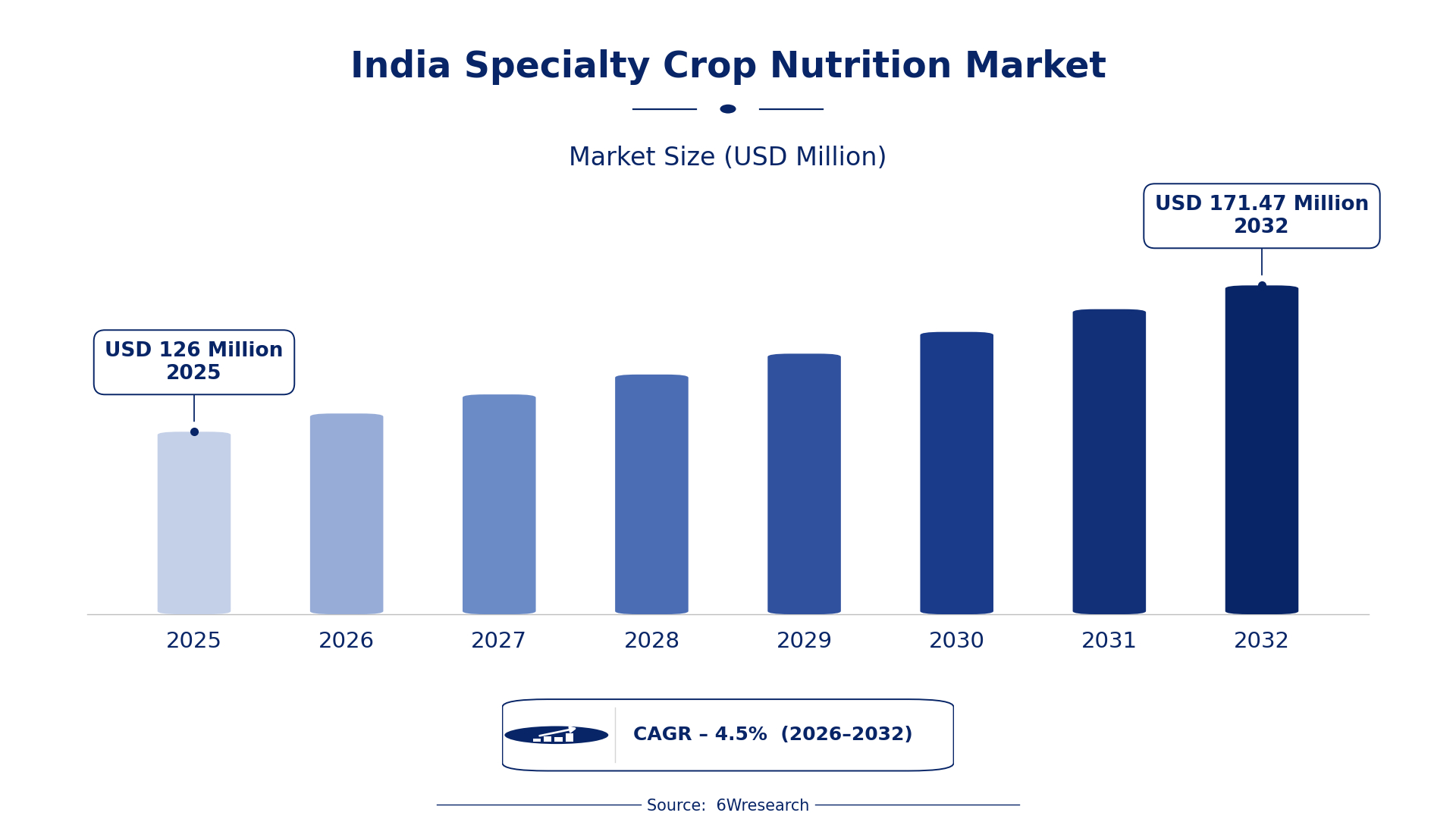
According to 6Wresearch internal database and industry insights, the India Specialty Crop Nutrition Market was valued at USD 126.0 million in 2025 and is projected to reach USD 171.47 million by 2032, growing at a CAGR of approximately 4.5% during 2026–2032.
India Specialty Crop Nutrition Market Highlights
| Report Metric | Details |
| Report Name | India Specialty Crop Nutrition Market |
| Market Size 2025 | USD 126.0 million |
| Market Size 2032 | USD 171.47 million |
| Absolute Growth 2025–2032 | USD 45.47 million |
| CAGR 2026–2032 | 4.5% |
| Peak Annual Growth | 6.9% in 2028 |
| Forecast Period | 2026–2032 |
| Historical Data | 2022–2025 |
| Base Year | 2025 |
| Leading Nutrient Type, 2025 | Micronutrient Mixes (37% share) |
| Leading Crop Type, 2025 | Fruits & Vegetables (47% share) |
| Leading Formulation Type, 2025 | Liquid/Soluble (46% share) |
| Leading End User, 2025 | Horticulture Growers (34% share) |
| Fastest-Growing Nutrient Type | Bio-Stimulants (6.1% CAGR) |
| Fastest-Growing Crop Type | High-Value Crops (7.2% CAGR) |
| Fastest-Growing Formulation Type | Foliar Spray (6.5% CAGR) |
| Fastest-Growing End User | Vertical Farming Units (5.7% CAGR) |
| Growing Sector | Horticulture |
| Key End Users | Horticulture Growers, Organic Farm Operators, Vertical Farming Units, Precision Agri-Farms |
India Specialty Crop Nutrition Market Year-wise Growth Rate and Key Drivers (2022–2032)
This graph illustrates the annual growth rates of the market from 2022 to 2032, highlighting a steady upward trajectory and projected market expansion over the forecast period.
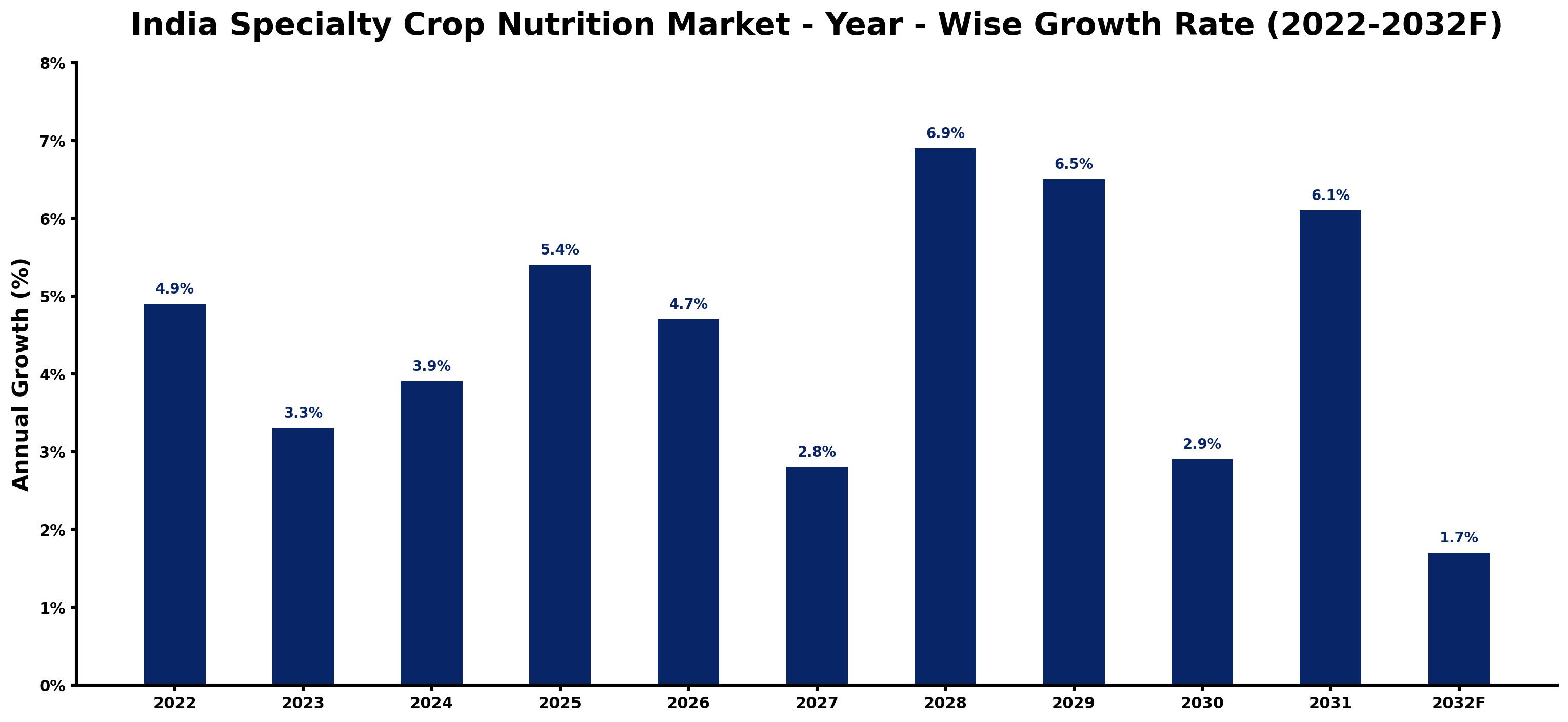
Below, each year's estimated growth is shown next to the factor that most influenced it.
| Year | Estimated Annual Growth (%) | Market Rationale |
| 2022 | 4.9 | The market showed steady growth with increasing interest in specialty crop nutrition products driven by the National Horticulture Mission. |
| 2023 | 3.3 | Growth slowed as farmers adjusted to market conditions and input costs rose, particularly affecting horticulture growers. |
| 2024 | 3.9 | Demand improved as more growers adopted advanced nutrient solutions for better yields, especially in Maharashtra. |
| 2025 | 5.4 | The market peaked with heightened focus on horticulture and high-value crops, supported by the Soil Health Card Scheme. |
| 2026 | 4.7 | Growth is expected to slow as farmers face challenges in balancing nutrient applications effectively due to regulatory compliance. |
| 2027 | 2.8 | Demand is projected to continue slowing as market saturation begins to affect purchasing behaviour among horticulture growers. |
| 2028 | 6.9 | A surge in growth is expected due to increased investments in bio-stimulants and micronutrients, improving crop resilience. |
| 2029 | 6.5 | Growth is projected to slow slightly as buyers become more selective in their purchases of specialty crop nutrition products. |
| 2030 | 2.9 | Demand is expected to continue slowing as the market stabilises after rapid growth phases in urban horticulture. |
| 2031 | 6.1 | Growth is projected to pick up again as new innovations in nutrient formulations emerge, particularly in high-value crops. |
| 2032 | 1.7 | The market growth rate is expected to slow as maturity sets in and competition increases for specialty products. |
Note: Market size estimations and growth projections presented in this report are based on 6Wresearch's proprietary forecasting methodology, utilizing the latest available industry data, government publications, and primary research inputs.
India Specialty Crop Nutrition Market Synopsis
Specialty Crop Nutrition in India includes products designed to promote crop growth through targeted nutrient delivery. These encompass micronutrients, bio-stimulants, and customised blends aimed at improving yield quality. The India Specialty Crop Nutrition Market is expanding, driven by rising demand from horticulture and high-value crop sectors, particularly influenced by the National Horticulture Mission. This growth reflects a strong focus on quality produce and sustainable agricultural practices, with the horticulture sector contributing approximately 30% to the agricultural GDP.
Market Dynamics Impact Analysis (2026–2032)
| Factor | Type | Impact | Primary Segment Affected |
| Increasing adoption of bio-stimulants among horticulture growers | Driver | High | Bio-Stimulants |
| Rising demand for micronutrient mixes to address deficiencies | Driver | High | Micronutrient Mixes |
| Growing interest in organic farming practices | Opportunity | Medium | Organic Farm Operators |
| Expansion of vertical farming units in urban areas | Opportunity | Medium | Vertical Farming Units |
| Regulatory challenges in product approvals | Restraint | High | Chelated Fertilizers |
| High production costs affecting affordability | Restraint | Medium | Custom NPK Blends |
| Limited awareness of specialty crop nutrition benefits | Challenge | High | Horticulture Growers |
| Dependence on traditional farming practices | Challenge | Medium | High-Value Crops |
Evaluation of Drivers in India Specialty Crop Nutrition Market (2026–2032)
The table below links each growth driver to the segment it affects and the evidence for it.
| Drivers | Primary Segment Affected | Why It Matters (Evidence) |
| Increasing demand for high-quality fruits and vegetables | Fruits & Vegetables | This trend increases purchases of specialty nutrients to improve yield and quality, with the horticulture sector contributing approximately 30% to agricultural GDP. |
| Growing interest in bio-stimulants for crop resilience | Bio-Stimulants | The availability of over 1,000 registered bio-stimulant products boosts farmer confidence, leading to higher purchases in Maharashtra and Karnataka. |
| Focus on maximizing profitability in high-value crops | High-Value Crops | Farmers are investing in tailored nutrient solutions to improve productivity and returns, particularly in states like Maharashtra and Karnataka. |
| Government support through initiatives like the National Horticulture Mission | Horticulture Growers | This initiative promotes improved nutrient management practices, encouraging growers to invest in specialty crop nutrition products. |
| Increased consumer demand for organic produce | Organic Farm Operators | The anticipated growth of organic farming to 3 million hectares by 2025 drives the need for organic specialty nutrients. |
Market growth in India for Specialty Crop Nutrition rests on strong end-use demand for high-quality fruits and vegetables, prompting farmers to invest in specialty nutrients. The horticulture sector contributes significantly to agricultural GDP, driving purchases of tailored nutrient solutions. The growing availability of registered bio-stimulant products boosts farmer confidence, leading to increased adoption among horticulture growers. The expected expansion of organic farming to 3 million hectares by 2025 creates substantial demand for organic specialty nutrients, which opens new opportunities for suppliers.
Evaluation of Restraints in India Specialty Crop Nutrition Market
The following restraints limit how fast demand can grow.
| Market Restraint | Primary Segment Affected | Why It Matters (Evidence) |
| Regulatory challenges in obtaining product approvals | Chelated Fertilizers | The Fertilizer Control Order complicates the approval process, delaying product launches and affecting availability for growers. |
| High production costs impacting affordability | Custom NPK Blends | Rising input costs make specialty fertilizers less accessible for smallholders, limiting market reach and growth potential. |
| Limited consumer awareness of specialty crop nutrition benefits | Horticulture Growers | Many growers remain unaware of the advantages of using specialty products, hindering market expansion and adoption. |
| Dependence on traditional farming practices | High-Value Crops | Farmers often resist adopting new technologies, which slows the uptake of specialty crop nutrition solutions among producers. |
| Inconsistent quality of specialty fertilizers | Micronutrient Mixes | Variability in product quality can lead to distrust among buyers, affecting overall sales and market confidence. |
India Specialty Crop Nutrition Market Challenges
The India Specialty Crop Nutrition Market encounters several practical problems, with technology adoption being a primary hurdle. Many farmers lack access to advanced formulations, which limits their ability to enhance crop yields effectively. Buyers in the horticulture sector face challenges with inconsistent quality, as over 1,000 registered bio-stimulant products vary widely in standards, undermining supplier trust. Cost pressures arise from compliance with the Fertilizer Control Order, increasing expenses for producers and raising prices for buyers, which can reach up to 15% higher than expected. Competition from imported specialty fertilizers, which generated ₹1,500 crores in exports in 2022, further complicates the landscape for domestic producers.
Trends in the India Specialty Crop Nutrition Market
The trends below show where the India Specialty Crop Nutrition Market is heading.
- Shift Towards Bio-Stimulants: The Indian market is increasingly favouring bio-stimulants, with over 1,000 registered products available as of 2023. This shift reflects a growing recognition of their benefits in improving crop resilience, prompting growers to adopt these solutions.
- Rise in Organic Farming: Organic farming in India is expected to reach 3 million hectares by 2025, boosting demand for specialty nutrients. This trend highlights the increasing consumer preference for organic produce and the need for tailored nutrient solutions.
- Increased Focus on Precision Agriculture: The adoption of precision agriculture practices is on the rise, particularly among vertical farming units. This approach improves nutrient management, leading to more efficient use of specialty crop nutrition products and better yields.
- Growth of Urban Horticulture: Urban horticulture is expanding rapidly, driven by the need for fresh produce in cities. This trend is prompting increased sales of specialty crop nutrition products tailored for urban growers, reflecting changing consumer preferences.
Investment Opportunities in the India Specialty Crop Nutrition Market
Some of the investment opportunities in the India Specialty Crop Nutrition Market are mentioned below.
- Horticulture Growers Seeking Quality Inputs: Horticulture growers are increasingly looking for high-quality specialty nutrients to improve crop yield and quality. With the market projected to reach ₹171.47 million by 2032, suppliers can benefit from this growing demand by offering tailored solutions.
- Supply of Organic Specialty Nutrients: With organic farming projected to reach 3 million hectares by 2025, there is an opportunity to supply organic specialty nutrients. Collaborating with organic farm operators can facilitate market entry and growth in this segment.
- Investment in Bio-Stimulants: The increasing adoption of bio-stimulants presents an opportunity for investment in this segment. Suppliers can target horticulture growers who are keen on improving crop resilience and yield through advanced formulations.
- Development of Tailored Nutrient Solutions: With high-value crops gaining traction, there is a need for customised nutrient solutions. Suppliers can engage with precision agri-farms to develop products that meet specific crop requirements and enhance profitability.
Government Initiatives in the India Specialty Crop Nutrition Market
The 'Soil Health Card Scheme' by the Ministry of Agriculture, launched in 2015, promotes balanced fertilisation and nutrient management for farmers. This measure complements the 'National Mission for Sustainable Agriculture', which focuses on enhancing productivity while ensuring sustainability through nutrient management practices since 2020. Together, these initiatives support the adoption of specialty crop nutrition products, enabling farmers to improve crop quality and yield.
The 'National Horticulture Mission' supports the production of high-value crops through improved nutrient management practices. The Ministry of Agriculture oversees this initiative, providing funding for projects aimed at boosting horticultural productivity and quality, benefiting farmers who adopt these practices. The 'Fertilizer Subsidy Scheme' continues to provide financial assistance for the purchase of fertilizers, including specialty products, making them more accessible to growers.
Future Insight of the India Specialty Crop Nutrition Market
The India Specialty Crop Nutrition Market is poised for notable changes by 2032, driven by supportive government initiatives and advancements in technology. The Soil Health Card Scheme will promote balanced nutrient application, enhancing crop productivity across the sector. Organic farming is projected to expand, significantly boosting demand for specialty nutrients. Research initiatives by the Indian Council of Agricultural Research will lead to enhanced product offerings, providing buyers with better options and suppliers with opportunities to innovate and capture market share.
Market Segmentation Analysis
The analysis below covers each segmentation, its leading category in 2025 and its fastest-growing category through 2032.
By Nutrient Type – Micronutrient Mixes Dominated, Bio-Stimulants Expected to Grow Fastest
According to Summon Dutta, Assistant Manager at 6Wresearch, Micronutrient Mixes held a 37% share of the India Specialty Crop Nutrition Market by nutrient type in 2025. Micronutrient mixes lead the India Specialty Crop Nutrition Market as they are crucial for addressing nutrient deficiencies in crops, particularly in horticulture. Their prevalence is underscored by the extensive range of over 1,000 registered bio-stimulant products available in the country. Over 2026–2032, Bio-Stimulants are expected to post the fastest growth, at a CAGR of 6.1%. Bio-stimulants are experiencing rapid growth because they effectively promote plant growth and resilience against stress, which aligns with the increasing shift towards sustainable agricultural practices. The projected expansion of organic farming to 3 million hectares by 2025 significantly contributes to this sub-segment's rise. Suppliers should prioritise the development of bio-stimulant products to meet the growing demand in the specialty crop nutrition market.
By Crop Type – Fruits & Vegetables Dominated, High-Value Crops Expected to Grow Fastest
Fruits & Vegetables took a 47% share of crop type in 2025, more than any other category. Fruits and vegetables command the largest market share in India due to the high demand for quality produce in urban markets, where health-conscious consumers are driving purchasing decisions. This segment's significance is further illustrated by the horticulture sector's contribution of approximately 30% to the agricultural GDP. The quickest growth will come from High-Value Crops, forecast to expand at a CAGR of 7.2% between 2026 and 2032. High-value crops are witnessing the fastest growth as farmers focus on maximising profitability through premium products. Initiatives such as the National Horticulture Mission, which aims to enhance production and productivity, play a crucial role in propelling this segment forward. Buyers should consider investing in high-value crop nutrition solutions to capitalise on market trends and consumer preferences.
By Formulation Type – Liquid/Soluble Dominated, Foliar Spray Expected to Grow Fastest
Liquid/Soluble accounted for a 46% market share by formulation type in 2025. Liquid/soluble formulations dominate the specialty crop nutrition market due to their preference for quick nutrient absorption, essential for effective crop management. This trend is particularly evident among horticulture growers who require immediate results from their nutrition products. Foliar Spray is set to record the highest CAGR in this split, 6.5% over 2026–2032. Foliar spray formulations are rapidly gaining traction as they provide effective immediate nutrient delivery, making them a popular choice among growers seeking swift solutions. The increasing emphasis on precision agriculture further fuels the expansion of this segment. Suppliers must innovate in foliar spray formulations to attract growers looking for effective and immediate crop nutrition solutions.
By End User – Horticulture Growers Dominated, Vertical Farming Units Expected to Grow Fastest
In 2025, Horticulture Growers led the end user split with a 34% share. Horticulture growers account for the largest market share as they are the primary users of specialty nutrition products, driven by the need for improved crop quality and yield. Their critical role in the agricultural sector highlights the necessity for tailored nutrient solutions for this user group. Vertical Farming Units are projected to grow fastest, at a CAGR of 5.7% during 2026–2032. Vertical farming units are experiencing the fastest growth due to the rising interest in urban agriculture and the demand for efficient crop production methods. This trend is supported by the increasing urban population and the corresponding need for fresh produce. Suppliers should tailor their offerings to meet the unique needs of vertical farming units as urban agriculture continues to expand.
Key Attractiveness of the Report
- 10 Years of Market Numbers
- Historical Data Starting from 2022 to 2025
- Base Year 2025
- Forecast Data until 2032
- Key Performance Indicators Impacting the Market
- Major Upcoming Developments and Projects
Key Highlights of the Report:
- India Specialty Crop Nutrition Market Outlook
- Market Size of India Specialty Crop Nutrition Market, 2025
- Forecast of India Specialty Crop Nutrition Market, 2032
- Historical Data and Forecast of India Specialty Crop Nutrition Revenues & Volume for the Period 2022 - 2032F
- India Specialty Crop Nutrition Market Trend Evolution
- India Specialty Crop Nutrition Market Drivers and Challenges
- India Specialty Crop Nutrition Price Trends
- India Specialty Crop Nutrition Porter's Five Forces
- India Specialty Crop Nutrition Industry Life Cycle
- Historical Data and Forecast of India Specialty Crop Nutrition Market Revenues & Volume By Nutrient Type for the Period 2022 - 2032F
- Historical Data and Forecast of India Specialty Crop Nutrition Market Revenues & Volume By Micronutrient Mixes for the Period 2022 - 2032F
- Historical Data and Forecast of India Specialty Crop Nutrition Market Revenues & Volume By Bio-Stimulants for the Period 2022 - 2032F
- Historical Data and Forecast of India Specialty Crop Nutrition Market Revenues & Volume By Chelated Fertilizers for the Period 2022 - 2032F
- Historical Data and Forecast of India Specialty Crop Nutrition Market Revenues & Volume By Custom NPK Blends for the Period 2022 - 2032F
- Historical Data and Forecast of India Specialty Crop Nutrition Market Revenues & Volume By Crop Type for the Period 2022 - 2032F
- Historical Data and Forecast of India Specialty Crop Nutrition Market Revenues & Volume By Fruits & Vegetables for the Period 2022 - 2032F
- Historical Data and Forecast of India Specialty Crop Nutrition Market Revenues & Volume By High-Value Crops for the Period 2022 - 2032F
- Historical Data and Forecast of India Specialty Crop Nutrition Market Revenues & Volume By Leafy Greens for the Period 2022 - 2032F
- Historical Data and Forecast of India Specialty Crop Nutrition Market Revenues & Volume By Plantation Crops for the Period 2022 - 2032F
- Historical Data and Forecast of India Specialty Crop Nutrition Market Revenues & Volume By Formulation Type for the Period 2022 - 2032F
- Historical Data and Forecast of India Specialty Crop Nutrition Market Revenues & Volume By Liquid/Soluble for the Period 2022 - 2032F
- Historical Data and Forecast of India Specialty Crop Nutrition Market Revenues & Volume By Granular for the Period 2022 - 2032F
- Historical Data and Forecast of India Specialty Crop Nutrition Market Revenues & Volume By Foliar Spray for the Period 2022 - 2032F
- Historical Data and Forecast of India Specialty Crop Nutrition Market Revenues & Volume By Controlled Release for the Period 2022 - 2032F
- Historical Data and Forecast of India Specialty Crop Nutrition Market Revenues & Volume By End User for the Period 2022 - 2032F
- Historical Data and Forecast of India Specialty Crop Nutrition Market Revenues & Volume By Horticulture Growers for the Period 2022 - 2032F
- Historical Data and Forecast of India Specialty Crop Nutrition Market Revenues & Volume By Organic Farm Operators for the Period 2022 - 2032F
- Historical Data and Forecast of India Specialty Crop Nutrition Market Revenues & Volume By Vertical Farming Units for the Period 2022 - 2032F
- Historical Data and Forecast of India Specialty Crop Nutrition Market Revenues & Volume By Precision Agri-Farms for the Period 2022 - 2032F
- India Specialty Crop Nutrition Import Export Trade Statistics
- Market Opportunity Assessment By Nutrient Type
- Market Opportunity Assessment By Crop Type
- Market Opportunity Assessment By Formulation Type
- Market Opportunity Assessment By End User
- India Specialty Crop Nutrition Top Companies Market Share
- India Specialty Crop Nutrition Competitive Benchmarking By Technical and Operational Parameters
- India Specialty Crop Nutrition Company Profiles
- India Specialty Crop Nutrition Key Strategic Recommendations
Market Covered
Segments analysed in this report are listed below.
By Nutrient Type
- Micronutrient Mixes
- Bio-Stimulants
- Chelated Fertilizers
- Custom NPK Blends
By Crop Type
- Fruits & Vegetables
- High-Value Crops
- Leafy Greens
- Plantation Crops
By Formulation Type
- Liquid/Soluble
- Granular
- Foliar Spray
- Controlled Release
By End User
- Horticulture Growers
- Organic Farm Operators
- Vertical Farming Units
- Precision Agri-Farms































