China Specialty Crop Nutrition Market Size & Growth Rate
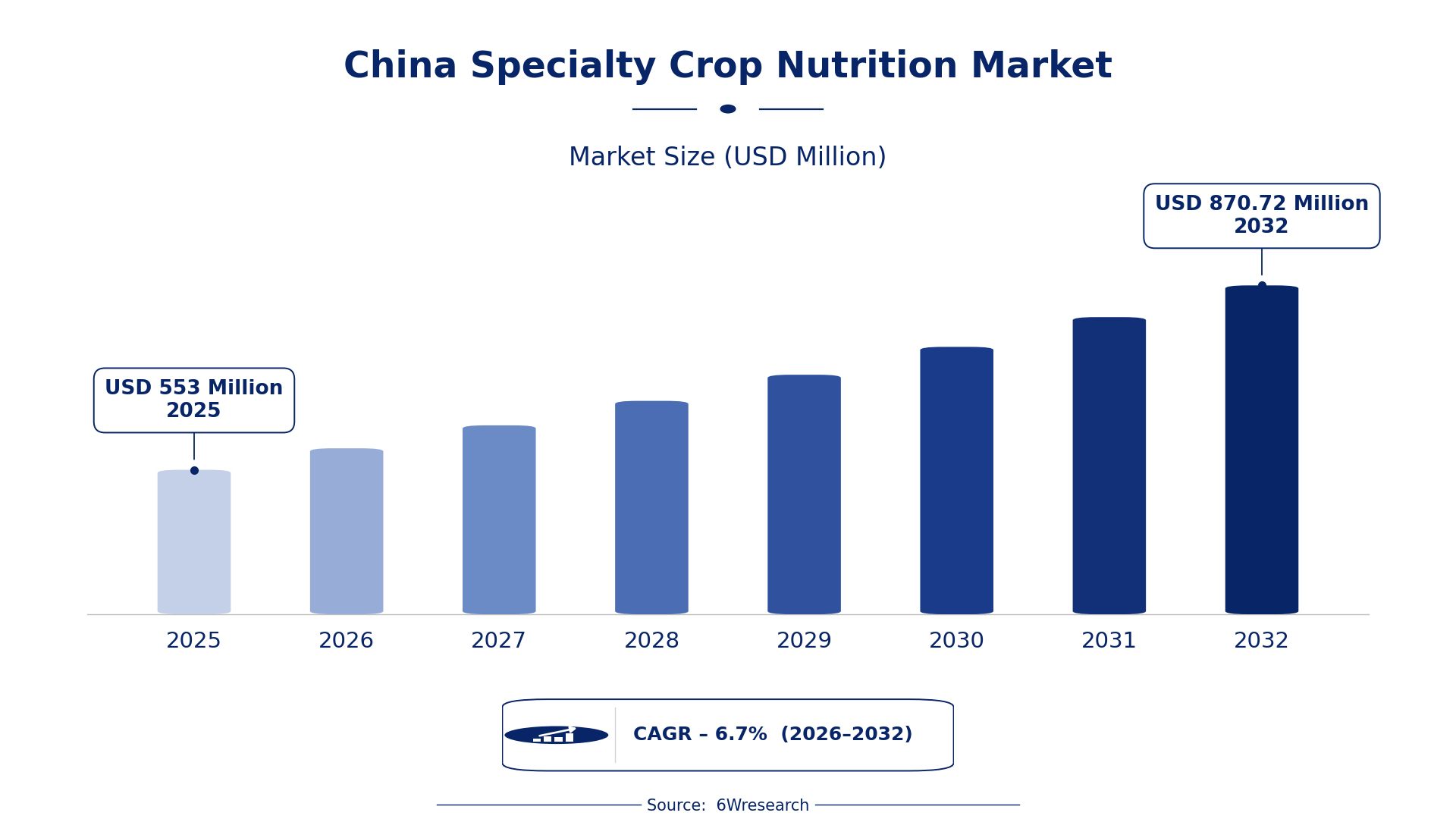
According to 6Wresearch internal database and industry insights, the China Specialty Crop Nutrition Market was valued at USD 553.0 million in 2025 and is projected to reach USD 870.72 million by 2032, growing at a CAGR of approximately 6.7% during 2026–2032.
China Specialty Crop Nutrition Market Highlights
| Report Metric | Details |
| Report Name | China Specialty Crop Nutrition Market |
| Market Size 2025 | USD 553.0 million |
| Market Size 2032 | USD 870.72 million |
| Absolute Growth 2025–2032 | USD 317.72 million |
| CAGR 2026–2032 | 6.7% |
| Peak Annual Growth | 8.7% in 2030 |
| Forecast Period | 2026–2032 |
| Historical Data | 2022–2025 |
| Base Year | 2025 |
| Leading Nutrient Type, 2025 | Micronutrient Mixes (40% share) |
| Leading Crop Type, 2025 | Fruits & Vegetables (39% share) |
| Leading Formulation Type, 2025 | Liquid/Soluble (46% share) |
| Leading End User, 2025 | Horticulture Growers (41% share) |
| Fastest-Growing Nutrient Type | Bio-Stimulants (8.6% CAGR) |
| Fastest-Growing Crop Type | High-Value Crops (9.3% CAGR) |
| Fastest-Growing Formulation Type | Foliar Spray (8.2% CAGR) |
| Fastest-Growing End User | Vertical Farming Units (9.3% CAGR) |
| Growing Sector | Horticulture |
| Key End Users | Horticulture Growers, Organic Farm Operators, Vertical Farming Units, Precision Agri-Farms |
China Specialty Crop Nutrition Market Year-wise Growth Rate and Key Drivers (2022–2032)
This graph illustrates the annual growth rates of the market from 2022 to 2032, highlighting a steady upward trajectory and projected market expansion over the forecast period.
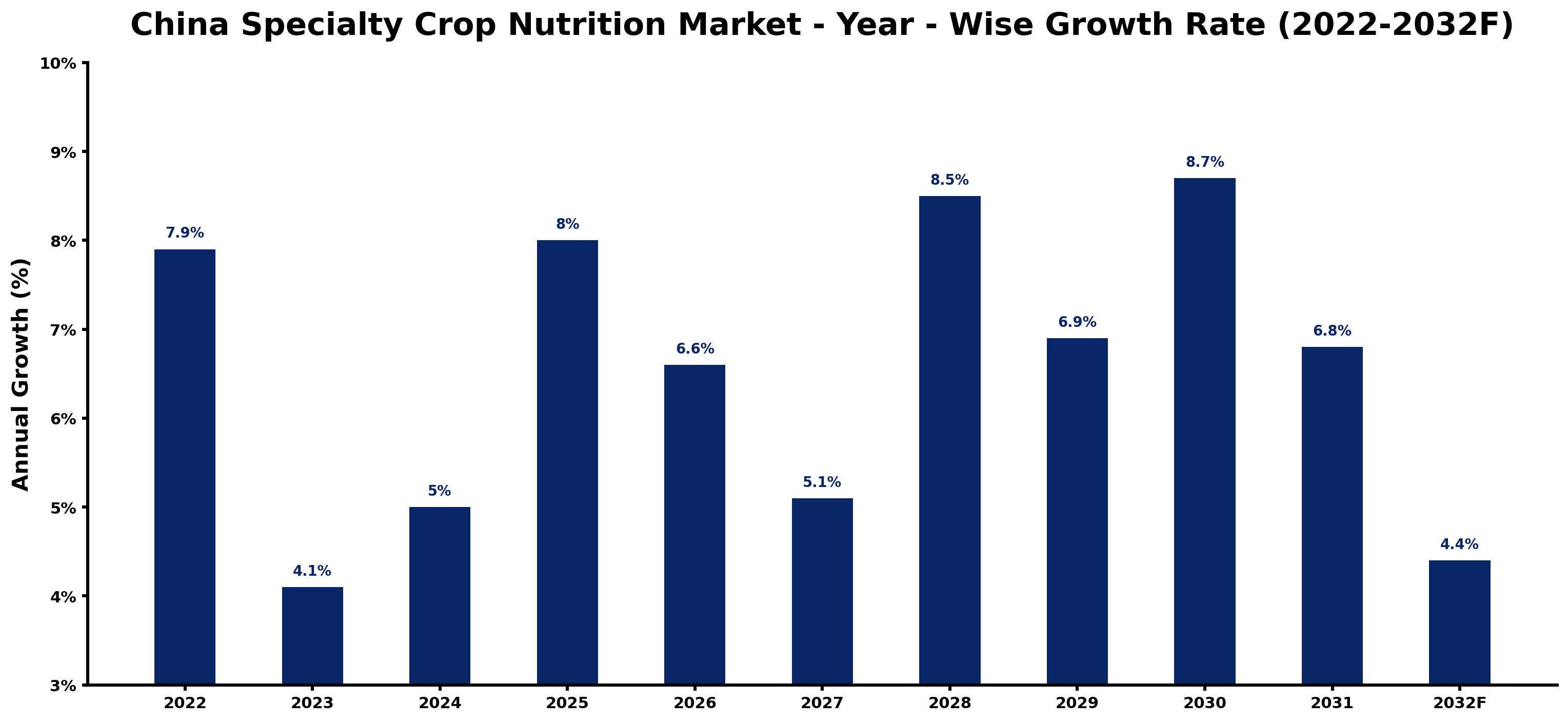
The following table presents the estimated annual growth rate for each year together with the principal factor influencing market performance.
| Year | Estimated Annual Growth (%) | Market Rationale |
| 2022 | 7.9 | The market experienced strong growth due to rising agricultural productivity demands. |
| 2023 | 4.1 | Adoption of bio-stimulants slowed, reflecting a temporary dip in growth rates. |
| 2024 | 5.0 | Increased interest in sustainable practices led to faster adoption of specialty nutrition products. |
| 2025 | 8.0 | High-value crop production drove significant demand, resulting in peak growth for the year. |
| 2026 | 6.6 | Market growth slowed as farmers adjusted to new regulations and practices. |
| 2027 | 5.1 | Continued focus on high-value crops contributed to a further slowdown in growth. |
| 2028 | 8.5 | Renewed interest in bio-stimulants spurred faster growth as farmers sought improved yields. |
| 2029 | 6.9 | Growth moderated as market dynamics stabilised following previous peaks. |
| 2030 | 8.7 | Innovations in precision agriculture technology led to the highest growth rate of the forecast period. |
| 2031 | 6.8 | Market growth slowed as saturation in certain segments began to occur. |
| 2032 | 4.4 | The market continues to grow, albeit at a slower rate as maturity sets in. |
Note: Market size estimations and growth projections presented in this report are based on 6Wresearch's proprietary forecasting methodology, utilizing the latest available industry data, government publications, and primary research inputs.
China Specialty Crop Nutrition Market Synopsis
Specialty Crop Nutrition in China includes products designed to improve crop growth through precise nutrient delivery. These offerings encompass micronutrients and bio-stimulants, primarily utilised in horticulture and high-value crop production. The Specialty Crop Nutrition Market is set for substantial growth, driven by rising agricultural productivity demands and the shift towards sustainable practices. The Green Agriculture Development Plan aims for a 20% increase in specialty nutrition usage by 2025, highlighting the emphasis on efficient food production methods. Furthermore, the adoption of precision agriculture technology is anticipated to further elevate the demand for specialised crop nutrition solutions.
Market Dynamics Impact Analysis (2026–2032)
| Factor | Type | Impact | Primary Segment Affected |
| Increasing agricultural productivity demands drive the need for specialized nutrition solutions. | Driver | High | Bio-Stimulants |
| The growing urban population necessitates efficient food production methods. | Driver | High | Fruits & Vegetables |
| Investment in organic farming solutions presents a significant market opportunity. | Opportunity | High | Organic Farm Operators |
| The rise of vertical farming units creates demand for specialized nutrition products. | Opportunity | High | Vertical Farming Units |
| Limited awareness of specialty nutrition benefits restrains market growth. | Restraint | Medium | Horticulture Growers |
| Regulatory compliance challenges may hinder product adoption among farmers. | Restraint | Medium | Precision Agri-Farms |
| Adapting to new agricultural technologies presents challenges for traditional farmers. | Challenge | Medium | Fruits & Vegetables |
| Competition from conventional fertilizers may limit market penetration. | Challenge | Medium | Bio-Stimulants |
Evaluation of Drivers in China Specialty Crop Nutrition Market (2026–2032)
Key forces behind demand, with the segment each one moves most, are listed below.
| Drivers | Primary Segment Affected | Why It Matters (Evidence) |
| Rising agricultural productivity demands fuel the need for specialty crop nutrition products. | Micronutrient Mixes | With over 300 million acres of cultivated land, farmers are increasingly adopting micronutrient mixes to improve yields. |
| The urban population's growth necessitates efficient food production methods. | Fruits & Vegetables | As urbanisation reached 64% in 2023, growers focus on high-value crops, increasing demand for specialty nutrition products. |
| The adoption of precision agriculture technology optimises nutrient use and boosts demand. | Bio-Stimulants | Adoption of precision agriculture is expected to rise to 30% by 2025, driving interest in bio-stimulants among farmers. |
| Investment in organic farming solutions enhances market opportunities. | Organic Farm Operators | With over 3 million hectares certified organic, operators require specialized nutrition for sustainable production. |
| The Green Agriculture Development Plan promotes sustainable farming practices. | Vertical Farming Units | The plan aims for a 20% increase in specialty nutrition adoption by 2025, benefiting vertical farming operations. |
The Specialty Crop Nutrition market in China is expanding as rising agricultural productivity demands, urban population growth, and precision agriculture technology adoption drive the need for specialized products. In 2023, urbanisation reached 64%, prompting growers to focus on high-value crops, thus increasing demand for specialty nutrition. The adoption of precision agriculture technology is expected to rise to 30% by 2025, optimising nutrient use and improving crop yields. With over 3 million hectares certified organic, organic farm operators are increasingly seeking specialized nutrition solutions.
Evaluation of Restraints in China Specialty Crop Nutrition Market
The main factors holding the market back are set out below.
| Market Restraint | Primary Segment Affected | Why It Matters (Evidence) |
| Limited awareness of specialty nutrition benefits among farmers restricts market growth. | Horticulture Growers | Many growers remain unaware of the advantages of specialty nutrition, impacting their purchasing decisions. |
| Regulatory compliance challenges may hinder product adoption among farmers. | Precision Agri-Farms | Farmers face difficulties in navigating complex regulations, delaying the adoption of specialty nutrition products. |
| High costs associated with specialty nutrition products may deter some growers. | Organic Farm Operators | The premium pricing of specialty products can limit access for smaller organic farmers. |
| Competition from conventional fertilizers may limit market penetration. | Bio-Stimulants | Conventional fertilizers are often cheaper, making it difficult for specialty products to compete effectively. |
| Inconsistent product quality can undermine farmer confidence in specialty nutrition. | Fruits & Vegetables | Variability in product quality leads to hesitation among growers to switch from traditional fertilizers. |
China Specialty Crop Nutrition Market Challenges
The China Specialty Crop Nutrition Market still has to solve a few problems, beginning with intense competition among suppliers. This rivalry drives prices down, which can reduce profit margins for producers and limit the quality of products available to buyers. Next, the rapid adoption of technology creates hurdles; many farmers struggle to integrate precision agriculture tools, delaying their access to effective nutrient delivery systems. Regulatory compliance with the National Standard for Fertilizers can also slow product launches, making it harder for suppliers to meet increasing market demands. Supply chain disruptions may occur due to fluctuations in raw material availability, causing delays in product delivery to agricultural businesses that rely on timely access to specialty crop nutrition.
Trends in the China Specialty Crop Nutrition Market
Below mentioned are some of the trends shaping the China Specialty Crop Nutrition Market growth.
- Shift towards Sustainable Practices: Since 2023, the Green Agriculture Development Plan has promoted sustainable farming practices, aiming for a 20% increase in specialty nutrition adoption by 2025. This shift encourages farmers to invest in environmentally friendly solutions.
- Rise of Precision Agriculture: The introduction of the Precision Agriculture Promotion Strategy in 2020 has led to increased integration of technology in farming. By 2025, precision agriculture technology adoption is projected to reach 30%, improving nutrient efficiency.
- Growing Demand for Organic Solutions: Organic farm operators are increasingly seeking specialized nutrition solutions, with over 3 million hectares certified organic as of 2022. This trend highlights the need for tailored products to meet organic farming standards.
- Increased Focus on Bio-Stimulants: The Ministry of Agriculture reported a 10% increase in bio-stimulant adoption among farmers in 2022. This trend reflects a growing recognition of their benefits in improving crop resilience and yields.
Investment Opportunities in the China Specialty Crop Nutrition Market
Several openings in the China Specialty Crop Nutrition Market merit attention from investors.
- Supply of Bio-Stimulants: With a 10% increase in adoption reported in 2022, there is a promising opportunity to supply bio-stimulants to farmers. Collaborating with organic farm operators can facilitate market entry.
- Investment in Precision Agriculture Tools: As precision agriculture adoption is projected to rise to 30% by 2025, investing in specialised tools can cater to the needs of precision agri-farms. Partnering with technology providers can enhance market access.
- Custom NPK Blends for High-Value Crops: The demand for tailored nutrient solutions is on the rise, particularly for high-value crops. Focusing on this segment can attract horticulture growers seeking specific nutrient profiles.
- Granular Formulations for Slow-Release Nutrients: With the increasing need for efficient nutrient delivery, supplying granular formulations can address market demand. Engaging with vertical farming units can provide a pathway for entry.
Government Initiatives in the China Specialty Crop Nutrition Market
In 2022, the Ministry of Agriculture and Rural Affairs launched the 'National Fertilizer Application Regulation' to improve fertilizer efficiency and promote specialty crop nutrition use. This regulation complements the existing National Standard for Fertilizers, ensuring that specialty crop nutrition products meet the necessary requirements for optimal performance in the field. Additionally, the 'Soil Health Improvement Program', established in 2021, focuses on enhancing soil quality through specialised nutrition, with an investment of 500 million yuan over five years. These measures support farmers in adopting advanced agricultural practices and improving crop yields.
The National Agricultural Technology Extension and Service Center introduced guidelines for the use of bio-stimulants in crop production in 2023, providing farmers with essential resources to improve yields and sustainability. These initiatives assist farmers in adopting advanced agricultural practices. The government also allocates funds for research into bio-stimulants, emphasising their role in modern agriculture and helping farmers access innovative solutions.
Future Insight of the China Specialty Crop Nutrition Market
By 2032, the China Specialty Crop Nutrition Market is expected to evolve significantly, driven by key factors. The government’s 'Green Agriculture Development Plan' will promote sustainable farming practices, encouraging farmers to seek tailored nutrition solutions. Precision agriculture technology adoption will increase, aiming for 30% by 2025, boosting the demand for specialised nutrient products. Research funding for bio-stimulants is likely to lead to breakthroughs that enhance crop yields, while the growth of organic farming will require more customised nutrition solutions to support over 3 million hectares of certified organic land.
Market Segmentation Analysis
The analysis below covers each segmentation, its leading category in 2025 and its fastest-growing category through 2032.
By Nutrient Type – Micronutrient Mixes Dominated, Bio-Stimulants Expected to Grow Fastest
According to Summon Dutta, Assistant Manager at 6Wresearch, Micronutrient Mixes held a 40% share of the China Specialty Crop Nutrition Market by nutrient type in 2025. Micronutrient mixes hold the largest market share as they are essential for plant growth and nutrient balance, particularly in horticulture. Their widespread use across China's agricultural landscape, especially for high-value crops, highlights their critical role in enhancing productivity. Bio-Stimulants are set to record the highest CAGR in this split, 8.6% over 2026–2032. Bio-stimulants are experiencing rapid growth, with a reported 10% increase in adoption among farmers, as they significantly improve plant health and resilience. This trend is likely to continue as growers increasingly recognise the benefits of bio-stimulants in addressing environmental challenges. Suppliers should focus on developing bio-stimulants to meet the growing demand for effective crop nutrition solutions.
By Crop Type – Fruits & Vegetables Dominated, High-Value Crops Expected to Grow Fastest
With a 39% revenue share in 2025, Fruits & Vegetables was the largest crop type category. Fruits and vegetables dominate the market share as they are vital for improving yield and quality within China's agricultural sector. With these crops constituting approximately 30% of total agricultural output, the demand for specialised nutrition is considerable. Over 2026–2032, High-Value Crops are expected to post the fastest growth, at a CAGR of 9.3%. High-value crops are rapidly gaining traction due to their potential to enhance profitability and market value for farmers. This segment's growth aligns with government initiatives that promote sustainable farming practices and increased agricultural productivity. Buyers should prioritise nutrition solutions tailored for high-value crops to capitalise on emerging market opportunities.
By Formulation Type – Liquid/Soluble Dominated, Foliar Spray Expected to Grow Fastest
The largest formulation type category in 2025 was Liquid/Soluble, with a 46% share of total revenue. Liquid/soluble formulations lead the market as they provide quick nutrient absorption, which is crucial for the growth cycles of specialty crops. Their efficiency in delivering nutrients makes them a preferred option among growers seeking optimal results. The quickest growth will come from Foliar Spray, forecast to expand at a CAGR of 8.2% between 2026 and 2032. Foliar sprays are the fastest-growing formulation type, ensuring immediate nutrient application directly onto plant leaves. This method's effectiveness in enhancing plant health is driving its adoption, especially in intensive farming systems. Suppliers should concentrate on developing foliar spray products to cater to the increasing demand for rapid nutrient delivery solutions.
By End User – Horticulture Growers Dominated, Vertical Farming Units Expected to Grow Fastest
Horticulture Growers took a 41% share of end user in 2025, more than any other category. Horticulture growers represent the largest market share as they are the primary users of specialty nutrition products aimed at improving crop yield and quality. Their significant presence in agriculture underscores the importance of targeted nutrition solutions for this sector. Vertical Farming Units are projected to grow fastest, at a CAGR of 9.3% during 2026–2032. Vertical farming units are the fastest-growing end user segment, essential for maximising space and yield in urban agriculture. The rising urban population and focus on efficient food production methods are propelling this growth. Suppliers should tailor their offerings to meet the specific needs of vertical farming units, which are becoming increasingly vital in modern agriculture.
Key Attractiveness of the Report
- 10 Years of Market Numbers
- Historical Data Starting from 2022 to 2025
- Base Year 2025
- Forecast Data until 2032
- Key Performance Indicators Impacting the Market
- Major Upcoming Developments and Projects
Key Highlights of the Report:
- China Specialty Crop Nutrition Market Outlook
- Market Size of China Specialty Crop Nutrition Market, 2025
- Forecast of China Specialty Crop Nutrition Market, 2032
- Historical Data and Forecast of China Specialty Crop Nutrition Revenues & Volume for the Period 2022 - 2032F
- China Specialty Crop Nutrition Market Trend Evolution
- China Specialty Crop Nutrition Market Drivers and Challenges
- China Specialty Crop Nutrition Price Trends
- China Specialty Crop Nutrition Porter's Five Forces
- China Specialty Crop Nutrition Industry Life Cycle
- Historical Data and Forecast of China Specialty Crop Nutrition Market Revenues & Volume By Nutrient Type for the Period 2022 - 2032F
- Historical Data and Forecast of China Specialty Crop Nutrition Market Revenues & Volume By Micronutrient Mixes for the Period 2022 - 2032F
- Historical Data and Forecast of China Specialty Crop Nutrition Market Revenues & Volume By Bio-Stimulants for the Period 2022 - 2032F
- Historical Data and Forecast of China Specialty Crop Nutrition Market Revenues & Volume By Chelated Fertilizers for the Period 2022 - 2032F
- Historical Data and Forecast of China Specialty Crop Nutrition Market Revenues & Volume By Custom NPK Blends for the Period 2022 - 2032F
- Historical Data and Forecast of China Specialty Crop Nutrition Market Revenues & Volume By Crop Type for the Period 2022 - 2032F
- Historical Data and Forecast of China Specialty Crop Nutrition Market Revenues & Volume By Fruits & Vegetables for the Period 2022 - 2032F
- Historical Data and Forecast of China Specialty Crop Nutrition Market Revenues & Volume By High-Value Crops for the Period 2022 - 2032F
- Historical Data and Forecast of China Specialty Crop Nutrition Market Revenues & Volume By Leafy Greens for the Period 2022 - 2032F
- Historical Data and Forecast of China Specialty Crop Nutrition Market Revenues & Volume By Plantation Crops for the Period 2022 - 2032F
- Historical Data and Forecast of China Specialty Crop Nutrition Market Revenues & Volume By Formulation Type for the Period 2022 - 2032F
- Historical Data and Forecast of China Specialty Crop Nutrition Market Revenues & Volume By Liquid/Soluble for the Period 2022 - 2032F
- Historical Data and Forecast of China Specialty Crop Nutrition Market Revenues & Volume By Granular for the Period 2022 - 2032F
- Historical Data and Forecast of China Specialty Crop Nutrition Market Revenues & Volume By Foliar Spray for the Period 2022 - 2032F
- Historical Data and Forecast of China Specialty Crop Nutrition Market Revenues & Volume By Controlled Release for the Period 2022 - 2032F
- Historical Data and Forecast of China Specialty Crop Nutrition Market Revenues & Volume By End User for the Period 2022 - 2032F
- Historical Data and Forecast of China Specialty Crop Nutrition Market Revenues & Volume By Horticulture Growers for the Period 2022 - 2032F
- Historical Data and Forecast of China Specialty Crop Nutrition Market Revenues & Volume By Organic Farm Operators for the Period 2022 - 2032F
- Historical Data and Forecast of China Specialty Crop Nutrition Market Revenues & Volume By Vertical Farming Units for the Period 2022 - 2032F
- Historical Data and Forecast of China Specialty Crop Nutrition Market Revenues & Volume By Precision Agri-Farms for the Period 2022 - 2032F
- China Specialty Crop Nutrition Import Export Trade Statistics
- Market Opportunity Assessment By Nutrient Type
- Market Opportunity Assessment By Crop Type
- Market Opportunity Assessment By Formulation Type
- Market Opportunity Assessment By End User
- China Specialty Crop Nutrition Top Companies Market Share
- China Specialty Crop Nutrition Competitive Benchmarking By Technical and Operational Parameters
- China Specialty Crop Nutrition Company Profiles
- China Specialty Crop Nutrition Key Strategic Recommendations
Market Covered
Segments analysed in this report are listed below.
By Nutrient Type
- Micronutrient Mixes
- Bio-Stimulants
- Chelated Fertilizers
- Custom NPK Blends
By Crop Type
- Fruits & Vegetables
- High-Value Crops
- Leafy Greens
- Plantation Crops
By Formulation Type
- Liquid/Soluble
- Granular
- Foliar Spray
- Controlled Release
By End User
- Horticulture Growers
- Organic Farm Operators
- Vertical Farming Units
- Precision Agri-Farms































