India Specialty Fibers Market Size & Growth Rate
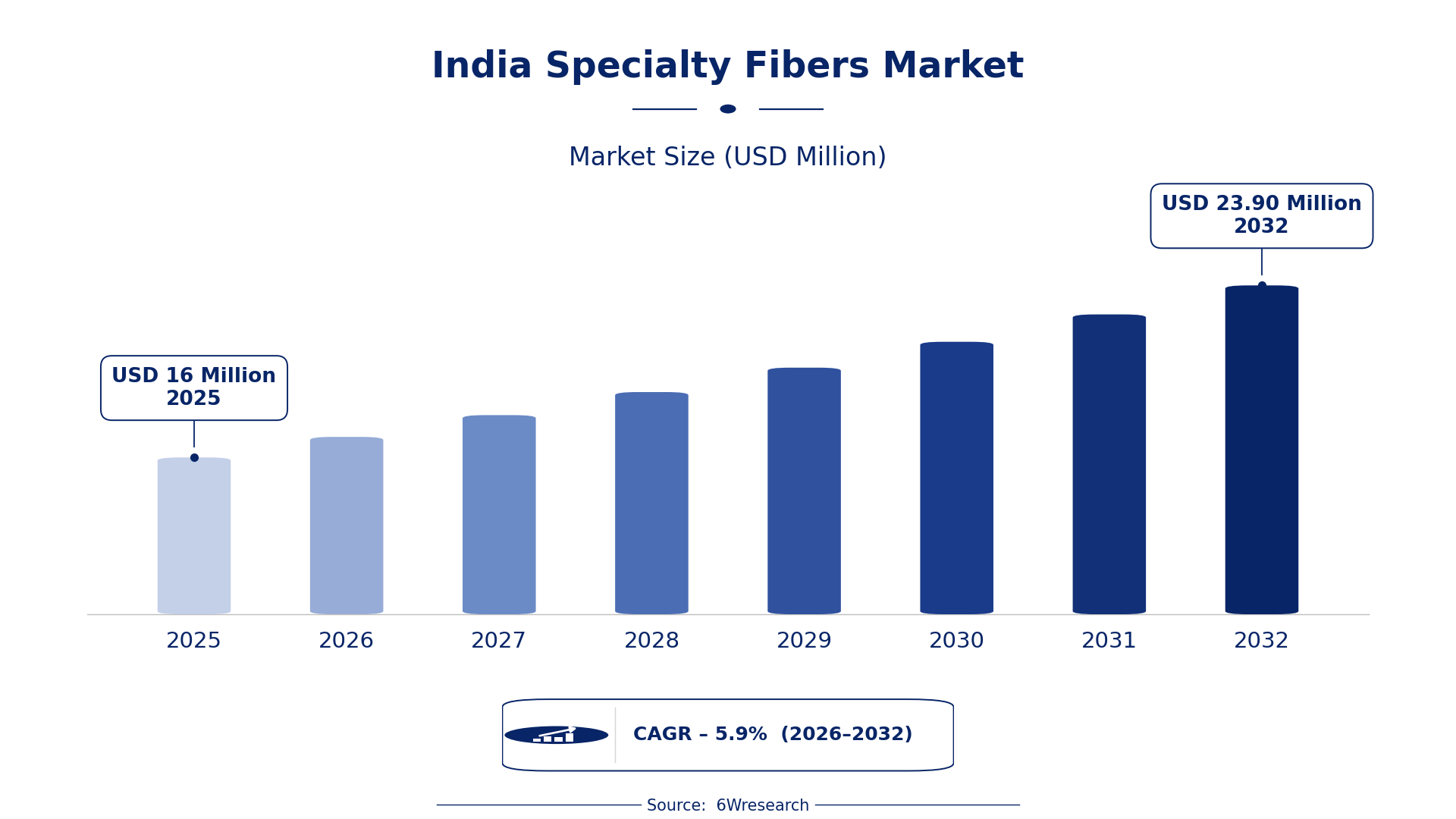
According to 6Wresearch internal database and industry insights, the India Specialty Fibers Market was valued at USD 16.0 million in 2025 and is projected to reach USD 23.90 million by 2032, growing at a CAGR of approximately 5.9% during 2026–2032.
India Specialty Fibers Market Highlights
| Report Metric | Details |
| Report Name | India Specialty Fibers Market |
| Market Size 2025 | USD 16.0 million |
| Market Size 2032 | USD 23.90 million |
| Absolute Growth 2025–2032 | USD 7.90 million |
| CAGR 2026–2032 | 5.9% |
| Peak Annual Growth | 8.4% in 2029 |
| Forecast Period | 2026–2032 |
| Historical Data | 2022–2025 |
| Base Year | 2025 |
| Leading Fiber Type, 2025 | Aramid Fibers (38% share) |
| Leading Composition, 2025 | Synthetic (52% share) |
| Leading Functionality, 2025 | High-Temperature Resistance (40% share) |
| Leading End User, 2025 | Protective Gear Makers (43% share) |
| Fastest-Growing Fiber Type | Carbon Fibers (8.4% CAGR) |
| Fastest-Growing Composition | Carbon Composite (8.2% CAGR) |
| Fastest-Growing Functionality | Lightweight Strength (7.2% CAGR) |
| Fastest-Growing End User | Aerospace OEMs (8.4% CAGR) |
| Growing Sector | Aerospace |
| Key End Users | Protective Gear Makers, Aerospace OEMs, Circuit Board Producers |
India Specialty Fibers Market Year-wise Growth Rate and Key Drivers (2022–2032)
This graph illustrates the annual growth rates of the market from 2022 to 2032, highlighting a steady upward trajectory and projected market expansion over the forecast period.
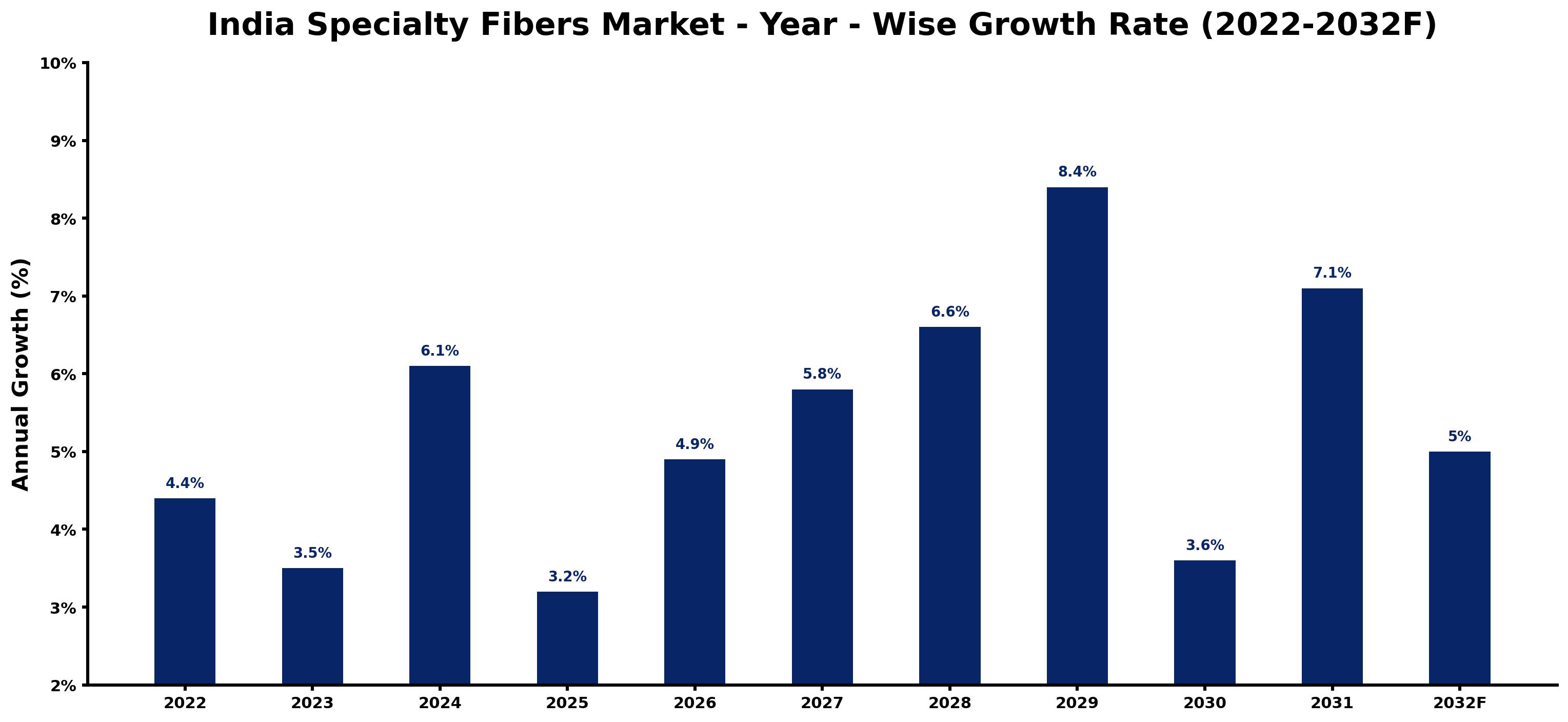
Each row of the following table gives one year's estimated growth and the event or demand shift that explains it.
| Year | Estimated Annual Growth (%) | Market Rationale |
| 2022 | 4.4 | The market experienced moderate growth due to steady demand from aerospace and automotive sectors. |
| 2023 | 3.5 | Growth slowed as the aerospace sector adjusted to supply chain challenges and fluctuating material costs. |
| 2024 | 6.1 | Demand surged with the aerospace sector's recovery and increased production of lightweight materials. |
| 2025 | 3.2 | The market faced temporary setbacks in production capacity due to the 'Make in India' initiative's early implementation. |
| 2026 | 4.9 | The market is expected to grow as the aerospace sector continues to expand and adopt advanced materials. |
| 2027 | 5.8 | Demand will rise as manufacturers increase investments in specialty fibers for high-performance applications. |
| 2028 | 6.6 | Growth is projected to accelerate with rising aerospace production and increased focus on lightweight solutions. |
| 2029 | 8.4 | The market is set to peak as demand from aerospace OEMs drives substantial purchases of specialty fibers. |
| 2030 | 3.6 | Growth will slow as the market stabilizes after reaching a peak in demand for specialty fibers. |
| 2031 | 7.1 | The market will rebound as manufacturers adapt to new technologies and increase production capacity. |
| 2032 | 5.0 | Growth will moderate as the market adjusts to evolving buyer preferences and sustainability initiatives. |
Note: Market size estimations and growth projections presented in this report are based on 6Wresearch's proprietary forecasting methodology, utilizing the latest available industry data, government publications, and primary research inputs.
India Specialty Fibers Market Synopsis
The India Specialty Fibers Market includes advanced materials utilised in aerospace, automotive, and protective clothing applications. These fibers are manufactured through intricate chemical processes involving polymers and composites. The market is growing due to increasing demand from domestic users and imports, particularly in the aerospace and defence sectors. Sustainability initiatives are also encouraging the production of bio-based fibers, further propelling market growth.
Market Dynamics Impact Analysis (2026–2032)
| Factor | Type | Impact | Primary Segment Affected |
| Rising demand for lightweight materials in aerospace applications | Driver | High | Carbon Fibers |
| Increased investments in protective gear manufacturing | Driver | High | Aramid Fibers |
| Growing interest in eco-friendly materials | Opportunity | Medium | Bio-Based Fibers |
| Expansion of the aerospace sector in India | Opportunity | High | Carbon Fibers |
| Challenges in sourcing raw materials for specialty fibers | Restraint | High | Synthetic |
| Fluctuating prices of raw materials affecting production costs | Restraint | Medium | Glass Fibers |
| Limited awareness of specialty fibers among smaller manufacturers | Challenge | Medium | Bio-Based Fibers |
| Technological barriers in adopting advanced fiber production methods | Challenge | High | Carbon Composite |
Evaluation of Drivers in India Specialty Fibers Market (2026–2032)
Key forces behind demand, with the segment each one moves most, are listed below.
| Drivers | Primary Segment Affected | Why It Matters (Evidence) |
| Increasing production of lightweight materials for aerospace applications | Carbon Fibers | The installed base of over 100 aircraft drives demand for lightweight components, leading to higher purchases of carbon fibers. |
| Growing investments in protective gear manufacturing | Aramid Fibers | Protective Gear Makers are expanding their product lines, increasing demand for aramid fibers used in high-performance applications. |
| Rising production of bio-based fibers due to sustainability initiatives | Bio-Based Fibers | Research by the National Institute of Fashion Technology boosts demand for bio-based fibers, attracting interest from textile brands. |
| Expansion of the aerospace sector in India | Carbon Fibers | The Aerospace and Defense Manufacturing Sector is projected to reach $70 billion by 2030, driving demand for carbon fibers. |
| Increasing need for electrical insulation materials | Electrical Insulation | The growth of the electronics manufacturing sector in India drives demand for specialty fibers used in circuit boards. |
The Specialty Fibers market in India is growing as end-use demand rises across aerospace, automotive, and protective clothing sectors. The installed base of over 100 aircraft generates substantial demand for lightweight carbon fibers, prompting increased purchases from aerospace OEMs. As manufacturers invest in protective gear production, aramid fibers see a corresponding rise in demand, solidifying their market position. The expansion of the electronics manufacturing sector further fuels the need for specialty fibers used in circuit boards, shaping market trends.
Evaluation of Restraints in India Specialty Fibers Market
The table below lists the restraints and the evidence behind each.
| Market Restraint | Primary Segment Affected | Why It Matters (Evidence) |
| Challenges in sourcing raw materials for specialty fibers | Synthetic | The reliance on imported materials leads to supply chain vulnerabilities, affecting production timelines and costs for manufacturers. |
| Fluctuating prices of raw materials affecting production costs | Glass Fibers | Volatility in raw material prices can disrupt production budgets, impacting profitability for producers of glass fibers. |
| Limited awareness of specialty fibers among smaller manufacturers | Bio-Based Fibers | Smaller manufacturers may lack knowledge about specialty fibers, which results in missed opportunities for market participation. |
| Technological barriers in adopting advanced fiber production methods | Carbon Composite | High investment costs for new technologies deter some manufacturers from upgrading their production capabilities. |
| Regulatory compliance challenges for specialty fiber production | Electrical Insulation | Meeting Bureau of Indian Standards guidelines can be complex, delaying product launches and increasing costs. |
India Specialty Fibers Market Challenges
The India Specialty Fibers Market faces a few practical problems, starting with high production costs that can reach up to 20% more than global competitors, limiting profit margins for suppliers. Buyers in the aerospace sector struggle with these elevated costs, which can inflate project budgets and delay timelines. Supply chain disruptions frequently occur, as reliance on imported raw materials can lead to delays of up to six months, impacting production schedules for manufacturers. Technology adoption remains low, with only 30% of producers employing advanced manufacturing techniques, which restricts efficiency and innovation for the industry.
Trends in the India Specialty Fibers Market
Several trends are reshaping the India Specialty Fibers Market; the most important are set out below.
- Shift from Traditional to Sustainable Fibers: Since 2021, the Indian textile industry has observed a shift towards sustainable materials, driven by the government's eco-friendly initiatives. The target to increase the use of eco-friendly materials by 30% by 2025 is prompting manufacturers to invest in bio-based fibers.
- Transition from Conventional to Lightweight Materials: Aerospace OEMs are increasingly adopting lightweight materials for improved fuel efficiency. The installed base of over 100 aircraft is driving demand for carbon fibers, which are essential for high-performance applications.
- Emergence of Advanced Protective Gear: Protective Gear Makers are innovating with advanced materials to improve safety and performance. The market for aramid fibers is growing as manufacturers respond to rising safety standards in various industries.
- Prioritisation of Electrical Insulation Materials: The electronics manufacturing sector is prioritising high-quality electrical insulation materials. With demand projected to grow, specialty fibers are becoming essential for circuit board producers.
Investment Opportunities in the India Specialty Fibers Market
Some of the investment opportunities in the India Specialty Fibers Market are mentioned below.
- Partnerships for Eco-Friendly Fiber Production: Local partnerships are essential for manufacturers looking to enter the bio-based fiber market. The Indian government's target to increase eco-friendly materials by 30% by 2025 creates a timely opportunity for investment.
- Investment in Aerospace Sector Supply Chains: Aerospace OEMs require advanced materials, presenting an opportunity for suppliers of carbon fibers. The projected growth of the aerospace sector to $70 billion by 2030 makes this an attractive investment area.
- Approval Pathways for Specialty Fiber Standards: Manufacturers can benefit from compliance with Bureau of Indian Standards guidelines for specialty fibers. This compliance opens doors to new markets and enhances product credibility.
- Expansion of Protective Gear Manufacturing: The growing demand for protective gear provides opportunities for suppliers of aramid fibers. By collaborating with Protective Gear Makers, suppliers can tap into this expanding market.
Government Initiatives in the India Specialty Fibers Market
In 2021, the Indian government launched the 'Make in India' initiative, which promotes local manufacturing and reduces reliance on imports, ultimately benefiting producers and buyers. This initiative complements existing laws by enhancing domestic production capabilities for specialty fibers. In 2023, the Ministry of Textiles announced a subsidy scheme for eco-friendly fiber manufacturers, supporting producers by offsetting production costs and allowing them to offer competitive pricing while meeting sustainability goals.
The Ministry of Textiles oversees the subsidy scheme, which funds eco-friendly fiber production, enabling manufacturers to invest in greener practices. Additionally, the Bureau of Indian Standards sets quality guidelines for specialty fibers, ensuring compliance and enhancing product credibility for buyers. This regulatory framework supports the growth of the specialty fibers market by facilitating access to new markets and improving product quality.
Future Insight of the India Specialty Fibers Market
The India Specialty Fibers Market will experience notable changes by 2032, driven by a significant increase in bio-based fiber production as sustainability becomes a priority. The government's 'Make in India' initiative will encourage local production, reducing import reliance. Additionally, the Ministry of Textiles' subsidy scheme for eco-friendly fibers will incentivise manufacturers to adopt greener practices, supporting the target to increase the use of eco-friendly materials in textiles by 30% by 2025.
Market Segmentation Analysis
The analysis below covers each segmentation, its leading category in 2025 and its fastest-growing category through 2032.
By Fiber Type – Aramid Fibers Dominated, Carbon Fibers Expected to Grow Fastest
According to Summon Dutta, Assistant Manager at 6Wresearch, Aramid Fibers held a 38% share of the India Specialty Fibers Market by fiber type in 2025. Aramid fibers lead the market share due to their critical application in protective gear, particularly in high-performance sectors like aerospace and defense. The substantial production base in Maharashtra and Gujarat supports their widespread use across various industries. Over 2026–2032, Carbon Fibers are expected to post the fastest growth, at a CAGR of 8.4%. Carbon fibers are experiencing rapid growth, primarily driven by the aerospace sector's increasing demand for lightweight materials, with over 100 aircraft currently utilising these advanced materials. As the aerospace and defense manufacturing sector is projected to reach $70 billion by 2030, this trend is expected to accelerate. Suppliers should prioritise carbon fiber innovations to meet the escalating demands of the aerospace industry.
By Composition – Synthetic Dominated, Carbon Composite Expected to Grow Fastest
In 2025, Synthetic led the composition split with a 52% share. Synthetic fibers hold the largest market share due to their widespread use in various industrial applications, providing versatility and high performance. Their established presence in India's textile industry, which was valued at approximately $150 billion, solidifies their leading position. Carbon Composite is projected to grow fastest, at a CAGR of 8.2% during 2026–2032. Carbon composites are experiencing rapid growth, primarily because of their critical role in high-strength applications, especially in the aerospace sector. As investments in aerospace continue to rise, the demand for these composites is expected to surge significantly. Suppliers should focus on enhancing their offerings of carbon composites to meet the increasing demand in high-strength applications.
By Functionality – High-Temperature Resistance Dominated, Lightweight Strength Expected to Grow Fastest
High-Temperature Resistance accounted for a 40% market share by functionality in 2025. High-temperature resistance fibers hold the largest market share as they are vital for applications in the aerospace and automotive sectors, where performance under extreme conditions is essential. Their established use in protective gear further solidifies their dominant market position. Lightweight Strength is set to record the highest CAGR in this split, 7.2% over 2026–2032. Lightweight strength fibers are rapidly growing, driven by the automotive industry's need for improved fuel efficiency and performance. As manufacturers increasingly adopt sustainable practices, the demand for lightweight materials is expected to rise. Suppliers must focus on developing lightweight strength materials to align with the automotive industry's sustainability goals.
By End User – Protective Gear Makers Dominated, Aerospace OEMs Expected to Grow Fastest
Protective Gear Makers took a 43% share of end user in 2025, more than any other category. Protective gear makers represent the largest market share, as they are major consumers of aramid and carbon fibers for producing high-performance protective equipment. Their ongoing reliance on advanced materials guarantees a steady demand for specialty fibers. The quickest growth will come from Aerospace OEMs, forecast to expand at a CAGR of 8.4% between 2026 and 2032. Aerospace OEMs are the fastest-growing segment, driven by a robust demand for lightweight materials that improve aircraft performance. As the aerospace sector expands, the need for specialty fibers will correspondingly increase. Suppliers should prioritise aerospace OEMs to capitalise on the rising demand for lightweight materials.
Key Attractiveness of the Report
- 10 Years of Market Numbers
- Historical Data Starting from 2022 to 2025
- Base Year 2025
- Forecast Data until 2032
- Key Performance Indicators Impacting the Market
- Major Upcoming Developments and Projects
Key Highlights of the Report:
- India Specialty Fibers Market Outlook
- Market Size of India Specialty Fibers Market, 2025
- Forecast of India Specialty Fibers Market, 2032
- Historical Data and Forecast of India Specialty Fibers Revenues & Volume for the Period 2022 - 2032F
- India Specialty Fibers Market Trend Evolution
- India Specialty Fibers Market Drivers and Challenges
- India Specialty Fibers Price Trends
- India Specialty Fibers Porter's Five Forces
- India Specialty Fibers Industry Life Cycle
- Historical Data and Forecast of India Specialty Fibers Market Revenues & Volume By Fiber Type for the Period 2022 - 2032F
- Historical Data and Forecast of India Specialty Fibers Market Revenues & Volume By Aramid Fibers for the Period 2022 - 2032F
- Historical Data and Forecast of India Specialty Fibers Market Revenues & Volume By Carbon Fibers for the Period 2022 - 2032F
- Historical Data and Forecast of India Specialty Fibers Market Revenues & Volume By Bio-Based Fibers for the Period 2022 - 2032F
- Historical Data and Forecast of India Specialty Fibers Market Revenues & Volume By Glass Fibers for the Period 2022 - 2032F
- Historical Data and Forecast of India Specialty Fibers Market Revenues & Volume By Composition for the Period 2022 - 2032F
- Historical Data and Forecast of India Specialty Fibers Market Revenues & Volume By Synthetic for the Period 2022 - 2032F
- Historical Data and Forecast of India Specialty Fibers Market Revenues & Volume By Carbon Composite for the Period 2022 - 2032F
- Historical Data and Forecast of India Specialty Fibers Market Revenues & Volume By Cellulose Derivatives for the Period 2022 - 2032F
- Historical Data and Forecast of India Specialty Fibers Market Revenues & Volume By Silica-Based for the Period 2022 - 2032F
- Historical Data and Forecast of India Specialty Fibers Market Revenues & Volume By Functionality for the Period 2022 - 2032F
- Historical Data and Forecast of India Specialty Fibers Market Revenues & Volume By High-Temperature Resistance for the Period 2022 - 2032F
- Historical Data and Forecast of India Specialty Fibers Market Revenues & Volume By Lightweight Strength for the Period 2022 - 2032F
- Historical Data and Forecast of India Specialty Fibers Market Revenues & Volume By Eco-Friendly for the Period 2022 - 2032F
- Historical Data and Forecast of India Specialty Fibers Market Revenues & Volume By Electrical Insulation for the Period 2022 - 2032F
- Historical Data and Forecast of India Specialty Fibers Market Revenues & Volume By End User for the Period 2022 - 2032F
- Historical Data and Forecast of India Specialty Fibers Market Revenues & Volume By Protective Gear Makers for the Period 2022 - 2032F
- Historical Data and Forecast of India Specialty Fibers Market Revenues & Volume By Aerospace OEMs for the Period 2022 - 2032F
- Historical Data and Forecast of India Specialty Fibers Market Revenues & Volume By Textile Brands for the Period 2022 - 2032F
- Historical Data and Forecast of India Specialty Fibers Market Revenues & Volume By Circuit Board Producers for the Period 2022 - 2032F
- India Specialty Fibers Import Export Trade Statistics
- Market Opportunity Assessment By Fiber Type
- Market Opportunity Assessment By Composition
- Market Opportunity Assessment By Functionality
- Market Opportunity Assessment By End User
- India Specialty Fibers Top Companies Market Share
- India Specialty Fibers Competitive Benchmarking By Technical and Operational Parameters
- India Specialty Fibers Company Profiles
- India Specialty Fibers Key Strategic Recommendations
Market Covered
This report examines the market across the segments below.
By Fiber Type
- Aramid Fibers
- Carbon Fibers
- Bio-Based Fibers
- Glass Fibers
By Composition
- Synthetic
- Carbon Composite
- Cellulose Derivatives
- Silica-Based
By Functionality
- High-Temperature Resistance
- Lightweight Strength
- Eco-Friendly
- Electrical Insulation
By End User
- Protective Gear Makers
- Aerospace OEMs
- Textile Brands
- Circuit Board Producers































