China Specialty Fibers Market Size & Growth Rate
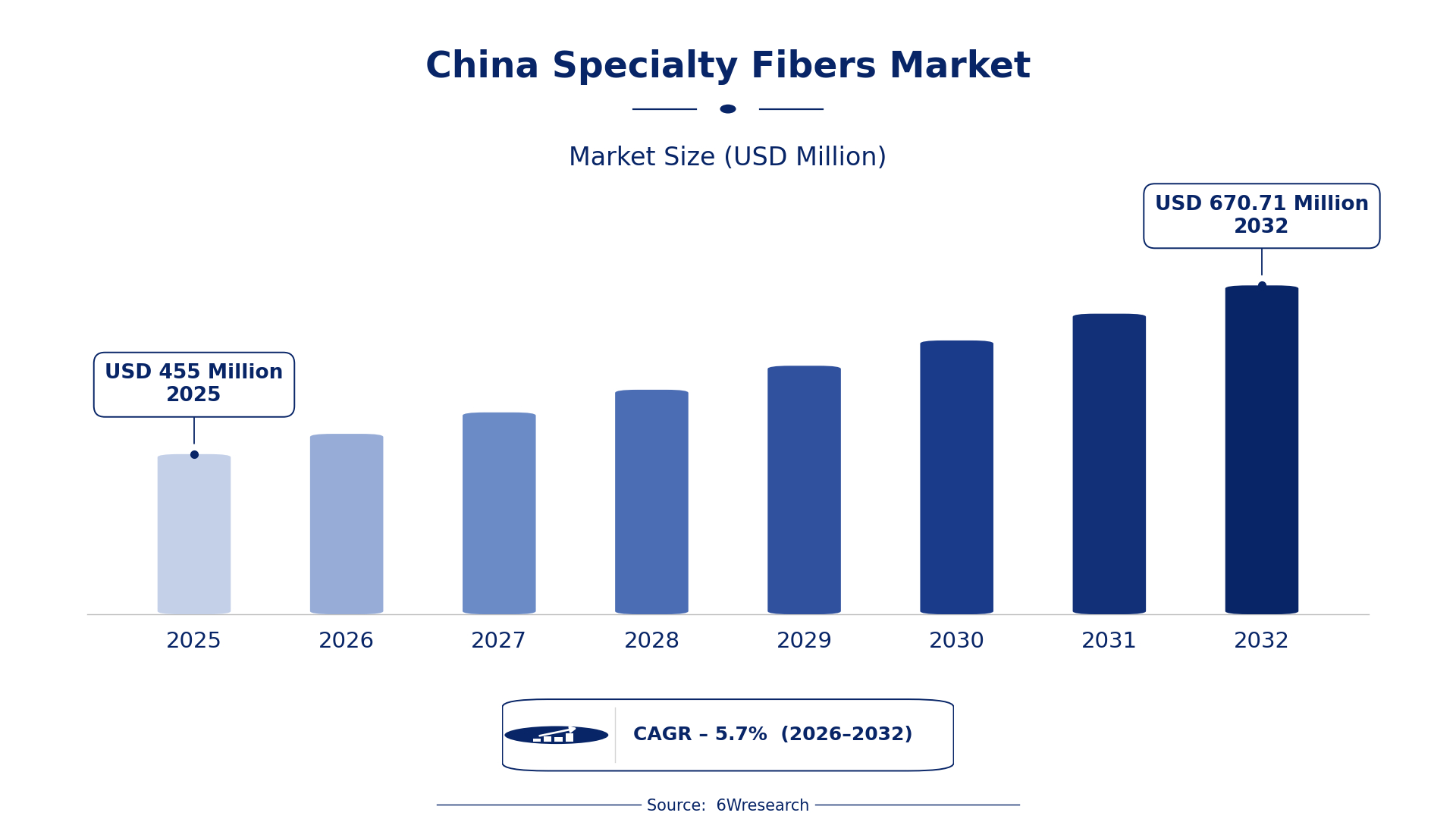
According to 6Wresearch internal database and industry insights, the China Specialty Fibers Market was valued at USD 455.0 million in 2025 and is projected to reach USD 670.71 million by 2032, growing at a CAGR of approximately 5.7% during 2026–2032.
China Specialty Fibers Market Highlights
| Report Metric | Details |
| Report Name | China Specialty Fibers Market |
| Market Size 2025 | USD 455.0 million |
| Market Size 2032 | USD 670.71 million |
| Absolute Growth 2025–2032 | USD 215.71 million |
| CAGR 2026–2032 | 5.7% |
| Peak Annual Growth | 8.1% in 2026 |
| Forecast Period | 2026–2032 |
| Historical Data | 2022–2025 |
| Base Year | 2025 |
| Leading Fiber Type, 2025 | Carbon Fibers (42% share) |
| Leading Composition, 2025 | Synthetic (38% share) |
| Leading Functionality, 2025 | High-Temperature Resistance (43% share) |
| Leading End User, 2025 | Aerospace OEMs (44% share) |
| Fastest-Growing Fiber Type | Bio-Based Fibers (6.7% CAGR) |
| Fastest-Growing Composition | Cellulose Derivatives (8.4% CAGR) |
| Fastest-Growing Functionality | Eco-Friendly (7.1% CAGR) |
| Fastest-Growing End User | Textile Brands (7.0% CAGR) |
| Growing Sector | Textile Brands |
| Key End Users | Aerospace OEMs, Protective Gear Makers, Circuit Board Producers, Textile Brands |
China Specialty Fibers Market Year-wise Growth Rate and Key Drivers (2022–2032)
This graph illustrates the annual growth rates of the market from 2022 to 2032, highlighting a steady upward trajectory and projected market expansion over the forecast period.
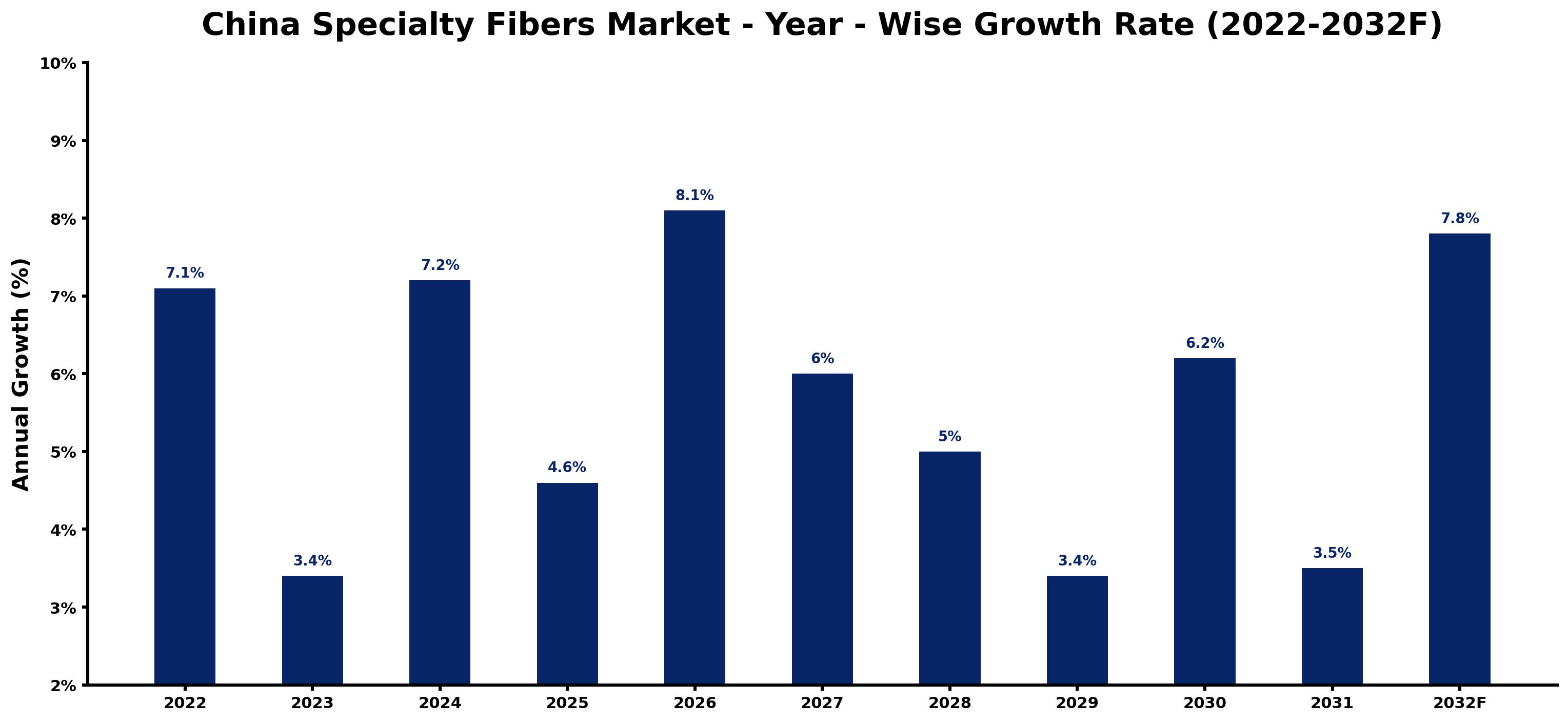
The table below sets out the estimated growth rate for each year and the main factor behind it.
| Year | Estimated Annual Growth (%) | Market Rationale |
| 2022 | 7.1 | The market showed strong demand driven by industrial growth in the textile sector. |
| 2023 | 3.4 | Growth slowed due to a temporary dip in aerospace investments and the Advanced Materials Industry Development Plan. |
| 2024 | 7.2 | The aerospace sector expanded, boosting demand for high-performance specialty fibers. |
| 2025 | 4.6 | Demand slowed again as the market adjusted to production capacities and supply chain issues. |
| 2026 | 8.1 | A surge in investments for lightweight materials in automotive applications is expected to drive growth. |
| 2027 | 6.0 | Market growth will slow as manufacturers face challenges in sourcing raw materials. |
| 2028 | 5.0 | Demand is projected to continue slowing as the Green Manufacturing initiative promotes sustainable materials. |
| 2029 | 3.4 | Growth is expected to slow further as the focus shifts to sustainable materials in textiles. |
| 2030 | 6.2 | A resurgence in automotive demand for carbon composites will spur market growth. |
| 2031 | 3.5 | The market will experience a slowdown as manufacturers adapt to changing regulations. |
| 2032 | 7.8 | Increased investments in bio-based fibers are projected to drive growth. |
Note: Market size estimations and growth projections presented in this report are based on 6Wresearch's proprietary forecasting methodology, utilizing the latest available industry data, government publications, and primary research inputs.
China Specialty Fibers Market Synopsis
Specialty Fibers in China encompasses advanced materials tailored for specific applications, primarily in aerospace, automotive, and textiles. These fibers are derived from synthetic processes or natural sources, offering properties such as strength and heat resistance. The China Specialty Fibers Market is expected to reach 1.5 million tons by 2025, propelled by the growing aerospace industry and the textile sector's need for sustainable materials. The government's emphasis on innovation and eco-friendly production further drives market expansion, creating avenues for investment and development.
Market Dynamics Impact Analysis (2026–2032)
| Factor | Type | Impact | Primary Segment Affected |
| Growing investments in lightweight materials by the automotive sector | Driver | High | Carbon Fibers |
| Increased demand for eco-friendly materials in textiles | Driver | High | Bio-Based Fibers |
| Rising need for advanced materials in aerospace applications | Opportunity | High | Aramid Fibers |
| Growing market for sustainable textiles in China | Opportunity | Medium | Bio-Based Fibers |
| Challenges in sourcing raw materials for production | Restraint | High | Synthetic |
| Quality regulations impacting production timelines | Restraint | Medium | Glass Fibers |
| Competition from alternative materials in the market | Challenge | High | Carbon Fibers |
| Technological barriers in developing new specialty fibers | Challenge | Medium | High-Temperature Resistance |
Evaluation of Drivers in China Specialty Fibers Market (2026–2032)
The factors lifting demand, and the evidence behind each, are summarised below.
| Drivers | Primary Segment Affected | Why It Matters (Evidence) |
| Increased investment in carbon fiber technology | Carbon Fibers | Higher production rates lead to increased demand from aerospace manufacturers, with production reaching approximately 30,000 tons in 2022. |
| Rising demand for lightweight materials in automotive | Carbon Composite | The automotive sector's focus on reducing vehicle weight drives purchases of carbon composites for improved performance, with a projected growth rate of 6%. |
| Growing adoption of eco-friendly materials in textiles | Bio-Based Fibers | The China National Textile and Apparel Council promotes sustainable fibers, increasing their use in innovative textile production, targeting a market value of 10 billion yuan by 2025. |
| Expansion of the aerospace sector in China | Aramid Fibers | The aerospace industry's projected growth at 7% CAGR drives demand for high-strength aramid fibers in protective gear, supporting a workforce of over 20 million in textiles. |
| Technological advancements in specialty fiber production | High-Temperature Resistance | Ongoing research and development efforts improve the performance of high-temperature resistant fibers, attracting new buyers in aerospace and automotive sectors. |
The Specialty Fibers market in China is growing on the back of increased investment in carbon fiber technology, which has led to production reaching approximately 30,000 tons in 2022. The aerospace sector's projected growth at a 7% CAGR from 2023 to 2028 drives demand for aramid fibers, essential for protective gear. The textile sector employs over 20 million workers, contributing to rising interest in sustainable production. The automotive sector's demand for lightweight materials propels innovation in carbon composites, ensuring a dynamic market environment.
Evaluation of Restraints in China Specialty Fibers Market
Below mentioned are some major restraints and their influence on market dynamics.
| Market Restraint | Primary Segment Affected | Why It Matters (Evidence) |
| Regulatory compliance delays production for manufacturers lacking certification | Glass Fibers | The national standard GB/T 14451-2018 can raise costs for suppliers due to compliance requirements. |
| Technological limitations impede material advancements | Carbon Fibers | Only 30,000 tons of carbon fibers were produced in 2022, restricting options for buyers. |
| Unpredictable demand from the textile sector creates planning challenges | Textile Brands | Employing over 20 million workers, fluctuations affect operational efficiency for producers. |
| Fierce competition among manufacturers drives prices down | Carbon Fibers | Over 1,000 manufacturers compete, squeezing margins for suppliers and curtailing innovation. |
| Supply chain disruptions impact production schedules | Carbon Fibers | Global supply chain issues have delayed raw material availability, affecting timely deliveries. |
China Specialty Fibers Market Challenges
The China Specialty Fibers Market still has to solve a few problems, starting with regulatory compliance. The national standard GB/T 14451-2018 for glass fibers can delay production for manufacturers lacking certification, which raises costs for suppliers. Next, technological limitations hinder the efficiency of carbon fiber production, where only 30,000 tons were produced in 2022, limiting options for buyers. Unpredictable demand from the textile sector, employing over 20 million workers, creates planning challenges for producers, affecting their operational efficiency. Finally, intense competition among over 1,000 manufacturers drives prices down, squeezing margins for suppliers and curtailing their capacity for innovation.
Trends in the China Specialty Fibers Market
Buyers and suppliers in the China Specialty Fibers Market are adjusting to the following trends.
- Shift Towards Eco-Friendly Materials: China's textile brands are increasingly adopting sustainable materials, influenced by the Green Manufacturing initiative. This shift is expected to increase the use of eco-friendly fibers by 30% by 2025, impacting purchasing decisions.
- Transition to Lightweight Composites: Aerospace OEMs are prioritising lightweight materials, particularly carbon composites, to improve fuel efficiency. This trend is projected to drive demand as the sector grows at a 7% CAGR from 2023 to 2028.
- Emergence of Bio-Based Fibers: The bio-based fibers market in China is gaining traction, with an estimated value of 10 billion yuan by 2025. This growth is supported by the China National Textile and Apparel Council's initiatives.
- Development of High-Temperature Resistant Fibers: The demand for high-temperature resistant fibers is on the rise, particularly in aerospace applications. Ongoing R&D efforts are improving their performance, attracting new buyers in this sector.
Investment Opportunities in the China Specialty Fibers Market
The following opportunities in the China Specialty Fibers Market pair current demand with a clear way in.
- Aerospace OEMs Seeking Advanced Materials: Aerospace OEMs in China are in search of high-performance specialty fibers, particularly carbon fibers. The market is projected to reach 1.5 million tons by 2025, presenting a notable investment opportunity.
- Textile Brands Adopting Sustainable Solutions: Textile brands are showing growing interest in eco-friendly fibers, backed by the Green Manufacturing initiative. Investing in bio-based fibers can align with the projected market value of 10 billion yuan by 2025.
- Automotive Sector's Demand for Lightweight Solutions: The automotive sector is concentrating on lightweight materials, with carbon composites leading the way. Collaborating with local manufacturers can effectively address this rising demand.
- Government Support for Eco-Friendly Production: Government initiatives aimed at increasing the use of eco-friendly materials in textiles present opportunities for suppliers. Engaging with the China National Textile and Apparel Council can facilitate market entry.
Government Initiatives in the China Specialty Fibers Market
The 'Advanced Materials Industry Development Plan' launched by the Ministry of Industry and Information Technology in 2021 aims to boost the specialty fibers sector by focusing on innovation and sustainability. Additionally, the 'National Standard for Glass Fibers' was updated in 2021 by the Standardization Administration of China to improve quality and safety in production, ensuring that manufacturers meet stringent requirements.
In 2022, the National Development and Reform Commission approved a budget of 500 million yuan to support research in bio-based fibers and their applications in textiles. The 'Green Manufacturing' initiative by the Ministry of Ecology and Environment, introduced in 2020, promotes the use of eco-friendly materials, including specialty fibers, across industries. The China National Textile and Apparel Council launched a program in 2023 to encourage the adoption of specialty fibers in sustainable textile production, further driving market growth.
Future Insight of the China Specialty Fibers Market
The China Specialty Fibers Market is set to evolve by 2032, driven by several key factors. The 'Advanced Materials Industry Development Plan' will enhance production capabilities, particularly in bio-based fibers, which are expected to experience substantial growth. The government's goal to increase eco-friendly material usage in textiles by 30% will create new opportunities for buyers seeking sustainable solutions. The automotive sector's growing demand for lightweight materials will further stimulate advancements in carbon composites, ensuring an active market.
Market Segmentation Analysis
Each segment group is reviewed below, with the leader by share and the fastest grower by CAGR.
By Fiber Type – Carbon Fibers Dominated, Bio-Based Fibers Expected to Grow Fastest
According to Summon Dutta, Assistant Manager at 6Wresearch, Carbon Fibers held a 42% share of the China Specialty Fibers Market by fiber type in 2025. Carbon fibers dominate the market share as they are essential for producing lightweight components in aerospace and automotive applications. The installed base of protective gear, estimated at 50 million units, highlights the ongoing demand for these advanced materials. Bio-Based Fibers are set to record the highest CAGR in this split, 6.7% over 2026–2032. Bio-based fibers are rapidly growing, driven by a rising consumer preference for eco-friendly textiles, with an estimated market value of 10 billion yuan by 2025. Government initiatives promoting sustainable materials in the textile sector further support this growth, ensuring a robust future for bio-based fibers. Suppliers should enhance their bio-based fiber offerings to capture the growing market share driven by sustainability trends.
By Composition – Synthetic Dominated, Cellulose Derivatives Expected to Grow Fastest
In 2025, Synthetic led the composition split with a 38% share. Synthetic fibers hold the largest market share as they are versatile and widely used across various industrial applications, making them a preferred choice for manufacturers. Their adaptability allows them to meet diverse performance requirements in sectors like aerospace and automotive. Over 2026–2032, Cellulose Derivatives are expected to post the fastest growth, at a CAGR of 8.4%. Cellulose derivatives are gaining traction, particularly in niche specialty applications, as industries increasingly seek sustainable alternatives. This growth is supported by the rising demand for eco-friendly materials in the textile sector. Buyers should consider sourcing synthetic fibers to ensure they meet the diverse needs of their applications while suppliers can capitalise on the growing interest in cellulose derivatives.
By Functionality – High-Temperature Resistance Dominated, Eco-Friendly Expected to Grow Fastest
With a 43% revenue share in 2025, High-Temperature Resistance was the largest functionality category. High-temperature resistance fibers capture the largest market share due to their critical role in aerospace and industrial applications, where safety and performance are paramount. The demand for these materials is driven by the need for reliability in extreme conditions, ensuring their continued relevance. Eco-Friendly is projected to grow fastest, at a CAGR of 7.1% during 2026–2032. Eco-friendly functionality is rapidly gaining traction as brands adapt to increasing consumer interest in sustainable materials for textiles. This shift indicates a significant trend towards sustainability in the industry, suggesting that eco-friendly options will see accelerated adoption. Suppliers must innovate to provide eco-friendly options, while buyers should prioritise sourcing materials that align with their sustainability goals.
By End User – Aerospace OEMs Dominated, Textile Brands Expected to Grow Fastest
Aerospace OEMs accounted for a 44% market share by end user in 2025. Aerospace OEMs hold the largest market share as they are substantial consumers of carbon fibers for aircraft manufacturing, underscoring the industry's reliance on advanced materials for performance and safety. Their ongoing projects and expansion plans reinforce this demand, ensuring a steady market for specialty fibers. The quickest growth will come from Textile Brands, forecast to expand at a CAGR of 7.0% between 2026 and 2032. Textile brands are the fastest-growing segment, driven by their need for innovative fabrics that incorporate specialty fibers. This growth reflects an increasing consumer focus on sustainability and performance in textiles, indicating a shift in market dynamics. Suppliers should target textile brands to leverage the growing demand for specialty fibers, while buyers should seek partnerships that enhance their product offerings.
Key Attractiveness of the Report
- 10 Years of Market Numbers
- Historical Data Starting from 2022 to 2025
- Base Year 2025
- Forecast Data until 2032
- Key Performance Indicators Impacting the Market
- Major Upcoming Developments and Projects
Key Highlights of the Report:
- China Specialty Fibers Market Outlook
- Market Size of China Specialty Fibers Market, 2025
- Forecast of China Specialty Fibers Market, 2032
- Historical Data and Forecast of China Specialty Fibers Revenues & Volume for the Period 2022 - 2032F
- China Specialty Fibers Market Trend Evolution
- China Specialty Fibers Market Drivers and Challenges
- China Specialty Fibers Price Trends
- China Specialty Fibers Porter's Five Forces
- China Specialty Fibers Industry Life Cycle
- Historical Data and Forecast of China Specialty Fibers Market Revenues & Volume By Fiber Type for the Period 2022 - 2032F
- Historical Data and Forecast of China Specialty Fibers Market Revenues & Volume By Aramid Fibers for the Period 2022 - 2032F
- Historical Data and Forecast of China Specialty Fibers Market Revenues & Volume By Carbon Fibers for the Period 2022 - 2032F
- Historical Data and Forecast of China Specialty Fibers Market Revenues & Volume By Bio-Based Fibers for the Period 2022 - 2032F
- Historical Data and Forecast of China Specialty Fibers Market Revenues & Volume By Glass Fibers for the Period 2022 - 2032F
- Historical Data and Forecast of China Specialty Fibers Market Revenues & Volume By Composition for the Period 2022 - 2032F
- Historical Data and Forecast of China Specialty Fibers Market Revenues & Volume By Synthetic for the Period 2022 - 2032F
- Historical Data and Forecast of China Specialty Fibers Market Revenues & Volume By Carbon Composite for the Period 2022 - 2032F
- Historical Data and Forecast of China Specialty Fibers Market Revenues & Volume By Cellulose Derivatives for the Period 2022 - 2032F
- Historical Data and Forecast of China Specialty Fibers Market Revenues & Volume By Silica-Based for the Period 2022 - 2032F
- Historical Data and Forecast of China Specialty Fibers Market Revenues & Volume By Functionality for the Period 2022 - 2032F
- Historical Data and Forecast of China Specialty Fibers Market Revenues & Volume By High-Temperature Resistance for the Period 2022 - 2032F
- Historical Data and Forecast of China Specialty Fibers Market Revenues & Volume By Lightweight Strength for the Period 2022 - 2032F
- Historical Data and Forecast of China Specialty Fibers Market Revenues & Volume By Eco-Friendly for the Period 2022 - 2032F
- Historical Data and Forecast of China Specialty Fibers Market Revenues & Volume By Electrical Insulation for the Period 2022 - 2032F
- Historical Data and Forecast of China Specialty Fibers Market Revenues & Volume By End User for the Period 2022 - 2032F
- Historical Data and Forecast of China Specialty Fibers Market Revenues & Volume By Protective Gear Makers for the Period 2022 - 2032F
- Historical Data and Forecast of China Specialty Fibers Market Revenues & Volume By Aerospace OEMs for the Period 2022 - 2032F
- Historical Data and Forecast of China Specialty Fibers Market Revenues & Volume By Textile Brands for the Period 2022 - 2032F
- Historical Data and Forecast of China Specialty Fibers Market Revenues & Volume By Circuit Board Producers for the Period 2022 - 2032F
- China Specialty Fibers Import Export Trade Statistics
- Market Opportunity Assessment By Fiber Type
- Market Opportunity Assessment By Composition
- Market Opportunity Assessment By Functionality
- Market Opportunity Assessment By End User
- China Specialty Fibers Top Companies Market Share
- China Specialty Fibers Competitive Benchmarking By Technical and Operational Parameters
- China Specialty Fibers Company Profiles
- China Specialty Fibers Key Strategic Recommendations
Market Covered
The report offers an extensive study of the following market segments.
By Fiber Type
- Aramid Fibers
- Carbon Fibers
- Bio-Based Fibers
- Glass Fibers
By Composition
- Synthetic
- Carbon Composite
- Cellulose Derivatives
- Silica-Based
By Functionality
- High-Temperature Resistance
- Lightweight Strength
- Eco-Friendly
- Electrical Insulation
By End User
- Protective Gear Makers
- Aerospace OEMs
- Textile Brands
- Circuit Board Producers































