India Static Dissipative Additives Market Size & Growth Rate
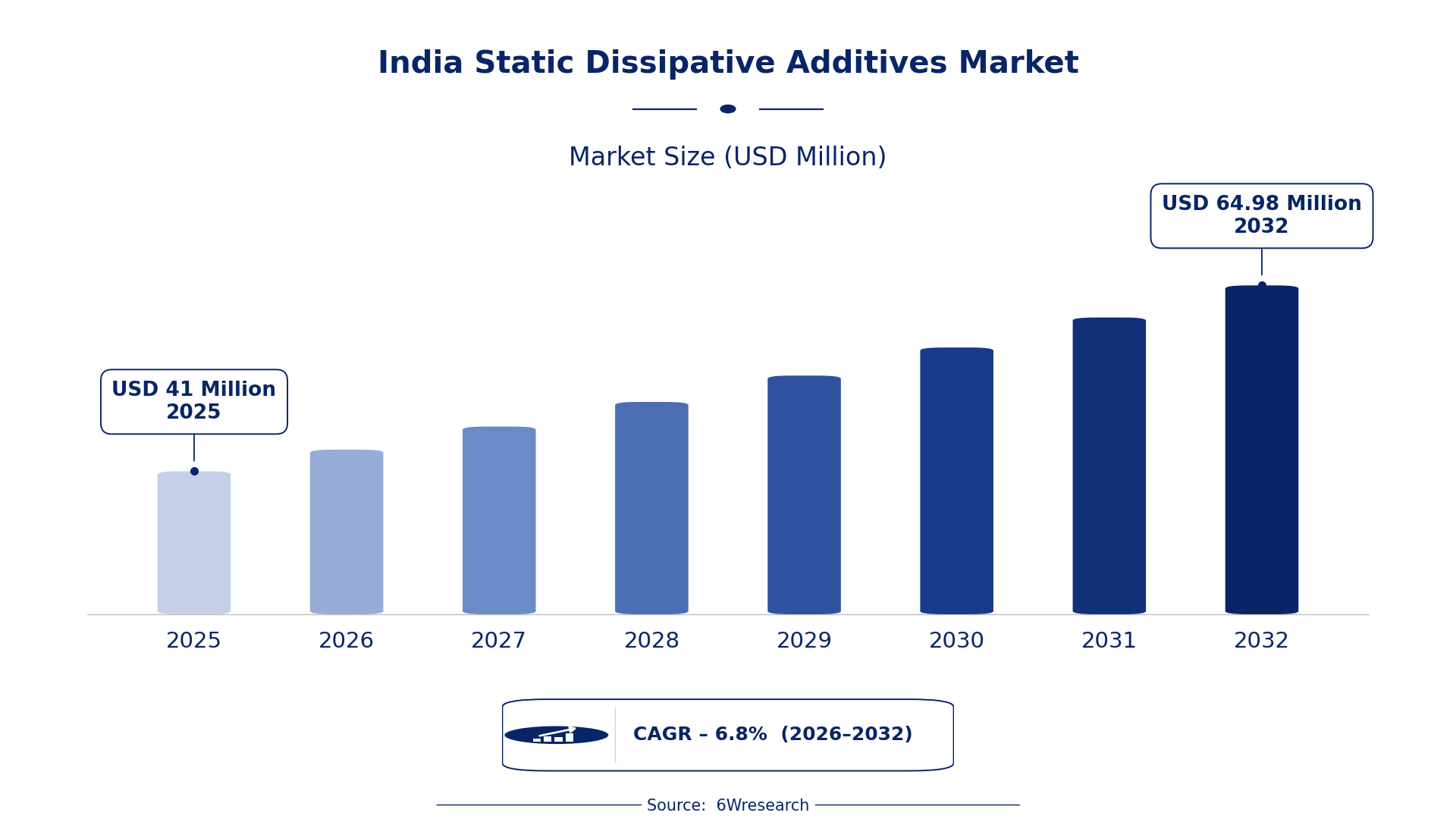
According to 6Wresearch internal database and industry insights, the India Static Dissipative Additives Market was valued at USD 41.0 million in 2025 and is projected to reach USD 64.98 million by 2032, growing at a CAGR of approximately 6.8% during 2026–2032.
India Static Dissipative Additives Market Highlights
| Report Metric | Details |
| Report Name | India Static Dissipative Additives Market |
| Market Size 2025 | USD 41.0 million |
| Market Size 2032 | USD 64.98 million |
| Absolute Growth 2025–2032 | USD 23.98 million |
| CAGR 2026–2032 | 6.8% |
| Peak Annual Growth | 9.1% in 2031 |
| Forecast Period | 2026–2032 |
| Historical Data | 2022–2025 |
| Base Year | 2025 |
| Leading Additive Type, 2025 | Carbon Black (44% share) |
| Leading Base Polymer, 2025 | PVC (40% share) |
| Leading Form, 2025 | Pellet (45% share) |
| Leading End Use Industry, 2025 | Electronics Components (49% share) |
| Fastest-Growing Additive Type | Conductive Polymer Blends (9.2% CAGR) |
| Fastest-Growing Base Polymer | TPU (8.4% CAGR) |
| Fastest-Growing Form | Powder (8.5% CAGR) |
| Fastest-Growing End Use Industry | Packaging Industry (8.0% CAGR) |
| Growing Sector | Packaging Industry |
| Key End Users | Electronics Components, Automotive Interiors, Packaging Industry, Industrial Flooring |
India Static Dissipative Additives Market Year-wise Growth Rate and Key Drivers (2022–2032)
This graph illustrates the annual growth rates of the market from 2022 to 2032, highlighting a steady upward trajectory and projected market expansion over the forecast period.
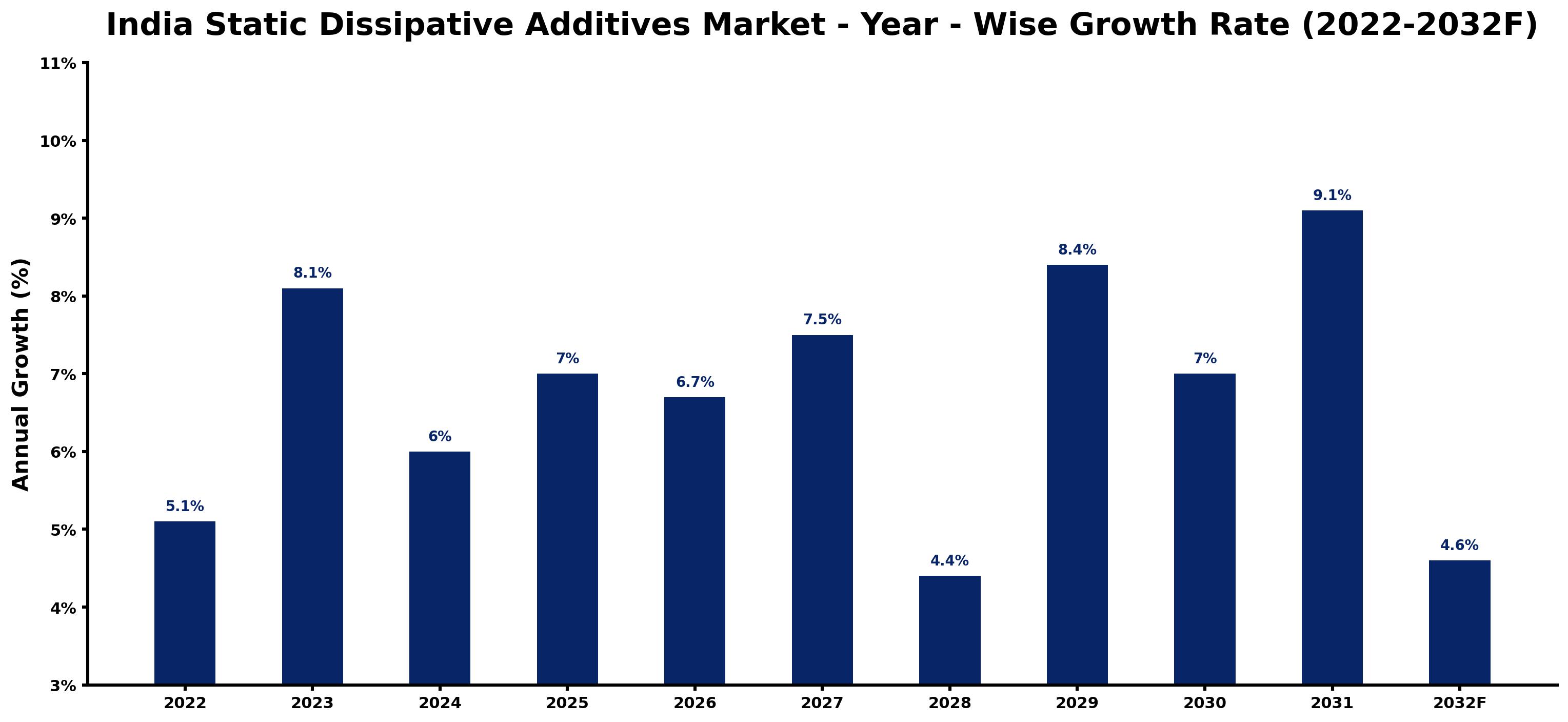
Annual growth estimates for each year appear below with the principal reason behind them, explaining the shifts that set the pace of the market.
| Year | Estimated Annual Growth (%) | Market Rationale |
| 2022 | 5.1 | The market showed steady growth, driven by ongoing demand in the electronics sector. |
| 2023 | 8.1 | Demand surged due to increased production in the automotive industry, leading to higher additive usage. |
| 2024 | 6.0 | Growth slowed slightly as manufacturers adjusted to supply chain challenges in raw materials. |
| 2025 | 7.0 | A rebound in demand from the packaging industry contributed to faster growth this year. |
| 2026 | 6.7 | The market experienced a slowdown as the growth rate stabilised following previous peaks. |
| 2027 | 7.5 | Increased investments in local manufacturing boosted demand across various sectors. |
| 2028 | 4.4 | A decline in growth rate occurred as market conditions normalised after rapid expansion. |
| 2029 | 8.4 | The electronics sector's growth accelerated, driving further demand for static dissipative additives. |
| 2030 | 7.0 | A slight slowdown was noted as the market adjusted to evolving industry standards. |
| 2031 | 9.1 | The peak growth year reflected heightened demand from both automotive and electronics sectors. |
| 2032 | 4.6 | Growth is expected to moderate as the market stabilises after reaching its peak. |
Note: Market size estimations and growth projections presented in this report are based on 6Wresearch's proprietary forecasting methodology, utilizing the latest available industry data, government publications, and primary research inputs.
India Static Dissipative Additives Market Synopsis
Static Dissipative Additives in India are materials designed to control static electricity in applications like packaging for electronic components and automotive interiors. These additives improve the electrical properties of polymers, ensuring safety and functionality. The India Static Dissipative Additives Market is expanding due to rising demand from the electronics and automotive sectors, supported by government initiatives such as the Production Linked Incentive Scheme. The automotive industry is projected to reach 300 billion USD by 2026, further increasing the need for these materials. Additionally, the packaging industry is expected to grow to 204 billion USD by 2025, driving the demand for static dissipative solutions.
Market Dynamics Impact Analysis (2026–2032)
| Factor | Type | Impact | Primary Segment Affected |
| Increased demand from the electronics sector | Driver | High | Electronics Components |
| Growth in the automotive industry | Driver | High | Automotive Interiors |
| Expansion of the packaging industry | Opportunity | High | Packaging Industry |
| Rising e-commerce activities | Opportunity | Medium | Packaging Industry |
| Regulatory compliance costs | Restraint | High | Carbon Black |
| Supply chain disruptions affecting raw materials | Restraint | Medium | Carbon Black |
| High costs of compliance with international standards | Challenge | High | Carbon Black |
| Delays in obtaining necessary certifications | Challenge | Medium | Carbon Black |
Evaluation of Drivers in India Static Dissipative Additives Market (2026–2032)
Key forces behind demand, with the segment each one moves most, are listed below.
| Drivers | Primary Segment Affected | Why It Matters (Evidence) |
| Growing automotive production | Automotive Interiors | The automotive industry in India is expected to reach 300 billion USD by 2026, increasing demand for static dissipative materials. |
| Expansion of e-commerce | Packaging Industry | The demand for static dissipative packaging is driven by a 25% increase in e-commerce in 2023, leading to higher additive usage. |
| Government incentives for electronics manufacturing | Electronics Components | The Production Linked Incentive Scheme aims to boost local manufacturing, increasing demand for additives in the sector. |
| Rising standards for static control | Electronics Components | Updated standards by the Bureau of Indian Standards ensure compliance, driving the need for static dissipative additives in manufacturing. |
| Sustainable solutions in manufacturing | Conductive Polymer Blends | The Indian market for conductive polymers is expanding, focusing on environmentally friendly materials that meet new regulations. |
A notable rise in e-commerce, with a 25% increase in 2023, has heightened the need for static dissipative packaging solutions. The Production Linked Incentive Scheme will enhance local manufacturing capabilities, further driving demand. Updated standards from the Bureau of Indian Standards ensure compliance, resulting in increased purchases from manufacturers in the electronics sector.
Evaluation of Restraints in India Static Dissipative Additives Market
The key brakes on demand, and where they bite hardest, are shown below.
| Market Restraint | Primary Segment Affected | Why It Matters (Evidence) |
| High compliance costs for international standards | Carbon Black | Compliance with updated standards can increase production costs by up to 15% for manufacturers. |
| Supply chain disruptions affecting raw materials | Carbon Black | Recent global supply chain issues have led to a 20% increase in raw material costs. |
| Limited awareness of static control solutions | Electronics Components | Many manufacturers are unaware of the benefits of static dissipative additives, limiting adoption and reducing market growth. |
| Regulatory hurdles in product approval | Carbon Black | Obtaining necessary certifications can delay product launches by several months, impacting market entry for new products. |
| Environmental regulations impacting production | Conductive Polymer Blends | New environmental guidelines have increased production costs by approximately 10%, affecting pricing strategies and competitiveness. |
India Static Dissipative Additives Market Challenges
Buyers in the India Static Dissipative Additives market face rising costs due to volatile raw material prices, which can inflate production expenses by 15% for manufacturers. Technology limitations hinder the development of advanced static dissipative materials, delaying product launches by up to six months for suppliers. A shortage of skilled workers impacts manufacturing efficiency, potentially reducing output by 20% for producers. Supply chain disruptions complicate logistics, extending delivery timelines by eight weeks for end-users and affecting their operational efficiency.
Trends in the India Static Dissipative Additives Market
Several trends are reshaping the India Static Dissipative Additives Market; the most important are set out below.
- Shift towards Sustainable Materials: Manufacturers are increasingly adopting sustainable materials for static dissipative additives, influenced by environmental regulations. The Indian market for conductive polymers is expanding, focusing on eco-friendly solutions, with a growth rate of 9.2%.
- Increasing Use in E-commerce Packaging: The rise of e-commerce in India has led to a growing demand for static dissipative packaging solutions. The packaging industry is expected to grow to 204 billion USD by 2025, pushing manufacturers to innovate.
- Adoption of Advanced Manufacturing Techniques: Advanced manufacturing techniques are being embraced to improve the production of static dissipative additives. The focus on efficiency and quality is clear as the market adapts to new technologies.
- Regulatory Compliance Driving Innovation: Regulatory compliance is prompting manufacturers to innovate in static dissipative additives. The Bureau of Indian Standards updated IS 13410:2021, ensuring products meet international standards.
Investment Opportunities in the India Static Dissipative Additives Market
The following opportunities in the India Static Dissipative Additives Market pair current demand with a clear way in.
- Investment in Sustainable Additives: With the market for sustainable materials projected to grow significantly, there is a gap for innovative static dissipative additives. Suppliers can target the electronics sector, partnering with local manufacturers to meet rising demand.
- Expansion in Automotive Applications: The automotive sector's growth presents an opportunity for static dissipative additives. Suppliers should focus on developing tailored solutions for automotive interiors, leveraging partnerships with automotive manufacturers.
- Growth in E-commerce Packaging: The surge in e-commerce creates a demand for static dissipative packaging solutions. Suppliers can enter this market by collaborating with packaging companies to provide innovative materials.
- Focus on Compliance Solutions: As regulatory standards evolve, there is a need for additives that meet compliance requirements. Suppliers should invest in developing products that adhere to the latest standards, targeting manufacturers in the electronics sector.
Government Initiatives in the India Static Dissipative Additives Market
The Bureau of Indian Standards governs static control in electronics through the updated IS 13410:2021, ensuring compliance with international standards. This regulation mandates that manufacturers adhere to specific guidelines for static dissipative additives, enhancing product reliability and safety. Additionally, the National Policy on Electronics 2019 aims to promote the manufacturing of electronic goods, targeting a production value of 100 billion USD by 2025. This policy encourages local production, reducing reliance on imports and stimulating innovation in static dissipative materials. The Automotive Mission Plan 2026 further supports the automotive sector's growth, which significantly utilises these additives, ensuring sustainable development in this industry.
The Production Linked Incentive Scheme, launched by the Ministry of Electronics and Information Technology in 2021, incentivises local manufacturers to enhance production capabilities. This scheme aims for a 25% increase in local production of electronic components, directly benefiting buyers of static dissipative additives. The initiative provides financial support for technology upgrades and capacity expansion, facilitating the growth of domestic suppliers. Furthermore, the Make in India initiative encourages local production of materials, including static dissipative additives, which helps reduce import dependency and stimulates the domestic market. Manufacturers can leverage these schemes to improve their operational efficiency and product offerings.
Future Insight of the India Static Dissipative Additives Market
The Production Linked Incentive Scheme will enhance local manufacturing capabilities, encouraging advancements in additive technologies. The rise of e-commerce will amplify the need for static dissipative packaging, creating new opportunities for suppliers. Adherence to ISO 9001 standards will improve product quality, ensuring buyers receive dependable and consistent materials.
Market Segmentation Analysis
Each segment group is reviewed below, with the leader by share and the fastest grower by CAGR.
By Additive Type – Carbon Black Dominated, Conductive Polymer Blends Expected to Grow Fastest
According to Summon Dutta, Assistant Manager at 6Wresearch, in 2025, Carbon Black led the additive type split with a 44% share. Carbon Black holds the largest market share due to its extensive application as a conductive filler in polymers, particularly in the automotive and electronics sectors. Its established compliance with national standards for static control further solidifies its dominant position in the Indian market. Conductive Polymer Blends are projected to grow fastest, at a CAGR of 9.2% during 2026–2032. Conductive Polymer Blends are experiencing rapid growth as they enhance conductivity in plastics, driven by the increasing demand for sustainable solutions in the electronics industry. The significant expansion of the Indian market for conductive polymers is a key factor in this growth trajectory. This development suggests that suppliers should focus on creating sustainable conductive additives to seize emerging market opportunities.
By Base Polymer – PVC Dominated, TPU Expected to Grow Fastest
PVC accounted for a 40% market share by base polymer in 2025. PVC is the leading base polymer in the market, primarily due to its widespread use in electrical insulation applications across various industries. Its compatibility with static dissipative additives makes it a preferred choice among manufacturers. Over 2026–2032, TPU is expected to post the fastest growth, at a CAGR of 8.4%. TPU is the fastest-growing base polymer, gaining traction in applications requiring flexibility, particularly in the automotive and electronics sectors. This trend is expected to continue as manufacturers seek versatile materials for dynamic applications. Buyers should consider the advantages of TPU for flexible applications as the market shifts towards more adaptable materials.
By Form – Pellet Dominated, Powder Expected to Grow Fastest
With a 45% revenue share in 2025, Pellet was the largest form category. Pellet form is the most common in the market, as it is widely used for processing static dissipative additives in various applications. Its ease of handling and compatibility with different manufacturing processes contribute to its leading position. The quickest growth will come from Powder, forecast to expand at a CAGR of 8.5% between 2026 and 2032. Powder form is growing rapidly due to its specific use in formulations that require fine particle sizes, particularly in the electronics packaging sector. This trend indicates a shift towards more tailored solutions in additive applications. Suppliers should invest in powder production capabilities to cater to the increasing demand for specialised formulations.
By End Use Industry – Electronics Components Dominated, Packaging Industry Expected to Grow Fastest
Electronics Components held a 49% share of the India Static Dissipative Additives Market by end use industry in 2025. The Electronics Components sector commands the largest market share as a key user of static control materials, essential for protecting sensitive electronic devices. The ongoing growth of the electronics industry in India reinforces this segment's leadership. Packaging Industry is set to record the highest CAGR in this split, 8.0% over 2026–2032. The Packaging Industry is the fastest-growing segment, driven by the surge in e-commerce which has seen a 25% increase in 2023. This growth highlights the rising importance of static dissipative packaging solutions to ensure product safety during transit. Suppliers must adapt to the packaging industry's needs to capitalise on the booming e-commerce market.
Key Attractiveness of the Report
- 10 Years of Market Numbers
- Historical Data Starting from 2022 to 2025
- Base Year 2025
- Forecast Data until 2032
- Key Performance Indicators Impacting the Market
- Major Upcoming Developments and Projects
Key Highlights of the Report:
- India Static Dissipative Additives Market Outlook
- Market Size of India Static Dissipative Additives Market, 2025
- Forecast of India Static Dissipative Additives Market, 2032
- Historical Data and Forecast of India Static Dissipative Additives Revenues & Volume for the Period 2022 - 2032F
- India Static Dissipative Additives Market Trend Evolution
- India Static Dissipative Additives Market Drivers and Challenges
- India Static Dissipative Additives Price Trends
- India Static Dissipative Additives Porter's Five Forces
- India Static Dissipative Additives Industry Life Cycle
- Historical Data and Forecast of India Static Dissipative Additives Market Revenues & Volume By Additive Type for the Period 2022 - 2032F
- Historical Data and Forecast of India Static Dissipative Additives Market Revenues & Volume By Polyethylene Glycol for the Period 2022 - 2032F
- Historical Data and Forecast of India Static Dissipative Additives Market Revenues & Volume By Carbon Black for the Period 2022 - 2032F
- Historical Data and Forecast of India Static Dissipative Additives Market Revenues & Volume By Conductive Polymer Blends for the Period 2022 - 2032F
- Historical Data and Forecast of India Static Dissipative Additives Market Revenues & Volume By Quaternary Ammonium Compounds for the Period 2022 - 2032F
- Historical Data and Forecast of India Static Dissipative Additives Market Revenues & Volume By Base Polymer for the Period 2022 - 2032F
- Historical Data and Forecast of India Static Dissipative Additives Market Revenues & Volume By Polyolefins for the Period 2022 - 2032F
- Historical Data and Forecast of India Static Dissipative Additives Market Revenues & Volume By PVC for the Period 2022 - 2032F
- Historical Data and Forecast of India Static Dissipative Additives Market Revenues & Volume By PS/ABS for the Period 2022 - 2032F
- Historical Data and Forecast of India Static Dissipative Additives Market Revenues & Volume By TPU for the Period 2022 - 2032F
- Historical Data and Forecast of India Static Dissipative Additives Market Revenues & Volume By Form for the Period 2022 - 2032F
- Historical Data and Forecast of India Static Dissipative Additives Market Revenues & Volume By Pellet for the Period 2022 - 2032F
- Historical Data and Forecast of India Static Dissipative Additives Market Revenues & Volume By Powder for the Period 2022 - 2032F
- Historical Data and Forecast of India Static Dissipative Additives Market Revenues & Volume By Granules for the Period 2022 - 2032F
- Historical Data and Forecast of India Static Dissipative Additives Market Revenues & Volume By Liquid Additive for the Period 2022 - 2032F
- Historical Data and Forecast of India Static Dissipative Additives Market Revenues & Volume By End Use Industry for the Period 2022 - 2032F
- Historical Data and Forecast of India Static Dissipative Additives Market Revenues & Volume By Packaging Industry for the Period 2022 - 2032F
- Historical Data and Forecast of India Static Dissipative Additives Market Revenues & Volume By Electronics Components for the Period 2022 - 2032F
- Historical Data and Forecast of India Static Dissipative Additives Market Revenues & Volume By Automotive Interiors for the Period 2022 - 2032F
- Historical Data and Forecast of India Static Dissipative Additives Market Revenues & Volume By Industrial Flooring for the Period 2022 - 2032F
- India Static Dissipative Additives Import Export Trade Statistics
- Market Opportunity Assessment By Additive Type
- Market Opportunity Assessment By Base Polymer
- Market Opportunity Assessment By Form
- Market Opportunity Assessment By End Use Industry
- India Static Dissipative Additives Top Companies Market Share
- India Static Dissipative Additives Competitive Benchmarking By Technical and Operational Parameters
- India Static Dissipative Additives Company Profiles
- India Static Dissipative Additives Key Strategic Recommendations
Market Covered
The report offers an extensive study of the following market segments.
By Additive Type
- Polyethylene Glycol
- Carbon Black
- Conductive Polymer Blends
- Quaternary Ammonium Compounds
By Base Polymer
- Polyolefins
- PVC
- PS/ABS
- TPU
By Form
- Pellet
- Powder
- Granules
- Liquid Additive
By End Use Industry
- Packaging Industry
- Electronics Components
- Automotive Interiors
- Industrial Flooring































