China Static Dissipative Additives Market Size & Growth Rate
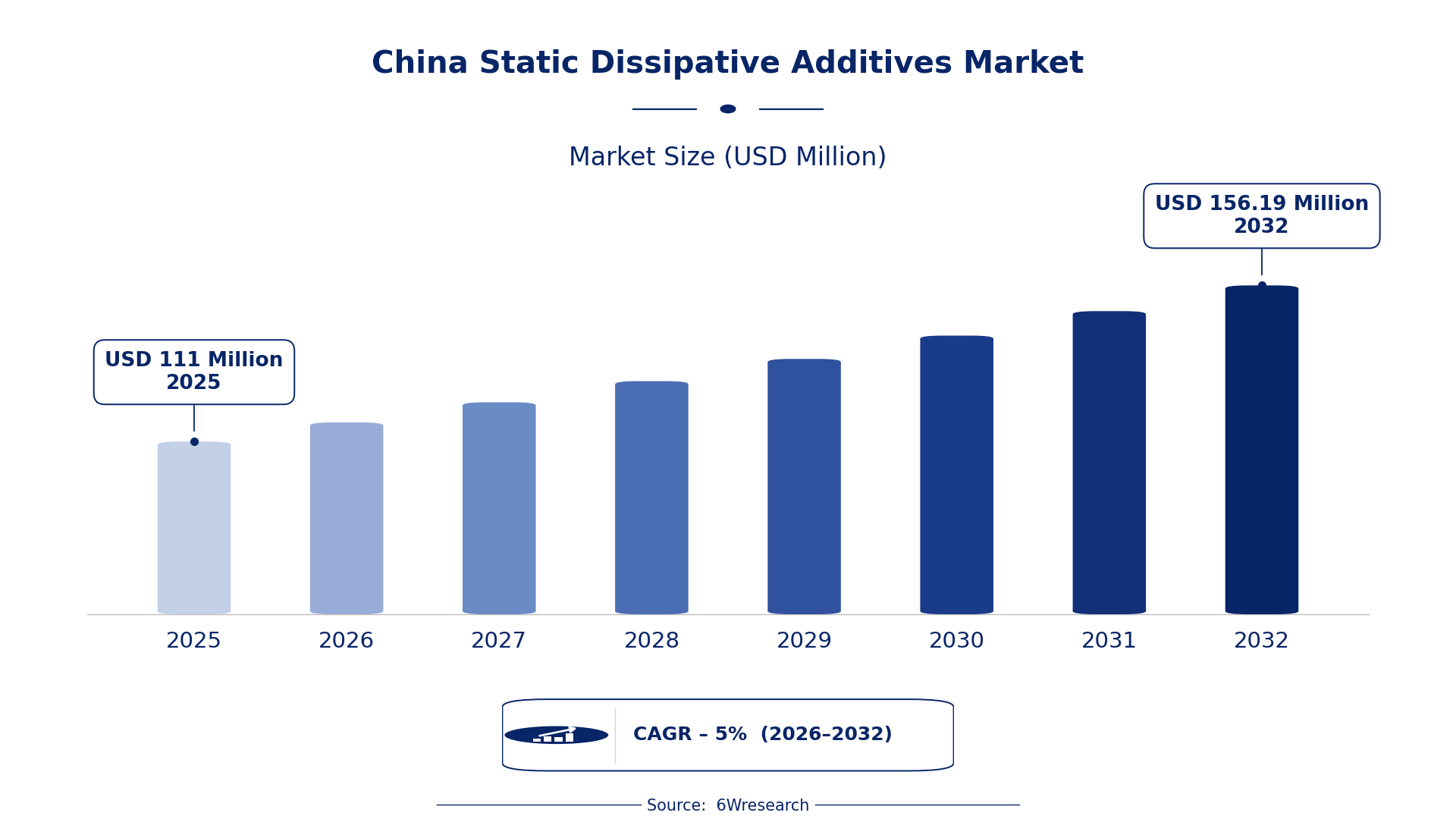
According to 6Wresearch internal database and industry insights, the China Static Dissipative Additives Market was valued at USD 111.0 million in 2025 and is projected to reach USD 156.19 million by 2032, growing at a CAGR of approximately 5% during 2026–2032.
China Static Dissipative Additives Market Highlights
| Report Metric | Details |
| Report Name | China Static Dissipative Additives Market |
| Market Size 2025 | USD 111.0 million |
| Market Size 2032 | USD 156.19 million |
| Absolute Growth 2025–2032 | USD 45.19 million |
| CAGR 2026–2032 | 5% |
| Peak Annual Growth | 6.9% in 2028 |
| Forecast Period | 2026–2032 |
| Historical Data | 2022–2025 |
| Base Year | 2025 |
| Leading Additive Type, 2025 | Polyethylene Glycol (39% share) |
| Leading Base Polymer, 2025 | Polyolefins (43% share) |
| Leading Form, 2025 | Pellet (47% share) |
| Leading End Use Industry, 2025 | Packaging Industry (40% share) |
| Fastest-Growing Additive Type | Carbon Black (6.8% CAGR) |
| Fastest-Growing Base Polymer | PVC (6.5% CAGR) |
| Fastest-Growing Form | Powder (7.4% CAGR) |
| Fastest-Growing End Use Industry | Electronics Components (7.3% CAGR) |
| Growing Sector | Packaging Industry |
| Key End Users | Electronics Manufacturers, Automotive Suppliers, Packaging Producers |
China Static Dissipative Additives Market Year-wise Growth Rate and Key Drivers (2022–2032)
This graph illustrates the annual growth rates of the market from 2022 to 2032, highlighting a steady upward trajectory and projected market expansion over the forecast period.
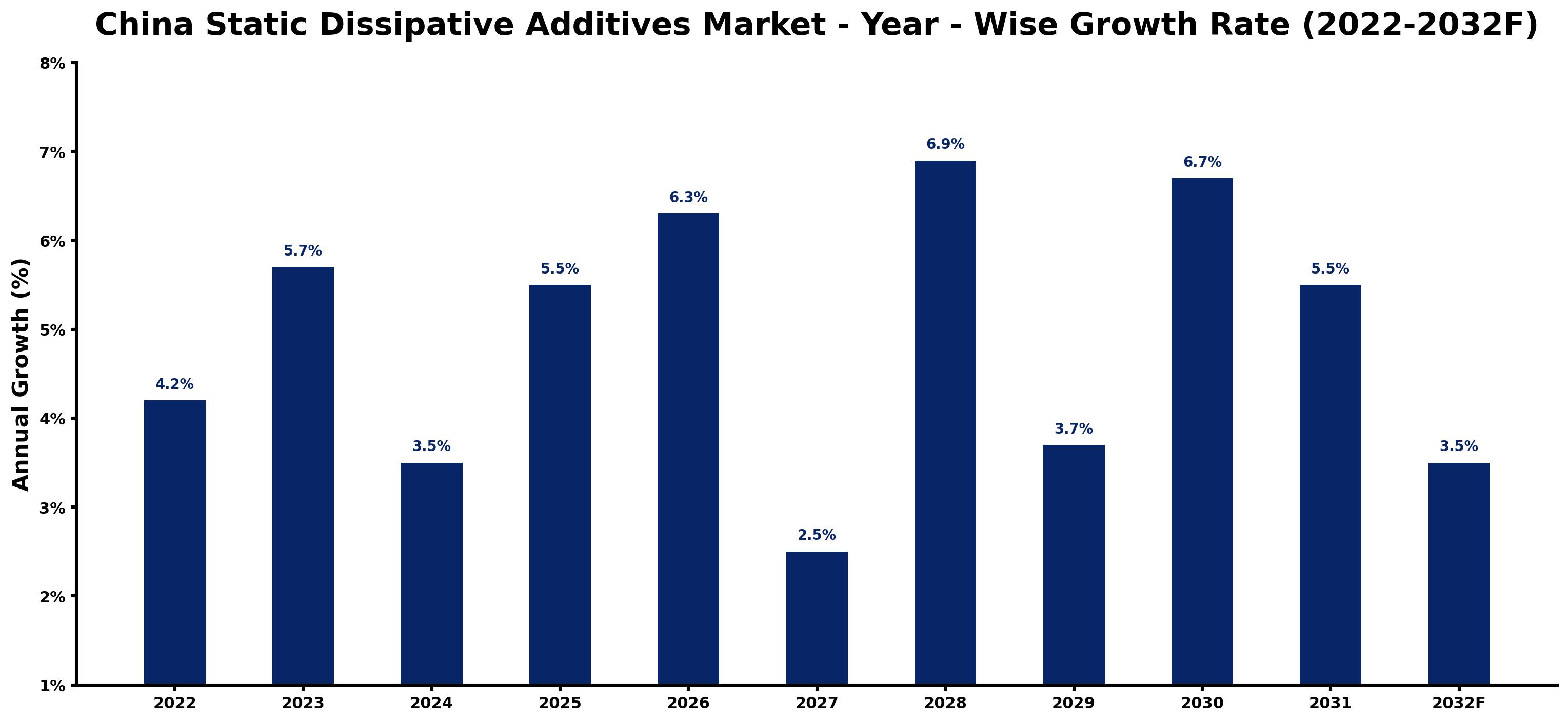
The table below sets out the estimated growth rate for each year and the main factor behind it.
| Year | Estimated Annual Growth (%) | Market Rationale |
| 2022 | 4.2 | The market experienced steady demand due to ongoing production in the electronics sector. |
| 2023 | 5.7 | Growth accelerated as the electronics industry produced over 1.5 billion units of consumer electronics. |
| 2024 | 3.5 | A slowdown occurred as production levels stabilised in the packaging sector. |
| 2025 | 5.5 | Demand surged with the packaging industry projected to reach 1 trillion yuan by 2025. |
| 2026 | 6.3 | The market expanded further as the automotive sector is expected to grow to 35 million vehicles annually by 2025. |
| 2027 | 2.5 | Growth is expected to slow as new safety regulations in automotive interiors are implemented. |
| 2028 | 6.9 | A peak growth rate is anticipated, driven by the introduction of enhanced safety standards for electronic components. |
| 2029 | 3.7 | Demand is projected to slow as the market stabilises following rapid growth in previous years. |
| 2030 | 6.7 | Growth is expected to accelerate again due to increased production in the electronics components sector. |
| 2031 | 5.5 | The market is projected to experience a slowdown as manufacturers adapt to updated quality standards. |
| 2032 | 3.5 | Growth is expected to continue slowing as the market matures. |
Note: Market size estimations and growth projections presented in this report are based on 6Wresearch's proprietary forecasting methodology, utilizing the latest available industry data, government publications, and primary research inputs.
China Static Dissipative Additives Market Synopsis
Static Dissipative Additives are chemical compounds used in China to mitigate static electricity in various materials. These compounds are produced by blending conductive materials with polymers, enhancing the safety of electronic components, packaging, and automotive interiors. The China Static Dissipative Additives Market is expanding due to strong demand from domestic electronics and packaging sectors. In 2022, the electronics industry produced over 1.5 billion units, while the packaging sector is projected to reach 1 trillion yuan by 2025. Stricter safety regulations in automotive interiors are further driving demand for these additives.
Market Dynamics Impact Analysis (2026–2032)
| Factor | Type | Impact | Primary Segment Affected |
| Strong demand from the electronics industry | Driver | High | Electronics Components |
| Growth in the packaging sector | Driver | High | Packaging Industry |
| Investment in advanced materials | Opportunity | Medium | Conductive Polymer Blends |
| Expansion of automotive production | Opportunity | High | Automotive Interiors |
| Stricter environmental regulations | Restraint | High | Polyethylene Glycol |
| Quality compliance costs for manufacturers | Restraint | Medium | Polyethylene Glycol |
| High production costs for additives | Challenge | Medium | Polyethylene Glycol |
| Supply chain disruptions affecting availability | Challenge | High | Polyethylene Glycol |
Evaluation of Drivers in China Static Dissipative Additives Market (2026–2032)
Below mentioned are some major drivers and their influence on market dynamics.
| Drivers | Primary Segment Affected | Why It Matters (Evidence) |
| Rising production of consumer electronics | Electronics Components | The electronics industry produced over 1.5 billion units in 2022, increasing the demand for static dissipative additives. |
| Growth in packaging demand | Packaging Industry | The packaging sector is set to reach a market size of 1 trillion yuan by 2025, driving additive purchases. |
| Increasing automotive production | Automotive Interiors | The automotive sector is expected to grow to 35 million vehicles produced annually by 2025, boosting demand for additives. |
| Adoption of safety standards | Conductive Polymer Blends | New safety regulations in automotive interiors are increasing the use of conductive polymer blends. |
| Investment in advanced materials | Conductive Polymer Blends | The National Development and Reform Commission's strategy promotes advanced materials, supporting market growth. |
Growth in the Static Dissipative Additives market in China comes from rising production of consumer electronics, increasing demand from the packaging sector, and expanding automotive production. The electronics industry produced over 1.5 billion units in 2022, which boosts demand for additives. Anticipated growth in the automotive sector, projected to reach 35 million vehicles annually by 2025, creates a substantial market for static dissipative materials. The introduction of new safety standards in automotive interiors is driving the adoption of conductive polymer blends. Additionally, the National Development and Reform Commission's strategy to promote advanced materials is expected to further support market growth.
Evaluation of Restraints in China Static Dissipative Additives Market
Below mentioned are some major restraints and their influence on market dynamics.
| Market Restraint | Primary Segment Affected | Why It Matters (Evidence) |
| Stricter environmental regulations | Polyethylene Glycol | In 2023, regulations on chemical additives were introduced, increasing compliance costs for manufacturers. |
| Quality compliance costs for manufacturers | Polyethylene Glycol | The updated Product Quality Law in 2022 requires manufacturers to invest in quality assurance measures. |
| High production costs for additives | Polyethylene Glycol | The rising costs of raw materials are impacting the overall production expenses for additives. |
| Supply chain disruptions affecting availability | Polyethylene Glycol | Global supply chain issues have led to delays in the procurement of essential materials. |
| Market saturation in certain sectors | Electronics Components | The installed base of electronic components reached 3 billion units in 2022, limiting growth opportunities. |
China Static Dissipative Additives Market Challenges
In China, over-reliance on a limited number of suppliers for static dissipative additives creates supply chain vulnerabilities, delaying production timelines for manufacturers. This situation forces producers to maintain higher inventory levels, costing them approximately 15% more in operational expenses. Buyers in the electronics and packaging sectors face challenges due to fluctuating prices, which can increase by up to 20% during peak demand periods, impacting their profit margins. Competition among local manufacturers intensifies as they strive to meet ISO 9001 standards, leading to increased production costs that are often passed on to buyers.
Trends in the China Static Dissipative Additives Market
Four trends stand out in the China Static Dissipative Additives Market.
- Shift towards Stricter Safety Regulations: In 2023, the Ministry of Industry and Information Technology launched a program to improve safety standards for electronic components. This initiative is likely to increase the demand for static dissipative additives, particularly in the electronics sector, as manufacturers strive to comply with new regulations.
- Transition from Traditional to Advanced Materials: The National Development and Reform Commission's 'Advanced Manufacturing 2025' plan initiated in 2021 is promoting the use of advanced materials in manufacturing. This shift is encouraging the adoption of static dissipative additives, particularly in automotive applications, as safety requirements evolve.
- Emergence of Conductive Polymer Blends: The increasing use of conductive polymer blends in automotive interiors is notable due to safety regulations. This trend is likely to grow as manufacturers seek to improve static control in vehicle components, reflecting a broader industry shift towards safety.
- Growing Demand in Packaging Industry: The packaging industry is set to reach a market size of 1 trillion yuan by 2025, driving the need for static dissipative additives. This growth presents an opportunity for suppliers to cater to the expanding market.
Investment Opportunities in the China Static Dissipative Additives Market
Below are the investment opportunities with the strongest case in the China Static Dissipative Additives Market.
- Investment in Conductive Polymer Blends: The demand for conductive polymer blends is rising due to safety regulations in automotive interiors. With the automotive sector expected to grow, suppliers should consider partnerships with manufacturers in this space.
- Supply of Static Dissipative Additives: Now is an ideal time to invest in static dissipative additives as the electronics industry continues to expand. Targeting manufacturers in Guangdong, a major electronics hub, can yield fruitful partnerships.
- Entry into the Packaging Sector: The packaging industry is set to reach 1 trillion yuan by 2025, creating opportunities for new suppliers. Establishing joint ventures with local manufacturers can facilitate market entry.
- Focus on Advanced Materials: With the National Development and Reform Commission promoting advanced materials, there is a strong opportunity to supply innovative additives. Collaborating with research institutions can enhance product development.
Government Initiatives in the China Static Dissipative Additives Market
The 'Advanced Manufacturing 2025' plan launched by the Ministry of Industry and Information Technology in 2021 aims to improve production capabilities for static dissipative materials. This initiative encourages manufacturers to invest in advanced technologies and improve product quality, ensuring compliance with international standards. The updated 'Product Quality Law' in 2022 by the State Administration for Market Regulation emphasises the importance of maintaining high-quality standards for additives, impacting production processes and ensuring safety in applications. These measures collectively drive the market towards improved safety and performance in static dissipative additives.
The Ministry of Ecology and Environment's 2023 regulations on chemical additives promote environmental safety, requiring manufacturers to adhere to stricter compliance measures. This affects producers by increasing operational costs, as they must invest in environmentally friendly practices and materials. The National Standardization Administration's 'Standard for Static Dissipative Materials' released in 2020 guides manufacturers in compliance and quality, ensuring that products meet safety requirements. These regulations help buyers by ensuring the reliability and safety of static dissipative additives.
Future Insight of the China Static Dissipative Additives Market
Several forward-looking factors should support the static dissipative additives market in China over the coming years. The automotive sector is expected to grow, with production projected to reach 35 million vehicles annually by 2025, driving demand for safer materials. The Ministry of Industry and Information Technology's new safety standards for electronic components will stimulate market growth. The National Development and Reform Commission's strategy to promote advanced materials will create new opportunities for producers, enhancing their competitiveness.
Market Segmentation Analysis
The analysis below covers each segmentation, its leading category in 2025 and its fastest-growing category through 2032.
By Additive Type – Polyethylene Glycol Dominated, Carbon Black Expected to Grow Fastest
According to Summon Dutta, Assistant Manager at 6Wresearch, Polyethylene Glycol held a 39% share of the China Static Dissipative Additives Market by additive type in 2025. Polyethylene Glycol holds the largest share in the China Static Dissipative Additives Market due to its extensive application in enhancing conductivity in plastics. Its significant use in the electronics sector, which produced over 1.5 billion consumer electronics units in 2022, highlights its critical importance. Carbon Black is set to record the highest CAGR in this split, 6.8% over 2026–2032. Carbon Black is experiencing rapid growth as it provides essential electrical conductivity across various applications. Its increasing demand in the automotive sector, projected to reach 35 million vehicles produced annually by 2025, underscores its vital role in safety and performance. Suppliers should expand their offerings of Carbon Black to capitalise on its growth potential in the automotive industry.
By Base Polymer – Polyolefins Dominated, PVC Expected to Grow Fastest
In 2025, Polyolefins led the base polymer split with a 43% share. Polyolefins dominate the market share as the preferred base polymer for static dissipative additives, widely utilised in various applications. Their versatility and compatibility with different manufacturing processes make them essential, particularly in the packaging sector projected to reach a market size of 1 trillion yuan by 2025. The quickest growth will come from PVC, forecast to expand at a CAGR of 6.5% between 2026 and 2032. PVC is witnessing the fastest growth owing to its common use in flooring and packaging applications. As the packaging industry expands, the demand for PVC-based additives is likely to surge, further driving market trends. Buyers should consider sourcing PVC-based additives to meet the growing demands in the packaging sector.
By Form – Pellet Dominated, Powder Expected to Grow Fastest
With a 47% revenue share in 2025, Pellet was the largest form category. Pellet form leads the market due to its commonality in processing within manufacturing environments. This format is particularly advantageous for producers, facilitating efficient handling and application in various static dissipative additive uses. Powder is projected to grow fastest, at a CAGR of 7.4% during 2026–2032. Powder form is growing rapidly as it is increasingly utilised in coatings and compounding processes. The shift towards powder-based solutions reflects the industry's need for more adaptable and effective static dissipative materials. Manufacturers should explore innovations in powder formulations to stay competitive in the evolving market.
By End Use Industry – Packaging Industry Dominated, Electronics Components Expected to Grow Fastest
Packaging Industry took a 40% share of end use industry in 2025, more than any other category. The Packaging Industry commands the largest share in the market for static dissipative additives, primarily due to its vital role in ensuring static control during product transport and storage. With the packaging industry projected to reach a market size of 1 trillion yuan by 2025, its demand for these additives is expected to remain robust. Over 2026–2032, Electronics Components are expected to post the fastest growth, at a CAGR of 7.3%. Electronics Components is the fastest-growing segment, driven by the increasing production of electronic devices and the need for enhanced safety standards. The recent programme by the Ministry of Industry and Information Technology to improve electronic component safety will further amplify this demand. Suppliers should prioritise the electronics sector to leverage its rapid growth and align with emerging safety standards.
Key Attractiveness of the Report
- 10 Years of Market Numbers
- Historical Data Starting from 2022 to 2025
- Base Year 2025
- Forecast Data until 2032
- Key Performance Indicators Impacting the Market
- Major Upcoming Developments and Projects
Key Highlights of the Report:
- China Static Dissipative Additives Market Outlook
- Market Size of China Static Dissipative Additives Market, 2025
- Forecast of China Static Dissipative Additives Market, 2032
- Historical Data and Forecast of China Static Dissipative Additives Revenues & Volume for the Period 2022 - 2032F
- China Static Dissipative Additives Market Trend Evolution
- China Static Dissipative Additives Market Drivers and Challenges
- China Static Dissipative Additives Price Trends
- China Static Dissipative Additives Porter's Five Forces
- China Static Dissipative Additives Industry Life Cycle
- Historical Data and Forecast of China Static Dissipative Additives Market Revenues & Volume By Additive Type for the Period 2022 - 2032F
- Historical Data and Forecast of China Static Dissipative Additives Market Revenues & Volume By Polyethylene Glycol for the Period 2022 - 2032F
- Historical Data and Forecast of China Static Dissipative Additives Market Revenues & Volume By Carbon Black for the Period 2022 - 2032F
- Historical Data and Forecast of China Static Dissipative Additives Market Revenues & Volume By Conductive Polymer Blends for the Period 2022 - 2032F
- Historical Data and Forecast of China Static Dissipative Additives Market Revenues & Volume By Quaternary Ammonium Compounds for the Period 2022 - 2032F
- Historical Data and Forecast of China Static Dissipative Additives Market Revenues & Volume By Base Polymer for the Period 2022 - 2032F
- Historical Data and Forecast of China Static Dissipative Additives Market Revenues & Volume By Polyolefins for the Period 2022 - 2032F
- Historical Data and Forecast of China Static Dissipative Additives Market Revenues & Volume By PVC for the Period 2022 - 2032F
- Historical Data and Forecast of China Static Dissipative Additives Market Revenues & Volume By PS/ABS for the Period 2022 - 2032F
- Historical Data and Forecast of China Static Dissipative Additives Market Revenues & Volume By TPU for the Period 2022 - 2032F
- Historical Data and Forecast of China Static Dissipative Additives Market Revenues & Volume By Form for the Period 2022 - 2032F
- Historical Data and Forecast of China Static Dissipative Additives Market Revenues & Volume By Pellet for the Period 2022 - 2032F
- Historical Data and Forecast of China Static Dissipative Additives Market Revenues & Volume By Powder for the Period 2022 - 2032F
- Historical Data and Forecast of China Static Dissipative Additives Market Revenues & Volume By Granules for the Period 2022 - 2032F
- Historical Data and Forecast of China Static Dissipative Additives Market Revenues & Volume By Liquid Additive for the Period 2022 - 2032F
- Historical Data and Forecast of China Static Dissipative Additives Market Revenues & Volume By End Use Industry for the Period 2022 - 2032F
- Historical Data and Forecast of China Static Dissipative Additives Market Revenues & Volume By Packaging Industry for the Period 2022 - 2032F
- Historical Data and Forecast of China Static Dissipative Additives Market Revenues & Volume By Electronics Components for the Period 2022 - 2032F
- Historical Data and Forecast of China Static Dissipative Additives Market Revenues & Volume By Automotive Interiors for the Period 2022 - 2032F
- Historical Data and Forecast of China Static Dissipative Additives Market Revenues & Volume By Industrial Flooring for the Period 2022 - 2032F
- China Static Dissipative Additives Import Export Trade Statistics
- Market Opportunity Assessment By Additive Type
- Market Opportunity Assessment By Base Polymer
- Market Opportunity Assessment By Form
- Market Opportunity Assessment By End Use Industry
- China Static Dissipative Additives Top Companies Market Share
- China Static Dissipative Additives Competitive Benchmarking By Technical and Operational Parameters
- China Static Dissipative Additives Company Profiles
- China Static Dissipative Additives Key Strategic Recommendations
Market Covered
Segments analysed in this report are listed below.
By Additive Type
- Polyethylene Glycol
- Carbon Black
- Conductive Polymer Blends
- Quaternary Ammonium Compounds
By Base Polymer
- Polyolefins
- PVC
- PS/ABS
- TPU
By Form
- Pellet
- Powder
- Granules
- Liquid Additive
By End Use Industry
- Packaging Industry
- Electronics Components
- Automotive Interiors
- Industrial Flooring































