India Stock Trading Market Size & Growth Rate
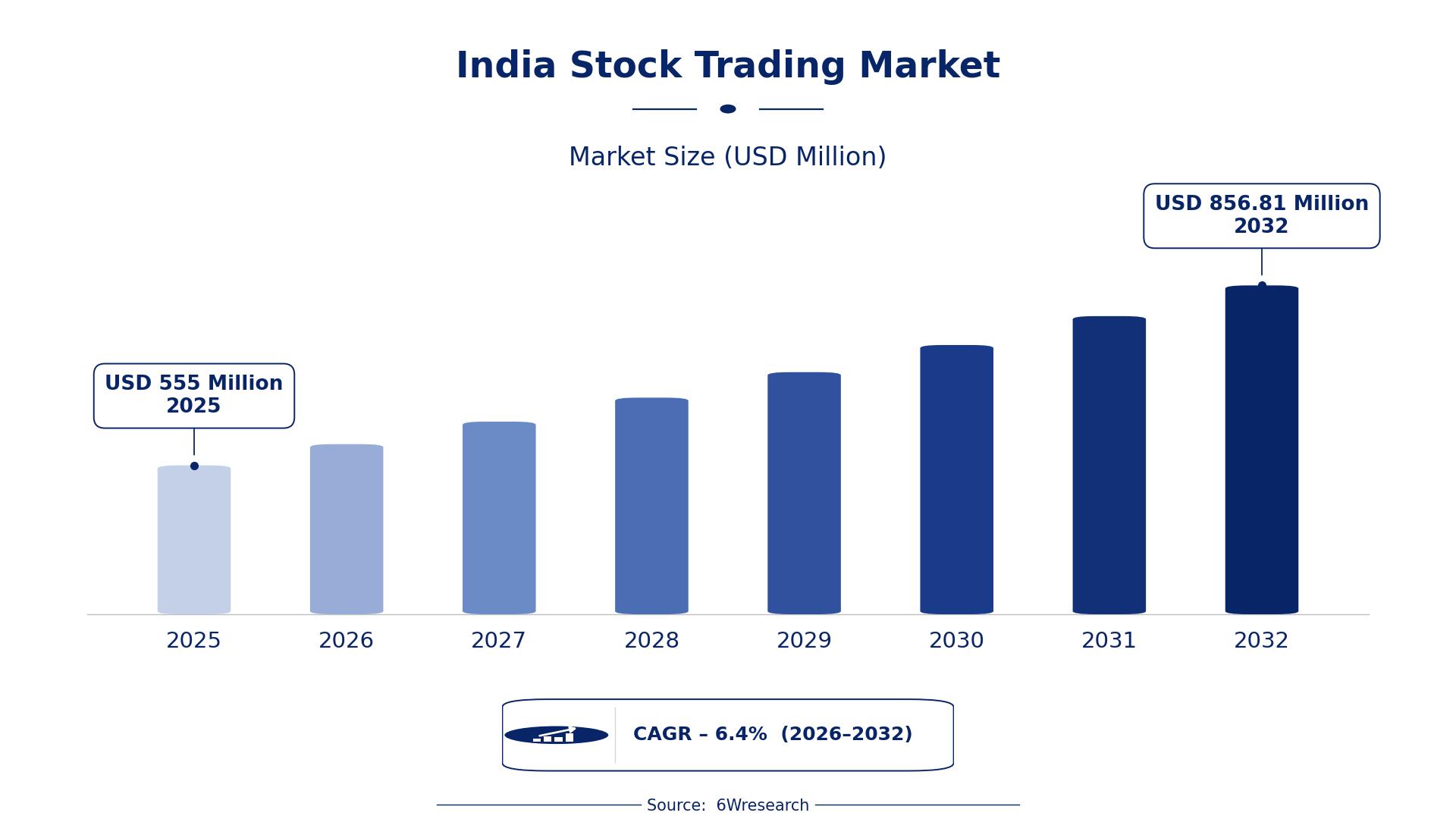
According to 6Wresearch internal database and industry insights, the India Stock Trading Market was valued at USD 555.0 million in 2025 and is projected to reach USD 856.81 million by 2032, growing at a CAGR of approximately 6.4% during 2026–2032.
India Stock Trading Market Highlights
| Report Metric | Details |
| Report Name | India Stock Trading Market |
| Market Size 2025 | USD 555.0 million |
| Market Size 2032 | USD 856.81 million |
| Absolute Growth 2025–2032 | USD 301.81 million |
| CAGR 2026–2032 | 6.4% |
| Peak Annual Growth | 8.8% in 2032 |
| Forecast Period | 2026–2032 |
| Historical Data | 2022–2025 |
| Base Year | 2025 |
| Leading Platform Type, 2025 | Online Trading Platforms (45% share) |
| Leading Asset Class, 2025 | Equities (48% share) |
| Leading Access Channel, 2025 | Web/Mobile (40% share) |
| Leading End User, 2025 | Individual Investors (49% share) |
| Fastest-Growing Platform Type | Robo-Advisors (8.1% CAGR) |
| Fastest-Growing Asset Class | ETFs (8.5% CAGR) |
| Fastest-Growing Access Channel | App-Based (7.7% CAGR) |
| Fastest-Growing End User | Retail Investors (7.7% CAGR) |
| Growing Sector | Retail Investment |
| Key End Users | Retail Investors, Individual Investors, Institutional Investors, High-Net-Worth Clients |
India Stock Trading Market Year-wise Growth Rate and Key Drivers (2022–2032)
This graph illustrates the annual growth rates of the market from 2022 to 2032, highlighting a steady upward trajectory and projected market expansion over the forecast period.
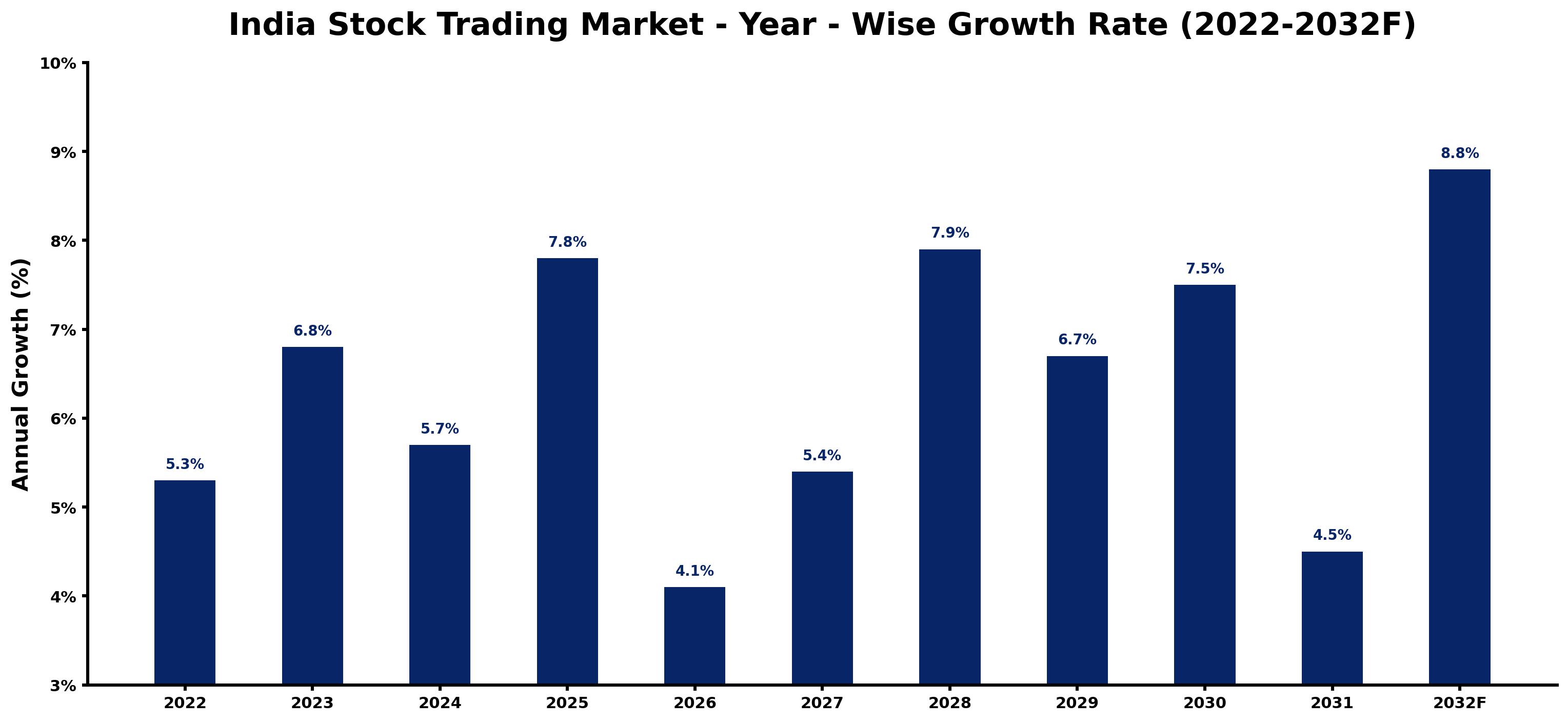
Annual growth estimates for each year appear below with the principal reason behind them, explaining the shifts that set the pace of the market.
| Year | Estimated Annual Growth (%) | Market Rationale |
| 2022 | 5.3 | The market showed steady activity, supported by a growing number of retail investors participating in stock trading activities. |
| 2023 | 6.8 | Growth was driven by increased participation from both domestic and foreign investors entering the market. |
| 2024 | 5.7 | A slight slowdown occurred as investor sentiment adjusted following a strong previous year of trading. |
| 2025 | 7.8 | The market rebounded with heightened trading volumes and renewed investor confidence in equities. |
| 2026 | 4.1 | Growth is expected to slow as market corrections prompt cautious trading among individual investors and institutions. |
| 2027 | 5.4 | Increased foreign direct investment will revitalise interest in stock trading, encouraging more participation. |
| 2028 | 7.9 | The market is projected to experience a surge in retail participation, significantly enhancing trading volumes. |
| 2029 | 6.7 | A slowdown is anticipated as market volatility influences trading strategies among investors. |
| 2030 | 7.5 | Growth is expected to accelerate again as new investment avenues attract more retail investors and institutional players. |
| 2031 | 4.5 | The market will face a slowdown as regulatory changes prompt increased caution among investors. |
| 2032 | 8.8 | A strong recovery is expected as investor confidence returns and new trading platforms emerge. |
Note: Market size estimations and growth projections presented in this report are based on 6Wresearch's proprietary forecasting methodology, utilizing the latest available industry data, government publications, and primary research inputs.
India Stock Trading Market Synopsis
Stock Trading in India encompasses buying and selling shares of publicly listed companies through various platforms. This market is facilitated by stock exchanges and regulated by the Securities and Exchange Board of India (SEBI). The India Stock Trading Market is expanding due to over 60 million retail investors and substantial foreign investments exceeding $50 billion in 2023. Initiatives like the Digital India program are improving accessibility to online trading platforms, driving demand for trading services. The growing interest in equities and mutual funds reflects a shift towards diversified investment strategies among Indian investors.
Market Dynamics Impact Analysis (2026–2032)
| Factor | Type | Impact | Primary Segment Affected |
| Growing number of retail investors | Driver | High | Online Trading Platforms |
| Increased foreign investments | Driver | High | Institutional Platforms |
| Rising interest in equity investments | Opportunity | High | Equities |
| Expansion of digital trading platforms | Opportunity | High | Web/Mobile |
| Market volatility affecting investor confidence | Restraint | Medium | Individual Investors |
| Regulatory changes causing uncertainty | Restraint | Medium | Retail Investors |
| High competition among trading platforms | Challenge | High | Online Trading Platforms |
| Technological barriers for older investors | Challenge | Medium | Traditional Brokers |
Evaluation of Drivers in India Stock Trading Market (2026–2032)
The table below links each growth driver to the segment it affects and the evidence for it.
| Drivers | Primary Segment Affected | Why It Matters (Evidence) |
| Increase in retail investor participation | Online Trading Platforms | Over 60 million retail investors are actively trading, boosting demand for accessible platforms. |
| Foreign direct investment driving institutional trading | Institutional Platforms | FDI inflows exceeding $50 billion in 2023 are driving institutional trading activities. |
| Growth of digital trading platforms | Equities | Equity mutual funds managed over $300 billion in assets, attracting more investors to the market. |
| Increased financial literacy initiatives | Individual Investors | The Financial Literacy Week by SEBI aims to educate investors about stock trading, improving engagement. |
| Rising interest in diversified investments | ETFs | The popularity of ETFs is increasing, reflecting a shift towards diversified investment strategies. |
Growth across the Stock Trading market in India is anchored in rising retail investor participation, foreign investments, and the expansion of digital trading platforms. Over 60 million retail investors are actively trading, which boosts demand for accessible platforms. In 2023, foreign direct investment inflows exceeded $50 billion, intensifying institutional trading activities. Equity mutual funds managed over $300 billion in assets, attracting more investors into the market.
Evaluation of Restraints in India Stock Trading Market
The table below lists the restraints and the evidence behind each.
| Market Restraint | Primary Segment Affected | Why It Matters (Evidence) |
| Market volatility affecting investor confidence | Individual Investors | Market fluctuations have led to uncertainty, causing individual investors to hesitate in their trading decisions. |
| Regulatory changes causing uncertainty | Retail Investors | Recent regulatory adjustments have created confusion among retail investors regarding compliance and trading practices. |
| High competition among trading platforms | Online Trading Platforms | Intense competition has led to reduced margins, affecting profitability for platform providers. |
| Technological barriers for older investors | Traditional Brokers | Older investors may struggle with digital platforms, limiting their participation in the stock market. |
| Limited awareness of investment options | Retail Investors | Many retail investors lack knowledge about diverse investment opportunities, restricting their market engagement. |
India Stock Trading Market Challenges
The India Stock Trading Market encounters notable supply chain delays, with average daily trading volumes exceeding $10 billion. Regulatory compliance issues contribute to transaction times that can extend by several hours, frustrating both domestic and foreign investors. Competition intensifies as over 60 million retail investors enter the market, compelling platforms to improve their service offerings rapidly. High transaction fees, averaging around 0.5% per trade, can diminish returns for investors, while skills shortages in financial literacy hinder effective participation for many potential traders.
Trends in the India Stock Trading Market
Buyers and suppliers in the India Stock Trading Market are adjusting to the following trends.
- Shift towards Digital Trading Platforms: India is experiencing a shift towards digital trading platforms, driven by the Digital India initiative. In 2023, online trading accounts grew by over 20% year-on-year, indicating a strong trend towards digitalisation.
- Growth of Robo-Advisors: Robo-Advisors are gaining traction among tech-savvy investors in India. The segment is expected to grow at a CAGR of 8.1% from 2026 to 2032, reflecting a shift towards automated investment management.
- Increased Participation of Retail Investors: Retail investors are becoming a dominant force in the stock market, with their share reaching 49% in 2025. This trend is supported by educational initiatives like the Financial Literacy Week by SEBI.
- Rise of Equity Mutual Funds: Equity mutual funds are increasingly popular, managing over $300 billion in assets in 2023. This growth showcases a shift towards diversified investment strategies among Indian investors.
Investment Opportunities in the India Stock Trading Market
Below are the investment opportunities with the strongest case in the India Stock Trading Market.
- Retail Investors Seeking Investment Options: Retail investors are increasingly looking for diverse investment options, with equity mutual funds managing over $300 billion in assets. Collaborating with financial advisors can help tap into this growing demand.
- Digital Platforms Expanding Market Access: The Indian stock market is witnessing a surge in digital platform usage, with online trading accounts increasing significantly. This trend presents opportunities for tech firms to develop user-friendly trading solutions.
- Emerging Demand for Robo-Advisors: The Robo-Advisors segment is projected to grow at a CAGR of 8.1%, indicating a need for automated investment solutions. Developing platforms that cater to this demand can capture a new customer base.
- Investment in Financial Literacy Programs: With many retail investors lacking knowledge about investment options, there is a pressing need for educational programs. Initiatives like the Financial Literacy Week can be expanded to enhance investor engagement.
Government Initiatives in the India Stock Trading Market
The Securities and Exchange Board of India (SEBI) launched the 'Securities Market Awareness Campaign' in 2021 to educate investors about stock trading. This initiative complements existing laws by improving investor knowledge and encouraging participation in the market. The 'National Strategy for Financial Literacy 2020-2025' aims to enhance financial literacy among the population, further supporting informed investment decisions. These measures are essential for fostering a more knowledgeable investor base in the stock trading market.
The Ministry of Electronics and Information Technology oversees the Digital India Initiative, which promotes digital trading platforms and improves accessibility for investors. This initiative funds projects aimed at enhancing digital infrastructure, enabling more efficient trading. Additionally, the 'Pradhan Mantri Awas Yojana' includes provisions for financial literacy, encouraging investment in financial markets. These efforts facilitate a more inclusive financial environment, allowing a broader range of investors to participate in stock trading.
Future Insight of the India Stock Trading Market
The India Stock Trading Market is set to evolve by 2032, driven by several key factors. The 'Digital India' program will strengthen online trading platforms, making stock trading more accessible. Initiatives like 'Atmanirbhar Bharat' will stimulate domestic investments in equities, promoting self-reliance. By 2023, equity mutual funds managed assets worth over $300 billion, indicating a growing appetite for investment. The Financial Literacy Week by SEBI will continue to improve investor knowledge, fostering a more informed trading environment.
Market Segmentation Analysis
The analysis below covers each segmentation, its leading category in 2025 and its fastest-growing category through 2032.
By Platform Type – Online Trading Platforms Dominated, Robo-Advisors Expected to Grow Fastest
According to Summon Dutta, Assistant Manager at 6Wresearch, Online Trading Platforms accounted for a 45% market share by platform type in 2025. Online trading platforms hold the largest share in the Indian stock trading market due to their accessibility for over 60 million retail investors. These platforms enable individual investors to trade directly, making them indispensable for active trading activities. The quickest growth will come from Robo-Advisors, forecast to expand at a CAGR of 8.1% between 2026 and 2032. Robo-advisors are rapidly gaining traction as they provide automated investment management, appealing to younger, tech-savvy investors. The increasing demand for user-friendly investment solutions is propelling this segment's growth. Suppliers must enhance online trading features to capture the growing interest of retail investors.
By Asset Class – Equities Dominated, ETFs Expected to Grow Fastest
With a 48% revenue share in 2025, Equities was the largest asset class category. Equities represent the dominant asset class in the Indian stock trading market, primarily due to their appeal for individual investors seeking capital appreciation. The market's robust capitalisation of approximately $3 trillion underscores the significance of equities in investment strategies. Over 2026–2032, ETFs are expected to post the fastest growth, at a CAGR of 8.5%. ETFs are experiencing rapid growth as they offer diversified exposure to various sectors, catering to the rising preference for passive investment strategies. This shift towards ETFs is significantly influencing the market's dynamics. Buyers should consider incorporating ETFs into their portfolios to achieve diversification and mitigate risk.
By Access Channel – Web/Mobile Dominated, App-Based Expected to Grow Fastest
In 2025, Web/Mobile led the access channel split with a 40% share. Web and mobile platforms are the primary access channels for retail investors, reflecting the trend of digitalisation in the stock trading market. With the average daily trading volume exceeding $10 billion, these channels are essential for facilitating high transaction volumes. App-Based is projected to grow fastest, at a CAGR of 7.7% during 2026–2032. App-based trading is becoming increasingly popular among tech-savvy users, driven by the convenience of trading on-the-go. This shift is supported by the 'Digital India' program, which promotes the adoption of digital financial services. Suppliers must optimise their app offerings to meet the rising demand for mobile trading solutions among investors.
By End User – Individual Investors Dominated, Retail Investors Expected to Grow Fastest
The largest end user category in 2025 was Individual Investors, with a 49% share of total revenue. Individual investors make up the largest user group in the Indian stock trading market, driven by the desire for capital growth and portfolio diversification. Their engagement is evident in the surge of demat accounts, which surpassed 100 million in 2023. Retail Investors are set to record the highest CAGR in this split, 7.7% over 2026–2032. Retail investors are the fastest-growing segment, significantly contributing to market volume as financial literacy initiatives encourage more individuals to invest. The 'Pradhan Mantri Jan Dhan Yojana' has played a crucial role in enhancing financial inclusion, leading to increased stock market participation. Suppliers should adapt their services to better cater to retail investors, who are becoming increasingly influential in the market.
Key Attractiveness of the Report
- 10 Years of Market Numbers
- Historical Data Starting from 2022 to 2025
- Base Year 2025
- Forecast Data until 2032
- Key Performance Indicators Impacting the Market
- Major Upcoming Developments and Projects
Key Highlights of the Report:
- India Stock Trading Market Outlook
- Market Size of India Stock Trading Market, 2025
- Forecast of India Stock Trading Market, 2032
- Historical Data and Forecast of India Stock Trading Revenues & Volume for the Period 2022 - 2032F
- India Stock Trading Market Trend Evolution
- India Stock Trading Market Drivers and Challenges
- India Stock Trading Price Trends
- India Stock Trading Porter's Five Forces
- India Stock Trading Industry Life Cycle
- Historical Data and Forecast of India Stock Trading Market Revenues & Volume By Platform Type for the Period 2022 - 2032F
- Historical Data and Forecast of India Stock Trading Market Revenues & Volume By Online Trading Platforms for the Period 2022 - 2032F
- Historical Data and Forecast of India Stock Trading Market Revenues & Volume By Institutional Platforms for the Period 2022 - 2032F
- Historical Data and Forecast of India Stock Trading Market Revenues & Volume By Robo-Advisors for the Period 2022 - 2032F
- Historical Data and Forecast of India Stock Trading Market Revenues & Volume By Traditional Brokers for the Period 2022 - 2032F
- Historical Data and Forecast of India Stock Trading Market Revenues & Volume By Asset Class for the Period 2022 - 2032F
- Historical Data and Forecast of India Stock Trading Market Revenues & Volume By Equities for the Period 2022 - 2032F
- Historical Data and Forecast of India Stock Trading Market Revenues & Volume By Derivatives for the Period 2022 - 2032F
- Historical Data and Forecast of India Stock Trading Market Revenues & Volume By ETFs for the Period 2022 - 2032F
- Historical Data and Forecast of India Stock Trading Market Revenues & Volume By Bonds for the Period 2022 - 2032F
- Historical Data and Forecast of India Stock Trading Market Revenues & Volume By Access Channel for the Period 2022 - 2032F
- Historical Data and Forecast of India Stock Trading Market Revenues & Volume By Web/Mobile for the Period 2022 - 2032F
- Historical Data and Forecast of India Stock Trading Market Revenues & Volume By Direct Exchange Access for the Period 2022 - 2032F
- Historical Data and Forecast of India Stock Trading Market Revenues & Volume By App-Based for the Period 2022 - 2032F
- Historical Data and Forecast of India Stock Trading Market Revenues & Volume By Telephone/Physical for the Period 2022 - 2032F
- Historical Data and Forecast of India Stock Trading Market Revenues & Volume By End User for the Period 2022 - 2032F
- Historical Data and Forecast of India Stock Trading Market Revenues & Volume By Individual Investors for the Period 2022 - 2032F
- Historical Data and Forecast of India Stock Trading Market Revenues & Volume By Hedge Funds for the Period 2022 - 2032F
- Historical Data and Forecast of India Stock Trading Market Revenues & Volume By Retail Investors for the Period 2022 - 2032F
- Historical Data and Forecast of India Stock Trading Market Revenues & Volume By High-Net-Worth Clients for the Period 2022 - 2032F
- India Stock Trading Import Export Trade Statistics
- Market Opportunity Assessment By Platform Type
- Market Opportunity Assessment By Asset Class
- Market Opportunity Assessment By Access Channel
- Market Opportunity Assessment By End User
- India Stock Trading Top Companies Market Share
- India Stock Trading Competitive Benchmarking By Technical and Operational Parameters
- India Stock Trading Company Profiles
- India Stock Trading Key Strategic Recommendations
Market Covered
The report offers an extensive study of the following market segments.
By Platform Type
- Online Trading Platforms
- Institutional Platforms
- Robo-Advisors
- Traditional Brokers
By Asset Class
- Equities
- Derivatives
- ETFs
- Bonds
By Access Channel
- Web/Mobile
- Direct Exchange Access
- App-Based
- Telephone/Physical
By End User
- Individual Investors
- Hedge Funds
- Retail Investors
- High-Net-Worth Clients































