China Stock Trading Market Size & Growth Rate
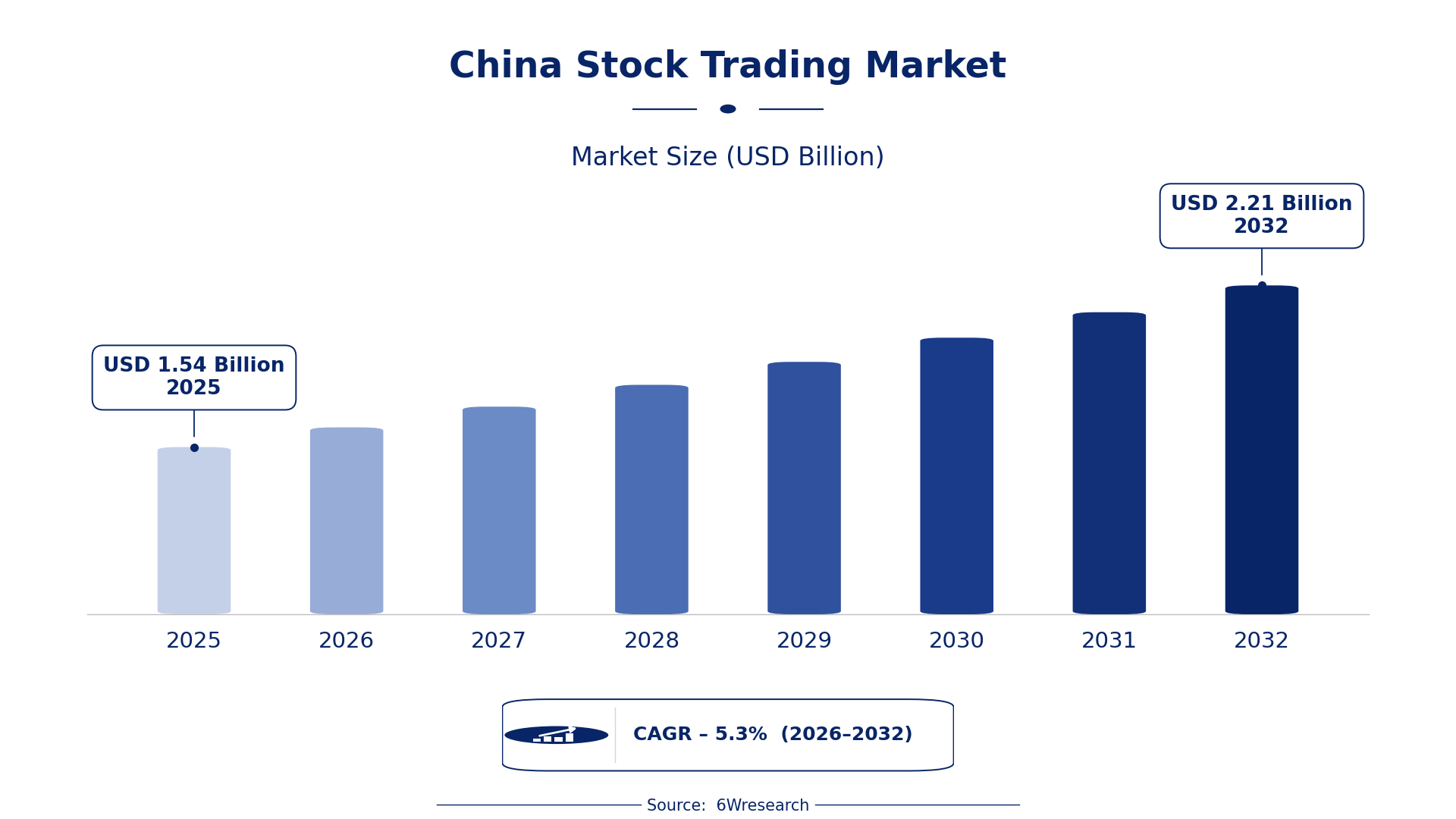
According to 6Wresearch internal database and industry insights, the China Stock Trading Market was valued at USD 1.54 billion in 2025 and is projected to reach USD 2.21 billion by 2032, growing at a CAGR of approximately 5.3% during 2026–2032.
China Stock Trading Market Highlights
| Report Metric | Details |
| Report Name | China Stock Trading Market |
| Market Size 2025 | USD 1.54 billion |
| Market Size 2032 | USD 2.21 billion |
| Absolute Growth 2025–2032 | USD 0.67 billion |
| CAGR 2026–2032 | 5.3% |
| Peak Annual Growth | 7.6% in 2027 |
| Forecast Period | 2026–2032 |
| Historical Data | 2022–2025 |
| Base Year | 2025 |
| Leading Platform Type, 2025 | Online Trading Platforms (49% share) |
| Leading Asset Class, 2025 | Equities (40% share) |
| Leading Access Channel, 2025 | Web/Mobile (36% share) |
| Leading End User, 2025 | Individual Investors (42% share) |
| Fastest-Growing Platform Type | Robo-Advisors (6.8% CAGR) |
| Fastest-Growing Asset Class | ETFs (7.1% CAGR) |
| Fastest-Growing Access Channel | App-Based (6.8% CAGR) |
| Fastest-Growing End User | Hedge Funds (6.3% CAGR) |
| Growing Sector | Retail Investment |
| Key End Users | Individual Investors, Institutional Investors, Hedge Funds, Retail Investors |
China Stock Trading Market Year-wise Growth Rate and Key Drivers (2022–2032)
This graph illustrates the annual growth rates of the market from 2022 to 2032, highlighting a steady upward trajectory and projected market expansion over the forecast period.
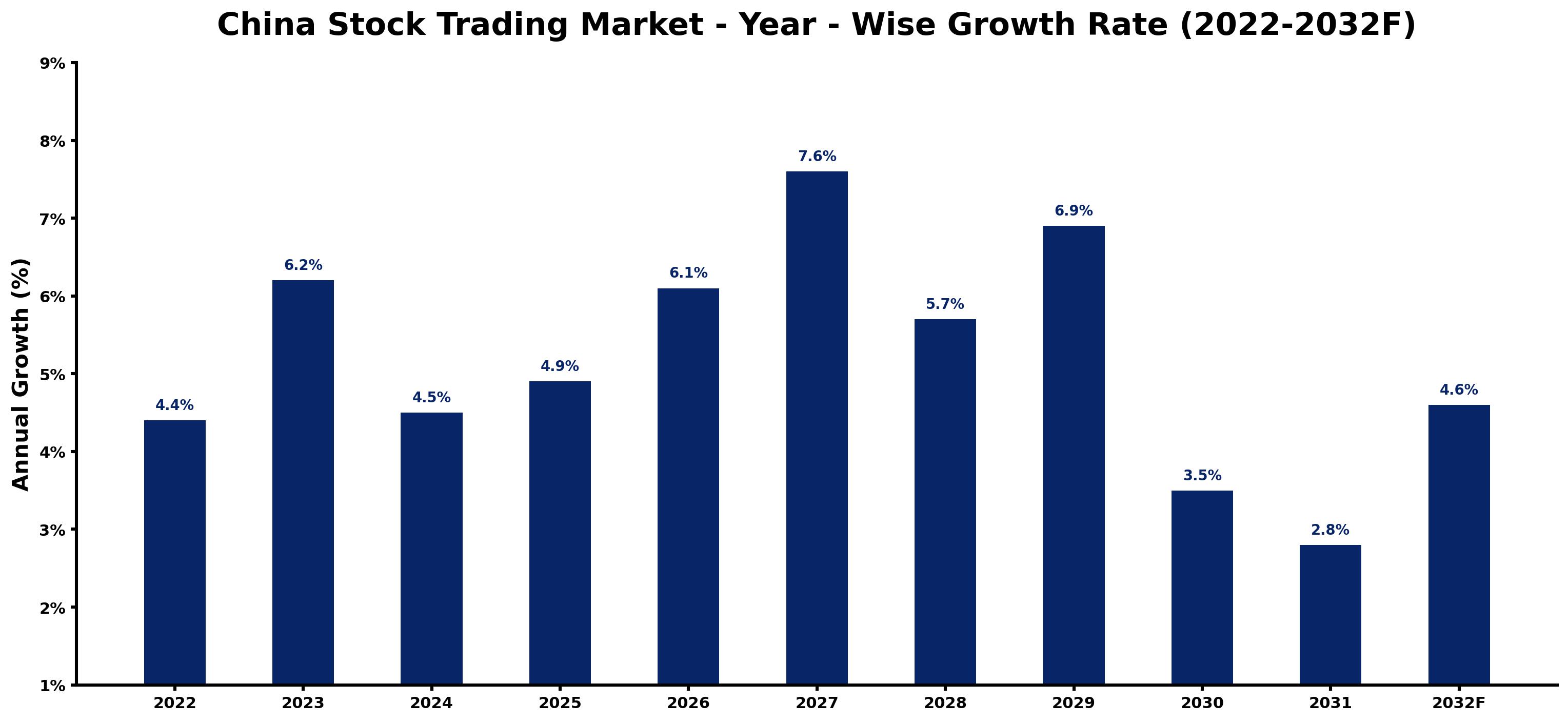
The following table presents the estimated annual growth rate for each year together with the principal factor influencing market performance.
| Year | Estimated Annual Growth (%) | Market Rationale |
| 2022 | 4.4 | The number of individual stock accounts exceeded 200 million, indicating strong participation. |
| 2023 | 6.2 | The Shanghai Composite Index showed growth, attracting more retail investors. |
| 2024 | 4.5 | Market activity slowed slightly as investors adjusted to the 'New Third Board Reform Plan'. |
| 2025 | 4.9 | Increased foreign investment contributed to a rise in trading volumes, with over 1 trillion CNY recorded. |
| 2026 | 6.1 | The number of publicly listed companies is expected to grow, providing more investment options. |
| 2027 | 7.6 | The average daily trading volume is projected to reach approximately 300 billion CNY, driving demand. |
| 2028 | 5.7 | Investor confidence is expected to remain high despite a slight slowdown in growth due to ongoing reforms. |
| 2029 | 6.9 | The market is projected to see renewed interest from high-net-worth clients, boosting trading activity. |
| 2030 | 3.5 | A younger demographic of retail investors will begin to dominate trading volumes, influencing market trends. |
| 2031 | 2.8 | The introduction of new investment vehicles is expected to attract more institutional investors, enhancing market participation. |
| 2032 | 4.6 | The market is expected to benefit from ongoing reforms that improve transparency and investor protection. |
Note: Market size estimations and growth projections presented in this report are based on 6Wresearch's proprietary forecasting methodology, utilizing the latest available industry data, government publications, and primary research inputs.
China Stock Trading Market Synopsis
Stock Trading in China involves buying and selling shares in publicly listed companies through various platforms. It is primarily conducted via online trading platforms and traditional brokers, serving purposes like investment and wealth management. The China Stock Trading Market is experiencing growth due to rising participation from individual and institutional investors, with over 200 million individual stock accounts reported in 2022. Foreign investment, exceeding 1 trillion CNY in 2022, is driving demand for trading activities as more investors seek exposure to the market.
Market Dynamics Impact Analysis (2026–2032)
| Factor | Type | Impact | Primary Segment Affected |
| Growing participation from individual investors in online trading platforms | Driver | High | Online Trading Platforms |
| Increased foreign investment in the stock market | Driver | High | Equities |
| Emerging demand for ETFs among retail investors | Opportunity | Medium | ETFs |
| Rising interest in robo-advisors for automated trading strategies | Opportunity | Medium | Robo-Advisors |
| Market volatility affecting investor confidence | Restraint | High | Institutional Platforms |
| Regulatory changes impacting trading practices | Restraint | Medium | Traditional Brokers |
| High competition among trading platforms | Challenge | High | Online Trading Platforms |
| Technological barriers for older investors | Challenge | Medium | Individual Investors |
Evaluation of Drivers in China Stock Trading Market (2026–2032)
Key forces behind demand, with the segment each one moves most, are listed below.
| Drivers | Primary Segment Affected | Why It Matters (Evidence) |
| Increasing number of individual stock accounts | Online Trading Platforms | Over 200 million accounts in 2022 drive demand for online trading services. |
| High daily trading volumes | Equities | Average daily trading volume of approximately 300 billion CNY in 2022 encourages more trading activity. |
| Rise in foreign investments | Institutional Platforms | Foreign investments exceeding 1 trillion CNY in 2022 support market liquidity. |
| Younger demographic of retail investors | Individual Investors | The average age of retail investors is around 38 years, indicating a shift towards younger participants. |
| Growing popularity of ETFs | ETFs | ETFs are gaining traction, appealing to retail investors seeking diversified options. |
Growth across the Stock Trading market in China is anchored in increasing participation from individual investors, high daily trading volumes, and rising foreign investments. In 2022, the average daily trading volume reached approximately 300 billion CNY, encouraging more trading activity among participants. The number of individual stock accounts surpassed 200 million, reflecting strong engagement in the market. The trend of younger retail investors seeking diversified investment options is further stimulating demand, as the average age of retail investors is around 38 years. Additionally, foreign investment exceeding 1 trillion CNY is boosting market liquidity and attracting institutional participants.
Evaluation of Restraints in China Stock Trading Market
Below mentioned are some major restraints and their influence on market dynamics.
| Market Restraint | Primary Segment Affected | Why It Matters (Evidence) |
| Market volatility affecting investor confidence | Institutional Platforms | Market fluctuations can deter institutional investors, leading to reduced trading activity. |
| Regulatory changes impacting trading practices | Traditional Brokers | New regulations may complicate trading processes for brokers, affecting service delivery. |
| High competition among trading platforms | Online Trading Platforms | Intense competition can lead to reduced profit margins for trading platforms. |
| Technological barriers for older investors | Individual Investors | Older investors may struggle with digital trading platforms, limiting their participation. |
| Limited awareness of investment options among retail investors | ETFs | Many retail investors remain unaware of ETFs, hindering their adoption. |
China Stock Trading Market Challenges
Buyers in the China Stock Trading Market encounter high transaction costs that can significantly diminish their investment returns. Broker fees and trading platform charges typically range from 0.1% to 0.3% per trade, placing a heavier burden on individual investors with smaller portfolios. Technology issues can also impede efficient trading; many platforms suffer from downtime or slow processing speeds, leading to missed opportunities for traders. Furthermore, delays in data feeds can obstruct timely decision-making for investors, while fierce competition among over 4,000 publicly listed companies complicates the identification of profitable investments.
Trends in the China Stock Trading Market
Below mentioned are some of the trends shaping the China Stock Trading Market growth.
- Shift from Traditional Brokers to Online Trading Platforms: Investors are increasingly moving from traditional brokers to online trading platforms, driven by convenience and lower fees. In 2022, online trading platforms captured 49% of the market share, reflecting this shift.
- Rise of Robo-Advisors in Investment Strategies: Robo-advisors are becoming more popular among younger investors seeking automated investment solutions. This trend is projected to grow at a CAGR of 6.8% from 2026 to 2032.
- Increasing Interest in ETFs Among Retail Investors: Retail investors are showing a growing interest in ETFs as a diversified investment vehicle. In 2022, ETFs gained traction, with a projected CAGR of 7.1% through 2032.
- Emergence of App-Based Trading Solutions: App-based trading solutions are gaining popularity, especially among younger investors. By 2026, app-based platforms are expected to grow at a CAGR of 6.8%, reflecting changing preferences.
Investment Opportunities in the China Stock Trading Market
Investors looking at the China Stock Trading Market should consider the following areas.
- Gap in Foreign Investment: With over 1 trillion CNY in foreign investment in 2022, there is an opportunity for platforms to attract more foreign investors. Targeting institutional investors through tailored services could yield high returns.
- Rising Demand for ETFs: The increasing interest in ETFs presents an opportunity for platforms to supply more diversified investment products. Retail investors, particularly in urban regions, are looking for accessible ETF options.
- Partnerships with Local Financial Institutions: Now is an ideal time to enter the market through partnerships with local financial institutions to build credibility. Collaborating with established players can facilitate smoother market entry.
- Growing Number of Individual Stock Accounts: With over 200 million individual stock accounts in 2022, there is a demand for trading platforms. Investing in user-friendly online platforms can capture this expanding market.
Government Initiatives in the China Stock Trading Market
In 2023, the China Securities Regulatory Commission updated the 'Guidelines for the Supervision of Securities Companies' to improve regulatory oversight. This measure introduces stricter compliance requirements for stock trading platforms, ensuring better investor protection and market transparency compared to previous regulations. The updated guidelines aim to improve the overall integrity of the market, benefiting both producers and buyers. Additionally, the 'Stock Market Stabilization Fund' launched in 2022 supports liquidity during periods of volatility, providing essential backing for investors and trading platforms.
The China Securities Regulatory Commission oversees the implementation of various initiatives, including the 'Stock Market Stabilization Fund' launched in 2022. This fund aims to support market liquidity during periods of volatility, providing essential backing for both investors and trading platforms. The fund plays a critical role in stabilising trading activities, ensuring that market participants can navigate fluctuations effectively. Furthermore, the Financial Stability and Development Committee launched initiatives in 2023 to stabilise the stock market, enhancing confidence among investors.
Future Insight of the China Stock Trading Market
The China Stock Trading Market is expected to transform by 2032, driven by technological advancements and regulatory changes. The China Securities Regulatory Commission's new regulations will improve market transparency and investor protection, fostering greater confidence among participants. Digital trading platforms will enhance accessibility for both domestic and foreign investors, facilitating smoother transactions. With foreign investment exceeding 1 trillion CNY in 2022, increased global participation is likely to create diverse opportunities for buyers and suppliers in the market.
Market Segmentation Analysis
Each segment group is reviewed below, with the leader by share and the fastest grower by CAGR.
By Platform Type – Online Trading Platforms Dominated, Robo-Advisors Expected to Grow Fastest
According to Summon Dutta, Assistant Manager at 6Wresearch, Online Trading Platforms took a 49% share of platform type in 2025, more than any other category. Online trading platforms dominate the China Stock Trading Market as they are the primary choice for individual and retail trading activities. With over 200 million individual stock accounts, these platforms facilitate convenient access to the market for a vast number of investors. Robo-Advisors are projected to grow fastest, at a CAGR of 6.8% during 2026–2032. Robo-advisors are rapidly gaining traction due to their appeal to tech-savvy investors seeking automated investment solutions. This growth is particularly notable among younger demographics, who are increasingly prioritising efficient investment management. Suppliers must focus on enhancing online trading features and consider integrating robo-advisory services to meet the rising demand for automated investment options.
By Asset Class – Equities Dominated, ETFs Expected to Grow Fastest
Equities accounted for a 40% market share by asset class in 2025. Equities hold the largest market share in the China Stock Trading Market as they represent the primary asset class traded, with a total market capitalization of around 60 trillion CNY. This asset class is favoured by both individual and institutional investors for its potential returns and liquidity. The quickest growth will come from ETFs, forecast to expand at a CAGR of 7.1% between 2026 and 2032. ETFs are experiencing rapid growth as they provide investors with diversified exposure to various sectors and are increasingly viewed as efficient investment vehicles. This trend is driven by the desire for lower costs and simplified portfolio management. Investors and suppliers should consider the increasing popularity of ETFs when developing investment strategies and product offerings.
By Access Channel – Web/Mobile Dominated, App-Based Expected to Grow Fastest
The largest access channel category in 2025 was Web/Mobile, with a 36% share of total revenue. Web and mobile channels dominate the China Stock Trading Market, serving as the most common access points for retail investors. This is evidenced by the substantial average daily trading volume of approximately 300 billion CNY on the Shanghai Stock Exchange, highlighting their importance. App-Based is set to record the highest CAGR in this split, 6.8% over 2026–2032. App-based trading is swiftly gaining traction, especially among younger investors who value the convenience of mobile applications for trading. This trend indicates a shift towards more accessible trading solutions that cater to a dynamic user base. Suppliers must prioritise mobile optimisation and app development to meet the increasing demand for convenient trading options.
By End User – Individual Investors Dominated, Hedge Funds Expected to Grow Fastest
In 2025, Individual Investors led the end user split with a 42% share. Individual investors constitute the largest segment in the China Stock Trading Market, representing a significant portion of market participants. Their active trading behaviour is crucial for maintaining liquidity, especially given the presence of over 4,000 publicly listed companies. Over 2026–2032, Hedge Funds are expected to post the fastest growth, at a CAGR of 6.3%. Hedge funds are becoming increasingly prominent, contributing to market liquidity and employing advanced investment strategies. Their growing influence reflects a shift towards more institutional investment in Chinese equities, altering the market landscape. Market participants should acknowledge the rising importance of hedge funds and adapt their investment strategies accordingly to align with this trend.
Key Attractiveness of the Report
- 10 Years of Market Numbers
- Historical Data Starting from 2022 to 2025
- Base Year 2025
- Forecast Data until 2032
- Key Performance Indicators Impacting the Market
- Major Upcoming Developments and Projects
Key Highlights of the Report:
- China Stock Trading Market Outlook
- Market Size of China Stock Trading Market, 2025
- Forecast of China Stock Trading Market, 2032
- Historical Data and Forecast of China Stock Trading Revenues & Volume for the Period 2022 - 2032F
- China Stock Trading Market Trend Evolution
- China Stock Trading Market Drivers and Challenges
- China Stock Trading Price Trends
- China Stock Trading Porter's Five Forces
- China Stock Trading Industry Life Cycle
- Historical Data and Forecast of China Stock Trading Market Revenues & Volume By Platform Type for the Period 2022 - 2032F
- Historical Data and Forecast of China Stock Trading Market Revenues & Volume By Online Trading Platforms for the Period 2022 - 2032F
- Historical Data and Forecast of China Stock Trading Market Revenues & Volume By Institutional Platforms for the Period 2022 - 2032F
- Historical Data and Forecast of China Stock Trading Market Revenues & Volume By Robo-Advisors for the Period 2022 - 2032F
- Historical Data and Forecast of China Stock Trading Market Revenues & Volume By Traditional Brokers for the Period 2022 - 2032F
- Historical Data and Forecast of China Stock Trading Market Revenues & Volume By Asset Class for the Period 2022 - 2032F
- Historical Data and Forecast of China Stock Trading Market Revenues & Volume By Equities for the Period 2022 - 2032F
- Historical Data and Forecast of China Stock Trading Market Revenues & Volume By Derivatives for the Period 2022 - 2032F
- Historical Data and Forecast of China Stock Trading Market Revenues & Volume By ETFs for the Period 2022 - 2032F
- Historical Data and Forecast of China Stock Trading Market Revenues & Volume By Bonds for the Period 2022 - 2032F
- Historical Data and Forecast of China Stock Trading Market Revenues & Volume By Access Channel for the Period 2022 - 2032F
- Historical Data and Forecast of China Stock Trading Market Revenues & Volume By Web/Mobile for the Period 2022 - 2032F
- Historical Data and Forecast of China Stock Trading Market Revenues & Volume By Direct Exchange Access for the Period 2022 - 2032F
- Historical Data and Forecast of China Stock Trading Market Revenues & Volume By App-Based for the Period 2022 - 2032F
- Historical Data and Forecast of China Stock Trading Market Revenues & Volume By Telephone/Physical for the Period 2022 - 2032F
- Historical Data and Forecast of China Stock Trading Market Revenues & Volume By End User for the Period 2022 - 2032F
- Historical Data and Forecast of China Stock Trading Market Revenues & Volume By Individual Investors for the Period 2022 - 2032F
- Historical Data and Forecast of China Stock Trading Market Revenues & Volume By Hedge Funds for the Period 2022 - 2032F
- Historical Data and Forecast of China Stock Trading Market Revenues & Volume By Retail Investors for the Period 2022 - 2032F
- Historical Data and Forecast of China Stock Trading Market Revenues & Volume By High-Net-Worth Clients for the Period 2022 - 2032F
- China Stock Trading Import Export Trade Statistics
- Market Opportunity Assessment By Platform Type
- Market Opportunity Assessment By Asset Class
- Market Opportunity Assessment By Access Channel
- Market Opportunity Assessment By End User
- China Stock Trading Top Companies Market Share
- China Stock Trading Competitive Benchmarking By Technical and Operational Parameters
- China Stock Trading Company Profiles
- China Stock Trading Key Strategic Recommendations
Market Covered
This report examines the market across the segments below.
By Platform Type
- Online Trading Platforms
- Institutional Platforms
- Robo-Advisors
- Traditional Brokers
By Asset Class
- Equities
- Derivatives
- ETFs
- Bonds
By Access Channel
- Web/Mobile
- Direct Exchange Access
- App-Based
- Telephone/Physical
By End User
- Individual Investors
- Hedge Funds
- Retail Investors
- High-Net-Worth Clients































