India Structural Adhesives for Vehicles Market Size & Growth Rate
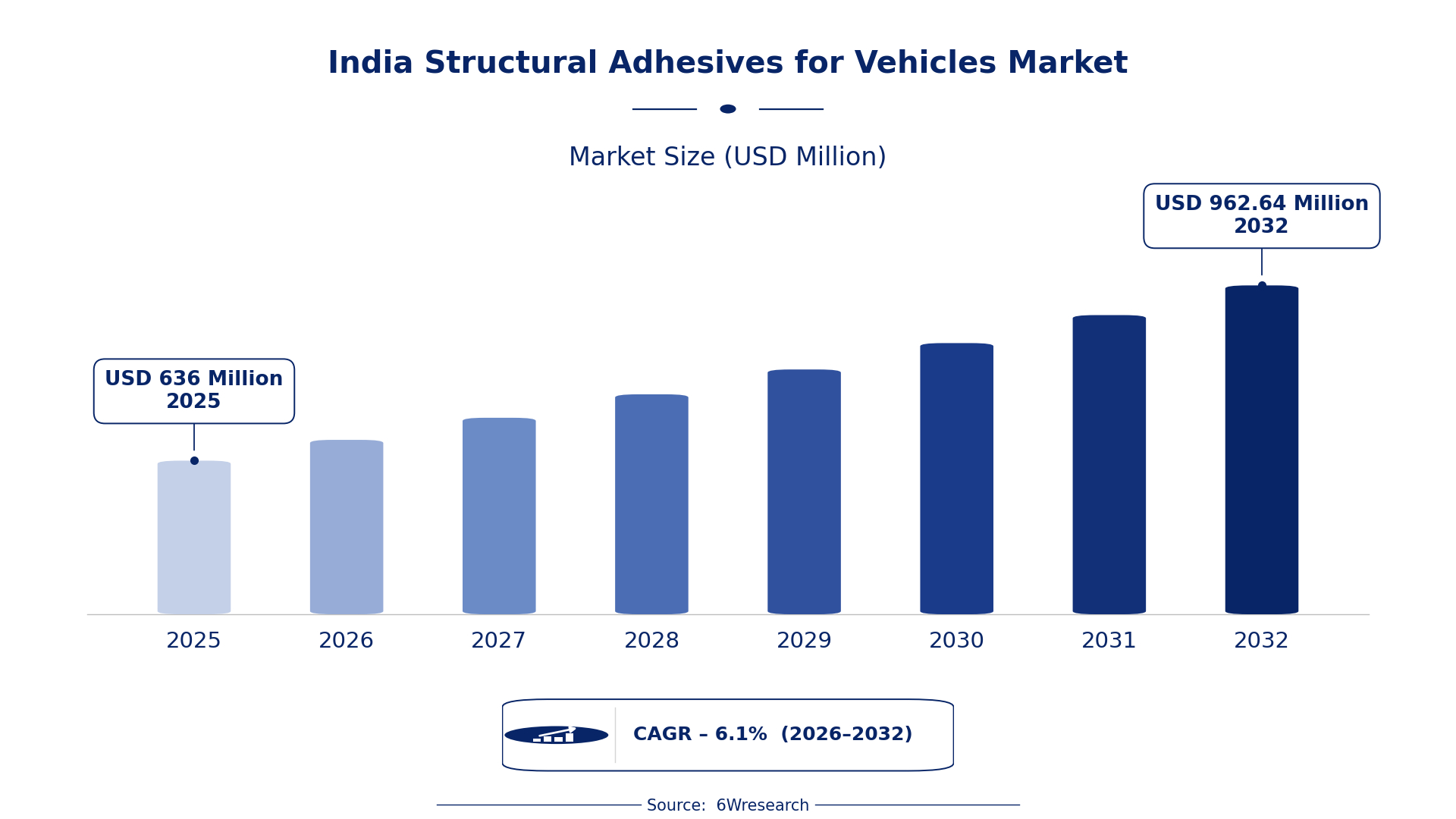
According to 6Wresearch internal database and industry insights, the India Structural Adhesives for Vehicles Market was valued at USD 636.0 million in 2025 and is projected to reach USD 962.64 million by 2032, growing at a CAGR of approximately 6.1% during 2026–2032.
India Structural Adhesives for Vehicles Market Highlights
| Report Metric | Details |
| Report Name | India Structural Adhesives for Vehicles Market |
| Market Size 2025 | USD 636.0 million |
| Market Size 2032 | USD 962.64 million |
| Absolute Growth 2025–2032 | USD 326.64 million |
| CAGR 2026–2032 | 6.1% |
| Peak Annual Growth | 7.9% in 2030 |
| Forecast Period | 2026–2032 |
| Historical Data | 2022–2025 |
| Base Year | 2025 |
| Leading Adhesive Type, 2025 | Epoxy Adhesives (40% share) |
| Leading Chemistry Base, 2025 | Two-Part Epoxy (50% share) |
| Leading Application Area, 2025 | Chassis Bonding (40% share) |
| Leading End User, 2025 | Vehicle OEMs (55% share) |
| Fastest-Growing Adhesive Type | Polyurethane Adhesives (7.4% CAGR) |
| Fastest-Growing Chemistry Base | One-Part Polyurethane (7.5% CAGR) |
| Fastest-Growing End User | Electric Vehicle Makers (7.9% CAGR) |
| Growing Sector | automotive manufacturing |
| Key End Users | Vehicle OEMs, Electric Vehicle Makers, Body Shops |
India Structural Adhesives for Vehicles Market Year-wise Growth Rate and Key Drivers (2022–2032)
This graph illustrates the annual growth rates of the market from 2022 to 2032, highlighting a steady upward trajectory and projected market expansion over the forecast period.
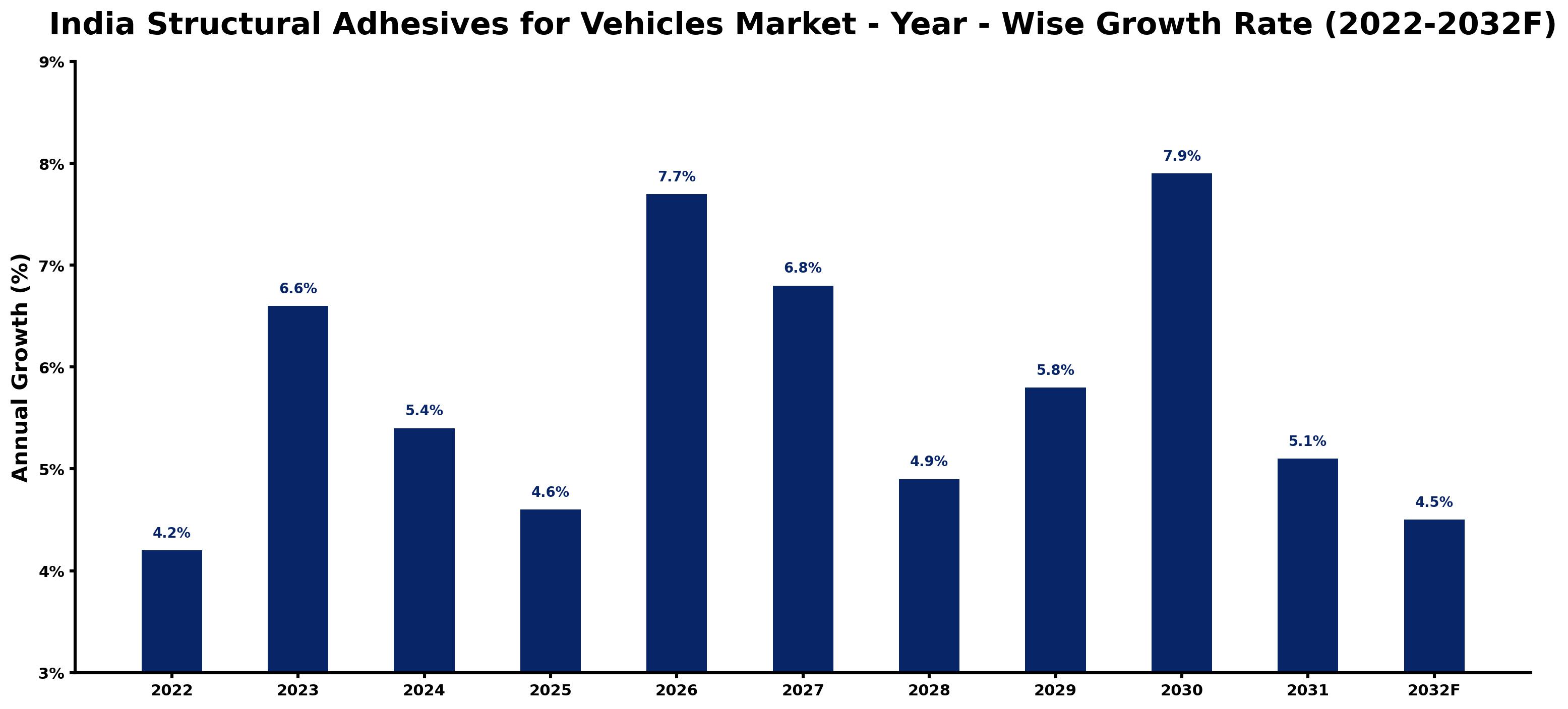
Year by year, the estimates below pair each growth rate with the development that shaped it.
| Year | Estimated Annual Growth (%) | Market Rationale |
| 2022 | 4.2 | The market showed steady growth as vehicle production remained strong, supported by domestic manufacturers. |
| 2023 | 6.6 | Increased demand from electric vehicle makers contributed to faster growth compared to the previous year. |
| 2024 | 5.4 | Growth slowed as manufacturers adjusted to supply chain challenges and shifting consumer preferences. |
| 2025 | 4.6 | A continued focus on electric vehicle production led to further growth, albeit at a slower rate. |
| 2026 | 7.7 | Rising investments in automotive manufacturing and infrastructure spurred growth beyond previous levels. |
| 2027 | 6.8 | The market experienced a slowdown as manufacturers faced challenges in sourcing materials. |
| 2028 | 4.9 | Growth continued to slow due to market adjustments and evolving consumer demands. |
| 2029 | 5.8 | A resurgence in demand from vehicle OEMs led to faster growth compared to the previous year. |
| 2030 | 7.9 | The peak growth rate was achieved as the market capitalised on increased electric vehicle production. |
| 2031 | 5.1 | Growth slowed as the market stabilised amid changing industry dynamics and competition. |
| 2032 | 4.5 | The market is expected to grow at a slower rate as it reaches maturity. |
Note: Market size estimations and growth projections presented in this report are based on 6Wresearch's proprietary forecasting methodology, utilizing the latest available industry data, government publications, and primary research inputs.
India Structural Adhesives for Vehicles Market Synopsis
Structural Adhesives for Vehicles in India serve as high-performance bonding agents crucial for joining various materials in vehicle manufacturing. These adhesives improve structural integrity, reduce weight, and enhance safety in vehicles. The India Structural Adhesives for Vehicles Market is expanding due to rising demand from domestic vehicle manufacturers and electric vehicle producers. The automotive sector's expected growth to $300 billion by 2026 further fuels this demand. The increasing emphasis on eco-friendly products is also shaping the market's future.
Market Dynamics Impact Analysis (2026–2032)
| Factor | Type | Impact | Primary Segment Affected |
| Rising demand from electric vehicle makers drives the need for lightweight and efficient bonding solutions. | Driver | High | Two-Part Epoxy |
| The increasing production of vehicles in India creates a growing market for structural adhesives. | Driver | High | Chassis Bonding |
| Investment in electric vehicle infrastructure presents opportunities for suppliers of eco-friendly adhesives. | Opportunity | High | Polyurethane Adhesives |
| The push for sustainability in automotive manufacturing opens avenues for bio-based adhesive products. | Opportunity | Medium | Acrylic Adhesives |
| Supply chain disruptions have affected the availability of raw materials for adhesive production. | Restraint | High | Epoxy Adhesives |
| Stringent regulations regarding automotive safety standards can limit the types of adhesives used. | Restraint | Medium | Polyurethane Adhesives |
| The Structural Adhesives for Vehicles market in India faces challenges from fluctuating raw material prices. | Challenge | High | Two-Part Epoxy |
| Technological advancements in adhesive formulations may outpace current production capabilities. | Challenge | Medium | Chassis Bonding |
Evaluation of Drivers in India Structural Adhesives for Vehicles Market (2026–2032)
Below mentioned are some major drivers and their influence on market dynamics.
| Drivers | Primary Segment Affected | Why It Matters (Evidence) |
| Increased vehicle production in India is driving demand for structural adhesives, with around 22 million units produced in 2021. | Chassis Bonding | This growth in production leads to higher adhesive consumption for vehicle assembly. |
| The rise of electric vehicle makers is pushing the demand for lightweight bonding solutions, with production projected to reach 6 million units by 2025. | Polyurethane Adhesives | Electric vehicles require efficient materials to optimise performance and reduce weight. |
| The focus on eco-friendly products is driving innovation in adhesive formulations, aligning with sustainability goals. | Acrylic Adhesives | Manufacturers are increasingly adopting bio-based adhesives to meet environmental standards. |
| Government initiatives like the Production Linked Incentive scheme are boosting manufacturing capabilities in the automotive sector. | Two-Part Epoxy | This support encourages local production, increasing the demand for high-performance adhesives. |
| Collaboration among over 800 manufacturers represented by the Automotive Component Manufacturers Association of India is driving innovation in adhesive technology. | Epoxy Adhesives | This collaboration fosters advancements in adhesive technology, supporting market growth. |
Market growth in India for Structural Adhesives for Vehicles relies on the rising production of vehicles, growing demand from domestic manufacturers, and a commitment to eco-friendly products. In 2021, India's vehicle production reached approximately 22 million units, significantly boosting adhesive consumption. The electric vehicle market is anticipated to grow to 6 million units by 2025, increasing the need for lightweight bonding solutions. Collaboration among manufacturers is driving advancements in adhesive technology, further supporting market expansion. The focus on sustainable products is encouraging manufacturers to adopt advanced adhesive formulations that comply with environmental standards.
Evaluation of Restraints in India Structural Adhesives for Vehicles Market
Below mentioned are some major restraints and their influence on market dynamics.
| Market Restraint | Primary Segment Affected | Why It Matters (Evidence) |
| Supply chain disruptions have led to shortages of key raw materials for adhesive production, impacting availability. | Epoxy Adhesives | This shortage can delay production schedules for vehicle manufacturers reliant on timely adhesive supply. |
| Stringent automotive safety regulations limit the types of adhesives that can be used in vehicle manufacturing. | Polyurethane Adhesives | Manufacturers must ensure compliance, which can increase production costs and complexity. |
| Fluctuating raw material prices create uncertainty for adhesive manufacturers, affecting pricing strategies. | Two-Part Epoxy | This volatility can lead to increased costs for vehicle OEMs, impacting their profitability. |
| Limited awareness of advanced adhesive technologies among smaller manufacturers can hinder market growth. | Chassis Bonding | This knowledge gap may prevent adoption of superior bonding solutions, affecting overall performance. |
| Competition from alternative bonding technologies may limit the market share of structural adhesives. | Polyurethane Adhesives | As new technologies emerge, manufacturers may seek alternatives, impacting adhesive demand. |
India Structural Adhesives for Vehicles Market Challenges
In India, the structural adhesives for vehicles market encounters a technological hurdle, as many producers struggle with outdated bonding techniques, which hampers innovation and raises production costs for manufacturers. Supply chain disruptions stem from inconsistent availability of raw materials, leading to production delays that can extend lead times by 20%. Domestic vehicle manufacturers face increased expenses due to fluctuating prices of imported adhesives, which can rise by 15% during peak demand periods. Regulatory compliance with the Bureau of Indian Standards can prolong product approvals, impacting time-to-market for new vehicles by several months.
Trends in the India Structural Adhesives for Vehicles Market
Below mentioned are some of the trends shaping the India Structural Adhesives for Vehicles Market growth.
- Shift towards Eco-Friendly Adhesives: The automotive industry is increasingly adopting eco-friendly adhesives to meet sustainability goals. The National Policy on Biofuels 2022 encourages the use of bio-based adhesives, with the market for eco-friendly products projected to grow significantly.
- Transition to Lightweight Materials: Since 2021, the automotive sector has focused on reducing vehicle weight to improve efficiency. The electric vehicle market's growth to 6 million units by 2025 is driving this trend, prompting manufacturers to seek advanced bonding solutions.
- Emergence of Advanced Adhesive Standards: In 2022, the Automotive Industry Standards Committee was established to develop standards for automotive adhesives. This initiative is expected to improve the quality and performance of adhesives used in vehicles.
- Increase in Electric Vehicle Production: The electric vehicle sector is rapidly expanding, with production projected to reach 6 million units by 2025. This growth is prompting a shift towards adhesives that support lightweight and efficient designs.
Investment Opportunities in the India Structural Adhesives for Vehicles Market
The following opportunities in the India Structural Adhesives for Vehicles Market pair current demand with a clear way in.
- Supply of Eco-Friendly Adhesives: With the increasing demand for sustainable products, manufacturers can invest in eco-friendly adhesives. The Automotive Component Manufacturers Association of India represents over 800 manufacturers, providing a network for collaboration in this area.
- Investment in Lightweight Bonding Solutions: As electric vehicle production rises, there is a need for lightweight bonding solutions. Suppliers can target electric vehicle makers to provide advanced adhesives that meet their specific requirements.
- Development of Advanced Adhesive Formulations: The establishment of the Automotive Industry Standards Committee in 2022 presents opportunities for innovation in adhesive formulations. Manufacturers can invest in research and development to create high-performance products.
- Expansion into Emerging Markets: The growing automotive sector in India offers opportunities for adhesive suppliers. With the market projected to reach $300 billion by 2026, suppliers can enter through partnerships with local manufacturers.
Government Initiatives in the India Structural Adhesives for Vehicles Market
The Production Linked Incentive (PLI) scheme for the automotive sector, launched in 2021, aims to boost manufacturing capabilities and attract investments. This measure encourages local production of automotive components, including adhesives, improving the supply chain and reducing dependence on imports. Additionally, the National Electric Mobility Mission Plan 2020 promotes electric vehicles and their components, focusing on sustainability and innovation in the automotive sector.
The Ministry of Heavy Industries and Public Enterprises oversees automotive manufacturing policies and funds initiatives to strengthen production capabilities. The Automotive Research Association of India (ARAI) approves standards and conducts research for automotive components, including adhesives. This collaboration ensures that manufacturers adhere to quality standards while promoting innovation in adhesive technology.
Future Insight of the India Structural Adhesives for Vehicles Market
Several forward-looking factors should support the structural adhesives for vehicles market in India over the coming years. The electric vehicle sector is set to expand, driving demand for advanced bonding solutions. The Production Linked Incentive scheme will enhance local manufacturing capabilities, streamlining supply chains. An increasing focus on eco-friendly products will promote the adoption of sustainable adhesives, aligning with national standards. These developments will open new avenues for both buyers and suppliers in the automotive industry.
Market Segmentation Analysis
Each segment group is reviewed below, with the leader by share and the fastest grower by CAGR.
By Adhesive Type – Epoxy Adhesives Dominated, Polyurethane Adhesives Expected to Grow Fastest
According to Summon Dutta, Assistant Manager at 6Wresearch, Epoxy Adhesives held a 40% share of the India Structural Adhesives for Vehicles Market by adhesive type in 2025. Epoxy adhesives dominate the market due to their exceptional strength and durability, making them indispensable for high-stress applications in vehicle chassis and components. Their widespread adoption among domestic vehicle manufacturers reinforces their leading market share. Over 2026–2032, Polyurethane Adhesives are expected to post the fastest growth, at a CAGR of 7.4%. Polyurethane adhesives are experiencing rapid growth as they provide the necessary flexibility for contemporary vehicle designs. The increasing trend towards lightweight materials in automotive production significantly propels this segment's expansion. Suppliers must focus on developing advanced polyurethane formulations to cater to the evolving demands of vehicle manufacturers.
By Chemistry Base – Two-Part Epoxy Dominated, One-Part Polyurethane Expected to Grow Fastest
Two-Part Epoxy took a 50% share of chemistry base in 2025, more than any other category. Two-part epoxy adhesives command the largest market share because they provide superior bonding capabilities critical for structural applications in vehicles. Their proven reliability in high-stress environments makes them the preferred choice for manufacturers. One-Part Polyurethane is projected to grow fastest, at a CAGR of 7.5% during 2026–2032. One-part polyurethane adhesives are seeing accelerated growth due to their ease of application and flexibility, which meet the changing demands of the automotive industry. Their user-friendly characteristics appeal to manufacturers aiming to optimise production processes. Buyers should consider one-part polyurethane options to improve production efficiency while maintaining bond quality.
By Application Area – Chassis Bonding Dominated and Is Expected to Record the Fastest Growth
The largest application area category in 2025 was Chassis Bonding, with a 40% share of total revenue. Chassis bonding is crucial for maintaining the structural integrity of vehicles, which is why it commands the largest market share. Its importance in ensuring vehicle safety and performance makes it a primary consideration for manufacturers. Its lead should widen, with a projected CAGR of 7.6% during 2026–2032, the highest in this split. Chassis bonding is also the fastest-growing application area, as it is essential for the overall safety and durability of vehicles. As vehicle designs advance, the need for robust chassis bonding solutions will continue to rise. This trend suggests that suppliers should concentrate on innovations in chassis bonding technologies to satisfy the increasing demand.
By End User – Vehicle OEMs Dominated, Electric Vehicle Makers Expected to Grow Fastest
Vehicle OEMs accounted for a 55% market share by end user in 2025. Vehicle OEMs represent the largest share of the market as they are the primary users of structural adhesives in vehicle manufacturing. Their extensive production volumes ensure a consistent demand for high-performance bonding solutions. Electric Vehicle Makers are set to record the highest CAGR in this split, 7.9% over 2026–2032. Electric vehicle makers are rapidly adopting structural adhesives to achieve lightweight and efficient designs, driving their growth in the market. As the electric vehicle sector expands, this trend is expected to accelerate. Suppliers should tailor their offerings to meet the specific needs of electric vehicle manufacturers to capitalise on this growth opportunity.
Key Attractiveness of the Report
- 10 Years of Market Numbers
- Historical Data Starting from 2022 to 2025
- Base Year 2025
- Forecast Data until 2032
- Key Performance Indicators Impacting the Market
- Major Upcoming Developments and Projects
Key Highlights of the Report:
- India Structural Adhesives for Vehicles Market Outlook
- Market Size of India Structural Adhesives for Vehicles Market, 2025
- Forecast of India Structural Adhesives for Vehicles Market, 2032
- Historical Data and Forecast of India Structural Adhesives for Vehicles Revenues & Volume for the Period 2022 - 2032F
- India Structural Adhesives for Vehicles Market Trend Evolution
- India Structural Adhesives for Vehicles Market Drivers and Challenges
- India Structural Adhesives for Vehicles Price Trends
- India Structural Adhesives for Vehicles Porter's Five Forces
- India Structural Adhesives for Vehicles Industry Life Cycle
- Historical Data and Forecast of India Structural Adhesives for Vehicles Market Revenues & Volume By Adhesive Type for the Period 2022 - 2032F
- Historical Data and Forecast of India Structural Adhesives for Vehicles Market Revenues & Volume By Epoxy Adhesives for the Period 2022 - 2032F
- Historical Data and Forecast of India Structural Adhesives for Vehicles Market Revenues & Volume By Polyurethane Adhesives for the Period 2022 - 2032F
- Historical Data and Forecast of India Structural Adhesives for Vehicles Market Revenues & Volume By Acrylic Adhesives for the Period 2022 - 2032F
- Historical Data and Forecast of India Structural Adhesives for Vehicles Market Revenues & Volume By Rubber-Based Adhesives for the Period 2022 - 2032F
- Historical Data and Forecast of India Structural Adhesives for Vehicles Market Revenues & Volume By Chemistry Base for the Period 2022 - 2032F
- Historical Data and Forecast of India Structural Adhesives for Vehicles Market Revenues & Volume By Two-Part Epoxy for the Period 2022 - 2032F
- Historical Data and Forecast of India Structural Adhesives for Vehicles Market Revenues & Volume By One-Part Polyurethane for the Period 2022 - 2032F
- Historical Data and Forecast of India Structural Adhesives for Vehicles Market Revenues & Volume By Methacrylate Base for the Period 2022 - 2032F
- Historical Data and Forecast of India Structural Adhesives for Vehicles Market Revenues & Volume By Synthetic Rubber for the Period 2022 - 2032F
- Historical Data and Forecast of India Structural Adhesives for Vehicles Market Revenues & Volume By Application Area for the Period 2022 - 2032F
- Historical Data and Forecast of India Structural Adhesives for Vehicles Market Revenues & Volume By Chassis Bonding for the Period 2022 - 2032F
- Historical Data and Forecast of India Structural Adhesives for Vehicles Market Revenues & Volume By Crash Structures for the Period 2022 - 2032F
- Historical Data and Forecast of India Structural Adhesives for Vehicles Market Revenues & Volume By Roof Panels for the Period 2022 - 2032F
- Historical Data and Forecast of India Structural Adhesives for Vehicles Market Revenues & Volume By Doors & Interiors for the Period 2022 - 2032F
- Historical Data and Forecast of India Structural Adhesives for Vehicles Market Revenues & Volume By End User for the Period 2022 - 2032F
- Historical Data and Forecast of India Structural Adhesives for Vehicles Market Revenues & Volume By Vehicle OEMs for the Period 2022 - 2032F
- Historical Data and Forecast of India Structural Adhesives for Vehicles Market Revenues & Volume By Body Shops for the Period 2022 - 2032F
- Historical Data and Forecast of India Structural Adhesives for Vehicles Market Revenues & Volume By Electric Vehicle Makers for the Period 2022 - 2032F
- Historical Data and Forecast of India Structural Adhesives for Vehicles Market Revenues & Volume By Auto Parts Manufacturers for the Period 2022 - 2032F
- India Structural Adhesives for Vehicles Import Export Trade Statistics
- Market Opportunity Assessment By Adhesive Type
- Market Opportunity Assessment By Chemistry Base
- Market Opportunity Assessment By Application Area
- Market Opportunity Assessment By End User
- India Structural Adhesives for Vehicles Top Companies Market Share
- India Structural Adhesives for Vehicles Competitive Benchmarking By Technical and Operational Parameters
- India Structural Adhesives for Vehicles Company Profiles
- India Structural Adhesives for Vehicles Key Strategic Recommendations
Market Covered
This report examines the market across the segments below.
By Adhesive Type
- Epoxy Adhesives
- Polyurethane Adhesives
- Acrylic Adhesives
- Rubber-Based Adhesives
By Chemistry Base
- Two-Part Epoxy
- One-Part Polyurethane
- Methacrylate Base
- Synthetic Rubber
By Application Area
- Chassis Bonding
- Crash Structures
- Roof Panels
- Doors & Interiors
By End User
- Vehicle OEMs
- Body Shops
- Electric Vehicle Makers
- Auto Parts Manufacturers































