India Structural Bonding Materials Market Size & Growth Rate
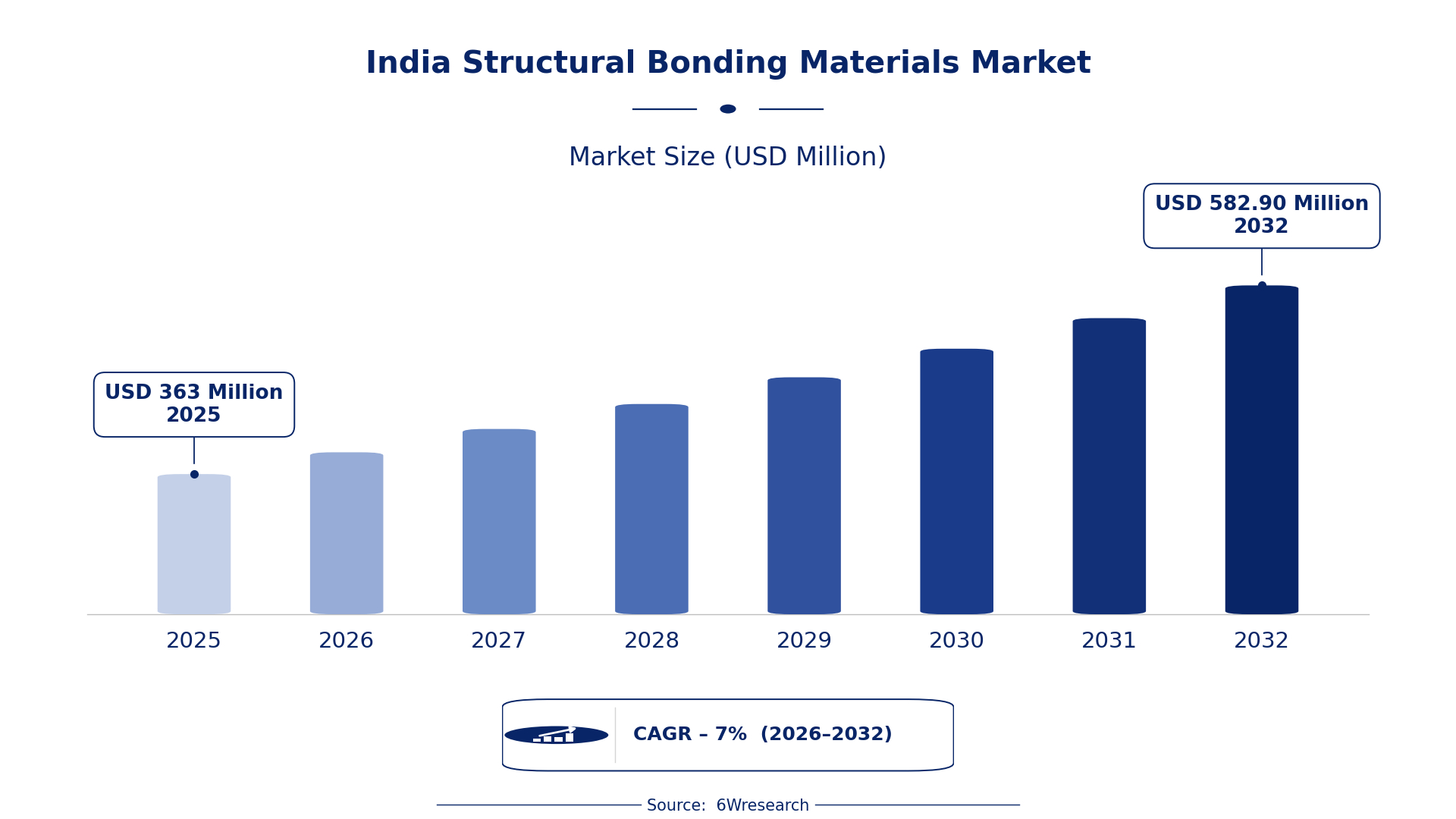
According to 6Wresearch internal database and industry insights, the India Structural Bonding Materials Market was valued at USD 363.0 million in 2025 and is projected to reach USD 582.90 million by 2032, growing at a CAGR of approximately 7% during 2026–2032.
India Structural Bonding Materials Market Highlights
| Report Metric | Details |
| Report Name | India Structural Bonding Materials Market |
| Market Size 2025 | USD 363.0 million |
| Market Size 2032 | USD 582.90 million |
| Absolute Growth 2025–2032 | USD 219.90 million |
| CAGR 2026–2032 | 7% |
| Peak Annual Growth | 8.7% in 2028 |
| Forecast Period | 2026–2032 |
| Historical Data | 2022–2025 |
| Base Year | 2025 |
| Leading Material Type, 2025 | Epoxy Resins (49% share) |
| Leading Chemical Base, 2025 | Thermosetting Polymer (36% share) |
| Leading Bonding Application, 2025 | Automotive Panels (53% share) |
| Leading End User, 2025 | Body Assembly Units (52% share) |
| Fastest-Growing Material Type | Polyurethanes (9.5% CAGR) |
| Fastest-Growing Chemical Base | Solvent-Free (9.6% CAGR) |
| Fastest-Growing Bonding Application | Prefab Construction (8.1% CAGR) |
| Fastest-Growing End User | Building Component Firms (8.9% CAGR) |
| Growing Sector | Aerospace and Automotive |
| Key End Users | Automotive manufacturers, construction firms, aerospace manufacturers |
India Structural Bonding Materials Market Year-wise Growth Rate and Key Drivers (2022–2032)
This graph illustrates the annual growth rates of the market from 2022 to 2032, highlighting a steady upward trajectory and projected market expansion over the forecast period.
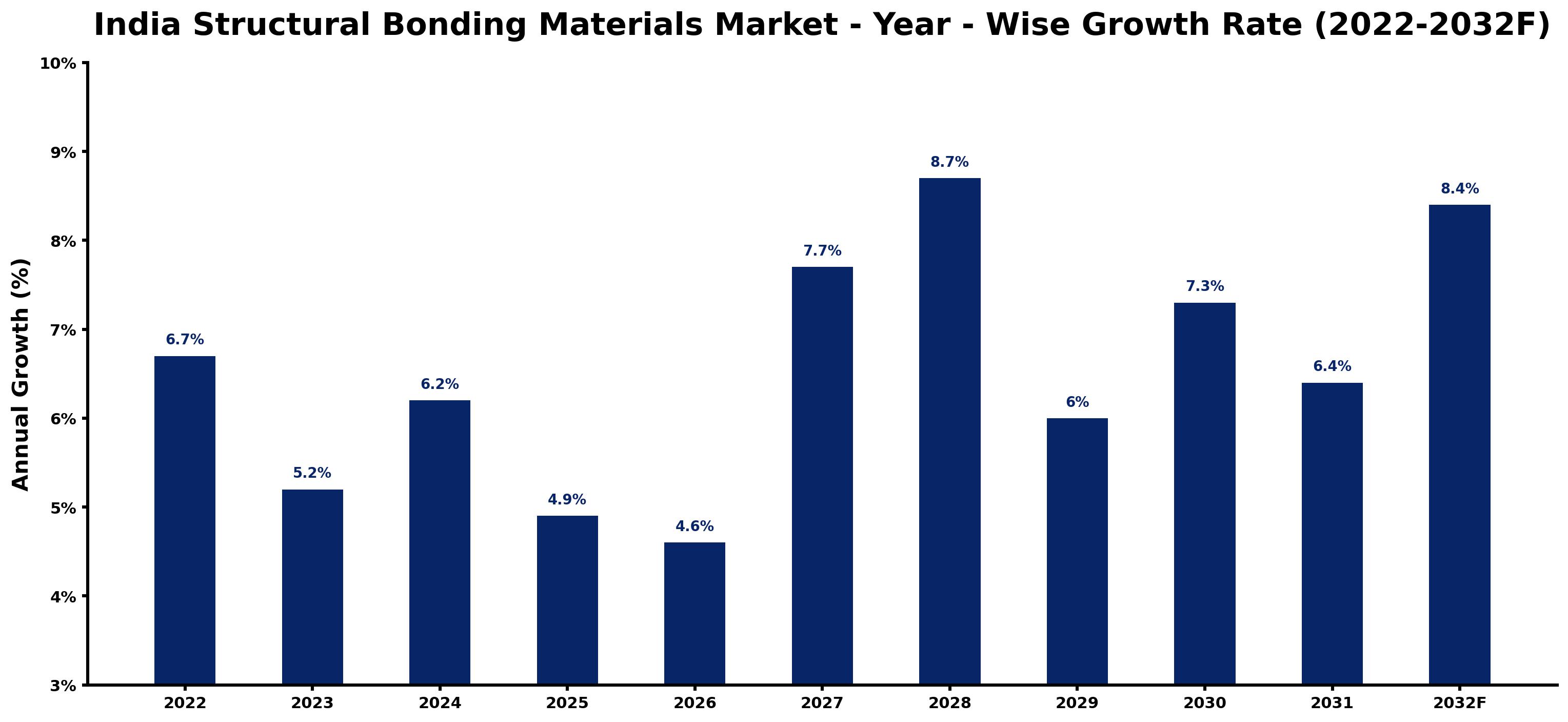
Annual growth estimates for each year appear below with the principal reason behind them, explaining the shifts that set the pace of the market.
| Year | Estimated Annual Growth (%) | Market Rationale |
| 2022 | 6.7 | The automotive sector produced over 4.4 million vehicles, driving demand for bonding materials. |
| 2023 | 5.2 | Growth slowed as manufacturers adjusted to supply chain challenges in the automotive industry. |
| 2024 | 6.2 | Increased production in the automotive sector led to a rise in bonding material usage. |
| 2025 | 4.9 | Demand growth slowed due to market saturation in certain construction applications. |
| 2026 | 4.6 | The construction sector is expected to grow as projects ramp up under the National Infrastructure Pipeline. |
| 2027 | 7.7 | The automotive sector's recovery will boost demand for structural bonding materials. |
| 2028 | 8.7 | A surge in infrastructure projects will lead to peak demand for bonding materials in construction. |
| 2029 | 6.0 | Growth is projected to slow as the market adjusts to the high demand levels of the previous year. |
| 2030 | 7.3 | Increased investments in infrastructure projects will revitalise demand for bonding materials. |
| 2031 | 6.4 | The market is expected to experience a slowdown as new projects face regulatory hurdles and delays. |
| 2032 | 8.4 | A projected increase in automotive production will drive demand for bonding materials. |
Note: Market size estimations and growth projections presented in this report are based on 6Wresearch's proprietary forecasting methodology, utilizing the latest available industry data, government publications, and primary research inputs.
India Structural Bonding Materials Market Synopsis
Structural Bonding Materials in India are advanced adhesives primarily made from polymers and resins, used extensively in construction and manufacturing. These materials create strong, durable bonds essential for various applications, particularly in aerospace and automotive sectors. The India Structural Bonding Materials Market is expanding due to increasing demand from domestic manufacturers and government initiatives like the National Aerospace Policy 2021, which boosts manufacturing capabilities. The construction sector's projected growth to $1 trillion by 2025 further elevates the need for effective bonding solutions.
Market Dynamics Impact Analysis (2026–2032)
| Factor | Type | Impact | Primary Segment Affected |
| Growing demand for structural bonding materials in the automotive sector due to increased vehicle production | Driver | High | Automotive Panels |
| Significant investments in infrastructure projects under the National Infrastructure Pipeline, boosting bonding material usage | Driver | High | Prefab Construction |
| Rising demand for environmentally friendly bonding solutions as consumers prefer sustainable options | Opportunity | Medium | Solvent-Free |
| Expansion of the aerospace sector driven by government policies, increasing the need for advanced bonding materials | Opportunity | High | Aerospace Structures |
| Supply chain disruptions affecting the availability of key raw materials like polymers and resins | Restraint | High | Epoxy Resins |
| Increasing costs of structural bonding materials impacting budgets for manufacturers and construction firms | Restraint | High | Polyurethanes |
| Competition from imported bonding materials leading to price pressure on local producers | Challenge | Medium | Acrylics |
| Limited adoption of advanced bonding technologies resulting in inefficiencies for suppliers | Challenge | Medium | Thermosetting Polymer |
Evaluation of Drivers in India Structural Bonding Materials Market (2026–2032)
Below mentioned are some major drivers and their influence on market dynamics.
| Drivers | Primary Segment Affected | Why It Matters (Evidence) |
| Increased vehicle production in India requires extensive use of bonding materials. | Automotive Panels | The automotive industry produced over 4.4 million vehicles in 2021, boosting demand for adhesives. |
| The National Infrastructure Pipeline aims to invest ₹111 trillion in infrastructure projects by 2025. | Prefab Construction | This initiative will increase the demand for construction adhesives. |
| The construction sector's growth to $1 trillion by 2025 increases the need for bonding solutions. | Prefab Construction | Ongoing infrastructure projects require effective adhesives for efficient assembly. |
| ISO 9001 certification ensures quality assurance in the production of bonding materials. | Epoxy Resins | This standard builds buyer confidence and increases market demand. |
| The PM Gati Shakti initiative aims to streamline infrastructure development across India. | Building Component Firms | This initiative is expected to boost the demand for construction adhesives. |
The automotive sector produced over 4.4 million vehicles in 2021, driving demand for bonding materials in vehicle assembly. The construction sector is projected to grow to $1 trillion by 2025, increasing the need for effective bonding solutions. Ongoing investments in the aerospace sector will strengthen domestic manufacturing capabilities, further boosting demand for these materials. The National Infrastructure Pipeline will enhance infrastructure projects, creating additional opportunities for suppliers.
Evaluation of Restraints in India Structural Bonding Materials Market
Below mentioned are some major restraints and their influence on market dynamics.
| Market Restraint | Primary Segment Affected | Why It Matters (Evidence) |
| Supply chain disruptions affecting availability of polymers and resins | Epoxy Resins | These disruptions can delay production timelines for manufacturers, impacting project schedules. |
| Increasing costs of structural bonding materials | Polyurethanes | Rising prices, which have increased by 15% over the past year, affect budgets for automotive and aerospace projects. |
| Competition from imported bonding materials | Acrylics | Local producers face pressure to lower prices, which may compromise quality for buyers. |
| Limited adoption of advanced bonding technologies | Thermosetting Polymer | This results in inefficiencies for suppliers, reducing their competitiveness in a market where innovation is crucial. |
| Inconsistent availability of bonding materials | Polyurethanes | Inconsistency can lead to project delays for construction firms that depend on timely deliveries. |
India Structural Bonding Materials Market Challenges
The India Structural Bonding Materials market faces supply chain disruptions due to inconsistent availability of polymers and resins, which can delay production timelines for manufacturers. This inconsistency can lead to project delays for construction firms that depend on timely deliveries. Rising costs of structural bonding materials are a pressing issue, with prices increasing by 15% over the past year, affecting budgets for automotive and aerospace projects. Limited adoption of advanced bonding technologies results in inefficiencies for suppliers, reducing their competitiveness in a market where innovation is crucial. Increased competition from imported bonding materials pressures local producers to lower prices, potentially compromising quality for buyers.
Trends in the India Structural Bonding Materials Market
Four trends stand out in the India Structural Bonding Materials Market.
- Shift Towards Eco-Friendly Adhesives: Body Assembly Units are increasingly adopting solvent-free bonding materials to meet environmental standards. The demand for these adhesives is expected to grow by 9.6% as manufacturers seek sustainable solutions.
- Growth in Prefabricated Construction: Prefab Construction has gained momentum, with a growth rate of 8.1% as infrastructure projects expand. This trend is driven by the need for efficient assembly and reduced construction times.
- Increased Use of Acrylics in Automotive: Acrylic adhesives are becoming popular in the automotive sector for lightweight applications, improving fuel efficiency. This shift reflects a growing trend towards effective bonding solutions.
- Expansion of Aerospace Manufacturing: The National Aerospace Policy 2021 has spurred growth in aerospace structures, with bonding materials critical for safety. This sector will see increased demand as domestic manufacturing capabilities expand.
Investment Opportunities in the India Structural Bonding Materials Market
Several openings in the India Structural Bonding Materials Market merit attention from investors.
- Timing for Investment in Eco-Friendly Solutions: With a growing preference for sustainable products, there is an opportunity to invest in solvent-free bonding materials. The automotive sector's shift towards eco-friendly solutions is a key driver.
- Supply of Advanced Bonding Materials: The construction sector's projected growth to $1 trillion by 2025 presents an opportunity to supply effective bonding solutions. Engaging with building component firms can facilitate market entry.
- Focus on Aerospace Applications: The enhancement of domestic manufacturing capabilities under the National Aerospace Policy creates a window for supplying bonding materials to aviation OEMs. This sector is set for growth.
- Infrastructure Development Investments: The National Infrastructure Pipeline aims to invest ₹111 trillion by 2025, creating demand for construction adhesives. Suppliers can enter through partnerships with local construction firms.
Government Initiatives in the India Structural Bonding Materials Market
The National Policy on Electronics 2020 promotes domestic manufacturing of electronic components, including bonding materials, with a target of $300 billion by 2025. This policy strengthens local production capabilities and reduces reliance on imports, benefiting producers in the structural bonding materials market. Additionally, the Make in India initiative encourages local manufacturing, which has been in effect since 2014, further supporting the growth of domestic bonding material production.
The National Infrastructure Pipeline (NIP) aims to invest ₹111 trillion in infrastructure projects by 2025. This initiative funds various infrastructure projects, enhancing the need for effective bonding solutions. Furthermore, the Automotive Mission Plan 2026, initiated by the Ministry of Heavy Industries and Public Enterprises, aims to boost the automotive sector, which directly influences the usage of bonding materials.
Future Insight of the India Structural Bonding Materials Market
The India Structural Bonding Materials market will experience significant changes by 2032, primarily due to the National Aerospace Policy 2021, which is expected to boost domestic manufacturing capabilities. The construction sector's anticipated growth to $1 trillion by 2025 will drive demand for effective bonding solutions across various projects. The PM Gati Shakti initiative will support infrastructure development, increasing the need for structural bonding materials. The National Automotive Testing and R&D Infrastructure Project will promote advancements in bonding technologies, enabling suppliers to better address the evolving requirements of the automotive industry.
Market Segmentation Analysis
The report offers a comprehensive study of the following market segments and their leading categories in the market.
By Material Type – Epoxy Resins Dominated, Polyurethanes Expected to Grow Fastest
According to Summon Dutta, Assistant Manager at 6Wresearch, Epoxy Resins took a 49% share of material type in 2025, more than any other category. Epoxy resins dominate the India Structural Bonding Materials Market due to their extensive application in structural bonding, particularly in the automotive industry, which produced over 4.4 million vehicles in 2021. Their superior bonding strength is essential for manufacturers prioritising durability and safety in vehicle assembly. Over 2026–2032, Polyurethanes are expected to post the fastest growth, at a CAGR of 9.5%. Polyurethanes are experiencing significant growth as they are increasingly preferred for their flexibility and durability, especially in lightweight automotive applications that enhance fuel efficiency. This shift is driven by the automotive sector's ongoing focus on innovation and performance improvements. Suppliers should focus on developing polyurethane solutions to seize the growing market share resulting from advancements in the automotive industry.
By Chemical Base – Thermosetting Polymer Dominated, Solvent-Free Expected to Grow Fastest
In 2025, Thermosetting Polymer led the chemical base split with a 36% share. Thermosetting polymers lead the market due to their critical role in high-strength applications, particularly within the automotive and construction sectors where durability is essential. Their capacity to endure extreme conditions makes them a preferred choice among manufacturers seeking reliable bonding solutions. Solvent-Free is projected to grow fastest, at a CAGR of 9.6% during 2026–2032. The solvent-free segment is rapidly expanding as manufacturers transition towards environmentally friendly options, aligning with global sustainability movements. This shift is further encouraged by initiatives promoting local production and minimising environmental impact. Buyers are increasingly demanding solvent-free solutions, urging suppliers to adapt their offerings to align with these eco-conscious preferences.
By Bonding Application – Automotive Panels Dominated, Prefab Construction Expected to Grow Fastest
The largest bonding application category in 2025 was Automotive Panels, with a 53% share of total revenue. Automotive panels represent the largest share in bonding applications as they are vital for vehicle assembly and safety, reflecting the extensive production in the automotive industry. The need for reliable bonding in this sector drives consistent demand for structural bonding materials. Prefab Construction is set to record the highest CAGR in this split, 8.1% over 2026–2032. Prefab construction is the fastest-growing application due to its efficiency in assembling pre-manufactured components, which is becoming increasingly popular in the booming construction sector projected to reach $1 trillion by 2025. This trend highlights the shift towards modern construction methods. Suppliers should consider expanding their product lines to cater to the rising demand for bonding solutions in prefab construction.
By End User – Body Assembly Units Dominated, Building Component Firms Expected to Grow Fastest
Body Assembly Units held a 52% share of the India Structural Bonding Materials Market by end user in 2025. Body assembly units capture the largest market share as they are essential to vehicle manufacturing processes, ensuring safety and structural integrity in automotive production. The high volume of vehicle assembly in India reinforces the strong demand for bonding materials in this segment. The quickest growth will come from Building Component Firms, forecast to expand at a CAGR of 8.9% between 2026 and 2032. Building component firms are the fastest-growing end user, crucial for the construction and assembly of building materials, spurred by ongoing infrastructure projects backed by government initiatives. This trend underscores the increasing demand for effective construction solutions in the market. Suppliers must actively engage with building component firms to capitalise on the expanding market opportunities within the construction sector.
Key Attractiveness of the Report
- 10 Years of Market Numbers
- Historical Data Starting from 2022 to 2025
- Base Year 2025
- Forecast Data until 2032
- Key Performance Indicators Impacting the Market
- Major Upcoming Developments and Projects
Key Highlights of the Report:
- India Structural Bonding Materials Market Outlook
- Market Size of India Structural Bonding Materials Market, 2025
- Forecast of India Structural Bonding Materials Market, 2032
- Historical Data and Forecast of India Structural Bonding Materials Revenues & Volume for the Period 2022 - 2032F
- India Structural Bonding Materials Market Trend Evolution
- India Structural Bonding Materials Market Drivers and Challenges
- India Structural Bonding Materials Price Trends
- India Structural Bonding Materials Porter's Five Forces
- India Structural Bonding Materials Industry Life Cycle
- Historical Data and Forecast of India Structural Bonding Materials Market Revenues & Volume By Material Type for the Period 2022 - 2032F
- Historical Data and Forecast of India Structural Bonding Materials Market Revenues & Volume By Epoxy Resins for the Period 2022 - 2032F
- Historical Data and Forecast of India Structural Bonding Materials Market Revenues & Volume By Acrylics for the Period 2022 - 2032F
- Historical Data and Forecast of India Structural Bonding Materials Market Revenues & Volume By Polyurethanes for the Period 2022 - 2032F
- Historical Data and Forecast of India Structural Bonding Materials Market Revenues & Volume By Silicone-Based for the Period 2022 - 2032F
- Historical Data and Forecast of India Structural Bonding Materials Market Revenues & Volume By Chemical Base for the Period 2022 - 2032F
- Historical Data and Forecast of India Structural Bonding Materials Market Revenues & Volume By Thermosetting Polymer for the Period 2022 - 2032F
- Historical Data and Forecast of India Structural Bonding Materials Market Revenues & Volume By Solvent-Free for the Period 2022 - 2032F
- Historical Data and Forecast of India Structural Bonding Materials Market Revenues & Volume By Flexible Bonding for the Period 2022 - 2032F
- Historical Data and Forecast of India Structural Bonding Materials Market Revenues & Volume By Weatherproofing for the Period 2022 - 2032F
- Historical Data and Forecast of India Structural Bonding Materials Market Revenues & Volume By Bonding Application for the Period 2022 - 2032F
- Historical Data and Forecast of India Structural Bonding Materials Market Revenues & Volume By Aerospace Structures for the Period 2022 - 2032F
- Historical Data and Forecast of India Structural Bonding Materials Market Revenues & Volume By Automotive Panels for the Period 2022 - 2032F
- Historical Data and Forecast of India Structural Bonding Materials Market Revenues & Volume By Rail Vehicle Bonding for the Period 2022 - 2032F
- Historical Data and Forecast of India Structural Bonding Materials Market Revenues & Volume By Prefab Construction for the Period 2022 - 2032F
- Historical Data and Forecast of India Structural Bonding Materials Market Revenues & Volume By End User for the Period 2022 - 2032F
- Historical Data and Forecast of India Structural Bonding Materials Market Revenues & Volume By Aviation OEMs for the Period 2022 - 2032F
- Historical Data and Forecast of India Structural Bonding Materials Market Revenues & Volume By Body Assembly Units for the Period 2022 - 2032F
- Historical Data and Forecast of India Structural Bonding Materials Market Revenues & Volume By Rolling Stock Manufacturers for the Period 2022 - 2032F
- Historical Data and Forecast of India Structural Bonding Materials Market Revenues & Volume By Building Component Firms for the Period 2022 - 2032F
- India Structural Bonding Materials Import Export Trade Statistics
- Market Opportunity Assessment By Material Type
- Market Opportunity Assessment By Chemical Base
- Market Opportunity Assessment By Bonding Application
- Market Opportunity Assessment By End User
- India Structural Bonding Materials Top Companies Market Share
- India Structural Bonding Materials Competitive Benchmarking By Technical and Operational Parameters
- India Structural Bonding Materials Company Profiles
- India Structural Bonding Materials Key Strategic Recommendations
Market Covered
Segments analysed in this report are listed below.
By Material Type
- Epoxy Resins
- Acrylics
- Polyurethanes
- Silicone-Based
By Chemical Base
- Thermosetting Polymer
- Solvent-Free
- Flexible Bonding
- Weatherproofing
By Bonding Application
- Aerospace Structures
- Automotive Panels
- Rail Vehicle Bonding
- Prefab Construction
By End User
- Aviation OEMs
- Body Assembly Units
- Rolling Stock Manufacturers
- Building Component Firms































