India Structural Light-Weight Design Market Size & Growth Rate
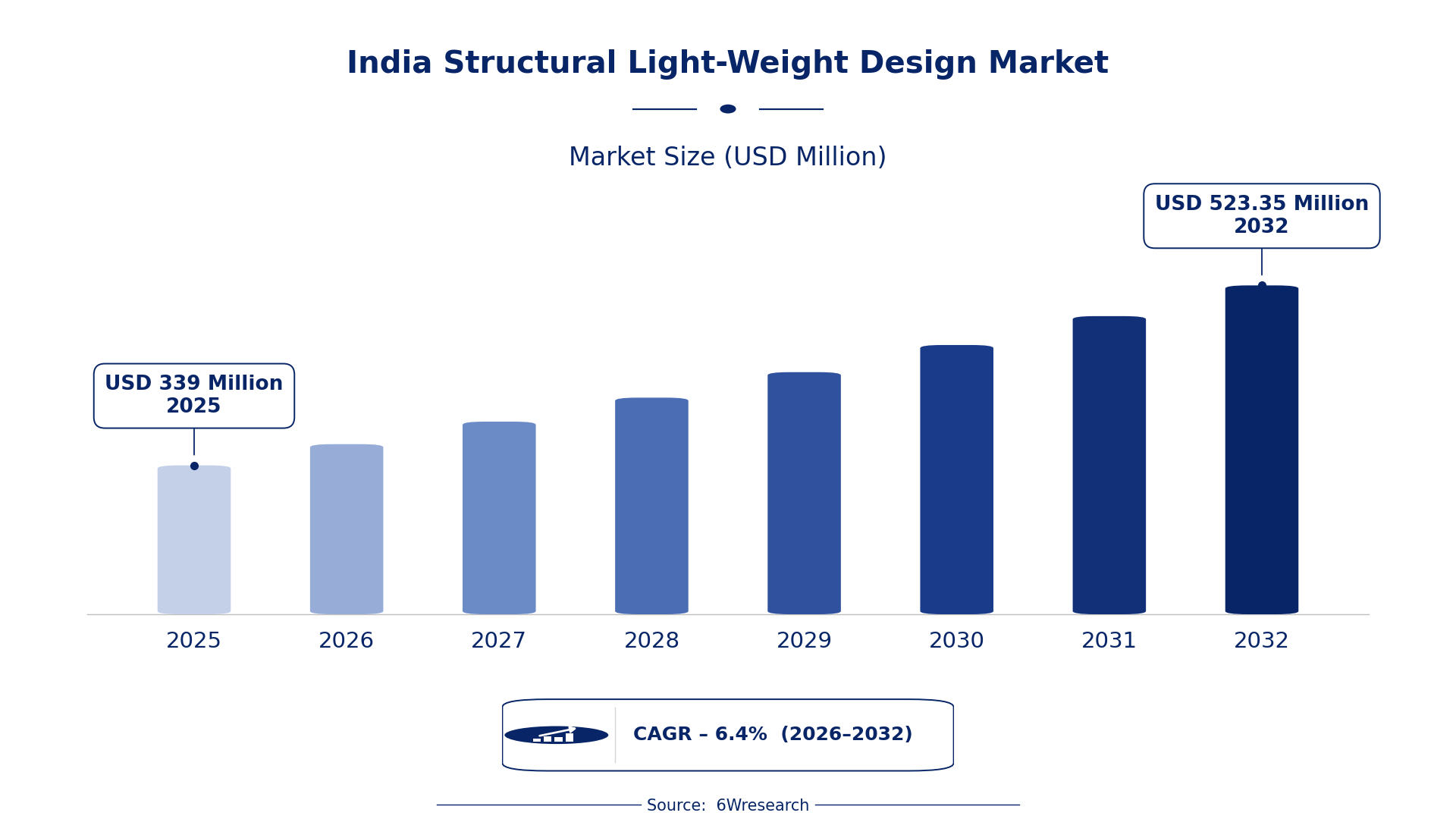
According to 6Wresearch internal database and industry insights, the India Structural Light-Weight Design Market was valued at USD 339.0 million in 2025 and is projected to reach USD 523.35 million by 2032, growing at a CAGR of approximately 6.4% during 2026–2032.
India Structural Light-Weight Design Market Highlights
| Report Metric | Details |
| Report Name | India Structural Light-Weight Design Market |
| Market Size 2025 | USD 339.0 million |
| Market Size 2032 | USD 523.35 million |
| Absolute Growth 2025–2032 | USD 184.35 million |
| CAGR 2026–2032 | 6.4% |
| Peak Annual Growth | 8.2% in 2027 |
| Forecast Period | 2026–2032 |
| Historical Data | 2022–2025 |
| Base Year | 2025 |
| Leading Material Type, 2025 | Aluminum Alloy (46% share) |
| Leading Design Approach, 2025 | Topology Optimization (47% share) |
| Leading Application Area, 2025 | Chassis (45% share) |
| Leading End User, 2025 | Vehicle OEMs (42% share) |
| Fastest-Growing Material Type | Carbon Fiber Composite (8.6% CAGR) |
| Fastest-Growing Application Area | EV Body Frames (9.1% CAGR) |
| Fastest-Growing End User | Electric Vehicle Makers (7.5% CAGR) |
| Growing Sector | automotive |
| Key End Users | Vehicle OEMs, Electric Vehicle Makers, Performance Car Manufacturers |
India Structural Light-Weight Design Market Year-wise Growth Rate and Key Drivers (2022–2032)
This graph illustrates the annual growth rates of the market from 2022 to 2032, highlighting a steady upward trajectory and projected market expansion over the forecast period.
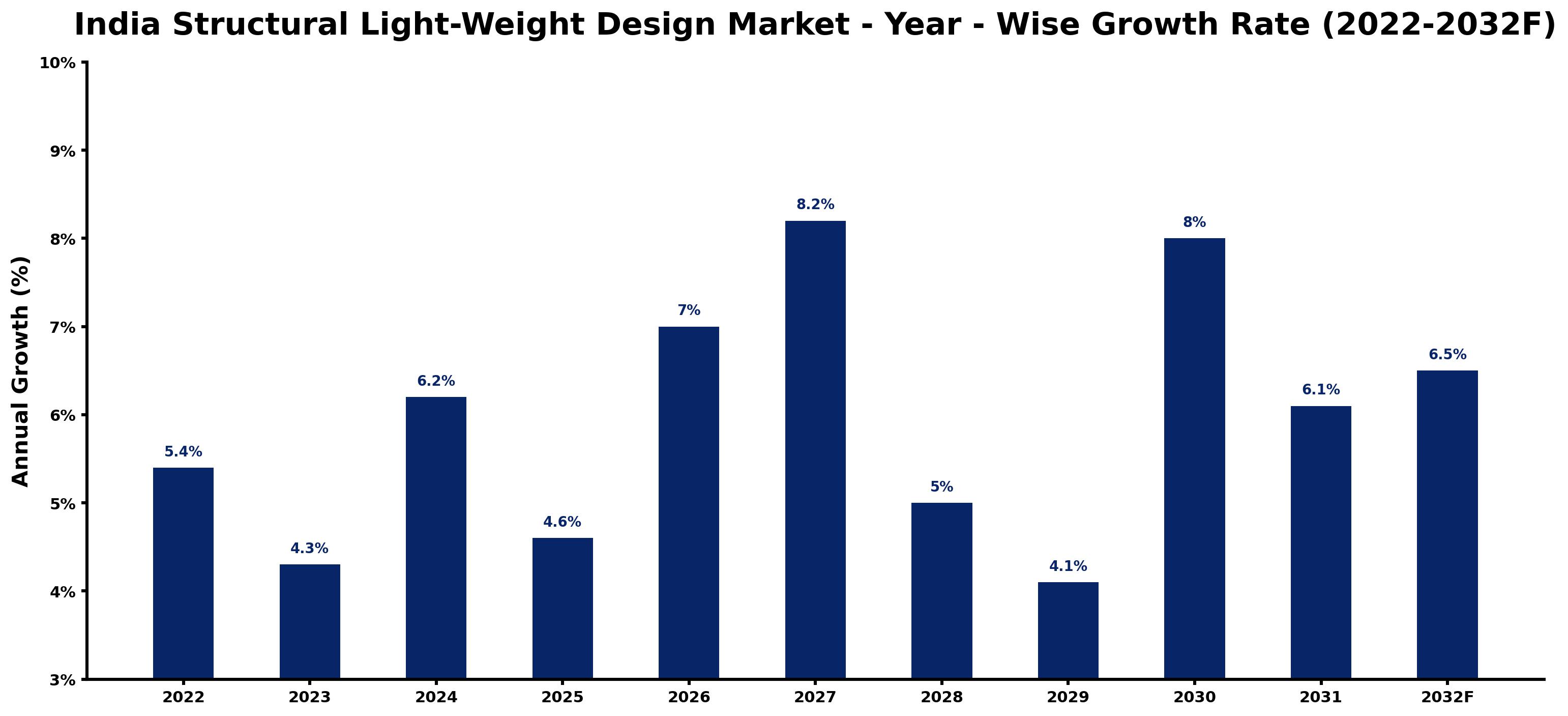
Year by year, the estimates below pair each growth rate with the development that shaped it.
| Year | Estimated Annual Growth (%) | Market Rationale |
| 2022 | 5.4 | The market experienced steady growth,. |
| 2023 | 4.3 | Growth slowed as manufacturers adjusted to supply chain challenges and rising material costs. |
| 2024 | 6.2 | Increased production and demand for electric vehicles boosted growth in lightweight design applications. |
| 2025 | 4.6 | Demand remained strong but growth slowed as the market stabilised after rapid expansion. |
| 2026 | 7.0 | The introduction of new automotive standards spurred innovation and demand for lightweight designs. |
| 2027 | 8.2 | The peak growth year saw heightened investments in electric vehicle manufacturing capabilities. |
| 2028 | 5.0 | Growth slowed as market dynamics shifted towards established production methods and materials. |
| 2029 | 4.1 | Demand for lightweight designs remained strong, but growth rates normalised after the peak. |
| 2030 | 8.0 | A renewed focus on sustainability and efficiency in vehicle manufacturing drove growth higher again. |
| 2031 | 6.1 | Growth slowed as the market matured, with established players consolidating their positions. |
| 2032 | 6.5 | The market is set to grow as electric vehicle adoption continues to accelerate. |
Note: Market size estimations and growth projections presented in this report are based on 6Wresearch's proprietary forecasting methodology, utilizing the latest available industry data, government publications, and primary research inputs.
India Structural Light-Weight Design Market Synopsis
Structural Light-Weight Design in India utilises advanced materials and techniques to produce strong, lightweight automotive components. This market predominantly employs aluminum alloys and carbon fiber composites to improve fuel efficiency and safety in vehicles. The India Structural Light-Weight Design Market is expanding due to robust demand from vehicle manufacturers and the growing electric vehicle sector. With over 4.4 million vehicles produced in 2022 and a projected electric vehicle market reaching 6.34 million units by 2025, the need for effective lightweight designs is set to increase.
Market Dynamics Impact Analysis (2026–2032)
| Factor | Type | Impact | Primary Segment Affected |
| Growing demand for electric vehicles necessitates lightweight designs for improved range and efficiency. | Driver | High | EV Body Frames |
| Increased investments in automotive manufacturing are driving innovation in lightweight materials. | Driver | High | Chassis |
| The automotive sector's shift towards sustainability creates opportunities for lightweight design solutions. | Opportunity | High | Hybrid Structures |
| The rising automotive production in key states presents a significant opportunity for suppliers. | Opportunity | High | Vehicle OEMs |
| High costs of advanced materials can limit adoption among smaller manufacturers. | Restraint | High | Carbon Fiber Composite |
| Regulatory compliance requirements can delay product development timelines for manufacturers. | Restraint | Medium | Topology Optimization |
| Buyers face challenges in sourcing high-quality lightweight materials due to limited suppliers. | Challenge | High | Aluminum Alloy |
| Suppliers struggle with fluctuating raw material prices, affecting production costs and margins. | Challenge | Medium | Magnesium Alloy |
Evaluation of Drivers in India Structural Light-Weight Design Market (2026–2032)
Key forces behind demand, with the segment each one moves most, are listed below.
| Drivers | Primary Segment Affected | Why It Matters (Evidence) |
| Increased production of electric vehicles requires lightweight components to improve efficiency. | EV Body Frames | The electric vehicle market is projected to reach 6.34 million units by 2025, driving demand for lightweight designs. |
| Growing automotive manufacturing in states like Maharashtra and Tamil Nadu boosts demand for lightweight designs. | Chassis | India's automotive industry produced over 4.4 million vehicles in 2022, increasing the need for advanced materials. |
| The Automotive Mission Plan 2026 encourages local manufacturing and innovation in lightweight design. | Hybrid Structures | This plan aims to make India a global hub for automobile manufacturing, promoting the use of advanced materials. |
| Rising fuel efficiency standards necessitate the use of lightweight materials in vehicle design. | Topology Optimization | The Bureau of Indian Standards established guidelines for automotive safety standards in 2021, influencing design choices. |
| The demand for high-performance vehicles drives interest in carbon fiber composites for lightweight applications. | Carbon Fiber Composite | These materials are increasingly used in high-end performance vehicles, improving speed and handling. |
Growth in the Structural Light-Weight Design market in India stems from rising end-use demand in the automotive sector, especially for electric vehicles. The electric vehicle market is expected to reach 6.34 million units by 2025, which will drive the need for lightweight designs in EV Body Frames. The production of over 4.4 million vehicles in 2022 has created a higher demand for advanced materials, particularly in Chassis applications. The introduction of new fuel efficiency standards encourages the adoption of lightweight designs across various vehicle types. Investment in local manufacturing is likely to spur the development of new lightweight solutions, boosting market competitiveness.
Evaluation of Restraints in India Structural Light-Weight Design Market
The main factors holding the market back are set out below.
| Market Restraint | Primary Segment Affected | Why It Matters (Evidence) |
| High costs of carbon fiber composites limit their widespread adoption in the automotive sector. | Carbon Fiber Composite | These materials account for a large portion of production costs, affecting pricing strategies for manufacturers. |
| Regulatory compliance can slow down the development of new lightweight designs. | Topology Optimization | Manufacturers must adhere to safety and performance standards, which can extend the product development timeline. |
| Limited availability of high-quality lightweight materials poses challenges for manufacturers. | Aluminum Alloy | Sourcing reliable suppliers for advanced materials can be difficult, impacting production schedules. |
| Fluctuating raw material prices create uncertainty for suppliers and manufacturers alike. | Magnesium Alloy | This volatility can lead to increased production costs, affecting overall market competitiveness. |
| Market maturity may lead to slower innovation rates in lightweight design technologies. | Hybrid Structures | As established players consolidate, the pace of new developments may decelerate. |
India Structural Light-Weight Design Market Challenges
Buyers and suppliers in the India Structural Light-Weight Design market face regulatory challenges, as the Bureau of Indian Standards updated automotive safety guidelines in 2021, which can delay product approvals for manufacturers by several months. Importers struggle with supply chain disruptions due to reliance on imported materials like carbon fiber composites, leading to potential production delays that can extend timelines for producers by up to 20%. Competition intensifies for buyers as domestic manufacturers strive to meet the growing demand for electric vehicles, forcing suppliers to innovate rapidly or risk losing market share. Cost fluctuations in raw materials, particularly aluminum alloys, can inflate production costs by 15%, affecting pricing strategies for automotive buyers.
Trends in the India Structural Light-Weight Design Market
Buyers and suppliers in the India Structural Light-Weight Design Market are adjusting to the following trends.
- Shift from Traditional to Advanced Materials: Since 2021, the automotive industry has increasingly adopted advanced materials like carbon fiber for lightweight designs. This shift is reflected in the growing market share for carbon fiber composites, projected to reach an 8.6% CAGR.
- Transition from Conventional to Electric Vehicles: The rise of electric vehicle production in India, particularly in Maharashtra, is driving demand for lightweight designs. With the electric vehicle market expected to reach 6.34 million units by 2025, manufacturers are prioritising structural light-weight design.
- Emergence of Integrated Design Approaches: The use of topology optimization has gained traction since 2022, improving design efficiency. This method is becoming standard in automotive design processes, with a projected growth rate of 8.4% CAGR.
- Prioritisation of Safety in Design: The introduction of new automotive safety standards in 2021 has led to a focus on lightweight designs that improve safety. This trend is shaping design practices across the industry, encouraging innovation in crash zone designs.
Investment Opportunities in the India Structural Light-Weight Design Market
Below are the investment opportunities with the strongest case in the India Structural Light-Weight Design Market.
- Electric Vehicle Manufacturers Seeking Lightweight Solutions: Electric vehicle makers are increasingly looking for lightweight designs to improve efficiency. With the market projected to reach 6.34 million units by 2025, suppliers can enter through partnerships with local manufacturers.
- Collaboration with Vehicle OEMs: Vehicle OEMs are actively seeking advanced lightweight materials to improve vehicle performance. Establishing joint ventures with local firms can facilitate access to this growing market segment, which produced over 4.4 million vehicles in 2022.
- Investment in Advanced Material Production: The automotive sector is expected to attract $8-10 billion in investments by 2025, creating opportunities for suppliers of lightweight materials. Targeting states like Tamil Nadu and Gujarat can provide strategic advantages.
- Focus on Research and Development: The National Automotive Testing and R&D Infrastructure Project aims to improve testing capabilities for automotive components. With a budget of INR 1,000 crores, this initiative presents opportunities for advancements in lightweight design.
Government Initiatives in the India Structural Light-Weight Design Market
The National Electric Mobility Mission Plan 2020 promotes electric vehicle adoption with a target of 6 million units by 2025. This initiative encourages manufacturers to develop lightweight designs that improve vehicle efficiency and performance, directly impacting the structural light-weight design market. The Automotive Mission Plan 2026 aims to position India as a global hub for automotive manufacturing, focusing on sustainability and innovation. This framework supports the growth of lightweight design technologies in the automotive sector.
The Production Linked Incentive Scheme for the automobile sector, administered by the Ministry of Heavy Industries, provides financial incentives to boost local manufacturing and innovation. This scheme supports the development of advanced lightweight materials and technologies, fostering growth in the structural light-weight design market. The National Automotive Testing and R&D Infrastructure Project, also under the Ministry of Heavy Industries, has a budget of INR 1,000 crores to enhance testing capabilities for automotive components. This funding allows manufacturers to improve product quality and safety standards.
Future Insight of the India Structural Light-Weight Design Market
The India Structural Light-Weight Design market will undergo substantial changes by 2032, driven by the National Automotive Testing and R&D Infrastructure Project, which will enhance research capabilities and innovation. The electric vehicle market is projected to reach 6.34 million units by 2025, stimulating demand for lightweight components. The Automotive Mission Plan 2026 aims to position India as a global hub for automobile manufacturing, attracting substantial investments. The Faster Adoption and Manufacturing of Hybrid and Electric Vehicles scheme will further promote the shift towards sustainable automotive solutions.
Market Segmentation Analysis
The report offers a comprehensive study of the following market segments and their leading categories in the market.
By Material Type – Aluminum Alloy Dominated, Carbon Fiber Composite Expected to Grow Fastest
According to Summon Dutta, Assistant Manager at 6Wresearch, Aluminum Alloy held a 46% share of the India Structural Light-Weight Design Market by material type in 2025. Aluminum alloys dominate the market share in India due to their extensive use in vehicle manufacturing, accounting for approximately 30% of materials used. Their lightweight properties are essential for improving fuel efficiency, particularly in the automotive sector where performance is key. Over 2026–2032, Carbon Fiber Composite is expected to post the fastest growth, at a CAGR of 8.6%. The surge in carbon fiber composites is fuelled by their application in high-performance vehicles, where their exceptional strength-to-weight ratio is critical. This trend is closely linked to the expanding electric vehicle market, which prioritises lighter components for better efficiency. Suppliers should invest in advanced aluminum alloy and carbon fiber composite solutions to meet the growing demands of the automotive industry.
By Design Approach – Topology Optimization Dominated and Is Expected to Record the Fastest Growth
The largest design approach category in 2025 was Topology Optimization, with a 47% share of total revenue. Topology optimization leads the design approach segment, as it is crucial for minimising weight while ensuring structural integrity in vehicle components. This method is widely used in the automotive sector, particularly for creating lightweight structures that enhance overall vehicle performance. Its lead should widen, with a projected CAGR of 8.4% during 2026–2032, the highest in this split. The continuous use of topology optimization in both traditional and electric vehicle designs secures its position as the fastest-growing approach, as manufacturers aim to optimise weight and efficiency. Its proven effectiveness in achieving lightweight designs will likely strengthen its market position. Buyers should seek suppliers that utilise topology optimization to ensure they receive the most efficient and lightweight designs for their vehicles.
By Application Area – Chassis Dominated, EV Body Frames Expected to Grow Fastest
In 2025, Chassis led the application area split with a 45% share. Chassis components are the leading application area for structural light-weight design, as they are vital for vehicle efficiency and safety. The production of over 4.4 million vehicles annually in the automotive industry highlights the critical need for lightweight chassis structures. EV Body Frames are set to record the highest CAGR in this split, 9.1% over 2026–2032. EV body frames are the fastest-growing application area, driven by the projected rise in electric vehicle production expected to reach 6.34 million units by 2025. This growth underscores the industry's focus on enhancing range and performance through lightweight designs. Manufacturers must adapt to the increasing demand for lightweight EV body frames to maintain competitiveness in the evolving automotive sector.
By End User – Vehicle OEMs Dominated, Electric Vehicle Makers Expected to Grow Fastest
Vehicle OEMs accounted for a 42% market share by end user in 2025. Vehicle OEMs are the primary end users of structural light-weight design, as they directly incorporate these materials and techniques into their manufacturing processes. Their significant role in the automotive sector ensures a steady demand for lightweight components to enhance vehicle efficiency. The quickest growth will come from Electric Vehicle Makers, forecast to expand at a CAGR of 7.5% between 2026 and 2032. Electric vehicle makers represent the fastest-growing end user segment, focusing on structural light-weight design to boost performance and efficiency. This trend is driven by rising investments in electric vehicle technology and infrastructure across India. Suppliers should tailor their offerings to meet the specific needs of electric vehicle makers, ensuring they provide advanced lightweight solutions.
Key Attractiveness of the Report
- 10 Years of Market Numbers
- Historical Data Starting from 2022 to 2025
- Base Year 2025
- Forecast Data until 2032
- Key Performance Indicators Impacting the Market
- Major Upcoming Developments and Projects
Key Highlights of the Report:
- India Structural Light-Weight Design Market Outlook
- Market Size of India Structural Light-Weight Design Market, 2025
- Forecast of India Structural Light-Weight Design Market, 2032
- Historical Data and Forecast of India Structural Light-Weight Design Revenues & Volume for the Period 2022 - 2032F
- India Structural Light-Weight Design Market Trend Evolution
- India Structural Light-Weight Design Market Drivers and Challenges
- India Structural Light-Weight Design Price Trends
- India Structural Light-Weight Design Porter's Five Forces
- India Structural Light-Weight Design Industry Life Cycle
- Historical Data and Forecast of India Structural Light-Weight Design Market Revenues & Volume By Material Type for the Period 2022 - 2032F
- Historical Data and Forecast of India Structural Light-Weight Design Market Revenues & Volume By Aluminum Alloy for the Period 2022 - 2032F
- Historical Data and Forecast of India Structural Light-Weight Design Market Revenues & Volume By Carbon Fiber Composite for the Period 2022 - 2032F
- Historical Data and Forecast of India Structural Light-Weight Design Market Revenues & Volume By Magnesium Alloy for the Period 2022 - 2032F
- Historical Data and Forecast of India Structural Light-Weight Design Market Revenues & Volume By Hybrid Structures for the Period 2022 - 2032F
- Historical Data and Forecast of India Structural Light-Weight Design Market Revenues & Volume By Design Approach for the Period 2022 - 2032F
- Historical Data and Forecast of India Structural Light-Weight Design Market Revenues & Volume By Topology Optimization for the Period 2022 - 2032F
- Historical Data and Forecast of India Structural Light-Weight Design Market Revenues & Volume By CAD-Integrated Design for the Period 2022 - 2032F
- Historical Data and Forecast of India Structural Light-Weight Design Market Revenues & Volume By Load Bearing Elements for the Period 2022 - 2032F
- Historical Data and Forecast of India Structural Light-Weight Design Market Revenues & Volume By Simulation-Based for the Period 2022 - 2032F
- Historical Data and Forecast of India Structural Light-Weight Design Market Revenues & Volume By Application Area for the Period 2022 - 2032F
- Historical Data and Forecast of India Structural Light-Weight Design Market Revenues & Volume By Chassis for the Period 2022 - 2032F
- Historical Data and Forecast of India Structural Light-Weight Design Market Revenues & Volume By EV Body Frames for the Period 2022 - 2032F
- Historical Data and Forecast of India Structural Light-Weight Design Market Revenues & Volume By Engine Bays for the Period 2022 - 2032F
- Historical Data and Forecast of India Structural Light-Weight Design Market Revenues & Volume By Crash Zones for the Period 2022 - 2032F
- Historical Data and Forecast of India Structural Light-Weight Design Market Revenues & Volume By End User for the Period 2022 - 2032F
- Historical Data and Forecast of India Structural Light-Weight Design Market Revenues & Volume By Vehicle OEMs for the Period 2022 - 2032F
- Historical Data and Forecast of India Structural Light-Weight Design Market Revenues & Volume By Electric Vehicle Makers for the Period 2022 - 2032F
- Historical Data and Forecast of India Structural Light-Weight Design Market Revenues & Volume By Performance Car Manufacturers for the Period 2022 - 2032F
- Historical Data and Forecast of India Structural Light-Weight Design Market Revenues & Volume By Safety Engineering Firms for the Period 2022 - 2032F
- India Structural Light-Weight Design Import Export Trade Statistics
- Market Opportunity Assessment By Material Type
- Market Opportunity Assessment By Design Approach
- Market Opportunity Assessment By Application Area
- Market Opportunity Assessment By End User
- India Structural Light-Weight Design Top Companies Market Share
- India Structural Light-Weight Design Competitive Benchmarking By Technical and Operational Parameters
- India Structural Light-Weight Design Company Profiles
- India Structural Light-Weight Design Key Strategic Recommendations
Market Covered
The report offers an extensive study of the following market segments.
By Material Type
- Aluminum Alloy
- Carbon Fiber Composite
- Magnesium Alloy
- Hybrid Structures
By Design Approach
- Topology Optimization
- CAD-Integrated Design
- Load Bearing Elements
- Simulation-Based
By Application Area
- Chassis
- EV Body Frames
- Engine Bays
- Crash Zones
By End User
- Vehicle OEMs
- Electric Vehicle Makers
- Performance Car Manufacturers
- Safety Engineering Firms































