India Textile Grade Cellulose Market Size & Growth Rate
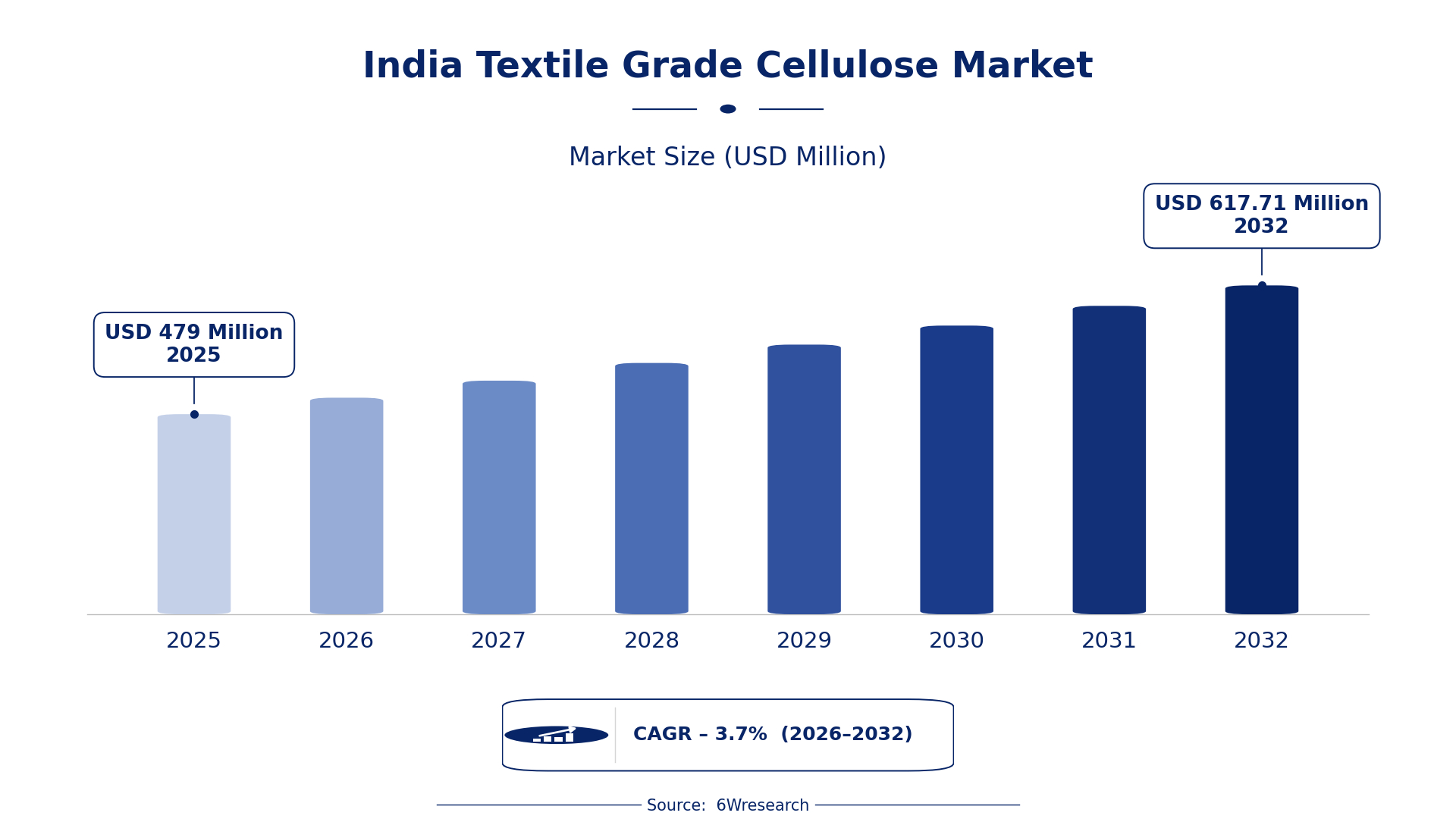
According to 6Wresearch internal database and industry insights, the India Textile Grade Cellulose Market was valued at USD 479.0 million in 2025 and is projected to reach USD 617.71 million by 2032, growing at a CAGR of approximately 3.7% during 2026–2032.
India Textile Grade Cellulose Market Highlights
| Report Metric | Details |
| Report Name | India Textile Grade Cellulose Market |
| Market Size 2025 | USD 479.0 million |
| Market Size 2032 | USD 617.71 million |
| Absolute Growth 2025–2032 | USD 138.71 million |
| CAGR 2026–2032 | 3.7% |
| Peak Annual Growth | 5.7% in 2026 |
| Forecast Period | 2026–2032 |
| Historical Data | 2022–2025 |
| Base Year | 2025 |
| Leading Textile Grade Cellulose, 2025 | Dissolving Pulp (36% share) |
| Leading Product Type, 2025 | Viscose (38% share) |
| Leading Cellulose Type, 2025 | Wood Pulp Derived (36% share) |
| Leading Distribution Channel, 2025 | Chemical Traders (47% share) |
| Leading End User Industry, 2025 | Fiber Spinning Mills (45% share) |
| Fastest-Growing Textile Grade Cellulose | Cellulose Acetate Dope (5.1% CAGR) |
| Fastest-Growing Product Type | Lyocell (4.9% CAGR) |
| Fastest-Growing Distribution Channel | Industrial Suppliers (6.5% CAGR) |
| Fastest-Growing End User Industry | Technical Textiles (5.8% CAGR) |
| Growing Sector | Technical Textiles |
| Key End Users | Fiber Spinning Mills, High-End Apparel, Technical Textiles, Industrial Suppliers |
India Textile Grade Cellulose Market Year-wise Growth Rate and Key Drivers (2022–2032)
This graph illustrates the annual growth rates of the market from 2022 to 2032, highlighting a steady upward trajectory and projected market expansion over the forecast period.
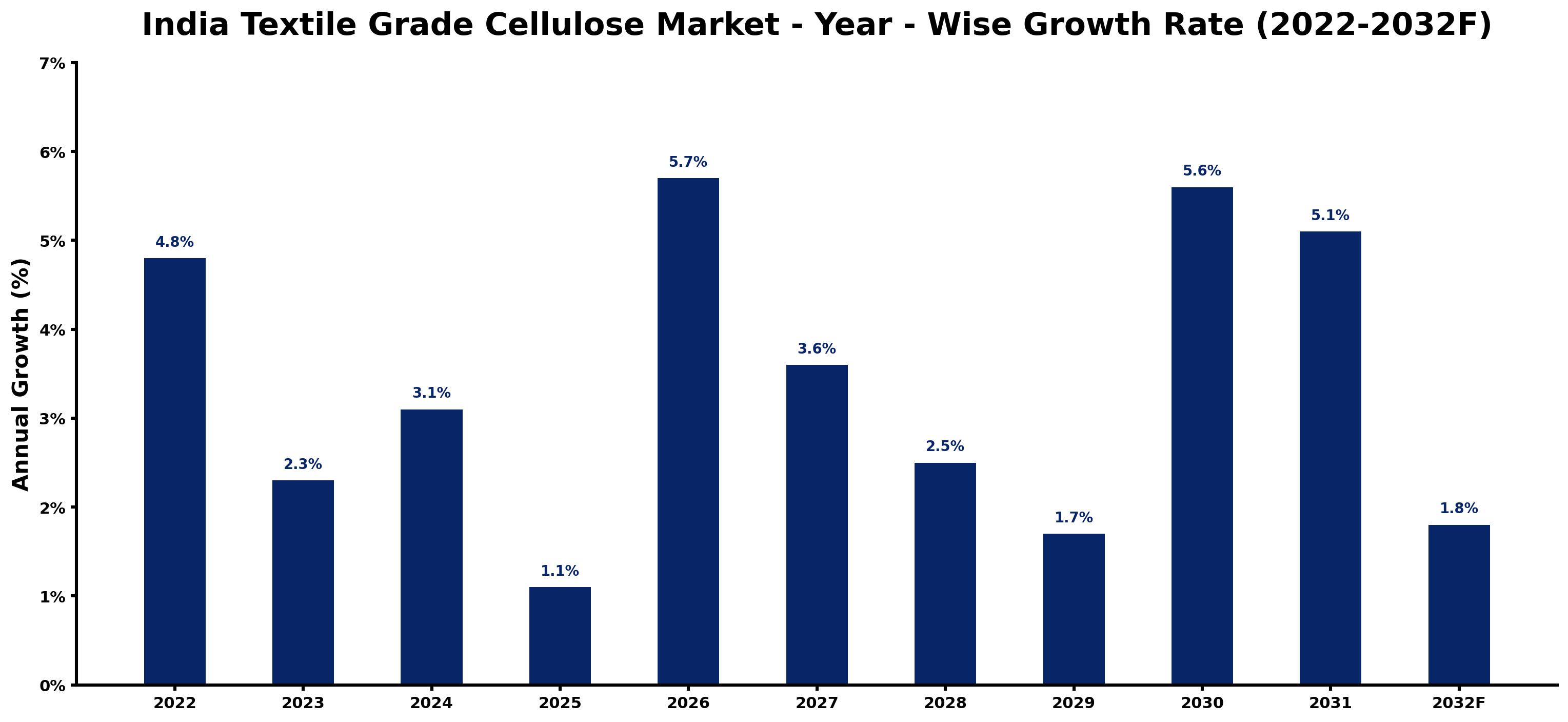
The following table presents the estimated annual growth rate for each year together with the principal factor influencing market performance.
| Year | Estimated Annual Growth (%) | Market Rationale |
| 2022 | 4.8 | The market exhibited strong performance, driven by demand from fiber spinning mills. |
| 2023 | 2.3 | Growth slowed due to temporary supply chain disruptions affecting cellulose availability. |
| 2024 | 3.1 | Demand increased as production of lyocell surged by 20% in the past two years. |
| 2025 | 1.1 | Growth decelerated as the National Textile Policy aimed to enhance competitiveness. |
| 2026 | 5.7 | A rise in demand is expected as the textile sector aims to double by 2025. |
| 2027 | 3.6 | Market growth is expected to slow as challenges in scaling production efficiently emerge. |
| 2028 | 2.5 | Demand is expected to decrease due to market saturation in certain cellulose applications. |
| 2029 | 1.7 | Slower growth is anticipated as competition intensifies among cellulose suppliers. |
| 2030 | 5.6 | A resurgence in demand is expected as the high-end apparel market expands. |
| 2031 | 5.1 | Growth is projected to slow as manufacturers adjust to updated Bureau of Indian Standards. |
| 2032 | 1.8 | The market is expected to grow steadily, supported by increasing textile consumption. |
Note: Market size estimations and growth projections presented in this report are based on 6Wresearch's proprietary forecasting methodology, utilizing the latest available industry data, government publications, and primary research inputs.
India Textile Grade Cellulose Market Synopsis
Textile Grade Cellulose in India encompasses cellulose derived from wood pulp, primarily used in producing fibers like viscose and lyocell. This product is essential for fiber spinning mills and high-end apparel manufacturers. The India Textile Grade Cellulose Market is growing due to rising domestic demand and exports, driven by a growing population and increased textile consumption. With the textile industry valued at approximately $150 billion, the market is set to expand further as innovation and sustainability practices gain traction.
Market Dynamics Impact Analysis (2026–2032)
| Factor | Type | Impact | Primary Segment Affected |
| Rising domestic demand for high-quality textiles | Driver | High | Fiber Spinning Mills |
| Increased production capacity of lyocell fibers | Driver | High | Lyocell |
| Growing demand for eco-friendly textiles | Opportunity | High | Technical Textiles |
| Expansion of fiber spinning mills in Tamil Nadu | Opportunity | High | Fiber Spinning Mills |
| Supply chain disruptions affecting cellulose availability | Restraint | Medium | Dissolving Pulp |
| Stringent quality standards set by the Bureau of Indian Standards | Restraint | Medium | Wood Pulp Derived |
| Challenges in scaling production efficiently | Challenge | High | Lyocell |
| Intense competition among cellulose suppliers | Challenge | Medium | Dissolving Pulp |
Evaluation of Drivers in India Textile Grade Cellulose Market (2026–2032)
The table below links each growth driver to the segment it affects and the evidence for it.
| Drivers | Primary Segment Affected | Why It Matters (Evidence) |
| Increased domestic production of viscose fibers | Viscose | India produces around 3 million tons of viscose annually, boosting demand from fiber spinning mills. |
| Growing population leading to higher textile consumption | Fiber Spinning Mills | India's population is projected to reach 1.5 billion by 2025, increasing demand for textiles. |
| Support from the 'Textile Technology Mission' | Lyocell | The initiative aims to improve innovation, with a budget of $200 million over five years. |
| Rising demand for eco-friendly textiles | Technical Textiles | The 'Sustainable Textile Program' initiated in 2023 promotes eco-friendly practices in manufacturing. |
| Expansion of the high-end apparel market | High-End Apparel | This market is projected to reach $30 billion by 2025, driving cellulose purchases. |
The textile sector employs over 45 million people, reflecting its significance in the economy. Approximately 3 million tons of viscose are produced annually, boosting demand from manufacturers. The 'Textile Technology Mission' allocates substantial funding to improve innovation, stimulating market growth. The high-end apparel market is expanding, driving cellulose purchases from suppliers.
Evaluation of Restraints in India Textile Grade Cellulose Market
The key brakes on demand, and where they bite hardest, are shown below.
| Market Restraint | Primary Segment Affected | Why It Matters (Evidence) |
| Supply chain disruptions affecting cellulose availability | Dissolving Pulp | In 2022, challenges in sourcing raw materials delayed production timelines for manufacturers. |
| Stringent quality standards set by the Bureau of Indian Standards | Wood Pulp Derived | Compliance with updated standards in 2022 requires additional testing and certification. |
| Production capacity struggles to meet demand | Lyocell | Manufacturers face challenges in scaling production efficiently, leading to delays in supply. |
| Intense competition among cellulose suppliers | Dissolving Pulp | Increased competition has resulted in price pressures, impacting profit margins for suppliers. |
| Market saturation in certain cellulose applications | Technical Textiles | As demand stabilises, growth opportunities become limited in traditional applications. |
India Textile Grade Cellulose Market Challenges
Buyers in the India Textile Grade Cellulose market encounter delays due to stringent Bureau of Indian Standards regulations, which can extend product approval times by up to six months and disrupt manufacturing schedules. Suppliers face challenges with outdated technology, as many still rely on conventional processing methods, inflating production costs by 15% and reducing competitiveness. The skills gap persists, with the 'Skill India' initiative not adequately addressing the need for trained workers, leading to increased labour costs and production inefficiencies for manufacturers. Rising raw material prices, particularly from cotton production reaching 6 million tons in 2022, compel producers to raise prices, straining buyers' budgets.
Trends in the India Textile Grade Cellulose Market
Below mentioned are some of the trends shaping the India Textile Grade Cellulose Market growth.
- Shift towards Eco-Friendly Textiles: The 'Sustainable Textile Program' launched in 2023 promotes eco-friendly practices in textile manufacturing, with an emphasis on reducing environmental impact. This shift is expected to increase demand for sustainable cellulose products.
- Transition from Conventional to Technical Textiles: The textile industry is increasingly focusing on technical textiles, which are anticipated to grow at a rate of 15% annually. This trend is driven by the need for functional textiles in various applications.
- Emergence of Lyocell as a Preferred Fiber: Lyocell production in India has increased by 20% in the last two years, reflecting a growing preference for sustainable fibers among manufacturers. This change is reshaping the cellulose market dynamics.
- Growth in High-End Apparel Market: The high-end apparel market in India is set to reach $30 billion by 2025, driving demand for premium cellulose fibers. This trend highlights the increasing consumer focus on quality and sustainability.
Investment Opportunities in the India Textile Grade Cellulose Market
Below are the investment opportunities with the strongest case in the India Textile Grade Cellulose Market.
- Investment from Government Funding: The Indian government allocated $1.5 billion for the textile sector in the 2023 budget, creating opportunities for investment in cellulose production facilities. This funding can improve production capabilities.
- Expansion of Fiber Spinning Mills in Tamil Nadu: The Southern region of India, particularly Tamil Nadu, is a hub for fiber spinning mills. Investing in local partnerships can facilitate market entry and growth in this region.
- Growing demand for Eco-Friendly Textiles: With the 'Sustainable Textile Program' promoting eco-friendly practices, there is an opportunity to supply sustainable cellulose products to manufacturers focused on green initiatives.
- Technical Textiles Market Growth: The technical textiles segment is expected to grow rapidly, presenting opportunities for suppliers of specialty additives and cellulose products. Collaborating with industrial suppliers can improve market presence.
Government Initiatives in the India Textile Grade Cellulose Market
The 'Textile Technology Mission' launched by the Ministry of Textiles in 2021 adds a budget of $200 million to improve R&D in the textile sector. This initiative aims to boost innovation and production processes, benefiting manufacturers of textile grade cellulose. The updated 'National Textile Policy' in 2022 further enhances competitiveness, targeting increased exports by 2025, which directly influences market conditions for cellulose producers.
Buyers in the textile industry benefit from the 'Skill India' initiative, which has trained over 1 million workers in textile-related skills as of 2023. This scheme ensures a skilled workforce for manufacturers, improving production efficiency and quality. Additionally, the Bureau of Indian Standards (BIS) oversees the implementation of updated quality standards for textile grade cellulose, ensuring that buyers receive high-quality products.
Future Insight of the India Textile Grade Cellulose Market
Several forward-looking factors should support the India Textile Grade Cellulose market in the coming years. The 'Textile Technology Mission' aims to improve innovation, enhancing production efficiency across the sector. The National Textile Policy is expected to double the textile sector's size by 2025, creating new opportunities for suppliers. The textile machinery market, valued at $2 billion in 2023, will evolve with advancements that improve manufacturing capabilities. The 'Sustainable Textile Program' launched in 2023 will promote eco-friendly practices, aligning with global sustainability trends.
Market Segmentation Analysis
The report offers a comprehensive study of the following market segments and their leading categories in the market.
By Textile Grade Cellulose – Dissolving Pulp Dominated, Cellulose Acetate Dope Expected to Grow Fastest
According to Vasudha, AM at 6Wresearch, in 2025, Dissolving Pulp led the textile grade cellulose split with a 36% share. Dissolving Pulp holds the largest share in the India Textile Grade Cellulose Market due to its essential role in producing key fibers like viscose and lyocell. Its extensive application in fiber spinning mills, particularly in Tamil Nadu, highlights its critical position in the textile supply chain. The quickest growth will come from Cellulose Acetate Dope, forecast to expand at a CAGR of 5.1% between 2026 and 2032. Cellulose Acetate Dope is experiencing rapid growth, propelled by the rising demand for sustainable textile solutions, with production increasing significantly following the Sustainable Textile Program initiated in 2023. This segment's growth aligns with the industry's ongoing shift towards eco-friendliness, ensuring its sustained importance. Suppliers should focus on enhancing dissolving pulp offerings to meet the rising demands of fiber spinning mills.
By Product Type – Viscose Dominated, Lyocell Expected to Grow Fastest
With a 38% revenue share in 2025, Viscose was the largest product type category. Viscose dominates the market share as it is the primary product derived from textile grade cellulose, widely used in the production of various textiles. Its established presence in the industry makes it a staple for manufacturers looking to produce high-quality fibers. Lyocell is set to record the highest CAGR in this split, 4.9% over 2026–2032. Lyocell is experiencing the fastest growth due to its eco-friendly production process, which appeals to a growing segment of environmentally conscious consumers. The increasing popularity of sustainable textiles is driving manufacturers to invest in lyocell production capabilities. Buyers should consider diversifying their sourcing strategies to include lyocell to cater to the rising demand for sustainable textile options.
By Cellulose Type – Wood Pulp Derived Dominated and Is Expected to Record the Fastest Growth
Wood Pulp Derived took a 36% share of cellulose type in 2025, more than any other category. Wood Pulp Derived cellulose leads the market share as it is the primary source for producing textile grade cellulose, essential for various applications in the textile industry. Its widespread availability and established supply chains solidify its position as the preferred choice among manufacturers. Its lead should widen, with a projected CAGR of 6.4% during 2026–2032, the highest in this split. Wood Pulp Derived cellulose also records the fastest growth due to its versatility and increasing adoption in sustainable textile production processes. As manufacturers shift towards eco-friendly practices, this segment is expected to maintain its momentum. Suppliers must ensure a steady supply of wood pulp derived cellulose to meet the growing demand from textile manufacturers focused on sustainability.
By Distribution Channel – Chemical Traders Dominated, Industrial Suppliers Expected to Grow Fastest
Chemical Traders accounted for a 47% market share by distribution channel in 2025. Chemical Traders dominate the distribution of textile grade cellulose, as they play a crucial role in supplying cellulose to manufacturers throughout the textile industry. Their established networks ensure efficient delivery to fiber spinning mills, solidifying their leading position in the market. Over 2026–2032, Industrial Suppliers are expected to post the fastest growth, at a CAGR of 6.5%. Industrial Suppliers are experiencing the fastest growth due to the increasing trend towards direct supply channels in the textile sector. As manufacturers prioritise efficiency and reliability, the demand for industrial suppliers is expected to rise, boosting their market share. Suppliers should explore partnerships with industrial suppliers to enhance their distribution capabilities within the textile market.
By End User Industry – Fiber Spinning Mills Dominated, Technical Textiles Expected to Grow Fastest
Fiber Spinning Mills held a 45% share of the India Textile Grade Cellulose Market by end user industry in 2025. Fiber Spinning Mills represent the largest share of the market, serving as the primary consumers of textile grade cellulose for fiber production. Their extensive operations and steady demand for cellulose underscore their foundational role in the textile industry. The quickest growth will come from Technical Textiles, forecast to expand at a CAGR of 5.8% between 2026 and 2032. Technical Textiles are witnessing the fastest growth, driven by the increasing need for textiles that meet specific functional requirements. As the market for innovative textile applications expands, this segment is well-positioned for ongoing growth. Manufacturers should actively seek opportunities in the technical textiles sector to capitalise on the growing demand for specialised textile products.
Key Attractiveness of the Report
- 10 Years of Market Numbers
- Historical Data Starting from 2022 to 2025
- Base Year 2025
- Forecast Data until 2032
- Key Performance Indicators Impacting the Market
- Major Upcoming Developments and Projects
Key Highlights of the Report:
- India Textile Grade Cellulose Market Outlook
- Market Size of India Textile Grade Cellulose Market, 2025
- Forecast of India Textile Grade Cellulose Market, 2032
- Historical Data and Forecast of India Textile Grade Cellulose Revenues & Volume for the Period 2022 - 2032F
- India Textile Grade Cellulose Market Trend Evolution
- India Textile Grade Cellulose Market Drivers and Challenges
- India Textile Grade Cellulose Price Trends
- India Textile Grade Cellulose Porter's Five Forces
- India Textile Grade Cellulose Industry Life Cycle
- Historical Data and Forecast of India Textile Grade Cellulose Market Revenues & Volume By Textile Grade Cellulose for the Period 2022 - 2032F
- Historical Data and Forecast of India Textile Grade Cellulose Market Revenues & Volume By Dissolving Pulp for the Period 2022 - 2032F
- Historical Data and Forecast of India Textile Grade Cellulose Market Revenues & Volume By Cotton Linters for the Period 2022 - 2032F
- Historical Data and Forecast of India Textile Grade Cellulose Market Revenues & Volume By Cellulose Acetate Dope for the Period 2022 - 2032F
- Historical Data and Forecast of India Textile Grade Cellulose Market Revenues & Volume By Nanocellulose Fibers for the Period 2022 - 2032F
- Historical Data and Forecast of India Textile Grade Cellulose Market Revenues & Volume By Product Type for the Period 2022 - 2032F
- Historical Data and Forecast of India Textile Grade Cellulose Market Revenues & Volume By Viscose, Lyocell for the Period 2022 - 2032F
- Historical Data and Forecast of India Textile Grade Cellulose Market Revenues & Volume By Short Staple Pulp for the Period 2022 - 2032F
- Historical Data and Forecast of India Textile Grade Cellulose Market Revenues & Volume By Dope Solutions for the Period 2022 - 2032F
- Historical Data and Forecast of India Textile Grade Cellulose Market Revenues & Volume By Specialty Additive for the Period 2022 - 2032F
- Historical Data and Forecast of India Textile Grade Cellulose Market Revenues & Volume By Cellulose Type for the Period 2022 - 2032F
- Historical Data and Forecast of India Textile Grade Cellulose Market Revenues & Volume By Wood Pulp Derived for the Period 2022 - 2032F
- Historical Data and Forecast of India Textile Grade Cellulose Market Revenues & Volume By High-Purity Linter for the Period 2022 - 2032F
- Historical Data and Forecast of India Textile Grade Cellulose Market Revenues & Volume By Acetate Chemistry for the Period 2022 - 2032F
- Historical Data and Forecast of India Textile Grade Cellulose Market Revenues & Volume By Nano-Fibrils for the Period 2022 - 2032F
- Historical Data and Forecast of India Textile Grade Cellulose Market Revenues & Volume By Distribution Channel for the Period 2022 - 2032F
- Historical Data and Forecast of India Textile Grade Cellulose Market Revenues & Volume By Chemical Traders for the Period 2022 - 2032F
- Historical Data and Forecast of India Textile Grade Cellulose Market Revenues & Volume By Industrial Suppliers for the Period 2022 - 2032F
- Historical Data and Forecast of India Textile Grade Cellulose Market Revenues & Volume By Direct Chemical Sales for the Period 2022 - 2032F
- Historical Data and Forecast of India Textile Grade Cellulose Market Revenues & Volume By Specialty Distributors for the Period 2022 - 2032F
- Historical Data and Forecast of India Textile Grade Cellulose Market Revenues & Volume By End User Industry for the Period 2022 - 2032F
- Historical Data and Forecast of India Textile Grade Cellulose Market Revenues & Volume By Fiber Spinning Mills for the Period 2022 - 2032F
- Historical Data and Forecast of India Textile Grade Cellulose Market Revenues & Volume By High-End Apparel for the Period 2022 - 2032F
- Historical Data and Forecast of India Textile Grade Cellulose Market Revenues & Volume By Photographic/Film for the Period 2022 - 2032F
- Historical Data and Forecast of India Textile Grade Cellulose Market Revenues & Volume By Technical Textiles for the Period 2022 - 2032F
- India Textile Grade Cellulose Import Export Trade Statistics
- Market Opportunity Assessment By Textile Grade Cellulose
- Market Opportunity Assessment By Product Type
- Market Opportunity Assessment By Cellulose Type
- Market Opportunity Assessment By Distribution Channel
- Market Opportunity Assessment By End User Industry
- India Textile Grade Cellulose Top Companies Market Share
- India Textile Grade Cellulose Competitive Benchmarking By Technical and Operational Parameters
- India Textile Grade Cellulose Company Profiles
- India Textile Grade Cellulose Key Strategic Recommendations
Market Covered
The report offers an extensive study of the following market segments.
By Textile Grade Cellulose
- Dissolving Pulp
- Cotton Linters
- Cellulose Acetate Dope
- Nanocellulose Fibers
By Product Type
- Viscose
- Lyocell
- Short Staple Pulp
- Dope Solutions
- Specialty Additive
By Cellulose Type
- Wood Pulp Derived
- High-Purity Linter
- Acetate Chemistry
- Nano-Fibrils
By Distribution Channel
- Chemical Traders
- Industrial Suppliers
- Direct Chemical Sales
- Specialty Distributors
By End User Industry
- Fiber Spinning Mills
- High-End Apparel
- Photographic/Film
- Technical Textiles































