China Textile Grade Cellulose Market Size & Growth Rate
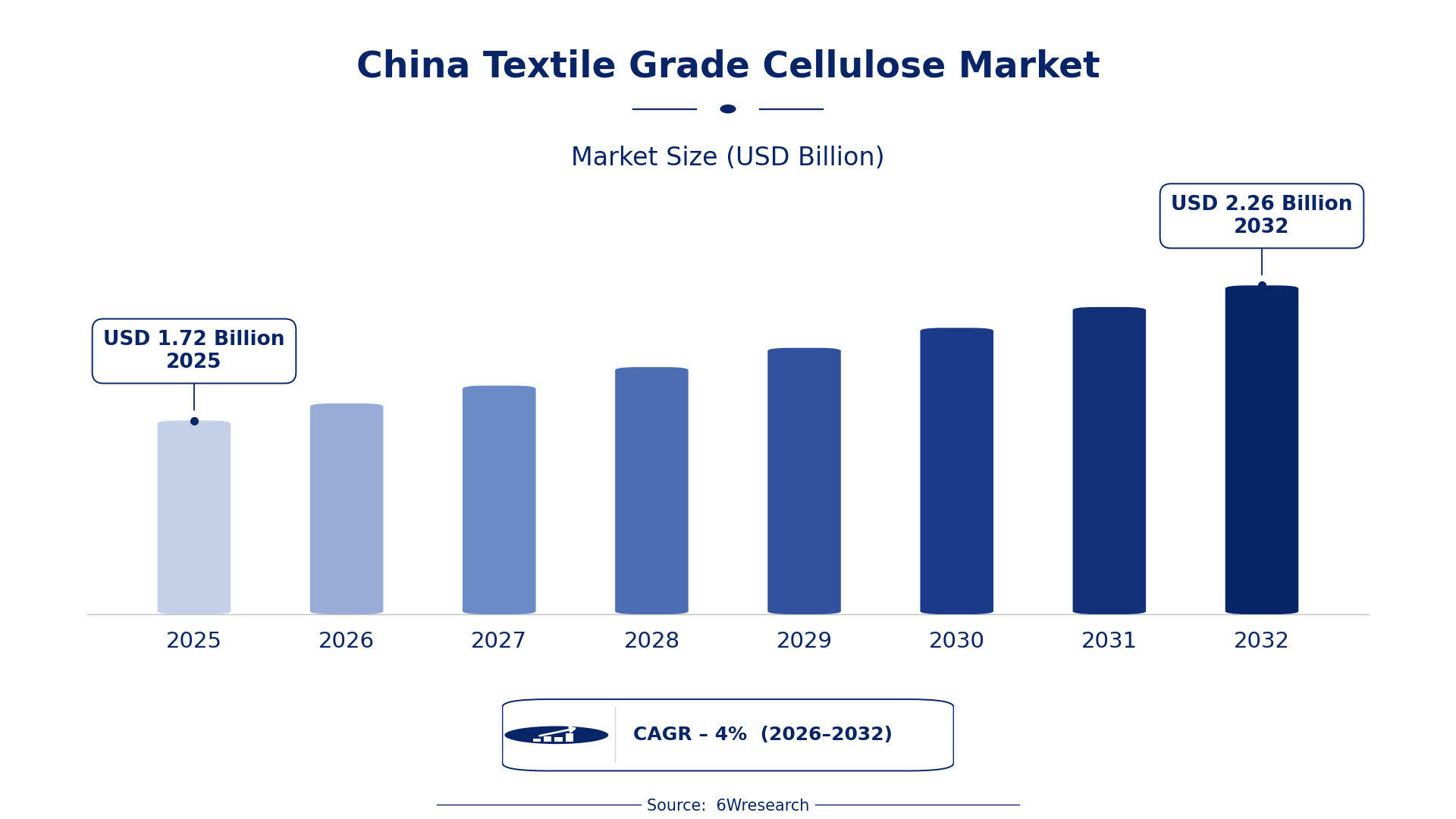
According to 6Wresearch internal database and industry insights, the China Textile Grade Cellulose Market was valued at USD 1.72 billion in 2025 and is projected to reach USD 2.26 billion by 2032, growing at a CAGR of approximately 4% during 2026–2032.
China Textile Grade Cellulose Market Highlights
| Report Metric | Details |
| Report Name | China Textile Grade Cellulose Market |
| Market Size 2025 | USD 1.72 billion |
| Market Size 2032 | USD 2.26 billion |
| Absolute Growth 2025–2032 | USD 0.54 billion |
| CAGR 2026–2032 | 4% |
| Peak Annual Growth | 6.1% in 2027 |
| Forecast Period | 2026–2032 |
| Historical Data | 2022–2025 |
| Base Year | 2025 |
| Leading Textile Grade Cellulose, 2025 | Dissolving Pulp (40% share) |
| Leading Product Type, 2025 | Viscose (32% share) |
| Leading Cellulose Type, 2025 | Wood Pulp Derived (35% share) |
| Leading Distribution Channel, 2025 | Chemical Traders (42% share) |
| Leading End User Industry, 2025 | Fiber Spinning Mills (47% share) |
| Fastest-Growing Textile Grade Cellulose | Nanocellulose Fibers (5.5% CAGR) |
| Fastest-Growing Product Type | Lyocell (6.5% CAGR) |
| Fastest-Growing Cellulose Type | Nano-Fibrils (6.1% CAGR) |
| Fastest-Growing Distribution Channel | Specialty Distributors (6.2% CAGR) |
| Fastest-Growing End User Industry | Technical Textiles (5.4% CAGR) |
| Growing Sector | Technical Textiles |
| Key End Users | Fiber Spinning Mills, Chemical Traders, Industrial Suppliers, Specialty Distributors |
China Textile Grade Cellulose Market Year-wise Growth Rate and Key Drivers (2022–2032)
This graph illustrates the annual growth rates of the market from 2022 to 2032, highlighting a steady upward trajectory and projected market expansion over the forecast period.
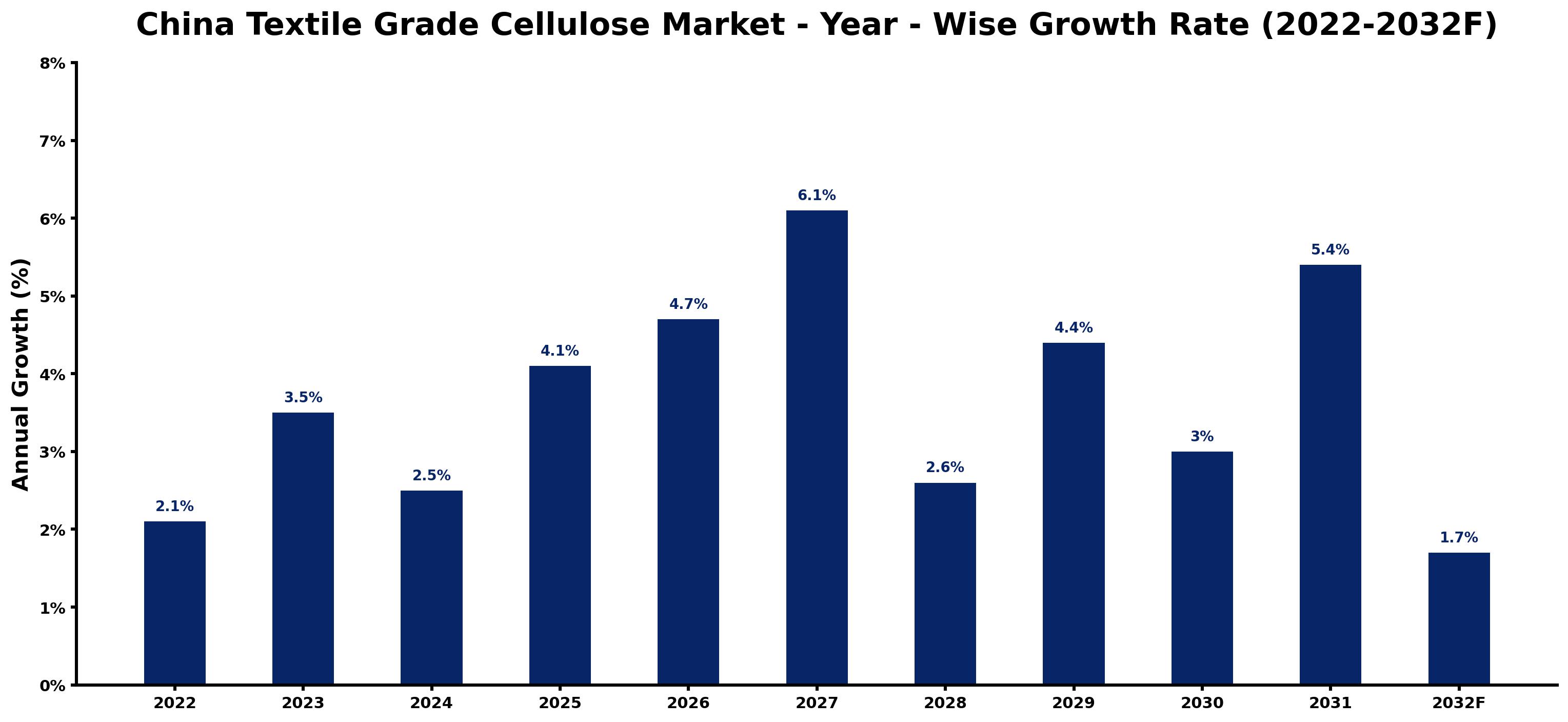
The table below sets out the estimated growth rate for each year and the main factor behind it.
| Year | Estimated Annual Growth (%) | Market Rationale |
| 2022 | 2.1 | The market experienced steady demand from local manufacturers and downstream processing. |
| 2023 | 3.5 | Growth accelerated due to increased production of viscose fibers in Jiangsu province. |
| 2024 | 2.5 | A slowdown occurred as production adjustments took place in response to market conditions. |
| 2025 | 4.1 | Demand surged with the textile industry focusing on sustainable fiber production initiatives under the National Strategy for Sustainable Development of the Textile Industry. |
| 2026 | 4.7 | Investment in cellulose production technologies is expected to boost growth rates as manufacturers adapt to the 14th Five-Year Plan. |
| 2027 | 6.1 | The peak growth year will see a major rise in orders from fiber spinning mills due to increased capacity in Guangdong province. |
| 2028 | 2.6 | A slowdown is projected as the market adjusts to previous high production levels and demand stabilises under the updated National Standard GB/T 20000.2-2008. |
| 2029 | 4.4 | Demand is expected to increase again as technical textiles begin to gain traction in the market, particularly in Jiangsu and Zhejiang provinces. |
| 2030 | 3.0 | Growth will slow as manufacturers face challenges in sourcing high-quality raw materials for cellulose production. |
| 2031 | 5.4 | A recovery in growth will be driven by renewed interest in eco-friendly fibers and sustainable practices, supported by the Ministry of Industry and Information Technology. |
| 2032 | 1.7 | The market is projected to grow at a slower rate as it stabilises under the 14th Five-Year Plan. |
Note: Market size estimations and growth projections presented in this report are based on 6Wresearch's proprietary forecasting methodology, utilizing the latest available industry data, government publications, and primary research inputs.
China Textile Grade Cellulose Market Synopsis
Textile Grade Cellulose Market in China encompasses high-purity cellulose derived from wood pulp or cotton linters, primarily used in textile applications such as fiber production. This product is essential for creating fibers like viscose and lyocell, which are vital for the textile industry. The government's support for sustainable fiber production through initiatives like the 14th Five-Year Plan and the National Strategy for Sustainable Development of the Textile Industry is creating new demand in the sector.
Market Dynamics Impact Analysis (2026–2032)
| Factor | Type | Impact | Primary Segment Affected |
| Growing domestic demand for viscose fibers from local manufacturers | Driver | High | Dissolving Pulp |
| Increased focus on sustainable fiber production practices | Driver | High | Lyocell |
| Rising demand for technical textiles requiring advanced cellulose applications | Opportunity | High | Nanocellulose Fibers |
| Expansion of the fiber spinning mills sector in Jiangsu province | Opportunity | High | Fiber Spinning Mills |
| Challenges in sourcing high-quality raw materials for cellulose production | Restraint | High | Wood Pulp Derived |
| Regulatory compliance costs associated with quality standards | Restraint | Medium | Chemical Traders |
| Technological barriers in cellulose production processes | Challenge | High | Dissolving Pulp |
| Competition from alternative fiber sources impacting market share | Challenge | Medium | Lyocell |
Evaluation of Drivers in China Textile Grade Cellulose Market (2026–2032)
Below mentioned are some major drivers and their influence on market dynamics.
| Drivers | Primary Segment Affected | Why It Matters (Evidence) |
| Increased production of viscose fibers | Dissolving Pulp | China produced 1.5 million tons of viscose fibers in 2022, boosting demand from fiber spinning mills. |
| Government support for sustainable practices | Nanocellulose Fibers | The demand for nanocellulose fibers is rising, particularly in advanced textile applications, reflecting innovation in the sector. |
| Investment in cellulose production technologies | Wood Pulp Derived | Investment supported by the Ministry of Science and Technology is aimed at improving production efficiency and capacity. |
| Expansion of fiber spinning mills | Fiber Spinning Mills | Major textile hubs in Jiangsu and Zhejiang provinces are driving higher cellulose consumption, reflecting sector growth. |
| Rising demand for specialty additives | Specialty Additive | The demand for specialty additives in textiles is projected to rise by 10% annually, influencing purchasing decisions. |
Market growth in China for Textile Grade Cellulose rests on rising domestic demand from fiber spinning mills, alongside investments in production technologies. In 2022, the production of viscose fibers reached 1.5 million tons, directly increasing demand for dissolving pulp. The 14th Five-Year Plan supports sustainable practices, driving demand for lyocell as manufacturers adapt to eco-friendly requirements. The demand for nanocellulose fibers is growing in technical textiles applications, with investment improving production efficiency. Expanding textile hubs in Jiangsu and Zhejiang provinces are also contributing to increased cellulose consumption, reflecting the sector's growth potential.
Evaluation of Restraints in China Textile Grade Cellulose Market
The main factors holding the market back are set out below.
| Market Restraint | Primary Segment Affected | Why It Matters (Evidence) |
| Sourcing high-quality raw materials for cellulose production is challenging | Wood Pulp Derived | The production of dissolving pulp reached 800,000 tons in 2022, but quality issues persist. |
| Compliance with stringent quality standards raises costs | Chemical Traders | The updated National Standard GB/T 20000.2-2008 governs cellulose quality, impacting producers. |
| Technological barriers hinder production efficiency | Dissolving Pulp | Investment in advanced technologies is required to meet growing demand effectively, affecting operational costs. |
| Competition from alternative fibers affects market share | Lyocell | High-end apparel brands are increasingly sourcing sustainable cellulose fibers, impacting traditional cellulose sales. |
| Market fluctuations impact pricing strategies | Fiber Spinning Mills | The demand for specialty additives in textiles is projected to rise by 10% annually, affecting pricing. |
China Textile Grade Cellulose Market Challenges
Skills shortages in advanced processing techniques limit production efficiency, causing delays in fulfilling orders for textile manufacturers. Rising production costs, driven by increased energy prices, can lead to a 15% hike in manufacturing expenses, impacting the pricing strategies of suppliers. Compliance with the National Standard GB/T 20000.2-2008 complicates operations for manufacturers, often resulting in longer lead times for buyers seeking high-quality cellulose.
Trends in the China Textile Grade Cellulose Market
Below mentioned are some of the trends shaping the China Textile Grade Cellulose Market growth.
- Shift towards Sustainable Fiber Production: The 14th Five-Year Plan initiated a shift towards sustainable fiber production in China, targeting a 20% increase in renewable fiber use by 2025. This shift is expected to create a more favourable market for eco-friendly cellulose, benefiting producers.
- Growth of Technical Textiles: The demand for technical textiles is rising, particularly in advanced applications. In 2022, the production of nanocellulose fibers began to gain traction, reflecting a growing trend towards innovative textile solutions and applications.
- Increased Focus on Quality Standards: The updated National Standard GB/T 20000.2-2008 has reinforced quality control measures for textile grade cellulose. This change, effective since 2021, ensures higher quality products in the market, benefiting buyers and producers alike.
- Expansion of Fiber Spinning Mills: Fiber spinning mills are expanding rapidly, particularly in Jiangsu province, which is a major consumer of cellulose. This growth is reflected in the 1.5 million tons of viscose fibers produced in 2022, indicating a strong market demand.
Investment Opportunities in the China Textile Grade Cellulose Market
The following opportunities in the China Textile Grade Cellulose Market pair current demand with a clear way in.
- Investment in Eco-Friendly Cellulose Production: With a target of increasing renewable fiber use by 20% by 2025, there is an opportunity for investment in eco-friendly cellulose production technologies. Fiber spinning mills are key buyers in this sector, driving demand for sustainable products.
- Supply of Nanocellulose Fibers: The demand for nanocellulose fibers is expected to grow, with an increase in technical textiles applications. Suppliers can target fiber spinning mills in Jiangsu and Zhejiang provinces to meet this demand effectively.
- Development of Specialty Additives: The projected 10% annual rise in demand for specialty additives presents an opportunity for manufacturers. Focusing on high-quality cellulose for textile applications can attract buyers in the high-end apparel sector, enhancing market presence.
- Expansion of Distribution Channels: As Chemical Traders currently account for 42% of the distribution market, there is room for growth in specialty distributors. Targeting niche cellulose products can strengthen market presence and improve sales.
Government Initiatives in the China Textile Grade Cellulose Market
The National Strategy for Sustainable Development of the Textile Industry, approved by the State Council in 2022, aims for a 20% increase in renewable fiber use by 2025. This measure encourages producers to adopt sustainable practices, positively impacting the cellulose market. The updated National Standard GB/T 20000.2-2008 improves quality control measures for textile grade cellulose, ensuring producers meet stringent requirements, thereby enhancing product quality for buyers.
The National Development and Reform Commission oversees the implementation of the 14th Five-Year Plan, which promotes sustainable cellulose production. The Ministry of Industry and Information Technology's Green Manufacturing System Construction Guidelines support eco-friendly practices, encouraging manufacturers to improve production efficiency. In 2023, the Ministry of Science and Technology initiated the Advanced Fiber Materials Program, allocating a budget of 500 million yuan to support cellulose research and development, which is expected to enhance market growth potential.
Future Insight of the China Textile Grade Cellulose Market
The expansion of the fiber market in Guangdong province will create new opportunities for suppliers to meet evolving textile demands. Government initiatives under the 14th Five-Year Plan will promote sustainable production practices, encouraging buyers to source eco-friendly materials. The production of dissolving pulp reached 800,000 tons in 2022, supporting innovation in cellulose applications and benefiting both producers and buyers as they adapt to changing market needs.
Market Segmentation Analysis
Each segment group is reviewed below, with the leader by share and the fastest grower by CAGR.
By Textile Grade Cellulose – Dissolving Pulp Dominated, Nanocellulose Fibers Expected to Grow Fastest
According to Vasudha, AM at 6Wresearch, Dissolving Pulp accounted for a 40% market share by textile grade cellulose in 2025. The strong demand from fiber spinning mills in regions like Jiangsu province further reinforces its dominant position. Nanocellulose Fibers are projected to grow fastest, at a CAGR of 5.5% during 2026–2032. Nanocellulose fibers are experiencing rapid growth, driven by their increasing integration into advanced textile applications, with a notable 10% annual rise in demand for specialty additives. As the market for technical textiles expands, the established base of dissolving pulp will continue to widen its lead. This means suppliers should enhance production capabilities for dissolving pulp while also exploring opportunities in the growing nanocellulose segment.
By Product Type – Viscose Dominated, Lyocell Expected to Grow Fastest
The largest product type category in 2025 was Viscose, with a 32% share of total revenue. Viscose dominates the market share as the primary product derived from textile grade cellulose, essential for various textile applications. Its widespread use in the textile industry, particularly in high-demand regions like Jiangsu, reinforces its leading position. Over 2026–2032, Lyocell is expected to post the fastest growth, at a CAGR of 6.5%. Lyocell is experiencing the fastest growth due to its increasing adoption in sustainable textile production, particularly in Guangdong province where the market is expanding. As consumer preferences shift towards eco-friendly options, viscose's lead will remain strong. Suppliers should prioritise investments in viscose production while also considering the growing demand for lyocell to meet market trends.
By Cellulose Type – Wood Pulp Derived Dominated, Nano-Fibrils Expected to Grow Fastest
With a 35% revenue share in 2025, Wood Pulp Derived was the largest cellulose type category. Wood pulp derived cellulose commands the largest market share as it is the main source for textile applications, providing the necessary purity and quality for production. Its established supply chains and production processes support its dominance in the market. Nano-Fibrils are set to record the highest CAGR in this split, 6.1% over 2026–2032. Nano-fibrils, while currently a minor segment, are projected to grow rapidly as they find applications in specialized textiles, driven by increasing innovation in the sector. The established position of wood pulp derived cellulose will likely continue to strengthen as demand for traditional products remains high. This suggests that suppliers should maintain a strong focus on wood pulp derived cellulose while also exploring the potential of nano-fibrils in niche markets.
By Distribution Channel – Chemical Traders Dominated, Specialty Distributors Expected to Grow Fastest
In 2025, Chemical Traders led the distribution channel split with a 42% share. Chemical traders dominate the distribution channel for textile grade cellulose, leveraging extensive networks and established relationships with manufacturers. Their critical role in supplying cellulose products to fiber spinning mills solidifies their leading market share. The quickest growth will come from Specialty Distributors, forecast to expand at a CAGR of 6.2% between 2026 and 2032. Specialty distributors are the fastest growing channel, focusing on niche cellulose products that cater to the rising demand for specialized textile applications. The established presence of chemical traders will help maintain their lead as the market diversifies. This indicates that suppliers should strengthen partnerships with chemical traders while also developing strategies to engage specialty distributors.
By End User Industry – Fiber Spinning Mills Dominated, Technical Textiles Expected to Grow Fastest
Fiber Spinning Mills took a 47% share of end user industry in 2025, more than any other category. Fiber spinning mills represent the largest share of the end user industry, as they are the primary consumers of textile grade cellulose for fiber production. Their significant operational scale and demand for viscose fibers solidify their leading position in the market. Technical Textiles are projected to grow fastest, at a CAGR of 5.4% during 2026–2032. The technical textiles sector is the fastest growing end user, driven by increasing applications of cellulose fibers in advanced materials. As fiber spinning mills continue to dominate, the growth in technical textiles will create new opportunities for cellulose suppliers. This suggests that suppliers should focus on meeting the needs of fiber spinning mills while also exploring the expanding technical textiles market.
Key Attractiveness of the Report
- 10 Years of Market Numbers
- Historical Data Starting from 2022 to 2025
- Base Year 2025
- Forecast Data until 2032
- Key Performance Indicators Impacting the Market
- Major Upcoming Developments and Projects
Key Highlights of the Report:
- China Textile Grade Cellulose Market Outlook
- Market Size of China Textile Grade Cellulose Market, 2025
- Forecast of China Textile Grade Cellulose Market, 2032
- Historical Data and Forecast of China Textile Grade Cellulose Revenues & Volume for the Period 2022 - 2032F
- China Textile Grade Cellulose Market Trend Evolution
- China Textile Grade Cellulose Market Drivers and Challenges
- China Textile Grade Cellulose Price Trends
- China Textile Grade Cellulose Porter's Five Forces
- China Textile Grade Cellulose Industry Life Cycle
- Historical Data and Forecast of China Textile Grade Cellulose Market Revenues & Volume By Textile Grade Cellulose for the Period 2022 - 2032F
- Historical Data and Forecast of China Textile Grade Cellulose Market Revenues & Volume By Dissolving Pulp for the Period 2022 - 2032F
- Historical Data and Forecast of China Textile Grade Cellulose Market Revenues & Volume By Cotton Linters for the Period 2022 - 2032F
- Historical Data and Forecast of China Textile Grade Cellulose Market Revenues & Volume By Cellulose Acetate Dope for the Period 2022 - 2032F
- Historical Data and Forecast of China Textile Grade Cellulose Market Revenues & Volume By Nanocellulose Fibers for the Period 2022 - 2032F
- Historical Data and Forecast of China Textile Grade Cellulose Market Revenues & Volume By Product Type for the Period 2022 - 2032F
- Historical Data and Forecast of China Textile Grade Cellulose Market Revenues & Volume By Viscose, Lyocell for the Period 2022 - 2032F
- Historical Data and Forecast of China Textile Grade Cellulose Market Revenues & Volume By Short Staple Pulp for the Period 2022 - 2032F
- Historical Data and Forecast of China Textile Grade Cellulose Market Revenues & Volume By Dope Solutions for the Period 2022 - 2032F
- Historical Data and Forecast of China Textile Grade Cellulose Market Revenues & Volume By Specialty Additive for the Period 2022 - 2032F
- Historical Data and Forecast of China Textile Grade Cellulose Market Revenues & Volume By Cellulose Type for the Period 2022 - 2032F
- Historical Data and Forecast of China Textile Grade Cellulose Market Revenues & Volume By Wood Pulp Derived for the Period 2022 - 2032F
- Historical Data and Forecast of China Textile Grade Cellulose Market Revenues & Volume By High-Purity Linter for the Period 2022 - 2032F
- Historical Data and Forecast of China Textile Grade Cellulose Market Revenues & Volume By Acetate Chemistry for the Period 2022 - 2032F
- Historical Data and Forecast of China Textile Grade Cellulose Market Revenues & Volume By Nano-Fibrils for the Period 2022 - 2032F
- Historical Data and Forecast of China Textile Grade Cellulose Market Revenues & Volume By Distribution Channel for the Period 2022 - 2032F
- Historical Data and Forecast of China Textile Grade Cellulose Market Revenues & Volume By Chemical Traders for the Period 2022 - 2032F
- Historical Data and Forecast of China Textile Grade Cellulose Market Revenues & Volume By Industrial Suppliers for the Period 2022 - 2032F
- Historical Data and Forecast of China Textile Grade Cellulose Market Revenues & Volume By Direct Chemical Sales for the Period 2022 - 2032F
- Historical Data and Forecast of China Textile Grade Cellulose Market Revenues & Volume By Specialty Distributors for the Period 2022 - 2032F
- Historical Data and Forecast of China Textile Grade Cellulose Market Revenues & Volume By End User Industry for the Period 2022 - 2032F
- Historical Data and Forecast of China Textile Grade Cellulose Market Revenues & Volume By Fiber Spinning Mills for the Period 2022 - 2032F
- Historical Data and Forecast of China Textile Grade Cellulose Market Revenues & Volume By High-End Apparel for the Period 2022 - 2032F
- Historical Data and Forecast of China Textile Grade Cellulose Market Revenues & Volume By Photographic/Film for the Period 2022 - 2032F
- Historical Data and Forecast of China Textile Grade Cellulose Market Revenues & Volume By Technical Textiles for the Period 2022 - 2032F
- China Textile Grade Cellulose Import Export Trade Statistics
- Market Opportunity Assessment By Textile Grade Cellulose
- Market Opportunity Assessment By Product Type
- Market Opportunity Assessment By Cellulose Type
- Market Opportunity Assessment By Distribution Channel
- Market Opportunity Assessment By End User Industry
- China Textile Grade Cellulose Top Companies Market Share
- China Textile Grade Cellulose Competitive Benchmarking By Technical and Operational Parameters
- China Textile Grade Cellulose Company Profiles
- China Textile Grade Cellulose Key Strategic Recommendations
Market Covered
Segments analysed in this report are listed below.
By Textile Grade Cellulose
- Dissolving Pulp
- Cotton Linters
- Cellulose Acetate Dope
- Nanocellulose Fibers
By Product Type
- Viscose
- Lyocell
- Short Staple Pulp
- Dope Solutions
- Specialty Additive
By Cellulose Type
- Wood Pulp Derived
- High-Purity Linter
- Acetate Chemistry
- Nano-Fibrils
By Distribution Channel
- Chemical Traders
- Industrial Suppliers
- Direct Chemical Sales
- Specialty Distributors
By End User Industry
- Fiber Spinning Mills
- High-End Apparel
- Photographic/Film
- Technical Textiles































