India Textile Supply Chain Market Size & Growth Rate
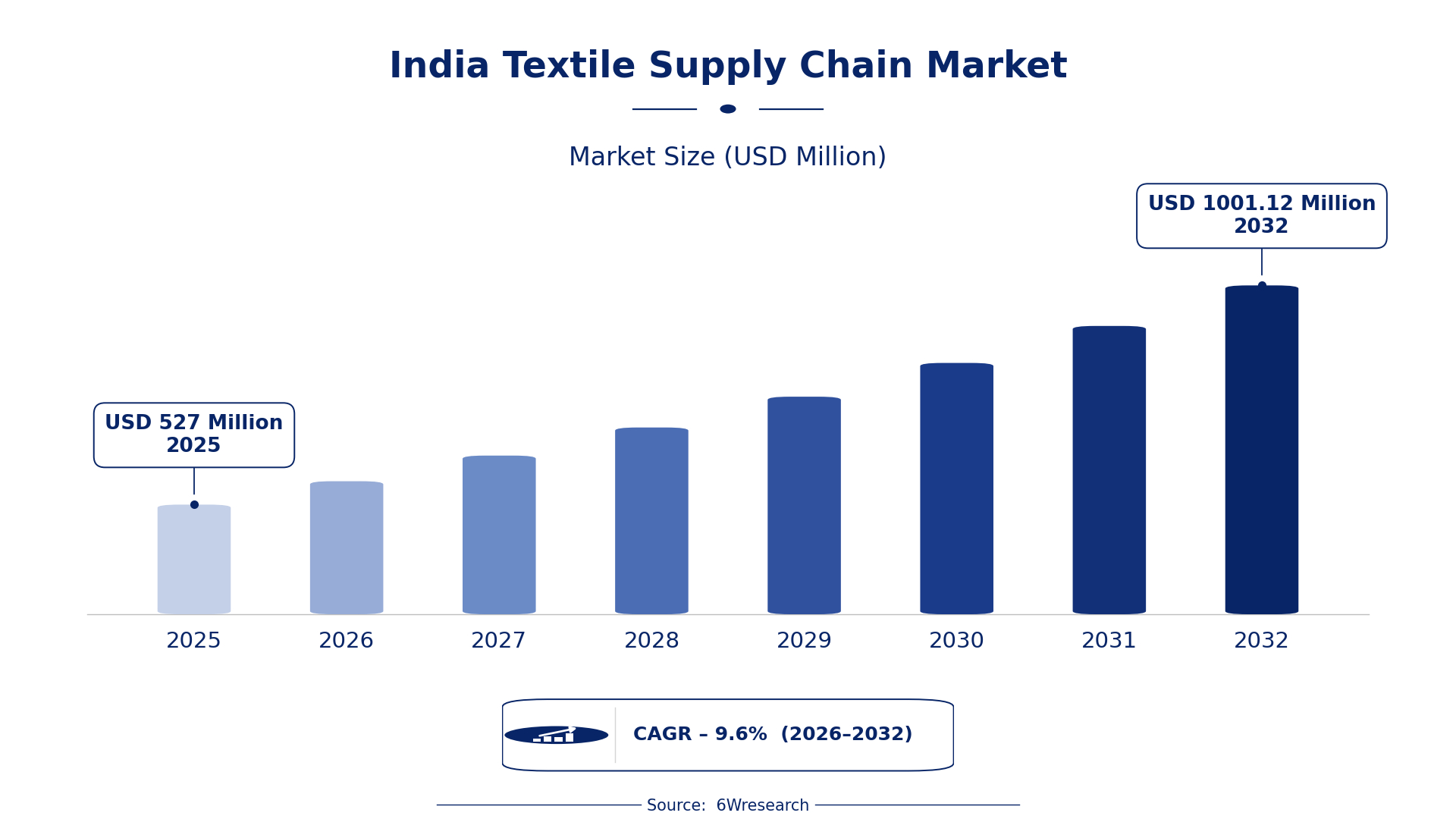
According to 6Wresearch internal database and industry insights, the India Textile Supply Chain Market was valued at USD 527.0 million in 2025 and is projected to reach USD 1,001.12 million by 2032, growing at a CAGR of approximately 9.6% during 2026–2032.
India Textile Supply Chain Market Highlights
| Report Metric | Details |
| Report Name | India Textile Supply Chain Market |
| Market Size 2025 | USD 527.0 million |
| Market Size 2032 | USD 1,001.12 million |
| Absolute Growth 2025–2032 | USD 474.12 million |
| CAGR 2026–2032 | 9.6% |
| Peak Annual Growth | 10.8% in 2029 |
| Forecast Period | 2026–2032 |
| Historical Data | 2022–2025 |
| Base Year | 2025 |
| Leading Textile Supply Chain, 2025 | Logistics & Distribution (44% share) |
| Leading Segment, 2025 | Yarn Production (39% share) |
| Leading Service Type, 2025 | Sustainability Certification (44% share) |
| Leading Distribution Channel, 2025 | Direct Sourcing (49% share) |
| Leading End User Industry, 2025 | Apparel Brands (36% share) |
| Fastest-Growing Segment | Textile Logistics (12.3% CAGR) |
| Fastest-Growing Service Type | Fast DV to Retail (10.8% CAGR) |
| Fastest-Growing Distribution Channel | Contract Production (12.0% CAGR) |
| Fastest-Growing End User Industry | Retail & Fashion (11.2% CAGR) |
| Growing Sector | Apparel Brands |
| Key End Users | Apparel Brands, Retail & Fashion, Fashion Industry |
India Textile Supply Chain Market Year-wise Growth Rate and Key Drivers (2022–2032)
This graph illustrates the annual growth rates of the market from 2022 to 2032, highlighting a steady upward trajectory and projected market expansion over the forecast period.
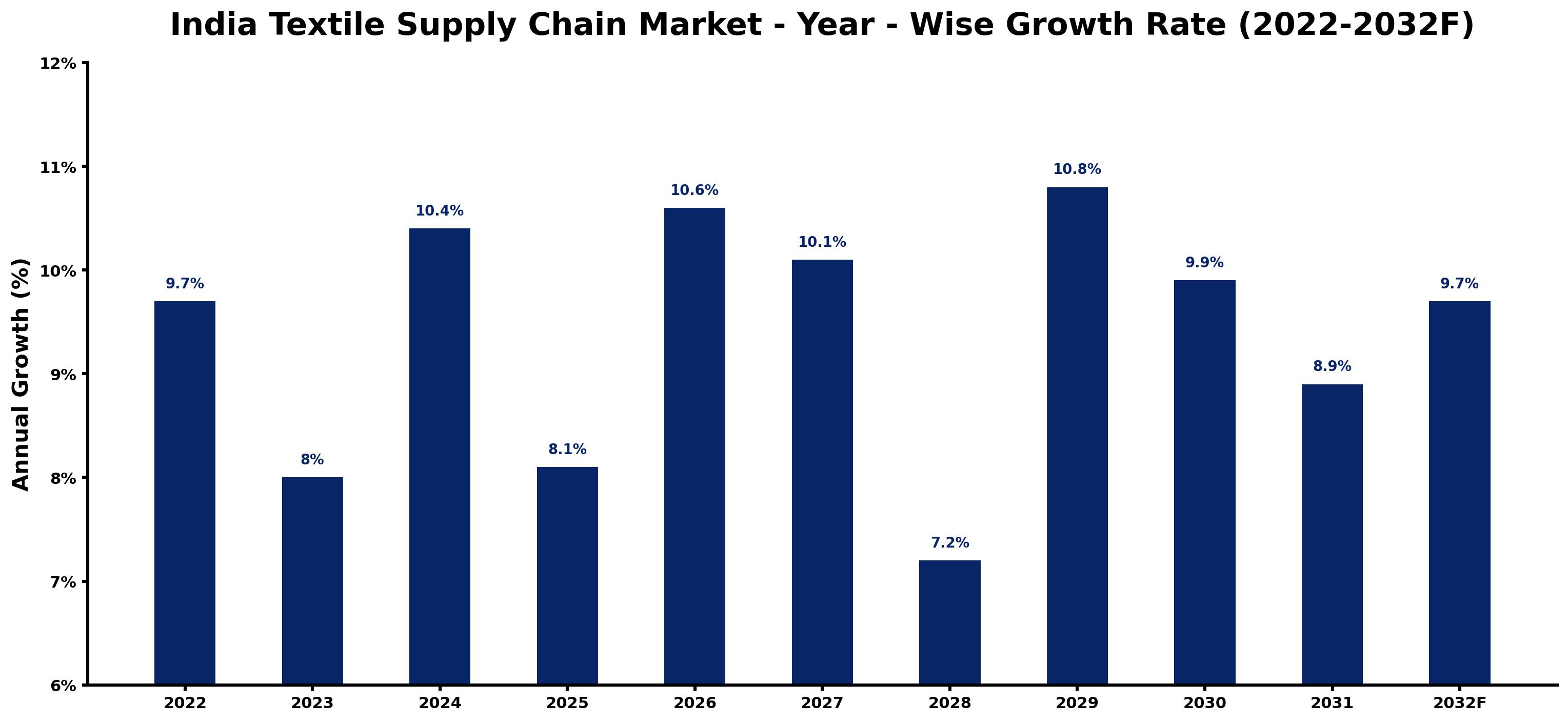
Each row of the following table gives one year's estimated growth and the event or demand shift that explains it.
| Year | Estimated Annual Growth (%) | Market Rationale |
| 2022 | 9.7 | The market experienced steady demand from local manufacturers and retailers. |
| 2023 | 8.0 | Growth slowed due to challenges in logistics and supply chain disruptions. |
| 2024 | 10.4 | Increased demand from apparel brands boosted growth rates. |
| 2025 | 8.1 | A reduction in growth was noted as market adjustments took place. |
| 2026 | 10.6 | Investment in the Production Linked Incentive Scheme spurred a resurgence in growth rates. |
| 2027 | 10.1 | Demand from the retail sector moderated growth compared to the previous year. |
| 2028 | 7.2 | Slower growth was attributed to market saturation in certain segments. |
| 2029 | 10.8 | A peak in growth occurred as innovation in textile solutions gained traction. |
| 2030 | 9.9 | Growth slowed as manufacturers faced challenges in sourcing materials. |
| 2031 | 8.9 | The market continued to grow but at a reduced pace due to competitive pressures. |
| 2032 | 9.7 | An increase in demand from apparel brands revitalised market growth. |
Note: Market size estimations and growth projections presented in this report are based on 6Wresearch's proprietary forecasting methodology, utilizing the latest available industry data, government publications, and primary research inputs.
India Textile Supply Chain Market Synopsis
The India Textile Supply Chain Market encompasses the entire process from raw material sourcing to final product distribution. It involves stages such as fibre procurement, manufacturing, and logistics, primarily serving the apparel and fashion industries. This market is expanding due to rising domestic demand from local manufacturers and retailers. With India being the second-largest textile producer globally, the sector is supported by investments and policies aimed at sustainability and innovation. The National Textile Policy aims to improve the sector's global competitiveness by 2025, driving further growth in the industry.
Market Dynamics Impact Analysis (2026–2032)
| Factor | Type | Impact | Primary Segment Affected |
| Rising domestic demand from apparel brands drives sourcing and production. | Driver | High | Yarn Production |
| Investment in technology upgrades enhances manufacturing efficiency. | Driver | High | Manufacturing & Spinning |
| The growing need for sustainable practices creates opportunities for certification services. | Opportunity | Medium | Sustainability Certification |
| Expansion of logistics infrastructure supports faster distribution of textiles. | Opportunity | High | Logistics & Distribution |
| Supply chain disruptions can delay production timelines. | Restraint | High | Logistics & Distribution |
| Quality standards set by the Bureau of Indian Standards can limit market access. | Restraint | Medium | Fabric & Garment Manufacturing |
| High operational costs impact profitability for manufacturers. | Challenge | High | Manufacturing & Spinning |
| Regulatory approvals can slow down the introduction of new products. | Challenge | Medium | Textile Logistics |
Evaluation of Drivers in India Textile Supply Chain Market (2026–2032)
The factors lifting demand, and the evidence behind each, are summarised below.
| Drivers | Primary Segment Affected | Why It Matters (Evidence) |
| Increased investment in technology and infrastructure. | Manufacturing & Spinning | This investment leads to improved production capacity, allowing manufacturers to meet a growing market demand of 44 billion in textile exports. |
| Rising demand from the apparel industry. | Yarn Production | Apparel brands are increasingly sourcing locally, boosting the need for yarn and raw materials, which grew significantly in 2021. |
| Government initiatives promoting sustainability. | Sustainability Certification | These initiatives encourage brands to adopt eco-friendly practices, increasing demand for certification services, especially with the National Textile Policy. |
| Expansion of logistics networks across key states. | Logistics & Distribution | Enhanced logistics capabilities facilitate faster delivery, meeting the needs of the growing retail sector, particularly in Maharashtra and Gujarat. |
| Support from the Apparel Export Promotion Council. | Fabric & Garment Manufacturing | This support helps manufacturers access international markets, increasing production volumes and driving exports. |
The Textile Supply Chain market in India is expanding as investment in technology and infrastructure rises, alongside increasing demand from the apparel industry. In 2021, India's textile exports reached $44 billion, showcasing strong international interest. The expansion of logistics networks in Maharashtra and Gujarat improves distribution efficiency, allowing manufacturers to meet local and international needs. Support from the Apparel Export Promotion Council stimulates production volumes, creating a positive feedback loop in the market.
Evaluation of Restraints in India Textile Supply Chain Market
The following restraints limit how fast demand can grow.
| Market Restraint | Primary Segment Affected | Why It Matters (Evidence) |
| Supply chain disruptions due to logistical challenges. | Logistics & Distribution | These disruptions can lead to delays in production and increased costs for manufacturers, impacting their ability to fulfil orders. |
| Strict quality standards by the Bureau of Indian Standards. | Fabric & Garment Manufacturing | Compliance with these standards can limit market access for smaller producers, affecting their competitiveness in the industry. |
| High operational costs in manufacturing processes. | Manufacturing & Spinning | These costs can reduce profit margins, making it difficult for manufacturers to compete effectively in the market. |
| Regulatory hurdles in product approvals. | Textile Logistics | Lengthy approval processes can delay the introduction of new textile products to the market, affecting time-to-market for manufacturers. |
| Limited access to skilled labour in certain regions. | Yarn Production | This shortage can hinder production capabilities and affect overall supply chain efficiency, impacting output. |
India Textile Supply Chain Market Challenges
The India Textile Supply Chain Market faces intense competition from international suppliers, which pressures local manufacturers to lower prices and reduces profit margins for producers. Operational costs, particularly in logistics, have risen by up to 15%, limiting manufacturers' ability to invest in essential technology upgrades. Buyers, especially local retailers, encounter issues with inconsistent quality standards set by the Bureau of Indian Standards, leading to delays in product approvals and potential revenue losses. Regulatory changes under the National Textile Policy require compliance with sustainable practices by 2025, which could impose additional costs on unprepared producers.
Trends in the India Textile Supply Chain Market
Four trends stand out in the India Textile Supply Chain Market.
- Shift towards Sustainable Practices: Apparel brands are increasingly adopting sustainable practices to meet consumer demand. The National Textile Policy 2021 promotes eco-friendly initiatives, aiming for a 25% reduction in carbon emissions by 2025.
- Growth in Direct Sourcing: Direct sourcing is becoming more prevalent among manufacturers, with 49% of the market share in 2025. This shift allows for better control over quality and costs, improving competitiveness.
- Increase in Technology Adoption: The 'Technology Mission on Technical Textiles' launched in 2021 aims to boost innovation in the sector. This initiative is expected to increase the adoption of advanced manufacturing technologies significantly.
- Expansion of Logistics Infrastructure: The logistics sector is evolving with investments in modern facilities. The CAGR for Logistics & Distribution is projected at 11.6% from 2026 to 2032, reflecting the growing importance of efficient supply chains.
Investment Opportunities in the India Textile Supply Chain Market
Some of the investment opportunities in the India Textile Supply Chain Market are mentioned below.
- Investment in Logistics Facilities: Maharashtra is seeing a rise in logistics facilities to support textile distribution. The market gap in logistics investment is estimated at ₹5,000 crore, presenting opportunities for new entrants.
- Support for Sustainable Certification Services: Apparel brands are increasingly seeking sustainability certifications, creating demand for certification services. The growing focus on eco-friendly practices opens avenues for service providers in this sector.
- Partnerships for Technology Upgrades: Manufacturers are looking for partnerships to improve technology capabilities. Collaborating with local firms can facilitate access to advanced manufacturing techniques and improve competitiveness.
- Expansion of Direct Sourcing Channels: With direct sourcing holding a 49% market share, there is significant potential for growth. Manufacturers can explore partnerships with local suppliers to streamline sourcing processes.
Government Initiatives in the India Textile Supply Chain Market
The National Textile Policy 2021, launched by the Ministry of Textiles, aims to improve the global competitiveness and sustainability of the textile supply chain. This policy encourages investments in modernisation and eco-friendly practices, which are essential for meeting international standards. Additionally, the Production Linked Incentive (PLI) Scheme for textiles, approved in 2021 with a budget of ₹10,683 crore, aims to boost manufacturing capacity and create jobs in the sector. This funding is intended to support technological upgrades and improve production capabilities across various textile segments.
The Ministry of Textiles oversees several initiatives to support the textile supply chain. The 'Skill India' program aims to train over 1 million workers in the textile industry by 2025, improving workforce capabilities. Furthermore, the 'Atmanirbhar Bharat' initiative includes provisions for improving self-reliance in textile production, ensuring that local manufacturers can meet domestic and international demand effectively. These measures collectively aim to strengthen the sector and promote sustainable growth.
Future Insight of the India Textile Supply Chain Market
The India Textile Supply Chain Market is expected to transform by 2032, influenced by several key initiatives. The Textile Industry Development Scheme will support modernisation and technology upgrades, enhancing production efficiency. The 'Make in India' initiative will strengthen local manufacturing capabilities, reducing reliance on imports. The National Textile Policy will advance sustainable practices, aligning the industry with global standards. India's textile exports, which reached $44 billion in 2021, are anticipated to grow further as international demand continues to rise.
Market Segmentation Analysis
The analysis below covers each segmentation, its leading category in 2025 and its fastest-growing category through 2032.
By Textile Supply Chain – Logistics & Distribution Dominated and Is Expected to Record the Fastest Growth
According to Vasudha, AM at 6Wresearch, in 2025, Logistics & Distribution led the textile supply chain split with a 44% share. Logistics & Distribution dominates the India Textile Supply Chain Market due to its vital role in ensuring timely delivery of goods across the sector. The extensive logistics networks in key states like Maharashtra and Gujarat support this segment's strong position, facilitating seamless operations for manufacturers. Its lead should widen, with a projected CAGR of 11.6% during 2026–2032, the highest in this split. Logistics & Distribution is also the fastest-growing segment as manufacturers increasingly focus on optimising supply chain efficiency. The National Textile Policy's emphasis on sustainable practices is likely to further boost demand for advanced logistics solutions, solidifying this segment's lead. Suppliers must enhance logistics capabilities to meet the rising demand for efficient distribution in the textile supply chain.
By Segment – Yarn Production Dominated, Textile Logistics Expected to Grow Fastest
Yarn Production took a 39% share of segment in 2025, more than any other category. Yarn Production leads the segment with a substantial share as it is essential for converting raw fibers into usable yarn for various textile applications. The strong reliance of local manufacturers on yarn production reinforces its position in the market, ensuring consistent demand. Textile Logistics is set to record the highest CAGR in this split, 12.3% over 2026–2032. Textile Logistics is the fastest-growing segment, driven by the increasing need for efficient supply chain management among manufacturers. With India's textile exports reaching $44 billion, the demand for streamlined logistics solutions is set to rise significantly, supporting the growth of this segment. Buyers should prioritise partnerships with efficient yarn producers to ensure a steady supply of quality materials for their textile needs.
By Service Type – Sustainability Certification Dominated, Fast DV to Retail Expected to Grow Fastest
The largest service type category in 2025 was Sustainability Certification, with a 44% share of total revenue. Sustainability Certification captures the largest share as brands increasingly seek to comply with eco-standards in their production processes. The Bureau of Indian Standards plays a key role by establishing quality benchmarks, which drives demand for certification services. Over 2026–2032, Fast DV to Retail is expected to post the fastest growth, at a CAGR of 10.8%. Fast DV to Retail is the fastest-growing service type, reflecting the industry's push for quicker market entry of products. Initiatives like the 'Technology Mission on Technical Textiles' launched in 2021 highlight the urgency for rapid development and distribution, propelling this segment's growth. Suppliers need to invest in sustainability certifications to align with market demands and enhance their competitive edge.
By Distribution Channel – Direct Sourcing Dominated, Contract Production Expected to Grow Fastest
Direct Sourcing accounted for a 49% market share by distribution channel in 2025. Direct Sourcing commands the largest share as it enables manufacturers to obtain materials directly, thus reducing costs and improving supply chain efficiency. This approach is particularly advantageous for local manufacturers aiming to streamline their operations and enhance profitability. The quickest growth will come from Contract Production, forecast to expand at a CAGR of 12.0% between 2026 and 2032. Contract Production is the fastest-growing distribution channel, allowing brands to outsource manufacturing while focusing on their core competencies. The 'Make in India' initiative is expected to drive further demand for contract production services, supporting this segment's rapid growth. Buyers should consider leveraging direct sourcing strategies to optimise their procurement processes and reduce lead times.
By End User Industry – Apparel Brands Dominated, Retail & Fashion Expected to Grow Fastest
With a 36% revenue share in 2025, Apparel Brands was the largest end user industry category. Apparel Brands hold the largest share in the end-user industry, as they are the primary consumers of textile products. The robust domestic demand from local apparel manufacturers solidifies this segment's leading position in the market. Retail & Fashion is projected to grow fastest, at a CAGR of 11.2% during 2026–2032. Retail & Fashion is the fastest-growing end-user industry, driven by the increasing consumer preference for diverse and fashionable textile goods. The expansion of retail platforms in India further fuels this segment's growth, reflecting changing consumer behaviours. Suppliers should align their offerings with the evolving needs of apparel brands to capture a larger share of the market.
Key Attractiveness of the Report
- 10 Years of Market Numbers
- Historical Data Starting from 2022 to 2025
- Base Year 2025
- Forecast Data until 2032
- Key Performance Indicators Impacting the Market
- Major Upcoming Developments and Projects
Key Highlights of the Report:
- India Textile Supply Chain Market Outlook
- Market Size of India Textile Supply Chain Market, 2025
- Forecast of India Textile Supply Chain Market, 2032
- Historical Data and Forecast of India Textile Supply Chain Revenues & Volume for the Period 2022 - 2032F
- India Textile Supply Chain Market Trend Evolution
- India Textile Supply Chain Market Drivers and Challenges
- India Textile Supply Chain Price Trends
- India Textile Supply Chain Porter's Five Forces
- India Textile Supply Chain Industry Life Cycle
- Historical Data and Forecast of India Textile Supply Chain Market Revenues & Volume By Textile Supply Chain for the Period 2022 - 2032F
- Historical Data and Forecast of India Textile Supply Chain Market Revenues & Volume By Raw Material Sourcing for the Period 2022 - 2032F
- Historical Data and Forecast of India Textile Supply Chain Market Revenues & Volume By Manufacturing & Spinning for the Period 2022 - 2032F
- Historical Data and Forecast of India Textile Supply Chain Market Revenues & Volume By Fabric & Garment Manufacturing for the Period 2022 - 2032F
- Historical Data and Forecast of India Textile Supply Chain Market Revenues & Volume By Logistics & Distribution for the Period 2022 - 2032F
- Historical Data and Forecast of India Textile Supply Chain Market Revenues & Volume By Segment for the Period 2022 - 2032F
- Historical Data and Forecast of India Textile Supply Chain Market Revenues & Volume By Fiber Procurement for the Period 2022 - 2032F
- Historical Data and Forecast of India Textile Supply Chain Market Revenues & Volume By Yarn Production for the Period 2022 - 2032F
- Historical Data and Forecast of India Textile Supply Chain Market Revenues & Volume By Cut & Sew for the Period 2022 - 2032F
- Historical Data and Forecast of India Textile Supply Chain Market Revenues & Volume By Textile Logistics for the Period 2022 - 2032F
- Historical Data and Forecast of India Textile Supply Chain Market Revenues & Volume By Service Type for the Period 2022 - 2032F
- Historical Data and Forecast of India Textile Supply Chain Market Revenues & Volume By Sustainability Certification for the Period 2022 - 2032F
- Historical Data and Forecast of India Textile Supply Chain Market Revenues & Volume By Vertical Integration for the Period 2022 - 2032F
- Historical Data and Forecast of India Textile Supply Chain Market Revenues & Volume By Fast DV to Retail for the Period 2022 - 2032F
- Historical Data and Forecast of India Textile Supply Chain Market Revenues & Volume By Cold Chain/Textile Handling for the Period 2022 - 2032F
- Historical Data and Forecast of India Textile Supply Chain Market Revenues & Volume By Distribution Channel for the Period 2022 - 2032F
- Historical Data and Forecast of India Textile Supply Chain Market Revenues & Volume By Direct Sourcing for the Period 2022 - 2032F
- Historical Data and Forecast of India Textile Supply Chain Market Revenues & Volume By Contract Production for the Period 2022 - 2032F
- Historical Data and Forecast of India Textile Supply Chain Market Revenues & Volume By OEM Partnerships for the Period 2022 - 2032F
- Historical Data and Forecast of India Textile Supply Chain Market Revenues & Volume By Freight Forwarders for the Period 2022 - 2032F
- Historical Data and Forecast of India Textile Supply Chain Market Revenues & Volume By End User Industry for the Period 2022 - 2032F
- Historical Data and Forecast of India Textile Supply Chain Market Revenues & Volume By Apparel Brands for the Period 2022 - 2032F
- Historical Data and Forecast of India Textile Supply Chain Market Revenues & Volume By Retail & Fashion for the Period 2022 - 2032F
- Historical Data and Forecast of India Textile Supply Chain Market Revenues & Volume By Fashion Industry for the Period 2022 - 2032F
- Historical Data and Forecast of India Textile Supply Chain Market Revenues & Volume By Global Retail Platforms for the Period 2022 - 2032F
- India Textile Supply Chain Import Export Trade Statistics
- Market Opportunity Assessment By Textile Supply Chain
- Market Opportunity Assessment By Segment
- Market Opportunity Assessment By Service Type
- Market Opportunity Assessment By Distribution Channel
- Market Opportunity Assessment By End User Industry
- India Textile Supply Chain Top Companies Market Share
- India Textile Supply Chain Competitive Benchmarking By Technical and Operational Parameters
- India Textile Supply Chain Company Profiles
- India Textile Supply Chain Key Strategic Recommendations
Market Covered
Segments analysed in this report are listed below.
By Textile Supply Chain
- Raw Material Sourcing
- Manufacturing & Spinning
- Fabric & Garment Manufacturing
- Logistics & Distribution
By Segment
- Fiber Procurement
- Yarn Production
- Cut & Sew
- Textile Logistics
By Service Type
- Sustainability Certification
- Vertical Integration
- Fast DV to Retail
- Cold Chain/Textile Handling
By Distribution Channel
- Direct Sourcing
- Contract Production
- OEM Partnerships
- Freight Forwarders
By End User Industry
- Apparel Brands
- Retail & Fashion
- Fashion Industry
- Global Retail Platforms































