China Textile Supply Chain Market Size & Growth Rate
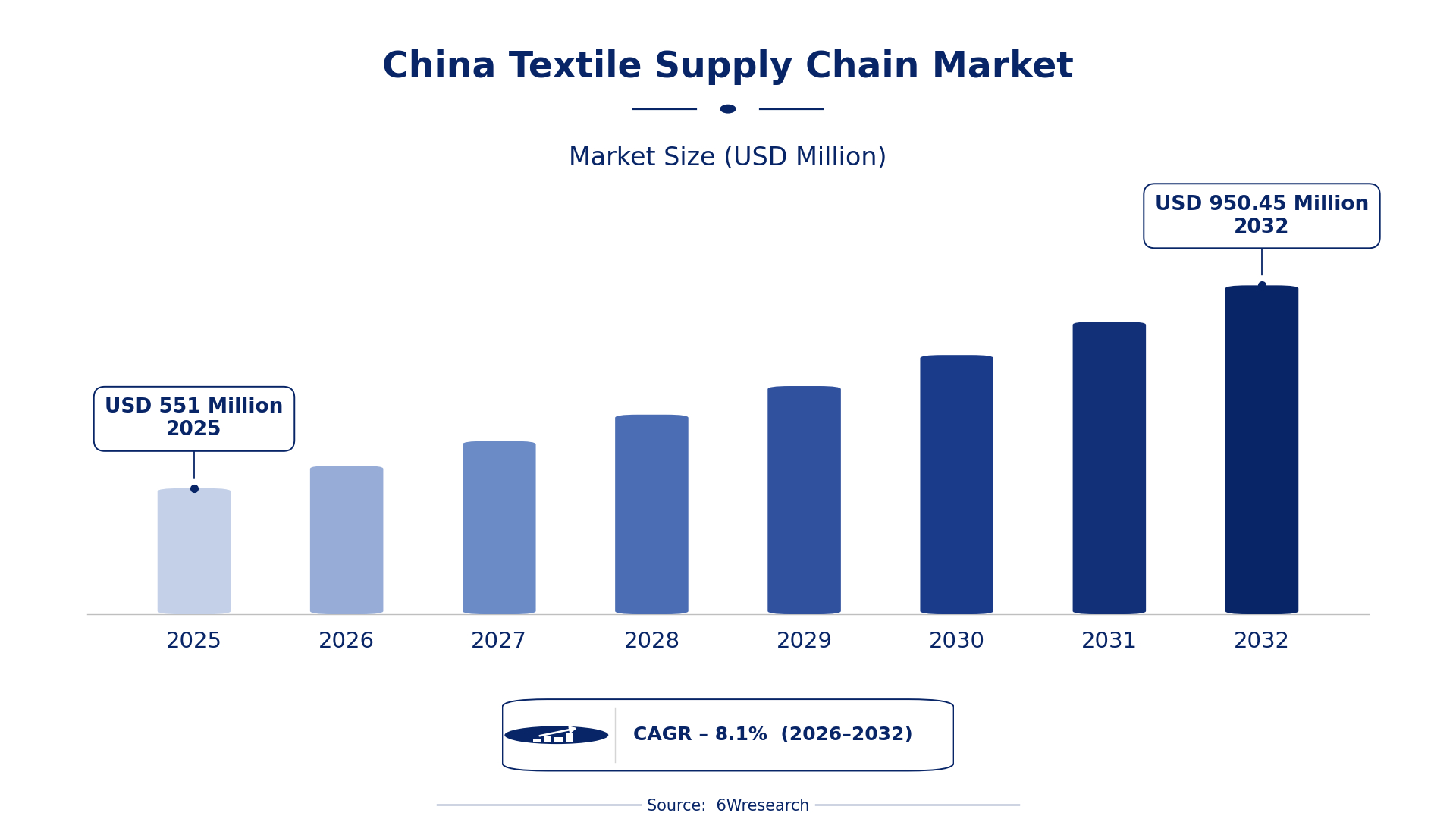
According to 6Wresearch internal database and industry insights, the China Textile Supply Chain Market was valued at USD 551.0 million in 2025 and is projected to reach USD 950.45 million by 2032, growing at a CAGR of approximately 8.1% during 2026–2032.
China Textile Supply Chain Market Highlights
| Report Metric | Details |
| Report Name | China Textile Supply Chain Market |
| Market Size 2025 | USD 551.0 million |
| Market Size 2032 | USD 950.45 million |
| Absolute Growth 2025–2032 | USD 399.45 million |
| CAGR 2026–2032 | 8.1% |
| Peak Annual Growth | 10.6% in 2031 |
| Forecast Period | 2026–2032 |
| Historical Data | 2022–2025 |
| Base Year | 2025 |
| Leading Textile Supply Chain, 2025 | Fabric & Garment Manufacturing (42% share) |
| Leading Segment, 2025 | Yarn Production (55% share) |
| Leading Service Type, 2025 | Sustainability Certification (46% share) |
| Leading Distribution Channel, 2025 | Direct Sourcing (43% share) |
| Leading End User Industry, 2025 | Apparel Brands (42% share) |
| Fastest-Growing Textile Supply Chain | Logistics & Distribution (9.1% CAGR) |
| Fastest-Growing Segment | Textile Logistics (9.9% CAGR) |
| Fastest-Growing Distribution Channel | Contract Production (9.6% CAGR) |
| Fastest-Growing End User Industry | Global Retail Platforms (10.6% CAGR) |
| Growing Sector | Apparel Brands |
| Key End Users | Apparel Brands, Retail & Fashion, Global Retail Platforms |
China Textile Supply Chain Market Year-wise Growth Rate and Key Drivers (2022–2032)
This graph illustrates the annual growth rates of the market from 2022 to 2032, highlighting a steady upward trajectory and projected market expansion over the forecast period.
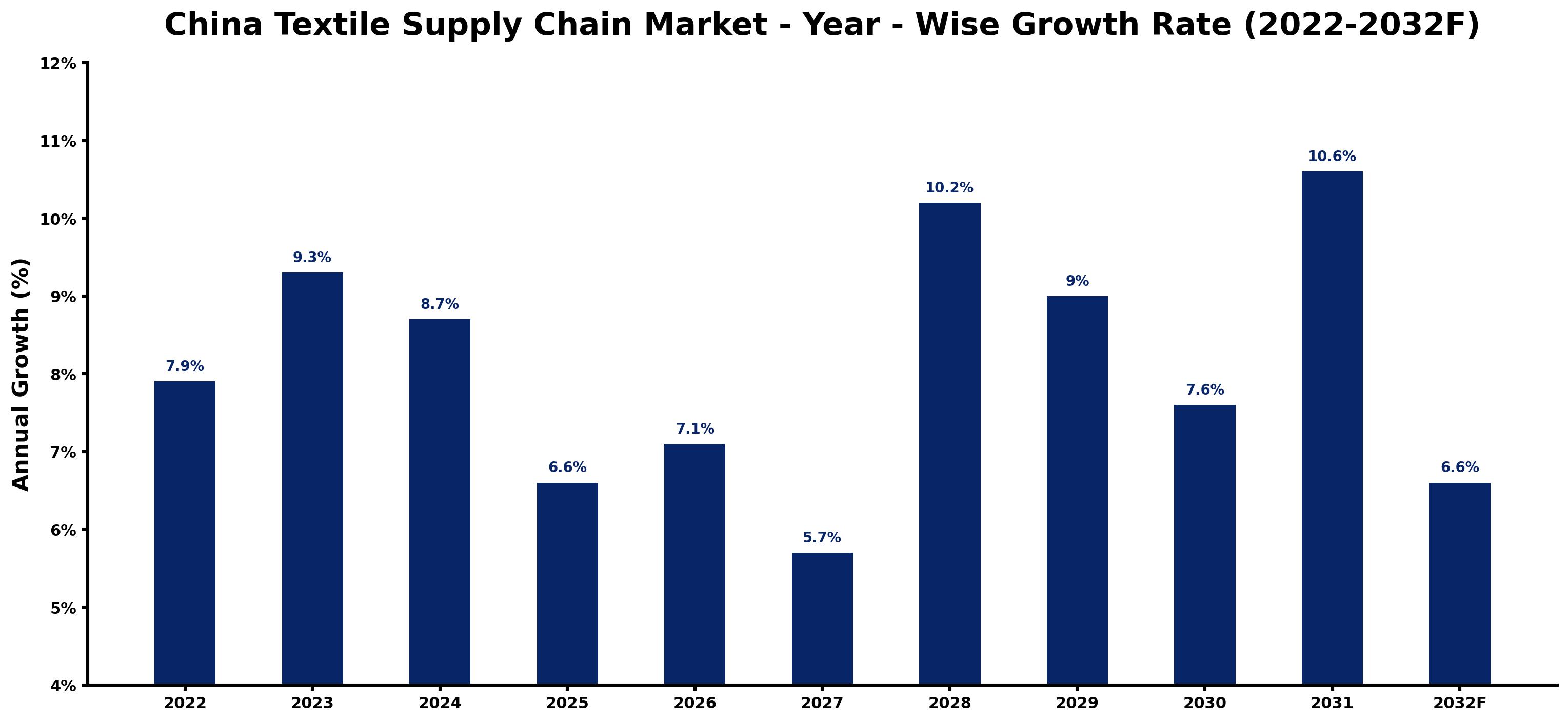
Year by year, the estimates below pair each growth rate with the development that shaped it.
| Year | Estimated Annual Growth (%) | Market Rationale |
| 2022 | 7.9 | The market experienced steady growth due to strong domestic demand for textiles from apparel brands. |
| 2023 | 9.3 | Growth accelerated as textile exports reached approximately $300 billion, boosting production in Zhejiang province. |
| 2024 | 8.7 | A slight slowdown occurred as manufacturers adjusted to changing global demand patterns in the apparel sector. |
| 2025 | 6.6 | The market continued to grow as the 'Textile Industry Development Plan' drove innovation in production efficiency. |
| 2026 | 7.1 | Investment in advanced textile technologies is expected to increase growth rates in the logistics segment this year. |
| 2027 | 5.7 | Growth is projected to slow as companies face challenges in meeting the updated 'National Standard for Textile Safety'. |
| 2028 | 10.2 | A surge in demand for sustainable textiles is expected to drive a faster growth rate this year, particularly in Jiangsu province. |
| 2029 | 9.0 | Growth will moderate as the market adjusts to increased competition from global retail platforms. |
| 2030 | 7.6 | A further slowdown is anticipated as manufacturers focus on improving operational efficiency in logistics. |
| 2031 | 10.6 | The market is projected to peak with rising investments in advanced textile manufacturing technologies under the 'Made in China 2025' initiative. |
| 2032 | 6.6 | Growth is expected to slow as the market matures, reflecting a stabilisation in demand for sustainable practices. |
Note: Market size estimations and growth projections presented in this report are based on 6Wresearch's proprietary forecasting methodology, utilizing the latest available industry data, government publications, and primary research inputs.
China Textile Supply Chain Market Synopsis
The Textile Supply Chain Market in China encompasses the processes involved in sourcing, manufacturing, and distributing textiles. It includes stages such as fiber procurement, spinning, and garment production, primarily serving apparel brands and retailers. The market is growing due to strong domestic demand, investments in advanced technologies, and initiatives like the 'Textile Industry Development Plan'. With over 100 million textile workers, the sector remains a critical part of China's economy, contributing over 30% to global textile production and supporting local manufacturing.
Market Dynamics Impact Analysis (2026–2032)
| Factor | Type | Impact | Primary Segment Affected |
| Increased investment in advanced textile technologies | Driver | High | Manufacturing & Spinning |
| Growing demand for sustainable textiles from consumers | Driver | High | Sustainability Certification |
| Expansion of logistics capabilities to support e-commerce | Opportunity | High | Logistics & Distribution |
| Rising demand for eco-friendly textiles in global markets | Opportunity | High | Fabric & Garment Manufacturing |
| Challenges in meeting sustainability certifications | Restraint | High | Sustainability Certification |
| Compliance with stringent safety regulations | Restraint | High | Manufacturing & Spinning |
| Supply chain disruptions affecting raw material sourcing | Challenge | Medium | Raw Material Sourcing |
| Intense competition from international textile producers | Challenge | Medium | Apparel Brands |
Evaluation of Drivers in China Textile Supply Chain Market (2026–2032)
Key forces behind demand, with the segment each one moves most, are listed below.
| Drivers | Primary Segment Affected | Why It Matters (Evidence) |
| Investment in advanced textile machinery | Manufacturing & Spinning | This investment boosts production efficiency, with over 1 million textile machinery units installed in China. |
| Increased consumer demand for sustainable textiles | Sustainability Certification | This demand drives brands to seek sustainability certifications, with a target of 50% certification by 2025. |
| Growth of e-commerce platforms requiring efficient logistics | Logistics & Distribution | The logistics market is valued at approximately $50 billion, reflecting the need for improved distribution channels. |
| Rising global demand for apparel | Fabric & Garment Manufacturing | China's textile exports reached $300 billion in 2022, spurring production increases. |
| Government support through strategic initiatives | Yarn Production | The 'Textile Industry Development Plan' aims to boost competitiveness in the sector by 2025. |
Growth in the Textile Supply Chain market in China comes from increased investment in advanced textile machinery, which improves production efficiency. The logistics market, valued at approximately $50 billion, reflects the rising demand for efficient distribution channels. Consumer preferences are shifting towards sustainable textiles, driving brands to seek sustainability certifications, with a target of 50% certification by 2025. China's textile exports reached $300 billion in 2022, boosting production in the fabric and garment manufacturing segment. The 'Textile Industry Development Plan' is also promoting innovation and competitiveness in the market.
Evaluation of Restraints in China Textile Supply Chain Market
The table below lists the restraints and the evidence behind each.
| Market Restraint | Primary Segment Affected | Why It Matters (Evidence) |
| Challenges in meeting sustainability certifications | Sustainability Certification | Compliance with the 'Green Textile Initiative' requires substantial investments from manufacturers. |
| Compliance with stringent safety regulations | Manufacturing & Spinning | The updated 'National Standard for Textile Safety' mandates stricter testing, increasing operational costs. |
| Supply chain disruptions affecting raw material sourcing | Raw Material Sourcing | Global supply chain issues have led to delays in fiber procurement, impacting production timelines. |
| Intense competition from international textile producers | Apparel Brands | Increased competition pressures local brands to lower prices, affecting profit margins. |
| Rising operational costs due to inflation | Logistics & Distribution | Higher fuel and transportation costs are straining logistics operations and profitability. |
China Textile Supply Chain Market Challenges
The Textile Supply Chain in China still faces several issues, starting with regulatory compliance. The national standard GB/T 22864-2009 mandates rigorous testing methods, which can delay product launches for manufacturers by up to six months, impacting their market readiness. Competition is fierce, especially in Zhejiang province, where over 100 million textile workers contribute to price reductions, forcing suppliers to compromise on profit margins. Supply chain vulnerabilities arise from dependence on cotton sourced from Xinjiang, where production fluctuations can increase costs for producers. Skills shortages in advanced textile technologies restrict innovation, costing buyers access to efficient manufacturing processes and limiting overall productivity.
Trends in the China Textile Supply Chain Market
The trends below show where the China Textile Supply Chain Market is heading.
- Shift towards Sustainable Textile Production: Zhejiang province is leading the shift towards sustainable textile production, with over 50% of manufacturers targeting sustainability certifications by 2025. This trend is driven by consumer demand for eco-friendly products, enhancing market competitiveness.
- Growth of E-commerce in Textile Distribution: Apparel brands are increasingly adopting e-commerce platforms, with logistics capabilities valued at approximately $50 billion. This shift improves market reach and responsiveness to consumer needs, transforming distribution strategies.
- Increased Adoption of Advanced Textile Technologies: The 'Made in China 2025' initiative is driving the adoption of advanced textile technologies, with significant funding allocated for innovation. This trend is expected to improve production efficiency and quality across the industry.
- Expansion of Global Retail Platforms: Global retail platforms are expanding their presence in China, with a projected growth rate of 10.6% for this segment by 2032. This expansion increases competition among local brands and diversifies consumer access.
Investment Opportunities in the China Textile Supply Chain Market
The following opportunities in the China Textile Supply Chain Market pair current demand with a clear way in.
- Joint Ventures for Sustainable Practices: Entering into joint ventures with local manufacturers can facilitate compliance with sustainability certifications. With a target of 50% certification by 2025, this is a timely opportunity for investment in eco-friendly practices.
- Investment in Textile Logistics Facilities: Investing in logistics facilities in Zhejiang province can improve distribution efficiency. The logistics market is valued at approximately $50 billion, presenting a significant opportunity for growth in supply chain operations.
- Supply of Advanced Textile Machinery: There is a growing need for advanced textile machinery as manufacturers upgrade their production capabilities. With over 1 million units already installed, suppliers can benefit from this increasing demand for modernisation.
- Focus on Eco-friendly Textile Products: Now is the time to supply eco-friendly textile products as consumer demand rises. The 'Green Textile Initiative' aims for substantial growth in this area by 2025, creating opportunities for suppliers.
Government Initiatives in the China Textile Supply Chain Market
The 'Textile Industry Development Plan' by the Ministry of Industry and Information Technology aims to enhance competitiveness and sustainability in the textile sector by 2025. This plan builds on previous initiatives, reinforcing the focus on innovation and quality improvement. It sets clear targets for production efficiency and environmental standards, impacting manufacturers significantly. The plan encourages investment in advanced technologies, ensuring that the industry remains competitive on a global scale. Additionally, the 'Circular Economy Promotion Law' encourages recycling and sustainable practices in textile manufacturing, aiming for a 50% reduction in textile waste by 2025.
The Ministry of Ecology and Environment oversees the implementation of the 'Green Textile Initiative', which targets a 50% reduction in textile waste by 2025. This initiative funds projects aimed at promoting sustainable practices among manufacturers. Furthermore, the 'National Textile Industry Development Fund' supports innovation in textile technologies, providing financial backing for research and development. These measures ensure that producers can meet evolving market demands while adhering to sustainability standards and improving operational efficiency.
Future Insight of the China Textile Supply Chain Market
By 2032, the Textile Supply Chain in China will undergo significant changes that will benefit buyers and suppliers. The 'Made in China 2025' initiative will drive advancements in manufacturing technologies, boosting operational efficiency. The 'Textile Industry Development Plan' will facilitate smoother processes, while the 'Green Textile Initiative' aims for 50% of manufacturers to achieve sustainability certifications by 2025, raising environmental standards. The annual textile production, estimated at around 30 million tons, will likely increase as innovations improve quality and reduce lead times throughout the supply chain.
Market Segmentation Analysis
The analysis below covers each segmentation, its leading category in 2025 and its fastest-growing category through 2032.
By Textile Supply Chain – Fabric & Garment Manufacturing Dominated, Logistics & Distribution Expected to Grow Fastest
According to Vasudha, AM at 6Wresearch, in 2025, Fabric & Garment Manufacturing led the textile supply chain split with a 42% share. Fabric and garment manufacturing holds the largest share due to its essential function in creating finished textiles for both local and international markets. A notable example is Zhejiang province, which stands out as a major manufacturing hub, significantly contributing to China's textile production. The quickest growth will come from Logistics & Distribution, forecast to expand at a CAGR of 9.1% between 2026 and 2032. Logistics and distribution are experiencing rapid growth, primarily due to the rising demand for efficient delivery systems, particularly as China's textile exports reached approximately $300 billion in 2022. This sector's expansion is crucial for supporting the increasing needs of global retail platforms. Suppliers must focus on improving logistics capabilities to remain competitive in the growing textile supply chain market.
By Segment – Yarn Production Dominated, Textile Logistics Expected to Grow Fastest
With a 55% revenue share in 2025, Yarn Production was the largest segment category. Yarn production commands the largest share as it is a key step in the textile manufacturing process, essential for producing various fabric types. The installed base of textile machinery in China, exceeding 1 million units, supports this segment's dominance. Textile Logistics is set to record the highest CAGR in this split, 9.9% over 2026–2032. Textile logistics is growing quickly, driven by the need for efficient supply chain management, especially with the textile logistics market valued at approximately $50 billion in 2023. This growth reflects the increasing complexity of distribution networks in the textile industry. Buyers should consider investing in logistics solutions to optimise their supply chain efficiency and reduce costs.
By Service Type – Sustainability Certification Dominated and Is Expected to Record the Fastest Growth
Sustainability Certification accounted for a 46% market share by service type in 2025. Sustainability certification leads the market as it supports eco-friendly practices, increasingly demanded by consumers and regulatory frameworks. The 'Green Textile Initiative' aims for 50% of manufacturers to achieve these certifications by 2025, highlighting its significance. Its lead should widen, with a projected CAGR of 10.6% during 2026–2032, the highest in this split. Sustainability certification is also the fastest-growing segment, with more manufacturers striving to comply with environmental standards and appeal to eco-conscious consumers. This dual role reinforces its critical position in the textile supply chain. Suppliers should prioritise sustainability certifications to meet market demands and strengthen their competitive position.
By Distribution Channel – Direct Sourcing Dominated, Contract Production Expected to Grow Fastest
Direct Sourcing took a 43% share of distribution channel in 2025, more than any other category. Direct sourcing holds the largest share as it effectively reduces costs for buyers by cutting out intermediaries in the supply chain. This strategy is particularly advantageous for apparel brands aiming to optimise procurement processes. Contract Production is projected to grow fastest, at a CAGR of 9.6% during 2026–2032. Contract production is experiencing rapid growth, offering brands the flexibility to adapt to shifting market demands and consumer preferences. This trend indicates a movement towards more agile manufacturing practices within the textile industry. Buyers should consider contract production options to improve operational flexibility and responsiveness.
By End User Industry – Apparel Brands Dominated, Global Retail Platforms Expected to Grow Fastest
Apparel Brands held a 42% share of the China Textile Supply Chain Market by end user industry in 2025. Apparel brands lead the market as the primary consumers of textiles, creating substantial demand for various types of fabrics and finished garments. The presence of over 200 textile industry associations in China facilitates the growth of this segment by promoting standards and practices. The quickest growth will come from Global Retail Platforms, forecast to expand at a CAGR of 10.6% between 2026 and 2032. Global retail platforms represent the fastest-growing segment, as they expand market reach and amplify the demand for a diverse range of textile products. This growth mirrors the shift in the retail landscape towards online and international sales channels. Suppliers should tailor their strategies to meet the evolving needs of global retail platforms to capitalise on emerging market opportunities.
Key Attractiveness of the Report
- 10 Years of Market Numbers
- Historical Data Starting from 2022 to 2025
- Base Year 2025
- Forecast Data until 2032
- Key Performance Indicators Impacting the Market
- Major Upcoming Developments and Projects
Key Highlights of the Report:
- China Textile Supply Chain Market Outlook
- Market Size of China Textile Supply Chain Market, 2025
- Forecast of China Textile Supply Chain Market, 2032
- Historical Data and Forecast of China Textile Supply Chain Revenues & Volume for the Period 2022 - 2032F
- China Textile Supply Chain Market Trend Evolution
- China Textile Supply Chain Market Drivers and Challenges
- China Textile Supply Chain Price Trends
- China Textile Supply Chain Porter's Five Forces
- China Textile Supply Chain Industry Life Cycle
- Historical Data and Forecast of China Textile Supply Chain Market Revenues & Volume By Textile Supply Chain for the Period 2022 - 2032F
- Historical Data and Forecast of China Textile Supply Chain Market Revenues & Volume By Raw Material Sourcing for the Period 2022 - 2032F
- Historical Data and Forecast of China Textile Supply Chain Market Revenues & Volume By Manufacturing & Spinning for the Period 2022 - 2032F
- Historical Data and Forecast of China Textile Supply Chain Market Revenues & Volume By Fabric & Garment Manufacturing for the Period 2022 - 2032F
- Historical Data and Forecast of China Textile Supply Chain Market Revenues & Volume By Logistics & Distribution for the Period 2022 - 2032F
- Historical Data and Forecast of China Textile Supply Chain Market Revenues & Volume By Segment for the Period 2022 - 2032F
- Historical Data and Forecast of China Textile Supply Chain Market Revenues & Volume By Fiber Procurement for the Period 2022 - 2032F
- Historical Data and Forecast of China Textile Supply Chain Market Revenues & Volume By Yarn Production for the Period 2022 - 2032F
- Historical Data and Forecast of China Textile Supply Chain Market Revenues & Volume By Cut & Sew for the Period 2022 - 2032F
- Historical Data and Forecast of China Textile Supply Chain Market Revenues & Volume By Textile Logistics for the Period 2022 - 2032F
- Historical Data and Forecast of China Textile Supply Chain Market Revenues & Volume By Service Type for the Period 2022 - 2032F
- Historical Data and Forecast of China Textile Supply Chain Market Revenues & Volume By Sustainability Certification for the Period 2022 - 2032F
- Historical Data and Forecast of China Textile Supply Chain Market Revenues & Volume By Vertical Integration for the Period 2022 - 2032F
- Historical Data and Forecast of China Textile Supply Chain Market Revenues & Volume By Fast DV to Retail for the Period 2022 - 2032F
- Historical Data and Forecast of China Textile Supply Chain Market Revenues & Volume By Cold Chain/Textile Handling for the Period 2022 - 2032F
- Historical Data and Forecast of China Textile Supply Chain Market Revenues & Volume By Distribution Channel for the Period 2022 - 2032F
- Historical Data and Forecast of China Textile Supply Chain Market Revenues & Volume By Direct Sourcing for the Period 2022 - 2032F
- Historical Data and Forecast of China Textile Supply Chain Market Revenues & Volume By Contract Production for the Period 2022 - 2032F
- Historical Data and Forecast of China Textile Supply Chain Market Revenues & Volume By OEM Partnerships for the Period 2022 - 2032F
- Historical Data and Forecast of China Textile Supply Chain Market Revenues & Volume By Freight Forwarders for the Period 2022 - 2032F
- Historical Data and Forecast of China Textile Supply Chain Market Revenues & Volume By End User Industry for the Period 2022 - 2032F
- Historical Data and Forecast of China Textile Supply Chain Market Revenues & Volume By Apparel Brands for the Period 2022 - 2032F
- Historical Data and Forecast of China Textile Supply Chain Market Revenues & Volume By Retail & Fashion for the Period 2022 - 2032F
- Historical Data and Forecast of China Textile Supply Chain Market Revenues & Volume By Fashion Industry for the Period 2022 - 2032F
- Historical Data and Forecast of China Textile Supply Chain Market Revenues & Volume By Global Retail Platforms for the Period 2022 - 2032F
- China Textile Supply Chain Import Export Trade Statistics
- Market Opportunity Assessment By Textile Supply Chain
- Market Opportunity Assessment By Segment
- Market Opportunity Assessment By Service Type
- Market Opportunity Assessment By Distribution Channel
- Market Opportunity Assessment By End User Industry
- China Textile Supply Chain Top Companies Market Share
- China Textile Supply Chain Competitive Benchmarking By Technical and Operational Parameters
- China Textile Supply Chain Company Profiles
- China Textile Supply Chain Key Strategic Recommendations
Market Covered
This report examines the market across the segments below.
By Textile Supply Chain
- Raw Material Sourcing
- Manufacturing & Spinning
- Fabric & Garment Manufacturing
- Logistics & Distribution
By Segment
- Fiber Procurement
- Yarn Production
- Cut & Sew
- Textile Logistics
By Service Type
- Sustainability Certification
- Vertical Integration
- Fast DV to Retail
- Cold Chain/Textile Handling
By Distribution Channel
- Direct Sourcing
- Contract Production
- OEM Partnerships
- Freight Forwarders
By End User Industry
- Apparel Brands
- Retail & Fashion
- Fashion Industry
- Global Retail Platforms































