India Thixotropic Clay Market Size & Growth Rate
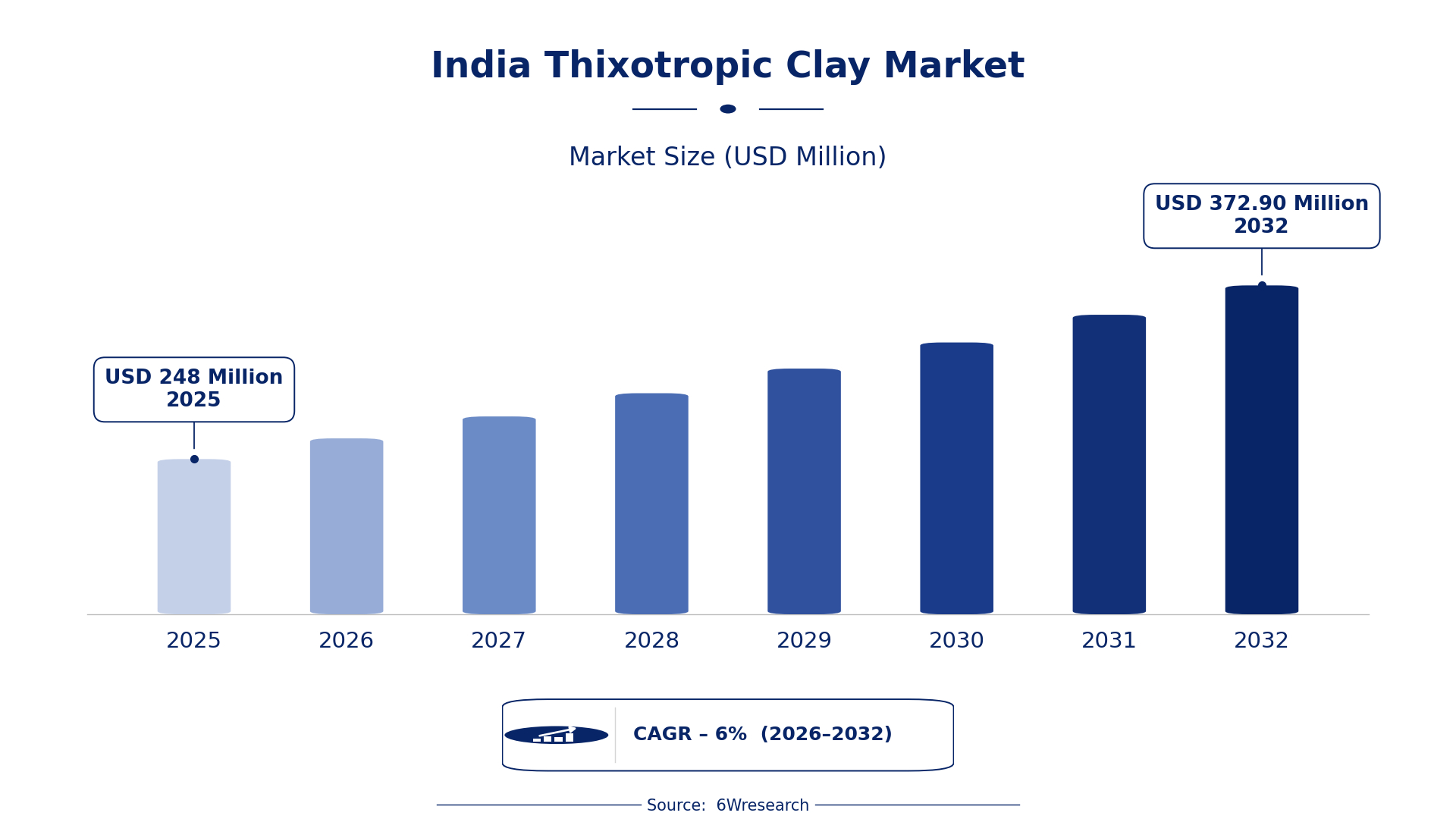
According to 6Wresearch internal database and industry insights, the India Thixotropic Clay Market was valued at USD 248.0 million in 2025 and is projected to reach USD 372.90 million by 2032, growing at a CAGR of approximately 6% during 2026–2032.
India Thixotropic Clay Market Highlights
| Report Metric | Details |
| Report Name | India Thixotropic Clay Market |
| Market Size 2025 | USD 248.0 million |
| Market Size 2032 | USD 372.90 million |
| Absolute Growth 2025–2032 | USD 124.90 million |
| CAGR 2026–2032 | 6% |
| Peak Annual Growth | 7.9% in 2032 |
| Forecast Period | 2026–2032 |
| Historical Data | 2022–2025 |
| Base Year | 2025 |
| Leading Clay Type, 2025 | Natural Clay (39% share) |
| Leading Base Material, 2025 | Bentonite (41% share) |
| Leading Functionality, 2025 | Rheology Modifier (42% share) |
| Leading End User, 2025 | Paint Manufacturers (49% share) |
| Fastest-Growing Base Material | Modified Silicates (7.9% CAGR) |
| Fastest-Growing Functionality | Viscosity Control (7.6% CAGR) |
| Fastest-Growing End User | Cosmetics Industry (7.9% CAGR) |
| Growing Sector | Cosmetics Industry |
| Key End Users | Paint Manufacturers, Cosmetics Industry, Oil & Gas Drillers |
India Thixotropic Clay Market Year-wise Growth Rate and Key Drivers (2022–2032)
This graph illustrates the annual growth rates of the market from 2022 to 2032, highlighting a steady upward trajectory and projected market expansion over the forecast period.
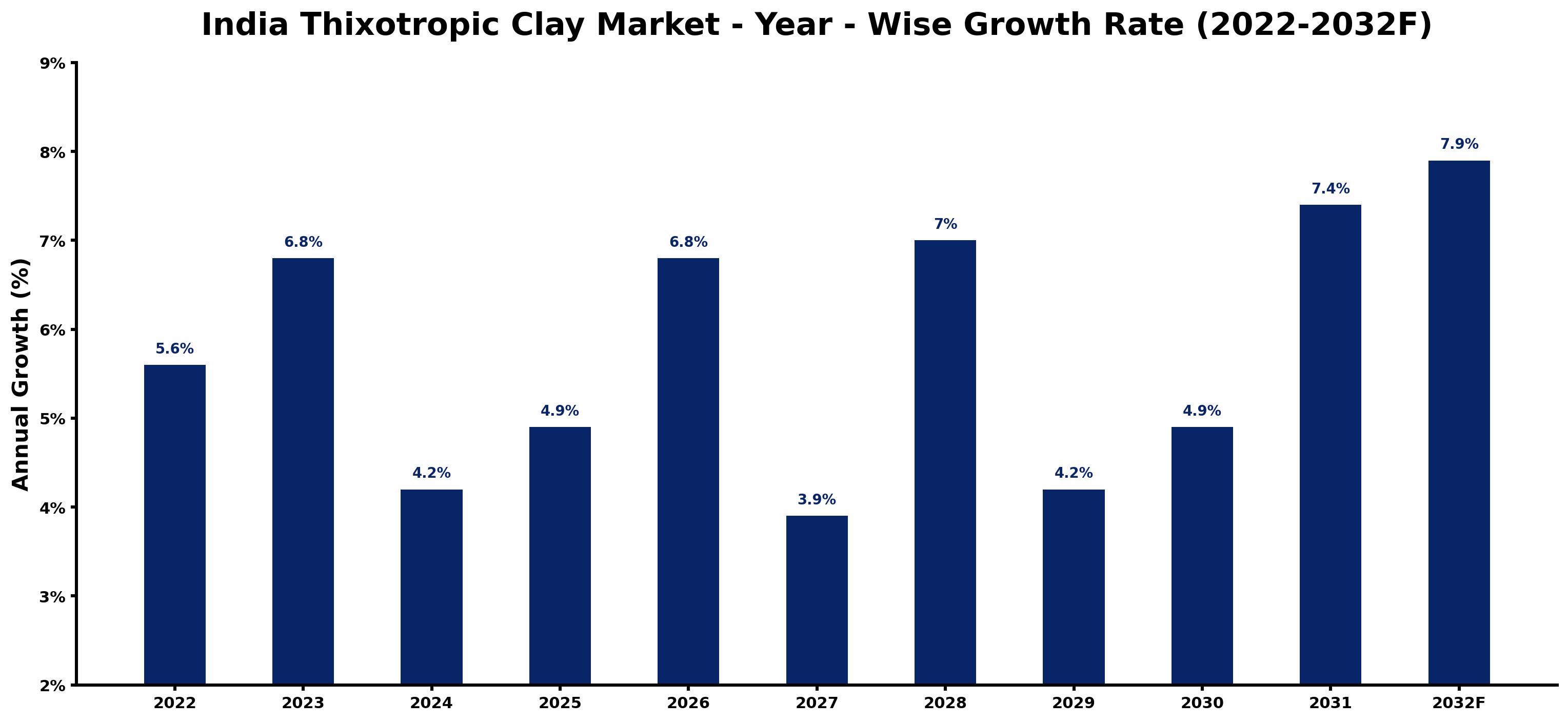
The table below sets out the estimated growth rate for each year and the main factor behind it.
| Year | Estimated Annual Growth (%) | Market Rationale |
| 2022 | 5.6 | Demand from the paint industry remained strong, supporting growth in thixotropic clay consumption. |
| 2023 | 6.8 | The Indian cosmetics market expanded rapidly, increasing the need for thixotropic clay in formulations. |
| 2024 | 4.2 | Growth slowed as the paint sector faced temporary supply chain challenges affecting production. |
| 2025 | 4.9 | The oil and gas sector's recovery boosted demand for thixotropic clay in drilling applications. |
| 2026 | 6.8 | Investment in the cosmetics industry will lead to higher consumption of thixotropic clay. |
| 2027 | 3.9 | Growth is projected to slow as the market adjusts to new regulatory standards impacting production. |
| 2028 | 7.0 | The paint industry will see a resurgence, driving demand for thixotropic clay in formulations. |
| 2029 | 4.2 | Demand growth is expected to slow due to market saturation in certain applications of thixotropic clay. |
| 2030 | 4.9 | The cosmetics sector's expansion will sustain demand for thixotropic clay products. |
| 2031 | 7.4 | Increased focus on sustainable practices in the paint industry will enhance thixotropic clay demand. |
| 2032 | 7.9 | The oil and gas sector's growth is projected to drive thixotropic clay consumption to new heights. |
Note: Market size estimations and growth projections presented in this report are based on 6Wresearch's proprietary forecasting methodology, utilizing the latest available industry data, government publications, and primary research inputs.
India Thixotropic Clay Market Synopsis
Thixotropic Clay in India encompasses a unique type of clay that alters its viscosity under agitation, primarily derived from natural sources like bentonite. This clay is essential in improving the rheological properties of paints, cosmetics, and drilling fluids. The India Thixotropic Clay Market is experiencing growth due to rising demand from the cosmetics and paint industries, which are projected to reach 1.5 lakh crore INR by 2025. The oil and gas sector's expansion further fuels this demand, creating opportunities for producers and suppliers in the market.
Market Dynamics Impact Analysis (2026–2032)
| Factor | Type | Impact | Primary Segment Affected |
| Growing demand from the paint industry due to increasing construction activities | Driver | High | Paint Manufacturers |
| Rising consumption in the cosmetics sector driven by market expansion | Driver | High | Cosmetics Industry |
| Increased investment in indigenous raw materials for sustainable production | Opportunity | High | Natural Clay |
| Emerging applications in the oil and gas sector for drilling fluids | Opportunity | Medium | Oil & Gas Drillers |
| Regulatory compliance costs affecting production processes | Restraint | High | Natural Clay |
| Supply chain disruptions impacting raw material availability | Restraint | Medium | Paint Manufacturers |
| Competition from synthetic alternatives affecting market share | Challenge | High | Natural Clay |
| Technological limitations in production affecting efficiency | Challenge | Medium | Natural Clay |
Evaluation of Drivers in India Thixotropic Clay Market (2026–2032)
The table below links each growth driver to the segment it affects and the evidence for it.
| Drivers | Primary Segment Affected | Why It Matters (Evidence) |
| Increased construction activities driving paint demand | Paint Manufacturers | The Indian paint industry is projected to grow by 10% annually, leading to higher thixotropic clay usage. |
| Expansion in cosmetics boosting ingredient requirements | Cosmetics Industry | India's cosmetics market is expected to reach 1.5 lakh crore INR by 2025, increasing thixotropic clay demand. |
| Investment in sustainable practices enhancing production capabilities | Natural Clay | The 'Make in India' initiative promotes local production, encouraging investment in thixotropic clay by 15%. |
| Growth in the oil and gas sector increasing drilling fluid needs | Oil & Gas Drillers | The projected growth of the Indian oil and gas sector is expected to boost thixotropic clay consumption by 20%. |
| Demand for rheology modifiers in various applications | Rheology Modifier | Thixotropic clay is essential for controlling flow properties in formulations, driving demand by 12%. |
Market growth in India for Thixotropic Clay rests on increased construction activities, expanding the paint sector and driving demand for thixotropic clay. The Indian paint industry is projected to grow by 10% annually, which will increase thixotropic clay usage. The cosmetics market is anticipated to reach 1.5 lakh crore INR by 2025, resulting in a higher demand for thixotropic clay. Investment in local production is improving capabilities, while the growth of the oil and gas sector is likely to increase thixotropic clay consumption in drilling fluids. Overall, these factors are creating strong demand for thixotropic clay across various industries.
Evaluation of Restraints in India Thixotropic Clay Market
The table below lists the restraints and the evidence behind each.
| Market Restraint | Primary Segment Affected | Why It Matters (Evidence) |
| High regulatory compliance costs impacting production | Natural Clay | Producers must adhere to stringent quality standards, which increases operational expenses by up to 20%. |
| Supply chain disruptions affecting raw material availability | Paint Manufacturers | Disruptions have delayed sourcing thixotropic clay, impacting production timelines by several weeks. |
| Competition from synthetic alternatives reducing market share | Synthetic Clay | Synthetic clays are often cheaper, affecting the demand for natural thixotropic clay by approximately 15%. |
| Technological limitations in production processes | Natural Clay | Outdated technology can hinder efficiency and increase production costs by around 10%. |
| Market saturation in certain applications leading to slower growth | Cosmetics Industry | As the market matures, growth rates for thixotropic clay in cosmetics may decline by 5%. |
India Thixotropic Clay Market Challenges
The India Thixotropic Clay Market still has to solve a few problems, starting with regulatory compliance. The Bureau of Indian Standards mandates specifications for bentonite under IS 6186, which can delay production timelines for producers by up to six months. A shortage of skilled workers in chemical processing affects the quality of thixotropic clay, leading to potential losses of around 10% for producers. Competition from imported alternatives pressures local suppliers to reduce prices, which can cut profit margins by as much as 15%. Rising costs of raw materials increase operational expenses for buyers, forcing them to reconsider sourcing strategies.
Trends in the India Thixotropic Clay Market
Four trends stand out in the India Thixotropic Clay Market.
- National Programme on Organic Farming Promoting Natural Clays: The National Programme on Organic Farming encourages the use of natural clays in sustainable agriculture. This initiative supports the growth of thixotropic clay, with an anticipated increase in demand by 10%.
- Shift in Paint Formulations Towards Eco-Friendly Ingredients: In 2023, the Ministry of Chemicals and Fertilizers launched a scheme promoting indigenous raw materials in the paint industry. This shift is projected to increase thixotropic clay demand by approximately 20%.
- 2022 Update to National Policy on Chemical and Petrochemicals: The updated National Policy on Chemical and Petrochemicals aims to improve competitiveness in the chemical industry. This policy is expected to drive demand for thixotropic clay as manufacturers adapt to new standards.
- Growing Focus on Sustainable Practices in Oil & Gas: The Sustainable Clay Mining Initiative, approved in 2023, promotes eco-friendly extraction practices in the oil and gas sector. This trend is likely to increase the demand for thixotropic clay in drilling applications by 10%.
Investment Opportunities in the India Thixotropic Clay Market
Below are the investment opportunities with the strongest case in the India Thixotropic Clay Market.
- Paint Manufacturers Seeking Sustainable Solutions: Paint manufacturers are increasingly pursuing sustainable raw materials, with the Indian paint industry expected to grow by 10%. Investing in thixotropic clay production can satisfy this demand, particularly in Maharashtra and Tamil Nadu.
- Cosmetics Industry Expanding with Natural Ingredients: The cosmetics sector is rapidly growing, with a projected growth rate of 7.9% from 2026 to 2032. Producers can tap into this market by collaborating with local manufacturers to supply thixotropic clay.
- Oil & Gas Drillers Requiring High-Quality Drilling Fluids: The growth of the oil and gas sector is driving the need for high-quality drilling fluids. Investing in thixotropic clay production can meet this demand, especially in regions with active drilling operations.
- Growing Demand for Rheology Modifiers in Various Applications: With an increasing emphasis on rheology modifiers, there is a chance to supply thixotropic clay. The market is set to expand as manufacturers aim to enhance product performance.
Government Initiatives in the India Thixotropic Clay Market
The 'Make in India' initiative, launched in 2021, promotes domestic production of specialty chemicals, including thixotropic clay. This initiative encourages local manufacturers to invest in production capabilities, ensuring a steady supply of thixotropic clay for various applications. Additionally, the National Policy on Chemical and Petrochemicals, updated in 2022, aims to improve the competitiveness of the chemical industry by providing a framework for sustainable practices and innovation. The Bureau of Indian Standards implemented IS 6186 in 2020, setting quality standards for bentonite used in various applications, ensuring that thixotropic clay meets safety and performance criteria.
The Department of Industrial Policy and Promotion introduced a subsidy scheme in 2022 for manufacturers using indigenous raw materials, benefiting thixotropic clay producers. This scheme provides financial support to local manufacturers, enabling them to reduce production costs and improve competitiveness. The Ministry of Chemicals and Fertilizers also launched the 'Sustainable Clay Mining Initiative' in 2023, promoting eco-friendly extraction practices, which helps producers align with environmental standards.
Future Insight of the India Thixotropic Clay Market
By 2032, buyers and suppliers in the India Thixotropic Clay Market can anticipate notable shifts driven by various factors. The expected growth of the Indian oil and gas sector will elevate demand for thixotropic clay in drilling applications, increasing usage by 20%. The expansion of the cosmetics market will further fuel the need for high-quality thixotropic clay, particularly as the industry adheres to stricter quality standards. The Ministry of Chemicals and Fertilizers' initiative to promote indigenous raw materials in the paint sector will encourage local sourcing, creating a more sustainable supply chain.
Market Segmentation Analysis
Each segment group is reviewed below, with the leader by share and the fastest grower by CAGR.
By Clay Type – Natural Clay Dominated and Is Expected to Record the Fastest Growth
According to Vasudha, AM at 6Wresearch, Natural Clay held a 39% share of the India Thixotropic Clay Market by clay type in 2025. Natural clay holds the largest share in the India thixotropic clay market due to its extensive use in sectors such as paints and cosmetics. The Indian cosmetics market's projected growth to 1.5 lakh crore INR by 2025 underscores the increasing reliance on natural clay in formulations. The same category is also set to grow fastest, at a CAGR of 7.8% during 2026–2032. Natural clay is also the fastest-growing segment, with its adoption in sustainable practices highlighted by the National Programme on Organic Farming. This shift towards eco-friendly products will ensure that natural clay's lead continues to expand. Suppliers should focus on increasing the availability of natural clay to cater to the surging demand across various industries.
By Base Material – Bentonite Dominated, Modified Silicates Expected to Grow Fastest
With a 41% revenue share in 2025, Bentonite was the largest base material category. Bentonite is the leading base material in the India thixotropic clay market, primarily due to its role as a key component in drilling fluids and paints. Its significance is underscored by India's position as one of the largest producers of bentonite globally. Modified Silicates are set to record the highest CAGR in this split, 7.9% over 2026–2032. Modified silicates represent the fastest-growing base material segment, as they are increasingly incorporated into specific formulations to meet evolving industry standards. This growth indicates a shift towards more tailored solutions, allowing bentonite to maintain its lead. Buyers should consider diversifying their sourcing strategies to include modified silicates for specialised applications.
By Functionality – Rheology Modifier Dominated, Viscosity Control Expected to Grow Fastest
The largest functionality category in 2025 was Rheology Modifier, with a 42% share of total revenue. Rheology modifiers dominate the functionality segment in the India thixotropic clay market, as they are crucial for controlling flow properties in formulations. Their vital role in enhancing product performance makes them indispensable for manufacturers across multiple sectors. The quickest growth will come from Viscosity Control, forecast to expand at a CAGR of 7.6% between 2026 and 2032. Viscosity control is the fastest-growing functionality, driven by its essential role in ensuring product stability and performance in a range of applications. As the demand for rheology modifiers remains strong, the growth of viscosity control will further reinforce this trend. Suppliers must prioritise the development of viscosity control solutions to align with the changing needs of manufacturers.
By End User – Paint Manufacturers Dominated, Cosmetics Industry Expected to Grow Fastest
Paint Manufacturers took a 49% share of end user in 2025, more than any other category. Paint manufacturers are the primary end users of thixotropic clay in India, relying on it to achieve the desired texture and consistency in their products. This reliance is particularly pronounced in Maharashtra and Tamil Nadu, where the paint industry is heavily concentrated. Cosmetics Industry is projected to grow fastest, at a CAGR of 7.9% during 2026–2032. The cosmetics industry is the fastest-growing end user, propelled by rising demand for high-quality ingredients that improve product texture and stability. As this sector expands, paint manufacturers are likely to maintain their dominant position in the market. Suppliers should tailor their offerings to address the specific needs of the cosmetics industry while sustaining strong relationships with paint manufacturers.
Key Attractiveness of the Report
- 10 Years of Market Numbers
- Historical Data Starting from 2022 to 2025
- Base Year 2025
- Forecast Data until 2032
- Key Performance Indicators Impacting the Market
- Major Upcoming Developments and Projects
Key Highlights of the Report:
- India Thixotropic Clay Market Outlook
- Market Size of India Thixotropic Clay Market, 2025
- Forecast of India Thixotropic Clay Market, 2032
- Historical Data and Forecast of India Thixotropic Clay Revenues & Volume for the Period 2022 - 2032F
- India Thixotropic Clay Market Trend Evolution
- India Thixotropic Clay Market Drivers and Challenges
- India Thixotropic Clay Price Trends
- India Thixotropic Clay Porter's Five Forces
- India Thixotropic Clay Industry Life Cycle
- Historical Data and Forecast of India Thixotropic Clay Market Revenues & Volume By Clay Type for the Period 2022 - 2032F
- Historical Data and Forecast of India Thixotropic Clay Market Revenues & Volume By Organoclay for the Period 2022 - 2032F
- Historical Data and Forecast of India Thixotropic Clay Market Revenues & Volume By Synthetic Clay for the Period 2022 - 2032F
- Historical Data and Forecast of India Thixotropic Clay Market Revenues & Volume By Natural Clay for the Period 2022 - 2032F
- Historical Data and Forecast of India Thixotropic Clay Market Revenues & Volume By Nanoclay for the Period 2022 - 2032F
- Historical Data and Forecast of India Thixotropic Clay Market Revenues & Volume By Base Material for the Period 2022 - 2032F
- Historical Data and Forecast of India Thixotropic Clay Market Revenues & Volume By Bentonite for the Period 2022 - 2032F
- Historical Data and Forecast of India Thixotropic Clay Market Revenues & Volume By Modified Silicates for the Period 2022 - 2032F
- Historical Data and Forecast of India Thixotropic Clay Market Revenues & Volume By Montmorillonite for the Period 2022 - 2032F
- Historical Data and Forecast of India Thixotropic Clay Market Revenues & Volume By Layered Silicates for the Period 2022 - 2032F
- Historical Data and Forecast of India Thixotropic Clay Market Revenues & Volume By Functionality for the Period 2022 - 2032F
- Historical Data and Forecast of India Thixotropic Clay Market Revenues & Volume By Rheology Modifier for the Period 2022 - 2032F
- Historical Data and Forecast of India Thixotropic Clay Market Revenues & Volume By Suspension Stability for the Period 2022 - 2032F
- Historical Data and Forecast of India Thixotropic Clay Market Revenues & Volume By Viscosity Control for the Period 2022 - 2032F
- Historical Data and Forecast of India Thixotropic Clay Market Revenues & Volume By Barrier Properties for the Period 2022 - 2032F
- Historical Data and Forecast of India Thixotropic Clay Market Revenues & Volume By End User for the Period 2022 - 2032F
- Historical Data and Forecast of India Thixotropic Clay Market Revenues & Volume By Paint Manufacturers for the Period 2022 - 2032F
- Historical Data and Forecast of India Thixotropic Clay Market Revenues & Volume By Cosmetics Industry for the Period 2022 - 2032F
- Historical Data and Forecast of India Thixotropic Clay Market Revenues & Volume By Oil & Gas Drillers for the Period 2022 - 2032F
- Historical Data and Forecast of India Thixotropic Clay Market Revenues & Volume By Polymer Manufacturers for the Period 2022 - 2032F
- India Thixotropic Clay Import Export Trade Statistics
- Market Opportunity Assessment By Clay Type
- Market Opportunity Assessment By Base Material
- Market Opportunity Assessment By Functionality
- Market Opportunity Assessment By End User
- India Thixotropic Clay Top Companies Market Share
- India Thixotropic Clay Competitive Benchmarking By Technical and Operational Parameters
- India Thixotropic Clay Company Profiles
- India Thixotropic Clay Key Strategic Recommendations
Market Covered
This report examines the market across the segments below.
By Clay Type
- Organoclay
- Synthetic Clay
- Natural Clay
- Nanoclay
By Base Material
- Bentonite
- Modified Silicates
- Montmorillonite
- Layered Silicates
By Functionality
- Rheology Modifier
- Suspension Stability
- Viscosity Control
- Barrier Properties
By End User
- Paint Manufacturers
- Cosmetics Industry
- Oil & Gas Drillers
- Polymer Manufacturers































