China Thixotropic Clay Market Size & Growth Rate
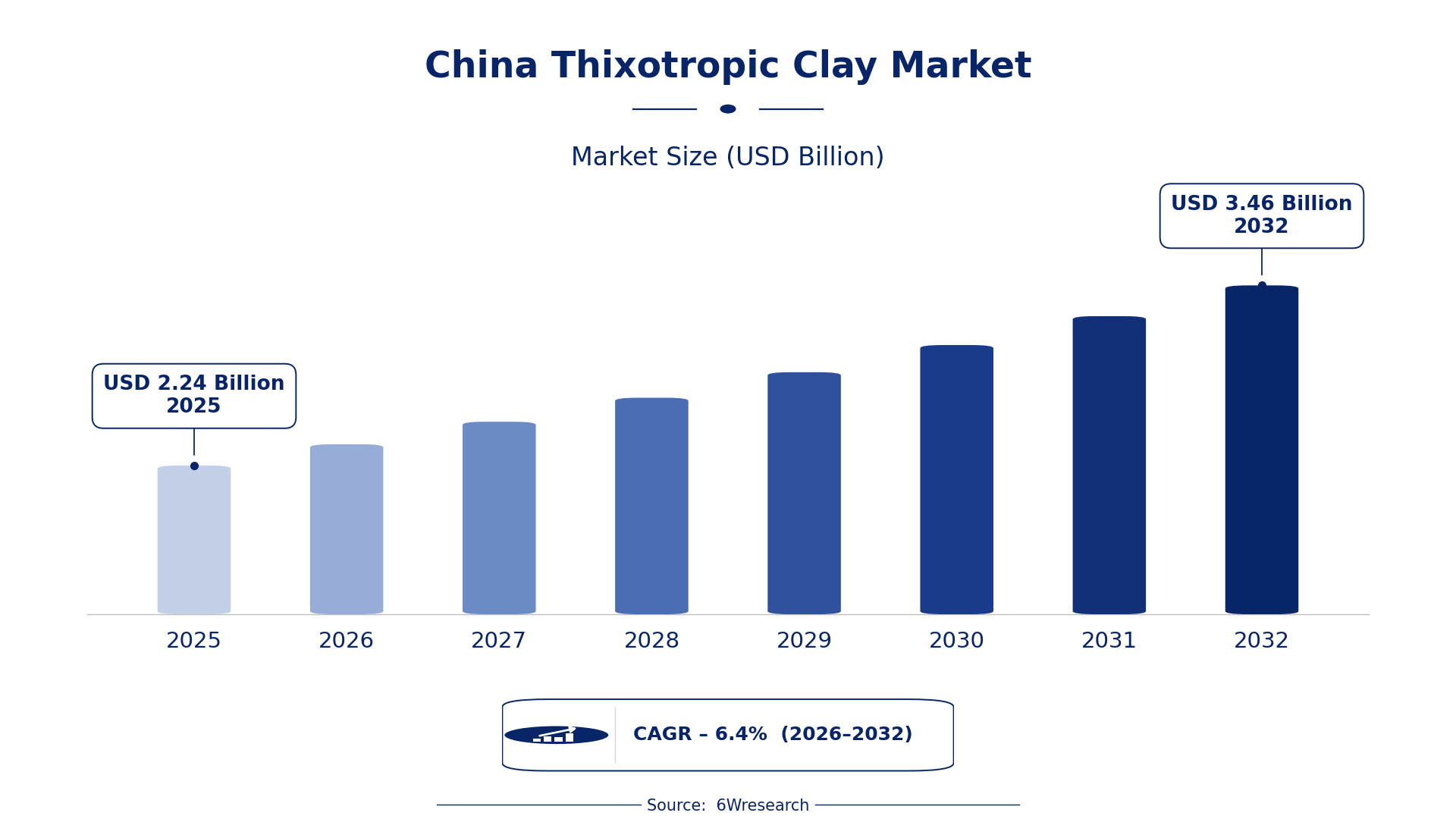
According to 6Wresearch internal database and industry insights, the China Thixotropic Clay Market was valued at USD 2.24 billion in 2025 and is projected to reach USD 3.46 billion by 2032, growing at a CAGR of approximately 6.4% during 2026–2032.
China Thixotropic Clay Market Highlights
| Report Metric | Details |
| Report Name | China Thixotropic Clay Market |
| Market Size 2025 | USD 2.24 billion |
| Market Size 2032 | USD 3.46 billion |
| Absolute Growth 2025–2032 | USD 1.22 billion |
| CAGR 2026–2032 | 6.4% |
| Peak Annual Growth | 8.5% in 2028 |
| Forecast Period | 2026–2032 |
| Historical Data | 2022–2025 |
| Base Year | 2025 |
| Leading Clay Type, 2025 | Organoclay (43% share) |
| Leading Base Material, 2025 | Bentonite (43% share) |
| Leading Functionality, 2025 | Rheology Modifier (45% share) |
| Leading End User, 2025 | Paint Manufacturers (42% share) |
| Fastest-Growing Clay Type | Synthetic Clay (7.7% CAGR) |
| Fastest-Growing Base Material | Modified Silicates (8.0% CAGR) |
| Fastest-Growing End User | Cosmetics Industry (7.7% CAGR) |
| Growing Sector | Cosmetics Industry |
| Key End Users | Paint Manufacturers, Cosmetics Industry, Oil & Gas Drillers |
China Thixotropic Clay Market Year-wise Growth Rate and Key Drivers (2022–2032)
This graph illustrates the annual growth rates of the market from 2022 to 2032, highlighting a steady upward trajectory and projected market expansion over the forecast period.
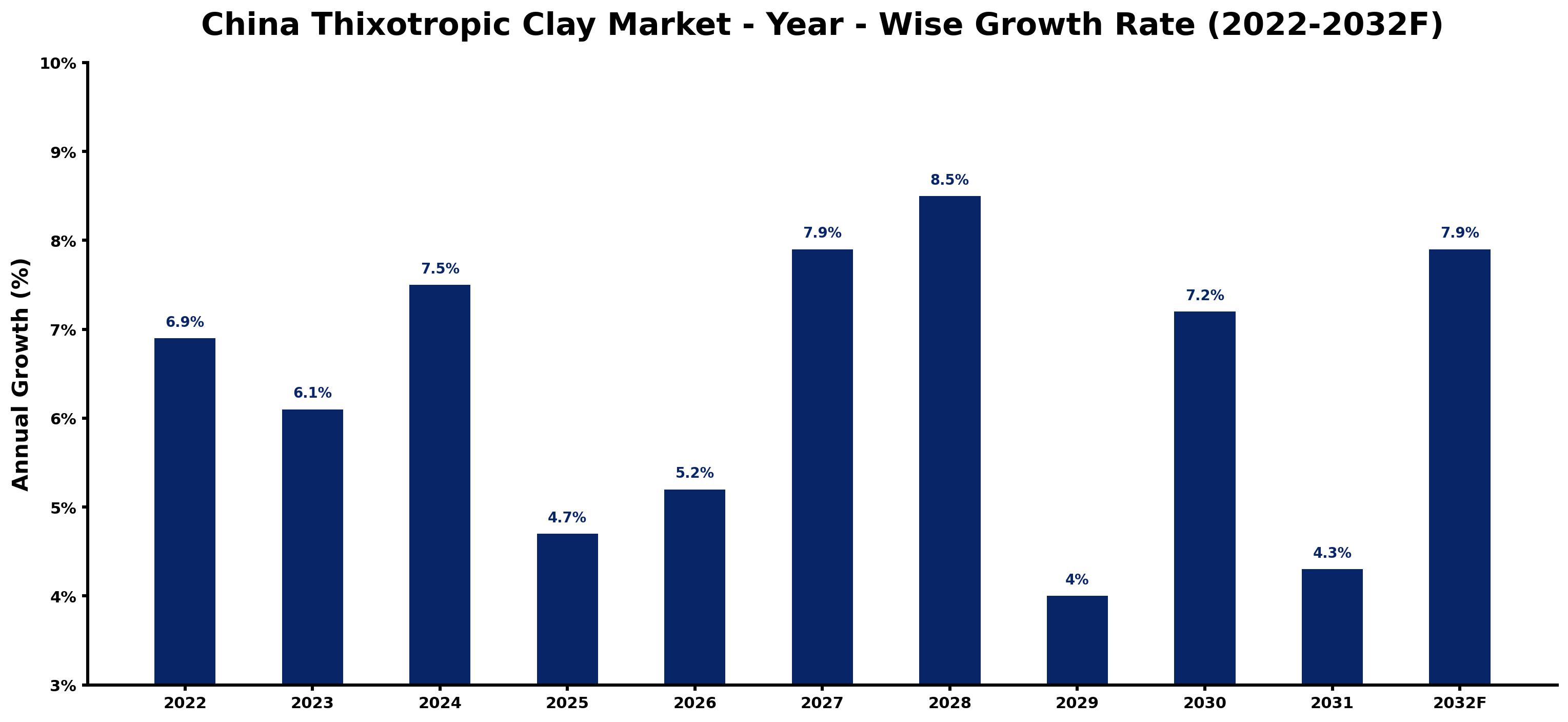
The following table presents the estimated annual growth rate for each year together with the principal factor influencing market performance.
| Year | Estimated Annual Growth (%) | Market Rationale |
| 2022 | 6.9 | The market experienced a strong demand from the paint manufacturing sector in China. |
| 2023 | 6.1 | Growth slowed due to a temporary dip in cosmetic product launches and demand. |
| 2024 | 7.5 | Increased production capacities in Jiangsu and Guangdong provinces boosted growth rates. |
| 2025 | 4.7 | Demand growth decelerated as the market adjusted to new environmental regulations. |
| 2026 | 5.2 | The introduction of advanced materials in coatings is projected to drive growth. |
| 2027 | 7.9 | Rising investments in the cosmetics industry are anticipated to increase demand. |
| 2028 | 8.5 | The peak growth rate is driven by the booming automotive coatings market. |
| 2029 | 4.0 | A slowdown occurs as the market stabilizes after rapid growth phases. |
| 2030 | 7.2 | Increased focus on sustainable practices in manufacturing will support growth. |
| 2031 | 4.3 | The market sees a slight slowdown as competition intensifies among suppliers. |
| 2032 | 7.9 | Demand is expected to rise again due to new applications in advanced composites. |
Note: Market size estimations and growth projections presented in this report are based on 6Wresearch's proprietary forecasting methodology, utilizing the latest available industry data, government publications, and primary research inputs.
China Thixotropic Clay Market Synopsis
Thixotropic Clay in China includes a distinctive type of clay that alters viscosity under stress, created through modifications of natural clay. This adaptable material finds primary use in paints, cosmetics, and drilling fluids. The China Thixotropic Clay Market is growing due to increasing demand from the paint and cosmetics sectors, spurred by heightened production and regulatory backing for eco-friendly materials. The cosmetics industry is anticipated to reach $100 billion by 2025, driving up thixotropic clay consumption. Furthermore, the automotive coatings sector is on an upward trend, creating additional market opportunities.
Market Dynamics Impact Analysis (2026–2032)
| Factor | Type | Impact | Primary Segment Affected |
| Growing demand from the paint manufacturing sector due to increased production capacities | Driver | High | Paint Manufacturers |
| Rising investments in the cosmetics industry to meet consumer preferences | Driver | High | Cosmetics Industry |
| Expansion of eco-friendly product lines in the paint sector creates new demand | Opportunity | High | Paint Manufacturers |
| Increasing applications of thixotropic clay in automotive coatings provide growth potential | Opportunity | Medium | Synthetic Clay |
| Regulatory pressures to reduce VOC emissions may limit production capabilities | Restraint | High | Bentonite |
| Competition from alternative thickening agents could hinder market growth | Restraint | Medium | Organoclay |
| This market still has to solve a few problems, including regulatory compliance. | Challenge | High | Organoclay |
| Supply chain disruptions in raw materials impact production timelines and costs | Challenge | Medium | Organoclay |
Evaluation of Drivers in China Thixotropic Clay Market (2026–2032)
Key forces behind demand, with the segment each one moves most, are listed below.
| Drivers | Primary Segment Affected | Why It Matters (Evidence) |
| Increased production capacities in Jiangsu and Guangdong provinces | Paint Manufacturers | These regions produced over 2 million tons of bentonite clay in 2022, increasing supply. |
| Growing investments in high-end cosmetic products | Cosmetics Industry | Over 70% of high-end cosmetic products use organoclay, driving demand. |
| Implementation of the 'Green Manufacturing' initiative | Paint Manufacturers | This initiative promotes sustainable practices, increasing demand for eco-friendly thixotropic agents. |
| Rising automotive coatings market | Synthetic Clay | This segment is expected to grow significantly by 2026, boosting thixotropic clay consumption. |
| Focus on reducing VOC emissions in paints | Bentonite | The Chinese government aims to cut VOC emissions by 30% by 2025, raising thixotropic clay demand. |
Growth in the Thixotropic Clay market in China comes from rising investments in the cosmetics industry, projected to reach $100 billion by 2025. The paint manufacturing sector is expanding, particularly in Jiangsu and Guangdong provinces, where over 2 million tons of bentonite clay were produced in 2022. The automotive coatings market is set to grow by 2026, increasing thixotropic clay consumption. These factors create a favourable environment for suppliers and manufacturers alike.
Evaluation of Restraints in China Thixotropic Clay Market
Below mentioned are some major restraints and their influence on market dynamics.
| Market Restraint | Primary Segment Affected | Why It Matters (Evidence) |
| Regulatory pressures to reduce VOC emissions may limit production capabilities | Bentonite | Compliance with regulations can increase production costs and complicate supply chains. |
| Competition from alternative thickening agents could hinder market growth | Organoclay | As new materials enter the market, buyers may shift away from traditional thixotropic clay. |
| Supply chain disruptions in raw materials impact production timelines and costs | Synthetic Clay | Delays in sourcing essential materials can lead to increased operational costs for producers. |
| Economic fluctuations may affect investment in the cosmetics sector | Cosmetics Industry | Economic downturns can reduce consumer spending on non-essential cosmetic products. |
| Market saturation in certain applications could limit growth potential | Natural Clay | As the market matures, finding new applications for natural clay becomes increasingly challenging. |
China Thixotropic Clay Market Challenges
Buyers in the China thixotropic clay market face supply chain disruptions due to dependence on montmorillonite sourced from Inner Mongolia, which can delay production timelines by up to two months. Heightened competition from synthetic clays is compelling producers to lower prices, impacting profit margins by approximately 15% for those unable to adapt. Buyers in the cosmetics sector encounter inconsistent quality standards, leading to product recalls and potential losses in consumer trust. Rising costs associated with compliance to the ISO 1302 standard can add an extra 10% to operational expenses for paint manufacturers, straining their budgets.
Trends in the China Thixotropic Clay Market
Below mentioned are some of the trends shaping the China Thixotropic Clay Market growth.
- Shift in Cosmetic Formulations: The cosmetics industry increasingly adopts thixotropic clay for its thickening properties, with over 70% of high-end products utilising organoclay. This trend supports the growing demand for formulations that improve product texture.
- Transition to Eco-Friendly Practices: The 'Green Manufacturing' initiative launched in 2021 drives the paint sector towards sustainable practices, promoting thixotropic clay as a key component. This initiative aims to reduce environmental impact and improve product safety.
- Emergence of Advanced Coatings: The automotive coatings market is gaining traction, with synthetic clays expected to see substantial growth by 2026. This shift indicates broader acceptance of advanced materials in various industries, increasing thixotropic clay demand.
- Rising Focus on VOC Reduction: The Chinese government's target to reduce VOC emissions from paints by 30% by 2025 influences the market. This regulatory push increases the adoption of thixotropic agents in formulations.
Investment Opportunities in the China Thixotropic Clay Market
The following opportunities in the China Thixotropic Clay Market pair current demand with a clear way in.
- Expansion in Jiangsu and Guangdong Provinces: Investing in production facilities in Jiangsu and Guangdong can tap into the booming paint manufacturing sector, which produced over 2 million tons of bentonite clay in 2022. Local partnerships can facilitate market entry.
- Growing Demand from Cosmetics Manufacturers: The cosmetics industry is projected to reach $100 billion by 2025, presenting a notable opportunity for suppliers of thixotropic clay. Collaborating with cosmetic manufacturers can enhance market presence.
- Entry through Sustainable Product Lines: Developing eco-friendly thixotropic clay products can meet the increasing need for sustainable materials. Engaging with buyers focused on green formulations will be essential for market penetration.
- Utilization in Automotive Coatings: The automotive coatings market is set to grow by 2026, creating opportunities for thixotropic clay suppliers. Establishing joint ventures with automotive manufacturers can facilitate entry into this sector.
Government Initiatives in the China Thixotropic Clay Market
The Ministry of Ecology and Environment initiated the 'National Strategy for Sustainable Development of Mineral Resources' in 2021 to promote eco-friendly mining practices for clay. This law mandates that producers adhere to sustainable extraction methods, ensuring minimal environmental impact. Following this, the State Administration for Market Regulation implemented the 'Quality Standards for Clay Products' in 2022, which requires rigorous testing and certification of clay products to ensure they meet safety benchmarks. In 2023, the Ministry of Industry and Information Technology introduced the 'Industrial Upgrade Plan for Coatings' to encourage the use of advanced materials, including thixotropic clay, supporting manufacturers in adopting innovative materials. Additionally, the National Development and Reform Commission's '2023-2025 Action Plan for Green Manufacturing' aims to reduce environmental impact in the paint industry, providing funding for projects focusing on sustainability and eco-friendly practices.
The 'Industrial Upgrade Plan for Coatings' enables paint manufacturers to access funding for adopting advanced materials, thereby improving product quality. The Ministry of Industry and Information Technology oversees this initiative, which encourages innovation in the coatings sector. Furthermore, the National Development and Reform Commission's '2023-2025 Action Plan for Green Manufacturing' supports projects that aim to reduce the environmental impact of paint production. This plan allows manufacturers to receive grants for implementing eco-friendly practices, enhancing their competitive edge in the market.
Future Insight of the China Thixotropic Clay Market
Several forward-looking factors should support the thixotropic clay market in China over the coming years. The cosmetics sector's expansion will drive demand for high-quality thixotropic agents, enhancing their application in premium products. The 'Green Manufacturing' initiative will promote sustainable practices, increasing the appeal of thixotropic clay in eco-friendly applications. By 2026, the automotive coatings market is expected to grow significantly, creating new opportunities for thixotropic clay in advanced formulations.
Market Segmentation Analysis
The report offers a comprehensive study of the following market segments and their leading categories in the market.
By Clay Type – Organoclay Dominated, Synthetic Clay Expected to Grow Fastest
According to Vasudha, AM at 6Wresearch, Organoclay held a 43% share of the China Thixotropic Clay Market by clay type in 2025. Organoclay leads the market share in China due to its essential role in over 70% of premium cosmetic formulations. This widespread use reflects the strong demand from local cosmetic manufacturers prioritising high-quality thixotropic agents. The quickest growth will come from Synthetic Clay, forecast to expand at a CAGR of 7.7% between 2026 and 2032. Synthetic clay is experiencing rapid growth as it gains traction in high-performance coatings, particularly in the automotive sector, projected to expand significantly by 2026. This trend suggests that organoclay's lead will continue to widen as industries increasingly seek superior performance materials. Suppliers should focus on developing synthetic clay solutions to meet the growing demand in the automotive coatings market.
By Base Material – Bentonite Dominated, Modified Silicates Expected to Grow Fastest
The largest base material category in 2025 was Bentonite, with a 43% share of total revenue. Bentonite commands a substantial market share as it is extensively utilised in drilling fluids and as a binder across various industries in China. The established supply chain and infrastructure for bentonite reinforce its leading position in the market. Modified Silicates are projected to grow fastest, at a CAGR of 8.0% during 2026–2032. Modified silicates are rapidly growing due to their application in paints, where they improve viscosity and stability, aligning with quality standards set by the Ministry of Industry and Information Technology. This trend indicates that bentonite's dominance will persist as industries seek enhanced material performance. Buyers in the paint sector should consider sourcing modified silicates to enhance their product formulations and comply with industry standards.
By Functionality – Rheology Modifier Dominated and Is Expected to Record the Fastest Growth
With a 45% revenue share in 2025, Rheology Modifier was the largest functionality category. Rheology modifiers lead the market as they are essential for controlling flow properties in various formulations, making them critical for product performance. Their versatility across multiple applications solidifies their position as the top functionality in thixotropic clay. The same category is also set to grow fastest, at a CAGR of 8.8% during 2026–2032. Rheology modifiers are also the fastest-growing segment, driven by their increasing importance in formulations across both cosmetics and paints. As industries continue to prioritise product quality, the demand for effective rheology modifiers will only intensify. Suppliers must ensure a steady supply of rheology modifiers to cater to the growing needs of manufacturers in both the cosmetics and paint sectors.
By End User – Paint Manufacturers Dominated, Cosmetics Industry Expected to Grow Fastest
In 2025, Paint Manufacturers led the end user split with a 42% share. Paint manufacturers represent the largest share of the thixotropic clay market, as they are primary consumers for product formulation. Their consistent demand for high-quality thixotropic agents solidifies a strong market position for this segment. Over 2026–2032, Cosmetics Industry is expected to post the fastest growth, at a CAGR of 7.7%. The cosmetics industry is the fastest-growing end user, with projections indicating a market value of $100 billion by 2025, leading to increased demand for thixotropic clay in creams and lotions. This growth underscores the industry's focus on improving product texture and performance. Suppliers should strategically target the cosmetics industry to capitalise on the increasing demand for thixotropic clay in personal care products.
Key Attractiveness of the Report
- 10 Years of Market Numbers
- Historical Data Starting from 2022 to 2025
- Base Year 2025
- Forecast Data until 2032
- Key Performance Indicators Impacting the Market
- Major Upcoming Developments and Projects
Key Highlights of the Report:
- China Thixotropic Clay Market Outlook
- Market Size of China Thixotropic Clay Market, 2025
- Forecast of China Thixotropic Clay Market, 2032
- Historical Data and Forecast of China Thixotropic Clay Revenues & Volume for the Period 2022 - 2032F
- China Thixotropic Clay Market Trend Evolution
- China Thixotropic Clay Market Drivers and Challenges
- China Thixotropic Clay Price Trends
- China Thixotropic Clay Porter's Five Forces
- China Thixotropic Clay Industry Life Cycle
- Historical Data and Forecast of China Thixotropic Clay Market Revenues & Volume By Clay Type for the Period 2022 - 2032F
- Historical Data and Forecast of China Thixotropic Clay Market Revenues & Volume By Organoclay for the Period 2022 - 2032F
- Historical Data and Forecast of China Thixotropic Clay Market Revenues & Volume By Synthetic Clay for the Period 2022 - 2032F
- Historical Data and Forecast of China Thixotropic Clay Market Revenues & Volume By Natural Clay for the Period 2022 - 2032F
- Historical Data and Forecast of China Thixotropic Clay Market Revenues & Volume By Nanoclay for the Period 2022 - 2032F
- Historical Data and Forecast of China Thixotropic Clay Market Revenues & Volume By Base Material for the Period 2022 - 2032F
- Historical Data and Forecast of China Thixotropic Clay Market Revenues & Volume By Bentonite for the Period 2022 - 2032F
- Historical Data and Forecast of China Thixotropic Clay Market Revenues & Volume By Modified Silicates for the Period 2022 - 2032F
- Historical Data and Forecast of China Thixotropic Clay Market Revenues & Volume By Montmorillonite for the Period 2022 - 2032F
- Historical Data and Forecast of China Thixotropic Clay Market Revenues & Volume By Layered Silicates for the Period 2022 - 2032F
- Historical Data and Forecast of China Thixotropic Clay Market Revenues & Volume By Functionality for the Period 2022 - 2032F
- Historical Data and Forecast of China Thixotropic Clay Market Revenues & Volume By Rheology Modifier for the Period 2022 - 2032F
- Historical Data and Forecast of China Thixotropic Clay Market Revenues & Volume By Suspension Stability for the Period 2022 - 2032F
- Historical Data and Forecast of China Thixotropic Clay Market Revenues & Volume By Viscosity Control for the Period 2022 - 2032F
- Historical Data and Forecast of China Thixotropic Clay Market Revenues & Volume By Barrier Properties for the Period 2022 - 2032F
- Historical Data and Forecast of China Thixotropic Clay Market Revenues & Volume By End User for the Period 2022 - 2032F
- Historical Data and Forecast of China Thixotropic Clay Market Revenues & Volume By Paint Manufacturers for the Period 2022 - 2032F
- Historical Data and Forecast of China Thixotropic Clay Market Revenues & Volume By Cosmetics Industry for the Period 2022 - 2032F
- Historical Data and Forecast of China Thixotropic Clay Market Revenues & Volume By Oil & Gas Drillers for the Period 2022 - 2032F
- Historical Data and Forecast of China Thixotropic Clay Market Revenues & Volume By Polymer Manufacturers for the Period 2022 - 2032F
- China Thixotropic Clay Import Export Trade Statistics
- Market Opportunity Assessment By Clay Type
- Market Opportunity Assessment By Base Material
- Market Opportunity Assessment By Functionality
- Market Opportunity Assessment By End User
- China Thixotropic Clay Top Companies Market Share
- China Thixotropic Clay Competitive Benchmarking By Technical and Operational Parameters
- China Thixotropic Clay Company Profiles
- China Thixotropic Clay Key Strategic Recommendations
Market Covered
The report offers an extensive study of the following market segments.
By Clay Type
- Organoclay
- Synthetic Clay
- Natural Clay
- Nanoclay
By Base Material
- Bentonite
- Modified Silicates
- Montmorillonite
- Layered Silicates
By Functionality
- Rheology Modifier
- Suspension Stability
- Viscosity Control
- Barrier Properties
By End User
- Paint Manufacturers
- Cosmetics Industry
- Oil & Gas Drillers
- Polymer Manufacturers































