India Threat Detection AI Market Size & Growth Rate
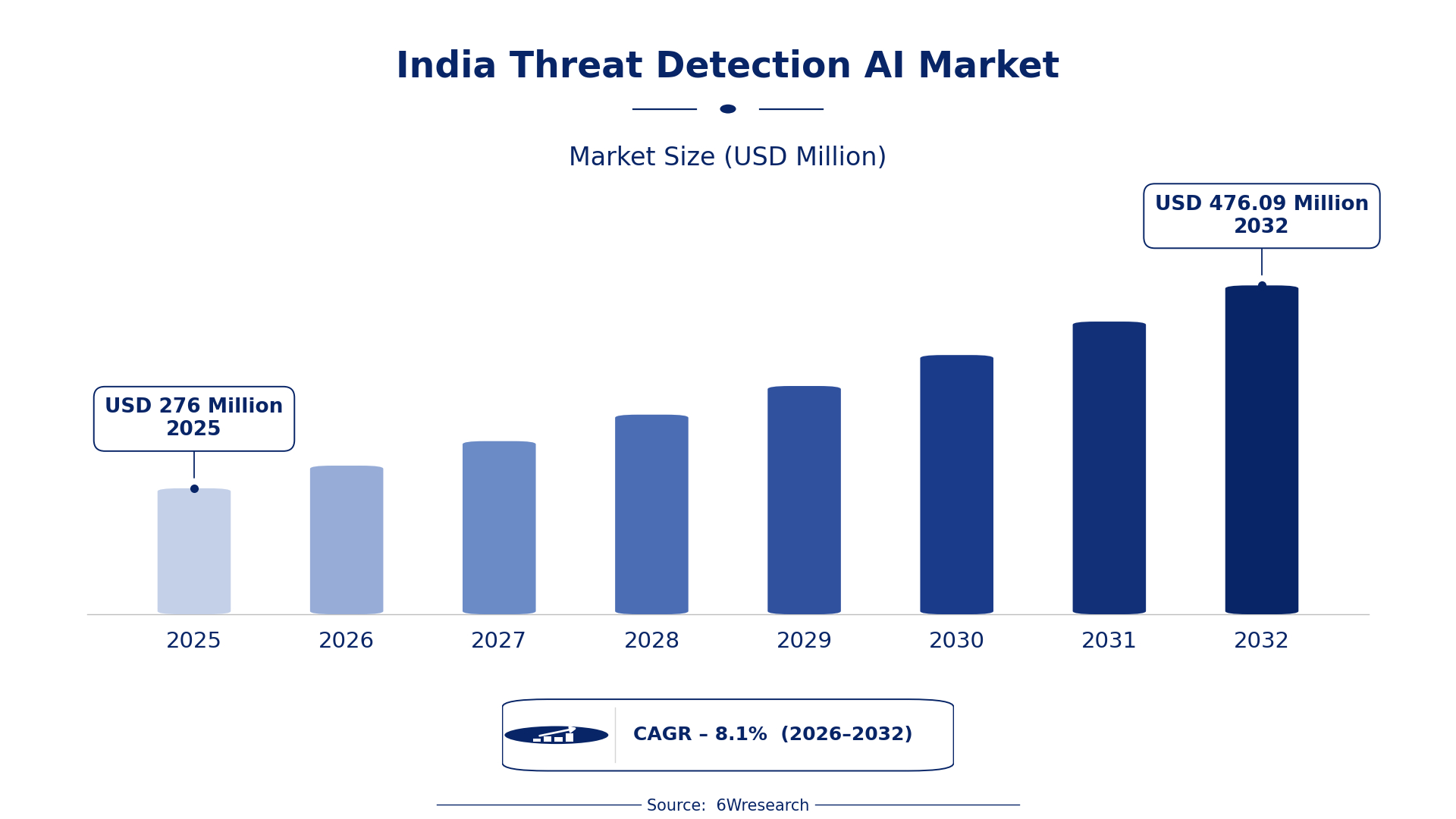
According to 6Wresearch internal database and industry insights, the India Threat Detection AI Market was valued at USD 276.0 million in 2025 and is projected to reach USD 476.09 million by 2032, growing at a CAGR of approximately 8.1% during 2026–2032.
India Threat Detection AI Market Highlights
| Report Metric | Details |
| Report Name | India Threat Detection AI Market |
| Market Size 2025 | USD 276.0 million |
| Market Size 2032 | USD 476.09 million |
| Absolute Growth 2025–2032 | USD 200.09 million |
| CAGR 2026–2032 | 8.1% |
| Peak Annual Growth | 10.5% in 2029 |
| Forecast Period | 2026–2032 |
| Historical Data | 2022–2025 |
| Base Year | 2025 |
| Leading Detection Type, 2025 | Malware Detection (53% share) |
| Leading AI Technique Used, 2025 | Machine Learning (44% share) |
| Leading Deployment Mode, 2025 | Cloud-Based (48% share) |
| Leading End User, 2025 | IT Security Teams (40% share) |
| Fastest-Growing Detection Type | Phishing Threats (9.9% CAGR) |
| Fastest-Growing AI Technique Used | Behavioral Analytics (10.5% CAGR) |
| Fastest-Growing Deployment Mode | Hybrid (9.3% CAGR) |
| Fastest-Growing End User | Fintech Companies (9.7% CAGR) |
| Growing Sector | Fintech Companies |
| Key End Users | IT Security Teams, Enterprises, Government Agencies, Fintech Companies |
India Threat Detection AI Market Year-wise Growth Rate and Key Drivers (2022–2032)
This graph illustrates the annual growth rates of the market from 2022 to 2032, highlighting a steady upward trajectory and projected market expansion over the forecast period.
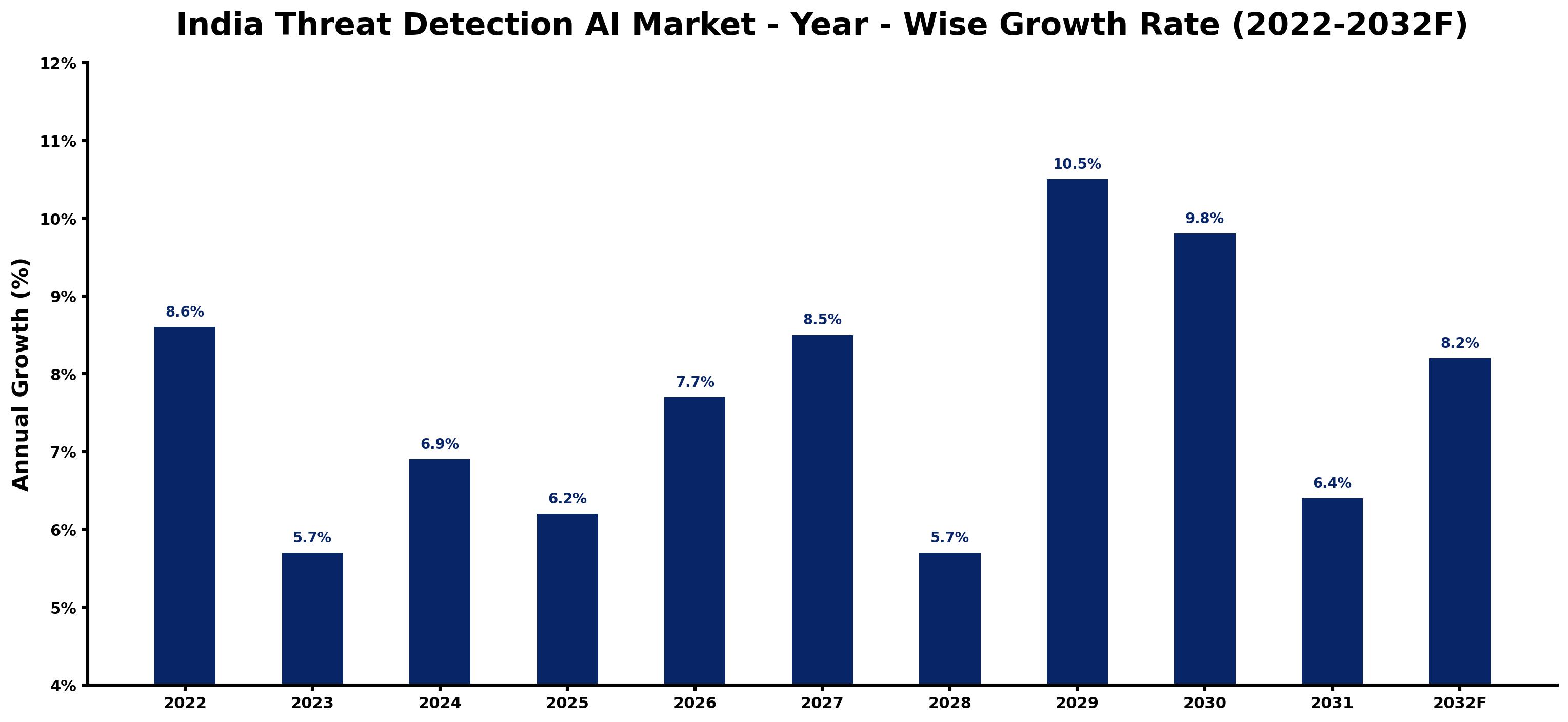
The following table presents the estimated annual growth rate for each year together with the principal factor influencing market performance.
| Year | Estimated Annual Growth (%) | Market Rationale |
| 2022 | 8.6 | The market experienced solid growth, driven by increasing cybersecurity incidents and awareness. |
| 2023 | 5.7 | Growth slowed as enterprises adjusted to new cybersecurity measures and technologies. |
| 2024 | 6.9 | Demand increased with further adoption of threat detection solutions across various sectors. |
| 2025 | 6.2 | Growth decelerated as the market matured and competition intensified among providers. |
| 2026 | 7.7 | An uptick in investments in cybersecurity initiatives is expected to lead to faster growth in demand. |
| 2027 | 8.5 | The market will benefit from rising concerns over cyber threats, prompting further investments. |
| 2028 | 5.7 | Growth is projected to slow again as companies focus on optimising existing solutions rather than new purchases. |
| 2029 | 10.5 | A surge in cyber incidents is expected to drive demand to its peak, prompting significant investments. |
| 2030 | 9.8 | Growth will moderate as the market stabilises after the peak in cybersecurity investments. |
| 2031 | 6.4 | Demand is projected to continue growing, albeit at a slower pace, as companies refine their strategies. |
| 2032 | 8.2 | An increase in regulatory requirements is expected to drive further adoption of threat detection solutions. |
Note: Market size estimations and growth projections presented in this report are based on 6Wresearch's proprietary forecasting methodology, utilizing the latest available industry data, government publications, and primary research inputs.
India Threat Detection AI Market Synopsis
Threat Detection AI refers to advanced technologies that identify and mitigate cybersecurity threats using artificial intelligence in India. This technology safeguards sensitive information and prevents data breaches through algorithms that analyze data patterns. The India Threat Detection AI Market is expanding due to rising cybersecurity incidents and increased investments from sectors like finance and government. Over 60% of Indian enterprises have adopted threat detection solutions as of 2023, highlighting the urgency of effective cybersecurity measures. The National Cyber Security Policy 2020 further supports this growth by strengthening the cybersecurity framework across the nation.
Market Dynamics Impact Analysis (2026–2032)
| Factor | Type | Impact | Primary Segment Affected |
| Increasing cybersecurity incidents drive demand for effective threat detection solutions. | Driver | High | Malware Detection |
| Growing investments in IT infrastructure enhance the need for advanced cybersecurity measures. | Driver | High | Intrusion Detection |
| The rise of fintech companies necessitates robust cybersecurity solutions to protect financial transactions. | Opportunity | High | Fintech Companies |
| The Cybersecurity Skills Development Program aims to train professionals, increasing workforce capabilities. | Opportunity | Medium | IT Security Teams |
| Limited awareness among smaller enterprises hampers broader adoption of threat detection solutions. | Restraint | High | Phishing Threats |
| High costs associated with implementing advanced AI solutions deter some organizations from investing. | Restraint | Medium | Behavioral Analytics |
| A shortage of skilled cybersecurity professionals makes it difficult to implement solutions effectively. | Challenge | High | Cloud-Based |
| Rapid technological advancements may outpace current solutions, leading to potential obsolescence. | Challenge | Medium | Hybrid |
Evaluation of Drivers in India Threat Detection AI Market (2026–2032)
The main growth drivers and the segments they affect most are set out below.
| Drivers | Primary Segment Affected | Why It Matters (Evidence) |
| Rising cybersecurity incidents necessitate effective solutions to protect sensitive data. | Malware Detection | The Indian Computer Emergency Response Team reported over 1.5 million cybersecurity incidents in 2022, prompting increased demand. |
| Growing investments in IT infrastructure increase the need for advanced cybersecurity measures. | Intrusion Detection | Maharashtra and Karnataka are leading states in cybersecurity investments, driving demand for effective solutions. |
| The surge in fintech companies requires strong cybersecurity to safeguard financial transactions. | Fintech Companies | As fintech adoption rises, the demand for threat detection solutions in this sector is expected to grow rapidly. |
| Increased regulatory requirements push organizations to adopt comprehensive cybersecurity measures. | Government Agencies | The Reserve Bank of India mandates cybersecurity measures for all banking institutions, driving compliance-related purchases. |
| The Cyber Swachhta Kendra initiative promotes awareness and security against malware. | IT Security Teams | This initiative by the Ministry of Electronics and Information Technology supports the adoption of threat detection technologies. |
Market growth for Threat Detection AI in India is driven by the surge in cyber threats, increased investments in IT infrastructure, and demand from fintech companies. In 2022, over 1.5 million cybersecurity incidents were recorded, prompting organisations to pursue effective solutions. Maharashtra and Karnataka lead in cybersecurity investments, which stimulates the demand for advanced measures. The Reserve Bank of India's mandate for cybersecurity in banking institutions propels compliance-related purchases.
Evaluation of Restraints in India Threat Detection AI Market
Below mentioned are some major restraints and their influence on market dynamics.
| Market Restraint | Primary Segment Affected | Why It Matters (Evidence) |
| Limited awareness among smaller enterprises hampers broader adoption of threat detection solutions. | Phishing Threats | Many small enterprises lack knowledge about the importance of cybersecurity measures, resulting in lower adoption rates. |
| High costs associated with implementing advanced AI solutions deter some organizations from investing. | Behavioral Analytics | The financial burden of adopting sophisticated threat detection technologies limits access for smaller firms. |
| Complex regulatory compliance requirements can overwhelm organizations, leading to delays in implementation. | Intrusion Detection | Organizations may struggle to navigate compliance, causing hesitancy in adopting necessary cybersecurity measures. |
| Rapid technological advancements may outpace current solutions, creating challenges for organizations. | Hybrid | Organizations may hesitate to invest in solutions that could quickly become outdated due to fast-evolving technologies. |
| The demand for skilled professionals exceeds supply, creating challenges in deploying effective threat detection systems. | Cloud-Based | A shortage of skilled cybersecurity professionals makes it difficult to implement solutions effectively. |
India Threat Detection AI Market Challenges
The India Threat Detection AI market still has to solve a few problems, starting with a skills shortage. Many organisations face difficulties in recruiting qualified professionals due to a lack of effective training programs, which delays project implementation and raises costs for buyers. Regulatory compliance is another challenge; existing standards like ISO/IEC 27001 necessitate significant investment for adherence, straining budgets for suppliers. Buyers also struggle with the high costs of advanced threat detection solutions, which can consume over 20% of their IT budgets, limiting widespread adoption. Finally, technology integration issues persist as many firms continue to rely on outdated systems, causing delays in deployment and increasing vulnerability to cyber threats.
Trends in the India Threat Detection AI Market
Buyers and suppliers in the India Threat Detection AI Market are adjusting to the following trends.
- Cloud-Based Solutions Gaining Traction: India is increasingly adopting cloud-based threat detection solutions as organizations seek flexibility and scalability. As of 2023, cloud-based deployments accounted for 48% of the market share, enabling companies to strengthen their cybersecurity posture.
- Behavioral Analytics on the Rise: The use of behavioral analytics is gaining traction in India, with a projected CAGR of 10.5% from 2026 to 2032. This trend is driven by the need to understand user behavior for better threat detection and mitigation.
- Fintech Companies Emphasising Cybersecurity: Fintech companies are prioritising cybersecurity measures to protect sensitive financial data. With a projected CAGR of 9.7%, this sector is driving substantial investments in threat detection technologies.
- Focus on Regulatory Compliance: Organizations are placing greater emphasis on compliance with cybersecurity regulations. The Reserve Bank of India's mandates are prompting financial institutions to invest in effective threat detection solutions.
Investment Opportunities in the India Threat Detection AI Market
The following opportunities in the India Threat Detection AI Market pair current demand with a clear way in.
- Fintech Companies Seeking Advanced Solutions: Fintech companies are increasingly investing in Threat Detection AI to protect financial transactions. With over 9.7% growth projected in this sector by 2032, there is a pressing need for advanced cybersecurity measures.
- Government Agencies Enhancing Cybersecurity: Government agencies are focusing on adopting Threat Detection AI to safeguard public data. The National Cyber Security Policy 2020 aims to strengthen frameworks, with an anticipated investment of ₹100 crore to support innovation.
- IT Security Teams Adopting New Technologies: IT security teams are prioritising Threat Detection AI to mitigate risks. With over 60% of enterprises adopting these solutions by 2023, the demand for advanced technologies is surging.
- Cybersecurity Skills Development Program: The Cybersecurity Skills Development Program is crucial for training professionals. With a target of 500,000 trained by 2025, this initiative will enhance the workforce and support market growth.
Government Initiatives in the India Threat Detection AI Market
The National Cyber Security Strategy 2020 was launched by the Ministry of Electronics and Information Technology to enhance cybersecurity resilience across sectors. This strategy builds on previous frameworks, strengthening the overall cybersecurity framework in India. It mandates comprehensive measures for protecting sensitive information and encourages the adoption of advanced technologies. The strategy aims to improve collaboration between public and private sectors, ensuring a unified approach to cybersecurity. With a focus on innovation, it also supports the development of new cybersecurity solutions.
The Cyber Crime Coordination Centre (4Cs) was established in 2022 to combat cybercrime effectively and streamline responses. This centre assists government agencies in coordinating efforts to address cyber threats. It provides resources and support for organisations to enhance their cybersecurity measures. The centre also promotes awareness and education on cybersecurity best practices among citizens and businesses. Through its initiatives, it aims to foster a safer digital environment across India.
Future Insight of the India Threat Detection AI Market
Several forward-looking factors should support the India Threat Detection AI market in the coming years. The Cybersecurity Skills Development Program aims to train 500,000 professionals by 2025, helping to bridge the skills gap. The National Cyber Security Policy 2020 will enhance the regulatory framework, making compliance easier for buyers. The Digital India initiative will stimulate investments in threat detection technologies across various sectors. As a result, over 60% of Indian enterprises are projected to adopt threat detection solutions, bolstering their overall cybersecurity posture.
Market Segmentation Analysis
Each segment group is reviewed below, with the leader by share and the fastest grower by CAGR.
By Detection Type – Malware Detection Dominated, Phishing Threats Expected to Grow Fastest
According to Vasudha, AM at 6Wresearch, Malware Detection took a 53% share of detection type in 2025, more than any other category. Malware Detection holds the largest share in the India Threat Detection AI Market because it is essential for identifying malicious software attacks that threaten sensitive data. The substantial number of over 1.5 million cybersecurity incidents reported in 2022 highlights its critical importance across various sectors. The quickest growth will come from Phishing Threats, forecast to expand at a CAGR of 9.9% between 2026 and 2032. Phishing Threats is experiencing rapid growth as cybercriminals increasingly exploit deceptive email tactics, leading to a notable rise in reported incidents. This trend underscores the urgent need for advanced detection mechanisms to protect users, ensuring sustained demand for such solutions. Suppliers should prioritise Malware Detection solutions while also expanding their offerings to address the growing threat of Phishing.
By AI Technique Used – Machine Learning Dominated, Behavioral Analytics Expected to Grow Fastest
Machine Learning accounted for a 44% market share by ai technique used in 2025. Machine Learning leads the market share as it forms the backbone of effective threat detection technologies, enabling sophisticated analysis of data patterns. Its widespread adoption across sectors underscores its crucial role in tackling the challenges posed by evolving cybersecurity threats. Behavioral Analytics is projected to grow fastest, at a CAGR of 10.5% during 2026–2032. Behavioral Analytics is witnessing rapid growth as it provides insights into user behaviour, allowing organisations to detect anomalies and potential threats more effectively. This capability is increasingly vital as cyber threats become more sophisticated, driving demand for advanced detection technologies. Suppliers must focus on enhancing Machine Learning capabilities while also investing in Behavioral Analytics to meet the market's evolving demands.
By Deployment Mode – Cloud-Based Dominated, Hybrid Expected to Grow Fastest
Cloud-Based held a 48% share of the India Threat Detection AI Market by deployment mode in 2025. Cloud-Based deployment commands the largest share due to its flexibility and scalability, making it an attractive choice for organisations implementing threat detection solutions. The increasing reliance on cloud infrastructure across various industries reinforces its dominant position in the market. Over 2026–2032, Hybrid is expected to post the fastest growth, at a CAGR of 9.3%. Hybrid deployment is experiencing the fastest growth as it merges the benefits of both cloud and on-premise solutions, catering to diverse organisational needs. This trend reflects a shift towards adaptable security strategies that leverage existing infrastructure while embracing cloud capabilities. Suppliers should enhance their Cloud-Based offerings and develop Hybrid solutions to align with market trends and customer preferences.
By End User – IT Security Teams Dominated, Fintech Companies Expected to Grow Fastest
With a 40% revenue share in 2025, IT Security Teams was the largest end user category. IT Security Teams represent the largest share in the market as they are the primary users of threat detection technologies, responsible for protecting organisational data and systems. Their essential role in implementing security measures across various sectors drives the demand for advanced solutions. Fintech Companies are set to record the highest CAGR in this split, 9.7% over 2026–2032. Fintech Companies are seeing the fastest growth in demand for threat detection solutions, driven by the need to secure sensitive financial transactions and data from cyber threats. As this sector expands rapidly, the urgency for robust security measures will further accelerate market growth. Suppliers should tailor their offerings to meet the specific needs of IT Security Teams while also addressing the unique requirements of Fintech Companies to capture emerging opportunities.
Key Attractiveness of the Report
- 10 Years of Market Numbers
- Historical Data Starting from 2022 to 2025
- Base Year 2025
- Forecast Data until 2032
- Key Performance Indicators Impacting the Market
- Major Upcoming Developments and Projects
Key Highlights of the Report:
- India Threat Detection AI Market Outlook
- Market Size of India Threat Detection AI Market, 2025
- Forecast of India Threat Detection AI Market, 2032
- Historical Data and Forecast of India Threat Detection AI Revenues & Volume for the Period 2022 - 2032F
- India Threat Detection AI Market Trend Evolution
- India Threat Detection AI Market Drivers and Challenges
- India Threat Detection AI Price Trends
- India Threat Detection AI Porter's Five Forces
- India Threat Detection AI Industry Life Cycle
- Historical Data and Forecast of India Threat Detection AI Market Revenues & Volume By Detection Type for the Period 2022 - 2032F
- Historical Data and Forecast of India Threat Detection AI Market Revenues & Volume By Malware Detection for the Period 2022 - 2032F
- Historical Data and Forecast of India Threat Detection AI Market Revenues & Volume By Intrusion Detection for the Period 2022 - 2032F
- Historical Data and Forecast of India Threat Detection AI Market Revenues & Volume By Phishing Threats for the Period 2022 - 2032F
- Historical Data and Forecast of India Threat Detection AI Market Revenues & Volume By Insider Threats for the Period 2022 - 2032F
- Historical Data and Forecast of India Threat Detection AI Market Revenues & Volume By AI Technique Used for the Period 2022 - 2032F
- Historical Data and Forecast of India Threat Detection AI Market Revenues & Volume By Machine Learning for the Period 2022 - 2032F
- Historical Data and Forecast of India Threat Detection AI Market Revenues & Volume By Anomaly Detection AI for the Period 2022 - 2032F
- Historical Data and Forecast of India Threat Detection AI Market Revenues & Volume By NLP + Classification for the Period 2022 - 2032F
- Historical Data and Forecast of India Threat Detection AI Market Revenues & Volume By Behavioral Analytics for the Period 2022 - 2032F
- Historical Data and Forecast of India Threat Detection AI Market Revenues & Volume By Deployment Mode for the Period 2022 - 2032F
- Historical Data and Forecast of India Threat Detection AI Market Revenues & Volume By Cloud-Based for the Period 2022 - 2032F
- Historical Data and Forecast of India Threat Detection AI Market Revenues & Volume By On-Premise for the Period 2022 - 2032F
- Historical Data and Forecast of India Threat Detection AI Market Revenues & Volume By Email Systems for the Period 2022 - 2032F
- Historical Data and Forecast of India Threat Detection AI Market Revenues & Volume By Hybrid for the Period 2022 - 2032F
- Historical Data and Forecast of India Threat Detection AI Market Revenues & Volume By End User for the Period 2022 - 2032F
- Historical Data and Forecast of India Threat Detection AI Market Revenues & Volume By IT Security Teams for the Period 2022 - 2032F
- Historical Data and Forecast of India Threat Detection AI Market Revenues & Volume By Enterprises for the Period 2022 - 2032F
- Historical Data and Forecast of India Threat Detection AI Market Revenues & Volume By Fintech Companies for the Period 2022 - 2032F
- Historical Data and Forecast of India Threat Detection AI Market Revenues & Volume By Government Agencies for the Period 2022 - 2032F
- India Threat Detection AI Import Export Trade Statistics
- Market Opportunity Assessment By Detection Type
- Market Opportunity Assessment By AI Technique Used
- Market Opportunity Assessment By Deployment Mode
- Market Opportunity Assessment By End User
- India Threat Detection AI Top Companies Market Share
- India Threat Detection AI Competitive Benchmarking By Technical and Operational Parameters
- India Threat Detection AI Company Profiles
- India Threat Detection AI Key Strategic Recommendations
Market Covered
Segments analysed in this report are listed below.
By Detection Type
- Malware Detection
- Intrusion Detection
- Phishing Threats
- Insider Threats
By AI Technique Used
- Machine Learning
- Anomaly Detection AI
- NLP + Classification
- Behavioral Analytics
By Deployment Mode
- Cloud-Based
- On-Premise
- Email Systems
- Hybrid
By End User
- IT Security Teams
- Enterprises
- Fintech Companies
- Government Agencies































